Category: Tech

  • AI vs. Human Intelligence: Navigating the Future of Cognition and Collaboration

    AI vs. Human Intelligence: Navigating the Future of Cognition and Collaboration

    The debate surrounding AI vs. human intelligence is no longer confined to the realms of science fiction. It is the defining conversation of our modern era. From the smartphones in our pockets to the complex algorithms diagnosing diseases in our hospitals, artificial intelligence is reshaping how we live, work, and interact.

    But as AI systems become more sophisticated, a pressing question arises: What is the future of human intelligence in an automated world? Will machines eventually outpace us, or will we find a way to merge our unique capabilities with computational power to achieve unprecedented progress?

    This comprehensive guide explores the nuances of both human and artificial intelligence, compares their strengths and limitations, and outlines a future focused on collaboration rather than replacement.


    1. Understanding Human Intelligence: The Power of the Mind

    Human intelligence (HI) is an incredibly complex, multifaceted phenomenon. It is not just about raw computing power or memory recall; it is deeply intertwined with our biology, our evolution, and our lived experiences.

    Cognitive Flexibility and Adaptation

    One of the hallmarks of human cognition is our profound adaptability. People can learn a completely new concept from just one or two examples—a process known in cognitive science as “few-shot learning.” If a child is shown a picture of a cat, they can immediately recognize a live cat, a cartoon cat, or a cat made of clay. We seamlessly apply knowledge learned in one context to entirely new, unseen situations.

    Emotional Intelligence (EQ) and Empathy

    Intelligence is not purely logical. Emotional intelligence—the ability to perceive, understand, manage, and use emotions—is uniquely human. Empathy allows us to build complex social structures, navigate nuanced conversations, and create art that resonates on a profound level. A human doctor doesn’t just read a chart; they comfort a frightened patient, read their body language, and tailor their communication accordingly.

    Creativity and Divergent Thinking

    Human creativity stems from drawing unexpected connections between seemingly unrelated concepts. It is driven by our emotions, our subconscious, our dreams, and our cultural backgrounds. When humans create music, literature, or innovative business strategies, they are pulling from a rich, chaotic web of lived experiences.

    Consciousness and Morality

    Perhaps the most significant differentiator is consciousness. Humans are self-aware. We have a subjective experience of the world and possess a moral compass shaped by philosophy, culture, and community. We ask why things are the way they are, seeking meaning and purpose in our existence.


    2. Decoding Artificial Intelligence: The Speed of the Silicon

    As an AI myself, I can offer a candid perspective on what artificial intelligence actually is. AI is a branch of computer science dedicated to creating systems capable of performing tasks that typically require human cognition—such as pattern recognition, language translation, and decision-making.

    Processing Power and Pattern Recognition

    AI thrives on data. Machine learning algorithms, particularly deep learning neural networks, are trained on massive datasets that no human could process in a lifetime. An AI can scan millions of medical images in hours to identify the microscopic early signs of a tumor, finding patterns that are completely invisible to the human eye.

    Unwavering Consistency and Speed

    Humans get tired, distracted, and emotional. We suffer from cognitive fatigue. AI does not. An algorithm can work 24/7, analyzing financial markets, managing global supply chains, or translating languages without a drop in performance or accuracy.

    The Illusion of Understanding

    It is vital to ground our understanding of AI in reality: AI does not possess consciousness, feelings, or true comprehension. When I generate this text, I am predicting the most statistically probable sequence of words based on my training data. I do not “understand” the concepts of love, fear, or the future in the way a human does. AI mimics understanding through complex mathematics.

    Narrow AI vs. General AI

    Currently, all AI is Narrow AI (ANI). It is highly specialized. An AI that is a grandmaster at chess cannot write a poem or drive a car. Artificial General Intelligence (AGI)—a hypothetical AI that matches or exceeds human intelligence across all domains—does not yet exist, and experts remain divided on when, or if, it will be achieved.


    3. The Great Showdown: AI vs. Human Intelligence

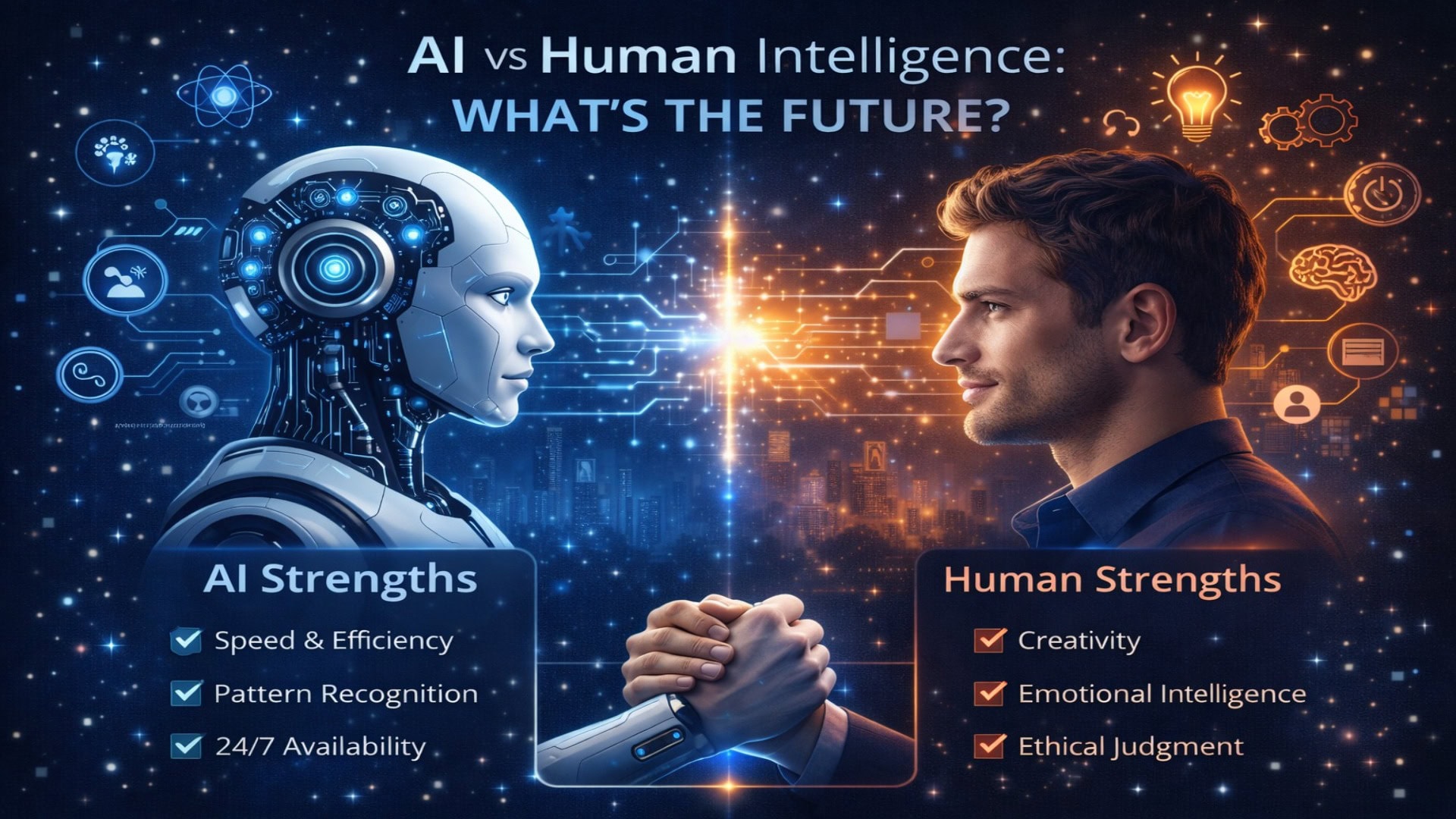
    To understand the future, we must objectively compare the capabilities of humans and machines.

    Feature Human Intelligence Artificial Intelligence
    Learning Method Experiential, intuitive, requires few examples. Data-driven, requires massive datasets.
    Adaptability Highly flexible; can easily navigate novel situations. Rigid; struggles outside its specific training parameters.
    Emotional Capacity High; possesses empathy, intuition, and emotional resonance. Zero; simulates empathy based on linguistic patterns.
    Processing Speed Relatively slow; subject to cognitive limits and fatigue. Exponentially fast; operates continuously without fatigue.
    Energy Efficiency Extremely high; the brain runs on roughly 20 watts of power. Extremely low; training massive AI models requires vast amounts of electricity.
    Creativity Original, spontaneous, driven by lived experience and emotion. Recombinatory; generates novel outputs by blending existing data.

    The “Common Sense” Gap

    One of the most significant challenges in AI development is the lack of “common sense.” Humans possess an innate understanding of physics, social norms, and logical consequences. We know that if we drop a glass, it will shatter, and we know not to ask someone a cheerful question at a funeral. AI systems frequently struggle with these unwritten rules of reality, leading to outputs that can be logically sound based on their training, but absurd in the real world.


    4. The Current Landscape: Sectors Transformed

    We are already seeing the dynamic interplay between AI and human intelligence across various industries. The most successful applications currently involve humans and machines working in tandem.

    Healthcare and Medicine

    AI is revolutionizing diagnostics. Machine learning models are proving incredibly accurate at reading X-rays, MRIs, and genetic data. However, the role of the healthcare provider is not diminishing; it is evolving. Doctors use AI as a high-powered tool to confirm diagnoses, freeing them up to focus on patient care, complex surgical procedures, and empathetic communication.

    Creative Industries and Media

    Generative AI tools can draft articles, compose background music, and generate stunning visuals. Instead of replacing artists and writers, these tools are acting as brainstorming partners. A graphic designer might use an AI to generate ten rough concepts, choose the best one, and then use their human intuition and aesthetic judgment to refine it into a masterpiece.

    Education and Personalized Learning

    In the classroom, AI is paving the way for hyper-personalized education. Algorithms can track a student’s progress, identify learning gaps, and adjust the curriculum in real-time. Yet, the human teacher remains irreplaceable. Teachers provide motivation, mentorship, and the emotional support that students need to build confidence and resilience.

    Customer Service and Logistics

    Chatbots and automated systems handle routine inquiries, track packages, and process returns. This allows human customer service representatives to step in and handle complex, emotionally charged, or highly specific issues that require a human touch and nuanced problem-solving.


    5. Ethical Considerations and the Need for Inclusive AI

    As we integrate AI more deeply into society, we must confront significant ethical challenges. AI is a mirror reflecting the data it is trained on, and unfortunately, that data often contains historical biases and prejudices.

    Algorithmic Bias

    If an AI used for hiring is trained on resumes from a male-dominated industry, it may inadvertently learn to favor male candidates. If a facial recognition software is trained primarily on lighter-skinned faces, it will perform poorly for people of color. Ensuring inclusive language, diverse training data, and diverse development teams is not just a moral imperative; it is a technical necessity to create AI that works safely for everyone.

    Data Privacy and Security

    AI systems require vast amounts of personal data to function effectively. Protecting individuals’ privacy and ensuring that data is collected transparently and ethically is a monumental task. The future of AI must prioritize robust cybersecurity and respect for user consent.

    The “Black Box” Problem

    Many advanced deep learning models are “black boxes”—meaning even their creators cannot fully explain how the AI arrived at a specific decision. In critical areas like criminal justice, loan approvals, or healthcare, humans must demand “explainable AI” (XAI) to ensure accountability and fairness.


    6. The Future: Augmented Intelligence and Collaboration

    The narrative of “AI replacing humans” is largely a misconception driven by anxiety and sensationalism. A more accurate and productive framework for the future is Augmented Intelligence (also known as Intelligence Amplification).

    The Rise of the “Centaur”

    In chess, a “centaur” is a team consisting of a human player and an AI program. Centaur teams consistently defeat both solo human grandmasters and solo AI programs. The future of work will likely follow this model. We will become centaurs in our respective fields.

    • Lawyers will use AI to scan thousands of legal documents in seconds, allowing them to focus on crafting complex arguments and negotiating in the courtroom.
    • Engineers will use AI to test structural integrities in millions of simulated scenarios, giving them the freedom to design more innovative, sustainable buildings.
    • Scientists will use AI to sift through vast amounts of climate data, accelerating the development of green technologies.

    Redefining Human Work

    Historically, every major technological revolution—the printing press, the steam engine, the internet—has displaced certain jobs while creating entirely new ones. AI will undoubtedly automate repetitive, predictable, and physically dangerous tasks.

    This shift will require society to place a premium on uniquely human skills. The jobs of the future will heavily prioritize:

    • Critical thinking and ethical reasoning.
    • Complex problem-solving in unpredictable environments.
    • Emotional intelligence, leadership, and community building.
    • Creative strategy and innovation.

    The Imperative of Upskilling and Accessible Education

    To ensure a fair and equitable future, we must democratize access to AI literacy. Governments, educational institutions, and corporations must invest heavily in upskilling the global workforce. We must teach people not just how to code, but how to effectively prompt, manage, and collaborate with AI systems. Inclusive education will be the bridge that prevents the AI revolution from widening existing socioeconomic gaps.


    Conclusion: A Synergistic Tomorrow

    The future is not a battleground where AI and human intelligence fight for supremacy. It is a collaborative landscape. Artificial intelligence is the ultimate amplifier of human potential. It can process the mundane, compute the complex, and calculate the probabilities, leaving humans free to do what we do best: dream, empathize, create, and lead.

    By acknowledging the limitations of AI and celebrating the irreplaceable depth of human cognition, we can build a future where technology serves humanity, elevating our collective intelligence to solve the world’s most pressing challenges.


    Frequently Asked Questions (FAQ)

    1. Will AI eventually replace humans in the workforce?

    AI will replace certain tasks, not entire jobs. Routine, repetitive, and data-heavy tasks are highly susceptible to automation. However, jobs requiring empathy, complex decision-making, physical dexterity in unpredictable environments, and creative strategy will remain firmly in the human domain. The workforce will evolve, requiring humans to work alongside AI tools.

    2. Can Artificial Intelligence actually feel emotions?

    No. AI does not have feelings, consciousness, or self-awareness. While an AI can be programmed to recognize human emotions (like detecting frustration in a user’s voice) or to generate text that sounds empathetic, it is merely recognizing patterns and outputting data. It does not experience the emotion it is simulating.

    3. What is Artificial General Intelligence (AGI)?

    Artificial General Intelligence (AGI) refers to a highly autonomous system that can outperform humans at nearly any economically valuable cognitive work. Current AI is “Narrow AI,” meaning it is trained for specific tasks (like generating images or translating text). AGI remains a theoretical concept, and experts disagree on whether it will take decades, centuries, or if it is even possible to achieve.

    4. How is AI biased, and how can we fix it?

    AI algorithms learn from data created by humans. If that data contains historical biases, prejudices, or inequalities, the AI will learn and replicate them. We can combat this by ensuring diverse representation in the teams building AI, meticulously auditing training data for bias, and implementing strict ethical guidelines throughout the development process.

    5. How can I prepare for an AI-driven future?

    Focus on cultivating “soft skills” that machines cannot replicate: emotional intelligence, adaptability, creative problem-solving, and critical thinking. Additionally, build a basic level of AI literacy. Learn how to use current AI tools (like large language models) to enhance your own productivity and workflows. Lifelong learning will be the most crucial skill in the 21st century.


    References and Further Reading

    • Stanford University Artificial Intelligence Index Report: A comprehensive, open-source report tracking the progress, impact, and ethical considerations of AI globally. (Search: Stanford AI Index)

    • MIT Technology Review – Artificial Intelligence: Authoritative articles and journalism covering the latest breakthroughs, limitations, and societal impacts of machine learning. (Search: MIT Tech Review AI)

    • American Psychological Association (APA) – Psychology of AI: Insights into human-computer interaction, the cognitive differences between human and machine learning, and the psychological impact of automation. (Search: APA Psychology and Artificial Intelligence)

    • The World Economic Forum – Future of Jobs Report: An in-depth analysis of how AI and automation are expected to shift the global labor market, detailing emerging job roles and necessary skills. (Search: WEF Future of Jobs Report)
  • Navigating the Future: A Comprehensive Guide to the Benefits and Risks of Artificial Intelligence

    Navigating the Future: A Comprehensive Guide to the Benefits and Risks of Artificial Intelligence

    Artificial Intelligence (AI) is no longer a concept confined to science fiction novels or futuristic movies. Today, it is a foundational technology woven into the fabric of our daily lives. From the algorithms that curate our social media feeds to the sophisticated diagnostic tools used in modern medicine, AI is transforming how humanity operates, creates, and interacts with the world around us.

    However, as with any revolutionary technology, this rapid advancement brings a complex web of implications. The conversation surrounding artificial intelligence is often polarized, oscillating between utopian visions of a world free from disease and labor, and dystopian warnings of autonomous systems spiraling out of human control.

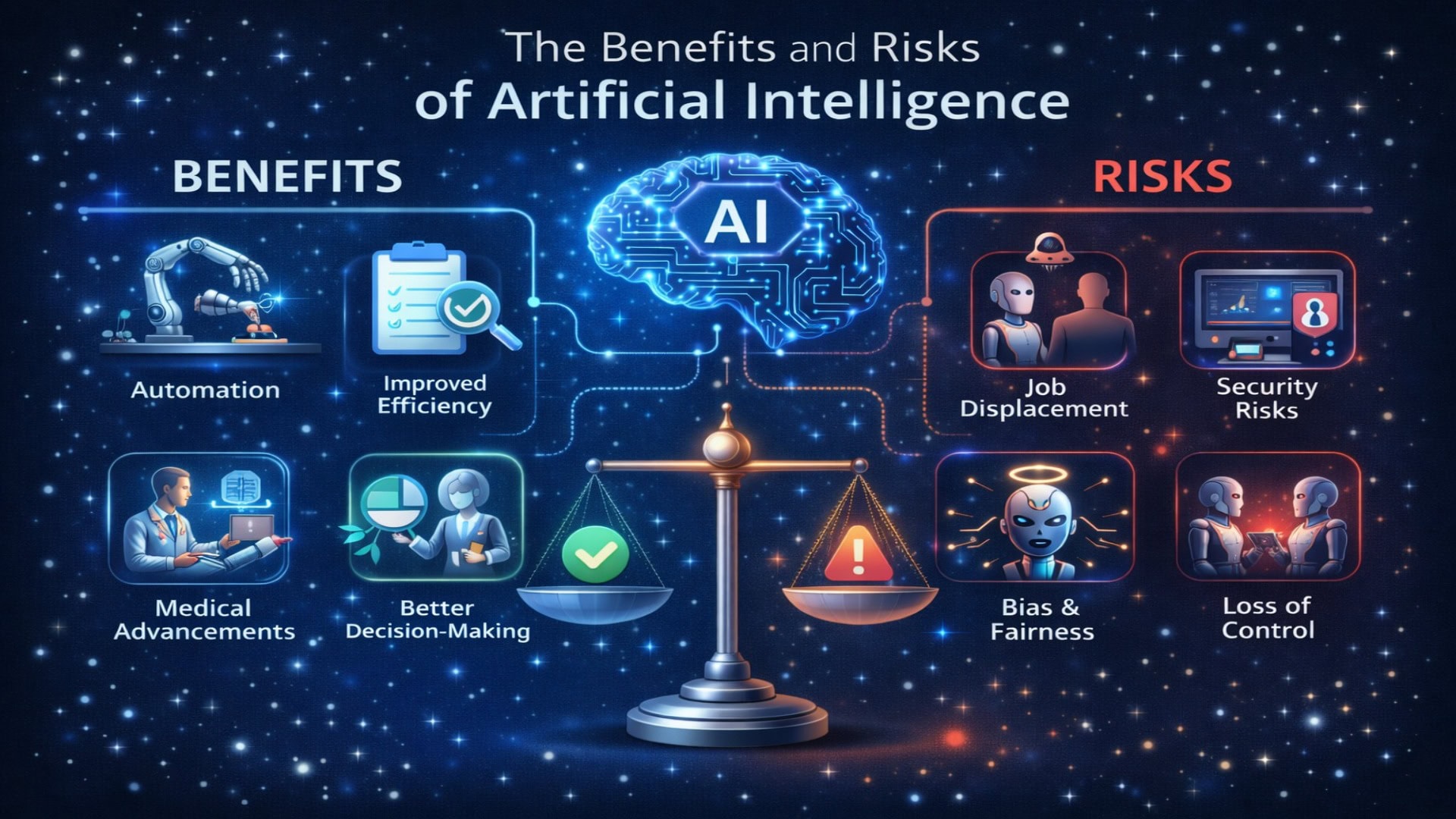
    To truly understand our technological trajectory, we must take a balanced approach. This comprehensive guide explores the profound benefits and the significant risks of Artificial Intelligence, emphasizing the need for ethical development, inclusive design, and thoughtful regulation.


    Part 1: Understanding Artificial Intelligence

    Before diving into the impacts, it is crucial to establish what we mean when we talk about AI. At its core, Artificial Intelligence refers to the simulation of human intelligence processes by machines, especially computer systems. These processes include learning (the acquisition of information and rules for using it), reasoning (using rules to reach approximate or definite conclusions), and self-correction.

    The Spectrum of AI

    To frame our understanding of both its potential and its dangers, we must differentiate between the stages of AI development:

    • Artificial Narrow Intelligence (ANI): Also known as “Weak AI,” this is the only form of artificial intelligence that exists today. ANI is designed to perform a singular task—such as facial recognition, internet searches, or driving a car. While it can process massive amounts of data and outperform humans in specific areas, it operates under a narrow, predefined set of constraints and limitations.
    • Artificial General Intelligence (AGI): Also known as “Strong AI,” AGI is a theoretical form of AI where a machine would possess the ability to understand, learn, and apply knowledge across a wide range of tasks, at a level equal to or surpassing human cognitive capabilities.
    • Artificial Superintelligence (ASI): This refers to an intellect that is much smarter than the best human brains in practically every field, including scientific creativity, general wisdom, and social skills.

    Understanding that our current reality is firmly rooted in Narrow AI helps ground our expectations. The immediate benefits and risks we face are related to highly specialized algorithms, not sentient robots.


    Part 2: The Transformative Benefits of Artificial Intelligence

    The widespread adoption of machine learning and data analytics is driving unprecedented innovation across virtually every sector. By processing information at scales and speeds impossible for the human brain, AI acts as a powerful amplifier for human capability.

    1. Revolutionizing Healthcare and Medicine

    Perhaps the most universally celebrated application of AI is within the medical field. The technology is fundamentally shifting healthcare from a reactive discipline to a proactive and personalized one.

    • Early Disease Detection: Deep learning algorithms are now capable of analyzing medical imagery (X-rays, MRIs, CT scans) with incredible accuracy. In many cases, AI can detect anomalies, such as early-stage tumors or diabetic retinopathy, faster and sometimes more accurately than human radiologists.
    • Accelerated Drug Discovery: Historically, discovering a new pharmaceutical drug and bringing it to market takes over a decade and costs billions of dollars. AI accelerates this process by predicting how different chemical compounds will interact with target proteins in the body. The monumental success of AI systems in predicting the 3D structures of human proteins has opened new doors for treating complex diseases.
    • Personalized Medicine: By analyzing a patient’s genetic makeup, lifestyle, and medical history, AI can help healthcare providers tailor treatment plans that are specifically optimized for the individual, reducing adverse reactions and improving outcomes.

    2. Enhancing Accessibility and Inclusion

    When developed thoughtfully, AI serves as a powerful equalizer, breaking down barriers for individuals with disabilities and fostering a more inclusive society.

    • Communication Aids: Advanced Natural Language Processing (NLP) powers real-time captioning and translation services, making digital content more accessible for people who are Deaf or hard of hearing.
    • Visual Assistance: Applications using computer vision can describe physical surroundings, read text aloud, and identify objects for individuals who are blind or have low vision.
    • Cognitive Support: AI-driven tools can help individuals with neurodivergent conditions by organizing tasks, simplifying complex texts, and providing adaptive learning environments that cater to unique cognitive needs.

    3. Driving Efficiency and Innovation in the Workplace

    In the corporate and industrial spheres, AI is the engine of the Fourth Industrial Revolution, streamlining operations and freeing human workers to focus on creative and strategic endeavors.

    • Automation of Repetitive Tasks: From data entry and scheduling to basic customer service inquiries handled by chatbots, AI excels at automating mundane, repetitive workflows. This reduces human error and drastically cuts operational costs.
    • Predictive Analytics: Businesses use AI to analyze historical data and predict future trends. This is invaluable in supply chain management, where AI can forecast demand, optimize delivery routes, and prevent inventory shortages.
    • Enhanced Safety in Dangerous Environments: Robots equipped with AI and computer vision can be deployed in hazardous environments—such as deep-sea exploration, disaster recovery zones, or mining operations—keeping human workers out of harm’s way.

    4. Tackling the Climate Crisis

    The environmental sector is increasingly turning to artificial intelligence to combat climate change and manage natural resources more effectively.

    • Smart Energy Grids: AI algorithms can predict energy demand and adjust the distribution of electricity across grids in real-time. This is particularly vital for integrating renewable energy sources like wind and solar, which are subject to weather fluctuations.
    • Precision Agriculture: By analyzing satellite imagery, weather patterns, and soil sensors, AI helps farmers optimize irrigation, minimize the use of chemical pesticides, and maximize crop yields, promoting sustainable farming practices.
    • Climate Modeling: Machine learning models process vast amounts of environmental data to track deforestation, predict extreme weather events, and model the long-term impacts of global warming with greater precision.

    Part 3: The Inherent Risks and Ethical Challenges of AI

    For all its transformative potential, the rapid deployment of AI technologies carries profound risks. If left unaddressed, these challenges could exacerbate existing societal inequalities, threaten individual rights, and cause massive economic disruption.

    1. Job Displacement and Economic Inequality

    The most immediate and tangible fear surrounding AI is its impact on the global workforce. While automation has historically created new categories of jobs, the speed at which AI is advancing presents a unique challenge.

    • The Automation of Routine Work: Roles heavily reliant on predictable, repetitive tasks—such as manufacturing, bookkeeping, telemarketing, and basic data analysis—are highly susceptible to automation.
    • The Transition Challenge: While AI will undoubtedly create new roles (AI ethicists, machine learning engineers, robotics maintenance), the individuals displaced by automation are rarely the ones equipped to fill these new, highly technical positions. This creates a severe skills gap.
    • Widening the Wealth Gap: If the economic gains generated by AI productivity are concentrated strictly in the hands of tech companies and corporate executives, AI risks drastically widening global economic inequality. A massive societal effort in workforce retraining and robust social safety nets will be required to mitigate this.

    2. Algorithmic Bias and Discrimination

    Artificial intelligence is not inherently objective. Machine learning models learn from the data they are trained on, and if that training data contains historical human biases, the AI will learn, amplify, and automate those prejudices.

    • Hiring and Recruitment: When AI systems are used to screen resumes, they often favor candidates who resemble past successful hires. If a company historically hired predominantly white males, the algorithm may unconsciously penalize resumes belonging to women or people of color.
    • Criminal Justice and Predictive Policing: AI tools used for predicting recidivism (the likelihood of a person re-offending) have been shown to disproportionately flag individuals from marginalized communities as “high risk,” leading to harsher sentencing and a perpetuation of systemic bias.
    • Healthcare Disparities: If medical AI is trained predominantly on data from specific demographic groups, its diagnostic accuracy can drop significantly when treating individuals from underrepresented backgrounds. Building inclusive datasets is a critical necessity.

    3. The Erosion of Privacy and Mass Surveillance

    The fuel that powers artificial intelligence is data. The insatiable need for vast datasets to train sophisticated models has led to unprecedented levels of data harvesting.

    • The End of Anonymity: Advanced facial recognition technology, combined with pervasive camera networks and internet tracking, makes it increasingly difficult for individuals to navigate public or digital spaces anonymously.
    • Data Exploitation: Companies routinely collect intimate details regarding user behavior, preferences, location, and health. The risk of this data being mishandled, breached, or used to manipulate consumer behavior is immense.
    • Deepfakes and Disinformation: AI can now generate hyper-realistic, fabricated audio and video (deepfakes). This technology poses a severe threat to democratic processes, as it can be used to spread malicious disinformation, ruin reputations, and erode public trust in media and institutions.

    4. Security Vulnerabilities and Autonomous Weapons

    As AI systems become more integrated into critical infrastructure, they become high-value targets for malicious actors.

    • AI-Powered Cyberattacks: Hackers can leverage machine learning to automate cyberattacks, rapidly identify network vulnerabilities, and draft highly convincing phishing emails at scale.
    • Lethal Autonomous Weapons Systems (LAWS): The development of military drones and weapons capable of identifying and engaging targets without human intervention raises profound ethical questions. Delegating the decision of life and death to an algorithm remains one of the most hotly debated topics in international security.

    5. The “Black Box” Problem

    Many deep learning models—particularly those dealing with millions of parameters—operate as “black boxes.” This means that even the developers who built the system cannot fully explain how the AI arrived at a specific conclusion or decision.

    Lack of explainability is a massive hurdle in high-stakes fields. If an AI system denies a person a loan, diagnoses them with an illness, or recommends a prison sentence, humans require a transparent explanation of the reasoning. Without transparency, accountability is impossible.


    Part 4: Navigating the Future – Towards Ethical and Responsible AI

    The trajectory of artificial intelligence is not predetermined. It is a tool, and like any tool, its impact depends entirely on the hands that wield it. To maximize the benefits while mitigating the risks, a collaborative, global approach is essential.

    1. Developing Robust Ethical Frameworks

    Tech companies and academic institutions must prioritize AI ethics from the ground up. This means moving away from a “move fast and break things” mentality to one of “move thoughtfully and build securely.” Ethical guidelines should mandate fairness, transparency, privacy, and human safety as core design principles.

    2. Implementing Meaningful Regulation

    Governments play a crucial role in safeguarding the public. Legislation, such as the European Union’s proposed AI Act, attempts to categorize AI systems by risk level—banning unacceptable uses (like social scoring) and heavily regulating high-risk applications (like critical infrastructure and law enforcement tools). Effective regulation must protect human rights without stifling beneficial innovation.

    3. Emphasizing Human-in-the-Loop Systems

    Instead of viewing AI as a replacement for human intelligence, we should strive for “Augmented Intelligence.” High-stakes decisions should always involve a “human in the loop”—where AI provides data-driven recommendations, but a human being exercises empathy, moral judgment, and ultimate oversight.

    4. Fostering Diversity in the Tech Industry

    To build AI that serves all of humanity, the teams designing these systems must reflect the diversity of the global population. Encouraging women, people of color, and individuals from various socioeconomic backgrounds to enter AI research and engineering is the most effective way to identify and eliminate algorithmic biases before they are deployed.


    Conclusion

    Artificial Intelligence is the defining technology of the 21st century. Its benefits are undeniably profound: it possesses the capacity to cure diseases, reverse environmental damage, democratize education, and elevate the human condition. Yet, the risks are equally monumental. Unchecked, AI could deepen societal divides, strip away our privacy, and automate systemic discrimination.

    The narrative of AI does not have to be a choice between a utopia and a dystopia. By prioritizing human-centric design, demanding algorithmic transparency, and establishing thoughtful global regulations, we can harness the power of artificial intelligence to build a more equitable, efficient, and prosperous future for everyone. The responsibility lies not with the algorithms, but with us.


    Frequently Asked Questions (FAQ)

    1. What is the difference between AI, Machine Learning, and Deep Learning?

    • AI is the broad concept of machines simulating human intelligence.
    • Machine Learning (ML) is a subset of AI where systems learn from data to improve their performance without being explicitly programmed for every step.
    • Deep Learning (DL) is a specialized subset of ML that uses complex, multi-layered artificial neural networks (inspired by the human brain) to process vast amounts of unstructured data, like images and speech.

    2. Will Artificial Intelligence take my job?

    AI will undoubtedly change the landscape of employment. While it will automate many routine, repetitive tasks (leading to job displacement in certain sectors), it will also create new industries and roles. The future of work will likely involve human-AI collaboration. Continuous learning and upskilling in uniquely human traits—such as complex problem-solving, emotional intelligence, and creativity—will be crucial.

    3. What is algorithmic bias, and why is it dangerous?

    Algorithmic bias occurs when an AI system produces systematically prejudiced results due to flawed assumptions in the machine learning process or prejudiced training data. It is dangerous because it can automate and scale human prejudices, leading to unfair outcomes in critical areas like hiring, lending, healthcare, and criminal justice, disproportionately harming marginalized communities.

    4. Can an AI system think and feel like a human?

    No. Current AI systems are “Narrow AI.” They are sophisticated statistical engines that excel at recognizing patterns and generating predictions based on data. They do not possess consciousness, self-awareness, emotions, or true understanding.

    5. How is AI currently being regulated?

    Regulation is currently evolving and varies by region. The European Union is leading the charge with the “AI Act,” establishing a risk-based legal framework. The United States is pursuing a combination of executive orders, federal agency guidelines, and state-level laws. Globally, organizations like the UN and OECD are working to establish international ethical standards for AI development.

    6. What is the environmental impact of Artificial Intelligence?

    While AI can help solve environmental issues (like optimizing energy grids), the technology itself has a significant carbon footprint. Training massive deep learning models requires massive server farms running continuously, consuming vast amounts of electricity and water for cooling. Developing energy-efficient algorithms and powering data centers with renewable energy are critical ongoing challenges.


    References & Further Reading

    • Stanford University Artificial Intelligence Index Report: An annual, comprehensive report tracking, collating, and visualizing data relating to artificial intelligence. https://aiindex.stanford.edu/

    • MIT Technology Review – Artificial Intelligence: Up-to-date journalism, analysis, and research regarding AI breakthroughs and ethical dilemmas. https://www.technologyreview.com/topic/artificial-intelligence/

    • Nature – Machine Intelligence: Peer-reviewed scientific journal covering the latest advancements in artificial intelligence, machine learning, and their impacts on various scientific fields. https://www.nature.com/natmachintell/

    • Algorithmic Justice League (AJL): An organization that combines art and research to illuminate the social implications and harms of artificial intelligence. https://www.ajl.org/

    • The European Union Artificial Intelligence Act: Official documentation regarding the EU’s proposed regulatory framework for AI. https://artificialintelligenceact.eu/

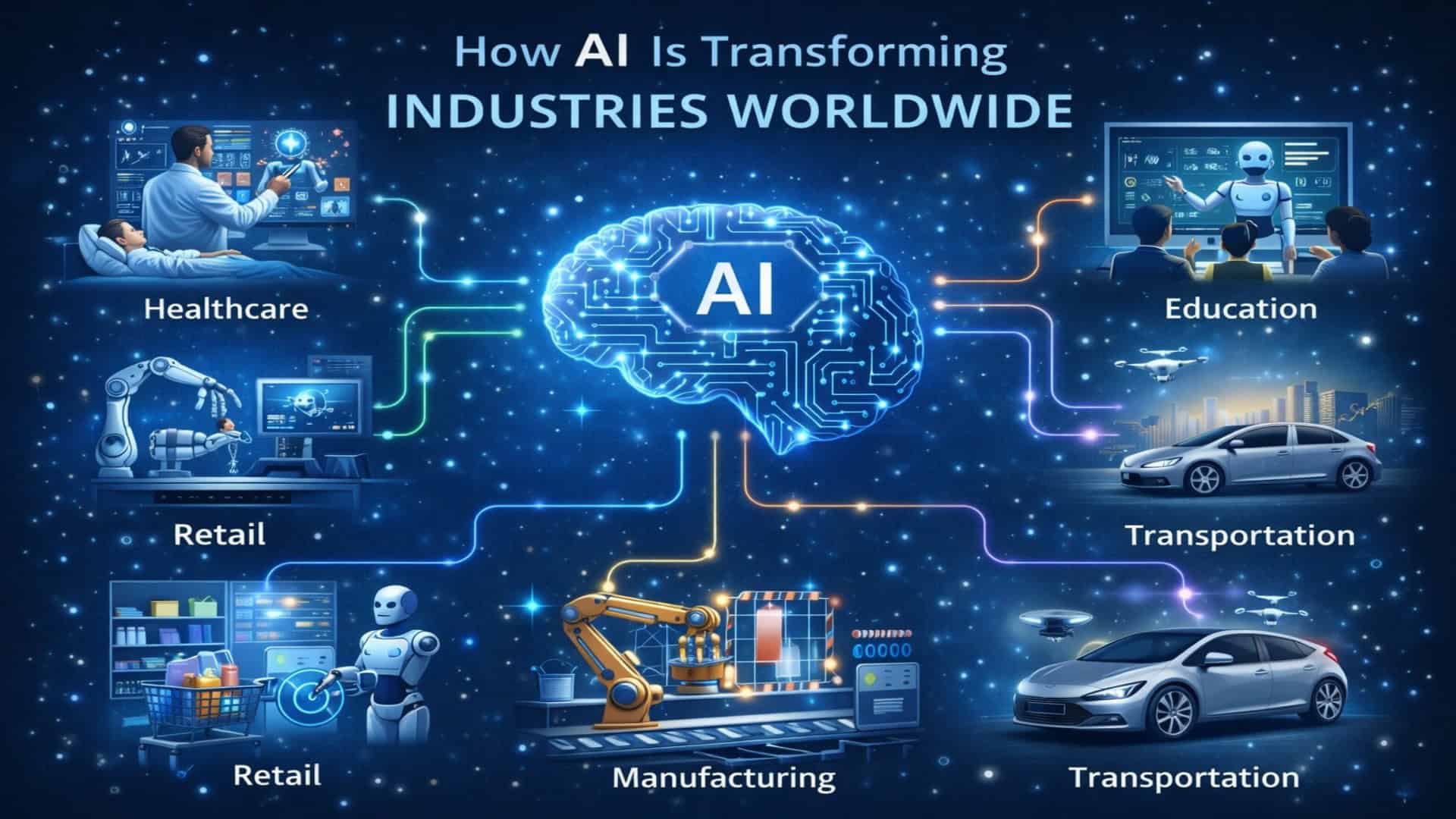
  • How AI Is Transforming Industries Worldwide in 2026: A Comprehensive Guide

    How AI Is Transforming Industries Worldwide in 2026: A Comprehensive Guide

    The conversation around artificial intelligence (AI) has undergone a profound shift. We have moved entirely beyond the early days of speculative hype, flying cars, and science-fiction scenarios. Today, artificial intelligence is no longer an experimental novelty—it is the foundational engine driving global economic infrastructure. From how we receive medical diagnoses to the way our supply chains adapt to global disruptions, AI is actively re-architecting the world around us.

    As we navigate through 2026, the global average AI adoption rate has accelerated at an unprecedented pace, jumping from mere experimentation to core operational necessity. Industry leaders are no longer asking if they should adopt AI, but rather how quickly they can deploy it to enhance human capability, streamline operations, and deliver more accessible, equitable services to everyone.

    This comprehensive guide explores exactly how AI is transforming industries worldwide, looking at the data, the real-world applications, and the human-centric benefits of this technological revolution. Whether you are a business leader, an aspiring professional, or simply a curious learner, understanding this shift is vital for navigating the future of work and society.


    1. The Global AI Landscape: From Hype to Trillion-Dollar Reality

    Before diving into specific industries, it is crucial to understand the sheer scale of the AI transformation. The numbers paint a picture of an integrated, global digital economy that relies heavily on machine learning, predictive analytics, and agentic AI (systems designed to autonomously reason, plan, and execute tasks).

    The Scale of Investment and Growth

    Analysts report that total global spending on artificial intelligence is projected to exceed $2.02 trillion in 2026, representing a massive annual increase across hardware, services, and software. We are witnessing a transition from a “training-heavy” economy—where companies spent billions teaching AI models—to an “inference economy,” where these models are actively used in day-to-day business operations.

    A Shift Toward Real-World Value

    The most exciting development in the current AI landscape is the focus on practical, immediate value. Organizations are utilizing AI to:

    • Bridge the productivity gap: Empowering workers by automating tedious administrative tasks, allowing human employees to focus on creative, strategic, and empathetic “wisdom work.”
    • Democratize data access: Allowing team members across all departments—not just data scientists—to query complex datasets using natural language.

    • Enhance accessibility: Creating tools that break down language barriers, assist individuals with disabilities, and create more inclusive digital environments for a diverse global population.


    2. Healthcare: The Drive Toward Proactive and Personalized Care

    Perhaps no industry stands to benefit more profoundly from artificial intelligence than healthcare. AI is fundamentally shifting the medical paradigm from a reactive system (treating people after they get sick) to a proactive, preventative, and deeply personalized model. Research suggests that AI’s impact on the global healthcare market will create an $868 billion opportunity by 2030, increasing its addressable market share from 15% to over 30%.

    Predictive Diagnostics and Early Intervention

    AI systems excel at recognizing complex patterns in massive datasets. In medical imaging, AI algorithms can spot subtle abnormalities in X-rays, MRIs, and CT scans that even the most experienced human eye might miss. This capability drastically cuts diagnostic times from days down to minutes, ensuring that patients receive life-saving treatments for conditions like cancer or cardiovascular disease much earlier.

    Accelerating Drug Discovery

    Historically, developing a new pharmaceutical drug took over a decade and cost billions of dollars, with a high rate of failure. Today, AI-enabled drug discovery is transforming the pharmaceutical sector. Machine learning models can predict how different chemical compounds will interact with target proteins in the human body, simulating millions of combinations in hours. This not only lowers the cost of research and development but also speeds up the delivery of crucial medications to the people who need them most.

    Alleviating Burnout Among Healthcare Workers

    We cannot discuss healthcare without acknowledging the immense pressure placed on doctors, nurses, and administrative staff. AI serves as a “digital coworker,” alleviating burnout by taking over heavy documentation workloads. For example, AI-powered medical assistants can synthesize patient data, transcribe clinical notes during consultations, and update electronic health records in real-time. This reduces documentation errors and gives healthcare professionals their most valuable resource back: time to connect deeply and empathetically with their patients.


    3. Financial Services: Security, Inclusion, and Intelligent Automation

    The financial sector has long been an early adopter of advanced technologies, but the current wave of AI integration is unprecedented. Financial institutions are moving beyond basic algorithmic trading to deploy AI across risk management, customer service, and financial inclusion initiatives.

    Next-Generation Fraud Detection

    As digital transactions multiply, so do the sophisticated methods of financial fraudsters. Traditional rules-based security systems are no longer sufficient to protect consumers. AI transforms cybersecurity by employing dynamic, continuous monitoring. Machine learning models analyze millions of transactions per second, identifying anomalous behavior patterns—like a sudden change in purchasing location or an unusual transaction volume—and flagging or halting fraudulent activity before funds are lost. This protects vulnerable populations and builds vital trust in the digital banking ecosystem.

    Hyper-Personalized Wealth Management

    Historically, personalized financial advising was a service reserved for high-net-worth individuals. AI is democratizing financial guidance by powering accessible “robo-advisors” and intelligent financial planning apps. These platforms analyze an individual’s income, spending habits, and long-term goals to offer tailored advice on budgeting, investing, and saving. By lowering the barrier to entry, AI is helping individuals from all socioeconomic backgrounds build financial stability.

    Dynamic Credit Scoring and Financial Inclusion

    Traditional credit scoring models often inadvertently exclude individuals who lack a formal credit history, such as recent immigrants or young adults. AI-driven alternative credit scoring looks beyond traditional metrics. By analyzing diverse data points—such as utility bill payments, rental history, and even mobile phone usage patterns—AI can assess creditworthiness more holistically and fairly. This inclusive approach opens up access to loans, mortgages, and capital for underserved communities worldwide.


    4. Manufacturing and Supply Chain: The Era of Resilient Automation

    Global supply chains and manufacturing facilities face immense pressure from volatile markets, geopolitical shifts, and changing consumer demands. AI provides the predictive power and adaptability required to turn fragile supply chains into resilient, responsive networks.

    Predictive Maintenance and Minimal Downtime

    In a modern manufacturing plant, an unexpected equipment failure can cost millions of dollars in halted production. AI completely revolutionizes maintenance operations. Through the use of IoT (Internet of Things) sensors placed on factory equipment, AI continuously monitors vibrations, temperature, and performance metrics. It can predict exactly when a machine is likely to fail and schedule maintenance during off-hours. This “predictive maintenance” saves resources, extends the lifespan of machinery, and creates a safer working environment for factory personnel.

    Digital Twins

    A “digital twin” is a highly complex, virtual replica of a physical system—whether that system is a single jet engine or an entire automotive assembly line. AI powers these digital twins, allowing engineers to run endless “what-if” simulations. They can test how a new production layout will impact efficiency, or how a change in materials might affect the final product, all without disrupting actual physical operations.

    Re-Architecting Industrial Procurement

    Recent global events have proven that supply chains can be incredibly fragile. Today, AI helps procurement leaders navigate global instability by constantly evaluating sourcing options. Instead of relying on static, annual surveys, AI platforms offer continuous, risk-based monitoring of supplier networks. If a primary shipping route becomes unstable due to weather or geopolitical tension, AI systems can instantly recommend alternative local or regional suppliers, ensuring that essential goods continue to flow without interruption.


    5. Retail and E-Commerce: Hyper-Personalization at Scale

    Retailers are leveraging artificial intelligence to bridge the gap between digital convenience and the personalized touch of an in-store experience. In 2026, AI in retail is focused on understanding the consumer as an individual, optimizing inventory, and creating frictionless purchasing journeys.

    Curated Customer Experiences

    When you log into your favorite e-commerce platform, the homepage you see is entirely unique to you, thanks to AI. Recommendation engines analyze your past purchases, browsing history, and even the time you spend lingering on specific images to curate a tailored selection of products. This hyper-personalization reduces “decision fatigue” for shoppers and significantly boosts customer satisfaction and retention.

    Agentic AI Customer Support

    Customer service has evolved far beyond the frustrating, robotic chatbots of the past. Today’s retail landscape utilizes Agentic AI—intelligent agents capable of understanding nuance, context, and sentiment. These virtual assistants can handle complex customer queries, process returns, track lost packages, and even offer style advice in multiple languages. They provide 24/7 support, ensuring that customers receive immediate, empathetic, and helpful responses regardless of their time zone.

    Intelligent Inventory Management

    Waste is a massive issue in the retail sector, particularly in fast fashion and grocery. AI helps retailers optimize their inventory by predicting demand with astonishing accuracy. By analyzing historical sales data, local weather forecasts, social media trends, and upcoming events, AI can tell a store manager exactly how many units of a specific item to stock. This prevents overproduction, drastically reduces waste, and minimizes the carbon footprint of retail operations.


    6. The Energy Sector: Powering a Sustainable Future

    The transition to clean, renewable energy is one of the most critical challenges of our time. Artificial intelligence is acting as a crucial catalyst in the fight against climate change, optimizing how we generate, distribute, and consume power.

    Smart Grids and Energy Distribution

    Renewable energy sources, like wind and solar, are inherently intermittent—the sun isn’t always shining, and the wind isn’t always blowing. AI is essential for managing “smart grids” that balance this fluctuating supply with real-time consumer demand. AI algorithms can predict energy spikes, seamlessly route power from storage batteries to the grid, and ensure a stable, reliable supply of green energy to communities.

    Optimizing Renewable Infrastructure

    AI is also used to maximize the efficiency of the physical infrastructure itself. For example, AI algorithms can adjust the angle of solar panels in real-time to follow the sun’s trajectory perfectly, capturing the maximum amount of light. Similarly, AI can adjust the pitch and yaw of wind turbines based on micro-weather predictions, increasing energy output while reducing wear and tear on the machinery.


    7. Education: Empowering the Next Generation of Learners

    Education is the foundation of an equitable society. AI is helping to dismantle a “one-size-fits-all” approach to schooling, offering tools that cater to the unique learning pace, style, and needs of every individual student.

    Adaptive Learning Platforms

    Every student learns differently. AI-driven adaptive learning platforms assess a student’s proficiency in real-time. If a student is struggling with a specific mathematical concept, the AI will automatically adjust the curriculum, providing additional foundational exercises, visual aids, or alternative explanations until the concept clicks. Conversely, if a student is excelling, the system will introduce more challenging material to keep them engaged.

    Accessibility and Universal Translation

    For students with visual or auditory impairments, or those studying in a non-native language, AI provides vital support. Real-time captioning, text-to-speech, and highly accurate translation tools ensure that educational materials are accessible to everyone, regardless of their physical abilities or geographic location.

    Supporting Educators

    Teachers are often overwhelmed by administrative duties, grading, and lesson planning. AI tools can automate routine grading for multiple-choice and short-answer assessments, freeing up teachers to focus on one-on-one mentorship, classroom engagement, and fostering critical thinking skills in their students.


    8. Navigating the Challenges: Ethics, Governance, and the Workforce

    While the benefits of AI are transformative, this rapid acceleration does not come without profound responsibilities. As AI integrates deeper into our daily lives, industries must prioritize ethical implementation, human well-being, and robust governance.

    Prioritizing Data Privacy and Security

    AI models require massive amounts of data to function effectively. Consequently, organizations must be unwavering in their commitment to data privacy. Protecting consumer information, utilizing anonymized data sets, and adhering to strict regional frameworks (such as GDPR) are non-negotiable standards for responsible AI deployment.

    Mitigating Algorithmic Bias

    If an AI model is trained on biased data, it will inevitably produce biased outcomes—whether that involves denying a loan to a qualified applicant or misdiagnosing a patient. The industry is currently heavily focused on auditing algorithms for fairness, ensuring diverse representation in training data, and building transparent models where human oversight remains in the loop.

    The Evolution of the Workforce

    A common fear is that AI will universally replace human workers. However, the data points to a different reality: AI is reshaping roles, not erasing the need for human insight. The focus in 2026 is on upskilling and reskilling. Forward-thinking organizations are investing heavily in training programs to help their employees transition into “wisdom work.” Humans possess traits that AI simply cannot replicate: deep empathy, complex moral reasoning, creative leaps of imagination, and the ability to build authentic relationships. The most successful industries are those that use AI to augment human potential, not replace it.


    Conclusion

    The transformation brought about by artificial intelligence worldwide is profound, far-reaching, and permanent. From the $868 billion revolution in healthcare to the resilient, AI-monitored supply chains of the manufacturing sector, AI is proving to be much more than a technological trend—it is a fundamental restructuring of how society operates.

    By driving efficiency, enhancing accessibility, and freeing human beings from repetitive tasks, AI presents an unprecedented opportunity to solve some of our most complex global challenges. However, the true success of this era will not be measured solely by profit margins or processing speeds. It will be measured by our commitment to deploying these technologies ethically, inclusively, and responsibly, ensuring that the AI revolution benefits every corner of our global community.


    Frequently Asked Questions (FAQ)

    Q1: Is AI going to replace my job?

    While AI is automating repetitive and administrative tasks across many industries, it is largely functioning as an augmenting tool—a “digital coworker.” Instead of replacing jobs entirely, AI is reshaping them. Workers who learn to leverage AI tools will find themselves empowered to focus on the creative, strategic, and interpersonal aspects of their professions. Upskilling is key to adapting to this shift.

    Q2: How does AI actually improve healthcare?

    AI improves healthcare by analyzing massive amounts of data much faster than a human could. This leads to earlier detection of diseases via medical imaging, hyper-personalized treatment plans based on a patient’s unique genetic makeup, and accelerated drug discovery. Furthermore, it automates administrative tasks, reducing burnout and giving doctors more time to spend with patients.

    Q3: What are “Agentic AI” systems?

    Agentic AI refers to advanced artificial intelligence systems that don’t just answer questions, but can autonomously reason, plan, and execute complex tasks to achieve a high-level goal. For example, instead of just drafting an email, an AI agent could analyze a supply chain shortage, contact three alternative suppliers, negotiate a rate, and place the order with minimal human supervision.

    Q4: How does AI make the financial sector safer for everyday consumers?

    AI continuously monitors financial networks, analyzing millions of data points per second to identify the subtle, dynamic patterns of fraud. Because it operates in real-time and adapts to new threats instantly, it can block suspicious transactions before money is stolen, providing a much higher level of security than traditional, static defense systems.

    Q5: What is the biggest challenge to adopting AI in business today?

    Currently, the largest barriers include data quality and strategic governance. An AI system is only as good as the data it is trained on. Many companies struggle with siloed, messy, or biased data. Additionally, organizations must implement strong ethical guidelines and security measures to ensure their AI tools are used responsibly and safely.

    Q6: How can small businesses afford to implement AI?

    The democratization of technology means AI is no longer just for massive enterprise corporations. With the rise of cloud-computing, Software-as-a-Service (SaaS) AI tools, and a strong open-source community, small businesses can easily integrate scalable AI solutions—such as automated customer service bots, intelligent inventory managers, and predictive marketing software—at a fraction of the cost of building custom models.


    Reference Links & Further Reading

  • Demystifying the Future: What Is Artificial Intelligence and How Does It Work?

    Demystifying the Future: What Is Artificial Intelligence and How Does It Work?

    Whether you are scrolling through your morning news feed, relying on a navigation app to avoid traffic, or using voice-to-text to send a message, you are interacting with Artificial Intelligence (AI). Once relegated to the realms of science fiction and academic laboratories, AI has seamlessly woven itself into the fabric of our daily lives.

    However, despite its ubiquitous presence, the core concepts behind AI remain a mystery to many. The terminology can feel overwhelming, and the narratives surrounding the technology often swing between utopian promises and dystopian fears.

    This comprehensive guide is designed to cut through the jargon. We will explore exactly what Artificial Intelligence is, unpack the mechanics of how it actually works, and examine the profound ways it is reshaping our world. Whether you are a student, a business owner, or simply a curious digital citizen, this post will provide you with a foundational, reality-based understanding of the technology defining our era.


    Part 1: What Exactly Is Artificial Intelligence?

    At its most fundamental level, Artificial Intelligence (AI) refers to the simulation of human cognitive processes by machines, particularly computer systems. These processes include learning (the acquisition of information and rules for using the information), reasoning (using rules to reach approximate or definite conclusions), and self-correction.

    Instead of being explicitly programmed to perform a single, rigid task, an AI system is designed to process data, identify patterns, and make decisions or predictions based on that data.

    To truly understand AI, it is helpful to categorize it by its capabilities. Experts generally divide AI into three primary evolutionary stages:

    1. Artificial Narrow Intelligence (ANI)

    Also known as “Weak AI,” Artificial Narrow Intelligence is the only form of AI that exists today. It is designed and trained to perform a specific, tightly defined task. ANI operates within a pre-determined context and has no self-awareness, consciousness, or genuine understanding.

    Every AI application you currently use—from the algorithms recommending movies on your favorite streaming platform to virtual assistants predicting the weather, and even complex systems like autonomous driving software—is a form of Narrow AI. They are exceptionally good at their specific jobs, but a chess-playing AI cannot suddenly decide to write a poem or diagnose an illness.

    2. Artificial General Intelligence (AGI)

    Artificial General Intelligence, often referred to as “Strong AI,” is a theoretical form of AI. An AGI system would possess the ability to understand, learn, and apply knowledge across a wide range of tasks at a level equal to a human being. It would feature generalized cognitive abilities, allowing it to solve unfamiliar problems in domains it was not explicitly trained for. While researchers are actively working toward AGI, we have not yet achieved it, and timelines for its potential realization remain a subject of intense debate among experts.

    3. Artificial Superintelligence (ASI)

    Artificial Superintelligence is a hypothetical concept describing a machine that vastly surpasses human intelligence and capability in every conceivable metric—from scientific innovation and general wisdom to social skills and creativity. This remains purely in the realm of theoretical philosophy and science fiction.


    Part 2: The Core Components: How Does AI Work?

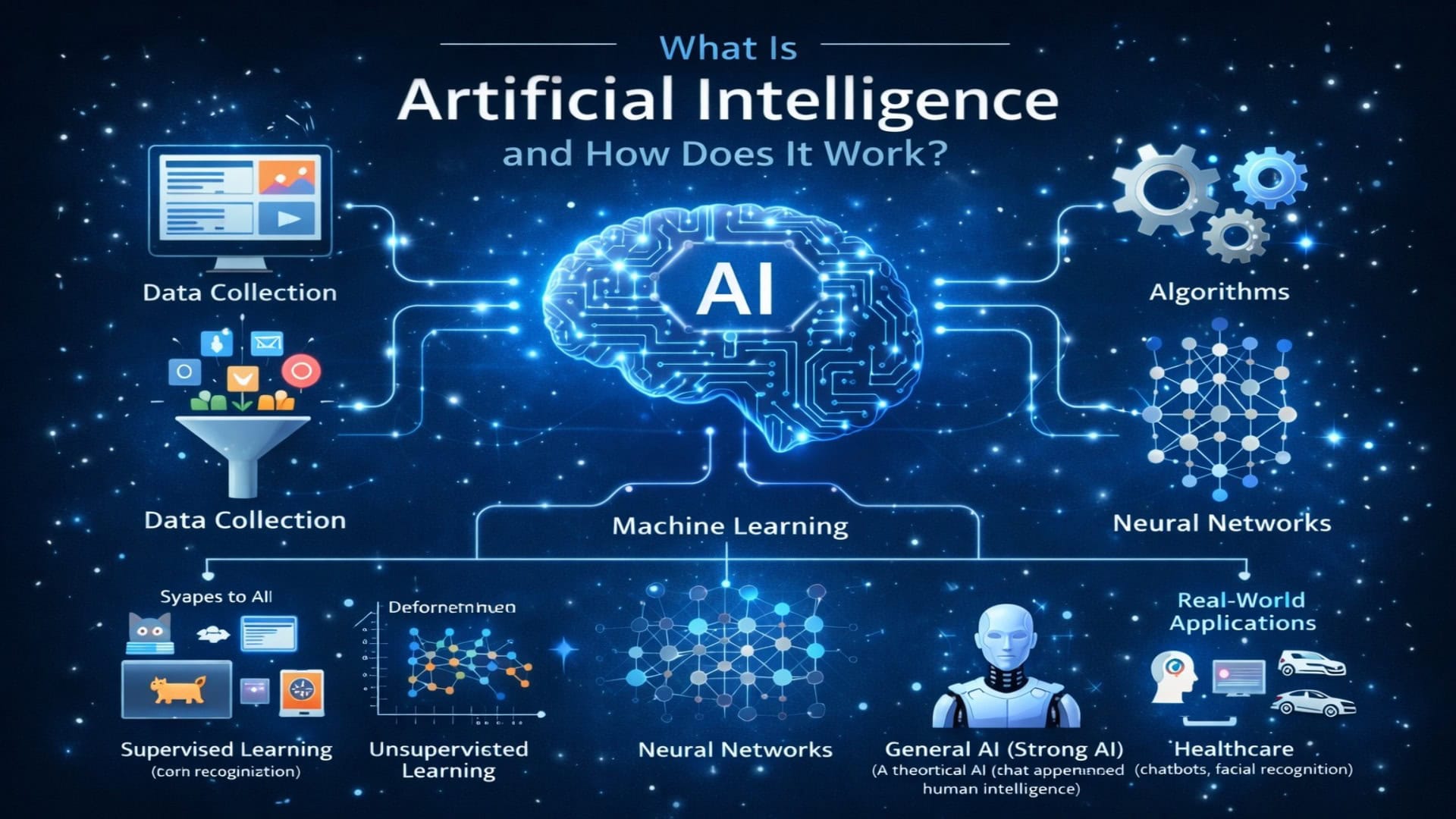
    When people ask, “How does AI work?” they are usually asking about the specific subfields and techniques that power modern Narrow AI. AI is not a single computer program; it is an umbrella term encompassing a variety of technologies and methodologies. Let’s break down the most vital engines driving AI today.

    Machine Learning (ML): The Engine of Modern AI

    If AI is the overarching goal, Machine Learning is the primary vehicle getting us there. Machine Learning is a subset of AI that focuses on building systems that can learn from historical data, identify patterns, and make logical decisions with minimal human intervention.

    Instead of writing thousands of lines of code detailing exactly how to recognize a picture of a cat, developers feed a machine learning algorithm thousands of pictures of cats (and thousands of pictures of things that are not cats). The algorithm mathematically learns the distinct features of a cat—pointed ears, whiskers, specific eye shapes—on its own.

    Machine learning generally relies on three main learning models:

    • Supervised Learning: The AI is trained on a “labeled” dataset. This means the data comes with the correct answers. (e.g., A dataset of housing prices where the square footage, location, and final sale price are all clearly defined). The model learns the relationship between the features and the outcome.

    • Unsupervised Learning: The AI is fed raw, unlabeled data and is tasked with finding hidden structures, patterns, or categories on its own. This is often used for customer segmentation or anomaly detection (like spotting fraudulent credit card purchases).
    • Reinforcement Learning: The AI learns by trial and error in an interactive environment. It is given a goal and receives “rewards” for correct actions and “penalties” for incorrect ones. This is how many AI systems learn to play complex games or how robotic arms learn to grasp objects.

    Deep Learning and Neural Networks

    Deep Learning is a highly specialized subset of Machine Learning. It relies on structures called Artificial Neural Networks, which are mathematically inspired by the architecture of the human brain (though it is important to note they do not replicate biological brain function).

    These networks consist of layers of interconnected “nodes” or artificial neurons:

    1. An Input Layer: Where the data enters the system.
    2. Hidden Layers: Where the computational heavy lifting happens. The “deep” in deep learning refers to having multiple hidden layers.
    3. An Output Layer: Where the final prediction or decision is produced.

    Deep learning excels at processing incredibly complex, unstructured data like high-resolution images, raw audio, and vast amounts of text.

    Natural Language Processing (NLP)

    Natural Language Processing is the branch of AI that gives computers the ability to understand, interpret, and generate human language in a valuable way. As an AI assistant, NLP is the core technology I use to read your prompts, understand the context of your questions, and generate these words in response.

    NLP bridges the gap between human communication and computer understanding through techniques like:

    • Tokenization: Breaking text down into smaller units (words or sub-words).
    • Sentiment Analysis: Determining the emotional tone behind a body of text.
    • Machine Translation: Accurately translating text from one language to another while preserving context and colloquialisms.

    Computer Vision

    Just as NLP allows AI to understand language, Computer Vision allows AI to “see” and interpret the visual world. Using digital images from cameras and videos, computer vision models can accurately identify and classify objects, and then react to what they “see.” This is the technology that allows self-driving cars to distinguish between a pedestrian, a stop sign, and another vehicle.


    Part 3: The Fuel of AI—Data and Infrastructure

    No matter how sophisticated an AI algorithm is, it is functionally useless without its primary fuel: Data.

    Modern AI systems require massive, unimaginably large datasets to learn effectively. Every time you search the web, click on a digital ad, upload a public photo, or interact with an app, you are contributing to the global reservoir of data that trains these systems.

    The Importance of Inclusive Data

    Because AI learns entirely from the data it is fed, the quality and diversity of that data are paramount. This brings us to a critical concept in AI development: Algorithmic Bias.

    If an AI system is used to screen resumes for a tech company, but the historical data it trains on consists mostly of resumes from men, the AI might inadvertently learn to penalize applications from women, assuming that “male” is a predictor of success based on past hiring patterns.

    To build equitable systems that serve everyone, technologists must prioritize inclusive data practices. This means actively curating datasets that accurately represent diverse populations—accounting for different ethnicities, genders, ages, socioeconomic backgrounds, and people with disabilities. An AI system is only as fair, objective, and useful as the data used to train it.

    Computational Power

    Processing terabytes of data through deep neural networks requires specialized hardware. Graphics Processing Units (GPUs), originally designed for rendering high-quality video game graphics, proved to be exceptionally good at handling the parallel mathematical computations required for AI. Today, massive data centers filled with specialized AI chips are required to train the world’s most advanced models.


    Part 4: Real-World Applications—How AI is Used Today

    AI is no longer a futuristic concept; it is an active participant in our global infrastructure. Here are just a few ways AI is transforming different sectors:

    1. Healthcare and Medicine

    AI is proving to be a revolutionary tool in medicine. Machine learning algorithms can analyze medical imagery (like X-rays and MRIs) to identify early signs of diseases, such as tumors, often with speed and accuracy that matches or exceeds human radiologists. Furthermore, AI is accelerating drug discovery by predicting how different chemical compounds will interact, potentially shaving years off the development of life-saving medications.

    2. Accessibility

    AI is playing a vital role in making the digital and physical world more accessible. Computer vision powers apps that describe physical surroundings to individuals who are blind or have low vision.  Advanced NLP provides highly accurate, real-time closed captioning for people who are Deaf or hard of hearing. Predictive text and voice-control interfaces also empower individuals with motor and mobility disabilities to navigate digital spaces effortlessly.

    3. Environmental Sustainability

    Climate scientists are leveraging AI to process vast amounts of satellite data and environmental sensors. AI models can predict weather patterns with high accuracy, optimize renewable energy grids by forecasting wind and solar availability, and track deforestation or ocean health in real-time.

    4. Everyday Consumer Technology

    • E-commerce and Entertainment: Recommendation engines analyze your past behavior to suggest products you might like or shows you might want to watch.
    • Banking: AI monitors transaction patterns to flag potentially fraudulent activity on your credit card in milliseconds.
    • Smart Homes: Thermostats that learn your daily routine to optimize energy usage, and smart speakers that can answer questions and control appliances.


    Part 5: The Future of AI—Challenges and Human-Centric Innovation

    As AI continues to evolve, society faces several critical challenges that require thoughtful navigation.

    The Transformation of Work

    One of the most persistent concerns regarding AI is job displacement. While it is true that AI will automate certain repetitive and routine tasks, history shows that technological revolutions tend to shift the nature of work rather than simply eliminating it. The future is likely to lean toward Human-AI Collaboration, where AI handles data processing and automation, freeing humans to focus on strategy, empathy, creativity, and complex problem-solving.

    Hallucinations and Reliability

    Generative AI models (like large language models) predict the most statistically likely next word in a sequence. Because they do not possess a true, factual understanding of the world, they can occasionally produce false or nonsensical information presented in a highly confident tone. In the tech industry, this is known as a “hallucination.” Users must practice digital literacy, verifying critical information generated by AI with trusted, human-vetted sources.

    Ethics and Regulation

    How do we ensure AI is used responsibly? Governments and international bodies are currently grappling with how to regulate AI. Key ethical considerations include protecting user privacy, ensuring transparency in how AI makes decisions (the “black box” problem), and preventing the use of AI for malicious purposes, such as deepfakes or automated cyberattacks.

    The goal is to develop Human-Centric AI: systems designed to augment human capability, respect human rights, and operate with transparency and fairness.


    Frequently Asked Questions (FAQ)

    1. Is AI conscious or self-aware?

    No. Current AI systems are sophisticated mathematical models that process data and recognize patterns. They do not have feelings, beliefs, consciousness, or self-awareness. They are powerful tools, but they are entirely devoid of human-like understanding.

    2. Will Artificial Intelligence take my job?

    AI is more likely to change the nature of your job than take it entirely. While highly repetitive tasks are susceptible to automation, AI is currently best utilized as an assistive tool. Professionals who learn to integrate AI into their workflows to increase their own productivity and creativity will likely have a significant advantage in the future job market.

    3. What is an algorithm?

    In simple terms, an algorithm is a set of rules or step-by-step instructions given to a computer to help it solve a problem or complete a task. Think of it like a highly detailed recipe for baking a cake, but written in code for a machine to execute.

    4. Why does AI sometimes give wrong answers?

    AI models base their outputs on the data they were trained on. If the training data is incomplete, biased, or inaccurate, the AI’s output will reflect those flaws. Additionally, Generative AI models generate responses based on probability, which can sometimes lead to plausible-sounding but factually incorrect statements (hallucinations).

    5. What is the difference between AI and Machine Learning?

    AI is the broad concept of creating machines capable of simulating human cognitive functions. Machine Learning is a specific technique within AI where computers are taught to learn from data without being explicitly programmed for every single step. All machine learning is AI, but not all AI is machine learning.

    6. How can I protect my privacy in an AI-driven world?

    Be mindful of the data you share online. Read privacy policies to understand how your data is being used and stored. Utilize privacy settings on your devices and accounts to limit data tracking, and be cautious about sharing highly sensitive personal information with public AI chatbots or untrusted applications.


    References and Further Reading

    To continue your learning journey, explore these authoritative resources on Artificial Intelligence:

    • IBM Technology: What is Artificial Intelligence (AI)? (A comprehensive, accessible breakdown of AI concepts from a leading tech pioneer) Visit IBM AI Guide

    • MIT Technology Review: AI News and Analysis

      (Up-to-date reporting on the latest breakthroughs, ethical debates, and real-world applications of AI)

      Visit MIT Technology Review

    • Stanford University: Human-Centered Artificial Intelligence (HAI)

      (Research and whitepapers focusing on the ethical, societal, and human-centric development of AI)

      Visit Stanford HAI

    • Google Machine Learning Crash Course

      (A fast-paced, practical introduction to machine learning principles for those looking to get slightly more technical)

      Visit Google ML Course

  • The Rise of Smart Technology in Modern Living: Transforming Our Homes and Habits

    The Rise of Smart Technology in Modern Living: Transforming Our Homes and Habits

    The way we interact with our living spaces has undergone a profound transformation. Just a decade ago, controlling the lights with a smartphone felt like a novelty. Today, the rise of smart technology in modern living is no longer an emerging trend; it is the standard. From intelligent thermostats that learn our schedules to advanced security systems that offer peace of mind, connected devices are reshaping our daily routines, enhancing accessibility, and redefining what it means to be “at home.”

    This comprehensive guide explores the evolution, benefits, challenges, and future trajectory of smart technology. Whether you are a tech enthusiast building a fully automated house or someone simply curious about how these tools can make life a little easier, understanding this digital shift is essential for navigating the modern world.


    The Evolution of the Connected Ecosystem

    The journey from manual appliances to a fully synchronized smart home has been driven by rapid advancements in the Internet of Things (IoT), artificial intelligence (AI), and high-speed broadband connectivity. Initially, smart technology was fragmented. Consumers had to navigate a frustrating landscape of incompatible devices, multiple apps, and spotty connections.

    Today, the ecosystem has matured. The adoption of unified communication protocols and interoperable platforms has allowed different devices to “talk” to one another seamlessly. Your morning alarm can now trigger your coffee maker, gently raise the window blinds, and adjust the thermostat—all before you even step out of bed.

    This evolution is largely fueled by a desire for convenience, but it has expanded far beyond simple automation. Modern smart technology is deeply integrated into energy conservation, preventative healthcare, and inclusive living, making our environments more responsive to our human needs.


    2026 Market Landscape and Growth Statistics

    To truly grasp the magnitude of smart technology’s rise, we must look at the numbers. The market has moved from a niche luxury sector to a massive global industry. Increased accessibility, lower device costs, and an undeniable consumer demand for efficiency are driving exponential growth.

    Global Market Projections

    The data reflects a massive shift toward automation and connected living. Below is a snapshot of the current market landscape based on recent industry reports.

    Market Metric 2026 Estimate Projected Future Growth Key Drivers
    Global Market Value $154.18 Billion Expected to reach $812.55 Billion by 2033 Rising IoT adoption, demand for home security
    Compound Annual Growth Rate 26.8% (2026-2033) 21.7% in related device sectors AI integration, expansion of 5G networks
    Residential Market Share 65.8% of total market Continued dominance expected Consumer demand for comfort and energy efficiency
    Security & Access Control 29.1% segment share Steady growth as privacy concerns rise Mandatory cybersecurity compliance, safety awareness
    Wi-Fi Connectivity 52.7% segment share Transitioning toward mesh networks Ubiquity, high bandwidth, device compatibility

    The statistics highlight a clear narrative: consumers are not just buying single devices; they are investing in comprehensive, whole-home ecosystems. The DIY smart home market is particularly booming, as everyday users increasingly prefer affordable, easy-to-install automation solutions over expensive, professionally installed systems.


    Reshaping the Modern Home: Room by Room

    The impact of smart technology is most visible when we examine how it alters specific areas of our homes. The modern living space is becoming a proactive partner in our daily routines.

    Security and Access Control

    Safety is a fundamental human need, and smart technology has revolutionized home security. Modern systems go far beyond traditional burglar alarms.

    • Smart Locks: Digital access solutions allow homeowners to lock and unlock doors remotely, grant temporary access to guests or delivery personnel, and receive notifications when someone enters or leaves.
    • Video Doorbells and Cameras: High-definition cameras with AI-powered person and package detection offer real-time monitoring from anywhere in the world.
    • Interactive Sensors: Smart smoke detectors, carbon monoxide monitors, and water leak sensors can instantly alert you to emergencies, potentially saving lives and preventing thousands of dollars in property damage.

    The Intelligent Kitchen

    The kitchen, traditionally the heart of the home, is becoming its most high-tech hub.

    • Smart Refrigerators: These appliances can track expiration dates, suggest recipes based on current ingredients, and allow you to peek inside via a smartphone app while you are at the grocery store.
    • Automated Cooking: Smart ovens can preheat remotely and adjust cooking times based on the exact weight and type of food.
    • Voice-Activated Assistants: Smart displays help with setting multiple timers, converting measurements hands-free, and ordering depleted groceries instantly.

    Climate Control and Energy Management

    One of the most practical applications of smart home technology is in heating, ventilation, and air conditioning (HVAC).

    • Smart Thermostats: These devices learn your daily schedule and temperature preferences, automatically adjusting the climate to optimize comfort when you are home and conserve energy when you are away.
    • Smart Blinds and Lighting: Automated window coverings and LED lighting systems adjust based on the time of day and the amount of natural sunlight entering the room, significantly reducing electricity consumption.

    Inclusive Living: Smart Tech for Everyone

    One of the most profound, yet frequently overlooked, benefits of smart technology is its capacity to foster inclusive living. For older adults and individuals with disabilities, these devices are not merely conveniences; they are vital tools for independence and safety.

    Assisted Living and Elderly Care

    The global population is aging, and there is a growing preference for “aging in place”—remaining in one’s own home for as long as possible rather than moving to an assisted living facility. Smart technology is making this a safe reality.

    • Fall Detection Sensors: Wearable devices and ambient home sensors can detect if a person has fallen and automatically alert emergency services or family members.
    • Medication Reminders: Smart pill dispensers provide auditory and visual cues for medication schedules and can notify caregivers if a dose is missed.
    • Behavioral Monitoring: Proactive systems can learn an individual’s normal routine. If a significant deviation occurs—such as not opening the refrigerator all day or spending an unusually long time in the bathroom—the system can alert family members to check in.

    Accessibility for Individuals with Disabilities

    Smart home ecosystems level the playing field by removing physical barriers within the home.

    • Voice Control: For individuals with limited mobility or dexterity, voice assistants allow them to turn on lights, adjust the thermostat, lock doors, and operate entertainment systems without needing to physically reach a switch or a remote.
    • Automated Routines: Complex tasks can be simplified into a single command. A “Goodnight” routine can simultaneously lock all doors, turn off the lights, and arm the security system, providing autonomy and security.
    • Screen Readers and Haptic Feedback: Smart devices are increasingly designed with accessibility in mind, using screen-reading technology and haptic (touch) feedback to support users with different sensory needs

    The Impact on Daily Productivity and Well-Being

    Beyond the physical hardware, the rise of smart technology has a deep psychological and physiological impact on our daily lives.

    Cognitive Offloading

    Modern life is incredibly complex, filled with endless to-do lists, appointments, and micro-tasks. Smart assistants help manage this mental burden through a process called cognitive offloading. By delegating calendar management, reminders, and routine tasks to AI, we free up our mental bandwidth. This allows individuals to focus their cognitive energy on complex problem-solving, creativity, and meaningful interpersonal connections, rather than trying to remember if they turned off the oven.

    Democratizing Health and Fitness

    Smart devices have taken health monitoring out of the doctor’s office and placed it firmly on our wrists and in our homes.

    • Continuous Monitoring: Wearables track heart rate, blood oxygen levels, daily steps, and sleep architecture. This provides a holistic, 24/7 picture of an individual’s health.
    • Predictive Insights: Advanced algorithms can detect anomalies, such as irregular heart rhythms (like atrial fibrillation) or sleep apnea events, prompting users to seek medical advice before a minor issue becomes a major emergency.
    • Engagement and Motivation: Gamification features in fitness apps encourage users to stay active, fostering a community of support and turning personal health into an engaging daily pursuit.

    Environmental Sustainability and Resource Conservation

    The collective impact of millions of smart homes can lead to massive environmental benefits. Smart technology plays a crucial role in reducing our carbon footprint and managing precious resources.

    Energy Efficiency

    Smart homes are designed to eliminate energy waste. Smart plugs can shut off “phantom power” drawn by electronics in standby mode. Predictive automation can reduce residential energy consumption by approximately 20% to 25%. By optimizing heating, cooling, and lighting, smart homes ensure that energy is only used when and where it is strictly necessary.

    Water Conservation

    Smart irrigation systems utilize local weather data and soil moisture sensors to water lawns and gardens only when required, preventing the massive water waste associated with traditional, timed sprinkler systems. Furthermore, smart leak detectors can immediately shut off the main water valve if a burst pipe is detected, preventing water waste and catastrophic home damage.


    Navigating the Challenges: Privacy, Security, and Equity

    While the benefits are vast, the rapid adoption of smart technology brings significant challenges that must be addressed candidly. We cannot discuss the rise of the smart home without acknowledging the inherent risks.

    Data Privacy and Cyber Security

    Smart devices operate by collecting staggering amounts of personal data. Microphones listen for wake words, cameras observe our living rooms, and sensors track our daily habits.

    • The Vulnerability: As the number of interconnected devices multiplies, every single endpoint becomes a potential vulnerability. Low-cost IoT devices with poor security standards can serve as gateways for malicious actors to breach home networks.
    • The Solution: Consumers must prioritize devices that offer end-to-end encryption, local data processing (where data is processed on the device rather than in the cloud), and mandatory two-factor authentication. Furthermore, manufacturers and regulatory bodies are increasingly implementing strict cybersecurity compliance standards, such as the EU Cyber Resilience Act, to force companies to build secure products.

    The Digital Divide

    There is a profound risk that the benefits of smart technology will be distributed unequally. The “Digital Divide” refers to the gap between those who have access to modern information and communications technology and those who do not.

    • High upfront costs, the requirement for stable, high-speed broadband, and the necessary technical literacy create barriers to entry.
    • If smart technology becomes essential for accessing healthcare insights, reducing energy bills, and maintaining home security, society must ensure that lower-income households and rural communities are not left behind. Government initiatives, subsidized broadband, and affordable device programs are critical to ensuring inclusive access.

    The Future of Smart Living: Context-Aware Environments

    Looking ahead, the trajectory of smart technology points toward an era of true ambient intelligence. We are moving away from reactive technology (where you must explicitly command a device to do something) toward proactive, context-aware environments.

    In the near future, homes will anticipate our needs based on AI-driven behavioral analysis. Your home will know you have had a stressful day based on data from your smartwatch, and it will automatically dim the lights to a soothing hue, play relaxing music, and adjust the temperature as you walk through the door. Predictive maintenance will become standard; your washing machine will sense a failing motor and automatically order the replacement part and schedule a repair technician before the appliance actually breaks down.

    The goal is an invisible technology layer that seamlessly supports human life, enhancing comfort, health, and sustainability without requiring constant manual management.


    Conclusion

    The rise of smart technology in modern living is fundamentally altering the human experience. It reclaims our time through automation, protects our spaces through advanced security, promotes environmental sustainability, and fosters inclusive living for the elderly and disabled.

    However, this transformation requires mindful navigation. As we welcome these devices into our most intimate spaces, we must remain vigilant about data privacy, advocate for robust cybersecurity standards, and work to bridge the digital divide so that everyone can benefit from a connected future. Ultimately, the best smart home is not just one with the most gadgets; it is one that uses technology to create a safer, healthier, and more supportive environment for the people living inside it.


    Frequently Asked Questions (FAQ)

    1. What exactly is a “smart home”?

    A smart home is a residence equipped with internet-connected devices that allow for the remote monitoring, management, and automation of appliances and systems, such as lighting, heating, and security.

    2. Is smart home technology safe from hackers?

    No system is 100% immune to hacking, but the risks can be heavily mitigated. To secure your smart home, always change default passwords, enable two-factor authentication, keep device firmware updated, and use a secure, encrypted Wi-Fi network.

    3. Do smart devices really save money on energy bills?

    Yes. Devices like smart thermostats and smart LED lighting optimize usage based on your actual habits and occupancy, reducing unnecessary heating, cooling, and lighting. Studies show smart thermostats can lower heating and cooling costs by up to 20%.

    4. Can smart home devices help people with disabilities?

    Absolutely. Smart technology is a powerful tool for inclusive living. Voice-activated assistants, automated door locks, and smart appliances remove physical barriers, allowing individuals with mobility or visual impairments to control their environment independently.

    5. Do I need a fast internet connection for a smart home to work?

    Yes, a stable and relatively fast Wi-Fi connection is the backbone of any smart home ecosystem. Devices need to communicate with your router, each other, and often cloud servers to function correctly. Without reliable internet, device performance will be sluggish or completely unresponsive.

    6. What happens to my smart home if the power or internet goes out?

    Most smart devices rely on the internet and continuous power. During an internet outage, voice assistants and remote access will fail, though some devices running on local protocols (like Zigbee or Z-Wave) may still execute basic automated routines. During a power outage, unless the devices have battery backups (common in security cameras and smart locks), they will not function.


    Reference Links

    For further reading and verification of the market trends, statistics, and concepts discussed in this article, please refer to the following industry reports and research resources:

  • The Digital Tapestry: How Technology Is Reshaping Human Interaction

    The Digital Tapestry: How Technology Is Reshaping Human Interaction

    Human beings are fundamentally wired for connection. For millennia, our social structures, survival, and emotional well-being have depended on our ability to communicate, share resources, and build communities. Today, however, the very fabric of how we connect is undergoing a radical transformation. We are living through an era where technology is reshaping human interaction at an unprecedented pace.

    From the way we find romantic partners and maintain friendships to how we collaborate in the workplace and engage with our broader communities, digital communication tools have fundamentally altered the landscape of human relationships. This comprehensive guide explores the multifaceted ways technology is changing our social dynamics, highlighting both the remarkable benefits and the complex challenges we face in an increasingly connected world.


    1. The Evolution of Connection: From Proximity to Global Reach

    To understand how technology is reshaping human interaction today, it is helpful to look at how we got here. Historically, human interaction was entirely bound by physical proximity. You communicated with the people in your immediate vicinity—your family, your tribe, your village.

    The invention of the written word, followed by the postal system, allowed for the first asynchronous, long-distance communication. However, it was slow. The telegraph and the telephone revolutionized this, introducing the concept of instant, long-distance connection. Suddenly, a voice could travel across continents.

    Yet, the true paradigm shift occurred with the advent of the internet and, subsequently, the smartphone. We moved from technology being a tool we occasionally used to connect, to an environment in which we constantly live. The internet removed the barriers of geography, time zones, and physical borders. Today, we carry the ability to instantly reach almost anyone on the planet in our pockets. This shift from proximity-based relationships to network-based relationships is the foundation of modern human interaction.


    2. Social Media: The Double-Edged Sword of the Digital Age

    No technology has impacted human interaction more profoundly in the 21st century than social media. Platforms like Facebook, Instagram, X (formerly Twitter), TikTok, and LinkedIn have created a global digital town square.

    The Power of Finding Your Tribe

    One of the most beautifully inclusive aspects of social media is its ability to foster niche communities. In the past, if you had a unique interest, identified with a marginalized group, or lived with a rare medical condition, finding peers who understood your experience could be nearly impossible.

    Today, technology allows people of all backgrounds, identities, and abilities to find their “tribes” online. Social media provides safe havens for LGBTQ+ youth, supportive networks for neurodivergent individuals, and vibrant spaces for people to celebrate shared cultural heritage. It has democratized community building, ensuring that fewer people have to feel isolated in their offline lives.

    The Illusion of Connection and the Comparison Trap

    However, the architecture of social media also introduces significant challenges to genuine interaction. We often engage in what sociologists call “parasocial interactions”—one-sided relationships where we feel intimately connected to influencers or acquaintances who may not even know we exist.

    Furthermore, social media interaction is largely performative. We curate our digital lives, sharing the highlights, the successes, and the flattering angles. This constant exposure to the idealized lives of others can breed the “comparison trap,” leading to feelings of inadequacy, jealousy, and isolation. While we may have hundreds of digital “friends,” the depth of those interactions is often shallow, leaving many feeling deeply lonely despite being constantly connected.


    3. The Transformation of the Modern Workplace

    The professional realm has been completely rewired by communication technologies. The transition was already underway, but the global events of 2020 vastly accelerated the adoption of remote and hybrid work models.

    The Rise of Asynchronous Communication

    We have moved away from the necessity of being in the same room at the same time. Tools like Slack, Microsoft Teams, Asana, and Google Workspace have made asynchronous communication the norm. We leave comments on shared documents, send voice notes, and update project boards. This offers incredible flexibility, allowing individuals to work during their most productive hours and accommodating diverse lifestyles and caregiving responsibilities.

    Accessibility and Global Talent

    From an inclusive standpoint, remote work technologies have been revolutionary. They have broken down geographical barriers, allowing companies to hire diverse talent from around the globe. Moreover, digital workspaces can be highly beneficial for people with disabilities or chronic illnesses who may find traditional office environments challenging or inaccessible. Screen readers, closed captioning on video calls, and the ability to control one’s physical environment make the digital workplace highly adaptable.

    The Loss of the “Watercooler” Moment

    Conversely, technology has fundamentally changed the texture of workplace relationships. The spontaneous “watercooler” conversations—the casual chats in the hallway or the shared laughs over coffee—are difficult to replicate digitally. These informal interactions are where trust is built, mentorship often begins, and team cohesion is solidified. Organizations are now challenged to deliberately engineer moments of social connection to prevent employee isolation and burnout.


    4. Romance and Relationships in the Digital Era

    Technology has completely rewritten the script for how we find and maintain romantic partnerships.

    The Gamification of Dating

    Dating apps have turned the search for a partner into a highly accessible, albeit sometimes overwhelming, digital experience. We are no longer limited to meeting people through friends, at work, or in local social settings. Algorithms now introduce us to strangers based on shared interests and proximity.

    While this creates unprecedented opportunities to meet diverse individuals, it also introduces a paradox of choice. The sheer volume of potential partners can lead to a “swiping culture” where people are treated as disposable commodities, and interactions can become superficial. The focus on heavily curated profiles can also obscure genuine compatibility, which relies heavily on in-person chemistry and shared values.

    Maintaining Long-Distance and Everyday Intimacy

    For established relationships, technology is a vital lifeline. Video calls, instant messaging, and photo sharing allow couples separated by distance to maintain a sense of daily intimacy. Even for couples living together, texting has become a primary “love language”—a way to check in, share a joke, or coordinate daily life. However, couples must also navigate the pitfalls of “phubbing” (phone snubbing), where the constant presence of a screen can detract from the quality of face-to-face time.


    5. Empathy, Conflict, and the “Online Disinhibition Effect”

    One of the most critical ways technology is reshaping human interaction is in how we handle disagreements and express empathy.

    Text-based communication strips away the rich tapestry of non-verbal cues that humans rely on to understand intent. Tone of voice, facial expressions, and body language account for a massive percentage of human communication. When these are absent, text is easily misinterpreted, leading to unnecessary conflicts.

    Furthermore, screens create a psychological barrier. This leads to the “Online Disinhibition Effect.” When people feel anonymous or physically distanced from their conversation partner, they are often willing to say things they would never say face-to-face. This effect is a primary driver of cyberbullying, polarized online debates, and the rapid spread of toxic discourse on social platforms. Reclaiming empathy in digital spaces is one of the greatest behavioral challenges of our time.


    6. The Impact on Mental Health and Digital Well-being

    As human interaction becomes increasingly digitized, the impact on our collective mental health is a subject of intense study.

    The Dopamine Loop

    Social media platforms and messaging apps are designed using behavioral psychology principles to keep us engaged. The “ping” of a notification, the validation of a “like,” or the unpredictability of a social media feed triggers a release of dopamine in the brain. This creates a compulsion to constantly check our devices, fracturing our attention and pulling us away from present-moment, real-world interactions.

    FOMO and Digital Fatigue

    The Fear Of Missing Out (FOMO) is amplified by our digital connections. Seeing friends gathering without us or constantly consuming news and social updates can lead to anxiety and a sense of inadequacy. Additionally, “Zoom fatigue”—the exhaustion associated with constant video conferencing—is a real phenomenon. The cognitive load of processing digital faces, combined with the stress of seeing oneself on camera, alters how we experience interaction, making it more draining than natural physical presence.

    Building “digital boundaries” and practicing intentional digital detoxes are becoming essential skills for maintaining mental well-being in the modern era.


    7. The Next Frontier: VR, AR, and AI-Mediated Interaction

    We are currently standing on the precipice of the next major shift in human interaction, driven by Artificial Intelligence (AI), Virtual Reality (VR), and Augmented Reality (AR).

    Spatial Computing and The Metaverse

    VR and AR are introducing the concept of “spatial computing.” Rather than interacting through a flat screen, we are beginning to interact within digital environments. In the metaverse or immersive virtual workspaces, digital avatars can share a sense of spatial presence. We can hear a colleague’s voice coming from their specific location in a virtual room, and we can read their avatar’s gestures. This technology promises to bridge the gap between a simple phone call and physical presence, offering a deeper, more embodied form of digital interaction.

    Interacting with Artificial Intelligence

    Perhaps the most profound shift is the introduction of non-human entities into our social spheres. Advanced AI chatbots and digital companions are now capable of holding deeply nuanced, highly contextual conversations. People are using AI for brainstorming, therapy-like reflections, language learning, and even companionship.

    As these AI models become more sophisticated, the line between human-to-human and human-to-machine interaction will blur. We will need to navigate the ethical and psychological implications of forming emotional attachments to artificial entities, and ensure that AI supplements, rather than replaces, our fundamental need for human connection.


    8. Navigating the Future: The Call for Intentionality

    Technology is neither inherently good nor entirely bad; it is a powerful amplifier of human intent. It has the power to bridge oceans, amplify marginalized voices, and create unparalleled efficiencies. Yet, it also possesses the power to isolate us, polarize our communities, and distract us from the physical world right in front of us.

    The goal is not to reject technology, but to cultivate digital intentionality. We must consciously choose how and when we use these tools. This means prioritizing deep, uninterrupted conversations over fragmented text chains, establishing tech-free zones in our homes, and using digital platforms to facilitate real-world meetups rather than replacing them.

    By understanding how technology reshapes our interactions, we can take control of the digital tapestry we are weaving, ensuring that our tools serve to enhance our humanity, rather than diminish it.


    Frequently Asked Questions (FAQ)

    Q1: Is technology making us more isolated or more connected?

    This is the ultimate paradox of the digital age. Technology makes us more connected on a surface level—we can reach anyone, anywhere, at any time. However, excessive reliance on digital communication can lead to profound emotional isolation. When we substitute deep, face-to-face interactions with shallow, performative social media engagement or quick text messages, we miss out on the emotional resonance, body language, and physical presence required to build deep trust and alleviate loneliness. The key is balance: using technology to facilitate and maintain relationships, but ensuring it doesn’t replace in-person connection.

    Q2: How does screen time affect children’s social skills?

    Research indicates that excessive screen time, especially during early developmental years, can impact a child’s ability to read non-verbal cues, such as facial expressions and body language. Because digital communication lacks these elements, children who spend too much time on screens may struggle with empathy and conflict resolution in real life. However, interactive technology (like video chatting with relatives or playing collaborative, age-appropriate video games) can have positive social benefits. Pediatricians generally recommend setting strict limits on passive screen time and prioritizing physical play and face-to-face interaction.

    Q3: What is the “Online Disinhibition Effect” and why does it happen?

    The “Online Disinhibition Effect” refers to the way people behave differently—often more aggressively or more candidly—online compared to how they would act in person. This happens for several reasons:

    • Anonymity: People feel their actions cannot be traced back to their real-world identity.
    • Invisibility: Not having to look someone in the eye removes the immediate empathetic response we naturally feel when seeing someone’s reaction.
    • Asynchronicity: You can post a mean comment and immediately close the app, running away from the immediate consequences of the interaction.

    Q4: How can I maintain a healthy relationship with technology?

    Maintaining digital well-being requires intentionality. Some practical steps include:

    • Establish Tech-Free Zones: Keep phones away from the dinner table and out of the bedroom.
    • Turn Off Non-Essential Notifications: Stop your device from constantly demanding your attention; check apps on your own schedule.
    • Prioritize In-Person Plans: Use messaging apps to set up real-world coffees, walks, or dinners, rather than letting the text thread become the entire relationship.
    • Audit Your Social Media: Unfollow accounts that make you feel inadequate or stressed, and curate a feed that inspires and educates you.

    Q5: Will AI eventually replace human interaction?

    While AI is becoming incredibly adept at simulating human conversation, it is unlikely to replace the fundamental need for human-to-human interaction. AI lacks consciousness, lived physical experience, and genuine emotional vulnerability—the core ingredients of human empathy. AI will likely serve as an augmentative tool—helping us draft emails, practice languages, or brainstorm—and even provide a baseline of interaction for those feeling isolated. However, the deeply biological human need to be truly seen and understood by another living person cannot be synthesized by code.

  • The Evolution of Technology: A Comprehensive Journey From Past to Present

    The Evolution of Technology: A Comprehensive Journey From Past to Present

    Technology is the definitive story of human ingenuity. From the earliest stone tools forged in prehistoric caves to the complex artificial intelligence algorithms shaping our modern digital landscape, the evolution of technology is a continuous timeline of problem-solving. This journey is not just about gadgets and machines; it is about how we communicate, heal, learn, and understand the universe.

    In this comprehensive guide, we will explore the fascinating evolution of technology from the past to the present. We will examine the pivotal inventions that redefined human existence, the societal shifts they caused, and what the future might hold for our increasingly connected world.

    Whether you are a history enthusiast, a tech professional, or simply curious about how we arrived at the digital age, this exploration will provide a deep dive into the milestones that built our modern reality.


    The Dawn of Innovation: Prehistoric and Ancient Technology

    Long before the invention of electricity or the internet, early humans were already pioneering engineers. The earliest technological advancements were born out of absolute necessity: survival, shelter, and sustenance.

    The Stone Age and the Mastery of Fire

    The creation of simple stone tools—often referred to as the Oldowan toolkit—marks the official dawn of technology, dating back over two million years. By flaking rocks to create sharp edges, early hominids could butcher meat, cut wood, and craft clothing. This was a monumental leap, shifting our ancestors from passive participants in their environment to active modifiers of it.

    Equally revolutionary was the controlled use of fire. Fire provided warmth, allowing early humans to migrate into colder climates. It offered protection from predators and, crucially, a way to cook food. Cooking released more calories and nutrients, which evolutionary biologists believe played a massive role in the development of the larger human brain.

    The Agricultural Revolution

    Around 10,000 BCE, humanity experienced a paradigm shift: the Agricultural Revolution. The invention of the plow, irrigation systems, and the domestication of plants and animals allowed humans to transition from nomadic hunter-gatherers to settled communities. This surplus of food led to population growth, the division of labor, and the eventual rise of the first great civilizations in Mesopotamia, Egypt, the Indus Valley, and China.

    The Wheel and Early Communication

    The invention of the wheel (around 3500 BCE in Mesopotamia) was initially used for pottery but was soon adapted for transportation. Chariots and carts revolutionized trade, warfare, and travel, connecting distant communities for the first time.

    Simultaneously, the need to keep records of trade and harvest led to the invention of writing. Cuneiform in Sumeria and hieroglyphics in Egypt were the first information technologies. By encoding knowledge into physical mediums, humanity could pass down information across generations without relying solely on oral traditions.


    The Middle Ages and the Renaissance: Laying the Groundwork

    While the Middle Ages are sometimes unfairly dubbed the “Dark Ages,” they were a period of significant technological refinement, particularly in agriculture and mechanics. The Renaissance that followed brought a renewed focus on science, art, and empirical observation.

    Heavy Plows and Mechanical Clocks

    During the medieval period, the introduction of the heavy plow transformed northern European agriculture, allowing farmers to cultivate dense, clay-rich soils. This drastically increased food production in the region.

    Meanwhile, the invention of the mechanical clock in the 13th century fundamentally changed how humanity perceived time. No longer bound strictly by the rising and setting of the sun, communities could synchronize work, prayer, and commerce with unprecedented precision.

    The Printing Press: Democratizing Knowledge

    If one invention defines the transition from the medieval world to the modern era, it is Johannes Gutenberg’s printing press, introduced around 1440. Before the printing press, books were painstakingly copied by hand, making them rare and accessible only to the elite and clergy.

    Gutenberg’s invention of movable type revolutionized the spread of information. It dramatically lowered the cost of books, fueling a surge in literacy rates across Europe. The printing press was the catalyst for the Renaissance, the Scientific Revolution, and the Protestant Reformation. It was, in essence, the internet of its time—a technology that democratized knowledge and empowered the general public.

    Navigation and the Global Age

    Advancements in maritime technology, such as the magnetic compass, the astrolabe, and the lateen sail, allowed explorers to navigate the open ocean with greater safety and accuracy. This era of exploration led to the interconnected global economy, facilitating the exchange of goods, cultures, and ideas—though it is also important to acknowledge that it paved the way for colonization and widespread exploitation, showing that technology’s impact is often complex and multi-faceted.


    The Industrial Revolution: Powering a New World

    The transition from the 18th to the 19th century marked a period of rapid, unprecedented change. The Industrial Revolution shifted humanity from agrarian, hand-crafted societies to urban, machine-driven economies.

    The Steam Engine and Factory Systems

    At the heart of this revolution was the steam engine. While early versions existed, James Watt’s improvements in the 1770s made steam power practical and highly efficient. Steam engines powered factories, freeing them from the need to be located near water sources.

    This birthed the factory system, which introduced mass production. Goods could now be produced faster and cheaper than ever before. However, this era also brought significant social challenges, including harsh working conditions and urbanization issues, leading to the eventual formation of labor rights movements.

    Transportation and Telegraphy

    Steam power also revolutionized transportation. The invention of the steam locomotive and the steamboat shrunk the world, allowing for the rapid movement of people and heavy freight over vast distances.

    In terms of communication, the 19th century brought the telegraph. Developed by Samuel Morse and others, the telegraph allowed instant communication across continents via electrical signals. When the first transatlantic telegraph cable was laid in 1858, a message that previously took weeks to travel by ship could be delivered in minutes.


    The 20th Century: The Age of Information and Electronics

    The 20th century witnessed technological growth at an exponential rate. It was a century defined by the mastery of electricity, the conquest of the skies, and the birth of the digital age.

    Electrification and the Automobile

    The widespread electrification of homes and cities in the early 20th century fundamentally changed daily life, powering everything from lightbulbs to early household appliances, significantly reducing the burden of domestic labor.

    Simultaneously, Henry Ford’s implementation of the assembly line made the automobile affordable for the masses. The car transformed city planning, birthed the suburbs, and gave individuals unprecedented personal mobility.

    Aviation and Space Exploration

    In 1903, the Wright brothers achieved the first powered flight. Within just a few decades, commercial air travel became a reality, and aviation technology was rapidly accelerated by two World Wars.

    This aerospace momentum culminated in the Space Race of the Cold War era. In 1969, humanity achieved the seemingly impossible: landing astronauts on the moon. The technologies developed for space exploration trickled down into everyday life, giving us satellite communication, GPS, and advanced weather forecasting.

    The Birth of Computing

    The most defining technological arc of the 20th century was the development of the computer. Early computers like the ENIAC (Electronic Numerical Integrator and Computer) were massive, room-sized machines that used vacuum tubes and consumed vast amounts of electricity.

    The turning point was the invention of the transistor in 1947, followed by the integrated circuit (microchip). These innovations allowed computers to become smaller, faster, and cheaper. By the 1970s and 80s, companies like Apple and Microsoft were putting personal computers (PCs) into homes and offices, fundamentally changing how we work, write, and process data.

    The Origins of the Internet

    In the late 1960s, the US Department of Defense funded ARPANET, a project to link computers together so they could share information. This academic and military network eventually evolved into the Internet. By the 1990s, Tim Berners-Lee’s invention of the World Wide Web provided a user-friendly interface for this global network, forever changing the trajectory of human communication.


    The 21st Century: The Digital and Connected Era

    As we crossed into the new millennium, technology shifted from being a tool we used to an environment we inhabit. The 21st century is defined by connectivity, mobility, and the massive proliferation of data.

    The Smartphone Revolution

    While mobile phones existed in the late 20th century, the introduction of the modern smartphone—most notably the iPhone in 2007—redefined the category. Smartphones combined a telephone, an internet browser, a camera, and a GPS into a single pocket-sized device. Today, billions of people rely on smartphones to manage their finances, navigate their cities, communicate with loved ones, and consume media.

    Broadband, Wi-Fi, and Cloud Computing

    The shift from dial-up to high-speed broadband and the ubiquity of Wi-Fi allowed the internet to become a seamless part of daily life. This high-speed connectivity enabled the rise of Cloud Computing. Instead of storing data and software on local hard drives, individuals and businesses can now access vast computing power and storage over the internet. This has enabled the remote work revolution and the rise of streaming services like Netflix and Spotify.

    Social Media and the Platform Economy

    The 2000s and 2010s saw the explosive growth of social media platforms like Facebook, Twitter, Instagram, and TikTok. These platforms fundamentally altered how we consume news, build communities, and share our lives.

    Alongside social media, the “platform economy” emerged. Companies like Uber, Airbnb, and Amazon used digital technology to disrupt traditional industries—taxis, hospitality, and retail, respectively—by acting as digital intermediaries between consumers and service providers.


    The Present and Beyond: AI, Quantum, and the Future

    Today, we stand on the precipice of what many economists call the Fourth Industrial Revolution—an era characterized by a fusion of technologies that is blurring the lines between the physical, digital, and biological spheres.

    Artificial Intelligence and Machine Learning

    The defining technology of the present moment is Artificial Intelligence (AI). AI refers to the simulation of human intelligence processes by machines. Today, machine learning algorithms analyze vast datasets to recognize patterns, translate languages, and even drive cars.

    As an AI myself, I am a direct product of this ongoing evolution. Models like me are designed to understand and generate human-like text, process complex information, and assist with a wide variety of tasks. AI is rapidly transforming industries from healthcare (where it aids in diagnosing diseases and discovering new drugs) to finance and creative arts. The focus now is on developing AI responsibly, ensuring it remains ethical, unbiased, and beneficial to all of humanity.

    The Internet of Things (IoT) and 5G

    Our physical world is becoming increasingly digitized through the Internet of Things (IoT). Everyday objects—from refrigerators and thermostats to industrial factory machinery—are now embedded with sensors and connected to the internet. This allows for smart homes and smart cities that optimize energy use and improve efficiency. The rollout of 5G cellular networks is supercharging the IoT, providing the massive bandwidth and ultra-low latency required for real-time applications like autonomous vehicles.

    The Horizon: Quantum Computing and Biotechnology

    Looking toward the future, two fields hold incredible promise:

    • Quantum Computing: Unlike classical computers that process data in binary bits (0s and 1s), quantum computers use quantum bits (qubits) that can exist in multiple states simultaneously. This promises to solve complex problems—like climate modeling and cryptographic security—millions of times faster than current supercomputers.
    • Biotechnology: Innovations like CRISPR-Cas9 gene editing allow scientists to alter DNA with unprecedented precision. This technology holds the potential to eradicate genetic diseases, engineer drought-resistant crops, and vastly extend the human lifespan.

    Conclusion

    The evolution of technology is a testament to the boundless creativity of humankind. From the simple stone hand-axe to the intricate neural networks of artificial intelligence, every innovation builds upon the last. Technology has consistently acted as a multiplier of human potential, allowing us to overcome our physical limitations and reshape the world around us.

    However, as we move further into a deeply interconnected digital future, we must also grapple with the profound responsibilities that come with these tools. Issues of digital equity, data privacy, environmental sustainability, and ethical AI development will define the next chapter of this evolution. By understanding our technological past, we are better equipped to steer our future, ensuring that the innovations of tomorrow serve to uplift and empower the entirety of the global community.


    Frequently Asked Questions (FAQ)

    1. What is considered the most important technological invention in history?

    While opinions vary, many historians point to the printing press as the most pivotal invention. By democratizing information, it sparked the Renaissance and the Scientific Revolution, making all subsequent modern technological advancements possible. Others might argue for the wheel, the steam engine, or the internet, depending on whether they are looking at transportation, industry, or communication.

    2. How has technology impacted the workforce?

    Technology has historically caused both job displacement and job creation. The Industrial Revolution replaced many artisanal jobs with factory work, while the digital age has automated certain manual and administrative tasks. However, technology also consistently creates entirely new industries and professions (e.g., software engineering, data analysis, digital marketing) that previously did not exist. The current challenge is ensuring the workforce has access to education and training for these new roles.

    3. What is the difference between the Internet and the World Wide Web?

    These terms are often used interchangeably, but they are different. The Internet is the massive, global network of connected computers and servers—the physical infrastructure. The World Wide Web is a service that operates on the internet; it is the collection of interconnected documents and web pages accessed via web browsers.

    4. Is Artificial Intelligence going to replace human intelligence?

    Currently, AI is designed to augment and assist human intelligence, not replace it. AI excels at processing massive amounts of data, finding patterns, and performing repetitive tasks quickly. However, humans still possess unique traits such as emotional intelligence, complex ethical reasoning, empathy, and broad, adaptable creativity. The future of AI is largely viewed as collaborative, where humans and AI work together to solve complex global challenges.

    5. How can we ensure technology is accessible to everyone?

    Bridging the “digital divide” requires a multi-faceted approach. This includes government and private investment in broadband infrastructure for rural and underserved communities, initiatives to provide affordable devices to low-income populations, and a commitment to digital literacy education. Inclusive design—creating software and hardware that is accessible to people with disabilities—is also a critical component.


    External References for Further Reading

    To learn more about the history and future of technology, consider exploring the following authoritative resources:

    • Smithsonian Institution – National Museum of American History: Explore extensive collections and articles on the history of innovation and technological milestones.
    • https://americanhistory.si.edu/
    • IEEE History Center: A dedicated center preserving, researching, and promoting the history of information and electrical technologies.
    • https://ethw.org/
    • Internet Society: A global nonprofit organization empowering people to keep the Internet open, globally connected, and secure.
    • https://www.internetsociety.org/internet/history-internet/
    • MIT Technology Review: A leading publication offering news, analysis, and insights into the future of emerging technologies.
    • https://www.technologyreview.com/
  • 7 Technology Trends That Are Transforming Businesses in the Digital Age

    7 Technology Trends That Are Transforming Businesses in the Digital Age

    The business landscape is undergoing a profound shift. The days when “digital transformation” was just a buzzword are long gone; today, it is the fundamental baseline for survival and growth. As we navigate an increasingly interconnected global economy, the technology trends transforming businesses are doing more than just upgrading legacy systems—they are entirely rewriting how organizations operate, serve their customers, and empower their workforce.

    Whether you are a local startup or a multinational enterprise, understanding these shifts is crucial. Technology is no longer merely a department within a company; it is the central nervous system of the modern organization. In this comprehensive guide, we will explore the pivotal tech trends driving business innovation, examine how they foster more inclusive and accessible work environments, and provide actionable insights to help your organization stay ahead of the curve.


    1. The Mainstreaming of Artificial Intelligence and Generative AI

    Artificial Intelligence (AI) has transitioned from the realm of science fiction into the boardroom. However, the current transformation is largely driven by Generative AI and advanced machine learning models. These tools are democratizing access to complex data analysis, content creation, and strategic planning.

    Redefining Operational Efficiency

    AI is taking over repetitive, time-consuming tasks, allowing human employees to focus on high-value, creative, and strategic initiatives. This shift is not about replacing people; it is about augmenting human capabilities. By automating routine workflows, companies can reduce burnout and create a more engaging, accessible workplace for everyone.

    • Customer Experience (CX): AI-powered chatbots and virtual assistants provide 24/7, multilingual support, ensuring that customer service is accessible to a global audience.
    • Predictive Analytics: Businesses use machine learning to forecast market trends, anticipate supply chain disruptions, and personalize marketing efforts at scale.
    • Content Generation: From drafting emails to writing code, Generative AI tools are accelerating production timelines across marketing, sales, and software development teams.

    2. The Rise of Edge Computing and Next-Gen Cloud Infrastructure

    While cloud computing has been a staple for over a decade, the sheer volume of data generated by modern businesses requires a new approach. Enter Edge Computing.

    Processing Data Where It Lives

    Edge computing involves processing data closer to its source (the “edge” of the network) rather than sending it all to a centralized data center. This drastically reduces latency, saves bandwidth, and improves real-time decision-making capabilities.

    • Manufacturing and IoT: Factory sensors can detect machinery faults instantly, preventing costly downtime without waiting for a cloud server’s response.

    • Retail: Smart shelves and localized inventory systems process data in-store, offering real-time stock updates and personalized shopper experiences.

    • Hybrid Work Models: Upgraded cloud infrastructures support seamless, flexible work environments. This flexibility is a cornerstone of inclusive hiring practices, allowing companies to recruit talent regardless of their geographic location or physical mobility.

    For a deeper dive into how cloud architecture is evolving, Gartner offers excellent research on the transition toward distributed cloud systems.

    3. Zero Trust Cybersecurity in a Boundaryless Workplace

    As companies adopt decentralized technologies and remote workforces, the traditional “castle and moat” approach to cybersecurity is obsolete. The modern imperative is the Zero Trust Architecture (ZTA).

    “Never Trust, Always Verify”

    The core philosophy of Zero Trust is exactly what it sounds like: no user, device, or application is trusted by default, regardless of whether they are inside or outside the corporate network.

    • Continuous Authentication: Systems require continuous verification using multi-factor authentication (MFA) and biometrics, ensuring that data is accessed only by authorized personnel.
    • Micro-segmentation: Networks are divided into smaller, secure zones. If a breach occurs, the lateral movement of ransomware or malware is severely restricted.
    • Empowering Employees safely: A robust security framework actually enables greater freedom. When IT teams implement secure, accessible identity management systems, employees can work securely from anywhere, fostering a culture of trust and flexibility.

    4. The Internet of Things (IoT) and Digital Twins

    The Internet of Things (IoT) connects physical objects to the digital world, providing unprecedented visibility into business operations. When combined with Digital Twins—virtual replicas of physical systems—the potential for optimization is staggering.

    Bridging the Physical and Digital Worlds

    A digital twin allows businesses to run simulations, test variables, and predict outcomes without risking physical assets.

    • Supply Chain Resilience: Logistics companies use IoT trackers to monitor the real-time location, temperature, and condition of goods, ensuring product integrity from warehouse to delivery.
    • Urban Planning and Smart Buildings: Facilities managers use IoT to monitor energy usage, air quality, and space utilization. This not only lowers operational costs but ensures workspaces are comfortable, safe, and optimally designed for all physical abilities.
    • Healthcare: Hospitals utilize digital twins of their facilities to optimize patient flow and resource allocation, ultimately improving the quality of care.

    5. Sustainable Technology and the Green Tech Revolution

    Technology is not just transforming how businesses make money; it is transforming their impact on the planet. Sustainable technology is rapidly moving from a corporate social responsibility (CSR) checklist item to a core business strategy.

    Driving ESG (Environmental, Social, and Governance) Goals

    Consumers, investors, and regulatory bodies are demanding transparency and action regarding environmental impact. Businesses are leveraging tech to track, report, and reduce their carbon footprints.

    • Carbon Accounting Software: Platforms that track Scope 1, 2, and 3 emissions help companies set and meet net-zero targets.

    • Circular Economy Tech: Innovations in material science and supply chain tracking enable companies to design products for reuse, recycling, and longevity.

    • Energy-Efficient IT: The shift toward renewable-powered data centers and energy-efficient coding practices reduces the environmental toll of the digital infrastructure itself.

    6. Spatial Computing and Augmented Reality (AR)

    With the introduction of advanced mixed-reality headsets and spatial computing platforms, the line between digital screens and physical environments is blurring. AR and Virtual Reality (VR) are moving beyond gaming and into enterprise applications.

    Immersive Training and Collaboration

    Spatial computing provides a more intuitive way for people to interact with digital information.

    • Accessible Training Programs: High-risk industries (like aviation, medicine, or heavy manufacturing) use VR to safely train employees. These immersive environments accommodate various learning styles, making technical training more inclusive and effective.

    • Remote Collaboration: Teams dispersed globally can collaborate in shared virtual spaces, manipulating 3D models of products or architectural designs as if they were in the same room.

    • Retail and E-commerce: AR applications allow consumers to visualize furniture in their living rooms or “try on” clothing virtually, significantly reducing return rates and enhancing the buyer’s journey.

    7. Hyperautomation and Orchestrated Workflows

    Hyperautomation is the concept that anything that can be automated in an organization should be automated. It is not reliant on a single tool but rather the orchestration of multiple technologies—like Robotic Process Automation (RPA), AI, and low-code/no-code platforms.

    Democratizing Innovation

    One of the most exciting aspects of hyperautomation is the rise of low-code and no-code platforms. These tools empower employees who do not have formal computer science backgrounds to build custom applications and automate their own workflows.

    • Citizen Developers: By giving front-line workers the tools to solve their own software bottlenecks, companies foster a highly inclusive culture of innovation.
    • Streamlined HR and Onboarding: Automating the paperwork and logistical steps of employee onboarding allows HR professionals to focus on the human element—building relationships and ensuring new hires feel welcome and supported.
    • Agile Responses: In a volatile market, the ability to rapidly redesign automated processes gives businesses the agility needed to pivot their strategies overnight.

    How to Prepare Your Business for the Future

    Understanding these trends is only the first step. To truly harness the power of enterprise technology, organizations must cultivate a culture that embraces change. Here are three steps to get started:

    1. Invest in Continuous Learning: Technology moves fast, and human adaptability must keep pace. Provide accessible, ongoing training programs for your entire workforce to prevent skills gaps.
    2. Prioritize Data Privacy and Ethics: As you integrate AI and extensive data collection, ensure that ethical guidelines are clearly established. Protect user data and ensure AI algorithms are regularly audited for bias.
    3. Start Small, Scale Smart: Do not attempt to adopt all these technologies at once. Identify the biggest friction points in your current operations and pilot a specific technology (like RPA for data entry or Edge computing for inventory) before a company-wide rollout.

    Conclusion

    The technology trends transforming businesses today—from the cognitive power of AI to the immersive potential of spatial computing—are fundamentally reshaping the economic landscape. By adopting a forward-thinking mindset, prioritizing inclusive implementation, and focusing on sustainable growth, businesses can utilize these tools to not only survive the digital age but to define it. The future belongs to those who view technology not as a challenge to overcome, but as a canvas for innovation.


    Frequently Asked Questions (FAQ)

    Q1: What is the most important technology trend for small businesses?

    While it varies by industry, Cloud Computing and Generative AI are generally the most impactful for small businesses. Cloud infrastructure allows small teams to access enterprise-grade software without massive upfront costs, while AI tools can act as a “force multiplier” for small marketing, sales, and customer service teams.

    Q2: Will Artificial Intelligence replace human jobs?

    AI is designed to automate tasks, not entirely replace jobs. The current trend is toward augmented intelligence, where AI handles repetitive data processing, allowing humans to focus on empathy, complex problem-solving, and strategic creativity. Workers who learn to use AI effectively will be in high demand.

    Q3: How does technology promote an inclusive workplace?

    Technology removes physical and geographical barriers. Cloud computing enables remote work, accommodating people with mobility constraints or caregiving responsibilities. Furthermore, digital accessibility tools (like screen readers, AI-generated closed captions, and ergonomic hardware) ensure that digital environments are accessible to individuals of all abilities.

    Q4: What is the difference between Cloud Computing and Edge Computing?

    Cloud computing relies on centralized data centers to process and store information. Edge computing moves that processing power to the “edge” of the network, closer to where the data is actually being generated (like a smart factory machine or an autonomous vehicle). This reduces response time (latency) for critical real-time operations.

    Q5: How can a non-technical company implement these trends?

    You don’t need to be a software company to be a tech-driven business. Start by partnering with reliable IT consultants or Managed Service Providers (MSPs). Focus on user-friendly SaaS (Software as a Service) products that address your specific operational bottlenecks, and utilize low-code/no-code platforms to allow your existing staff to automate their daily tasks safely.

  • The Catalyst of Tomorrow: How Innovation is Driving the Tech Industry Forward

    The Catalyst of Tomorrow: How Innovation is Driving the Tech Industry Forward

    The technology sector is not merely a participant in the global economy; it is the very engine propelling it into the future. From the way we communicate and work to how we address global crises, the pace of change is relentless. But what fuels this perpetual motion? The answer is simple yet profoundly complex: innovation.

    In this comprehensive guide, we will explore exactly how innovation is driving the tech industry forward, examining the key trends, inclusive paradigms, and disruptive technologies that are reshaping our world. Whether you are a seasoned IT professional, a business leader looking to undergo a digital transformation, or an everyday consumer navigating the digital age, understanding these shifts is crucial.


    The Engine of Digital Transformation

    Innovation in the tech industry goes far beyond releasing a new smartphone model every year. It represents a fundamental shift in problem-solving. Digital transformation—the integration of digital technology into all areas of a business or society—relies entirely on a culture of continuous innovation.

    Historically, tech evolved in linear steps. Today, we are experiencing exponential growth. Disruptive innovation occurs when a new technology completely uproots an established industry. Think of how streaming services revolutionized entertainment or how ride-sharing apps transformed urban mobility.

    Why Innovation Matters Now More Than Ever

    1. Agility in a Volatile World: Global events have proven that adaptability is survival. Innovative tech infrastructures allow organizations to pivot seamlessly.
    2. Addressing Complex Global Challenges: From climate change to global health, humanity’s biggest hurdles require technological breakthroughs.
    3. Enhancing the Human Experience: At its core, inclusive tech innovation aims to make life easier, more accessible, and more connected for people of all abilities and backgrounds.

    Artificial Intelligence and Machine Learning: The New Frontier

    No conversation about tech industry advancement is complete without discussing Artificial Intelligence (AI) and Machine Learning (ML). These are no longer just buzzwords; they are foundational technologies driving the next generation of software and hardware.

    Generative AI and Automation

    The explosion of generative AI has democratized creativity and data analysis. Tools capable of generating text, code, and imagery are augmenting the modern workforce, allowing people to focus on high-level strategy rather than repetitive tasks.

    Machine learning algorithms are simultaneously processing vast oceans of data to identify patterns invisible to the human eye. This is driving innovation across sectors:

    • Healthcare: Predictive models are aiding in early disease detection and personalized medicine.
    • Finance: AI systems are detecting fraudulent transactions in milliseconds.
    • Retail: ML algorithms optimize supply chains and personalize customer shopping experiences.

    Cloud Computing: The Backbone of Modern Tech

    If AI is the brain of the modern tech industry, cloud computing is the central nervous system. The migration from on-premise servers to decentralized, cloud-based infrastructures has been a monumental driver of innovation.

    Scalability and Accessibility

    Cloud platforms (like AWS, Google Cloud, and Microsoft Azure) have leveled the playing field. Startups can now access the same immense computing power as Fortune 500 companies without the prohibitive upfront hardware costs. This democratization of resources fosters a diverse ecosystem of creators and innovators.

    Furthermore, cloud technology enabled the global shift to remote and hybrid work environments. By ensuring that teams can collaborate securely from anywhere on the planet, cloud computing has fundamentally altered the modern workforce landscape.


    Cybersecurity: Innovating to Protect

    As technology advances, so do the threats against it. Cybersecurity is an area where innovation is not just beneficial; it is a critical necessity. The tech industry is locked in a perpetual arms race with malicious actors, driving rapid advancements in digital defense.

    Zero-Trust Architecture and AI Defense

    The traditional “castle and moat” approach to security—where everything inside the network is trusted—is obsolete. Innovation has brought forth the Zero-Trust Architecture, a security model based on the principle of “never trust, always verify.”

    Moreover, cybersecurity professionals are now utilizing AI and ML to predict and neutralize threats before they execute. Automated threat hunting and decentralized blockchain technologies for secure data ledgers are prime examples of how security protocols are innovating to protect sensitive user data.


    Sustainable Technology: Innovating for the Planet

    As the tech industry’s physical footprint grows—evidenced by massive data centers and e-waste—there is a pressing need for sustainable technology (often referred to as Green Tech). Innovation is steering the industry toward environmentally responsible practices.

    The Shift to Green Tech

    Tech giants and startups alike are prioritizing sustainability through several innovative avenues:

    • Energy-Efficient Data Centers: Utilizing advanced cooling systems and transitioning to 100% renewable energy sources.
    • Circular Economy Models: Designing hardware for longevity, repairability, and recycling to drastically reduce electronic waste.
    • Smart Grid Technology: Using IoT (Internet of Things) devices to optimize energy consumption in smart cities and commercial buildings.

    The drive toward sustainable tech ensures that our digital advancement does not come at the cost of our physical environment.


    The Human Element: Inclusive Design and Accessibility

    True innovation serves everyone. A massive driver in the tech industry today is the push for inclusive design and accessibility. The industry is recognizing that technology must be built with—and for—diverse populations.

    Tech for All

    Inclusive innovation means moving away from a “one-size-fits-all” mentality. This involves:

    • Developing software compatible with screen readers and voice commands for users with visual or motor impairments.
    • Ensuring AI training data is diverse to prevent algorithmic bias that marginalizes specific demographic groups.
    • Creating affordable tech solutions to bridge the digital divide in underserved global communities.

    By prioritizing inclusive language, accessible UI/UX, and universal design principles, the tech industry is not just innovating for profit; it is innovating for humanity.


    Future Trends: What’s Next on the Horizon?

    The beautiful (and sometimes daunting) reality of the tech industry is that the goalposts are always moving. What are the disruptive innovations waiting just around the corner?

    1. Quantum Computing: While still in its infancy, quantum computing promises to solve complex problems—like molecular modeling and advanced cryptography—that would take classical computers millennia to crack.
    2. Extended Reality (XR): The convergence of Augmented Reality (AR) and Virtual Reality (VR) is set to revolutionize education, training, and remote collaboration, blending the digital and physical worlds.
    3. Edge Computing: Processing data closer to where it is generated (at the “edge” of the network) rather than in centralized cloud servers. This drastically reduces latency, which is essential for technologies like autonomous vehicles.

    Conclusion

    Innovation is the lifeblood of the tech industry. It is the force that transforms science fiction into science fact. From the predictive power of Artificial Intelligence and the expansive reach of cloud computing to the critical development of sustainable and inclusive technologies, innovation drives us toward a more connected, efficient, and equitable future.

    For businesses, embracing these technological advancements is no longer optional—it is a prerequisite for survival. For consumers, staying informed about these trends empowers us to navigate the digital world safely and effectively. As we look forward, one thing is certain: the tech industry will continue to innovate, and in doing so, it will continue to move the world forward.


    Frequently Asked Questions (FAQ)

    1. What does “disruptive innovation” mean in the tech industry?

    Disruptive innovation refers to a new technology or business model that significantly alters the way an existing industry operates. It often starts by serving a niche market before eventually displacing established market leaders (e.g., digital photography disrupting film, or cloud computing disrupting physical servers).

    2. How is Artificial Intelligence driving business forward?

    AI drives business forward by automating repetitive tasks, analyzing vast amounts of data to provide actionable insights, and enhancing customer experiences through personalization. This allows human workers to focus on strategic, creative problem-solving while increasing overall operational efficiency.

    3. Why is inclusive design considered an innovation?

    Historically, technology was often designed for a narrow demographic. Inclusive design is an innovation because it challenges standard development processes, requiring creators to build products that are accessible to people of all abilities, ages, and backgrounds. This expands market reach and ensures equitable access to digital tools.

    4. What is the role of sustainable technology in the future of the industry?

    Sustainable tech (Green Tech) aims to mitigate the environmental impact of digital advancement. Its role is crucial for reducing carbon footprints, minimizing e-waste through recyclable hardware, and creating energy-efficient software and data centers to combat climate change.

    5. How can small businesses keep up with rapid tech innovation?

    Small businesses can keep up by adopting scalable cloud-based solutions (SaaS), investing in continuous learning for their workforce, and focusing on incremental digital transformation rather than attempting to overhaul their entire infrastructure overnight.


    Reference Links for Further Reading

  • The Role of Technology in a Digital World: Navigating Our Interconnected Future

    The Role of Technology in a Digital World: Navigating Our Interconnected Future

    In an era defined by rapid innovation, the role of technology in a digital world extends far beyond simple convenience. It has fundamentally reshaped how we live, work, communicate, and understand the universe around us. We are currently experiencing a profound digital transformation, moving from isolated, analog systems into a globally interconnected tech ecosystem.

    Whether you are a business leader aiming to streamline operations, an educator fostering digital literacy, or simply an individual navigating modern life, understanding this technological landscape is no longer optional—it is essential.

    This comprehensive guide explores the multifaceted impact of modern technology, the driving forces behind the digital era, and how we can foster an inclusive, accessible future for everyone.


    Understanding the Digital Era: A Paradigm Shift

    The “digital world” refers to the pervasive integration of digital technologies into all aspects of human society. Unlike previous industrial revolutions driven by steam or electricity, the current paradigm is driven by information technology and data.

    Historically, information was siloed. Today, the digitization of information means that data can be shared globally in milliseconds. This shift has democratized knowledge, breaking down geographical and socioeconomic barriers that once restricted access to education and opportunity. The digital era is characterized by:

    • Hyper-connectivity: Billions of devices communicating constantly.
    • Data-driven decision-making: Leveraging vast amounts of information to predict trends.
    • Automation: Delegating repetitive tasks to software and machinery.
    • Agility: The ability of systems and societies to adapt rapidly to new inputs.

    To fully grasp this shift, we must look at the core pillars where technology has left its most indelible marks.


    Core Pillars of Technological Impact

    1. Communication and Global Connectivity

    At its heart, technology is about connection. The evolution from the telegraph to landlines, and now to smartphones and high-speed internet, has effectively shrunk the globe. Social media platforms, instant messaging applications, and video conferencing tools have transformed interpersonal relationships and business communications.

    Today, a team distributed across multiple continents can collaborate in real-time as efficiently as if they were in the same room. However, this hyper-connectivity also requires a new kind of social etiquette and digital literacy to ensure interactions remain respectful, inclusive, and productive.

    2. Revolutionizing the Modern Workplace

    The concept of the workplace has been entirely redefined. Automation and productivity software have optimized supply chains, streamlined project management, and minimized human error in administrative tasks.

    Perhaps the most visible shift is the normalization of remote work. Supported by cloud infrastructure and unified communication tools, professionals can now contribute from anywhere. This flexibility not only improves work-life balance but also allows organizations to tap into a truly global talent pool.

    Read More: For deeper insights into managing distributed teams, explore our comprehensive guide on remote team collaboration and productivity strategies.

    3. Education and Accessible Learning

    Educational Technology (EdTech) has democratized learning. Massive Open Online Courses (MOOCs), interactive virtual classrooms, and AI-driven personalized learning paths allow students to learn at their own pace.

    Furthermore, technology plays a crucial role in making education accessible to neurodivergent learners and people with disabilities. Text-to-speech software, closed captioning, and adaptive interfaces ensure that learning environments cater to diverse cognitive and physical needs, championing a more inclusive educational framework.

    4. Healthcare and Telemedicine Innovations

    The intersection of medicine and technology has led to unprecedented advancements in patient care. Electronic Health Records (EHRs) ensure continuity of care, while wearable technology (like smartwatches) monitors vital signs in real time, shifting healthcare from a reactive model to a proactive, preventative one.

    Telemedicine has been a game-changer, particularly for individuals in rural or underserved areas. Patients can now consult specialists hundreds of miles away via video link. For a broader perspective on how global health bodies view this shift, you can read the World Health Organization’s global strategy on digital health.


    Key Technologies Driving the Digital World

    To understand the role of technology, we must examine the specific innovations powering our modern infrastructure. These are the LSI (Latent Semantic Indexing) keywords that define the digital zeitgeist.

    Artificial Intelligence (AI) and Machine Learning (ML)

    Artificial Intelligence is arguably the most transformative technology of our time. From predictive text on our phones to complex algorithms capable of diagnosing diseases from medical imagery, AI is ubiquitous. Machine Learning, a subset of AI, allows systems to learn and improve from experience without being explicitly programmed. Generative AI models are now augmenting human creativity, assisting in everything from writing code to designing architecture.

    The Internet of Things (IoT) and Smart Living

    The Internet of Things refers to the network of physical objects embedded with sensors, software, and connectivity, allowing them to exchange data. In our homes, IoT translates to smart thermostats, automated lighting, and voice-activated assistants. On a larger scale, Industrial IoT (IIoT) optimizes manufacturing plants, while “smart cities” use connected sensors to manage traffic flow, reduce energy consumption, and improve public safety.

    Cloud Computing and Big Data Analytics

    The cloud is the backbone of the digital world. By providing on-demand access to computing resources and data storage over the internet, cloud computing has eliminated the need for businesses to maintain expensive, physical servers.

    This vast storage capacity enables Big Data Analytics. Organizations can now analyze massive datasets to uncover hidden patterns, market trends, and consumer preferences, allowing for highly targeted services and informed strategic planning.

    Related Content: Discover the top benefits of migrating your business operations to the cloud.

    Cybersecurity in a Connected Ecosystem

    With increased connectivity comes increased vulnerability. As our reliance on digital infrastructure grows, so does the sophistication of cyber threats. Cybersecurity is the critical practice of protecting systems, networks, and programs from digital attacks. Modern security paradigms focus on “Zero Trust” architecture—the principle that no entity, internal or external, should be trusted by default. robust encryption, multi-factor authentication, and AI-driven threat detection are vital to maintaining the integrity of the digital world.


    The Human Element: Inclusivity and Accessibility in Tech

    A truly advanced digital world must be built for everyone. Historically, technological advancements have sometimes left marginalized communities behind, creating a phenomenon known as the digital divide—the gap between demographics and regions that have access to modern information and communications technology, and those that do not.

    Designing for Neurodiversity and Accessibility

    Inclusive design is a fundamental requirement of modern software and hardware development. This involves creating products that are usable by people with a wide range of abilities and disabilities.

    • Visual Impairments: Screen readers, high-contrast modes, and alternative text for images.
    • Hearing Impairments: Real-time captioning, visual alerts, and sign language avatars.
    • Motor Disabilities: Voice control, adaptive keyboards, and eye-tracking software.
    • Neurodivergence: Clear, uncluttered interfaces, the ability to minimize animations, and customizable reading formats (like dyslexia-friendly fonts).

    Bridging the Digital Divide

    Access to high-speed internet and digital devices is increasingly viewed as a fundamental human right, akin to access to electricity or water. Initiatives to expand broadband infrastructure into rural and economically disadvantaged areas are crucial. Furthermore, digital literacy programs must be funded to ensure that people not only have the tools but also the knowledge to navigate the internet safely, evaluate the credibility of information, and participate fully in the modern economy.


    Environmental Impact: The Rise of Green Tech

    The digital world has a physical footprint. The massive data centers powering cloud computing, the manufacturing of billions of smart devices, and the resulting electronic waste (e-waste) pose significant environmental challenges.

    However, technology is also the key to solving these issues. Green Tech is focused on sustainability:

    • Smart Grids: AI-optimized electrical grids that balance power loads and seamlessly integrate renewable energy sources like solar and wind.
    • Precision Agriculture: Using IoT sensors and drones to optimize water usage and reduce pesticide application, maximizing crop yields while minimizing environmental harm.
    • Circular Economy: Developing modular devices that are easily repairable and recyclable, reducing the sheer volume of e-waste ending up in landfills.

    By prioritizing sustainable technology practices, we can ensure that digital progress does not come at the expense of our planet’s ecological health.


    Challenges, Ethics, and Responsibilities

    As we integrate deeper into the digital realm, we must confront profound ethical questions.

    Data Privacy: In a data-driven economy, personal information is a highly valuable commodity. Regulations like the European Union’s General Data Protection Regulation (GDPR) are vital steps toward giving individuals control over their own data, but the tension between corporate data collection and personal privacy remains a pressing issue.

    Algorithmic Bias: AI systems are only as objective as the data they are trained on. If historical data contains human biases, AI models can inadvertently learn and amplify those biases, leading to discriminatory outcomes in areas like hiring, lending, and law enforcement. Cultivating diverse engineering teams and implementing strict algorithmic auditing are essential to mitigate this.

    Digital Wellbeing: The design of many digital platforms leverages psychological principles to maximize user engagement, leading to concerns about screen addiction, social isolation, and the impact of curated social media feeds on mental health. Promoting digital well-being features (like screen time limits and focus modes) and cultivating mindful tech habits are necessary counterbalances.


    Future Trends: What Lies Ahead?

    The technological horizon is constantly expanding. Several emerging trends promise to further redefine the role of technology in our world:

    1. Web3 and Decentralization: The push toward a decentralized internet, built on blockchain technology, aims to return ownership and control of data back to the users, moving away from centralized corporate platforms.
    2. The Metaverse and Spatial Computing: Augmented Reality (AR) and Virtual Reality (VR) are evolving from gaming novelties into powerful tools for training, virtual collaboration, and immersive commerce. Spatial computing will blend the physical and digital worlds seamlessly.
    3. Quantum Computing: While still in its infancy, quantum computing promises to solve complex problems—from drug discovery to climate modeling—at speeds unimaginable with classical computers.

    Conclusion

    The role of technology in a digital world is both a reflection of human ingenuity and a catalyst for human progress. From revolutionizing how we cure diseases to fundamentally altering how we communicate across oceans, technology is the scaffolding of modern society.

    However, technology is inherently neutral; its impact is determined by how we choose to wield it. As we move forward, the collective goal must be to harness these powerful tools responsibly. By prioritizing inclusivity, ethical development, and environmental sustainability, we can ensure that the digital transformation benefits humanity as a whole, creating a future that is connected, equitable, and profoundly empowering.


    Frequently Asked Questions (FAQ)

    What is meant by the “digital transformation”?

    Digital transformation is the integration of digital technology into all areas of a business, society, or process. It fundamentally changes how operations are conducted and how value is delivered to people. It involves a cultural shift that requires organizations to continually challenge the status quo and experiment with new tech.

    How is technology impacting mental health?

    The impact is dual-sided. On one hand, technology provides unprecedented access to mental health resources, teletherapy, and supportive online communities. On the other hand, excessive screen time, cyberbullying, and the comparison culture fostered by social media can negatively impact mental well-being. Mindful tech usage is highly recommended.

    What is the “digital divide” and why is it important?

    The digital divide is the gap between those who have access to modern information and communication technology (like high-speed internet and computers) and those who do not. It is a critical issue because lacking digital access severely limits educational opportunities, career prospects, and access to essential services in today’s world.

    How does Artificial Intelligence affect daily life?

    AI is deeply woven into daily routines. It powers the algorithms that recommend what you watch on streaming services, filters spam from your email, optimizes GPS routing to avoid traffic, and enables voice assistants like Siri or Alexa to understand and execute your commands.

    What are the main cybersecurity threats for individuals today?

    Common threats include phishing (deceptive emails or messages designed to steal credentials), malware (malicious software), and identity theft. Protecting yourself involves using strong, unique passwords, enabling multi-factor authentication, and maintaining a healthy skepticism regarding unsolicited communications.

    Can technology help fight climate change?

    Yes. While the tech industry produces emissions, “Green Tech” is crucial for mitigation. Innovations include smart energy grids, advanced battery storage for renewable energy, AI models that optimize supply chains to reduce waste, and precision agriculture tools that minimize environmental resource depletion.