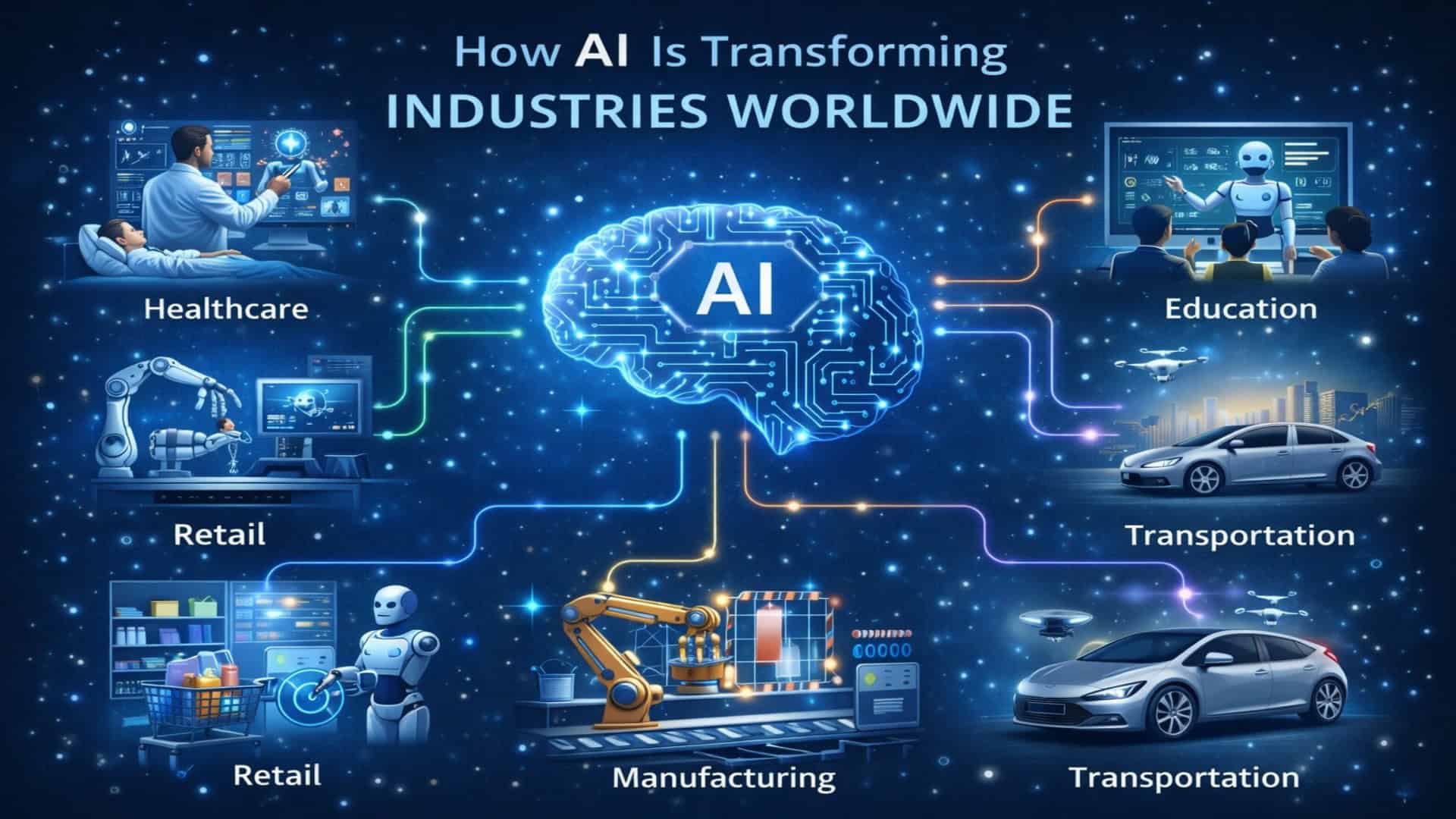
The conversation around artificial intelligence (AI) has undergone a profound shift. We have moved entirely beyond the early days of speculative hype, flying cars, and science-fiction scenarios. Today, artificial intelligence is no longer an experimental novelty—it is the foundational engine driving global economic infrastructure. From how we receive medical diagnoses to the way our supply chains adapt to global disruptions, AI is actively re-architecting the world around us.
As we navigate through 2026, the global average AI adoption rate has accelerated at an unprecedented pace, jumping from mere experimentation to core operational necessity. Industry leaders are no longer asking if they should adopt AI, but rather how quickly they can deploy it to enhance human capability, streamline operations, and deliver more accessible, equitable services to everyone.
This comprehensive guide explores exactly how AI is transforming industries worldwide, looking at the data, the real-world applications, and the human-centric benefits of this technological revolution. Whether you are a business leader, an aspiring professional, or simply a curious learner, understanding this shift is vital for navigating the future of work and society.
1. The Global AI Landscape: From Hype to Trillion-Dollar Reality
Before diving into specific industries, it is crucial to understand the sheer scale of the AI transformation. The numbers paint a picture of an integrated, global digital economy that relies heavily on machine learning, predictive analytics, and agentic AI (systems designed to autonomously reason, plan, and execute tasks).
The Scale of Investment and Growth
Analysts report that total global spending on artificial intelligence is projected to exceed $2.02 trillion in 2026, representing a massive annual increase across hardware, services, and software. We are witnessing a transition from a “training-heavy” economy—where companies spent billions teaching AI models—to an “inference economy,” where these models are actively used in day-to-day business operations.
A Shift Toward Real-World Value
The most exciting development in the current AI landscape is the focus on practical, immediate value. Organizations are utilizing AI to:
- Bridge the productivity gap: Empowering workers by automating tedious administrative tasks, allowing human employees to focus on creative, strategic, and empathetic “wisdom work.”
-
Democratize data access: Allowing team members across all departments—not just data scientists—to query complex datasets using natural language.
-
Enhance accessibility: Creating tools that break down language barriers, assist individuals with disabilities, and create more inclusive digital environments for a diverse global population.
2. Healthcare: The Drive Toward Proactive and Personalized Care
Perhaps no industry stands to benefit more profoundly from artificial intelligence than healthcare. AI is fundamentally shifting the medical paradigm from a reactive system (treating people after they get sick) to a proactive, preventative, and deeply personalized model. Research suggests that AI’s impact on the global healthcare market will create an $868 billion opportunity by 2030, increasing its addressable market share from 15% to over 30%.
Predictive Diagnostics and Early Intervention
AI systems excel at recognizing complex patterns in massive datasets. In medical imaging, AI algorithms can spot subtle abnormalities in X-rays, MRIs, and CT scans that even the most experienced human eye might miss. This capability drastically cuts diagnostic times from days down to minutes, ensuring that patients receive life-saving treatments for conditions like cancer or cardiovascular disease much earlier.
Accelerating Drug Discovery
Historically, developing a new pharmaceutical drug took over a decade and cost billions of dollars, with a high rate of failure. Today, AI-enabled drug discovery is transforming the pharmaceutical sector. Machine learning models can predict how different chemical compounds will interact with target proteins in the human body, simulating millions of combinations in hours. This not only lowers the cost of research and development but also speeds up the delivery of crucial medications to the people who need them most.
Alleviating Burnout Among Healthcare Workers
We cannot discuss healthcare without acknowledging the immense pressure placed on doctors, nurses, and administrative staff. AI serves as a “digital coworker,” alleviating burnout by taking over heavy documentation workloads. For example, AI-powered medical assistants can synthesize patient data, transcribe clinical notes during consultations, and update electronic health records in real-time. This reduces documentation errors and gives healthcare professionals their most valuable resource back: time to connect deeply and empathetically with their patients.
3. Financial Services: Security, Inclusion, and Intelligent Automation
The financial sector has long been an early adopter of advanced technologies, but the current wave of AI integration is unprecedented. Financial institutions are moving beyond basic algorithmic trading to deploy AI across risk management, customer service, and financial inclusion initiatives.
Next-Generation Fraud Detection
As digital transactions multiply, so do the sophisticated methods of financial fraudsters. Traditional rules-based security systems are no longer sufficient to protect consumers. AI transforms cybersecurity by employing dynamic, continuous monitoring. Machine learning models analyze millions of transactions per second, identifying anomalous behavior patterns—like a sudden change in purchasing location or an unusual transaction volume—and flagging or halting fraudulent activity before funds are lost. This protects vulnerable populations and builds vital trust in the digital banking ecosystem.
Hyper-Personalized Wealth Management
Historically, personalized financial advising was a service reserved for high-net-worth individuals. AI is democratizing financial guidance by powering accessible “robo-advisors” and intelligent financial planning apps. These platforms analyze an individual’s income, spending habits, and long-term goals to offer tailored advice on budgeting, investing, and saving. By lowering the barrier to entry, AI is helping individuals from all socioeconomic backgrounds build financial stability.
Dynamic Credit Scoring and Financial Inclusion
Traditional credit scoring models often inadvertently exclude individuals who lack a formal credit history, such as recent immigrants or young adults. AI-driven alternative credit scoring looks beyond traditional metrics. By analyzing diverse data points—such as utility bill payments, rental history, and even mobile phone usage patterns—AI can assess creditworthiness more holistically and fairly. This inclusive approach opens up access to loans, mortgages, and capital for underserved communities worldwide.
4. Manufacturing and Supply Chain: The Era of Resilient Automation
Global supply chains and manufacturing facilities face immense pressure from volatile markets, geopolitical shifts, and changing consumer demands. AI provides the predictive power and adaptability required to turn fragile supply chains into resilient, responsive networks.
Predictive Maintenance and Minimal Downtime
In a modern manufacturing plant, an unexpected equipment failure can cost millions of dollars in halted production. AI completely revolutionizes maintenance operations. Through the use of IoT (Internet of Things) sensors placed on factory equipment, AI continuously monitors vibrations, temperature, and performance metrics. It can predict exactly when a machine is likely to fail and schedule maintenance during off-hours. This “predictive maintenance” saves resources, extends the lifespan of machinery, and creates a safer working environment for factory personnel.
Digital Twins
A “digital twin” is a highly complex, virtual replica of a physical system—whether that system is a single jet engine or an entire automotive assembly line. AI powers these digital twins, allowing engineers to run endless “what-if” simulations. They can test how a new production layout will impact efficiency, or how a change in materials might affect the final product, all without disrupting actual physical operations.
Re-Architecting Industrial Procurement
Recent global events have proven that supply chains can be incredibly fragile. Today, AI helps procurement leaders navigate global instability by constantly evaluating sourcing options. Instead of relying on static, annual surveys, AI platforms offer continuous, risk-based monitoring of supplier networks. If a primary shipping route becomes unstable due to weather or geopolitical tension, AI systems can instantly recommend alternative local or regional suppliers, ensuring that essential goods continue to flow without interruption.
5. Retail and E-Commerce: Hyper-Personalization at Scale
Retailers are leveraging artificial intelligence to bridge the gap between digital convenience and the personalized touch of an in-store experience. In 2026, AI in retail is focused on understanding the consumer as an individual, optimizing inventory, and creating frictionless purchasing journeys.
Curated Customer Experiences
When you log into your favorite e-commerce platform, the homepage you see is entirely unique to you, thanks to AI. Recommendation engines analyze your past purchases, browsing history, and even the time you spend lingering on specific images to curate a tailored selection of products. This hyper-personalization reduces “decision fatigue” for shoppers and significantly boosts customer satisfaction and retention.
Agentic AI Customer Support
Customer service has evolved far beyond the frustrating, robotic chatbots of the past. Today’s retail landscape utilizes Agentic AI—intelligent agents capable of understanding nuance, context, and sentiment. These virtual assistants can handle complex customer queries, process returns, track lost packages, and even offer style advice in multiple languages. They provide 24/7 support, ensuring that customers receive immediate, empathetic, and helpful responses regardless of their time zone.
Intelligent Inventory Management
Waste is a massive issue in the retail sector, particularly in fast fashion and grocery. AI helps retailers optimize their inventory by predicting demand with astonishing accuracy. By analyzing historical sales data, local weather forecasts, social media trends, and upcoming events, AI can tell a store manager exactly how many units of a specific item to stock. This prevents overproduction, drastically reduces waste, and minimizes the carbon footprint of retail operations.
6. The Energy Sector: Powering a Sustainable Future
The transition to clean, renewable energy is one of the most critical challenges of our time. Artificial intelligence is acting as a crucial catalyst in the fight against climate change, optimizing how we generate, distribute, and consume power.
Smart Grids and Energy Distribution
Renewable energy sources, like wind and solar, are inherently intermittent—the sun isn’t always shining, and the wind isn’t always blowing. AI is essential for managing “smart grids” that balance this fluctuating supply with real-time consumer demand. AI algorithms can predict energy spikes, seamlessly route power from storage batteries to the grid, and ensure a stable, reliable supply of green energy to communities.
Optimizing Renewable Infrastructure
AI is also used to maximize the efficiency of the physical infrastructure itself. For example, AI algorithms can adjust the angle of solar panels in real-time to follow the sun’s trajectory perfectly, capturing the maximum amount of light. Similarly, AI can adjust the pitch and yaw of wind turbines based on micro-weather predictions, increasing energy output while reducing wear and tear on the machinery.
7. Education: Empowering the Next Generation of Learners
Education is the foundation of an equitable society. AI is helping to dismantle a “one-size-fits-all” approach to schooling, offering tools that cater to the unique learning pace, style, and needs of every individual student.
Adaptive Learning Platforms
Every student learns differently. AI-driven adaptive learning platforms assess a student’s proficiency in real-time. If a student is struggling with a specific mathematical concept, the AI will automatically adjust the curriculum, providing additional foundational exercises, visual aids, or alternative explanations until the concept clicks. Conversely, if a student is excelling, the system will introduce more challenging material to keep them engaged.
Accessibility and Universal Translation
For students with visual or auditory impairments, or those studying in a non-native language, AI provides vital support. Real-time captioning, text-to-speech, and highly accurate translation tools ensure that educational materials are accessible to everyone, regardless of their physical abilities or geographic location.
Supporting Educators
Teachers are often overwhelmed by administrative duties, grading, and lesson planning. AI tools can automate routine grading for multiple-choice and short-answer assessments, freeing up teachers to focus on one-on-one mentorship, classroom engagement, and fostering critical thinking skills in their students.
8. Navigating the Challenges: Ethics, Governance, and the Workforce
While the benefits of AI are transformative, this rapid acceleration does not come without profound responsibilities. As AI integrates deeper into our daily lives, industries must prioritize ethical implementation, human well-being, and robust governance.
Prioritizing Data Privacy and Security
AI models require massive amounts of data to function effectively. Consequently, organizations must be unwavering in their commitment to data privacy. Protecting consumer information, utilizing anonymized data sets, and adhering to strict regional frameworks (such as GDPR) are non-negotiable standards for responsible AI deployment.
Mitigating Algorithmic Bias
If an AI model is trained on biased data, it will inevitably produce biased outcomes—whether that involves denying a loan to a qualified applicant or misdiagnosing a patient. The industry is currently heavily focused on auditing algorithms for fairness, ensuring diverse representation in training data, and building transparent models where human oversight remains in the loop.
The Evolution of the Workforce
A common fear is that AI will universally replace human workers. However, the data points to a different reality: AI is reshaping roles, not erasing the need for human insight. The focus in 2026 is on upskilling and reskilling. Forward-thinking organizations are investing heavily in training programs to help their employees transition into “wisdom work.” Humans possess traits that AI simply cannot replicate: deep empathy, complex moral reasoning, creative leaps of imagination, and the ability to build authentic relationships. The most successful industries are those that use AI to augment human potential, not replace it.
Conclusion
The transformation brought about by artificial intelligence worldwide is profound, far-reaching, and permanent. From the $868 billion revolution in healthcare to the resilient, AI-monitored supply chains of the manufacturing sector, AI is proving to be much more than a technological trend—it is a fundamental restructuring of how society operates.
By driving efficiency, enhancing accessibility, and freeing human beings from repetitive tasks, AI presents an unprecedented opportunity to solve some of our most complex global challenges. However, the true success of this era will not be measured solely by profit margins or processing speeds. It will be measured by our commitment to deploying these technologies ethically, inclusively, and responsibly, ensuring that the AI revolution benefits every corner of our global community.
Frequently Asked Questions (FAQ)
Q1: Is AI going to replace my job?
While AI is automating repetitive and administrative tasks across many industries, it is largely functioning as an augmenting tool—a “digital coworker.” Instead of replacing jobs entirely, AI is reshaping them. Workers who learn to leverage AI tools will find themselves empowered to focus on the creative, strategic, and interpersonal aspects of their professions. Upskilling is key to adapting to this shift.
Q2: How does AI actually improve healthcare?
AI improves healthcare by analyzing massive amounts of data much faster than a human could. This leads to earlier detection of diseases via medical imaging, hyper-personalized treatment plans based on a patient’s unique genetic makeup, and accelerated drug discovery. Furthermore, it automates administrative tasks, reducing burnout and giving doctors more time to spend with patients.
Q3: What are “Agentic AI” systems?
Agentic AI refers to advanced artificial intelligence systems that don’t just answer questions, but can autonomously reason, plan, and execute complex tasks to achieve a high-level goal. For example, instead of just drafting an email, an AI agent could analyze a supply chain shortage, contact three alternative suppliers, negotiate a rate, and place the order with minimal human supervision.
Q4: How does AI make the financial sector safer for everyday consumers?
AI continuously monitors financial networks, analyzing millions of data points per second to identify the subtle, dynamic patterns of fraud. Because it operates in real-time and adapts to new threats instantly, it can block suspicious transactions before money is stolen, providing a much higher level of security than traditional, static defense systems.
Q5: What is the biggest challenge to adopting AI in business today?
Currently, the largest barriers include data quality and strategic governance. An AI system is only as good as the data it is trained on. Many companies struggle with siloed, messy, or biased data. Additionally, organizations must implement strong ethical guidelines and security measures to ensure their AI tools are used responsibly and safely.
Q6: How can small businesses afford to implement AI?
The democratization of technology means AI is no longer just for massive enterprise corporations. With the rise of cloud-computing, Software-as-a-Service (SaaS) AI tools, and a strong open-source community, small businesses can easily integrate scalable AI solutions—such as automated customer service bots, intelligent inventory managers, and predictive marketing software—at a fraction of the cost of building custom models.
Reference Links & Further Reading
-
PwC Strategy&: AI’s US$ 868 billion healthcare revolution – Insights into AI integration in preventative care and pharmaceutical developments.
-
World Economic Forum (WEF): Proof over Promise: Insights on Real-World AI Adoption from 2025 MINDS Organizations – A comprehensive look at global organizations scaling AI with trust, impact, and reliable data strategy.
-
OECD: The Impact of AI Adoption on Market Dynamics – Detailed economic analyses of AI in downstream markets, manufacturing, and global competition.
-
NVIDIA Blog: How AI Is Driving Revenue, Cutting Costs and Boosting Productivity for Every Industry in 2026 – Reports on AI adoption rates, agentic AI deployment, and open-source strategies across the enterprise sector.
Leave a Reply