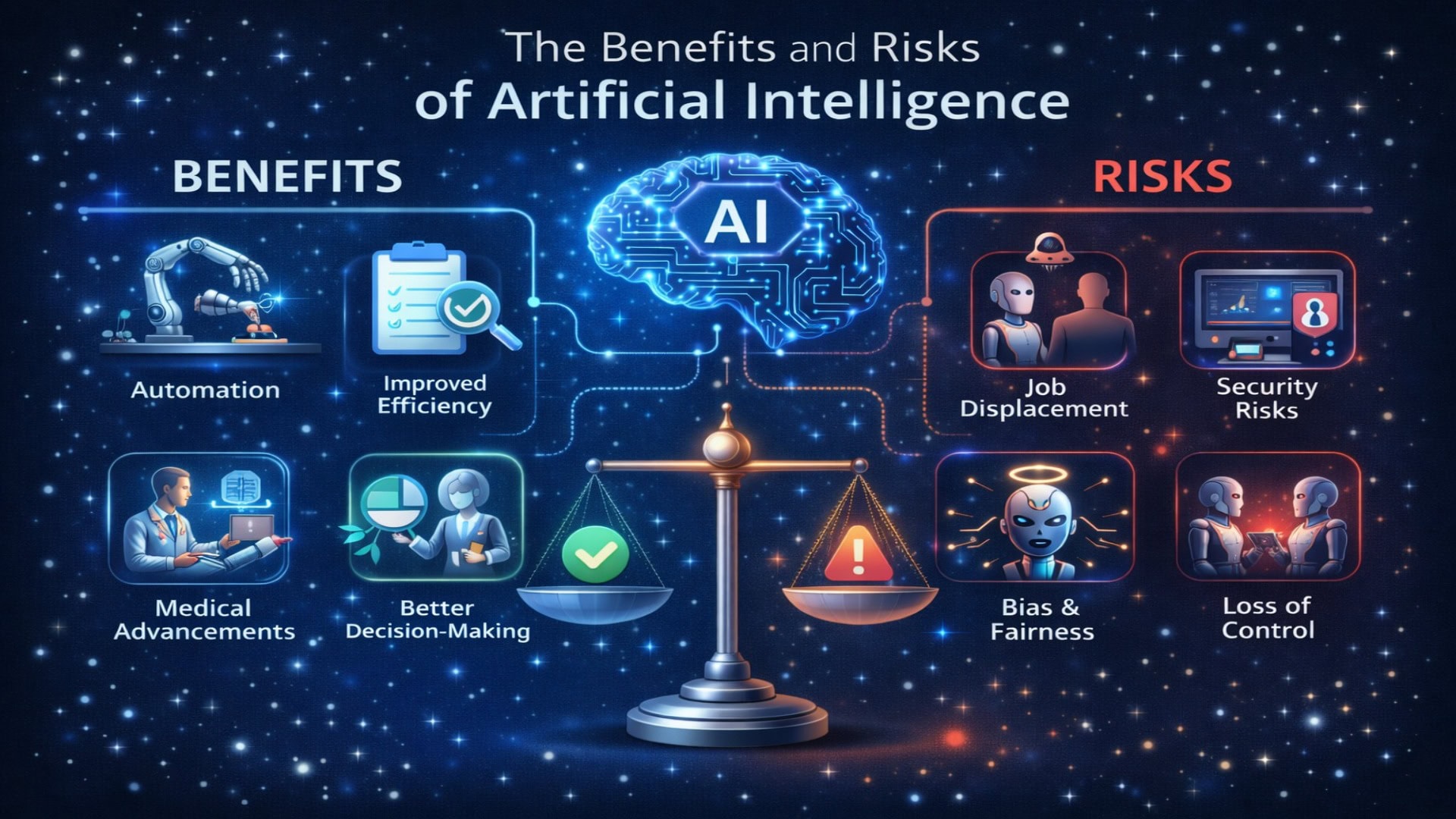
Artificial Intelligence (AI) is no longer a concept confined to science fiction novels or futuristic movies. Today, it is a foundational technology woven into the fabric of our daily lives. From the algorithms that curate our social media feeds to the sophisticated diagnostic tools used in modern medicine, AI is transforming how humanity operates, creates, and interacts with the world around us.
However, as with any revolutionary technology, this rapid advancement brings a complex web of implications. The conversation surrounding artificial intelligence is often polarized, oscillating between utopian visions of a world free from disease and labor, and dystopian warnings of autonomous systems spiraling out of human control.
To truly understand our technological trajectory, we must take a balanced approach. This comprehensive guide explores the profound benefits and the significant risks of Artificial Intelligence, emphasizing the need for ethical development, inclusive design, and thoughtful regulation.
Part 1: Understanding Artificial Intelligence
Before diving into the impacts, it is crucial to establish what we mean when we talk about AI. At its core, Artificial Intelligence refers to the simulation of human intelligence processes by machines, especially computer systems. These processes include learning (the acquisition of information and rules for using it), reasoning (using rules to reach approximate or definite conclusions), and self-correction.
The Spectrum of AI
To frame our understanding of both its potential and its dangers, we must differentiate between the stages of AI development:
- Artificial Narrow Intelligence (ANI): Also known as “Weak AI,” this is the only form of artificial intelligence that exists today. ANI is designed to perform a singular task—such as facial recognition, internet searches, or driving a car. While it can process massive amounts of data and outperform humans in specific areas, it operates under a narrow, predefined set of constraints and limitations.
- Artificial General Intelligence (AGI): Also known as “Strong AI,” AGI is a theoretical form of AI where a machine would possess the ability to understand, learn, and apply knowledge across a wide range of tasks, at a level equal to or surpassing human cognitive capabilities.
-
Artificial Superintelligence (ASI): This refers to an intellect that is much smarter than the best human brains in practically every field, including scientific creativity, general wisdom, and social skills.
Understanding that our current reality is firmly rooted in Narrow AI helps ground our expectations. The immediate benefits and risks we face are related to highly specialized algorithms, not sentient robots.
Part 2: The Transformative Benefits of Artificial Intelligence
The widespread adoption of machine learning and data analytics is driving unprecedented innovation across virtually every sector. By processing information at scales and speeds impossible for the human brain, AI acts as a powerful amplifier for human capability.
1. Revolutionizing Healthcare and Medicine
Perhaps the most universally celebrated application of AI is within the medical field. The technology is fundamentally shifting healthcare from a reactive discipline to a proactive and personalized one.
- Early Disease Detection: Deep learning algorithms are now capable of analyzing medical imagery (X-rays, MRIs, CT scans) with incredible accuracy. In many cases, AI can detect anomalies, such as early-stage tumors or diabetic retinopathy, faster and sometimes more accurately than human radiologists.
- Accelerated Drug Discovery: Historically, discovering a new pharmaceutical drug and bringing it to market takes over a decade and costs billions of dollars. AI accelerates this process by predicting how different chemical compounds will interact with target proteins in the body. The monumental success of AI systems in predicting the 3D structures of human proteins has opened new doors for treating complex diseases.
-
Personalized Medicine: By analyzing a patient’s genetic makeup, lifestyle, and medical history, AI can help healthcare providers tailor treatment plans that are specifically optimized for the individual, reducing adverse reactions and improving outcomes.
2. Enhancing Accessibility and Inclusion
When developed thoughtfully, AI serves as a powerful equalizer, breaking down barriers for individuals with disabilities and fostering a more inclusive society.
- Communication Aids: Advanced Natural Language Processing (NLP) powers real-time captioning and translation services, making digital content more accessible for people who are Deaf or hard of hearing.
- Visual Assistance: Applications using computer vision can describe physical surroundings, read text aloud, and identify objects for individuals who are blind or have low vision.
- Cognitive Support: AI-driven tools can help individuals with neurodivergent conditions by organizing tasks, simplifying complex texts, and providing adaptive learning environments that cater to unique cognitive needs.
3. Driving Efficiency and Innovation in the Workplace
In the corporate and industrial spheres, AI is the engine of the Fourth Industrial Revolution, streamlining operations and freeing human workers to focus on creative and strategic endeavors.
- Automation of Repetitive Tasks: From data entry and scheduling to basic customer service inquiries handled by chatbots, AI excels at automating mundane, repetitive workflows. This reduces human error and drastically cuts operational costs.
- Predictive Analytics: Businesses use AI to analyze historical data and predict future trends. This is invaluable in supply chain management, where AI can forecast demand, optimize delivery routes, and prevent inventory shortages.
- Enhanced Safety in Dangerous Environments: Robots equipped with AI and computer vision can be deployed in hazardous environments—such as deep-sea exploration, disaster recovery zones, or mining operations—keeping human workers out of harm’s way.
4. Tackling the Climate Crisis
The environmental sector is increasingly turning to artificial intelligence to combat climate change and manage natural resources more effectively.
- Smart Energy Grids: AI algorithms can predict energy demand and adjust the distribution of electricity across grids in real-time. This is particularly vital for integrating renewable energy sources like wind and solar, which are subject to weather fluctuations.
- Precision Agriculture: By analyzing satellite imagery, weather patterns, and soil sensors, AI helps farmers optimize irrigation, minimize the use of chemical pesticides, and maximize crop yields, promoting sustainable farming practices.
- Climate Modeling: Machine learning models process vast amounts of environmental data to track deforestation, predict extreme weather events, and model the long-term impacts of global warming with greater precision.
Part 3: The Inherent Risks and Ethical Challenges of AI
For all its transformative potential, the rapid deployment of AI technologies carries profound risks. If left unaddressed, these challenges could exacerbate existing societal inequalities, threaten individual rights, and cause massive economic disruption.
1. Job Displacement and Economic Inequality
The most immediate and tangible fear surrounding AI is its impact on the global workforce. While automation has historically created new categories of jobs, the speed at which AI is advancing presents a unique challenge.
- The Automation of Routine Work: Roles heavily reliant on predictable, repetitive tasks—such as manufacturing, bookkeeping, telemarketing, and basic data analysis—are highly susceptible to automation.
- The Transition Challenge: While AI will undoubtedly create new roles (AI ethicists, machine learning engineers, robotics maintenance), the individuals displaced by automation are rarely the ones equipped to fill these new, highly technical positions. This creates a severe skills gap.
- Widening the Wealth Gap: If the economic gains generated by AI productivity are concentrated strictly in the hands of tech companies and corporate executives, AI risks drastically widening global economic inequality. A massive societal effort in workforce retraining and robust social safety nets will be required to mitigate this.
2. Algorithmic Bias and Discrimination
Artificial intelligence is not inherently objective. Machine learning models learn from the data they are trained on, and if that training data contains historical human biases, the AI will learn, amplify, and automate those prejudices.
- Hiring and Recruitment: When AI systems are used to screen resumes, they often favor candidates who resemble past successful hires. If a company historically hired predominantly white males, the algorithm may unconsciously penalize resumes belonging to women or people of color.
- Criminal Justice and Predictive Policing: AI tools used for predicting recidivism (the likelihood of a person re-offending) have been shown to disproportionately flag individuals from marginalized communities as “high risk,” leading to harsher sentencing and a perpetuation of systemic bias.
- Healthcare Disparities: If medical AI is trained predominantly on data from specific demographic groups, its diagnostic accuracy can drop significantly when treating individuals from underrepresented backgrounds. Building inclusive datasets is a critical necessity.
3. The Erosion of Privacy and Mass Surveillance
The fuel that powers artificial intelligence is data. The insatiable need for vast datasets to train sophisticated models has led to unprecedented levels of data harvesting.
- The End of Anonymity: Advanced facial recognition technology, combined with pervasive camera networks and internet tracking, makes it increasingly difficult for individuals to navigate public or digital spaces anonymously.
- Data Exploitation: Companies routinely collect intimate details regarding user behavior, preferences, location, and health. The risk of this data being mishandled, breached, or used to manipulate consumer behavior is immense.
- Deepfakes and Disinformation: AI can now generate hyper-realistic, fabricated audio and video (deepfakes). This technology poses a severe threat to democratic processes, as it can be used to spread malicious disinformation, ruin reputations, and erode public trust in media and institutions.
4. Security Vulnerabilities and Autonomous Weapons
As AI systems become more integrated into critical infrastructure, they become high-value targets for malicious actors.
- AI-Powered Cyberattacks: Hackers can leverage machine learning to automate cyberattacks, rapidly identify network vulnerabilities, and draft highly convincing phishing emails at scale.
- Lethal Autonomous Weapons Systems (LAWS): The development of military drones and weapons capable of identifying and engaging targets without human intervention raises profound ethical questions. Delegating the decision of life and death to an algorithm remains one of the most hotly debated topics in international security.
5. The “Black Box” Problem
Many deep learning models—particularly those dealing with millions of parameters—operate as “black boxes.” This means that even the developers who built the system cannot fully explain how the AI arrived at a specific conclusion or decision.
Lack of explainability is a massive hurdle in high-stakes fields. If an AI system denies a person a loan, diagnoses them with an illness, or recommends a prison sentence, humans require a transparent explanation of the reasoning. Without transparency, accountability is impossible.
Part 4: Navigating the Future – Towards Ethical and Responsible AI
The trajectory of artificial intelligence is not predetermined. It is a tool, and like any tool, its impact depends entirely on the hands that wield it. To maximize the benefits while mitigating the risks, a collaborative, global approach is essential.
1. Developing Robust Ethical Frameworks
Tech companies and academic institutions must prioritize AI ethics from the ground up. This means moving away from a “move fast and break things” mentality to one of “move thoughtfully and build securely.” Ethical guidelines should mandate fairness, transparency, privacy, and human safety as core design principles.
2. Implementing Meaningful Regulation
Governments play a crucial role in safeguarding the public. Legislation, such as the European Union’s proposed AI Act, attempts to categorize AI systems by risk level—banning unacceptable uses (like social scoring) and heavily regulating high-risk applications (like critical infrastructure and law enforcement tools). Effective regulation must protect human rights without stifling beneficial innovation.
3. Emphasizing Human-in-the-Loop Systems
Instead of viewing AI as a replacement for human intelligence, we should strive for “Augmented Intelligence.” High-stakes decisions should always involve a “human in the loop”—where AI provides data-driven recommendations, but a human being exercises empathy, moral judgment, and ultimate oversight.
4. Fostering Diversity in the Tech Industry
To build AI that serves all of humanity, the teams designing these systems must reflect the diversity of the global population. Encouraging women, people of color, and individuals from various socioeconomic backgrounds to enter AI research and engineering is the most effective way to identify and eliminate algorithmic biases before they are deployed.
Conclusion
Artificial Intelligence is the defining technology of the 21st century. Its benefits are undeniably profound: it possesses the capacity to cure diseases, reverse environmental damage, democratize education, and elevate the human condition. Yet, the risks are equally monumental. Unchecked, AI could deepen societal divides, strip away our privacy, and automate systemic discrimination.
The narrative of AI does not have to be a choice between a utopia and a dystopia. By prioritizing human-centric design, demanding algorithmic transparency, and establishing thoughtful global regulations, we can harness the power of artificial intelligence to build a more equitable, efficient, and prosperous future for everyone. The responsibility lies not with the algorithms, but with us.
Frequently Asked Questions (FAQ)
1. What is the difference between AI, Machine Learning, and Deep Learning?
- AI is the broad concept of machines simulating human intelligence.
- Machine Learning (ML) is a subset of AI where systems learn from data to improve their performance without being explicitly programmed for every step.
- Deep Learning (DL) is a specialized subset of ML that uses complex, multi-layered artificial neural networks (inspired by the human brain) to process vast amounts of unstructured data, like images and speech.
2. Will Artificial Intelligence take my job?
AI will undoubtedly change the landscape of employment. While it will automate many routine, repetitive tasks (leading to job displacement in certain sectors), it will also create new industries and roles. The future of work will likely involve human-AI collaboration. Continuous learning and upskilling in uniquely human traits—such as complex problem-solving, emotional intelligence, and creativity—will be crucial.
3. What is algorithmic bias, and why is it dangerous?
Algorithmic bias occurs when an AI system produces systematically prejudiced results due to flawed assumptions in the machine learning process or prejudiced training data. It is dangerous because it can automate and scale human prejudices, leading to unfair outcomes in critical areas like hiring, lending, healthcare, and criminal justice, disproportionately harming marginalized communities.
4. Can an AI system think and feel like a human?
No. Current AI systems are “Narrow AI.” They are sophisticated statistical engines that excel at recognizing patterns and generating predictions based on data. They do not possess consciousness, self-awareness, emotions, or true understanding.
5. How is AI currently being regulated?
Regulation is currently evolving and varies by region. The European Union is leading the charge with the “AI Act,” establishing a risk-based legal framework. The United States is pursuing a combination of executive orders, federal agency guidelines, and state-level laws. Globally, organizations like the UN and OECD are working to establish international ethical standards for AI development.
6. What is the environmental impact of Artificial Intelligence?
While AI can help solve environmental issues (like optimizing energy grids), the technology itself has a significant carbon footprint. Training massive deep learning models requires massive server farms running continuously, consuming vast amounts of electricity and water for cooling. Developing energy-efficient algorithms and powering data centers with renewable energy are critical ongoing challenges.
References & Further Reading
-
Stanford University Artificial Intelligence Index Report: An annual, comprehensive report tracking, collating, and visualizing data relating to artificial intelligence. https://aiindex.stanford.edu/
-
MIT Technology Review – Artificial Intelligence: Up-to-date journalism, analysis, and research regarding AI breakthroughs and ethical dilemmas. https://www.technologyreview.com/topic/artificial-intelligence/
-
Nature – Machine Intelligence: Peer-reviewed scientific journal covering the latest advancements in artificial intelligence, machine learning, and their impacts on various scientific fields. https://www.nature.com/natmachintell/
-
Algorithmic Justice League (AJL): An organization that combines art and research to illuminate the social implications and harms of artificial intelligence. https://www.ajl.org/
-
The European Union Artificial Intelligence Act: Official documentation regarding the EU’s proposed regulatory framework for AI. https://artificialintelligenceact.eu/
Leave a Reply