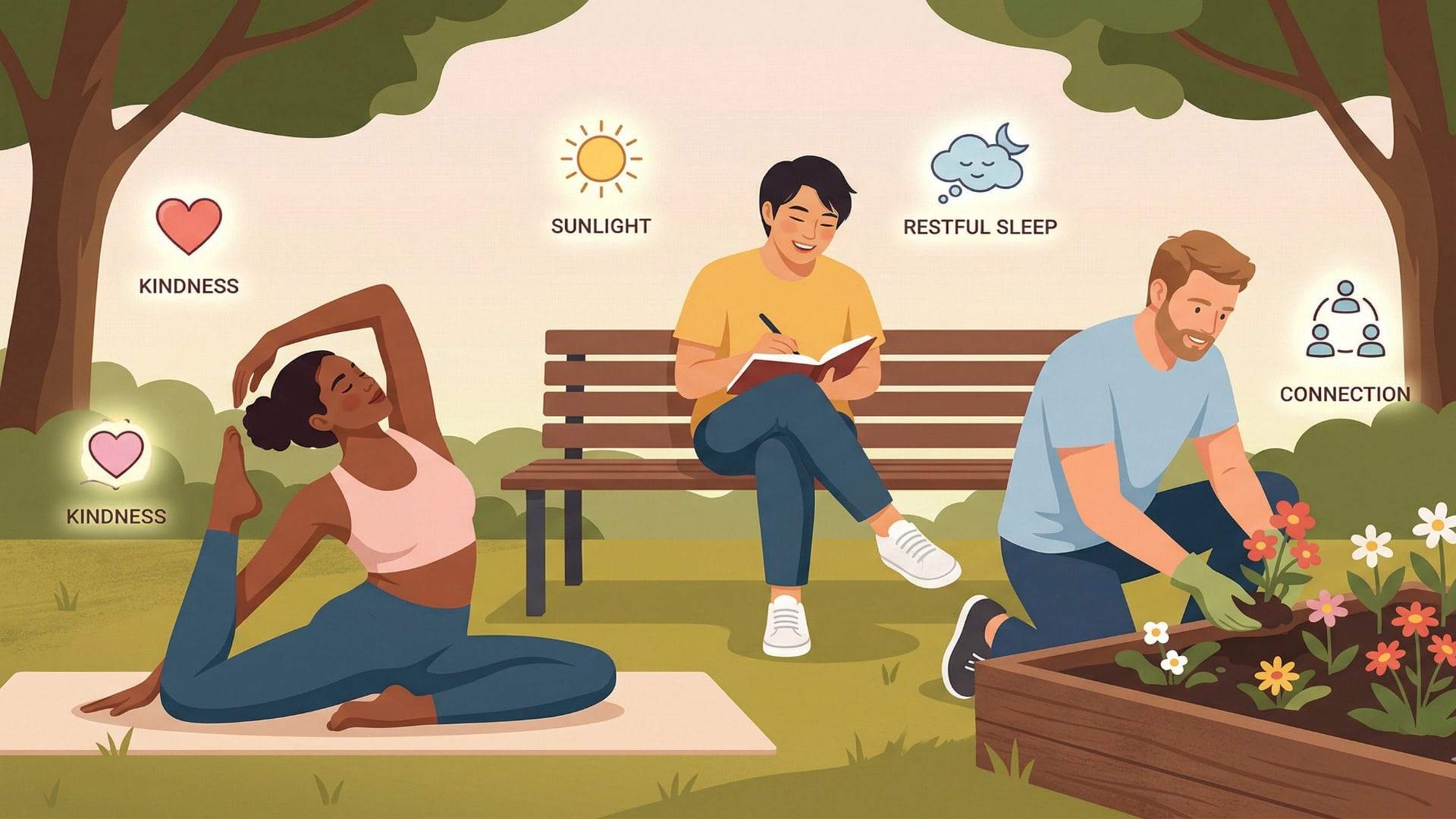
Let’s be real for a second: life can be incredibly overwhelming. Between balancing work or school, managing relationships, keeping up with the news, and just trying to figure out what to cook for dinner, our brains are constantly running a marathon. It is completely normal to feel stretched thin.
We talk a lot about physical health—hitting the gym, eating our greens, getting our steps in—but what about our mental well-being? Just like we all have physical health to maintain, every single one of us has mental health to nurture. And taking care of your mind doesn’t have to mean booking a month-long silent retreat in the mountains (though, let’s be honest, that does sound nice).
Improving your mental health is often about making small, manageable tweaks to your daily routine. It’s about finding accessible, realistic habits that support your unique brain and body. Whether you are currently thriving and want to maintain that momentum, or you are navigating a particularly heavy season, these strategies are here to help.
Grab a cozy beverage, get comfortable, and let’s dive into 15 easy, actionable ways to improve your mental health.
Daily Habits for Your Body and Brain
It might sound cliché, but the mind and body are deeply connected. How we treat our physical vessel has a massive impact on our cognitive function and emotional regulation.
1. Prioritize Restorative Sleep
We are putting this at number one because it is truly the foundation of mental well-being. When we don’t get enough sleep, our brain’s ability to regulate emotions plummets. Everything feels harder, sharper, and more stressful after a night of tossing and turning.
- The “Why”: During sleep, your brain processes emotions, consolidates memories, and clears out toxins.
- How to start today: Try going to bed just 15 minutes earlier than usual. Create a wind-down routine that doesn’t involve screens. If you want to dive deeper into sleep hygiene, check out the excellent resources at the Sleep Foundation.
2. Move Your Body in a Way That Feels Good
Exercise gets a bad rap when it’s framed as punishment for eating or something you “have” to do to look a certain way. Let’s reframe that: movement is a celebration of what your body can do, and it is a powerful tool for your mind. Physical activity releases endorphins, which are your brain’s natural mood lifters.
- The “Why”: Movement helps flush stress hormones like cortisol out of your system.
- How to start today: Don’t force yourself to run if you hate running. Dance in your kitchen while making coffee, do some gentle stretching on your living room rug, or take a 10-minute walk around the block. All movement counts.
3. Fuel Your Brain with Nourishing Foods
The connection between your gut and your brain is very real. In fact, a massive percentage of your body’s serotonin (the “happy chemical”) is produced in your digestive tract.
- The “Why”: Giving your body the nutrients it needs helps stabilize your blood sugar, which in turn stabilizes your mood.
- How to start today: Focus on adding to your plate rather than restricting. Can you add a handful of spinach to your smoothie? Can you snack on some walnuts or almonds for an omega-3 boost? Drink a glass of water when you wake up.
4. Hydrate Like It’s Your Job
Did you know your brain is made up of about 73% water? Even mild dehydration can lead to brain fog, fatigue, and increased feelings of anxiety and tension.
- The “Why”: Water is essential for delivering nutrients to the brain and removing toxins.
- How to start today: Keep a reusable water bottle within your line of sight. If plain water bores you, infuse it with cucumber, lemon, or mint.
5. Get a Daily Dose of Sunlight
Getting natural light in your eyes, especially early in the morning, is a game-changer for your mental health. It helps regulate your circadian rhythm, which dictates your sleep-wake cycle and influences your energy levels throughout the day.
- The “Why”: Sunlight triggers the release of serotonin and helps your body synthesize Vitamin D, both of which are crucial for warding off depressive symptoms.
- How to start today: Try to step outside for 5 to 10 minutes within the first hour of waking up. Sip your morning tea or coffee on the porch or by an open window.
Managing Stress and Navigating Emotions
Life is always going to throw curveballs. Improving your mental health isn’t about eliminating stress entirely—that’s impossible. It’s about building a toolkit to handle stress when it inevitably shows up.
6. Practice Bite-Sized Mindfulness
Mindfulness can sound intimidating. You might picture someone sitting perfectly still on a cushion for an hour. But mindfulness just means paying attention to the present moment without judgment. It is a powerful way to pull your brain out of anxiety (worrying about the future) or rumination (dwelling on the past).
- The “Why”: It literally rewires your brain to be less reactive to stress.
- How to start today: Next time you wash your hands, focus entirely on the sensation. The temperature of the water, the smell of the soap, the feeling of the bubbles. That is mindfulness! For guided practices, platforms like Mindful.org offer fantastic, beginner-friendly resources.
7. Do a Daily “Brain Dump” Journaling Session
When our minds are racing with to-do lists, worries, and random thoughts, it can feel like a browser with 100 tabs open. Journaling is like hitting the refresh button.
- The “Why”: Getting thoughts out of your head and onto paper reduces the cognitive load on your brain.
- How to start today: Grab a notebook and write stream-of-consciousness for 5 minutes. Don’t worry about spelling, grammar, or making sense. Just write whatever comes to mind until the timer goes off.
8. Set Boundaries with Screens and Social Media
We are consuming more information in a single day than our ancestors consumed in a lifetime. Doomscrolling—the act of obsessively scrolling through negative news or comparing yourself to highlight reels on social media—is a fast track to anxiety and low self-esteem.
- The “Why”: Constant digital stimulation keeps our nervous system in a state of high alert.
- How to start today: Implement a “no screens in bed” rule. Buy an old-school alarm clock so your phone doesn’t have to be the first and last thing you see every day.
9. Learn to Set Boundaries and Say “No”
People-pleasing is exhausting. Saying “yes” to everything out of guilt or obligation leads straight to burnout and resentment. Your time and energy are finite resources; you are allowed to protect them.
- The “Why”: Boundaries create safety. They teach people how to treat you and ensure you have enough energy left for yourself.
- How to start today: The next time someone asks you for a favor, practice saying, “Let me check my schedule and get back to you,” instead of an immediate “yes.” This gives you space to decide if you actually have the capacity to do it.
10. Challenge Your Inner Critic
We all have a voice in our heads, and for many of us, that voice can be incredibly mean. If you wouldn’t say it to a good friend, you shouldn’t say it to yourself.
- The “Why”: Persistent negative self-talk reinforces neural pathways of low self-worth and depression.
- How to start today: Catch yourself when you make a mistake. Instead of thinking, “I am so careless,” reframe it to, “I made a mistake, and I am still learning.” Practice treating yourself with the same compassion you would offer a loved one.
Cultivating Connection and Joy
Mental health isn’t just about surviving; it’s about finding ways to thrive. Incorporating elements of joy, play, and community into your life is essential for a resilient mind.
11. Connect with Your Community
Humans are inherently social creatures. We are biologically wired for connection. Isolation is one of the biggest risks to our mental well-being, while feeling understood and supported is a powerful protective factor.
- The “Why”: Social interaction releases oxytocin, a hormone that promotes feelings of trust and safety while reducing stress.
- How to start today: Send a quick text to a friend you haven’t spoken to in a while. Join a local club, attend a community class, or simply strike up a friendly chat with the barista at your local coffee shop.
12. Engage in a Hobby Just for Fun
In our hustle culture, we often feel like everything we do needs to be productive, monetized, or goal-oriented. We forget how to just play. Engaging in activities purely for the joy they bring is vital for your mental health.
- The “Why”: Hobbies provide a mental break from daily stressors and allow you to enter a state of “flow,” where time seems to stand still and you are fully immersed in the present.
- How to start today: Think about what you loved doing as a kid. Was it coloring? Building models? Playing a video game? Doing puzzles? Pick it back up, with zero pressure to be “good” at it.
13. Practice Intentional Gratitude
Gratitude is more than just a trendy buzzword; it is a scientifically backed way to boost your mood. Our brains have a natural “negativity bias,” meaning we are wired to notice threats and negative events more easily than positive ones. Gratitude helps balance the scales.
- The “Why”: Actively looking for things to be thankful for trains your brain to spot the good in your daily life.
- How to start today: Keep a small notebook by your bed. Every night, write down three specific things that went well that day. They don’t have to be massive—it could be the fact that the sun was shining, or that you had a really good cup of tea.
14. Do Something Kind for Someone Else
There is a concept in psychology known as the “helper’s high.” When we do good things for others, our brains reward us with feel-good neurotransmitters. Helping others takes us out of our own heads and shifts our perspective.
- The “Why”: Altruism fosters a sense of belonging, purpose, and self-worth.
- How to start today: Pay for the coffee of the person behind you in the drive-thru. Leave a kind note for a coworker. Volunteer a few hours of your time at a local animal shelter or food bank.
15. Seek Professional Support When You Need It
There is absolutely no shame in asking for help. Just as you would see a doctor for a broken arm, it makes perfect sense to see a professional when your mental health is struggling. Therapy is a fantastic tool for anyone, regardless of whether you have a diagnosed mental health condition.
- The “Why”: A therapist provides a safe, objective, and non-judgmental space to process your emotions, identify unhealthy patterns, and learn new coping skills.
- How to start today: Look into resources in your area or explore teletherapy options. If you aren’t sure where to start, the National Alliance on Mental Illness (NAMI) provides excellent guidance, helplines, and support groups for people from all walks of life.
The Bottom Line
Improving your mental health is a journey, not a destination. It is completely normal to have days where you feel on top of the world and days where getting out of bed feels like a monumental task. Give yourself grace.
You don’t have to implement all 15 of these tips tomorrow. In fact, trying to do so would probably be overwhelming! Pick one or two that resonate with you and gently incorporate them into your routine. Small, consistent steps build the foundation for lasting mental and emotional resilience. You are absolutely worth the effort.
Frequently Asked Questions (FAQ)
1. How long does it take to see an improvement in my mental health?
There is no single timeline because everyone’s brain, environment, and starting point are different. Some habits, like getting a good night’s sleep or spending time in nature, might make you feel better almost immediately. Other practices, like challenging negative self-talk or seeing the benefits of therapy, are cumulative and might take weeks or months to show significant shifts. The key is consistency and patience.
2. Do I really need therapy if I have good friends to talk to?
Friends are an incredibly important support system, but they aren’t therapists. A mental health professional is trained to help you unpack complex trauma, identify blind spots, and teach evidence-based coping strategies. They also offer an objective, neutral perspective that friends and family simply cannot provide due to their personal involvement in your life. Therapy is a dedicated space entirely for you.
3. I’m too exhausted to exercise or cook healthy meals. What should I do?
When you are dealing with depression, burnout, or severe stress, your energy levels can tank. This is completely valid. On low-energy days, lower the bar. Instead of a 45-minute workout, do a 3-minute stretch in bed. Instead of cooking a complex meal, grab an apple with peanut butter or a pre-made salad. Focus on the absolute basics: drink a glass of water, take a deep breath, and rest without guilt.
4. Is it normal for my mental health to fluctuate?
Absolutely. Mental health is not linear. You will experience setbacks, bad days, and seasons of increased stress. A decline in your mental health does not mean you have failed or that your coping strategies aren’t working; it usually just means you are reacting normally to the ups and downs of being human.
5. What is the difference between “self-care” and taking care of my mental health?
Self-care often gets marketed as bubble baths, face masks, and treating yourself. While those things are lovely and relaxing, true mental health care often involves less glamorous work. It means setting difficult boundaries, going to bed early, managing your finances to reduce stress, or doing the hard emotional work in therapy. True self-care is about building a life you don’t regularly need to escape from.
Leave a Reply