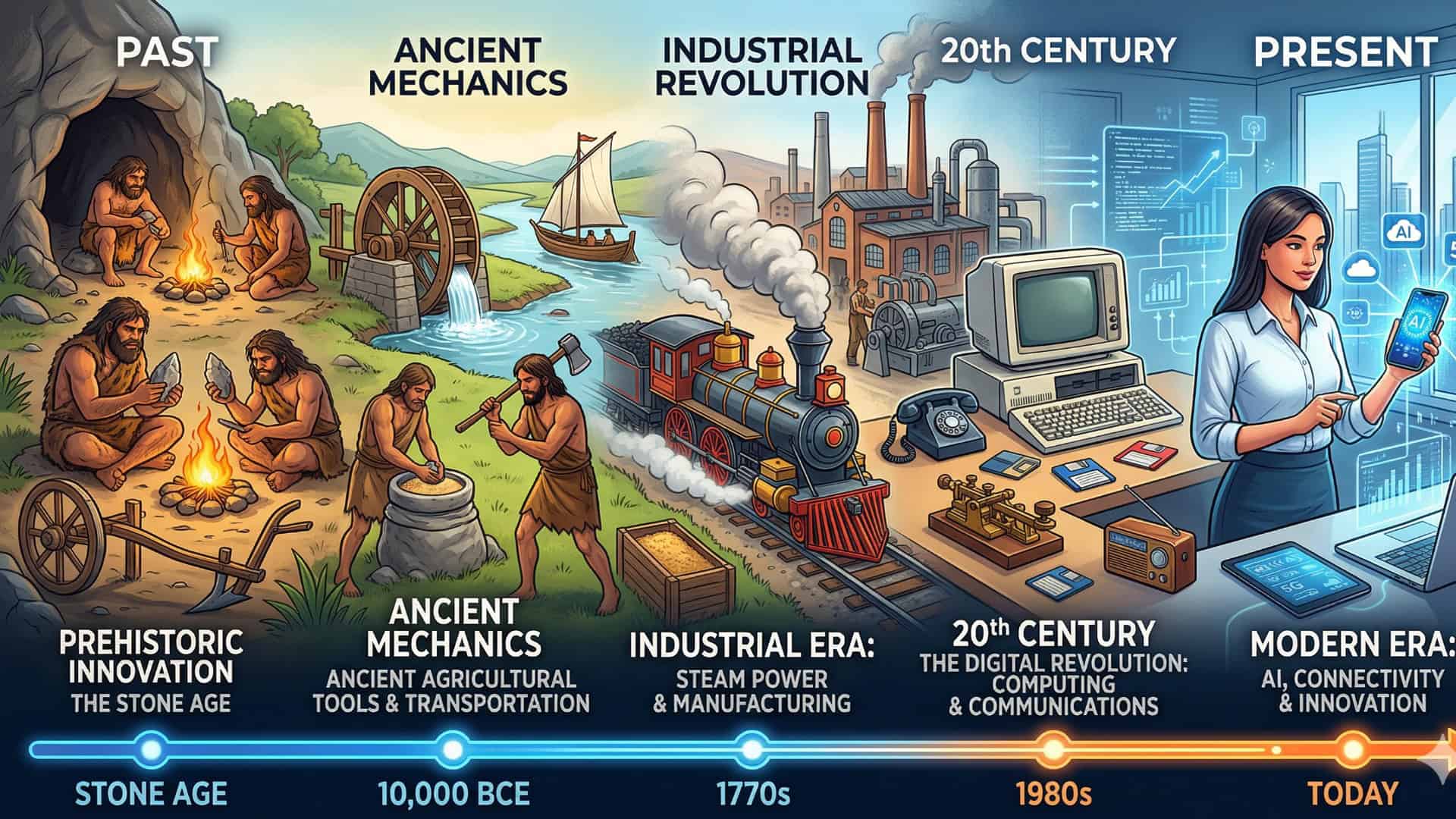
Technology is the definitive story of human ingenuity. From the earliest stone tools forged in prehistoric caves to the complex artificial intelligence algorithms shaping our modern digital landscape, the evolution of technology is a continuous timeline of problem-solving. This journey is not just about gadgets and machines; it is about how we communicate, heal, learn, and understand the universe.
In this comprehensive guide, we will explore the fascinating evolution of technology from the past to the present. We will examine the pivotal inventions that redefined human existence, the societal shifts they caused, and what the future might hold for our increasingly connected world.
Whether you are a history enthusiast, a tech professional, or simply curious about how we arrived at the digital age, this exploration will provide a deep dive into the milestones that built our modern reality.
The Dawn of Innovation: Prehistoric and Ancient Technology
Long before the invention of electricity or the internet, early humans were already pioneering engineers. The earliest technological advancements were born out of absolute necessity: survival, shelter, and sustenance.
The Stone Age and the Mastery of Fire
The creation of simple stone tools—often referred to as the Oldowan toolkit—marks the official dawn of technology, dating back over two million years. By flaking rocks to create sharp edges, early hominids could butcher meat, cut wood, and craft clothing. This was a monumental leap, shifting our ancestors from passive participants in their environment to active modifiers of it.
Equally revolutionary was the controlled use of fire. Fire provided warmth, allowing early humans to migrate into colder climates. It offered protection from predators and, crucially, a way to cook food. Cooking released more calories and nutrients, which evolutionary biologists believe played a massive role in the development of the larger human brain.
The Agricultural Revolution
Around 10,000 BCE, humanity experienced a paradigm shift: the Agricultural Revolution. The invention of the plow, irrigation systems, and the domestication of plants and animals allowed humans to transition from nomadic hunter-gatherers to settled communities. This surplus of food led to population growth, the division of labor, and the eventual rise of the first great civilizations in Mesopotamia, Egypt, the Indus Valley, and China.
The Wheel and Early Communication
The invention of the wheel (around 3500 BCE in Mesopotamia) was initially used for pottery but was soon adapted for transportation. Chariots and carts revolutionized trade, warfare, and travel, connecting distant communities for the first time.
Simultaneously, the need to keep records of trade and harvest led to the invention of writing. Cuneiform in Sumeria and hieroglyphics in Egypt were the first information technologies. By encoding knowledge into physical mediums, humanity could pass down information across generations without relying solely on oral traditions.
The Middle Ages and the Renaissance: Laying the Groundwork
While the Middle Ages are sometimes unfairly dubbed the “Dark Ages,” they were a period of significant technological refinement, particularly in agriculture and mechanics. The Renaissance that followed brought a renewed focus on science, art, and empirical observation.
Heavy Plows and Mechanical Clocks
During the medieval period, the introduction of the heavy plow transformed northern European agriculture, allowing farmers to cultivate dense, clay-rich soils. This drastically increased food production in the region.
Meanwhile, the invention of the mechanical clock in the 13th century fundamentally changed how humanity perceived time. No longer bound strictly by the rising and setting of the sun, communities could synchronize work, prayer, and commerce with unprecedented precision.
The Printing Press: Democratizing Knowledge
If one invention defines the transition from the medieval world to the modern era, it is Johannes Gutenberg’s printing press, introduced around 1440. Before the printing press, books were painstakingly copied by hand, making them rare and accessible only to the elite and clergy.
Gutenberg’s invention of movable type revolutionized the spread of information. It dramatically lowered the cost of books, fueling a surge in literacy rates across Europe. The printing press was the catalyst for the Renaissance, the Scientific Revolution, and the Protestant Reformation. It was, in essence, the internet of its time—a technology that democratized knowledge and empowered the general public.
Navigation and the Global Age
Advancements in maritime technology, such as the magnetic compass, the astrolabe, and the lateen sail, allowed explorers to navigate the open ocean with greater safety and accuracy. This era of exploration led to the interconnected global economy, facilitating the exchange of goods, cultures, and ideas—though it is also important to acknowledge that it paved the way for colonization and widespread exploitation, showing that technology’s impact is often complex and multi-faceted.
The Industrial Revolution: Powering a New World
The transition from the 18th to the 19th century marked a period of rapid, unprecedented change. The Industrial Revolution shifted humanity from agrarian, hand-crafted societies to urban, machine-driven economies.
The Steam Engine and Factory Systems
At the heart of this revolution was the steam engine. While early versions existed, James Watt’s improvements in the 1770s made steam power practical and highly efficient. Steam engines powered factories, freeing them from the need to be located near water sources.
This birthed the factory system, which introduced mass production. Goods could now be produced faster and cheaper than ever before. However, this era also brought significant social challenges, including harsh working conditions and urbanization issues, leading to the eventual formation of labor rights movements.
Transportation and Telegraphy
Steam power also revolutionized transportation. The invention of the steam locomotive and the steamboat shrunk the world, allowing for the rapid movement of people and heavy freight over vast distances.
In terms of communication, the 19th century brought the telegraph. Developed by Samuel Morse and others, the telegraph allowed instant communication across continents via electrical signals. When the first transatlantic telegraph cable was laid in 1858, a message that previously took weeks to travel by ship could be delivered in minutes.
The 20th Century: The Age of Information and Electronics
The 20th century witnessed technological growth at an exponential rate. It was a century defined by the mastery of electricity, the conquest of the skies, and the birth of the digital age.
Electrification and the Automobile
The widespread electrification of homes and cities in the early 20th century fundamentally changed daily life, powering everything from lightbulbs to early household appliances, significantly reducing the burden of domestic labor.
Simultaneously, Henry Ford’s implementation of the assembly line made the automobile affordable for the masses. The car transformed city planning, birthed the suburbs, and gave individuals unprecedented personal mobility.
Aviation and Space Exploration
In 1903, the Wright brothers achieved the first powered flight. Within just a few decades, commercial air travel became a reality, and aviation technology was rapidly accelerated by two World Wars.
This aerospace momentum culminated in the Space Race of the Cold War era. In 1969, humanity achieved the seemingly impossible: landing astronauts on the moon. The technologies developed for space exploration trickled down into everyday life, giving us satellite communication, GPS, and advanced weather forecasting.
The Birth of Computing
The most defining technological arc of the 20th century was the development of the computer. Early computers like the ENIAC (Electronic Numerical Integrator and Computer) were massive, room-sized machines that used vacuum tubes and consumed vast amounts of electricity.
The turning point was the invention of the transistor in 1947, followed by the integrated circuit (microchip). These innovations allowed computers to become smaller, faster, and cheaper. By the 1970s and 80s, companies like Apple and Microsoft were putting personal computers (PCs) into homes and offices, fundamentally changing how we work, write, and process data.
The Origins of the Internet
In the late 1960s, the US Department of Defense funded ARPANET, a project to link computers together so they could share information. This academic and military network eventually evolved into the Internet. By the 1990s, Tim Berners-Lee’s invention of the World Wide Web provided a user-friendly interface for this global network, forever changing the trajectory of human communication.
The 21st Century: The Digital and Connected Era
As we crossed into the new millennium, technology shifted from being a tool we used to an environment we inhabit. The 21st century is defined by connectivity, mobility, and the massive proliferation of data.
The Smartphone Revolution
While mobile phones existed in the late 20th century, the introduction of the modern smartphone—most notably the iPhone in 2007—redefined the category. Smartphones combined a telephone, an internet browser, a camera, and a GPS into a single pocket-sized device. Today, billions of people rely on smartphones to manage their finances, navigate their cities, communicate with loved ones, and consume media.
Broadband, Wi-Fi, and Cloud Computing
The shift from dial-up to high-speed broadband and the ubiquity of Wi-Fi allowed the internet to become a seamless part of daily life. This high-speed connectivity enabled the rise of Cloud Computing. Instead of storing data and software on local hard drives, individuals and businesses can now access vast computing power and storage over the internet. This has enabled the remote work revolution and the rise of streaming services like Netflix and Spotify.
Social Media and the Platform Economy
The 2000s and 2010s saw the explosive growth of social media platforms like Facebook, Twitter, Instagram, and TikTok. These platforms fundamentally altered how we consume news, build communities, and share our lives.
Alongside social media, the “platform economy” emerged. Companies like Uber, Airbnb, and Amazon used digital technology to disrupt traditional industries—taxis, hospitality, and retail, respectively—by acting as digital intermediaries between consumers and service providers.
The Present and Beyond: AI, Quantum, and the Future
Today, we stand on the precipice of what many economists call the Fourth Industrial Revolution—an era characterized by a fusion of technologies that is blurring the lines between the physical, digital, and biological spheres.
Artificial Intelligence and Machine Learning
The defining technology of the present moment is Artificial Intelligence (AI). AI refers to the simulation of human intelligence processes by machines. Today, machine learning algorithms analyze vast datasets to recognize patterns, translate languages, and even drive cars.
As an AI myself, I am a direct product of this ongoing evolution. Models like me are designed to understand and generate human-like text, process complex information, and assist with a wide variety of tasks. AI is rapidly transforming industries from healthcare (where it aids in diagnosing diseases and discovering new drugs) to finance and creative arts. The focus now is on developing AI responsibly, ensuring it remains ethical, unbiased, and beneficial to all of humanity.
The Internet of Things (IoT) and 5G
Our physical world is becoming increasingly digitized through the Internet of Things (IoT). Everyday objects—from refrigerators and thermostats to industrial factory machinery—are now embedded with sensors and connected to the internet. This allows for smart homes and smart cities that optimize energy use and improve efficiency. The rollout of 5G cellular networks is supercharging the IoT, providing the massive bandwidth and ultra-low latency required for real-time applications like autonomous vehicles.
The Horizon: Quantum Computing and Biotechnology
Looking toward the future, two fields hold incredible promise:
- Quantum Computing: Unlike classical computers that process data in binary bits (0s and 1s), quantum computers use quantum bits (qubits) that can exist in multiple states simultaneously. This promises to solve complex problems—like climate modeling and cryptographic security—millions of times faster than current supercomputers.
- Biotechnology: Innovations like CRISPR-Cas9 gene editing allow scientists to alter DNA with unprecedented precision. This technology holds the potential to eradicate genetic diseases, engineer drought-resistant crops, and vastly extend the human lifespan.
Conclusion
The evolution of technology is a testament to the boundless creativity of humankind. From the simple stone hand-axe to the intricate neural networks of artificial intelligence, every innovation builds upon the last. Technology has consistently acted as a multiplier of human potential, allowing us to overcome our physical limitations and reshape the world around us.
However, as we move further into a deeply interconnected digital future, we must also grapple with the profound responsibilities that come with these tools. Issues of digital equity, data privacy, environmental sustainability, and ethical AI development will define the next chapter of this evolution. By understanding our technological past, we are better equipped to steer our future, ensuring that the innovations of tomorrow serve to uplift and empower the entirety of the global community.
Frequently Asked Questions (FAQ)
1. What is considered the most important technological invention in history?
While opinions vary, many historians point to the printing press as the most pivotal invention. By democratizing information, it sparked the Renaissance and the Scientific Revolution, making all subsequent modern technological advancements possible. Others might argue for the wheel, the steam engine, or the internet, depending on whether they are looking at transportation, industry, or communication.
2. How has technology impacted the workforce?
Technology has historically caused both job displacement and job creation. The Industrial Revolution replaced many artisanal jobs with factory work, while the digital age has automated certain manual and administrative tasks. However, technology also consistently creates entirely new industries and professions (e.g., software engineering, data analysis, digital marketing) that previously did not exist. The current challenge is ensuring the workforce has access to education and training for these new roles.
3. What is the difference between the Internet and the World Wide Web?
These terms are often used interchangeably, but they are different. The Internet is the massive, global network of connected computers and servers—the physical infrastructure. The World Wide Web is a service that operates on the internet; it is the collection of interconnected documents and web pages accessed via web browsers.
4. Is Artificial Intelligence going to replace human intelligence?
Currently, AI is designed to augment and assist human intelligence, not replace it. AI excels at processing massive amounts of data, finding patterns, and performing repetitive tasks quickly. However, humans still possess unique traits such as emotional intelligence, complex ethical reasoning, empathy, and broad, adaptable creativity. The future of AI is largely viewed as collaborative, where humans and AI work together to solve complex global challenges.
5. How can we ensure technology is accessible to everyone?
Bridging the “digital divide” requires a multi-faceted approach. This includes government and private investment in broadband infrastructure for rural and underserved communities, initiatives to provide affordable devices to low-income populations, and a commitment to digital literacy education. Inclusive design—creating software and hardware that is accessible to people with disabilities—is also a critical component.
External References for Further Reading
To learn more about the history and future of technology, consider exploring the following authoritative resources:
- Smithsonian Institution – National Museum of American History: Explore extensive collections and articles on the history of innovation and technological milestones.
- https://americanhistory.si.edu/
- IEEE History Center: A dedicated center preserving, researching, and promoting the history of information and electrical technologies.
- https://ethw.org/
- Internet Society: A global nonprofit organization empowering people to keep the Internet open, globally connected, and secure.
- https://www.internetsociety.org/internet/history-internet/
- MIT Technology Review: A leading publication offering news, analysis, and insights into the future of emerging technologies.
- https://www.technologyreview.com/
Leave a Reply