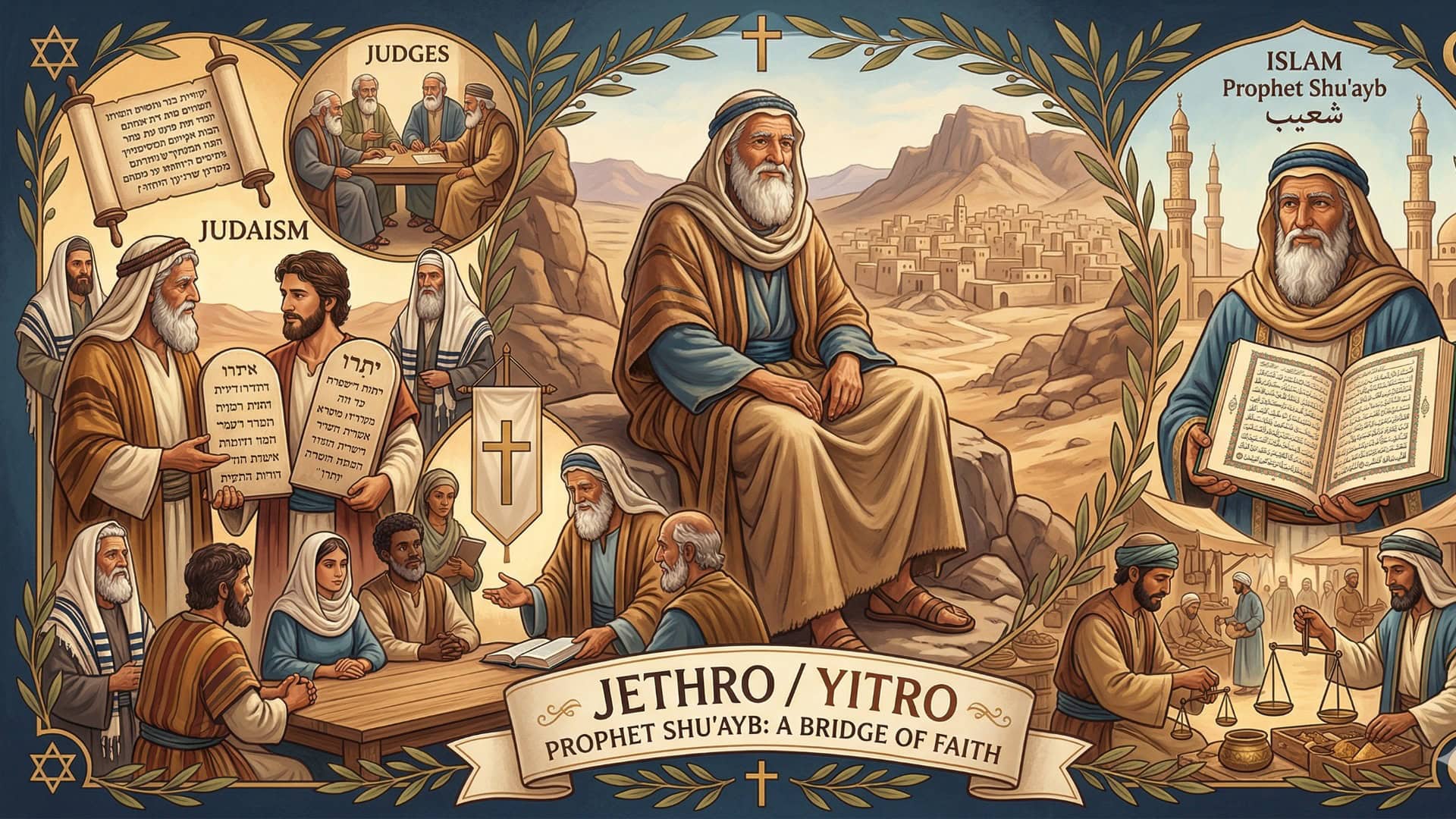
When exploring the rich tapestry of Abrahamic traditions, certain figures emerge as vital bridges connecting diverse narratives and theological principles. One such compelling figure is Jethro, famously known as the father-in-law of Moses. While he might seem like a supporting character in the grand saga of the Exodus, Jethro occupies a profoundly significant space across Judaism, Christianity, and Islam.
1. Introduction: Who Was Jethro?
To understand Jethro’s impact, we must first look at his historical and geographical origins. Jethro (often spelled Yitro in Hebrew) was a priest of Midian, a region generally located in the northwestern Arabian Peninsula, along the eastern shore of the Gulf of Aqaba. The Midianites were nomadic tribes, historically tracing their lineage back to Abraham through his later wife, Keturah.
This lineage is crucial: it positions Jethro as a distant relative of the Israelites, yet culturally and geographically distinct. When Moses fled Egypt after striking down an Egyptian taskmaster, he found refuge in the desert of Midian. Here, he encountered Jethro’s daughters at a well, protected them from rival shepherds, and was subsequently welcomed into Jethro’s household. Moses eventually married Jethro’s daughter, Zipporah, and spent forty years as a shepherd for his father-in-law before the momentous encounter with the burning bush.
However, Jethro is not merely a hospitable host or a family patriarch. Across Judaism, Christianity, and Islam, he is revered as a voice of wisdom, a pioneer of administrative justice, and a prophet of ethical commerce. Let us explore how each tradition honors his legacy.
2. Jethro in Judaism: The Wise Counselor and Seeker of Truth
In the Jewish tradition, Jethro (Yitro) is a highly esteemed figure. His significance is so profound that an entire Torah portion (Parashat Yitro in the Book of Exodus) is named after him—a rare honor shared by very few individuals in the Hebrew Bible. Parashat Yitro contains the pivotal moment of the Revelation at Mount Sinai and the giving of the Ten Commandments, further highlighting his narrative importance.
The Seven Names of Jethro
Jewish Rabbinic literature, particularly the Midrash, notes that Jethro had seven different names, each reflecting a specific aspect of his character, spiritual journey, or achievements:
- Reuel: “Friend of God,” highlighting his spiritual awakening.
- Jether (Yeter): “Addition,” because he added a portion to the Torah through his advice on the judicial system.
- Jethro (Yitro): Signifying the abundance of his good deeds.
- Hobab: “Beloved,” showing he was cherished by God.
- Heber: “Associate,” because he associated himself with the community of God.
- Putiel: “He who freed himself from idolatry,” a nod to his past as a pagan priest who eventually recognized the one true God.
- Keni: Highlighting his zealousness for God.
The Midrashic Backstory: Pharaoh’s Advisor
The Talmud and Midrash flesh out Jethro’s life before he met Moses. According to Sanhedrin 106a, Jethro was one of three esteemed advisors to the Pharaoh of Egypt, alongside Balaam and Job. When Pharaoh proposed the decree to drown all male Hebrew infants, the three advisors reacted differently:
- Balaam devised and encouraged the evil plot.
- Job remained silent, prioritizing his own safety.
- Jethro vehemently protested the decree. When his protests were ignored, he fled Egypt for Midian.
This rabbinic tradition establishes Jethro as a man of profound moral conviction long before he encounters Moses. His willingness to sacrifice his prestigious position for the sake of human life makes him a model of righteousness.
The Recognition of God and the Sacrificial Meal
In Exodus 18, after Moses leads the Israelites out of Egypt and defeats the Amalekites, Jethro travels into the wilderness to meet him, bringing along Zipporah and Moses’ two sons. Moses recounts all the miracles God performed.
Jethro’s reaction is a cornerstone of Jewish theology regarding the righteous among the nations. He declares, “Now I know that the Lord is greater than all other gods, for he did this to those who had treated Israel arrogantly” (Exodus 18:11). Following this declaration, Jethro brings a burnt offering and sacrifices to God, and Aaron and the elders of Israel join him in a communal, sacred meal. This act of a Midianite priest blessing the God of Israel and leading a sacred meal is viewed as a monumental moment of interfaith recognition.
The “Jethro Principle” of Judicial Administration
Perhaps Jethro’s most enduring legacy in the Torah is his practical wisdom. Observing Moses sitting from morning until evening, single-handedly judging every dispute among the massive Israelite camp, Jethro recognizes a recipe for burnout.
He offers a brilliant piece of organizational advice:
“What you are doing is not good. You and these people who come to you will only wear yourselves out. The work is too heavy for you; you cannot handle it alone.” (Exodus 18:17-18)
Jethro instructs Moses to delegate. He advises him to teach the people the laws, but to appoint capable, trustworthy, and incorruptible men as officials over thousands, hundreds, fifties, and tens. Only the most difficult cases would be brought to Moses.
This model, often studied in modern management and jurisprudence as the “Jethro Principle,” establishes the foundation of the Jewish judicial system (which later evolved into the Sanhedrin) and represents a perfect harmony between divine revelation and practical, human wisdom.
3. Jethro in Christianity: A Type for Gentile Inclusion and Leadership
Christianity inherits the Old Testament texts, and therefore, the foundational narrative of Jethro remains the same as in Judaism. However, Christian theologians, early Church Fathers, and modern commentators have extracted unique lessons from Jethro’s life, primarily focusing on typology, church administration, and the theology of Gentile inclusion.
A Foreshadowing of Gentile Salvation
In Christian theology, Jethro is often viewed as an early “type” or foreshadowing of the Gentile Church. Early Christian commentators noted the significance of Moses, the great deliverer and lawgiver of Israel, taking a Gentile bride (Zipporah) and being deeply influenced by a Gentile priest (Jethro).
When Jethro visits the camp of Israel, hears of the Exodus, praises Yahweh, and partakes in a communal meal with Moses and Aaron, Christian theologians see a prophetic picture of the New Testament era. It prefigures the moment when Gentiles would hear the Gospel, recognize the God of Israel, and sit at the table of fellowship alongside Jewish believers. The Apostle Paul’s later teachings on the inclusion of the Gentiles into the “olive tree” of faith find an early, beautiful illustration in Jethro’s integration into the Israelite camp.
The Wisdom of Common Grace
Christian theologians often use Jethro to illustrate the concept of Common Grace—the idea that God bestows wisdom, morality, and insight upon all people, regardless of their specific religious standing.
Moses had spoken face-to-face with God at the burning bush; he was the conduit for divine miracles. Yet, when it came to the practical organization of the community, the divine voice came through the practical, lived experience of his Midianite father-in-law. John Calvin and other reformers pointed to Jethro to argue that Christians should not reject good advice, science, or administrative wisdom simply because it originates from non-Christian sources. Truth is truth, regardless of the vessel.
A Model for Church Leadership and Pastoral Care
Within Christian pastoral circles, Exodus 18 is a frequently cited text for leadership training. Pastors and church planters use Jethro’s advice to combat pastoral burnout.
The Christian application of Jethro’s advice emphasizes:
- The Danger of the “Superhero” Leader: Moses trying to do everything alone was unsustainable. Modern ministry emphasizes that the church is a body with many parts, not a one-man show.
- The Importance of Delegation: Empowering others to lead is essential for community growth.
- Character Over Competence: When Jethro listed the qualifications for the judges, he prioritized character: “men who fear God, trustworthy men who hate dishonest gain” (Exodus 18:21). This mirrors the New Testament qualifications for elders and deacons outlined by Paul in his letters to Timothy and Titus.
Veneration in Christian Traditions
While Jethro is not widely venerated as a saint in Western Christianity (Catholicism and Protestantism), he holds a place of respect as a Patriarch. In the Eastern Orthodox Church, Old Testament patriarchs and prophets are often given feast days. He is remembered for his righteousness, his hospitality to the exiled Moses, and his humility in guiding the great prophet.
4. Jethro in Islam: Prophet Shu’ayb and the Call for Economic Justice
When we transition to the Islamic perspective, the narrative of the figure traditionally identified with Jethro takes on a distinct and expansive prophetic dimension. In Islamic tradition, Jethro is widely identified with Prophet Shu’ayb (Peace Be Upon Him).
While the Quran does not explicitly state that Shu’ayb is the father-in-law of Musa (Moses), the geographical location (Madyan/Midian), the timeline, and the interactions described in the Quran and Hadith have led the vast majority of Islamic scholars and exegetes (Mufassirun) to equate the two figures.
The Orator of the Prophets (Khatib al-Anbiya)
In Islam, Shu’ayb is a revered Messenger of Allah, sent to the people of Madyan (Midian) and the dwellers of the Wood (Aykah). He was given the title Khatib al-Anbiya (The Orator/Preacher of the Prophets) due to his eloquent, passionate, and deeply rational arguments when calling his people to the truth.
Unlike the Biblical narrative which introduces Jethro primarily in relation to Moses, the Quran focuses heavily on Shu’ayb’s own independent prophetic mission, which occurred prior to and during Moses’ exile.
The Core Message: Monotheism and Economic Justice
The Quranic narrative of Prophet Shu’ayb (detailed in Surahs Al-A’raf, Hud, and Ash-Shu’ara) presents a society that was plagued by two major sins:
- Shirk (Polytheism): The people of Midian worshipped a tangled tree or thicket (Al-Aykah) and had strayed from the monotheism of their forefather Ibrahim (Abraham).
- Economic Corruption: They were notorious for commercial fraud, shortchanging customers, highway robbery, and manipulating weights and measures.
Shu’ayb’s message inextricably linked spiritual purity with socio-economic justice. He pleaded with his people:
“O my people, worship Allah; you have no deity other than Him. There has come to you clear evidence from your Lord. So fulfill the measure and weight and do not deprive people of their due and cause not corruption upon the earth after its reformation…” (Quran 7:85)
This brings a fascinating dimension to the figure of Jethro/Shu’ayb. He is not just an administrator; he is the ancient world’s foremost advocate for fair trade, honest commerce, and consumer rights. He warned his people that wealth gained through fraud brings no blessing, stating, “That which is left by Allah is better for you, if you are believers” (Quran 11:86).
The Rejection and the Punishment
Despite his eloquence and familial ties to the community, the elites of Midian mocked Shu’ayb. They ridiculed the idea that his prayers should dictate how they managed their wealth and economy. They threatened to stone him and eventually expelled the believers from the city.
Consequently, divine judgment befell the transgressors. The Quran describes the punishment as a devastating earthquake (Rajfah) and a torment of a dark, overshadowing cloud (Zullah) that rained down fire. Shu’ayb and his followers were saved by the mercy of Allah.
The Encounter with Musa (Moses)
The Quran gracefully recounts the meeting of Musa and the elderly father in Midian in Surah Al-Qasas (Chapter 28). After fleeing Pharaoh, an exhausted Musa rests near a watering hole in Midian. He notices two women holding back their flocks because male shepherds are dominating the water source.
Musa chivalrously waters their flocks for them. The women return to their father—traditionally understood as Prophet Shu’ayb—who is impressed by Musa’s character and strength. Shu’ayb invites Musa to his home, offering him a safe haven.
Shu’ayb offers one of his daughters in marriage to Musa, on the condition that Musa works for him for eight to ten years.
“He said, ‘Indeed, I wish to wed you one of these, my two daughters, on [the condition] that you serve me for eight years; but if you complete ten, it will be [as a favor] from you. And I do not wish to put you in difficulty. You will find me, if Allah wills, from among the righteous.’” (Quran 28:27)
This interaction paints Shu’ayb as a compassionate, honorable patriarch who recognizes good character, offers sanctuary to a fugitive, and establishes a fair, mutually beneficial contract.
5. The Druze Perspective: A Central Pillar of Faith
No comprehensive article on Jethro is complete without mentioning the Druze faith. While distinct from mainstream Judaism, Christianity, and Islam, the Druze religion (an esoteric, monotheistic faith rooted in the Levant) holds Jethro in the highest possible esteem.
To the Druze, Jethro is known as Nabi Shu’ayb. He is considered the chief and most revered of their prophets, the spiritual founder of their faith, and the ancestor of all Druze people. They believe that while Moses was given the revelation of the outward law (Tanzil), Jethro possessed the esoteric, hidden wisdom (Tawil).
The tomb of Nabi Shu’ayb, located near Tiberias in the Lower Galilee, is the most sacred site in the Druze religion. Every year, thousands of Druze gather there for the festival of Ziyarat al-Nabi Shu’ayb, celebrating his teachings of loyalty, purity, and profound spiritual truth.
6. Comparative Analysis: A Summary of Perspectives
To clearly understand how these traditions converge and diverge regarding Jethro, let’s look at a comparative table:
| Feature / Tradition | Judaism (Jethro/Yitro) | Christianity (Jethro) | Islam (Prophet Shu’ayb) | Druze (Nabi Shu’ayb) |
| Primary Role | Priest of Midian, Moses’ father-in-law, wise counselor. | Wise counselor, type of the Gentile believer. | Messenger of Allah, preacher of economic justice. | Chief Prophet, spiritual founder, ancestor. |
| Key Contribution | Advising Moses on the judicial system (delegation). | Model for pastoral care, common grace, and church leadership. | Calling people to monotheism and honest business practices. | Possessor of ultimate esoteric wisdom. |
| Relationship to God | Converts/recognizes Yahweh as the Supreme God. | Represents Gentiles recognizing the true God. | Chosen Prophet born into monotheism (descendant of Abraham). | Divine manifestation/chief prophet. |
| Focus in Texts | Focuses on his interaction with Moses and Israel. | Focuses on his practical wisdom for the community. | Focuses heavily on his independent prophetic mission to Midian. | Focuses on his esoteric teachings and spiritual lineage. |
7. Frequently Asked Questions (FAQ) About Jethro
Q1: Was Jethro a Midianite or a Kenite?
This is a common source of confusion in biblical studies. Jethro is described as the “priest of Midian” (Exodus 3:1), but his descendants are later referred to as “Kenites” (Judges 1:16). Scholars generally believe that the Kenites were a specific clan or sub-tribe within the larger Midianite ethnic group. Therefore, he was both: ethnically a Midianite, and tribally a Kenite.
Q2: Is Prophet Shu’ayb in Islam definitely the same person as Jethro in the Bible?
While the Quran does not explicitly name the father of the two women Musa helped as “Shu’ayb,” centuries of Islamic scholarship, Tafsir (exegesis), and cultural tradition have seamlessly linked the two. The geographical setting of Midian, the timeline, and the role of a wise, patriarchal figure perfectly align the Biblical Jethro with the Islamic Shu’ayb. However, a small minority of modern scholars point out minor chronological debates, but the mainstream consensus embraces them as the same figure.
Q3: What exactly was the “Jethro Principle”?
The Jethro Principle is a concept of organizational leadership based on Exodus 18. It emphasizes that a leader should not micromanage or attempt to do all the work themselves. Instead, a leader should:
- Teach the vision and the rules clearly to everyone.
- Select capable, moral individuals.
- Delegate authority to them in a hierarchical structure (rulers of thousands, hundreds, fifties, tens).
- Only handle the most difficult, unprecedented issues themselves.
Q4: Why is Jethro considered so important if he wasn’t an Israelite?
His non-Israelite status is precisely what makes him so important. In a narrative deeply focused on the liberation and election of the Israelites, Jethro serves as a reminder of God’s universal sovereignty. He demonstrates that righteousness, wisdom, and the recognition of truth are not confined to one specific bloodline or nation.
Q5: What are the primary sins Prophet Shu’ayb preached against?
According to the Quran, Prophet Shu’ayb actively fought against polytheism (worshipping the Al-Aykah tree) and systemic economic fraud. His people were notorious for cheating in weights and measures, essentially stealing from trading caravans and consumers. Shu’ayb is thus viewed as a pioneer for fair trade and ethical capitalism.
8. Conclusion: The Enduring Legacy of a Midianite Priest
Whether known as Yitro, Jethro, or Prophet Shu’ayb, the legacy of this remarkable figure transcends the boundaries of individual faiths. He stands as a towering testament to the fact that profound wisdom, justice, and spiritual truth can emerge from the desert margins.
In Judaism, he is the quintessential wise counselor who helped build the infrastructure of a free nation. In Christianity, he is the beautiful foreshadowing of a world where all nations gather at the table of faith. Islam, he is the fearless orator demanding economic justice and societal integrity. And in the Druze faith, he is the ultimate spiritual beacon.
Studying Jethro allows us to find common ground among the Abrahamic faiths. His life teaches modern readers that true leadership requires humility, that economic integrity is a divine mandate, and that sometimes, the greatest wisdom comes from welcoming a stranger from the desert into our camp.
9. Reference Links for Further Reading
To continue your exploration of Jethro, Yitro, and Prophet Shu’ayb, consider consulting the following authoritative and educational resources:
-
Jewish Virtual Library – Jethro: A comprehensive look at Jethro in biblical texts and Rabbinic Midrash.
-
Chabad.org – Who Was Jethro? (Yitro): Deep theological insights from the Hasidic and Orthodox Jewish perspective on Parashat Yitro.
-
Bible Gateway (Exodus 18): Read the primary biblical text regarding Jethro’s advice to Moses in various Christian translations.
-
Quran.com – Surah Hud (Stories of Shu’ayb): Explore the primary Islamic texts detailing the preaching and socio-economic message of Prophet Shu’ayb.
-
Al-Islam.org – The Story of Prophet Shu’ayb: An in-depth Islamic perspective on his life, mission, and the destruction of the people of Midian.
-
https://www.al-islam.org/ (Search: Prophet Shu’ayb)
-
-
Druze Heritage Foundation: For a deeper understanding of Nabi Shu’ayb’s paramount importance in the Druze religion.
Leave a Reply