Category: Religions

  • The Problem of Evil: How Different Religions Interpret the Trials of Job

    The Problem of Evil: How Different Religions Interpret the Trials of Job

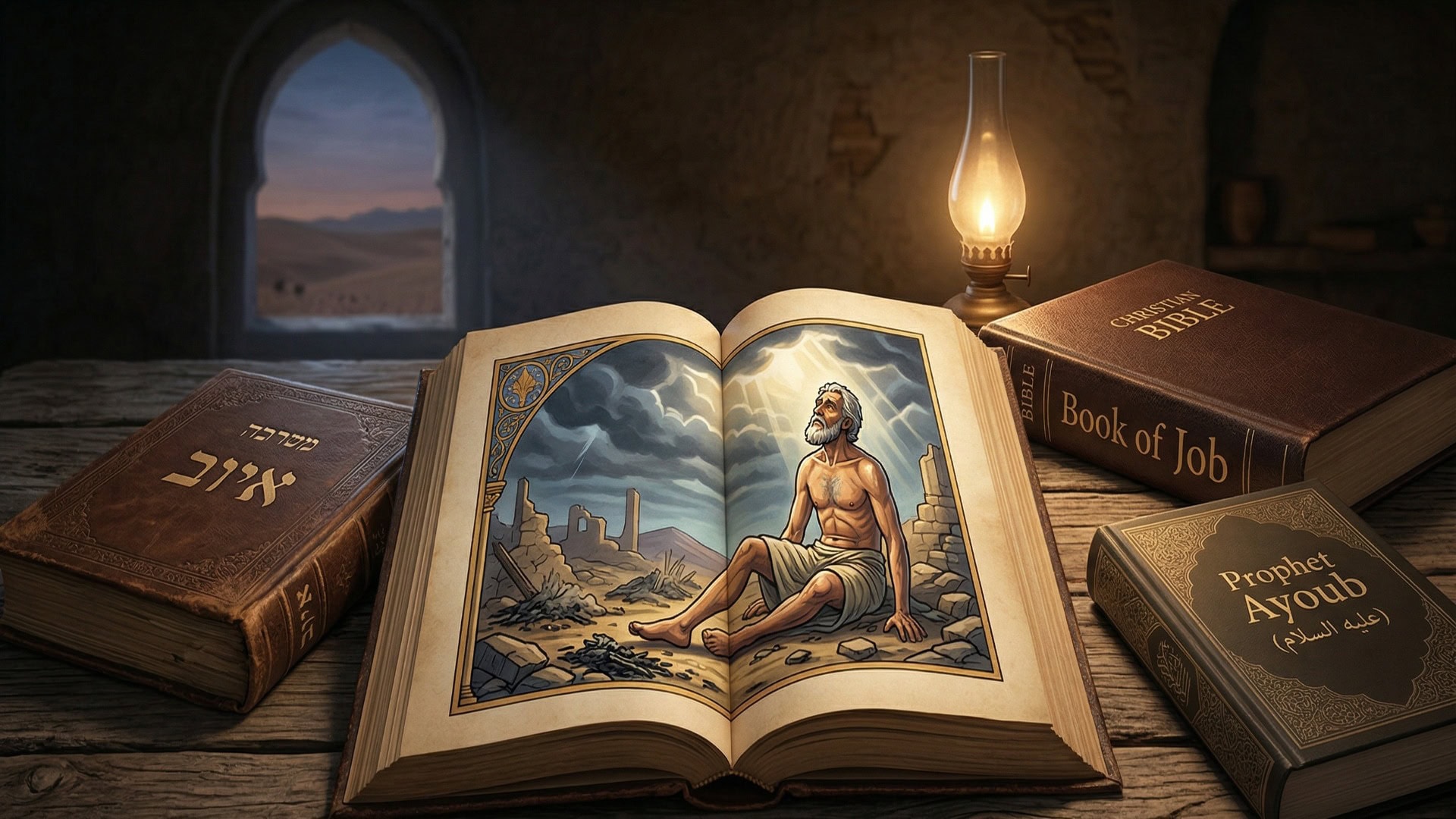
    The story of Job is one of the most profound, challenging, and universally recognized narratives in the history of world religion. Across diverse faiths and cultures, the figure of Job stands as the ultimate archetype of righteous suffering. When calamity strikes without cause, humanity inevitably turns to this ancient text to ask the most difficult question of all: If God is good, why do the innocent suffer? This age-old dilemma is known in philosophy and theology as theodicy. Exploring how different religions interpret the trials of Job offers incredible insight into the varied ways humanity attempts to reconcile divine justice with the harsh realities of the world.

    We will explore the narrative of Job through the lenses of Judaism, Christianity, and Islam, alongside philosophical interpretations. Whether you approach the story from a perspective of faith, historical curiosity, or philosophical inquiry, the lessons embedded in Job’s endurance remain deeply relevant today.


    The Core Narrative: A Universal Story of Loss and Endurance

    Before diving into specific religious interpretations, it is helpful to establish the foundation of the story. While nuances change across traditions, the core architecture of Job’s narrative remains consistent.

    Job is introduced as a remarkably prosperous, wealthy, and fundamentally righteous person. He is a person of deep integrity who actively avoids evil. However, a divine dialogue takes place in the heavenly realms. An adversary challenges the authenticity of Job’s devotion, suggesting that Job is only faithful because his life is easy and blessed.

    To prove the adversary wrong, permission is granted to test Job. In rapid, devastating succession, Job loses everything:

    • His Wealth: His livestock and livelihoods are stolen or destroyed.
    • .His Family: A catastrophic disaster claims the lives of his beloved children.
    • His Health: He is afflicted with agonizing, disfiguring boils from head to toe.

    Left sitting in ashes, Job is visited by friends who attempt to comfort him but ultimately blame him, insisting that he must have committed some hidden sin to deserve such punishment. Job maintains his innocence, occasionally crying out in despair, until a divine revelation shifts his perspective. Ultimately, Job’s health, wealth, and family are restored.

    “The story of Job is not merely a historical account; it is a profound exploration of human vulnerability, the limits of human understanding, and the mystery of divine justice.”


    1. Judaism: The Search for Divine Wisdom and Human Limits

    In the Jewish tradition, the Book of Job (Iyov in Hebrew) is part of the Ketuvim (Writings) section of the Tanakh (the Hebrew Bible). It is widely regarded as one of the most complex literary and theological masterpieces of ancient literature.

    The Role of “Ha-Satan”

    One of the most distinct aspects of the Jewish interpretation lies in the translation and understanding of the adversary. In the Hebrew text, the figure who challenges Job is called ha-satan, which translates literally to “the accuser” or “the prosecuting attorney.”

    In mainstream Jewish theology, ha-satan is not the independent, evil entity (the Devil) prominent in later Christian theology. Instead, ha-satan is viewed as a celestial servant of God—an angel whose specific job is to test the sincerity of human beings and present evidence of their flaws. This distinction is crucial; it maintains God’s absolute sovereignty. In the Jewish view, God is ultimately responsible for both the good and the bad, aligning with the words of Isaiah 45:7: “I form light and create darkness, I make well-being and create calamity, I am the Lord, who does all these things.”

    Retributive Justice and the Friends

    A significant portion of the Book of Job consists of poetic dialogues between Job and his friends: Eliphaz, Bildad, and Zophar (and later, Elihu). Job’s friends represent traditional ancient Near Eastern theology: the doctrine of retributive justice. They argue that God is perfectly just; therefore, if Job is suffering, he must have sinned.

    Judaism uses the Book of Job to fundamentally deconstruct this simplistic view of karma or direct retribution. Job fiercely defends his innocence, and ultimately, God rebukes the friends. The Jewish interpretation emphasizes that human beings cannot always map human suffering to human morality.

    The Whirlwind: A Lesson in Humility

    When God finally answers Job, He does not speak from a place of gentle comfort, nor does He explain why Job suffered. Instead, God speaks from a whirlwind, unleashing a barrage of majestic, rhetorical questions about the creation of the cosmos, the foundations of the earth, and the wild beasts (Behemoth and Leviathan).

    • “Where were you when I laid the foundation of the earth? Tell me, if you have understanding.” (Job 38:4)

    Rabbinic tradition often interprets this not as God bullying Job, but as a profound philosophical shift. God is illustrating the vast, incomprehensible complexity of the universe. Just as a human cannot understand the mechanics of the cosmos, a human cannot fully comprehend the mechanics of divine justice. The Talmud (Bava Batra 15a) even features rabbis debating whether Job was a real historical figure or a parable created specifically to teach this profound lesson on the limits of human knowledge.


    2. Christianity: Spiritual Warfare, Typology, and Grace

    While Christianity inherits the Hebrew text, its interpretation of Job has evolved through the lenses of the New Testament, early Church Fathers, and the theology of the cross.

    The Adversary as the Devil

    In contrast to the Jewish view of the prosecuting angel, the Christian tradition widely identifies the adversary in the Book of Job as Satan—the fallen angel, the Devil, and the ultimate source of evil. Consequently, the Christian interpretation often views Job’s trials as an early depiction of spiritual warfare. Job’s suffering is seen as an attack by the forces of darkness attempting to sever a human soul from its Creator, with God allowing the test to ultimately demonstrate the enduring power of faith.

    Job as a “Type” of Christ (Typology)

    A unique feature of Christian biblical interpretation is typology—the idea that figures and events in the Old Testament foreshadow the life and mission of Jesus Christ.

    Early Christian theologians, such as Gregory the Great in his massive commentary Moralia in Job, drew heavy parallels between Job and Jesus:

    • Innocent Suffering: Both Job and Jesus were righteous individuals who suffered immensely without having committed crimes to warrant such punishment.
    • Betrayal and Mockery: Just as Job was mocked by his community and misunderstood by his friends, Jesus was betrayed, mocked, and abandoned.
    • Vindication and Restoration: Job’s ultimate restoration foreshadows the resurrection and ultimate vindication of Christ.

    Through this lens, the Book of Job helps Christians understand that innocent suffering is not a sign of God’s abandonment, but can be a profound, mysterious participation in the suffering of Christ.

    The New Testament View: Patience and Grace

    The Book of Job is explicitly mentioned in the New Testament in the Epistle of James:

    • “As you know, we count as blessed those who have persevered. You have heard of Job’s perseverance and have seen what the Lord finally brought about. The Lord is full of compassion and mercy.” (James 5:11)

    For Christians, the primary takeaway is often the virtue of enduring faith and the reliance on God’s grace. Even when Job questioned God in his despair, he never abandoned his relationship with the Divine. His honesty in prayer—even in anger—is viewed as a deep, authentic faith.


    3. Islam: Prophet Ayoub and the Epitome of “Sabr” (Patience)

    In Islam, the figure of Job is known as Prophet Ayoub (عليه السلام). He is a highly revered figure, mentioned several times in the Quran, and his story is elaborated upon in the Hadith (sayings of Prophet Muhammad) and Islamic scholarly traditions (Tafsir).

    The Islamic interpretation shares the core elements of the story but presents a distinct theological tone, primarily emphasizing Ayoub’s status as a Prophet and his unshakeable patience.

    The Infallibility of Prophets

    A foundational principle in Islamic theology is Ismah, the concept that Prophets are divinely protected from committing major sins. Because Ayoub is a Prophet, Islamic tradition does not generally accept the Biblical depiction of Job angrily questioning God’s justice or cursing the day of his birth.

    Instead, Prophet Ayoub is the ultimate symbol of Sabr (beautiful, enduring patience). No matter how severe his afflictions became, Ayoub’s tongue and heart remained constantly engaged in the remembrance and praise of Allah.

    The Role of Iblis (Satan)

    In Islamic tradition, the suffering of Ayoub is often attributed to the whispers and machinations of Iblis (Satan). Iblis grew jealous of Ayoub’s elevated status and continuous gratitude to Allah. Allah allowed Iblis to strip away Ayoub’s wealth, family, and health to demonstrate to the angels and to humanity the unbreakable nature of a true Prophet’s devotion.

    Throughout years of illness—so severe that he was ostracized by his community, save for his devoted wife (often named Rahma in tradition)—Ayoub never complained to the people.

    The Prayer of Ayoub and Divine Healing

    The Quran beautifully encapsulates Ayoub’s trial and his ultimate supplication in Surah Al-Anbiya (The Prophets):

    “And [mention] Job, when he called to his Lord, ‘Indeed, adversity has touched me, and You are the most merciful of the merciful.’ So We responded to him and removed what afflicted him of adversity. And We gave him [back] his family and the like thereof with them as mercy from Us and a reminder for the worshippers [of Allah].” (Quran 21:83-84)

    Notice the profound humility in his prayer. He does not demand healing; he simply states his condition (“adversity has touched me”) and praises Allah’s mercy.

    The mechanism of his healing is also explicitly detailed in Surah Sad (38:41-44). Allah commands Ayoub to strike the ground with his foot. A miraculous spring of water gushes forth. By drinking from it and bathing in it, Ayoub is instantly cured of his internal and external ailments, illustrating the restorative power of divine mercy following unwavering patience.


    4. Comparing the Traditions: A Thematic Overview

    To better understand how these three great Abrahamic faiths interpret this profound story, we can look at a side-by-side thematic comparison.

    Theme / Concept Judaism (Tanakh) Christianity (Bible) Islam (Quran & Tradition)
    Primary Theme The limits of human understanding and the mystery of Divine Justice. Spiritual warfare, innocent suffering, and foreshadowing of Christ. Sabr (beautiful patience), complete submission, and divine reward.
    The Adversary Ha-satan (a prosecuting angel serving God’s court). Satan (the Devil, a fallen angel and enemy of God). Iblis (Satan, seeking to prove humanity’s ungratefulness).
    Job’s Attitude Righteous, but ultimately questions and challenges God before repenting. A model of enduring faith who authentically wrestles with grief. An infallible Prophet who exhibits perfect patience without complaint.
    The Resolution God speaks from the whirlwind; Job is humbled and restored. God’s sovereignty is established; points toward ultimate grace. A miraculous healing spring; Ayoub is rewarded for absolute trust.

    5. Secular and Philosophical Perspectives on Job

    The story of Job extends far beyond the boundaries of organized religion. It has captured the imagination of philosophers, psychologists, and literary critics for centuries.

    Carl Jung and “Answer to Job”

    The renowned analytical psychologist Carl Jung wrote a famous, albeit controversial, book titled Answer to Job (1952). Jung treated the Book of Job not as a literal history, but as a psychological myth reflecting the evolution of human consciousness. Jung argued that Job actually emerges morally superior to the depiction of the Old Testament God (Yahweh) in the story. In Jung’s view, Job’s unjust suffering forces “God” (representing the collective unconscious) to become self-aware and eventually incarnate as a human to experience the suffering He inflicted.

    Existentialism and the Absurd

    For secular existentialist thinkers, Job represents the human condition: humanity searching for meaning and justice in a universe that appears chaotic, silent, and indifferent. Job’s friends represent society’s desperate need to impose order and “blame the victim” rather than accept that bad things happen randomly. Job’s refusal to accept false guilt is seen as an act of profound existential courage.


    6. The Universal Takeaways: Why Job Still Matters Today

    Regardless of one’s spiritual background, the trials of Job offer essential insights for modern life.

    1. Empathy Over Explanations

    When Job’s friends first arrive, they sit with him in silence for seven days (the origin of the Jewish mourning practice of sitting shiva). During those seven days, they were perfect friends. It was only when they opened their mouths to offer unsolicited theological explanations for his pain that they caused harm. The story teaches us that those who are grieving need our presence and empathy, not our intellectual justifications or lectures.

    2. The Rejection of Toxic Positivity

    The biblical Job is deeply honest about his pain. He weeps, he mourns, he shaves his head, and he screams at the heavens. The text validates that experiencing deep sorrow, depression, and anger is a natural, human response to trauma, not a lack of faith.

    3. Accepting the Unknown

    We live in an age where we expect immediate answers to every problem. The conclusion of Job’s story is humbling. It reminds us that our perspective is finite. We cannot see the vast tapestry of existence, and learning to sit in the tension of the “unknown” is a crucial aspect of emotional and spiritual maturity.


    Frequently Asked Questions (FAQ)

    Is Job a historical figure or a parable?

    This is debated across traditions. In conservative Christian and Islamic traditions, Job/Ayoub is generally considered a real, historical figure who lived in the ancient Middle East (often associated with the land of Uz, possibly in modern-day Arabia or Edom). However, many Jewish rabbis (as noted in the Talmud), progressive Christian theologians, and secular scholars view the Book of Job as an extended, masterful parable or epic poem designed to explore the philosophical problem of evil.

    Why did God allow Job to suffer?

    The texts do not provide a simple, satisfying answer. In the biblical narrative, it is framed as a test to prove the adversary wrong and demonstrate that true devotion is not contingent on material blessings. Ultimately, God’s response from the whirlwind suggests that humans lack the cosmic perspective to fully understand the intricate workings of the universe and divine justice.

    What is the concept of “theodicy”?

    Theodicy is a theological and philosophical term that refers to the attempt to answer the question of why a good, all-powerful, and all-knowing God permits the manifestation of evil and suffering in the world. The Book of Job is the most famous ancient text dealing with theodicy.

    How does Islam view Job’s wife?

    In Islamic tradition, Prophet Ayoub’s wife (often named Rahma) is highly respected. She is viewed as a paragon of loyalty. While everyone else abandoned Ayoub due to his illness and poverty, she stayed by his side, working difficult jobs to provide for him for years. Her devotion is frequently highlighted in Islamic sermons regarding marriage and loyalty.

    Did Job ever get his original children back?

    According to the biblical text, after Job’s trials, God restores his wealth twofold and blesses him with ten more children (seven sons and three daughters). While he received new children, the text does not imply that the grief over his original children was erased, highlighting the complex, often bittersweet nature of human restoration.


    Reference Links and Further Reading

    For those who wish to explore the theology, history, and literature surrounding the trials of Job further, the following resources are excellent starting points:

    • My Jewish Learning: The Book of Job: A Summary – An accessible overview of the text and Rabbinic commentary from a Jewish perspective.

    • BibleProject: Book of Job Summary – A fantastic, visually engaging breakdown of the literary structure and Christian theological themes of the Book of Job.

    • Yaqeen Institute for Islamic Research: The Patience of Prophet Ayyub – A resource for deep dives into Islamic theology, the concept of Sabr, and the lives of the Prophets.

    • Stanford Encyclopedia of Philosophy: The Problem of Evil – A dense, academic exploration of theodicy and how philosophers have tackled the problem of innocent suffering throughout history.


    Note: The interpretations of sacred texts are vast and varied. This article provides a broad overview of mainstream perspectives within these major world religions, but individual beliefs and scholarly interpretations may vary widely within each tradition.
  • How Jethro is Described in Judaism, Christianity, and Islam

    How Jethro is Described in Judaism, Christianity, and Islam

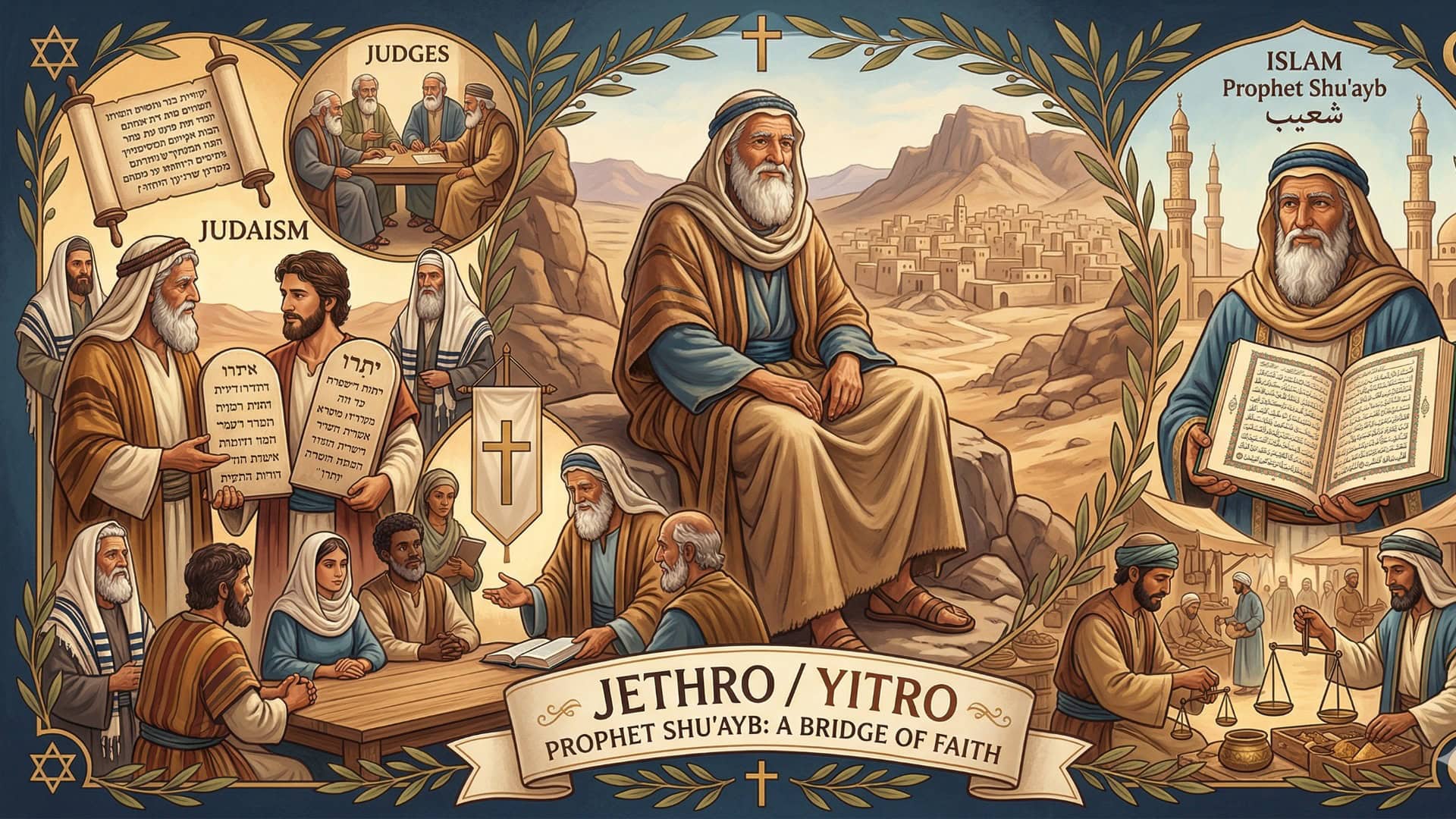
    When exploring the rich tapestry of Abrahamic traditions, certain figures emerge as vital bridges connecting diverse narratives and theological principles. One such compelling figure is Jethro, famously known as the father-in-law of Moses. While he might seem like a supporting character in the grand saga of the Exodus, Jethro occupies a profoundly significant space across Judaism, Christianity, and Islam.


    1. Introduction: Who Was Jethro?

    To understand Jethro’s impact, we must first look at his historical and geographical origins. Jethro (often spelled Yitro in Hebrew) was a priest of Midian, a region generally located in the northwestern Arabian Peninsula, along the eastern shore of the Gulf of Aqaba. The Midianites were nomadic tribes, historically tracing their lineage back to Abraham through his later wife, Keturah.

    This lineage is crucial: it positions Jethro as a distant relative of the Israelites, yet culturally and geographically distinct. When Moses fled Egypt after striking down an Egyptian taskmaster, he found refuge in the desert of Midian. Here, he encountered Jethro’s daughters at a well, protected them from rival shepherds, and was subsequently welcomed into Jethro’s household. Moses eventually married Jethro’s daughter, Zipporah, and spent forty years as a shepherd for his father-in-law before the momentous encounter with the burning bush.

    However, Jethro is not merely a hospitable host or a family patriarch. Across Judaism, Christianity, and Islam, he is revered as a voice of wisdom, a pioneer of administrative justice, and a prophet of ethical commerce. Let us explore how each tradition honors his legacy.


    2. Jethro in Judaism: The Wise Counselor and Seeker of Truth

    In the Jewish tradition, Jethro (Yitro) is a highly esteemed figure. His significance is so profound that an entire Torah portion (Parashat Yitro in the Book of Exodus) is named after him—a rare honor shared by very few individuals in the Hebrew Bible. Parashat Yitro contains the pivotal moment of the Revelation at Mount Sinai and the giving of the Ten Commandments, further highlighting his narrative importance.

    The Seven Names of Jethro

    Jewish Rabbinic literature, particularly the Midrash, notes that Jethro had seven different names, each reflecting a specific aspect of his character, spiritual journey, or achievements:

    • Reuel: “Friend of God,” highlighting his spiritual awakening.
    • Jether (Yeter): “Addition,” because he added a portion to the Torah through his advice on the judicial system.
    • Jethro (Yitro): Signifying the abundance of his good deeds.
    • Hobab: “Beloved,” showing he was cherished by God.
    • Heber: “Associate,” because he associated himself with the community of God.
    • Putiel: “He who freed himself from idolatry,” a nod to his past as a pagan priest who eventually recognized the one true God.
    • Keni: Highlighting his zealousness for God.

    The Midrashic Backstory: Pharaoh’s Advisor

    The Talmud and Midrash flesh out Jethro’s life before he met Moses. According to Sanhedrin 106a, Jethro was one of three esteemed advisors to the Pharaoh of Egypt, alongside Balaam and Job. When Pharaoh proposed the decree to drown all male Hebrew infants, the three advisors reacted differently:

    1. Balaam devised and encouraged the evil plot.
    2. Job remained silent, prioritizing his own safety.
    3. Jethro vehemently protested the decree. When his protests were ignored, he fled Egypt for Midian.

    This rabbinic tradition establishes Jethro as a man of profound moral conviction long before he encounters Moses. His willingness to sacrifice his prestigious position for the sake of human life makes him a model of righteousness.

    The Recognition of God and the Sacrificial Meal

    In Exodus 18, after Moses leads the Israelites out of Egypt and defeats the Amalekites, Jethro travels into the wilderness to meet him, bringing along Zipporah and Moses’ two sons. Moses recounts all the miracles God performed.

    Jethro’s reaction is a cornerstone of Jewish theology regarding the righteous among the nations. He declares, “Now I know that the Lord is greater than all other gods, for he did this to those who had treated Israel arrogantly” (Exodus 18:11). Following this declaration, Jethro brings a burnt offering and sacrifices to God, and Aaron and the elders of Israel join him in a communal, sacred meal. This act of a Midianite priest blessing the God of Israel and leading a sacred meal is viewed as a monumental moment of interfaith recognition.

    The “Jethro Principle” of Judicial Administration

    Perhaps Jethro’s most enduring legacy in the Torah is his practical wisdom. Observing Moses sitting from morning until evening, single-handedly judging every dispute among the massive Israelite camp, Jethro recognizes a recipe for burnout.

    He offers a brilliant piece of organizational advice:

    “What you are doing is not good. You and these people who come to you will only wear yourselves out. The work is too heavy for you; you cannot handle it alone.” (Exodus 18:17-18)

    Jethro instructs Moses to delegate. He advises him to teach the people the laws, but to appoint capable, trustworthy, and incorruptible men as officials over thousands, hundreds, fifties, and tens. Only the most difficult cases would be brought to Moses.

    This model, often studied in modern management and jurisprudence as the “Jethro Principle,” establishes the foundation of the Jewish judicial system (which later evolved into the Sanhedrin) and represents a perfect harmony between divine revelation and practical, human wisdom.


    3. Jethro in Christianity: A Type for Gentile Inclusion and Leadership

    Christianity inherits the Old Testament texts, and therefore, the foundational narrative of Jethro remains the same as in Judaism. However, Christian theologians, early Church Fathers, and modern commentators have extracted unique lessons from Jethro’s life, primarily focusing on typology, church administration, and the theology of Gentile inclusion.

    A Foreshadowing of Gentile Salvation

    In Christian theology, Jethro is often viewed as an early “type” or foreshadowing of the Gentile Church. Early Christian commentators noted the significance of Moses, the great deliverer and lawgiver of Israel, taking a Gentile bride (Zipporah) and being deeply influenced by a Gentile priest (Jethro).

    When Jethro visits the camp of Israel, hears of the Exodus, praises Yahweh, and partakes in a communal meal with Moses and Aaron, Christian theologians see a prophetic picture of the New Testament era. It prefigures the moment when Gentiles would hear the Gospel, recognize the God of Israel, and sit at the table of fellowship alongside Jewish believers. The Apostle Paul’s later teachings on the inclusion of the Gentiles into the “olive tree” of faith find an early, beautiful illustration in Jethro’s integration into the Israelite camp.

    The Wisdom of Common Grace

    Christian theologians often use Jethro to illustrate the concept of Common Grace—the idea that God bestows wisdom, morality, and insight upon all people, regardless of their specific religious standing.

    Moses had spoken face-to-face with God at the burning bush; he was the conduit for divine miracles. Yet, when it came to the practical organization of the community, the divine voice came through the practical, lived experience of his Midianite father-in-law. John Calvin and other reformers pointed to Jethro to argue that Christians should not reject good advice, science, or administrative wisdom simply because it originates from non-Christian sources. Truth is truth, regardless of the vessel.

    A Model for Church Leadership and Pastoral Care

    Within Christian pastoral circles, Exodus 18 is a frequently cited text for leadership training. Pastors and church planters use Jethro’s advice to combat pastoral burnout.

    The Christian application of Jethro’s advice emphasizes:

    • The Danger of the “Superhero” Leader: Moses trying to do everything alone was unsustainable. Modern ministry emphasizes that the church is a body with many parts, not a one-man show.
    • The Importance of Delegation: Empowering others to lead is essential for community growth.
    • Character Over Competence: When Jethro listed the qualifications for the judges, he prioritized character: “men who fear God, trustworthy men who hate dishonest gain” (Exodus 18:21). This mirrors the New Testament qualifications for elders and deacons outlined by Paul in his letters to Timothy and Titus.

    Veneration in Christian Traditions

    While Jethro is not widely venerated as a saint in Western Christianity (Catholicism and Protestantism), he holds a place of respect as a Patriarch. In the Eastern Orthodox Church, Old Testament patriarchs and prophets are often given feast days. He is remembered for his righteousness, his hospitality to the exiled Moses, and his humility in guiding the great prophet.


    4. Jethro in Islam: Prophet Shu’ayb and the Call for Economic Justice

    When we transition to the Islamic perspective, the narrative of the figure traditionally identified with Jethro takes on a distinct and expansive prophetic dimension. In Islamic tradition, Jethro is widely identified with Prophet Shu’ayb (Peace Be Upon Him).

    While the Quran does not explicitly state that Shu’ayb is the father-in-law of Musa (Moses), the geographical location (Madyan/Midian), the timeline, and the interactions described in the Quran and Hadith have led the vast majority of Islamic scholars and exegetes (Mufassirun) to equate the two figures.

    The Orator of the Prophets (Khatib al-Anbiya)

    In Islam, Shu’ayb is a revered Messenger of Allah, sent to the people of Madyan (Midian) and the dwellers of the Wood (Aykah). He was given the title Khatib al-Anbiya (The Orator/Preacher of the Prophets) due to his eloquent, passionate, and deeply rational arguments when calling his people to the truth.

    Unlike the Biblical narrative which introduces Jethro primarily in relation to Moses, the Quran focuses heavily on Shu’ayb’s own independent prophetic mission, which occurred prior to and during Moses’ exile.

    The Core Message: Monotheism and Economic Justice

    The Quranic narrative of Prophet Shu’ayb (detailed in Surahs Al-A’raf, Hud, and Ash-Shu’ara) presents a society that was plagued by two major sins:

    1. Shirk (Polytheism): The people of Midian worshipped a tangled tree or thicket (Al-Aykah) and had strayed from the monotheism of their forefather Ibrahim (Abraham).
    2. Economic Corruption: They were notorious for commercial fraud, shortchanging customers, highway robbery, and manipulating weights and measures.

    Shu’ayb’s message inextricably linked spiritual purity with socio-economic justice. He pleaded with his people:

    “O my people, worship Allah; you have no deity other than Him. There has come to you clear evidence from your Lord. So fulfill the measure and weight and do not deprive people of their due and cause not corruption upon the earth after its reformation…” (Quran 7:85)

    This brings a fascinating dimension to the figure of Jethro/Shu’ayb. He is not just an administrator; he is the ancient world’s foremost advocate for fair trade, honest commerce, and consumer rights. He warned his people that wealth gained through fraud brings no blessing, stating, “That which is left by Allah is better for you, if you are believers” (Quran 11:86).

    The Rejection and the Punishment

    Despite his eloquence and familial ties to the community, the elites of Midian mocked Shu’ayb. They ridiculed the idea that his prayers should dictate how they managed their wealth and economy. They threatened to stone him and eventually expelled the believers from the city.

    Consequently, divine judgment befell the transgressors. The Quran describes the punishment as a devastating earthquake (Rajfah) and a torment of a dark, overshadowing cloud (Zullah) that rained down fire. Shu’ayb and his followers were saved by the mercy of Allah.

    The Encounter with Musa (Moses)

    The Quran gracefully recounts the meeting of Musa and the elderly father in Midian in Surah Al-Qasas (Chapter 28). After fleeing Pharaoh, an exhausted Musa rests near a watering hole in Midian. He notices two women holding back their flocks because male shepherds are dominating the water source.

    Musa chivalrously waters their flocks for them. The women return to their father—traditionally understood as Prophet Shu’ayb—who is impressed by Musa’s character and strength. Shu’ayb invites Musa to his home, offering him a safe haven.

    Shu’ayb offers one of his daughters in marriage to Musa, on the condition that Musa works for him for eight to ten years.

    “He said, ‘Indeed, I wish to wed you one of these, my two daughters, on [the condition] that you serve me for eight years; but if you complete ten, it will be [as a favor] from you. And I do not wish to put you in difficulty. You will find me, if Allah wills, from among the righteous.’” (Quran 28:27)

    This interaction paints Shu’ayb as a compassionate, honorable patriarch who recognizes good character, offers sanctuary to a fugitive, and establishes a fair, mutually beneficial contract.


    5. The Druze Perspective: A Central Pillar of Faith

    No comprehensive article on Jethro is complete without mentioning the Druze faith. While distinct from mainstream Judaism, Christianity, and Islam, the Druze religion (an esoteric, monotheistic faith rooted in the Levant) holds Jethro in the highest possible esteem.

    To the Druze, Jethro is known as Nabi Shu’ayb. He is considered the chief and most revered of their prophets, the spiritual founder of their faith, and the ancestor of all Druze people. They believe that while Moses was given the revelation of the outward law (Tanzil), Jethro possessed the esoteric, hidden wisdom (Tawil).

    The tomb of Nabi Shu’ayb, located near Tiberias in the Lower Galilee, is the most sacred site in the Druze religion. Every year, thousands of Druze gather there for the festival of Ziyarat al-Nabi Shu’ayb, celebrating his teachings of loyalty, purity, and profound spiritual truth.


    6. Comparative Analysis: A Summary of Perspectives

    To clearly understand how these traditions converge and diverge regarding Jethro, let’s look at a comparative table:

    Feature / Tradition Judaism (Jethro/Yitro) Christianity (Jethro) Islam (Prophet Shu’ayb) Druze (Nabi Shu’ayb)
    Primary Role Priest of Midian, Moses’ father-in-law, wise counselor. Wise counselor, type of the Gentile believer. Messenger of Allah, preacher of economic justice. Chief Prophet, spiritual founder, ancestor.
    Key Contribution Advising Moses on the judicial system (delegation). Model for pastoral care, common grace, and church leadership. Calling people to monotheism and honest business practices. Possessor of ultimate esoteric wisdom.
    Relationship to God Converts/recognizes Yahweh as the Supreme God. Represents Gentiles recognizing the true God. Chosen Prophet born into monotheism (descendant of Abraham). Divine manifestation/chief prophet.
    Focus in Texts Focuses on his interaction with Moses and Israel. Focuses on his practical wisdom for the community. Focuses heavily on his independent prophetic mission to Midian. Focuses on his esoteric teachings and spiritual lineage.

    7. Frequently Asked Questions (FAQ) About Jethro

    Q1: Was Jethro a Midianite or a Kenite?

    This is a common source of confusion in biblical studies. Jethro is described as the “priest of Midian” (Exodus 3:1), but his descendants are later referred to as “Kenites” (Judges 1:16). Scholars generally believe that the Kenites were a specific clan or sub-tribe within the larger Midianite ethnic group. Therefore, he was both: ethnically a Midianite, and tribally a Kenite.

    Q2: Is Prophet Shu’ayb in Islam definitely the same person as Jethro in the Bible?

    While the Quran does not explicitly name the father of the two women Musa helped as “Shu’ayb,” centuries of Islamic scholarship, Tafsir (exegesis), and cultural tradition have seamlessly linked the two. The geographical setting of Midian, the timeline, and the role of a wise, patriarchal figure perfectly align the Biblical Jethro with the Islamic Shu’ayb. However, a small minority of modern scholars point out minor chronological debates, but the mainstream consensus embraces them as the same figure.

    Q3: What exactly was the “Jethro Principle”?

    The Jethro Principle is a concept of organizational leadership based on Exodus 18. It emphasizes that a leader should not micromanage or attempt to do all the work themselves. Instead, a leader should:

    1. Teach the vision and the rules clearly to everyone.
    2. Select capable, moral individuals.
    3. Delegate authority to them in a hierarchical structure (rulers of thousands, hundreds, fifties, tens).
    4. Only handle the most difficult, unprecedented issues themselves.

    Q4: Why is Jethro considered so important if he wasn’t an Israelite?

    His non-Israelite status is precisely what makes him so important. In a narrative deeply focused on the liberation and election of the Israelites, Jethro serves as a reminder of God’s universal sovereignty. He demonstrates that righteousness, wisdom, and the recognition of truth are not confined to one specific bloodline or nation.

    Q5: What are the primary sins Prophet Shu’ayb preached against?

    According to the Quran, Prophet Shu’ayb actively fought against polytheism (worshipping the Al-Aykah tree) and systemic economic fraud. His people were notorious for cheating in weights and measures, essentially stealing from trading caravans and consumers. Shu’ayb is thus viewed as a pioneer for fair trade and ethical capitalism.


    8. Conclusion: The Enduring Legacy of a Midianite Priest

    Whether known as Yitro, Jethro, or Prophet Shu’ayb, the legacy of this remarkable figure transcends the boundaries of individual faiths. He stands as a towering testament to the fact that profound wisdom, justice, and spiritual truth can emerge from the desert margins.

    In Judaism, he is the quintessential wise counselor who helped build the infrastructure of a free nation. In Christianity, he is the beautiful foreshadowing of a world where all nations gather at the table of faith. Islam, he is the fearless orator demanding economic justice and societal integrity. And in the Druze faith, he is the ultimate spiritual beacon.

    Studying Jethro allows us to find common ground among the Abrahamic faiths. His life teaches modern readers that true leadership requires humility, that economic integrity is a divine mandate, and that sometimes, the greatest wisdom comes from welcoming a stranger from the desert into our camp.


    9. Reference Links for Further Reading

    To continue your exploration of Jethro, Yitro, and Prophet Shu’ayb, consider consulting the following authoritative and educational resources:

  • The Legacy of Isaac: A Comprehensive Guide to His Role in Judaism, Christianity, and Islam

    The Legacy of Isaac: A Comprehensive Guide to His Role in Judaism, Christianity, and Islam

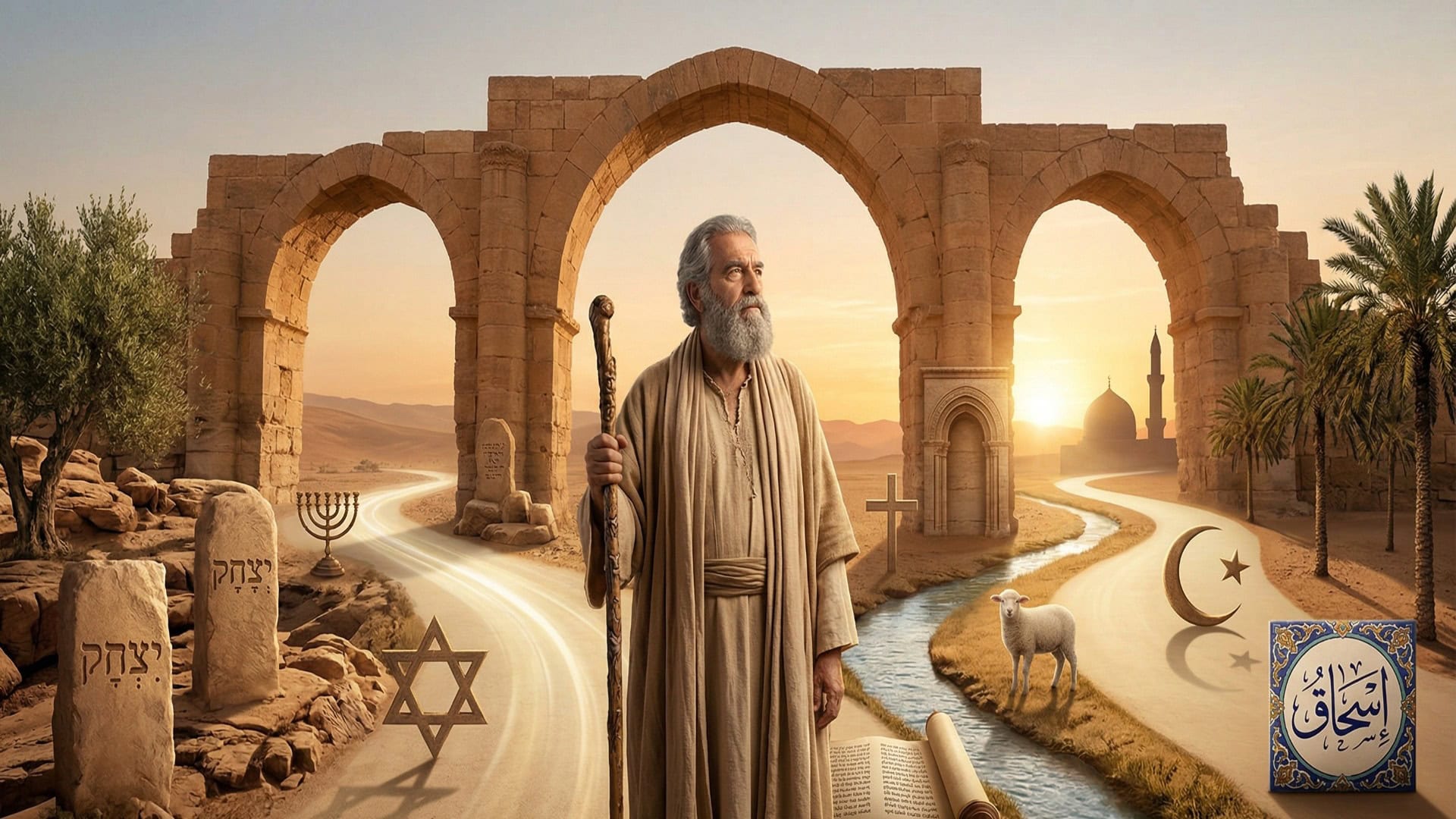
    When we explore the shared roots of the world’s major monotheistic faiths, few figures are as central—and yet as distinctively interpreted—as the patriarch Isaac. Known as Yitzchak in Hebrew and Ishaq in Arabic, he serves as a crucial bridge in the historical and spiritual genealogies of Judaism, Christianity, and Islam.

    Despite his pivotal role, Isaac is often overshadowed by his monumental father, Abraham, and his dynamic son, Jacob. However, a closer look at the sacred texts and traditions reveals a figure of immense spiritual depth, representing obedience, promise, and divine continuity.

    This comprehensive guide explores how Isaac is described across the three Abrahamic religions, highlighting the unique theological perspectives, shared narratives, and inclusive spiritual lessons each tradition offers.


    1. Introduction: The Patriarch of the Promise

    To understand Isaac, we must first understand his context within the Abrahamic religions. Judaism, Christianity, and Islam all trace their spiritual lineage back to Abraham (Ibrahim), a man chosen by God to spread the message of monotheism.

    Isaac is the miraculous child born to Abraham and his wife Sarah in their old age. His birth represents the fulfillment of a divine promise. However, how his life, his trials, and his legacy are interpreted varies significantly across the three faiths. By examining these perspectives side-by-side, we gain a richer understanding of religious history and the diverse ways humanity relates to the divine.


    2. Isaac in Judaism: The Pillar of Strength and Discipline (Yitzchak)

    In Jewish tradition, Isaac (Yitzchak) is the second of the three great Patriarchs (Abraham, Isaac, and Jacob). His story is primarily detailed in the Torah, specifically within the Book of Genesis (Bereshit).

    The Miraculous Birth and the Meaning of His Name

    The name Yitzchak translates to “he will laugh” or “laughter.” This name is deeply symbolic, deriving from the reactions of both Abraham and Sarah when God announced that they would have a child despite being well past childbearing age (Abraham was 100, and Sarah was 90). In Judaism, Isaac’s birth is the ultimate testament to God’s ability to transcend the laws of nature to fulfill a covenant.

    The Akedah: The Binding of Isaac

    The defining moment of Isaac’s life in Jewish theology is the Akedat Yitzchak, or the Binding of Isaac (Genesis 22). God commands Abraham to sacrifice his beloved son on Mount Moriah.

    While popular culture often focuses on Abraham’s test of faith, Jewish Midrash (commentary) and Rabbinic tradition heavily emphasize Isaac’s role.

    • A Willing Participant: According to traditional Jewish chronology, Isaac was not a small child during this event, but a grown man (often cited as 37 years old). Therefore, he was not a helpless victim but a willing participant who consciously accepted God’s decree.
    • Lasting Merit (Zechut Avot): The Akedah is central to Jewish liturgy, particularly during Rosh Hashanah (the Jewish New Year). The blowing of the shofar (ram’s horn) is a direct callback to the ram that was sacrificed in Isaac’s place, invoking the merit of Isaac’s supreme obedience and asking God for mercy on his descendants.

    The Earthbound Patriarch

    Unlike Abraham, who journeyed from Ur to Canaan, and Jacob, who fled to Haran and later died in Egypt, Isaac never left the Promised Land (Canaan). In Judaism, Isaac is viewed as the “olah temimah” (a perfect, unblemished offering). Because he was offered on the altar, he was considered sanctified and forbidden to leave the holy land.

    He is also closely associated with agriculture and digging wells. Digging wells is seen metaphorically in Kabbalah (Jewish mysticism) as a search for inner truth and spirituality.

    Kabbalistic Perspective: Gevurah

    In Jewish mysticism, the Patriarchs correspond to different divine attributes (Sefirot). While Abraham represents Chesed (loving-kindness and expansion), Isaac represents Gevurah (strength, discipline, justice, and restraint). Isaac’s life of passive endurance, his digging of wells (going deep into the earth rather than expanding outward), and his strict obedience epitomize the spiritual discipline required to maintain a relationship with the Divine.


    3. Isaac in Christianity: The Child of Promise and Typology of Christ

    Christianity inherits the historical narrative of Isaac from the Hebrew Bible (the Old Testament), but the New Testament writers and early Church Fathers reinterpreted his life through the lens of Jesus Christ’s life, death, and resurrection.

    The Child of the Promise

    In Christian theology, Isaac is fundamentally understood as the “Child of Promise.” The Apostle Paul makes a crucial theological point in his Epistle to the Galatians and Romans.

    • Grace vs. Works: Paul contrasts Isaac (born of Sarah, a free woman, through a miraculous promise) with Ishmael (born of Hagar, a slave woman, through human effort).
    • For Christians, Isaac represents those who are justified by faith and born of the Spirit, symbolizing the New Covenant.

    Typology: Foreshadowing the Cross

    The most profound significance of Isaac in Christianity lies in biblical typology—the study of how Old Testament figures and events foreshadow the New Testament. The Binding of Isaac is viewed as a direct parallel to the crucifixion of Jesus.

    Consider these profound parallels drawn by Christian theologians:

    • The Beloved Son: Just as God asked Abraham to sacrifice his “only son, whom you love” (Genesis 22:2), God the Father gave His only begotten Son, Jesus (John 3:16).
    • Carrying the Wood: Genesis notes that Isaac carried the wood for his own sacrifice up the mountain. Christian tradition mirrors this with Jesus carrying his own wooden cross to Golgotha.
    • The Resurrection Motif: In Hebrews 11:19, the author states that Abraham reasoned God could raise the dead, and figuratively speaking, he did receive Isaac back from death. This is seen as a foreshadowing of Christ’s literal resurrection.
    • Mount Moriah: Many biblical scholars and traditions link Mount Moriah (where Isaac was bound) to the geographic location of Jerusalem and Mount Calvary, where Jesus was crucified.

    The Genealogies

    Isaac is also a critical link in the genealogy of Jesus. Both the Gospel of Matthew and the Gospel of Luke trace the lineage of Jesus back through King David, Judah, Jacob, Isaac, and Abraham, cementing Jesus’s messianic credentials as the fulfillment of the covenant God made with the Patriarchs.


    4. Isaac in Islam: The Righteous Prophet (Ishaq)

    In Islam, Isaac is revered as Ishaq, an esteemed Prophet (Nabi) and a righteous leader chosen by Allah to guide humanity. His story is found in the Quran, and his legacy is expanded upon in the Hadith (sayings of the Prophet Muhammad) and Tafsir (Quranic exegesis).

    A Gift to Abraham

    The Quran frequently mentions Ishaq alongside his father Ibrahim and his son Yaqub (Jacob). His birth is depicted as a joyous reward for Ibrahim’s unwavering faith.

    “And We gave him Ishaq and Yaqub in addition, and all [of them] We made righteous.” (Quran 21:72)

    When angels visit Ibrahim to deliver the news of a coming son, his wife (Sarah) laughs in astonishment, much like the biblical narrative, and she is given the glad tidings of Ishaq, and after him, Yaqub.

    Prophet and Leader of the Israelites

    In Islamic tradition, Ishaq is crucial because he is the patriarch from whom the entire line of Israelite prophets descends—including Musa (Moses), Dawud (David), and Isa (Jesus). He is described as a man of vision, power, and deep spiritual insight.

    The Quran emphasizes that Ishaq was inspired with revelation and was commanded to establish prayer and give charity, serving as a beacon of monotheism in a polytheistic world.

    The Narrative of the Sacrifice (Dhabih)

    One of the most notable differences between the Judeo-Christian narrative and the Islamic narrative involves the story of the sacrifice.

    In the Quran (Surah As-Saffat 37:99-113), Allah commands Ibrahim to sacrifice his son in a dream. The son willingly submits to the will of Allah, saying, “O my father, do as you are commanded. You will find me, if Allah wills, of the steadfast.” Who was the sacrificed son?

    • The Quran itself does not explicitly name the son in this specific passage.
    • In early Islamic history, there was a robust debate among scholars (such as Al-Tabari) regarding whether the son was Ishaq (Isaac) or Ismail (Ishmael).
    • However, the prevailing consensus in mainstream Islamic theology today is that the sacrificed son was Ismail, the firstborn. The narrative follows that Ibrahim and Ismail were tested in Mecca, which ties into the Islamic pilgrimage (Hajj) and the festival of Eid al-Adha.
    • Following the story of the sacrifice in the Quran, Allah immediately says, “And We gave him good tidings of Ishaq, a prophet from among the righteous.” Many Islamic scholars interpret this sequence to mean that Ishaq’s prophetic birth was a reward after the trial with Ismail.

    Regardless of which son was involved in the sacrifice, Islam holds Ishaq in the highest esteem as a flawless prophet who continued the covenant of monotheism.


    5. Comparative Summary: Common Threads and Divergences

    Understanding Isaac across these three traditions requires appreciating both the harmonious overlaps and the distinct theological divergences.

    What Connects Them?

    1. Reverence and Sanctity: All three faiths honor Isaac as a holy man, a patriarch, and an essential link in the chain of divine revelation.
    2. Miraculous Origins: The miraculous nature of his birth to elderly parents is universally accepted, symbolizing God’s omnipotence and faithfulness to His promises.
    3. Submission to the Divine: Whether through his willing participation in the Akedah in Judaism, his prefiguration of Christ’s submission in Christianity, or his righteous prophethood in Islam, Isaac’s defining characteristic is his steadfast submission to God.

    Where Do They Diverge?

    • Theological Function: In Judaism, he is the embodiment of Gevurah (discipline) and the first inheritor of the Land Covenant. In Christianity, he is a theological metaphor for grace and a type of Christ. In Islam, he is a distinct Prophet bringing revelation to the ancestors of the Israelites.
    • The Sacrifice: The identity of the sacrificed son (Isaac in Judaism and Christianity vs. Ishmael in mainstream Islam) shapes significant cultural and liturgical practices in each religion today.

    6. Frequently Asked Questions (FAQ)

    Q1: Who was Isaac’s mother?

    Isaac’s mother was Sarah. According to the foundational texts of all three Abrahamic religions, she conceived Isaac miraculously in her old age after God promised Abraham a son.

    Q2: Does Islam recognize Isaac as a Prophet?

    Yes. In Islam, Isaac is known as Ishaq and is highly revered as a Prophet (Nabi) who received revelation from Allah and guided his people in righteousness.

    Q3: What does the name “Isaac” mean?

    The name Isaac originates from the Hebrew word Yitzchak, which means “he will laugh.” This refers to the joyful and incredulous laughter of his parents when they were told they would have a child in their old age.

    Q4: Who are the children of Isaac?

    According to the Biblical and historical traditions, Isaac married Rebecca (Rivkah), and they had twin sons: Esau and Jacob (Yaqub). Jacob would go on to be renamed Israel, becoming the father of the Twelve Tribes.

    Q5: Why is the Binding of Isaac (the Akedah) so important in Christianity?

    Christians view the Binding of Isaac as a “typology” or foreshadowing of the New Testament. Isaac’s willing journey up the mountain with the wood for the sacrifice is seen as a parallel to Jesus carrying the cross to his own crucifixion, symbolizing God’s ultimate sacrifice for humanity.


    7. Reference Links & Further Reading

    To continue exploring the profound history and theology surrounding Isaac, consider visiting these authoritative resources:

    1. Jewish Perspectives:

    2. Christian Perspectives:

    3. Islamic Perspectives:

    4. General/Historical:

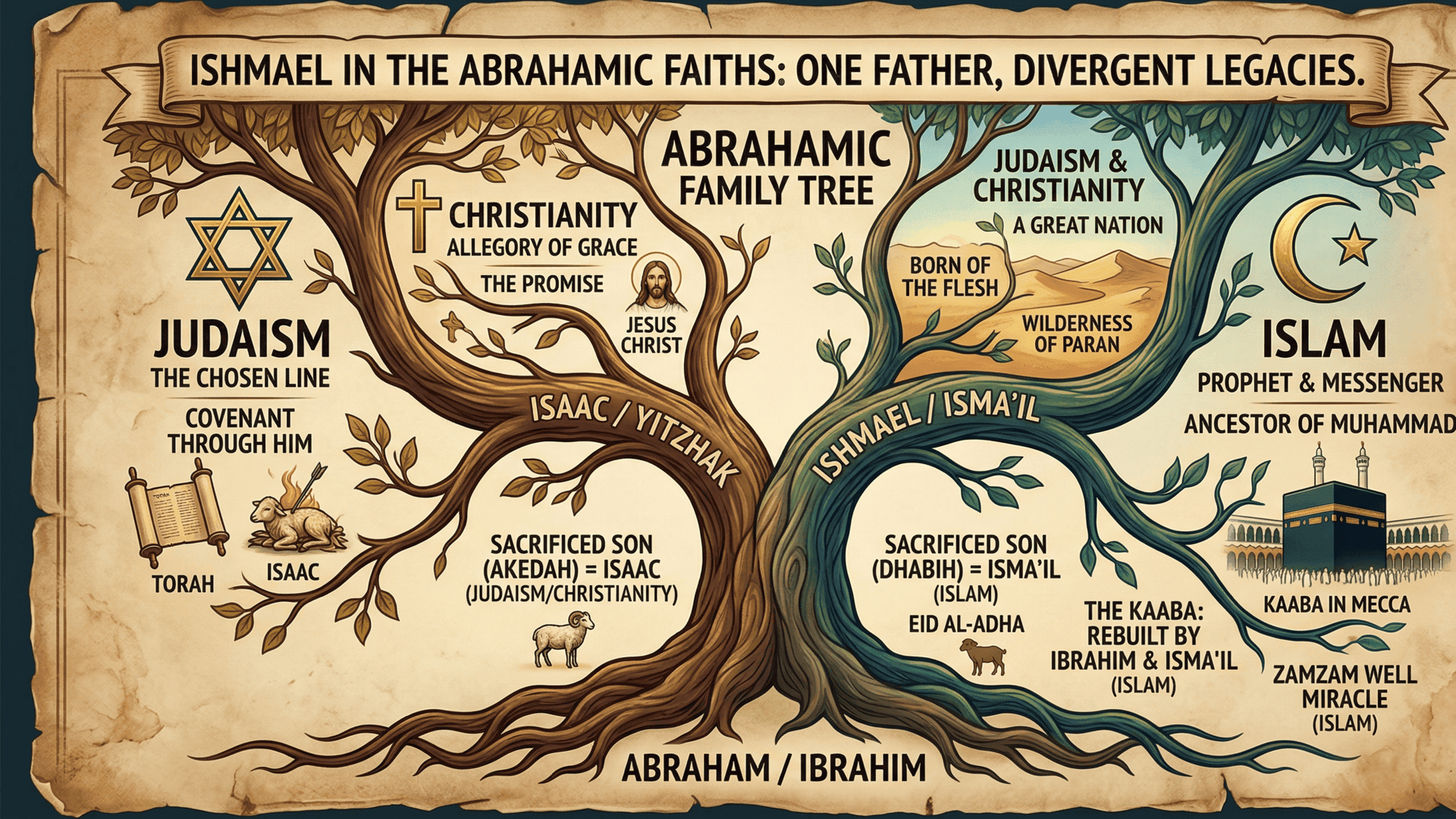
  • Ishmael in Judaism, Christianity, and Islam: Key Differences Explained

    Ishmael in Judaism, Christianity, and Islam: Key Differences Explained

    The figure of Abraham stands as a monumental pillar in the history of world religions, uniting billions of people under the umbrella of the “Abrahamic faiths.” However, the story of Abraham is not a solitary one. It is a complex family narrative woven with promises, trials, divine interventions, and complex family dynamics. At the heart of this ancient family tree sits a figure whose life, legacy, and spiritual significance diverge dramatically depending on which sacred text you are reading: Ishmael.

    Known as Yishma’el in Hebrew (“God will hear”) and Isma’il in Arabic, Ishmael is universally recognized as the firstborn son of Abraham. Yet, the narrative trajectory of his life—his legitimacy, his divine covenant, and his role in the history of salvation—varies significantly across Judaism, Christianity, and Islam.

    For the modern reader, student of theology, or anyone interested in interfaith dialogue, understanding the multifaceted figure of Ishmael is essential. He is not merely a historical or mythical character; he is a theological symbol, a patriarch of nations, and a lens through which three distinct worldviews interpret the will of the Divine.

    This comprehensive guide will explore the textual origins, theological interpretations, and key differences surrounding the figure of Ishmael in Judaism, Christianity, and Islam.


    Part 1: The Historical and Textual Foundation

    Before delving into the specific interpretations of each faith, it is crucial to establish the foundational narrative. The primary textual sources for the story of Ishmael are the Hebrew Bible (specifically the Book of Genesis), the Christian New Testament (which inherits the Genesis account and adds theological commentary), and the Quran (alongside the Hadith, the recorded sayings and actions of the Prophet Muhammad).

    The Shared Ancestry

    All three traditions agree on the basic genealogical premise: Abraham (Abram/Ibrahim) was married to Sarah (Sarai), who was initially unable to conceive. To ensure an heir, Sarah offered her Egyptian handmaiden, Hagar (Hajar), to Abraham. From this union, Ishmael was born.

    From this singular point of origin, the narratives begin to fracture. The disputes center around the nature of God’s covenant, the rightful heir to Abraham’s spiritual legacy, and the geographical focus of God’s interaction with humanity.

    The Etymology of “Ishmael”

    The name itself carries profound theological weight. In Genesis 16:11, an angel of the Lord tells Hagar, “You shall name him Ishmael, for the Lord has heard of your misery.” The root of the name comes from the Hebrew shama (to hear) and El (God). This establishes an immediate theme that resonates across all traditions: Ishmael is associated with a God who hears the cries of the marginalized, the exiled, and the faithful in the wilderness.


    Part 2: Ishmael in Judaism

    In Jewish tradition, the primary source of information regarding Ishmael is the Torah, specifically the Book of Genesis, supplemented by centuries of Rabbinic commentary (Midrash and Talmud). In Judaism, Ishmael’s story is fundamentally tied to the establishment of the Jewish covenant through his younger half-brother, Isaac.

    The Biblical Narrative

    1. The Birth and the Blessing According to Genesis 16, Hagar conceives Ishmael after Sarah gives her to Abraham. However, tension quickly arises between the two women. Hagar begins to despise Sarah, leading Sarah to treat her harshly. Hagar flees into the desert, where an angel meets her. The angel promises that her descendants will be too numerous to count and instructs her to return and submit to Sarah. Ishmael is born when Abraham is 86 years old.

    God explicitly blesses Ishmael. In Genesis 17:20, God tells Abraham: “And as for Ishmael, I have heard you: I will surely bless him; I will make him fruitful and will greatly increase his numbers. He will be the father of twelve rulers, and I will make him into a great nation.”

    2. The Covenant of Circumcision It is important to note that Ishmael is included in the covenant of circumcision. Genesis 17 records that Ishmael, at the age of 13, was circumcised alongside his father Abraham. However, God makes it clear that the eternal, spiritual covenant will be established through the miraculously conceived Isaac, not Ishmael.

    3. The Expulsion into the Wilderness The defining moment of Ishmael’s biblical narrative occurs in Genesis 21. Following the birth and weaning of Isaac, Sarah observes Ishmael “mocking” or “playing” (the Hebrew word m’tzachek is ambiguous and heavily debated by scholars). Fearing for Isaac’s inheritance and safety, Sarah demands that Abraham cast out Hagar and Ishmael.

    Though Abraham is distressed, God tells him to listen to Sarah, reassuring him that Ishmael will also become a great nation. Hagar and Ishmael are sent into the wilderness of Beersheba. When their water runs out, Hagar places the boy under a bush and walks away, unable to watch him die. God “hears the boy crying,” opens Hagar’s eyes to a well of water, and saves them. Ishmael grows up in the wilderness of Paran, becomes an expert archer, and marries an Egyptian woman.

    Rabbinic Interpretations (Midrash and Talmud)

    The Rabbinic perspective on Ishmael is nuanced and often ambivalent. Because the Biblical text focuses on the lineage of Isaac, Rabbinic literature frequently uses Ishmael as a foil to Isaac to highlight the distinctiveness of the Jewish covenant.

    • The Nature of the “Mocking”: Rabbis debated what Ishmael was doing in Genesis 21. Some Midrashic interpretations suggest he was engaging in idolatry, sexual immorality, or even attempting to kill Isaac with his bow. This paints Ishmael as a spiritually dangerous figure who had to be removed to protect the holy lineage.
    • The “Wild Donkey” of a Man: Genesis 16:12 prophesies that Ishmael will be a “wild donkey of a man; his hand will be against everyone and everyone’s hand against him.” Historically, some Jewish commentators viewed this as a prediction of the aggressive nature of the nomadic Arab tribes associated with Ishmael’s lineage.
    • Repentance (Teshuvah): Despite the negative portrayals, Jewish tradition also offers a redemptive arc for Ishmael. The Talmud (Bava Batra 16b) suggests that Ishmael repented later in life. This is drawn from Genesis 25:9, which notes that both Isaac and Ishmael came together to bury their father, Abraham, in the Cave of Machpelah. The fact that Isaac’s name is listed first, and Ishmael allowed him to lead, is interpreted by rabbis as proof of Ishmael’s repentance and acceptance of Isaac’s spiritual primacy.

    Ishmael as the Progenitor of the Arabs

    In later Jewish tradition, particularly during the Middle Ages, “Ishmael” became synonymous with the Arab world and, by extension, Islam. Jewish thinkers like Maimonides referred to Muslims as “Ishmaelites.” While recognizing theological differences, Jewish law generally considers Muslims to be strict monotheists (unlike some views on Christianity’s Trinity), a theological kinship traced back to their shared Abrahamic root.


    Part 3: Ishmael in Christianity

    Christianity inherits the Old Testament, meaning the foundational Christian understanding of Ishmael is identical to the Genesis narrative. However, Christianity introduces a radical reinterpretation of the Ishmael and Isaac story through the writings of the New Testament, specifically the theology of the Apostle Paul. In Christianity, Ishmael transitions from a historical patriarch into a profound theological allegory.

    The New Testament and Pauline Allegory

    The most significant Christian text regarding Ishmael is found in the Apostle Paul’s Epistle to the Galatians (Galatians 4:21-31). In this letter, Paul addresses early Christians who were debating whether Gentile converts needed to follow Jewish law (the Torah), specifically circumcision, to be true followers of Christ.

    Paul uses the story of Hagar/Ishmael and Sarah/Isaac as a complex allegory to explain the difference between the “Old Covenant” (the Law given at Mount Sinai) and the “New Covenant” (grace through Jesus Christ).

    1. Flesh vs. Promise Paul emphasizes the circumstances of the two births. Ishmael was born “according to the flesh”—meaning he was the result of human effort and planning (Abraham and Sarah trying to fulfill God’s promise through their own intervention with Hagar). Isaac, conversely, was born “by the power of the Spirit” or “through the promise”—a miraculous birth resulting solely from God’s intervention in Sarah’s old age.

    2. Slavery vs. Freedom Paul aligns Hagar, the slave woman, with the earthly city of Jerusalem and the Mosaic Law given at Mount Sinai. He argues that those who rely on the strict adherence to the Law are “slaves” to it, much like Ishmael was born into slavery. Sarah, the free woman, represents the “heavenly Jerusalem” and the freedom found in faith in Christ. Believers in Christ, Paul argues, are “children of promise, like Isaac.”

    3. The Expulsion as Theological Necessity Paul quotes Genesis 21:10: “Get rid of the slave woman and her son, for the slave woman’s son will never share in the inheritance with the free woman’s son.” For Paul, this was not just a family dispute; it was a divine decree that the covenant of Law (symbolized by Ishmael) cannot co-inherit with the covenant of Grace (symbolized by Isaac).

    The Christian Perspective on Ishmael’s Legacy

    Because of Paul’s strong allegorical use of the story, Christian theology has historically placed less emphasis on the historical Ishmael and more on what he represents.

    • A Symbol of Human Effort: In Christian homiletics and teachings, Ishmael often represents the human tendency to try and “help God out” or achieve righteousness through human works rather than trusting in divine grace.
    • Outside the Messianic Line: Christianity, like Judaism, views Isaac as the exclusive bearer of the covenant that eventually leads to the Messiah. Jesus Christ’s genealogy is traced through Isaac, Jacob, and Judah, leaving Ishmael outside the central narrative of redemption.
    • God’s Provision: Despite the theological distancing, Christian commentators still recognize God’s compassion toward Ishmael. The story of God hearing Ishmael’s cries in the desert is frequently used in Christian pastoral care to illustrate that God’s love and providential care extend to all people, even those outside the primary covenantal line. God still promised to make a great nation of him, a promise Christians acknowledge was historically fulfilled.

    Part 4: Ishmael (Isma’il) in Islam

    If Judaism views Ishmael as the displaced older brother, and Christianity views him as an allegory of the old law, Islam elevates him to the status of a major prophet, a patriarch, and the direct ancestor of the Prophet Muhammad. In Islamic tradition, the narrative shifts dramatically, placing Ishmael at the very center of God’s unfolding plan.

    The Quranic Narrative: A Prophet and Messenger

    In the Quran, Isma’il is mentioned by name 12 times. He is consistently praised for his righteousness, patience, and strict adherence to his promises.

    • Surah Maryam (19:54-55): “And mention in the Book, Ishmael. Indeed, he was true to his promise, and he was a messenger and a prophet. And he used to enjoin on his people prayer and zakah [charity] and was to his Lord pleasing.”
    • Surah Al-Anbiya (21:85): “And [mention] Ishmael and Idrees and Dhul-Kifl; all were of the patient.”

    In Islam, there is no narrative of Ishmael being “cast out” due to mocking or illegitimacy. Hagar (Hajar) is deeply respected, not viewed as a mere concubine, but as a righteous wife of Ibrahim. The journey to the desert is not seen as an expulsion driven by family jealousy, but as a deliberate divine command given to Ibrahim to establish a new center of monotheistic worship.

    The Miracle of Zamzam and the Hajj

    The Islamic tradition provides a rich, detailed account of Hajar and Isma’il’s experience in the desert, which forms the basis for major Islamic rituals today.

    According to Islamic tradition, Ibrahim left Hajar and the infant Isma’il in the barren valley of Mecca (Bakkah) under God’s strict orders. When their provisions ran out, the infant Isma’il began to cry from thirst. The desperate Hajar ran back and forth seven times between two hills, Safa and Marwa, searching for water or a passing caravan.

    In response to their distress, God sent the Angel Jibril (Gabriel), who struck the ground (some traditions say Isma’il kicked the ground with his heel), causing a miraculous spring of water to gush forth. This well, known as Zamzam, saved their lives and attracted nomadic tribes (the Jurhum tribe) to settle in the area, leading to the foundation of the city of Mecca.

    Millions of Muslims commemorate Hajar’s desperate search every year during the Hajj and Umrah pilgrimages by performing the Sa’i—walking and running seven times between the hills of Safa and Marwa.

    The Great Sacrifice (Dhabih)

    The most profound theological divergence between the Islamic and Judeo-Christian narratives involves the story of Abraham’s sacrifice.

    In Genesis 22, God commands Abraham to sacrifice “your son, your only son, whom you love—Isaac.”

    In the Quran (Surah As-Saffat 37:100-112), Ibrahim receives a vision that he must sacrifice his son. The Quran does not explicitly name the son in this passage, referring only to a “forbearing boy.” However, the overwhelming consensus among Islamic scholars and tradition is that the son to be sacrificed was Isma’il, not Isaac.

    The Quranic narrative emphasizes the absolute submission (the root meaning of the word “Islam”) of both father and son: “And when he reached with him [the age of] exertion, he said, ‘O my son, indeed I have seen in a dream that I [must] sacrifice you, so see what you think.’ He said, ‘O my father, do as you are commanded. You will find me, if Allah wills, of the steadfast.’” (Quran 37:102).

    As Ibrahim prepares to make the sacrifice, God intervenes, announcing that Ibrahim has fulfilled the vision, and replaces the boy with a “great sacrifice” (a ram). This event is commemorated globally by Muslims during Eid al-Adha (the Festival of Sacrifice).

    Building the Kaaba

    Islamic tradition asserts that Isma’il and Ibrahim were reunited later in life to fulfill a monumental divine task: rebuilding the Kaaba, the sacred house of worship in Mecca.

    • Surah Al-Baqarah (2:127): “And [mention] when Abraham was raising the foundations of the House and Ishmael, [saying], ‘Our Lord, accept [this] from us. Indeed You are the Hearing, the Knowing.’”

    This establishes Isma’il not just as a prophet, but as the co-founder of the most sacred site in Islam, orienting the spiritual geography of the Islamic world away from the Levant and toward the Arabian Peninsula.

    The Ancestor of the Prophet

    Finally, Isma’il is deeply revered as the patriarch of the Northern Arabs (the Adnanites). It is through Isma’il’s lineage that the Prophet Muhammad traces his ancestry, making Isma’il a vital link in the chain of prophetic revelation that culminates in the Quran.


    Part 5: Comparative Analysis – Key Differences Summarized

    To fully grasp the divergent views of Ishmael, it is helpful to look at the theological fault lines where the traditions separate.

    1. The Question of Covenant and Legitimacy

    • Judaism: Ishmael is a legitimate son and receives a blessing of earthly proliferation, but he is explicitly excluded from the spiritual, eternal covenant. That covenant is reserved solely for Isaac and his descendants.
    • Christianity: Aligns with the Jewish view of the covenant but allegorizes it. Ishmael represents the bondage of the Old Law and works-based righteousness, while Isaac represents the freedom of the New Covenant and grace.
    • Islam: Isma’il is fully legitimate, highly favored, and a prophet in his own right. He is a bearer of God’s light and covenant, tasked with building God’s house (the Kaaba) and acting as the patriarch of the final Prophet.

    2. The Identity of the Sacrificed Son

    • Judeo-Christianity: Isaac is undeniably the son placed on the altar (the Akedah). This underscores Isaac’s supreme importance and foreshadows (in Christianity) the sacrifice of Jesus.
    • Islam: Isma’il is widely accepted as the son of the sacrifice (the Dhabih). This highlights his supreme faith and submission to God’s will, forming the basis for Eid al-Adha.

    3. The Expulsion vs. The Divine Mission

    • Judeo-Christianity: Hagar and Ishmael are driven into the wilderness primarily due to family strife, jealousy, and a divine command to protect Isaac’s inheritance. It is a story of exile, though tempered by God’s rescue.
    • Islam: Ibrahim takes Hajar and Isma’il to Mecca not out of malice or to appease Sarah, but out of a direct divine command to populate the sacred valley and establish monotheism. It is a story of purposeful migration and trust in God.

    4. Geographical Centers

    • Judeo-Christianity: The narrative remains firmly rooted in the land of Canaan (modern-day Israel/Palestine). Ishmael is sent away from the promised land into the wilderness (Paran).
    • Islam: The narrative physically shifts the focal point of God’s activity to the Arabian Peninsula. The wilderness is not a place of exile, but the future site of the Kaaba, the spiritual center of the world.

    Part 6: Modern Implications and Interfaith Dialogue

    Understanding the figure of Ishmael is more than an academic exercise in comparative religion; it has profound implications for how followers of the Abrahamic faiths view one another today.

    The Danger of Exclusivity

    Historically, the differing narratives have been used to justify theological superiority.

    • In medieval times, Jewish and Christian polemics sometimes weaponized the biblical “wild donkey” prophecy to stereotype Arab and Islamic societies as inherently violent or lawless.
    • Conversely, some Islamic interpretations have accused the Judeo-Christian texts of being corrupted (tahrif) by early scribes who allegedly altered the Torah to elevate Isaac and marginalize Isma’il out of ethnic bias.

    Finding Common Ground

    In recent decades, scholars and interfaith leaders have sought to use the figure of Ishmael not as a wedge, but as a bridge.

    1. A Shared Reverence for the Patriarchs Regardless of who held the primary covenant, all three faiths honor Abraham as the quintessential man of faith. Recognizing that both Isaac and Ishmael called Abraham “father” provides a powerful metaphor for fraternity between Jews, Christians, and Muslims.

    2. The Theme of God’s Care for the Vulnerable A unifying theological thread is the character of God in the wilderness. In both the Biblical and Islamic accounts, Hagar and Ishmael represent the ultimate marginalized figures: a foreign servant, a helpless infant, dying of thirst in an unforgiving desert. In both traditions, God hears, God sees, and God saves. This shared narrative promotes a universal ethic of compassion for the refugee, the outcast, and the vulnerable.

    3. Textual Reconciliation Some modern Biblical scholars note that the Genesis text is surprisingly respectful of Ishmael. He is the first person in the Bible to be named by God before his birth. God’s promise to make him a great nation is fulfilled. Furthermore, the final mention of the two brothers in Genesis 25—standing shoulder to shoulder to bury their father—offers a powerful image of reconciliation that transcends historical grievances.


    Conclusion

    Ishmael is a profound and complex figure who sits at the crossroads of world history. To Judaism, he is the blessed but displaced brother, representing a divergence from the chosen path of Israel. Christianity, he serves as a powerful theological symbol contrasting human effort with divine grace. To Islam, he is Isma’il, the patient prophet, the obedient son of the sacrifice, and the ancestral key to the final revelation.

    While the differences in his narrative—from the identity of the sacrificed son to the geographical center of his legacy—are deep and irreconcilable from a strict theological standpoint, they do not have to be a source of endless conflict. By studying these differences with respect and intellectual honesty, followers of Judaism, Christianity, and Islam can gain a deeper appreciation for their own traditions while recognizing the shared spiritual heritage that binds the children of Abraham together.


    Frequently Asked Questions (FAQ)

    1. Who is older: Ishmael or Isaac?

    According to the foundational texts of all three Abrahamic religions, Ishmael is the older brother. The biblical account in Genesis states that Abraham was 86 years old when Hagar gave birth to Ishmael, and 100 years old when Sarah gave birth to Isaac. Therefore, Ishmael is 14 years older than Isaac.

    2. Does the Quran explicitly say Ishmael was the son to be sacrificed?

    Interestingly, the Quran does not explicitly mention the name of the son in the story of the sacrifice (Surah 37:100-112). It refers to him as a “forbearing boy.” However, the vast majority of Islamic scholars, historical tradition, and Hadith identify the boy as Isma’il. This interpretation is supported by the fact that the good tidings of Isaac’s birth are mentioned after the narrative of the sacrifice in the Quranic text.

    3. Did Ishmael and Isaac ever meet again after the expulsion?

    Yes, according to the Hebrew Bible. Genesis 25:9 records that when Abraham died at the age of 175, “his sons Isaac and Ishmael buried him in the cave of Machpelah.” This indicates that despite the geographical and familial separation, the brothers reunited to honor their father. Jewish Rabbinic tradition often views this peaceful reunion as evidence of Ishmael’s later repentance and reconciliation.

    4. What does the name “Ishmael” mean?

    The name Ishmael originates from Hebrew (Yishma’el) and translates to “God hears” or “God will hear.” This is a direct reference to the biblical and Islamic narratives where God hears the cries of Hagar and her son in their distress in the wilderness.

    5. Why did Sarah want Ishmael sent away?

    According to Genesis 21, Sarah observed Ishmael “mocking” or “playing” on the day Isaac was weaned. Fearing that Ishmael, as the firstborn, might claim a share of the inheritance that she believed belonged solely to her miraculous son Isaac, she demanded that Abraham expel Hagar and Ishmael. From a Christian theological perspective, this is interpreted by Paul as a necessary separation of the old covenant of flesh from the new covenant of promise.

    6. Are Arabs descended from Ishmael?

    In both Islamic tradition and later Jewish/Christian historical frameworks, Ishmael is considered the progenitor of various Arab tribes. Islamic genealogies specifically trace the lineage of the “Adnanite” Arabs of the northern, central, and western Arabian Peninsula back to Isma’il, and subsequently, trace the lineage of the Prophet Muhammad directly to him. The Bible also notes in Genesis 25 that Ishmael had twelve sons who became tribal rulers, settling in regions associated with the Arabian Peninsula.


    Reference Links and Further Reading

    To explore this topic further, consider consulting the following primary texts and academic resources:

    1. The Hebrew Bible (Tanakh): Specifically the Book of Genesis, Chapters 16, 17, 21, and 25. Sefaria: Genesis Online
    2. The New Testament: Specifically Paul’s Epistle to the Galatians, Chapter 4. Bible Gateway: Galatians 4
    3. The Quran: Specifically Surah Maryam (Chapter 19), Surah Al-Anbiya (Chapter 21), and Surah As-Saffat (Chapter 37). Quran.com
    4. Academic Journal: Ismael in the Bible and the Qur’an by various comparative theology authors. Available through JSTOR or university databases.
    5. Interfaith Dialogue Resource: The pluralism project at Harvard University offers comprehensive overviews of Abrahamic connections. Harvard Pluralism Project
    6. Book: Abraham: A Journey to the Heart of Three Faiths by Bruce Feiler. This provides a highly readable, journalistic exploration of how the three religions interpret the Abrahamic family tree.
  • Lot in Judaism, Christianity, and Islam: Similarities and Differences Explained

    Lot in Judaism, Christianity, and Islam: Similarities and Differences Explained

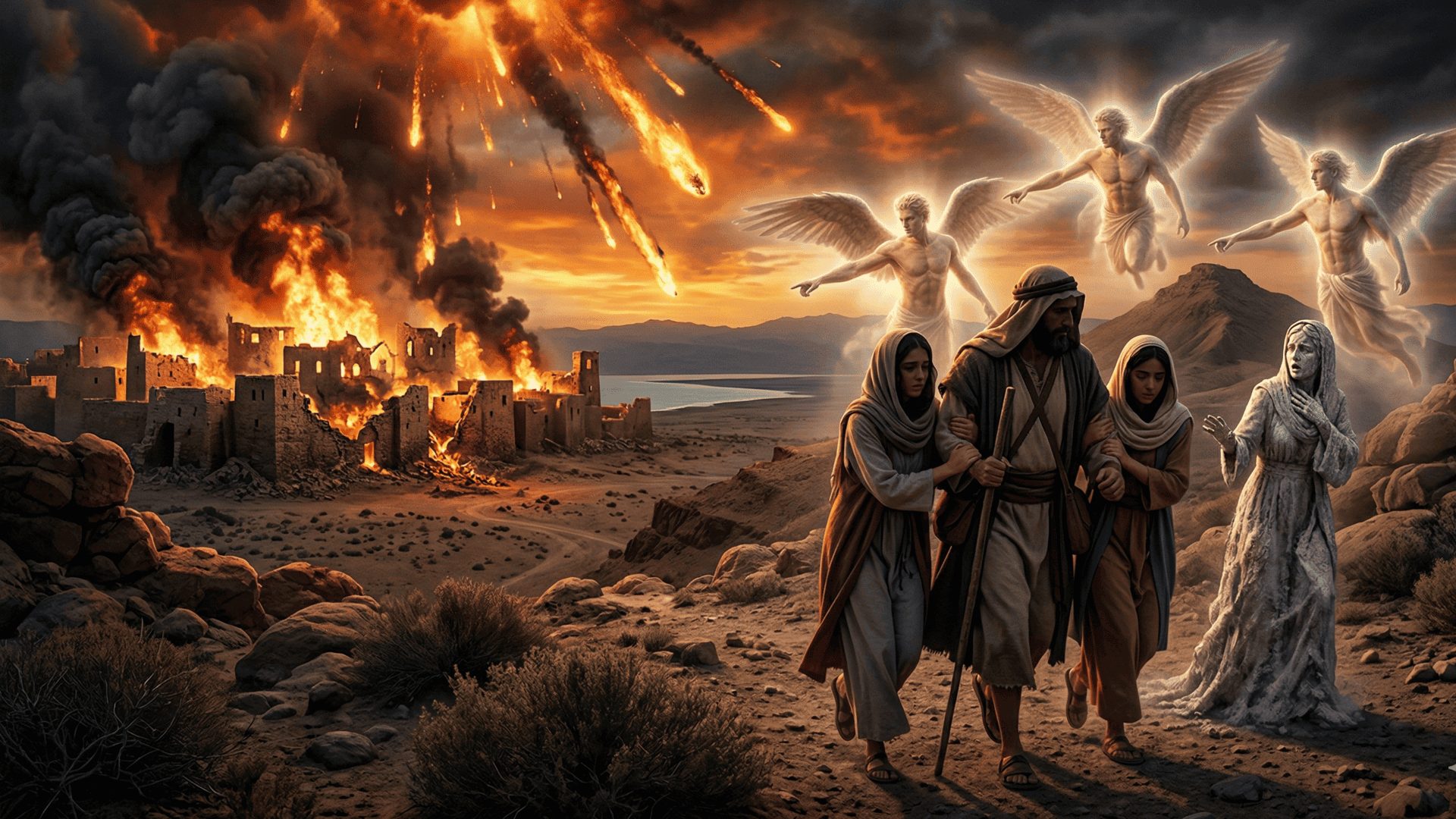
    The story of Lot is one of the most compelling, tragic, and deeply theological narratives shared across the three major Abrahamic religions: Judaism, Christianity, and Islam. Known as Lot in the Hebrew Bible and Christian Old Testament, and as Prophet Lut (لوط) in the Quran, his life serves as a profound case study in divine justice, mercy, human frailty, and the consequences of associating with profound wickedness.

    For centuries, theologians, rabbis, priests, and Islamic scholars have analyzed the story of Lot to understand the boundaries of God’s patience and the nature of salvation. However, while the foundational elements of his story—his association with Abraham (Ibrahim), his residence in a wicked city, a divine visitation by angels, and the catastrophic destruction of Sodom and Gomorrah—are shared, the theological interpretations of his character differ wildly. Was Lot a flawed, morally compromised survivor? Was he a righteous man tormented by the sins of his neighbors? Or was he an infallible prophet, divinely chosen by God to preach to a rebellious nation?

    In this comprehensive, 3000+ word guide, we will explore the story of Lot across Judaism, Christianity, and Islam. We will dive deep into the scriptures, explore the similarities that unite these traditions, unpack the theological differences that divide them, and provide answers to the most frequently asked questions.


    Historical and Geographical Context of the Lot Narrative

    Before examining the theological variations of Lot’s story, it is crucial to understand the historical and geographical backdrop against which this narrative unfolds. The story takes place in the Ancient Near East, during the Middle Bronze Age (roughly 2000–1500 BCE), a time characterized by nomadic pastoralism, the rise of early city-states, and tribal alliances.

    The Cities of the Plain

    The narrative centers around the “Cities of the Plain,” specifically Sodom and Gomorrah. According to biblical and historical geography, these cities were located in the Jordan River Valley, near the modern-day Dead Sea (also known historically as the Salt Sea or the Sea of Lot). This region is situated in a deep geological fault line, the Great Rift Valley, which is prone to seismic activity.

    In antiquity, the Jordan Valley was described as well-watered and lush—”like the garden of the Lord” (Genesis 13:10)—making it an incredibly attractive location for herdsmen like Lot. Today, the landscape is a stark, barren salt flat, a geographical transformation that heavily heavily mirrors the theological narrative of divine destruction by fire and brimstone.

    The Cultural Code of Hospitality

    To understand the gravity of the events in Lot’s story, one must grasp the ancient Near Eastern concept of hospitality (xenia in Greek, or hachnasat orchim in Jewish tradition). In a harsh, desert environment, offering shelter, food, and protection to traveling strangers was not just a courtesy; it was a sacred duty and a matter of life and death. A host was expected to protect their guests with their own life. The ultimate sin of the people of Sodom, across all three traditions, is rooted in their aggressive, violent perversion of this sacred code of hospitality when the angels arrive.


    Lot in Judaism: The Nephew, the Wanderer, and the Survivor

    In Judaism, the primary source for the story of Lot is the Torah, specifically the Book of Genesis (Bereshit). Lot is presented as a complex, deeply flawed, yet ultimately saved individual. He is not a prophet, but rather the nephew of Abraham (Abram), the patriarch of the Jewish faith.

    The Journey from Ur to Canaan

    Lot is the son of Haran, Abraham’s brother. After Haran’s early death in Ur of the Chaldeans, Lot is taken under Abraham’s wing. When God calls Abraham to leave his homeland and travel to Canaan, Lot travels with him (Genesis 12). They endure a famine, travel to Egypt, and eventually return to the region of the Negev and Bethel. During this time, Lot absorbs the teachings and ways of Abraham, but he never quite reaches his uncle’s level of spiritual magnitude.

    The Separation from Abraham

    The first major turning point in Lot’s biblical narrative occurs due to wealth. Both Abraham and Lot become incredibly prosperous, owning vast flocks, herds, and tents. The land can no longer support them both, leading to strife between their respective herdsmen.

    To prevent a family conflict, Abraham magnanimously offers Lot the choice of land. “If you go to the left, I will go to the right; if you go to the right, I will go to the left” (Genesis 13:9). Lot looks toward the fertile Jordan Valley, pitching his tents near Sodom. The Torah makes a crucial editorial note here: “Now the people of Sodom were wicked and were sinning greatly against the Lord” (Genesis 13:13). Lot’s choice is driven by economic opportunism, blinding him to the spiritual danger of his new neighbors.

    The Captivity and Rescue (Genesis 14)

    Before the famous destruction narrative, Lot is caught up in a regional conflict known as the War of the Kings. Four Mesopotamian kings rebel against five local kings of the Jordan Valley, including the king of Sodom. Sodom is defeated, and Lot and his possessions are taken captive.

    Upon hearing this, Abraham rallies 318 of his trained men, pursues the invaders, defeats them, and rescues Lot. This event highlights Abraham’s enduring familial loyalty to his nephew, despite Lot’s prior selfish choice of land. Yet, rather than returning to Abraham’s camp, Lot chooses to go back to Sodom, further embedding himself in the wicked city.

    The Destruction of Sodom and Gomorrah

    The climax of Lot’s story occurs in Genesis 19. Two angels, appearing as men, arrive in Sodom. Lot, sitting at the city gate (indicating he may have held a position of civic authority, possibly a judge), insists on hosting them, honoring the Abrahamic tradition of hospitality.

    However, the men of Sodom surround Lot’s house, demanding that he bring the strangers out so they can “know” them (a biblical euphemism for sexual assault, highlighting the city’s predatory violence and ultimate violation of hospitality). In a desperate and morally shocking attempt to protect his guests, Lot offers his two virgin daughters to the mob. The angels intervene, striking the mob with blindness, and inform Lot that God is going to destroy the city.

    The angels urge Lot to flee with his family. Lot hesitates, lingering so long that the angels physically grab his hand, his wife’s hand, and his daughters’ hands, dragging them out of the city before raining burning sulfur upon Sodom and Gomorrah.

    The Tragedy of Lot’s Wife

    As they flee, the angels issue a strict command: “Flee for your lives! Don’t look back, and don’t stop anywhere in the plain!” (Genesis 19:17). Despite the warning, Lot’s wife looks back, and she is transformed into a pillar of salt. In Jewish tradition, this is seen not just as punishment for curiosity, but as a consequence of her heart still being attached to the sinful city and her material possessions left behind.

    The Cave Incident and the Origins of Moab and Ammon

    The Jewish narrative contains a controversial and dark epilogue. Fearing further destruction and believing they are the last people on earth, Lot and his two daughters seek refuge in a cave. The daughters, desperate to preserve the human race, get their father drunk on wine on two consecutive nights and sleep with him.

    The resulting offspring are Moab and Ben-Ammi, who become the patriarchs of the Moabite and Ammonite nations—historic enemies of the Israelites. However, Jewish tradition also notes a divine providence hidden in this dark tale: Ruth the Moabite, a descendant of this union, eventually becomes the great-grandmother of King David, thus linking Lot to the Messianic lineage.

    Rabbinic Literature and Midrashic Interpretations

    In the Talmud and Midrash, the rabbis are highly critical of Lot. They view his separation from Abraham as a separation from God. When Lot chose Sodom, the rabbis say he essentially declared, “I want neither Abraham nor his God.”

    Rabbinic tradition often paints Lot as motivated by greed. Yet, they also acknowledge his redeeming quality: his commitment to hospitality, which he learned from Abraham. Regarding Lot’s wife (named Idit in Jewish tradition), the Midrash explains her punishment of salt was deeply poetic. When the angels arrived, Lot asked her to bring them salt, to which she stingily replied, “Are you introducing this evil custom [of extreme hospitality] to this place?” Because she sinned through salt, she was punished with salt.


    Lot in Christianity: The Righteous Man in a Wicked World

    Christianity inherits the Hebrew Bible as its Old Testament, and therefore, the foundational narrative of Lot remains identical to the Jewish account. Christians read Genesis 11-19 and accept the historical and scriptural accounts of Lot’s journey, his residence in Sodom, the angelic rescue, the destruction of the cities, and the subsequent cave narrative. However, the New Testament and subsequent Christian theology significantly shift the lens through which Lot’s character is viewed.

    The New Testament Perspective: “Righteous Lot”

    While Rabbinic Judaism often views Lot with skepticism, the New Testament elevates his moral standing. The most crucial text regarding Lot in Christianity is found in the Second Epistle of Peter (2 Peter 2:7-9):

    “And if he rescued righteous Lot, greatly distressed by the sensual conduct of the wicked (for as that righteous man lived among them day after day, he was tormenting his righteous soul over their lawless deeds that he saw and heard); then the Lord knows how to rescue the godly from trials…”

    Here, the Apostle Peter emphatically calls Lot “righteous” three times in two verses. In Christian theology, Lot becomes an archetype of the believer living in a fallen, sinful world. His hesitation to leave Sodom is downplayed, and instead, the focus is placed on his internal suffering. Lot is seen as a man who retained his faith and morality despite being surrounded by absolute depravity. God’s rescue of Lot serves as a theological promise that God will deliver believers from the final judgment of the wicked.

    Jesus’ Apocalyptic Warning: “Remember Lot’s Wife”

    Lot and his wife are directly invoked by Jesus Christ in the Gospel of Luke. When discussing the sudden and unexpected nature of the end times (the Second Coming), Jesus uses the destruction of Sodom as a parallel:

    “It was the same in the days of Lot. People were eating and drinking, buying and selling, planting and building. But the day Lot left Sodom, fire and sulfur rained down from heaven and destroyed them all… Remember Lot’s wife! Whoever tries to keep their life will lose it, and whoever loses their life will preserve it.” (Luke 17:28-33)

    In Christian theology, Lot’s wife becomes a powerful symbol of the dangers of being “double-minded” or loving the world more than God. Looking back is interpreted as a longing for her old life of sin and comfort. Jesus uses her story as a stark warning to His followers: when salvation is offered, one must leave their old, sinful life behind without hesitation or regret.

    Early Church Fathers and Allegorical Interpretations

    The Early Church Fathers heavily utilized the story of Lot for allegorical and moral instruction. St. Augustine viewed Lot’s escape from Sodom as an allegory for the Christian’s escape from the “City of Man” (the secular, sinful world) to the “City of God.”

    John Chrysostom, a prominent early Christian theologian, focused on Lot’s hospitality, urging Christians to emulate Lot’s willingness to welcome strangers, which Hebrews 13:2 references: “Do not forget to show hospitality to strangers, for by so doing some people have shown hospitality to angels without knowing it.”

    The Concept of Grace and Deliverance

    Christianity interprets Lot’s salvation entirely through the lens of God’s grace. Lot did not save himself; he hesitated and had to be physically dragged out of the city by angels. Theologically, this illustrates that human salvation relies entirely on God’s merciful intervention, not human perfection. Lot’s subsequent fall in the cave with his daughters is often viewed by Christian commentators as a sobering reminder of human depravity and the fact that even “righteous” individuals can fall into grave sin when isolated from godly communities (like Abraham’s camp).


    Lot (Lut) in Islam: The Chosen Prophet of God

    When we transition from the Judeo-Christian scriptures to the Quran, the narrative of Lot—known in Islam as Prophet Lut (عليه السلام, Peace Be Upon Him)—undergoes a massive theological transformation. In Islam, Lut is not merely Abraham’s nephew who made poor geographical choices; he is a highly esteemed Prophet and Messenger of God (Allah).

    The Status of Lut in the Quran

    The Quran mentions Lut 27 times across various Surahs (chapters), including Al-A’raf (7), Hud (11), Al-Hijr (15), Al-Anbiya (21), and Ash-Shu’ara (26). In Islam, prophets are the highest tier of human beings, chosen by God to guide humanity. The Quran explicitly elevates Lut, stating: “And We gave him [Lut] wisdom and knowledge… Indeed, he was of the righteous.” (Quran 21:74-75).

    As a Prophet (Nabi) and Messenger (Rasul), Lut is entirely detached from the moral ambiguities of the biblical narrative. He does not choose Sodom out of greed; rather, he is divinely commissioned by Allah to go to the people of Sodom to preach monotheism and call them away from their unprecedented sins.

    Prophet Lut’s Mission and Message

    In the Quranic narrative, Lut tirelessly preaches to his people, warning them of God’s wrath. He challenges them regarding their immorality, specifically highlighting their unprecedented sexual practices, highway robbery, and public indecency.

    Lut says to his people: “Do you commit such immorality as no one has preceded you with from among the worlds? Indeed, you approach men with desire, instead of women. Rather, you are a transgressing people.” (Quran 7:80-81).

    Despite his desperate pleas, the people of Sodom reject him, mock his purity, and threaten to expel him from the city, saying, “Evict them from your city! Indeed, they are men who keep themselves pure.” (Quran 7:82).

    The Rejection and the Angelic Visitation

    Just as in the biblical account, angels (traditionally understood in Islamic exegesis as Jibra’il, Mika’il, and Israfil) visit Lut in the form of handsome young men. Lut is deeply distressed by their arrival, knowing the vicious nature of his people. “And when Our messengers came to Lut, he was distressed for them and felt for them great discomfort, and said, ‘This is a trying day.’” (Quran 11:77).

    The men of the city rush to Lut’s house, demanding access to the guests. Lut attempts to dissuade them, offering his “daughters” to them in lawful marriage to prevent them from disgracing his guests. (Note: Many Islamic scholars, such as Ibn Kathir, interpret “my daughters” here not as his biological daughters, but referring to the women of the city, as a Prophet is considered the spiritual father of his nation, urging the men to return to lawful, natural marriages).

    The angels reveal their true identity, assuring Lut that the mob cannot harm him. They blind the attackers and command Lut to leave the city with his family during the night.

    The Punishment of the Cities of the Plain

    The destruction of Lut’s people in the Quran is apocalyptic. Allah sends a terrifying cry (a sonic blast), turns the city upside down, and rains upon them stones of baked clay, marked specifically for the transgressors. “So when Our command came, We made the highest part [of the city] its lowest and rained upon them stones of layered hard clay, [which were] marked from your Lord. And Allah’s punishment is not from the wrongdoers [very] far.” (Quran 11:82-83).

    The Betrayal of Lut’s Wife

    A significant parallel in the Quran is the fate of Lut’s wife. However, the Quran clarifies the nature of her sin. She is not punished simply for a reactionary glance over her shoulder. In Islam, Lut’s wife was a hypocrite who secretly aligned with the wicked people of Sodom. Exegesis (Tafsir) often details that she is the one who tipped off the townsfolk about the arrival of the handsome guests.

    In Surah At-Tahrim (66:10), Allah uses Lut’s wife as a definitive example of a disbeliever: “Allah presents an example of those who disbelieved: the wife of Noah and the wife of Lot. They were under two of Our righteous servants but betrayed them, so those prophets did not avail them from Allah at all, and it was said, ‘Enter the Fire with those who enter.’” Her betrayal was spiritual and ideological, proving that proximity to a prophet cannot save an unbeliever.

    The Doctrine of ‘Ismah (Infallibility) and the Rejection of the Cave Story

    The most profound difference between the Islamic and Judeo-Christian narratives is Islam’s total rejection of the biblical cave incident. Islamic theology holds to the doctrine of ‘Ismah, which dictates that Prophets are infallible and divinely protected by Allah from committing major sins, such as incest or drunkenness.

    Therefore, Muslims categorically reject the story of Lut committing incest with his daughters as a later corruption of the biblical text (tahrif). To attribute such a heinous act to a chosen Messenger of God is considered blasphemous in Islam. Lut’s story in the Quran ends with his dignified salvation and the destruction of his enemies, leaving his legacy as a pure, unwavering Prophet of God.


    Core Similarities: The Threads That Bind the Abrahamic Traditions

    Despite profound theological differences, reading the texts side-by-side reveals striking similarities that confirm a shared ancient origin for the narrative of Lot/Lut.

    1. The Centrality of Abraham/Ibrahim: In all three faiths, Lot’s story is inextricably linked to Abraham. He is Abraham’s relative, and his eventual salvation is deeply tied to God’s love and covenant with Abraham. (In Genesis, God remembers Abraham and brings Lot out of the catastrophe; in the Quran, the angels visit Ibrahim first to give him glad tidings of Isaac before telling him of their mission to destroy Lut’s people).
    2. The Sacred Duty of Hospitality: Lot’s defining positive virtue across Judaism, Christianity, and Islam is his aggressive defense of the ancient code of hospitality. He is willing to face a violent mob to protect strangers under his roof.
    3. Divine Justice vs. Extreme Wickedness: All three traditions agree that the destruction of Sodom was not a natural disaster, but a targeted act of divine retribution against a society that had embraced unprecedented levels of violence, sexual immorality, and cruelty to strangers.
    4. The Cautionary Tale of the Wife: Whether transformed into salt for looking back, or destroyed by brimstone for her spiritual betrayal, Lot’s wife serves universally as a cautionary archetype against sympathizing with sin and rejecting divine guidance.

    Key Differences: Theological Divergences

    The differences in how Judaism, Christianity, and Islam handle the story of Lot highlight the core theological frameworks unique to each religion.

    1. Character Evaluation: Flawed Survivor vs. Infallible Prophet

    • Judaism: Views Lot largely as a flawed individual who made poor choices motivated by wealth, distancing himself from the righteous Abraham. He is saved by the skin of his teeth, mostly due to Abraham’s merit.
    • Christianity: Emphasizes his internal righteousness in a fallen world. While acknowledging his biblical flaws, Christianity focuses on his salvation through God’s unmerited grace.
    • Islam: Elevates Lut to the highest human status as a Prophet (Nabi). He is not a compromised individual, but a brave, pure, and infallible messenger who suffers immensely to deliver God’s warning to a hostile nation.

    2. The Post-Destruction Narrative (The Cave)

    • Judeo-Christianity: Includes the dark narrative of Lot’s drunkenness and the incestuous origins of Moab and Ammon. This fits the biblical motif that even great biblical figures (like Noah, David, and Moses) have deep, highly visible flaws.
    • Islam: Completely rejects this story as a textual corruption. Islamic theology cannot reconcile prophethood with such grave sins, maintaining the absolute purity of Lut’s character.

    3. The Motivation of Lot’s Wife

    • Judeo-Christianity: Her destruction is often tied to her physical act of looking back (disobeying a direct angelic command), symbolizing a psychological attachment to the material wealth and life she left behind.
    • Islam: Her destruction is fundamentally rooted in Kufr (disbelief) and Nifaq (hypocrisy). She is destroyed not just for looking back, but for being an active participant and sympathizer with the wicked society, directly betraying her prophet husband.

    Conclusion

    The figure of Lot—whether viewed as the wandering nephew in Judaism, the righteous man saved by grace in Christianity, or the steadfast Prophet Lut in Islam—remains one of the most vital characters in religious history.

    His narrative forces believers to confront uncomfortable questions about wealth, the company we keep, the nature of divine judgment, and the lengths to which God will go to rescue those who hold onto faith. While the three Abrahamic faiths diverge significantly on the details of his character and his actions post-Sodom, they universally agree on the moral of his story: that ultimate justice belongs to the Divine, and that righteousness must be maintained even when the rest of the world falls into darkness.


    Frequently Asked Questions (FAQ) About Lot / Lut

    Was Lot a Prophet in the Bible?

    No. In the Hebrew Bible (Old Testament) and Christian traditions, Lot is not considered a prophet. He is known as the nephew of the Patriarch Abraham. While 2 Peter in the New Testament refers to him as “righteous Lot,” he does not hold the official office or calling of a prophet. In Islam, however, he is strictly revered as Prophet Lut, a chosen Messenger of Allah.

    Why did Lot’s wife turn into a pillar of salt?

    According to the Book of Genesis (19:26), Lot’s wife was turned into a pillar of salt because she disobeyed the angels’ direct command not to look back at the destruction of Sodom and Gomorrah. Theologically, in Judeo-Christian thought, this represents her heart’s lingering attachment to the sinful city. In Jewish Midrash, it is poetic justice for her refusal to offer salt to her guests.

    Who are Lot’s daughters, and what is their significance?

    In the biblical narrative, Lot escapes with two daughters. Believing the whole world has been destroyed, they intoxicate their father and sleep with him to preserve the human lineage. They give birth to Moab and Ben-Ammi, who become the founders of the Moabite and Ammonite nations. This story is significant in Judeo-Christianity as it explains the origins of Israel’s historic neighbors and enemies, and traces the lineage of Ruth (a Moabite) to King David. Islam completely rejects this story.

    What was the sin of Sodom and Gomorrah?

    While commonly associated purely with sexual immorality, the sins of Sodom were multifaceted. In Judaism and Christianity, the prophets (such as Ezekiel 16:49) state that Sodom was “arrogant, overfed and unconcerned; they did not help the poor and needy.” The attempted assault on the angels was the ultimate violation of the sacred law of hospitality. In Islam, the Quran highlights their unprecedented sexual immorality, highway robbery, and arrogant public rejection of Prophet Lut’s warnings.

    Are Abraham and Lot related?

    Yes. Across all three traditions, they are closely related. In the biblical account, Lot is the son of Haran, making him the nephew of Abraham (Abram). In Islamic tradition, Prophet Lut is also recognized as the nephew of Prophet Ibrahim, and Lut was one of the first people to believe in Ibrahim’s message before being sent on his own prophetic mission.


    Reference Links and Further Reading

    To explore the story of Lot further, consider consulting the following primary texts and historical resources:

    • The Holy Bible (NIV, ESV, or KJV): Read the foundational Judeo-Christian narrative in the Book of Genesis, Chapters 11-19. Additionally, explore New Testament references in Luke 17 and 2 Peter 2.
    • The Holy Quran: Read the Islamic narrative of Prophet Lut in clear English translation via Quran.com. Key chapters include Surah Al-A’raf (7:80-84), Surah Hud (11:77-83), and Surah At-Tahrim (66:10).
    • Jewish Encyclopedia: For a deep dive into Rabbinic literature and Midrashic interpretations of Lot, visit the Jewish Encyclopedia entry on Lot.
    • Catholic Encyclopedia: For early Church interpretations and allegorical meanings of Lot’s life, reference the New Advent Catholic Encyclopedia.
  • The Weight of Centuries: The Religious Significance of Methuselah in Judaism, Christianity, and Islam

    The Weight of Centuries: The Religious Significance of Methuselah in Judaism, Christianity, and Islam

    When contemplating the ancient figures of the Abrahamic faiths, certain names evoke immediate imagery: Adam, the first man; Noah, the survivor of the deluge; Abraham, the patriarch of monotheism. Yet, nestled within the intricate genealogies of the antediluvian (pre-flood) world lies a figure whose primary claim to fame is simply the sheer duration of his existence.

    Methuselah, the son of Enoch and the grandfather of Noah, is universally recognized as the longest-lived human being in biblical history, purportedly reaching the astonishing age of 969 years. However, to reduce Methuselah to a mere trivia question or a biological anomaly is to miss the profound theological, historical, and narrative significance he holds across Judaism, Christianity, and Islam.

    In all three major monotheistic traditions, the pre-flood world is viewed as an era of profound spiritual decay coupled with extraordinary human vitality. Methuselah stands at the precipice of this world, serving as a transitional figure between the idyllic origins of humanity in Eden and the catastrophic reset of the Great Flood. He is a symbol of divine patience, a preserver of esoteric wisdom, and a living monument to a lost age.

    This comprehensive exploration will delve deep into the texts, traditions, and theological interpretations surrounding Methuselah in Judaism, Christianity, and Islam, revealing how a man known primarily for his age became a pillar of ancient religious consciousness.


    1. Etymology and the Mystery of His Name

    Before examining the specific traditions of each faith, it is essential to understand the linguistic roots of Methuselah’s name, as ancient names often carried prophetic or descriptive significance.

    In Hebrew, the name is מְתוּשֶׁלַח (Məṯūšélaḥ). Scholars and theologians have debated its exact meaning for centuries, primarily settling on two dominant interpretations, both of which cast a prophetic shadow over his life.

    • “Man of the Dart” or “Man of the Spear”: The word math can mean “man,” and shelach can mean “dart,” “spear,” or “weapon.” Under this interpretation, Methuselah is viewed as a warrior figure, a concept that aligns surprisingly well with certain rabbinic traditions that depict him fighting against demons or the wicked generations of his time.
    • “His Death Shall Bring” or “When He Dies, It Shall Be Sent”: This is the more common theological interpretation. The root muth means “death,” and shalach means “to send.” According to this translation, Enoch (who walked with God and possessed prophetic foresight) named his son with the knowledge that the Great Flood would be withheld as long as Methuselah lived. The very year Methuselah died, the floodwaters were “sent.”

    This dual meaning—the warrior who defends righteousness and the living hourglass counting down to the apocalypse—forms the foundation of how Methuselah is understood across the various religious traditions.


    2. Methuselah in Judaism: The Righteous Pillar of the Antediluvian World

    In Jewish tradition, Methuselah is far more than a name on a genealogical list. He is fleshed out in the Midrash (rabbinic exegesis), the Aggadah (narrative lore), and mystical texts as a paragon of righteousness in an increasingly corrupt world.

    The Genesis Record

    The foundational text for Methuselah is Genesis 5:21–27, part of the Toledot (generations) of Adam. The text is highly formulaic, establishing the rhythm of life and death in the early world:

    “When Enoch had lived 65 years, he fathered Methuselah. Enoch walked with God after he fathered Methuselah 300 years and had other sons and daughters. Thus all the days of Enoch were 365 years. Enoch walked with God, and he was not, for God took him. When Methuselah had lived 187 years, he fathered Lamech. Methuselah lived after he fathered Lamech 782 years and had other sons and daughters. Thus all the days of Methuselah were 969 years, and he died.” (Genesis 5:21-27)

    This text establishes a crucial chronological fact that shapes Jewish theology: Methuselah lived right up to the very year of the Flood.

    Midrashic and Aggadic Traditions

    The rabbis of the Talmud and Midrash were deeply fascinated by the juxtaposition of Methuselah’s long life and the wickedness of his contemporaries. Why did God allow him to live so long?

    The Delay of the Flood According to the Midrash (specifically Genesis Rabbah), God intentionally delayed the Great Flood to honor Methuselah. The text suggests that the flood was held back for seven days after Methuselah’s passing to allow for the traditional Jewish mourning period (Shiva). Genesis 7:10 states, “And after the seven days the floodwaters came on the earth.” The rabbis interpret these “seven days” not as an arbitrary countdown, but as the days of mourning for Methuselah, the last truly righteous man of his generation aside from Noah. His immense lifespan was a manifestation of God’s extreme patience, offering humanity nearly a millennium to repent.

    The Sword of Methuselah One of the most fascinating aspects of Jewish folklore regarding Methuselah is his depiction as a warrior. Elaborating on the “Man of the Dart” etymology, the midrashic text Yalkut Shimoni and other medieval collections tell the legend of the Sword of Methuselah.

    According to this lore, Methuselah wielded a magnificent sword inscribed with the Ineffable Name of God (the Tetragrammaton). With this sword, he fought against the shedim (demons) and the wicked descendants of Cain who were filling the earth with violence. He reportedly slew thousands of demons, acting as a militant defender of righteousness. When he died, the sword passed to Noah, though the era of open, miraculous warfare against such entities came to an end with the deluge.

    Kabbalistic Perspectives

    In Kabbalah (Jewish mysticism), the extreme lifespans of the early patriarchs are often viewed through the lens of spiritual vitality. The souls of the antediluvian generations were considered “closer to the Source.” They had not yet suffered the spiritual degradation that would follow the flood. Methuselah, living the longest, possessed a soul capacity that allowed his physical vessel to endure for nearly a millennium. His life represents the maximum potential of the physical body when infused with a primal, uncorrupted soul-state.


    3. The Expansive Lore of the Pseudepigrapha: The Book of Enoch

    To fully grasp the ancient understanding of Methuselah, one must look beyond the canonical Hebrew Bible to the Pseudepigrapha, particularly the Book of Enoch (1 Enoch). While 1 Enoch is only canonical in the Ethiopian Orthodox Tewahedo Church and Beta Israel (Ethiopian Jewish) traditions, it was widely read by Second Temple Jews and early Christians, profoundly shaping their worldview.

    In the Enochic literature, Methuselah transforms from a passive genealogical link into a crucial protagonist.

    The Conduit of Revelation

    Because “God took” Enoch relatively early (at 365 years old), Enoch needed a reliable successor to preserve the divine visions and warnings he had received regarding the coming judgment. Methuselah serves as Enoch’s scribe and primary confidant.

    In 1 Enoch, Enoch takes his son on a visionary tour, explaining the movements of the stars, the origins of evil (the fallen angels, or Watchers), and the impending flood. Methuselah is commanded to preserve these writings and pass them down to future generations. He is the bridge of esoteric knowledge, ensuring that the wisdom of heaven survives the watery destruction of the earth.

    The Miraculous Birth of Noah

    Perhaps the most dramatic narrative involving Methuselah occurs in 1 Enoch 106, which details the birth of his grandson, Noah.

    According to the text, when Lamech’s wife gave birth to Noah, the baby was born extraordinary. His skin was “whiter than snow and redder than the bloom of a rose,” his hair was white, and when he opened his eyes, they illuminated the entire house like the sun. The infant immediately stood up and began to praise the Lord of Righteousness.

    Lamech was terrified, believing his wife had been unfaithful with one of the fallen angels (the Nephilim/Watchers). In a panic, Lamech ran to his father, Methuselah.

    Methuselah, recognizing the gravity of the situation, traveled to the ends of the earth to consult his own father, Enoch, who was residing with the angels. Enoch reassured Methuselah that the child was indeed human, but was specially chosen by God to be the savior of humanity during the coming destruction. Methuselah returned to Lamech, brought him the comforting news, and named the child Noah.

    This story elevates Methuselah to a patriarchal intercessor. He is the stabilizing elder, the one who seeks out divine truth when the younger generations are panicked by the supernatural.

    2 Enoch and the Priesthood

    In another pseudepigraphal text, 2 Enoch (also known as Slavonic Enoch), Methuselah is explicitly appointed as a priest. Following Enoch’s final assumption into heaven, the people ask Methuselah to take up his father’s mantle. Under divine instruction, Methuselah constructs an altar, offers animal sacrifices, and leads the people in worship, serving as the high priest of the antediluvian world until his death.


    4. Methuselah in Christianity: Grace, Lineage, and the Septuagint Crisis

    In Christianity, Methuselah’s significance is heavily tied to his place in the lineage of Jesus Christ, as well as complex theological debates held by the Early Church Fathers regarding the nature of the pre-flood world.

    The New Testament Lineage

    Methuselah’s only explicit mention in the New Testament is in the Gospel of Luke. Luke 3 traces the genealogy of Jesus backward from Joseph all the way to Adam.

    “…the son of Cainan, the son of Arphaxad, the son of Shem, the son of Noah, the son of Lamech, the son of Methuselah, the son of Enoch, the son of Jared, the son of Mahalaleel, the son of Cainan…” (Luke 3:36-37)

    For Christian theology, this lineage is vital. It establishes Jesus not merely as a descendant of Abraham (the Jewish Messiah, as emphasized in Matthew), but as a descendant of Adam—the savior of all humanity. Methuselah, as the longest-lived link in this chain, is a vital conduit through which the promise of the “seed of the woman” (Genesis 3:15) was preserved through the darkest era of human history.

    The Septuagint Chronology Crisis

    One of the most fascinating, yet often overlooked, controversies in early Christian biblical scholarship revolves around Methuselah’s age and the timing of the flood. This debate stems from differences between the Masoretic Text (the standard Hebrew text) and the Septuagint (the Greek translation of the Old Testament used by the early Church).

    Text Tradition Methuselah’s Age at Lamech’s Birth Years Lived After Lamech’s Birth Total Age Year of Death Relative to the Flood
    Masoretic Text 187 782 969 Died the exact year of the Flood.
    Septuagint (LXX) 167 802 969 Died 14 years AFTER the Flood began.

    The Septuagint numbers created a massive theological and logical crisis for early Christian scholars. If Methuselah lived 14 years past the flood, where was he? He was not on the Ark with Noah. Did he tread water for 14 years? Did God preserve him miraculously outside the Ark?

    Patristic Interpretations: St. Augustine’s Dilemma

    Saint Augustine of Hippo tackled this exact “Methuselah Problem” in his magnum opus, The City of God (Book XV, Chapter 13). Augustine, recognizing the infallibility of scripture, struggled deeply with this mathematical contradiction.

    Augustine rejected the idea that Methuselah survived the flood outside the Ark. He eventually concluded that the Septuagint translators had made an early scribal error that was subsequently copied. He leaned on the Hebrew texts (championed by his contemporary, Jerome) to resolve the timeline, affirming that Methuselah died before the deluge. This debate highlights how Methuselah was central to early Christian efforts to synchronize biblical chronologies.

    Theological Symbolism: The Long-Suffering of God

    Beyond mathematical debates, early Christians viewed Methuselah’s longevity as an allegory for God’s grace. In 1 Peter 3:20, the Apostle Peter speaks of how “God’s patience waited in the days of Noah.” Christian theologians applied this directly to Methuselah. Every extra decade added to Methuselah’s impossibly long life was viewed as God extending an olive branch to a wicked world, begging them to repent. His eventual death signaled that God’s grace, while vast, is not infinite, and judgment ultimately comes.


    5. Methuselah in Islam: Mattūshalakh and the Chain of Prophets

    While Methuselah is not mentioned by name in the Quran, he holds a respected place in Islamic tradition, particularly in the Qisas al-Anbiya (Tales of the Prophets) and the historical writings of renowned Islamic scholars like Al-Tabari and Ibn Kathir. In Arabic, he is known as متوشلخ (Mattūshalakh).

    The Chain of Prophetic Light

    In Islamic theology, the history of humanity is guided by an unbroken chain of prophets and righteous men who transmit the Tawhid (monotheism) from one generation to the next. Methuselah serves as a critical link between two great prophets: his father Idris (often identified with Enoch) and his grandson Nuh (Noah).

    According to Ibn Kathir in his Al-Bidayah wa’n-Nihayah (The Beginning and the End), when Idris was raised to heaven by God, the spiritual leadership of humanity fell to his son, Mattūshalakh. Islamic tradition portrays him not necessarily as a prophet (Nabi) in his own right, but as a deeply righteous patriarch who maintained the laws of God and preached against the creeping idolatry and corruption that was spreading among the descendants of Qabil (Cain).

    The Mu’ammarun (The Long-Lived Ones)

    Islamic literature contains a specific genre or concept known as the Mu’ammarun—individuals blessed by Allah with extraordinarily long lives. Mattūshalakh is universally cited as the chief of the Mu’ammarun prior to the flood.

    In Islamic thought, the longevity of these early generations is often accepted literally, attributed to several factors:

    1. Divine Will: Allah simply decreed longer lifespans for the early generations to populate the earth and establish the foundations of human civilization.
    2. Purity of Creation: The human body, being closer to its original creation from clay, possessed greater physical resilience and vitality.
    3. Absence of Disease: The environment and human genetics had not yet been corrupted by centuries of sin and environmental degradation.

    Historical Accounts in Islamic Tradition

    Al-Tabari, the great Persian scholar and historian, details the chronology of the pre-flood patriarchs. He aligns closely with the biblical narrative regarding Mattūshalakh’s age, recording that he lived for 969 years.

    Islamic narratives also echo the Jewish tradition that Mattūshalakh died right before the flood. Tabari notes that when Mattūshalakh passed away, the people of the earth had become entirely reprobate. Nuh, who had been preaching to his people for 950 years (as stated in Quran 29:14), finally received the command to build the Ark. The death of Mattūshalakh is seen in Islamic historical texts as the final withdrawal of God’s protective grace over the pre-flood world.


    6. The Enigma of Extreme Longevity: Theological and Rational Interpretations

    Across all three faiths, the sheer number—969 years—presents a profound intellectual and theological challenge. How do modern and classical scholars within Judaism, Christianity, and Islam reconcile this extreme longevity with the known biological limits of the human body? Several distinct schools of thought have emerged over the millennia.

    The Literal Interpretation

    Traditional, orthodox believers in all three faiths generally accept the 969 years literally. This view argues that biological realities in the antediluvian world were fundamentally different from today.

    • Genetic Purity: Adam and Eve were created perfect. As genetic mutations and degradation accumulated over successive generations, human lifespans naturally shortened. Methuselah, living relatively close to the dawn of creation, retained a high degree of this genetic purity.
    • Environmental Factors: Some interpretations refer to a “canopy theory,” based on the waters “above the firmament” in Genesis. According to this idea, the pre-flood earth may have experienced conditions such as reduced exposure to cosmic radiation, increased atmospheric pressure, and higher oxygen levels, which could have contributed to slower aging. The flood destroyed this optimal environment, leading to the rapid decline in lifespans seen in the generations after Noah.

    The Metaphorical/Mathematical Interpretations

    For those who find the literal interpretation incompatible with science, several alternative theories have been proposed by ancient commentators and modern scholars alike.

    1. The Lunar Month Theory One of the oldest rationalizations, even addressed and debunked by St. Augustine in the 5th century, is that the “years” mentioned in early Genesis were actually lunar months. If Methuselah’s 969 “years” were actually 969 months, his true age would be a highly realistic 78.5 years.

    • The Theological Problem: While this solves the biological issue for Methuselah, it destroys the rest of the timeline. If years were months, it means Enoch fathered Methuselah at the age of 65 months (a 5-and-a-half-year-old child), which is biologically absurd. Thus, this theory is generally rejected by serious scriptural scholars.

    2. The Dynasty or Clan Theory A more robust academic theory suggests that names like “Methuselah,” “Enoch,” and “Lamech” did not just represent single individuals, but entire tribes, dynasties, or familial epochs. Therefore, the statement “Methuselah lived 969 years” might mean that the tribal authority or dynasty founded by Methuselah ruled or existed for nearly a millennium before being assimilated or destroyed by the flood.

    3. Numerological Symbolism Ancient Near Eastern cultures, including the Sumerians and Babylonians, frequently used inflated numbers to express greatness, honor, or divine favor rather than literal chronological data. The Sumerian King List, for example, records kings who ruled for tens of thousands of years. In this context, Methuselah’s 969 years might be a symbolic Hebrew way of saying he was supremely blessed, deeply wise, and highly favored by God.

    The Theological Concept of Lifespan Decay

    Regardless of whether one takes the number literally or symbolically, all three faiths observe a theological narrative in the decay of the human lifespan. In Genesis 6:3, just before the flood, God declares: “My Spirit shall not abide in man forever, for he is flesh: his days shall be 120 years.” This represents a divine curtailing of human potential. Extreme longevity had not led humanity to greater wisdom or repentance; instead, it had allowed evil men to accumulate power, violence, and corruption over centuries. By shortening the human lifespan, God limited the amount of damage any single tyrant or wicked generation could inflict upon the earth. Methuselah stands as the high-water mark of human endurance, a peak from which humanity steadily descended to our current mortal constraints.


    7. Methuselah as a Cultural and Scientific Archetype

    The religious significance of Methuselah has deeply permeated secular culture, literature, and even modern science. His name has transcended its theological roots to become a universal shorthand for extreme age and endurance.

    Linguistic Idioms and Literature

    The phrase “as old as Methuselah” is a common idiom in the English language, used to hyperbolically describe something of great antiquity. In literature, figures who live unusually long lives or possess ancient, arcane knowledge are often compared to him. He appears as a character in works ranging from George Bernard Shaw’s Back to Methuselah, which explores the concept of extended human lifespans, to modern science fiction, where the “Methuselah syndrome” might refer to slowed aging or immortality.

    Scientific Metaphors

    In the scientific community, Methuselah’s name is frequently borrowed to describe organisms or celestial bodies of exceptional age.

    • The Methuselah Tree: A Great Basin bristlecone pine located in the White Mountains of California is named Methuselah. For many years, it was considered the oldest known living non-clonal organism on Earth, with an estimated age of over 4,800 years.
    • The Methuselah Star: HD 140283, a subgiant star located about 190 light-years away, is informally known as the Methuselah star. It is one of the oldest known stars in the universe, with an estimated age that borders on the estimated age of the universe itself, posing fascinating challenges for astronomers.
    • Genetics and Anti-Aging: In biology, the “Methuselah gene” (specifically the mth gene discovered in fruit flies) is a genetic mutation that significantly extends lifespan. Furthermore, the Methuselah Foundation is a non-profit medical charity focused on tissue engineering and regenerative medicine, with the explicit goal of extending healthy human lifespans.

    In all these secular usages, the shadow of the biblical patriarch remains intact. He is the ultimate benchmark against which all longevity is measured.


    Conclusion: The Enduring Legacy of the Oldest Man

    Methuselah’s presence in Judaism, Christianity, and Islam serves a remarkably similar, yet beautifully nuanced, purpose across the divides of theology.

    To the Jewish sages, he was the righteous warrior whose very breath held back the apocalypse, his death serving as the tragic catalyst for the world’s watery unmaking. The early Christians, his genealogy was a vital thread connecting the Savior to the dawn of creation, while his age was a testament to the agonizing, heart-breaking patience of a God waiting for a corrupted humanity to return to Him. To Islamic scholars, he was the faithful preserver of monotheism, carrying the light of his father Idris through a darkening world until it could be safely passed to Nuh.

    In a modern era obsessed with youth, health spans, and biological preservation, the ancient figure of Methuselah continues to resonate. He forces the reader of ancient texts to confront the brevity of their own existence. Whether one views his 969 years as literal biology, ancient dynastic history, or profound theological poetry, Methuselah remains a towering monolith in the landscape of human faith. He is the quiet sentinel standing at the edge of the old world, a man who watched centuries rise and fall, serving as the ultimate witness to both the height of human vitality and the depth of human frailty.

    Frequently Asked Questions About Methuselah

    Q: Did Methuselah really live to be 969 years old?

    A: This depends on the interpretive lens you use. Orthodox and traditional believers across Judaism, Christianity, and Islam generally accept the 969 years literally, attributing it to purer human genetics, a different pre-flood environment, or specific divine grace. However, many modern scholars and theologians suggest the number might be symbolic (representing a dynasty or clan), a translation of a different timekeeping method (like lunar cycles, though this creates mathematical issues), or a numerological ancient Near Eastern convention used to denote greatness and extreme divine favor.

    Q: Did Methuselah die in the Great Flood?

    A: No, traditional texts indicate he died before the floodwaters came. According to the standard Hebrew text (the Masoretic Text), he died in the exact year the flood began. Jewish Midrash actually teaches that God delayed the flood by seven days specifically to allow humanity to mourn Methuselah’s passing.

    Q: Why was there a controversy about his death in the Early Christian Church?

    A: The controversy stemmed from a mathematical discrepancy in the Septuagint (the ancient Greek translation of the Hebrew Bible). The numbers in that specific translation accidentally placed Methuselah’s death 14 years after the flood began. Since he wasn’t on Noah’s Ark, this created a major logical and theological headache for early Church fathers like St. Augustine, who eventually concluded it was a scribal error and deferred to the Hebrew timeline.

    Q: Who was Methuselah’s family?

    A: Methuselah was part of the pivotal antediluvian (pre-flood) patriarchal line. His father was Enoch (the man who “walked with God” and was taken to heaven without dying), his son was Lamech, and his grandson was Noah (the builder of the Ark).

    Q: If he only gets a few lines in Genesis, why is he so important?

    A: While his biblical real estate is small, his theological footprint is massive. He acts as the ultimate bridge between the creation of humanity and its destruction/reboot in the flood. Theologically, his incredibly long life is viewed as the ultimate symbol of God’s patience and long-suffering, giving a wicked world nearly a millennium to repent before the floodwaters were unleashed.

    Q: Are there any other books that talk about him besides the Bible?

    A: Yes! He is a major character in the pseudepigraphal Book of Enoch (1 Enoch), where he acts as a scribe, a preserver of heavenly secrets, and an intercessor for his family. He also features prominently in Jewish Midrashic lore (where he is sometimes depicted as a demon-fighting warrior) and Islamic historical texts by scholars like Al-Tabari.


  • Exploring Heber: The Hidden Figure Who Named a Nation and Bridged Three Faiths

    Exploring Heber: The Hidden Figure Who Named a Nation and Bridged Three Faiths

    History is often told through the lives of giants—the Abrahams, the Moseses, the Jesuses, and the Muhammads. Their names echo through the corridors of time, their deeds forming the bedrock of the world’s great monotheistic religions. Yet, standing quietly in the shadows of these monumental figures are the “hidden” ancestors, the crucial links in the chain of humanity without whom the grand narratives would snap.

    One such figure is Heber (most commonly known as Eber in Hebrew and English translations, and frequently identified with the Prophet Hud in Islamic tradition).

    Though he speaks no lines in the biblical book of Genesis, his legacy is staggering. He is the namesake of the Hebrew people, the preserver of a sacred language, a pivotal ancestor in Christian theology, and a mighty prophet of monotheism in the Quran. Heber represents a fascinating intersection of theology, etymology, and ancient Near Eastern history.

    This comprehensive exploration will take you on a journey through the ancient texts of Judaism, Christianity, and Islam to uncover the true identity, historical context, and enduring spiritual significance of Heber.


    1. The Etymological Enigma: What Does “Heber” Mean?

    Before we can understand the man, we must understand the name. In the ancient Near East, a name was never merely a label; it was a destiny, a description of character, or a monument to a historical event.

    The name Eber (Hebrew: עֵבֶר, romanized: ʿĒḇer) is derived from the Hebrew root word ע-ב-ר (Ayin-Bet-Resh). This root is one of the most dynamic and spiritually rich in the entire Hebrew lexicon.

    The Concept of “Crossing Over”

    The primary meaning of the root ע-ב-ר is “to pass over,” “to cross,” or “to transition.” It is a verb of motion, implying a journey from one state, location, or paradigm to another.

    • Geographical Meaning: Historically, it referred to the region “beyond” or “on the other side” of a major body of water, most likely the Euphrates River or the Jordan River. When the ancients spoke of “the people from across the river,” they used derivations of this root.
    • Spiritual Meaning: Theologically, it implies a transition. To be a “crosser over” is to leave behind the old world (polytheism, idolatry, familiar lands) and step into a new reality (monotheism, the Promised Land).

    When we look at the word Hebrew (Hebrew: עִבְרִי, ʿIvrī), it literally translates to “one who belongs to Eber” or “one who comes from the other side.” Therefore, the very identity of the Jewish people—and by extension, the spiritual roots of Christianity and Islam—is bound up in this concept of crossing boundaries and venturing into the unknown.

    “To be a Hebrew is to be eternally in a state of crossing over—from captivity to freedom, from idolatry to truth, from the known to the unknown.”


    2. Heber in Judaism: The Preserver of the Sacred Tongue

    In the Jewish tradition, Heber (Eber) is far more than a mere name in a dusty genealogical register. He is a man of profound righteousness, a prophet, and the vital bridge between the ancient world of Noah and the new world of Abraham.

    The Table of Nations (Genesis 10)

    Eber is introduced in the Book of Genesis during the famous “Table of Nations,” which outlines the descendants of Noah after the Great Flood.

    “To Shem also, the father of all the children of Eber, the elder brother of Japheth, children were born.”

    — Genesis 10:21

    This verse is incredibly significant. Shem is the father of many nations, yet the text specifically highlights him as the “father of all the children of Eber.” Eber is singled out. Why? Because from Eber’s line will eventually spring Abraham, Isaac, Jacob, and the entire nation of Israel.

    Eber is the great-grandson of Shem. His genealogy reads: Noah -> Shem -> Arpachshad -> Shelah -> Eber.

    The Division of the Earth: Peleg and the Tower of Babel

    Eber had two sons, and the naming of his firstborn provides one of the most tantalizing clues about his life:

    “To Eber were born two sons: the name of the one was Peleg, for in his days the earth was divided, and his brother’s name was Joktan.”

    — Genesis 10:25

    The name Peleg (פֶּלֶג) means “division.” But what division is Genesis referring to?

    Rabbinic tradition, captured in texts like the Midrash and the Seder Olam Rabbah, explains that Eber was a great prophet. He foresaw the catastrophic event of the Tower of Babel.

    According to the biblical narrative, humanity gathered in the plains of Shinar to build a tower to the heavens, an act of sheer hubris and defiance against God. As a consequence, God confused their languages and scattered them across the earth. This was the “division” of the world. Eber, acting under divine inspiration, named his son Peleg to memorialize this pivotal fracturing of the human family.

    The Refusal to Build and the Gift of Hebrew

    Jewish midrashic tradition provides a beautiful, albeit non-canonical, backstory to Eber’s life during the Tower of Babel crisis.

    When the tyrannical king Nimrod conscripted the known world to build the tower, Eber allegedly refused to participate. He rejected the idolatry and arrogance of the builders. Because he refused to join the rebellion, God rewarded him.

    When God struck the builders with the confusion of tongues (creating the myriad of languages we have today), He exempted Eber. Eber was allowed to retain the original, primordial language of Eden—the language God used to speak the universe into existence.

    This language became known as Hebrew—the language of Eber.

    Thus, in Jewish thought, the Hebrew language is not just an arbitrary human construct; it is a divine relic, preserved by the righteousness of one man who refused to follow the crowd. Eber represents the ultimate non-conformist, maintaining truth in an age of universal deception.

    The Academy of Shem and Eber

    Another fascinating element of Rabbinic literature is the concept of the Yeshiva (academy) of Shem and Eber.

    According to tradition, Shem and his great-grandson Eber lived extraordinarily long lives (Eber lived 464 years according to Genesis 11:16-17). Their lifespans overlapped with that of Abraham, Isaac, and Jacob. The Midrash claims that Shem and Eber established a spiritual academy where the ancient traditions, laws, and knowledge of God were taught.

    • Rebecca’s Inquiry: When Rebecca (Isaac’s wife) was experiencing turmoil in her womb with the twins Jacob and Esau, Genesis 25:22 says she “went to inquire of the Lord.” The Midrash explains that she actually went to the Academy of Shem and Eber to seek the wisdom of the ancient prophets.

    • Jacob’s Studies: Before fleeing to the house of Laban, tradition dictates that Jacob spent 14 years hidden away, studying Torah in the tents of Eber.

    Whether one views this as literal history or theological allegory, the meaning is clear: Eber represents the unbroken chain of divine truth. He is the custodian of faith between the destruction of the Flood and the covenant of Abraham.


    3. The Birth of the “Hebrews”: Identity and Ethnicity

    The transition from Eber the individual to the Hebrews as a people is a complex journey of linguistics and sociology.

    When Abram (Abraham) is first introduced as a major actor in the biblical narrative, he is given a specific title. In Genesis 14:13, a messenger comes to tell him that his nephew Lot has been captured. The text refers to him as “Abram the Hebrew” (Avram Ha-Ivri).

    This is the very first time the word “Hebrew” is used in the Bible. But what did it mean to Abraham’s contemporaries?

    The Genealogical vs. Geographical Debate

    1. The Genealogical View: The traditional, literalist view is straightforward. Abram is the descendant of Eber. Therefore, he is an Eberite, or a Hebrew. It is a marker of family lineage, connecting him back to the righteous preserver of the original language.
    2. The Geographical View: Many modern biblical scholars point out that Abram had just crossed the Euphrates River to enter the land of Canaan. To the native Canaanites, Abram was literally “the man from the other side” (Ivri). In this view, “Hebrew” started as a geographical descriptor that eventually evolved into an ethnic identity.

    The Mystery of the Habiru (Apiru)

    To be fully candid about the historical realities, we must look beyond religious texts and into the sands of archaeology.

    In the late 19th and early 20th centuries, archaeologists unearthing ancient Egyptian, Hittite, and Akkadian texts discovered repeated references to a group of people called the Habiru (or Apiru).

    These texts, dating from the 2nd millennium BCE (around the time the Patriarchs would have lived), describe the Habiru not as a specific ethnic group or a unified nation, but rather as a social class. The Habiru were outcasts, mercenaries, nomads, runaway slaves, and marginalized peoples who lived on the fringes of settled society. They were often viewed with suspicion by the established city-states.

    • The Linguistic Connection: Phonetically, Habiru and Hebrew (Ivri) are tantalizingly close.
    • The Social Connection: The biblical Israelites often found themselves in “Habiru-like” situations: wandering as nomads, living as oppressed slaves in Egypt, and fighting as outsiders to conquer the land of Canaan.

    The Academic Consensus today is nuanced. While most historians do not believe that all ancient Habiru were biblical Hebrews, they suggest that the early Hebrews might have been a subset of the wider Habiru social class. Over centuries, what began as a term for nomadic outsiders (those who “crossed over” borders) coalesced into the specific ethnic and religious identity of the Jewish people, traced retroactively to the eponymous ancestor, Eber.

    Regardless of the secular archaeological debate, the spiritual reality remains: the identity of the Hebrew is rooted in being an outsider, a traveler, a person who crosses boundaries for the sake of a higher calling.


    4. Heber in Christian Theology: The Typology of Crossing Over

    While Christianity shares the Old Testament foundation of Judaism, the figure of Heber is viewed through the specific lens of the New Testament and the fulfillment of the Messianic lineage.

    The Ancestor of the Christ

    In the Christian scriptures, Heber’s most prominent appearance is in the Gospel of Luke. Luke chapter 3 provides a reverse genealogy of Jesus Christ, tracing his lineage from Joseph all the way back to Adam, and ultimately to God.

    “the son of Serug, the son of Reu, the son of Peleg, the son of Eber, the son of Shelah, the son of Cainan, the son of Arphaxad, the son of Shem, the son of Noah…”

    — Luke 3:35-36

    In Christian theology, this genealogy is paramount. It proves that Jesus of Nazareth is fully integrated into the historical fabric of the human race. Unlike pagan gods who descended from the sky without context, the Christian Messiah is born of a specific lineage, fulfilling ancient promises.

    By including Eber, Luke emphasizes that Jesus is the ultimate “Hebrew.” He is the culmination of the promises made to the line of Shem.

    The Theological Typology: Baptism and Salvation

    Christianity is a religion heavily reliant on typology—the idea that events and figures in the Old Testament foreshadow greater spiritual realities in the New Testament. The concept of Eber (crossing over) is thoroughly woven into Christian sacramental theology.

    1. Crossing the Red Sea: The Israelites (the children of Eber) crossed the Red Sea to escape Egyptian slavery. In Christian theology (as articulated by the Apostle Paul in 1 Corinthians 10), this crossing is a “type” or foreshadowing of Christian Baptism. The believer passes through the waters, leaving the slavery of sin behind, and emerges on “the other side” as a new creation.

    2. Crossing the Jordan: Later, the Israelites cross the Jordan River to enter the Promised Land. Christians view this as a metaphor for passing from earthly life, through the “river” of death, into the heavenly Promised Land.

    3. The Epistle to the Hebrews: One of the most profound books of the New Testament is the Epistle to the Hebrews. The entire letter is an exhortation to Jewish Christians not to slide back into the familiar comforts of the old sacrificial system, but to press forward into the new covenant established by Christ. The writer is essentially telling them to live up to their namesake: to be true Hebrews, continuing to “cross over” into deeper faith, just as Abraham left his homeland to seek a city “whose designer and builder is God” (Hebrews 11:10).

    In this light, every Christian is called to adopt the spiritual posture of Eber—living as a pilgrim and a sojourner in a world that is not their ultimate home.


    5. Heber in Islam: The Prophet Hud and the Winds of Justice

    If you thought Eber was a significant, albeit quiet, figure in the Judeo-Christian tradition, the Islamic tradition offers a breathtaking expansion of his story. In Islam, the figure traditionally associated with the biblical Eber is the mighty Prophet Hud (Arabic: هود).

    Note: While some Islamic scholars draw a distinction between Eber and Hud, a vast majority of classical Islamic genealogists and historians (such as Ibn Kathir) identify Prophet Hud as the very same person as Eber from the biblical lineage. His lineage is often given as: Hud ibn Abd Allah ibn Ribah ibn Al-Khulud ibn ‘Ad ibn ‘Aus ibn Aram ibn Sam (Shem) ibn Nuh (Noah). Alternatively, a more direct mapping is Hud -> Shalikh (Shelah) -> Arfakhshand (Arpachshad) -> Sam (Shem).

    In the Quran, Hud is not a quiet scholar sitting in a tent; he is a fearless warner, a powerful orator, and the central figure of an epic struggle against one of the most terrifyingly powerful civilizations of the ancient world.

    The People of ‘Ad and Iram of the Pillars

    Hud was sent as a prophet to the tribe known as ʿĀd (عاد). The people of ‘Ad lived in a region called Al-Ahqaf (the sand dunes), traditionally located in the southern part of the Arabian Peninsula, possibly near modern-day Yemen or Oman, bordering the vast Rub’ al Khali (the Empty Quarter).

    The ‘Ad were not ordinary people. The Quran describes them as giants of men, blessed with immense physical strength and wealth. They were master builders, renowned for a magnificent city known as Iram of the Pillars (Iram Dhat al-Imad).

    “Have you not considered how your Lord dealt with ‘Aad – [with] Iram – who had lofty pillars, The likes of whom had never been created in the land?”

    — Quran, Surah Al-Fajr (89:6-8)

    Blessed with abundant rain, fertile lands, and incredible engineering skills, the ‘Ad built massive fortresses and towering palaces. However, their physical elevation was matched only by their spiritual degradation. They became incredibly arrogant, believing themselves invincible. T.hey abandoned the monotheistic teachings of their ancestor Noah and began worshipping stone idols (named Sada, Samud, and Heba). They were ruthless, oppressing the weak and acting as brutal tyrants in the land.

    The Message of Prophet Hud

    God chose Hud, a man from their own brethren, to guide them back to the straight path. The Quran recounts the fiery dialogues between Hud and his people across several Surahs (chapters), most notably Surah Hud (Chapter 11) and Surah Al-A’raf (Chapter 7).

    Hud’s message was the eternal message of Islam (Tawhid, or absolute monotheism):

    “O my people, worship Allah; you have no deity other than Him. You are not but inventors [of falsehood]. O my people, I do not ask you for it any reward. My reward is only from the one who created me. Then will you not reason?”

    — Quran, Surah Hud (11:50-51)

    Hud reminded them that their immense wealth, their muscular frames, and their soaring architecture were gifts from God, not the result of their own innate divinity. He warned them that just as the people of Noah were destroyed for their arrogance, the ‘Ad were not immune to God’s justice.

    The Arrogance of ‘Ad

    The response of the ‘Ad was predictable. They mocked him. T.hey viewed Hud as a madman, possessed by one of their idols. They scoffed at the idea of resurrection and divine judgment.

    “They said, ‘O Hud, you have not brought us clear evidence, and we are not ones to leave our gods on your say-so. Nor are we believers in you.’”

    — Quran, Surah Hud (11:53)

    They arrogantly challenged him, saying, “Who is greater than us in strength?” They dared him to bring about the punishment he promised.

    The Devastating Climax: The Sarsar Wind

    God’s patience eventually ran out. The punishment of the ‘Ad is one of the most chilling narratives in the Quran.

    It began with a severe drought that lasted for three years. The lush gardens of Iram withered. Just when the people were desperate, they saw a massive, dark cloud approaching the valley. They rejoiced, crying out, “This is a cloud bringing us rain!”

    But Hud knew better. It was not a cloud of mercy; it was the vehicle of divine wrath.

    The cloud unleashed a screaming, violent, freezing wind—a Sarsar wind. This was not a normal storm. It was a targeted, devastating tempest that raged for seven nights and eight consecutive days.

    “And as for ‘Aad, they were destroyed by a screaming, violent wind, which Allah imposed upon them for seven nights and eight days in succession, so you would see the people therein fallen as if they were hollow trunks of palm trees. Then do you see of them any remains?”

    — Quran, Surah Al-Haqqah (69:6-8)

    The wind was so powerful that it plucked the giants of ‘Ad from the ground and hurled them back down, snapping their necks. It destroyed their homes, eroded their mighty pillars, and buried their magnificent city beneath the sands of the desert.

    Hud and a small group of believers were saved by God’s mercy, safely sheltered from the devastation. After the destruction, tradition says Hud migrated to the Hadhramaut region, where he eventually died. His tomb is still a site of visitation in Yemen today.

    Through the figure of Hud, the Islamic tradition turns the genealogy of Eber into a profound moral epic. It serves as an eternal warning against the hubris of empire, the worship of material wealth, and the dangers of technological arrogance.


    6. Comparative Analysis: The Three Faces of Heber

    To truly appreciate the depth of this figure, we must look at how Judaism, Christianity, and Islam utilize him. While they share the same historical root, their theological applications diverge in fascinating ways.

    Feature / Tradition Judaism (Eber) Christianity (Eber) Islam (Hud / Eber)
    Primary Role Preserver of language, righteous ancestor, prophet who foresaw division. Genealogical link validating Christ’s humanity, typological symbol of salvation. Active Prophet, warner, and leader of an epic struggle against idolatry.
    Key Associated Event The Tower of Babel and the division of humanity (Peleg). The Incarnation (genealogy in Luke) and spiritual “crossing over” (baptism). The destruction of the arrogant ‘Ad people via a devastating windstorm.
    Theological Symbolism The non-conformist; staying true to God when the rest of the world rebels. The transition from the old covenant to the new; moving from death to life. The fragility of human power/wealth compared to the ultimate power of God.
    Linguistic Connection Eponymous ancestor of the “Hebrews” and the Hebrew language. Etymological root inspiring the Epistle to the Hebrews. Sometimes linguistically linked, but primary focus is on his prophetic message (Tawhid).
    Textual Source Genesis 10-11, Midrash, Book of Jubilees. Gospel of Luke 3, Book of Hebrews (thematically). Quran (Surah Hud, Surah Al-A’raf, Surah Al-Fajr).

    A Candid Observation:

    It is important to note the shift in narrative style. In the biblical text, Eber is entirely passive—a name in a list whose story is only fleshed out later by Rabbinic commentators trying to fill in the blanks. In the Quranic text, Hud is highly active, engaged in direct, quoted dialogue with his oppressors. This reflects the different purposes of the texts: Genesis uses genealogies to map the geopolitical world and Israel’s place within it, while the Quran uses prophetic narratives to demonstrate the repeating cycle of human arrogance and divine justice.


    7. The Archaeological Quest: Finding the Shadows of History

    While theology provides meaning, history seeks evidence. The quest to find secular, archaeological proof for Eber/Hud is fraught with challenges, typical of the ancient Near East.

    The Habiru Inscriptions

    As discussed earlier, the most substantial extrabiblical evidence relating to the name is the appearance of the Habiru/Apiru in Amarna letters and Egyptian steles. While these records do not confirm a single man named Eber, they definitively prove that a group of people identifying as “crossers over” or outsiders existed in the Levant during the 2nd millennium BCE. This lends massive historical credibility to the sociological backdrop of the Hebrew origins.

    The Search for Iram of the Pillars

    For centuries, Western scholars viewed the Quranic story of ‘Ad and the city of Iram as pure myth. How could a massive civilization simply vanish into the sand?

    However, in the early 1990s, an amateur archaeologist named Nicholas Clapp, using NASA satellite imagery and ancient maps by Ptolemy, identified ancient caravan routes converging at a well in the Dhofar region of Oman. Excavations led by Juris Zarins revealed the lost city of Ubar (which many scholars equate with Iram).

    They discovered a massive octagonal fortress with high walls and towering pillars. Fascinatingly, the archaeological evidence showed that the city met a sudden and catastrophic end. It did not fall to an invading army; rather, a massive sinkhole opened up beneath it, swallowing the fortress, likely triggered by a geological event or perhaps the severe atmospheric disturbances (like a devastating storm or cyclone) matching the Quranic description of a screaming wind.

    While we cannot definitively prove a man named Hud stood in that specific city, the discovery of a pillar-rich, suddenly destroyed ancient civilization in the exact region described by Islamic tradition forces historians to take the ancient narratives with intense seriousness.


    8. Lessons for the Modern Reader: The Enduring Legacy of Heber

    Why does a man who lived thousands of years ago matter in the 21st century? Whether you view Heber/Hud as a literal historical figure, a composite patriarch, or a spiritual archetype, the lessons embedded in his story are strikingly relevant to the modern human condition.

    1. The Courage of Non-Conformity

    In the Jewish tradition of the Tower of Babel, Eber is the lone dissenter. In an age where the entire world is moving in one direction (building a monument to human ego), Eber refuses to pick up a brick. Today, in a hyper-connected world driven by viral trends, outrage culture, and the pressure to conform, Eber stands as a testament to the power of the individual conscience. He teaches us that preserving truth is more important than achieving popularity.

    2. The Danger of Technological Hubris

    The Islamic narrative of Hud and the ‘Ad is a chilling warning for the modern era. The ‘Ad thought their advanced architecture, their mighty pillars, and their engineering prowess made them gods. They thought they had conquered nature.

    In our current era of artificial intelligence, genetic engineering, and unprecedented technological advancement, the story of Iram of the Pillars asks us a sobering question: Are we building our own towers of arrogance? The destructive wind that leveled ‘Ad reminds us that human civilization, no matter how advanced, remains profoundly fragile in the face of the natural world and the divine order.

    3. The Power of “Crossing Over”

    Finally, the very name Eber—to cross over—is the ultimate metaphor for human growth.

    • We must cross over from childhood to maturity.
    • We must cross over from ignorance to understanding.
    • We must cross over from our comfortable prejudices into the difficult terrain of empathy.

    The Christian interpretation of Eber reminds us that stagnation is spiritual death. We are meant to be travelers. To claim the identity of a “Hebrew” in the spiritual sense is to accept that you are a work in progress, constantly transitioning away from the bondage of your past and stepping bravely into the unknown future God has prepared.


    Conclusion: The Man on the Bridge

    History is not just the study of empires rising and falling; it is the study of the threads that connect us. Heber is one of those vital, golden threads.

    He is the bridge between the catastrophic cleansing of the Flood and the covenantal promise of Abraham. He is the bridge between the ancient, primordial language of Eden and the living Hebrew spoken in the streets of Jerusalem today. Hee is the bridge connecting the prophetic lineages of Judaism, the redemptive theology of Christianity, and the epic moral warnings of Islam.

    Though he may be a “hidden figure” in comparison to Moses or Abraham, his legacy is inescapable. Every time a Jewish person prays in the sacred tongue, every time a Christian speaks of crossing from death to life, and every time a Muslim recites the Quranic warnings against arrogance, the spirit of Heber is there.

    He stands at the riverbank of history, eternally beckoning humanity to leave behind the old idols, to refuse the vanity of the crowd, and to boldly cross over to the other side.

    Frequently Asked Questions About Heber (Eber/Hud)

    1. Who exactly is Heber in the Bible?

    Heber (most commonly translated as Eber in English Bibles) is a patriarch mentioned in the Book of Genesis. He is the great-grandson of Shem (Noah’s son) and a direct ancestor of Abraham. While he doesn’t have a speaking role in the biblical narrative, he is highly significant because he is the eponymous ancestor of the Israelites—the namesake of the “Hebrew” people.

    2. Are Heber and the Islamic Prophet Hud the same person?

    According to classical Islamic scholars and genealogists (such as Ibn Kathir), yes. The lineage of Prophet Hud maps directly to the biblical lineage of Eber, placing both figures in the exact same historical window between the Great Flood and the birth of Abraham. However, while the Bible focuses on his genealogical importance, the Quran details his active role as a prophet sent to warn the arrogant civilization of ‘Ad.

    3. Did Heber invent the Hebrew language?

    He didn’t invent it; rather, Jewish tradition states that he preserved it. According to the Midrash (ancient rabbinic commentaries), Eber refused to help build the Tower of Babel. Because he rejected this act of rebellion, God exempted him when He confused the languages of the earth. Eber was allowed to keep the original, primordial language of Eden, which subsequently became known as Hebrew—the language of Eber.

    4. What does the word “Hebrew” actually mean?

    The word Hebrew (Ivri in Hebrew) comes from the root word ע-ב-ר (Ayin-Bet-Resh), which means “to cross over” or “to pass through.” Historically, it likely referred to Abraham and his descendants as the people who “crossed over” the Euphrates River to enter Canaan. Spiritually, it signifies a people who crossed over from polytheism and idolatry into monotheism.

    5. Is there archaeological evidence for Heber or the Prophet Hud?

    While there is no direct physical evidence for a single man named Eber or Hud, there is fascinating historical context for both:

    • The Habiru: Ancient Egyptian and Akkadian texts frequently mention a group of nomadic outsiders and mercenaries called the Habiru or Apiru. Many historians believe this social class is the historical origin of the term “Hebrew.”
    • The City of Ubar: For centuries, the Quranic city of Iram (where Hud preached) was considered a myth. However, in the 1990s, satellite imagery helped uncover the lost city of Ubar in Oman. It featured the massive pillars described in the Quran and had collapsed into a massive sinkhole, mirroring the sudden, catastrophic destruction detailed in Islamic tradition.

    6. Why is Heber mentioned in the Christian New Testament?

    Heber is listed in the Gospel of Luke (Luke 3:35) in the genealogy of Jesus Christ. For Christians, this genealogy is crucial because it roots Jesus in literal human history and traces his lineage back through the ancient patriarchs, validating him as the fulfillment of God’s promises to the line of Shem and the Hebrew people.

    7. How old was Heber when he died?

    According to the genealogies in Genesis 11, Eber lived to be 464 years old. This incredibly long lifespan means that, according to biblical timelines, he actually outlived Abraham. This overlap is what inspired the Jewish tradition that Jacob studied at the “Academy of Shem and Eber” before fleeing to Haran.

  • The Man Who Cheated Death: Exploring Enoch’s Role in Judaism, Christianity, and Islam

    The Man Who Cheated Death: Exploring Enoch’s Role in Judaism, Christianity, and Islam

    In the grand, sweeping narratives of ancient scripture, most figures follow a familiar, inescapable pattern: they are born, they live (often for centuries, according to ancient texts), and they die. But tucked away in the fifth chapter of Genesis is a staggering, enigmatic exception.

    Between the creation of the world and the devastating flood of Noah, the Hebrew Bible lists a genealogy of patriarchs. When it reaches the seventh generation from Adam, the rhythm of the text breaks. We are introduced to Enoch. The text simply says: “Enoch walked with God; then he was no more, because God took him.”

    No death is recorded. No burial site is mentioned. He simply stepped out of the mortal realm and into the divine.

    From this single, tantalizing verse sprouted one of the most complex, fascinating, and widely adapted figures in ancient religious history. Enoch was transformed by later traditions from a quiet ancient patriarch into a heavenly scribe, a visionary of cosmic secrets, an exalted angel, and an Islamic prophet of wisdom.

    I do not hold personal religious beliefs, but I can analyze the vast historical texts to show how this one figure became a cornerstone of ancient mysticism. This article explores the evolution of Enoch across Judaism, Christianity, and Islam, examining how each tradition utilized his story to understand the cosmos, the nature of angels, and the bridge between humanity and the divine.


    Part I: The Biblical Foundation – The Enigma of Genesis

    To understand the massive mythology surrounding Enoch, we must first look at the sparse source material. Enoch appears in Genesis 5, right in the middle of the “antediluvian” (pre-flood) patriarchs.

    “When Enoch had lived 65 years, he became the father of Methuselah. After he became the father of Methuselah, Enoch walked faithfully with God 300 years and had other sons and daughters. Altogether, Enoch lived a total of 365 years. Enoch walked faithfully with God; then he was no more, because God took him.” (Genesis 5:21-24)

    The Significance of the Details

    While brief, this passage contains several highly significant details that ancient readers immediately seized upon:

    1. “Walked with God”: The phrasing here is unique. Prior patriarchs simply “lived.” Enoch is said to have “walked with God” (halakh eth-ha-elohim in Hebrew), suggesting an unparalleled level of righteous intimacy with the Creator. Noah is the only other figure in Genesis described this way.
    2. The 365 Years: In a list where men are recorded as living for 800 or 900 years (his son Methuselah famously lived to 969), Enoch’s lifespan is relatively short. However, the number 365 is not arbitrary. It perfectly matches the number of days in a solar year. This immediately linked Enoch in the ancient mind to astronomy, the heavens, and cosmic order.
    3. “God Took Him”: The Hebrew word used here is laqakh. It implies a divine assumption—being snatched away or received into heaven without tasting death. (A similar phrase is later used for the prophet Elijah, who ascends in a whirlwind of fire).

    Because the biblical text provided a blank slate regarding where Enoch went and what he saw when God took him, ancient writers rushed to fill in the gaps. If Enoch was taken into heaven, they reasoned, he must have seen the inner workings of the universe.


    Part II: Enoch in Judaism – From Patriarch to Heavenly Scribe

    It is in ancient Judaism—specifically during the Second Temple period (roughly 516 BCE to 70 CE)—that the character of Enoch truly explodes into a figure of cosmic importance. This era was marked by political turmoil, foreign occupations (Greek, then Roman), and the rise of “apocalyptic” literature. People were looking for heavenly explanations for their earthly suffering.

    Enoch became the ultimate apocalyptic hero. Because he had bypassed death to enter heaven, ancient Jewish writers used him as a mouthpiece to reveal the secrets of the universe, the origins of evil, and the coming judgment.

    The Book of Enoch (1 Enoch)

    The most famous text from this period is 1 Enoch, a massive compilation of texts written between 300 BCE and 100 CE. It is not a single book, but rather a library of five distinct works:

    • The Book of the Watchers: This is arguably the most famous section. It expands upon the strange story in Genesis 6 about the “Sons of God” mating with human women. In 1 Enoch, these are fallen angels called “Watchers” (led by Semjaza and Azazel). They descend to earth, mate with women, and produce giant, violent offspring called the Nephilim. Furthermore, the Watchers teach humanity forbidden arts: metallurgy, weaponry, cosmetics, and sorcery. God decides to flood the earth to cleanse it. Enoch is given the extraordinary task of acting as the intermediary, delivering God’s judgment to these fallen angels.
    • The Book of Parables: This section introduces a highly developed concept of a heavenly messiah figure known as the “Son of Man,” the “Chosen One,” and the “Righteous One.” Shockingly to modern readers, at the end of this book, Enoch himself is identified as this heavenly Son of Man.
    • The Astronomical Book: Expanding on his 365-year lifespan, this book presents Enoch being guided by the angel Uriel through the heavens, learning the movements of the sun, moon, and stars. It argues fiercely for a 364-day solar calendar (contrasting with the lunar calendar used by the Jerusalem Temple establishment).
    • The Book of Dream Visions: Enoch recounts the history of the world from Adam to the final judgment using animal allegories (e.g., bulls, sheep, wolves).
    • The Epistle of Enoch: A series of woes and warnings to the wicked, and encouragements to the righteous.

    During this era, 1 Enoch was wildly popular. Fragments of it were found among the Dead Sea Scrolls in Qumran, proving it was highly esteemed by ancient Jewish sects like the Essenes.

    3 Enoch: Metatron and Rabbinic Mysticism

    As Judaism evolved after the destruction of the Second Temple in 70 CE, the Rabbis began to distance themselves from apocalyptic literature. The Book of Enoch was marginalized. In fact, some later Rabbinic literature (like the Targum Onkelos) tried to downplay Enoch’s ascension entirely, suggesting that “God took him” simply meant he died prematurely so he wouldn’t be corrupted by the wicked world.

    However, Enoch survived in the underground world of Jewish mysticism (Kabbalah and Merkabah mysticism). In a later text known as 3 Enoch (dating to roughly the 5th century CE), a rabbi ascends to heaven and meets the supreme archangel, a towering figure of fire named Metatron.

    When the rabbi asks the angel who he is, Metatron replies that he was once the human Enoch. God took him, expanded his body to the size of the cosmos, gave him 72 wings and 365 eyes, and transformed his flesh into divine fire. In this mystical tradition, Enoch/Metatron becomes the “Lesser YHWH,” the heavenly scribe, and the chief of all angels who sits immediately next to the throne of God.


    Part III: Enoch in Christianity – Faith, Prophecy, and the Ethiopian Canon

    Early Christianity, born out of Second Temple Judaism, inherited the widespread fascination with Enoch. The early Christians were thoroughly familiar with 1 Enoch, and its theology deeply influenced the New Testament.

    The New Testament Echoes

    Enoch is explicitly mentioned three times in the New Testament, cementing his importance in the early Christian worldview:

    1. The Lineage of Jesus: In the Gospel of Luke (3:37), Enoch is listed in the genealogy connecting Jesus back to Adam.

    2. The Hall of Faith: In the Book of Hebrews, Enoch is held up as a paramount example of faith.

      “By faith Enoch was taken from this life, so that he did not experience death: ‘He could not be found, because God had taken him away.’ For before he was taken, he was commended as one who pleased God.” (Hebrews 11:5)

    3. The Epistle of Jude: The most remarkable New Testament reference is in the short letter of Jude. Jude explicitly quotes from the Book of Enoch (1 Enoch 1:9) as a genuine prophecy:

      “Enoch, the seventh from Adam, prophesied about them: ‘See, the Lord is coming with thousands upon thousands of his holy ones to judge everyone…’” (Jude 1:14-15)

    The fact that a canonical New Testament book quotes a non-canonical apocryphal book has caused headaches for Christian theologians for centuries. It proves undeniably that first-century Christians viewed Enochic literature with high authority.

    The Early Church Fathers

    In the first two centuries of the Church, many influential theologians—such as Justin Martyr, Irenaeus, and Tertullian—read the Book of Enoch, accepted its story of the fallen angels (the Watchers), and considered it divinely inspired scripture. Tertullian even argued that the Jews had deliberately removed it from their scriptures because it contained prophecies about Christ.

    However, by the 4th century, the tide turned. As the Christian biblical canon was being finalized, church leaders like St. Augustine and St. Jerome rejected 1 Enoch. They found its theology of angels mating with humans unsavory and incompatible with later Christian doctrines of angelic purity. Because the book lacked a Hebrew original (it was circulating in Greek and Aramaic), it was deemed uncanonical by the broader Western and Eastern churches. The text was slowly lost to Europe.

    The Ethiopian Orthodox Sanctuary

    There is one major, magnificent exception to the Christian marginalization of Enoch: The Ethiopian Orthodox Tewahedo Church.

    While the rest of the Christian world lost the Book of Enoch, the Ethiopian Church preserved it, translated it entirely into the Ge’ez language, and officially included it in their biblical canon. To this day, the Ethiopian Bible has 81 books, and 1 Enoch sits proudly among them.

    The Ethiopian Church viewed the prophecies of the “Son of Man” in 1 Enoch as clear, undeniable prophecies of Jesus Christ. For centuries, the complete text of 1 Enoch existed only in the highlands of Ethiopia. It wasn’t until 1773 that a Scottish explorer named James Bruce acquired three copies of the Ethiopic text and brought them back to Europe, sparking a massive revival in historical biblical scholarship that continues to this day.


    Part IV: Enoch in Islam – Idris, the Exalted Prophet

    While Judaism and Christianity trace Enoch through the specific genealogies of Genesis, the Islamic tradition recognizes him under a different name, integrating him seamlessly into the prophetic lineage of Islam. In the Islamic worldview, Enoch is highly associated with the prophet Idris (إدريس).

    The Quranic Elevation

    Idris is mentioned twice by name in the Quran. While the references are brief, they bestow upon him immense honor and validate his historical importance as a prophet of Allah.

    1. Surah Maryam (Mary):

      “And mention in the Book, Idris. Indeed, he was a man of truth and a prophet. And We raised him to a high station.” (Quran 19:56-57)

    2. Surah Al-Anbiya (The Prophets):

      “And [mention] Ishmael and Idris and Dhul-Kifl; all were of the patient. And We admitted them into Our mercy. Indeed, they were of the righteous.” (Quran 21:85-86)

    The phrase “raised him to a high station” (raf’anahu makanan aliyyan) in Surah Maryam is the critical link. Islamic scholars and commentators (Mufassirun) widely interpret this as a parallel to the biblical account of Enoch being taken up by God. According to many traditions, Allah raised Idris alive to heaven, where he remains.

    The Prophet of Civilization and Science

    Islamic tradition (found in the Hadith and the Tafsir, or exegetical writings) greatly expands on the character of Idris, viewing him not just as a religious figure, but as a foundational pillar of human civilization.

    The name “Idris” is often theorized by Arab linguists to be derived from the Arabic root d-r-s, which means “to study” or “to instruct.” True to this etymology, Islamic tradition paints Idris as a master of knowledge:

    • The First Scribe: Idris is widely credited in Islamic lore as being the first human being to write with a pen.
    • The First Tailor: Tradition holds that before Idris, humanity wore animal skins. Idris was the first to invent the art of tailoring and weaving garments.
    • Astronomy and Math: Much like the Jewish Astronomical Book of Enoch, Islamic historians like Al-Tabari recorded that Idris was the first to study the movements of the stars, introduce weights and measures, and develop early mathematics.

    In the Islamic narrative, Idris was sent to instruct the descendants of Cain (Qabil), who had fallen into corruption and ignorance. When they refused to listen, he became the first person to establish the concept of Jihad (struggle in the path of God) against corruption.

    The Night Journey (Isra and Mi’raj)

    Idris makes a pivotal appearance in one of the most important events in the life of the Prophet Muhammad: The Night Journey.

    According to Sahih Hadith literature, when the Prophet Muhammad ascended through the seven heavens, he met different prophets at each level. When Muhammad reached the fourth heaven, he was introduced to Idris. The Angel Jibril (Gabriel) said, “This is Idris; greet him.” Muhammad greeted him, and Idris replied, “Welcome, O pious brother and pious Prophet.”

    This placement in the fourth heaven aligns perfectly with the Quranic statement that he was “raised to a high station.”


    Part V: The Enduring Archetype – Why Enoch Matters Today

    How does a man who warrants only a few sentences in Genesis become a supreme angel in Jewish mysticism, a canonical prophet in Ethiopian Christianity, and the father of writing and civilization in Islam?

    The answer lies in what Enoch represents.

    Enoch stands at the precise intersection of the human and the divine. In a chaotic ancient world filled with death, flood, and corruption, Enoch represented the ultimate hope: that human beings are not strictly bound to the dirt. Through supreme righteousness, faith, and the pursuit of divine wisdom, a human being could breach the veil of heaven.

    Furthermore, as society became more complex, humans needed a way to explain the origins of advanced knowledge (astronomy, writing, mathematics) and the origins of systemic evil (warfare, vanity, corruption). Enoch became the ultimate literary vehicle. Because he had been to heaven, he was the perfect authoritative voice to explain the mechanics of the universe to those still stuck on earth.

    A Mirror to Three Faiths

    By looking at how each tradition handles Enoch, we see a mirror of their distinct theologies:

    • Judaism used Enoch to explore the deep mysteries of the cosmos, the tragedy of the fallen angels, and the mystical ascent to God’s throne (Metatron).
    • Christianity viewed Enoch as the ultimate model of faith, a foreshadowing of Jesus Christ’s own ascension, and a prophet of the coming judgment.
    • Islam presents Idris as a pioneer of civilization, rational thought, and prophethood, remembered as a teacher of humanity who was honored with a high station in Paradise.

    Conclusion

    The legacy of Enoch is a testament to the power of ancient storytelling and theology. From the briefest mention in the Hebrew Bible, he grew into a cosmic giant. Whether you are reading the apocalyptic visions of the Dead Sea Scrolls, chanting the ancient Ge’ez liturgy in an Ethiopian church, or studying the Tafsir of the Quran, the figure of the man who walked with God remains alive.

    Enoch bypassed death, not just in the ancient scriptures, but in human memory. By continually adapting his story to answer their deepest questions about the universe, Judaism, Christianity, and Islam ensured that the man God took would never truly be gone.


    Frequently Asked Questions About Enoch

    1. Why isn’t the Book of Enoch in the standard Bible?

    While 1 Enoch was highly influential among early Christians and Second Temple Jews, it was ultimately excluded from the biblical canons of modern Rabbinic Judaism, Catholicism, and Protestantism.

    By the 4th century CE, church leaders like St. Augustine and St. Jerome rejected it. They were uncomfortable with its theology—specifically the idea that spiritual angels (the Watchers) could mate with physical human women. Furthermore, because it lacked a surviving Hebrew manuscript at the time (circulating mostly in Greek and Aramaic), it was deemed non-canonical. The Ethiopian Orthodox Tewahedo Church is the only major Christian body that includes 1 Enoch in its official Bible, having preserved it in the Ge’ez language.

    2. Who are the “Watchers” and the “Nephilim”?

    In the Enochic tradition (specifically The Book of the Watchers), the Watchers are a group of fallen angels led by figures named Semjaza and Azazel. They rebelled against God by descending to Earth to mate with human women.

    The offspring of these unnatural unions were the Nephilim—a race of violent, ravenous giants who ravaged the earth. The Book of Enoch posits that the great flood of Noah’s time was sent primarily to wipe out the Nephilim and cleanse the earth of the forbidden knowledge (like weaponry and sorcery) that the Watchers had taught humanity.

    3. Is the Archangel Metatron the same person as Enoch?

    In specific branches of Jewish mysticism (Kabbalah and Merkabah mysticism), yes. According to the text known as 3 Enoch, when God took Enoch up to heaven, he did not just bring him there as a human guest. God transformed Enoch’s flesh into divine fire, enlarged him to cosmic proportions, and renamed him Metatron. In this tradition, Metatron serves as the “Lesser YHWH,” the heavenly scribe, and the highest of all angels, sitting right next to the throne of God.

    4. How is the Islamic prophet Idris connected to Enoch?

    Islamic scholars and historians widely identify the Quranic prophet Idris with the biblical Enoch. The Quran states that Idris was a man of truth whom Allah “raised to a high station” (Quran 19:56-57), which closely mirrors the Genesis account of Enoch being taken by God. Islamic tradition expands on Idris, viewing him not just as a prophet, but as the father of civilization—crediting him as the first human to write with a pen, tailor garments, and study mathematics and astronomy.

    5. Does the text literally mean Enoch never died?

    The phrase “he was no more, because God took him” (Genesis 5:24) has been debated for millennia:

    • Literal Assumption: Most ancient apocalyptic writers, early Christians, and Islamic commentators interpreted this to mean Enoch bypassed physical death entirely, being assumed alive into the heavenly realm.
    • Premature Death: Some later Rabbinic commentators (such as Rashi) and specific Targums pushed back against the mystical hype surrounding Enoch. They interpreted the verse to mean Enoch was a righteous man who died prematurely; God “took him” through an early natural death to spare him from being corrupted by the wicked generation living before the flood.

    6. Why is Enoch associated with the 365-day solar calendar?

    Genesis records Enoch’s earthly lifespan as exactly 365 years. In the ancient Near East, where lunar calendars (around 354 days) were often the standard for religious festivals, the number 365 immediately associated Enoch with the solar year. The authors of The Astronomical Book (part of 1 Enoch) used Enoch as a mouthpiece to fiercely advocate for a 364-day solar calendar, claiming Enoch was taught the precise movements of the sun and stars by the angel Uriel.

    7. Did the New Testament writers actually believe the Book of Enoch was real prophecy?

    Yes, evidence strongly suggests they did. The most glaring proof is in the Epistle of Jude (Jude 1:14-15), where the author directly quotes a passage from 1 Enoch 1:9, explicitly attributing it to “Enoch, the seventh from Adam” and calling it a prophecy. Additionally, the titles used for Jesus in the Gospels—most notably the “Son of Man”—draw heavily upon the messianic imagery first developed in the Book of Parables within 1 Enoch.

  • From Ark to Revelation: Noah in Judaism, Christianity, and Islam

    From Ark to Revelation: Noah in Judaism, Christianity, and Islam

    Few narratives in the tapestry of human history possess the enduring resonance of the great flood and the man chosen to survive it. Noah—known as Noach in Hebrew and Nuh in Arabic—stands as a monumental figure at the crossroads of the three great Abrahamic faiths: Judaism, Christianity, and Islam. While the basic architecture of his story remains recognizable across all three traditions—a righteous man, a divinely mandated vessel, a cataclysmic deluge, and the salvation of a remnant of life—the theological nuances, characterizations, and ultimate lessons drawn from his life vary remarkably.

    This comprehensive exploration delves into the figure of Noah across Judaism, Christianity, and Islam. By examining ancient scriptures, scholarly commentaries, and theological interpretations, we can trace how a single ancient mariner navigates the diverse spiritual waters of these three world religions, moving from a patriarch of a new humanity to a prefiguration of ultimate salvation, and finally, to an archetype of prophetic endurance.


    Part I: The Primordial Waters and Historical Context

    Before exploring the specific religious texts, it is essential to contextualize the narrative of Noah within the broader ancient Near East. The story of a global deluge was not born in a vacuum. Long before the codification of the Hebrew Bible, ancient Mesopotamian cultures circulated epic poems detailing catastrophic floods brought on by the gods.

    The Epic Precursors

    The most famous of these is the Epic of Gilgamesh, wherein the character Utnapishtim is instructed by the god Ea to build a boat to survive a flood decreed by the chief god, Enlil, who was simply annoyed by the noise of humanity. Similarly, the Atrahasis Epic details a flood sent to curb human overpopulation.

    The Monotheistic Shift

    When the Abrahamic traditions adapted the flood narrative, they enacted a profound theological revolution. The flood was no longer the result of capricious, irritated deities. Instead, it became a deeply moral event—a divine response to pervasive human wickedness, violence, and corruption. Noah is not saved because of a divine loophole or favoritism by a trickster god; he is saved because of his righteousness, his faith, and his obedience to a singular, moral Creator. This shift lays the foundation for how Judaism, Christianity, and Islam approach the figure of Noah.


    Part II: Noah in Judaism – The Righteous Man in His Generation

    In the Hebrew Bible (the Tanakh), Noah’s story is found primarily in the Book of Genesis (Chapters 6–9). Here, Noah is introduced as the bridge between the antediluvian (pre-flood) world and the world as we know it today. He is the second father of humanity, succeeding Adam.

    “Righteous in His Generation”

    Genesis 6:9 introduces him with a powerful but debated description:

    “These are the generations of Noah: Noah was a just man and perfect in his generations, and Noah walked with God.”

    The phrase “in his generations” (b’dorotav) has sparked centuries of profound Rabbinic debate, captured extensively in the Midrash and the Talmud.

    • The Relative View: Some rabbis, such as the great medieval commentator Rashi, noted that compared to the extreme wickedness of his contemporaries, Noah was righteous. However, had he lived in the generation of Abraham, he might have been considered merely ordinary. This view paints Noah as a man who managed to hold onto his morality in a dark time, but who lacked the proactive, world-changing faith of later patriarchs.
    • The Absolute View: Conversely, other sages argue that the phrase amplifies his praise. If Noah could maintain his righteousness in a generation so utterly corrupt that God chose to wipe it out, how much more righteous would he have been in a generation of good people!

    Unlike Abraham, who famously argued with God to save the wicked city of Sodom, Noah accepts God’s decree regarding the flood in silence. He builds the Ark, but the text does not record him pleading for the lives of his neighbors. This silence is a defining characteristic of the Jewish Noah—an obedient servant, but perhaps lacking the intercessory compassion of later prophets.

    The Ark (Tevah) and the Flood

    God commands Noah to build an Ark (in Hebrew, Tevah, which translates closer to “box” or “chest” rather than a shaped ship). The dimensions are precise: 300 cubits long, 50 cubits wide, and 30 cubits high. The building of this colossal structure—a process that Jewish tradition suggests took 120 years—was itself a sermon. It was a prolonged opportunity for humanity to observe, inquire, and repent, though none did.

    The floodwaters erupt from the “fountains of the great deep” and pour from the “windows of heaven.” For 40 days and 40 nights, the earth is submerged. Noah, his wife, his three sons (Shem, Ham, and Japheth), and their wives, along with the pairs of animals, endure a year-long confinement. The sending out of the raven and then the dove—which finally returns with a freshly plucked olive leaf—serves as one of the most enduring symbols of peace and divine reconciliation in human history.

    The Noahide Covenant and the Seven Laws

    Upon exiting the Ark, Noah builds an altar and offers sacrifices. God smells the “pleasing odor” and makes a unilateral, unconditional covenant with Noah, his descendants, and all living creatures: never again will a flood destroy the earth. The sign of this eternal covenant is the rainbow (keshet).

    Crucially, in Judaism, Noah is the recipient of a universal moral code. While the Torah later gives 613 commandments to the Jewish people at Mount Sinai, the Talmud (Sanhedrin 56a) identifies the Seven Laws of Noah (the Sheva Mitzvot B’nei Noach) as the bedrock moral obligations for all of humanity. These are:

    1. Not to worship idols.
    2. Not to curse God.
    3. Not to commit murder.
    4. Not to commit adultery or sexual immorality.
    5. Not to steal.
    6. Not to eat flesh torn from a living animal (respect for life).
    7. To establish courts of justice.

    In Jewish theology, any non-Jew who adheres to these seven laws is considered a “Righteous Gentile” and has a place in the World to Come. Thus, Noah is the foundational figure for universal human ethics.

    The Fall of Noah

    The Genesis narrative of Noah ends on a tragic, sobering note. Genesis 9 records that Noah, the man who survived the apocalypse, became a “man of the soil” and planted a vineyard. He drank of the wine, became intoxicated, and lay uncovered in his tent.

    His son Ham “saw the nakedness of his father” and told his brothers. Shem and Japheth respectfully walked backward with a garment to cover Noah. Upon waking, Noah curses Ham’s son, Canaan, condemning him to servitude, while blessing Shem and Japheth.

    For Jewish commentators, this episode underscores the frailty of human nature. The same man who could withstand a global cataclysm and the mockery of a wicked generation was undone by the comforts of the post-flood world. It serves as a stark warning about the dangers of losing one’s spiritual vigilance in times of peace and plenty.


    Part III: Noah in Christianity – Typology, Baptism, and the Preacher of Righteousness

    Christianity inherits the Hebrew scriptures, and thus accepts the entire Genesis account of Noah. However, through the lens of the New Testament and the writings of the early Church Fathers, the figure of Noah undergoes a profound typological and eschatological transformation. In Christianity, Noah is not just a historical patriarch; he is a prophetic shadow of Jesus Christ, and the Ark is a blueprint for Christian salvation.

    The Eschatological Warning: The “Days of Noah”

    In the Gospels, Jesus uses the story of Noah as a direct parallel to the end of the world and his own eventual return (the Parousia). In Matthew 24:37-39, Jesus warns:

    “But as the days of Noah were, so shall also the coming of the Son of man be. For as in the days that were before the flood they were eating and drinking, marrying and giving in marriage, until the day that Noah entered into the ark, And knew not until the flood came, and took them all away; so shall also the coming of the Son of man be.”

    Here, Noah’s generation represents spiritual apathy and distraction. The people were not necessarily condemned just for violence, but for being entirely consumed by the mundane aspects of life, ignoring the impending judgment. Noah stands as the model of the vigilant believer who prepares for divine judgment while the rest of the world remains blind.

    Faith and the “Preacher of Righteousness”

    The New Testament writers elevate Noah’s spiritual status, addressing the Rabbinic critique of his “silence.” In the Epistle to the Hebrews, Chapter 11 (often called the “Hall of Faith”), Noah is celebrated for his profound, active trust in God:

    “By faith Noah, being warned of God of things not seen as yet, moved with fear, prepared an ark to the saving of his house; by the which he condemned the world, and became heir of the righteousness which is by faith.” (Hebrews 11:7)

    Furthermore, the Apostle Peter explicitly labels Noah a “preacher of righteousness” (2 Peter 2:5). Christian tradition assumes that during the decades of building the Ark, Noah was actively preaching repentance to his contemporaries, warning them of the wrath to come. His failure to convert anyone is not seen as a lack of effort, but as proof of the utter hardness of human hearts.

    The Typology of the Ark and the Flood

    Perhaps the most significant Christian contribution to the Noah narrative is the use of typology—the theological concept where Old Testament figures, events, and objects prefigure (or serve as a “type” for) New Testament realities.

    1. The Ark as the Church: Early Church Fathers, such as St. Augustine and St. Cyprian, heavily utilized the Ark as a symbol for the Christian Church. Just as there was no salvation from the floodwaters outside the physical structure of the Ark, the early theologians argued that there was no spiritual salvation outside the Church (Extra Ecclesiam nulla salus). The wood of the Ark was frequently compared to the wood of the Cross—both being instruments of salvation crafted from trees.

    2. The Floodwaters as Baptism: The Apostle Peter draws a direct, explicit theological line between the waters of the flood and the sacrament of Christian baptism. In 1 Peter 3:20-21, he writes about those who were disobedient “in the days of Noah, while the ark was a preparing, wherein few, that is, eight souls were saved by water. The like figure whereunto even baptism doth also now save us…”

    In this striking reversal of imagery, the water that was an instrument of death and judgment in Genesis becomes the instrument of purification and new life in Christianity. Just as the flood washed the earth clean of its violent corruption, the waters of baptism wash the believer clean of original sin. Noah emerging from the Ark onto a cleansed earth prefigures the Christian rising from the baptismal font as a “new creation.”


    Part IV: Noah (Nuh) in Islam – The Arch-Prophet of Firm Resolve

    When we turn to the Quran and Islamic tradition, the portrait of Noah (known as Nuh) shifts dramatically from the Biblical account. In Islam, Nuh is a figure of monumental importance. He is not merely a righteous survivor; he is the first of the Rasul (Messengers sent with a specific law) and one of the five Ulu’l Azm (Arch-Prophets of Firm Resolve), alongside Abraham (Ibrahim), Moses (Musa), Jesus (Isa), and Muhammad.

    His story is dispersed throughout the Quran, with several chapters detailing his struggles, including an entire chapter named after him (Surah Nuh, Chapter 71).

    The 950-Year Struggle

    While the Bible mentions Noah’s age, the Quran specifically emphasizes the duration of his prophetic mission. Surah Al-‘Ankabut (29:14) states:

    “And We certainly sent Noah to his people, and he remained among them a thousand years minus fifty years, and the flood seized them while they were wrongdoers.”

    For 950 years, Nuh preached the message of Tawhid (the absolute oneness of God) to a fiercely polytheistic and idolatrous society. The Quran provides vivid details of his preaching. He preached to them day and night, in public and in secret. He reasoned with them using the beauty of the natural world and the promise of God’s forgiveness and bounty.

    Unlike the silent builder of Genesis, the Islamic Nuh is a desperate, weeping, exhausted, yet entirely unyielding orator. He faces mockery, physical abuse, and threats of stoning. The elites of his society dismiss him because his followers are only the poorest and lowest classes—a common theme in the struggles of all Islamic prophets.

    The Building of the Ark and the Mockery

    When God finally reveals to Nuh that no more of his people will believe, He commands Nuh to build the Ark under divine supervision. As he builds it, the societal mockery intensifies. The Quran notes that every time the chiefs of his people passed by him, they scoffed. Nuh’s response is one of supreme confidence in God: “If you ridicule us, then we will ridicule you just as you ridicule.” (Surah Hud, 11:38).

    The Heartbreak of the Drowning Son

    One of the most profound and uniquely Islamic elements of the Noah narrative is the story of his unnamed son (often called Canaan or Yam in Islamic tradition).

    In Genesis, Noah’s immediate family is saved entirely. In the Quran, faith—not bloodline—dictates salvation. As the waters rise, in a heartbreaking scene captured in Surah Hud (11:42-43), Nuh calls out to his son, who has separated himself from the believers:

    And it sailed with them through waves like mountains, and Noah called to his son who was apart [from them], “O my son, come aboard with us and be not with the disbelievers.” But he said, “I will take refuge on a mountain to protect me from the water.” [Noah] said, “There is no protector today from the decree of Allah, except for whom He gives mercy.” And the waves came between them, and he was among the drowned.

    Nuh, grieving, calls out to God, reminding Him of His promise to save his family. God’s response provides a foundational theological lesson in Islam regarding spiritual kinship versus biological kinship:

    He said, “O Noah, indeed he is not of your family; indeed, he is [one whose] work was other than righteous, so ask Me not for that about which you have no knowledge…” (Surah Hud 11:46).

    Prophetic Infallibility (Ismah) and the Absence of the Vineyard

    Crucially, the Islamic narrative ends with the Ark resting on Mount Judi (rather than the Biblical Ararat) and Nuh disembarking with God’s blessings.

    There is no mention whatsoever in the Quran or authentic Hadith of Noah planting a vineyard, getting drunk, or cursing his grandson. In Islamic theology, prophets are protected by God from committing major sins (Ismah). A prophet of God, an Ulu’l Azm, getting intoxicated and lying naked is considered entirely incompatible with the dignity, purity, and divinely protected status of prophethood. Thus, the Islamic Nuh remains an unblemished paragon of patience, endurance, and unwavering submission to the Divine will from beginning to end.


    Part V: Comparative Analysis and Theological Synthesis

    By placing these three traditions side-by-side, we can observe fascinating divergences and convergences that highlight the distinct theological priorities of Judaism, Christianity, and Islam.

    1. The Nature of Salvation and Covenant

    • Judaism emphasizes the legal and universal outcome of the flood. Noah is the anchor for the Noahide Laws, establishing a baseline of morality for all of civilization. The rainbow signifies a binding legal covenant between God and the physical earth.
    • Christianity spiritualizes the salvation. The physical rescue from the flood is secondary to what it represents: the spiritual rescue from sin through Jesus Christ. The Ark is the Church, and the water is Baptism. The focus moves from earthly preservation to eternal salvation.
    • Islam focuses on the theological boundary of salvation. Salvation is strictly a matter of Tawhid (monotheism) and obedience. The drowning of Nuh’s son serves as the ultimate proof that neither wealth, nor status, nor even being the biological child of an Arch-Prophet can save a soul that rejects God.

    2. The Character of the Man

    • Judaism presents a deeply human Noah. He is uniquely righteous in a dark time, but he is fundamentally flawed. His post-flood drunkenness serves as a poignant, realistic psychological portrait of survivor’s guilt or human frailty. He is a great man, but he is not elevated beyond human weakness.
    • Christianity smooths over some of his later flaws to emphasize his faith. The writer of Hebrews and the Apostle Peter lift him up as an exemplar of believing the unseen and preaching the truth. He becomes a heroic type of Christ.
    • Islam elevates Nuh to an almost superhuman level of endurance. Preaching for 950 years in the face of relentless abuse requires a fortitude that makes him one of the greatest human beings to ever live. His character is utterly spotless, fiercely protective of God’s message, and devoid of the moral failings depicted in Genesis.

    3. Justice versus Intercession

    The Rabbinic critique of Noah—that he did not pray for his generation like Abraham prayed for Sodom or Moses prayed for Israel—stands in stark contrast to the Islamic Nuh. In the Quran, Nuh does eventually pray against his people, but only after nearly a millennium of rejection, and only after God explicitly reveals to him that no one else will believe. In Surah Nuh, he finally prays: “My Lord, leave not upon the earth of the disbelievers an inhabitant.” This is not seen as a lack of compassion in Islam, but rather as perfect alignment with Divine justice after all human avenues for repentance have been exhausted.


    Conclusion: The Enduring Legacy of the Ark Builder

    From the ancient cuneiform tablets of Mesopotamia to the scrolls of the Torah, the epistles of the New Testament, and the recitation of the Quran, the figure of Noah has sailed through millennia of human consciousness.

    FFor the Jew, Noah is the righteous survivor who grounds the world in fundamental moral law, teaching us the fragility of human nature even after profound spiritual victories.

    For the Christian, Noah is the voice of warning in the wilderness, the builder of the wooden vessel that points forward to the cross, teaching us that faith in the unseen is the only refuge from the coming storm.

    For the Muslim, Nuh is the ultimate symbol of Sabr (patient endurance), a man who stood against the tide of an entire world for centuries without yielding, teaching us that true allegiance belongs to God alone, superseding even the deepest bonds of blood.

    Despite these differing theological lenses, the core of the Noahic narrative remains universally potent. The story of the flood confronts humanity with the uncomfortable realities of divine justice and human corruption. Yet, simultaneously, it offers the ultimate message of hope. Whether symbolized by a rainbow in the clouds, the cleansing waters of a baptismal font, or the peaceful resting of a ship on Mount Judi, Noah’s story assures us that even in the face of absolute catastrophe, divine mercy preserves the righteous, and a new beginning is always possible.

  • Comparing Joseph: Interpretations in Judaism, Christianity, and Islam

    Comparing Joseph: Interpretations in Judaism, Christianity, and Islam

    The story of Joseph—known as Yosef in Hebrew and Yusuf in Arabic—is one of the most profound, captivating, and intricately woven narratives shared across the Abrahamic faiths. As a figure who bridges the ancestral era of the patriarchs with the foundational era of national exodus and revelation, Joseph occupies a monumental space in Judaism, Christianity, and Islam. Yet, while the skeletal framework of his story remains remarkably consistent across the Torah, the Christian Bible, and the Quran, the theological lenses through which he is viewed diverge in fascinating ways.

    This comprehensive exploration delves into how Judaism, Christianity, and Islam interpret the life, trials, and triumphs of Joseph. By analyzing the sacred texts, commentaries, and theological traditions of these three world religions, we can uncover how a single historical and spiritual figure is utilized to teach deeply distinct lessons about divine providence, prophetic infallibility, redemptive suffering, and the human condition.


    Part I: Joseph in Judaism – The Righteous Sustainer and Prototype of Exile

    In Judaism, the story of Joseph (Yosef) is primarily found in the Book of Genesis (Bereshit), spanning chapters 37 through 50. It is the longest continuous narrative in the Torah, reflecting its critical importance. In the Jewish tradition, Joseph is the crucial link that explains how the Israelites transitioned from a small family of herdsmen in Canaan to a massive population enslaved in Egypt. However, beyond his historical role, Joseph represents an archetype of survival, moral fortitude, and divine providence.

    The Biblical Narrative in Genesis

    The Genesis account presents Joseph as the favored son of Jacob (Israel) and Rachel, born in Jacob’s old age. His father’s favoritism is symbolized by the gift of an ornate tunic, often translated as a “coat of many colors” (ketonet passim). This favoritism, combined with Joseph’s prophetic dreams wherein his brothers and parents bow down to him, breeds intense jealousy among his ten older half-brothers.

    The ensuing betrayal is stark: his brothers plot to kill him but ultimately sell him into slavery to passing Ishmaelite and Midianite merchants. Joseph is taken to Egypt and sold to Potiphar, a captain of Pharaoh’s guard. Through intellect and divine blessing, Joseph rises to manage Potiphar’s household, only to be falsely accused of attempted rape by Potiphar’s wife after he righteously rejects her advances.

    Thrown into the royal dungeon, Joseph remains steadfast. He successfully interprets the dreams of the Pharaoh’s cupbearer and baker, which eventually leads to him interpreting the Pharaoh’s own disturbing dreams of seven fat and seven lean cows. Recognizing Joseph’s divine wisdom, Pharaoh appoints him as the Vizier of Egypt. When a severe regional famine strikes, Joseph’s estranged brothers come to Egypt for food. In a dramatic, multi-chapter sequence of testing and revelation, Joseph eventually reveals his identity, forgives his brothers, and reunites with his grieving father, moving the entire family to the land of Goshen in Egypt.

    Yosef HaTzadik: The Righteous One

    In Jewish Rabbinic literature (the Talmud and Midrash), Joseph is bestowed with a unique title: Yosef HaTzadik (Joseph the Righteous). He is the only patriarch explicitly given this title. This designation is primarily rooted in his unwavering moral restraint during the episode with Potiphar’s wife.

    The Midrash expands on the Genesis narrative, detailing the intense psychological and emotional pressure Potiphar’s wife exerted on Joseph. According to Jewish tradition, her attempts to seduce him were relentless and daily. Joseph’s ability to resist temptation, especially as a young, isolated slave in a morally permissive foreign culture, elevates him to the pinnacle of righteous behavior. The Talmud (Sotah 36b) suggests that at the very moment Joseph was about to succumb, the image of his father Jacob’s face appeared to him in the window, giving him the spiritual strength to flee.

    Divine Providence (Hashgacha Pratit)

    The foundational theological theme of the Joseph narrative in Judaism is Hashgacha Pratit (Divine Providence). The text masterfully demonstrates how God operates not through overt, sea-splitting miracles, but through the seemingly mundane and tragic events of human history.

    Joseph himself articulates this theology at the climax of the narrative. When his brothers fear he will enact revenge after Jacob’s death, Joseph reassures them: “Although you intended me harm, God intended it for good, so as to bring about the present result—the survival of many people” (Genesis 50:20). In Judaism, Joseph teaches that even in the darkest pits of human malice and betrayal, God’s ultimate, benevolent plan is actively unfolding.

    The Prototype of the Jewish Exile

    For centuries of Jewish thinkers, Joseph has served as the ultimate prototype for the Diaspora Jew. He is stripped of his home, sold into an alien land, and forced to navigate the highest echelons of a foreign, pagan government. Yet, despite adopting Egyptian dress, taking an Egyptian name (Zaphenath-paneah), and marrying an Egyptian woman (Asenath), Joseph fundamentally retains his Israelite identity and morality.

    He demonstrates how a Jew can successfully engage with and even lead a secular society without assimilating spiritually. Before his death, he makes his brothers swear to carry his bones out of Egypt when God eventually redeems them, proving that his ultimate allegiance remained with the Promised Land and the covenant of Abraham.

    The Tension Between Joseph and Judah

    Rabbinic tradition also heavily focuses on the dynamic between Joseph and Judah (Yehuda). Joseph represents physical sustenance, administrative brilliance, and success in the material world. Judah represents leadership, repentance, and the eventual Davidic monarchy. In later Jewish eschatology, this dichotomy evolves into the concept of two messiahs: Mashiach ben Yosef (the Messiah son of Joseph), a practical, worldly leader who prepares the way and fights the physical battles of Israel, and Mashiach ben David (the Messiah son of David, descending from Judah), who brings about the ultimate spiritual redemption.


    Part II: Joseph in Christianity – The Ultimate Typology of Christ

    While Christianity fully inherits and venerates the Hebrew Bible’s account of Joseph, the Christian theological framework fundamentally shifts the interpretive lens. In the Christian tradition, Joseph is celebrated not only as a historical patriarch and moral exemplar but, most importantly, as a profound “type” or prefiguration of Jesus Christ.

    The Concept of Biblical Typology

    To understand the Christian interpretation of Joseph, one must understand typology. Typology is a method of biblical interpretation wherein Old Testament historical figures, events, or institutions (types) are viewed as prophetic foreshadowing of New Testament realities, specifically the life, death, and resurrection of Jesus Christ (the antitype).

    While Joseph is never explicitly named as a type of Christ by Jesus himself in the Gospels, the early Church Fathers (such as Augustine, Ambrose, and John Chrysostom) and centuries of Christian theologians have pointed to the staggering number of parallels between the two figures.

    Parallels Between Joseph and Jesus

    The Christological reading of Joseph outlines a narrative of suffering, betrayal, descent, and glorious exaltation that mirrors the Gospel accounts perfectly. Key parallels include:

    • The Beloved Son: Just as Joseph was the beloved son of his father Jacob, Jesus is the beloved Son of God the Father (Matthew 3:17).
    • Betrayal by Brethren: Joseph was rejected and envied by his own brothers. The Gospel of John (1:11) notes of Jesus: “He came to his own, and his own people did not receive him.”
    • The Plot and the Price: Joseph’s brothers plotted to kill him and ultimately sold him for 20 pieces of silver. Jesus was plotted against by the religious leaders and betrayed by Judas (the Greek translation of Judah, the brother who suggested selling Joseph) for 30 pieces of silver.
    • Descent into the “Pit”: Joseph was thrown into an empty well (a pit) and later placed in an Egyptian dungeon. In Christian theology, this mirrors Christ’s death, his descent into the grave, and the harrowing of hell.
    • Between Two Sinners: In the Egyptian dungeon, Joseph was placed between the chief baker and the chief cupbearer. He prophesied life for one and death for the other. Jesus was crucified between two thieves, granting salvation to the repentant thief and judgment to the unrepentant one.
    • Exaltation at Age Thirty: Genesis 41:46 notes that Joseph was thirty years old when he entered the service of Pharaoh. The Gospel of Luke (3:23) notes that Jesus was about thirty years old when he began his earthly ministry.
    • Sustainer of the World: Joseph became the savior of the known world, providing bread to starving nations during a severe famine. Jesus declares himself the “Bread of Life” (John 6:35), providing spiritual salvation and the Eucharist to a spiritually starving world.
    • Forgiveness and Reconciliation: Just as Joseph forgave his brothers and wept with them, Jesus forgave his executioners from the cross (“Father, forgive them, for they know not what they do”) and offers reconciliation to all of humanity who rebelled against him.

    New Testament References and Moral Example

    Beyond typology, Joseph is explicitly praised in the New Testament. In the Book of Acts (7:9-16), Stephen the Martyr summarizes Joseph’s story during his defense before the Sanhedrin, using Joseph’s rejection by his brothers as a historical precedent for the contemporary Jewish rejection of Jesus.

    In the Epistle to the Hebrews (11:22), Joseph is enshrined in the “Hall of Faith.” The author specifically highlights Joseph’s dying moments: “By faith Joseph, when his end was near, spoke about the exodus of the Israelites from Egypt and gave instructions concerning the burial of his bones.” This highlights Joseph’s unwavering faith in God’s promises, looking beyond his immediate Egyptian glory to the eternal promises made to Abraham.

    Furthermore, in Christian moral theology, Joseph serves as a supreme example of purity and chastity. Throughout the Middle Ages and the Renaissance, sermons and Christian literature frequently pointed to Joseph fleeing from Potiphar’s wife as the definitive blueprint for how believers should actively flee from sexual immorality and temptation, adhering strictly to the Pauline injunction to “flee from sexual immorality” (1 Corinthians 6:18).


    Part III: Joseph in Islam – The Infallible Prophet and the Beautiful Story

    In Islam, Joseph is known as Yusuf, and his status is elevated to that of a chosen Prophet (Nabi) of Allah. The narrative of Yusuf holds a totally unique position within the Quran. Unlike other prophets (such as Musa/Moses or Isa/Jesus) whose stories are scattered in fragments across various chapters, the story of Yusuf is told in a single, continuous, highly detailed narrative in Chapter 12 of the Quran, naturally named Surah Yusuf.

    Ahsan al-Qasas: The Most Beautiful of Stories

    The Quran itself introduces the narrative of Yusuf as Ahsan al-Qasas, “the most beautiful of stories” or “the best of narratives” (Quran 12:3). Revealed in Mecca during a period of immense sorrow and persecution for the Prophet Muhammad (often called the Year of Sorrow), the story of Yusuf was revealed to comfort Muhammad. It served as a divine reassurance that just as Yusuf was persecuted by his own brethren, exiled, and eventually made victorious by God, so too would Muhammad endure rejection by his tribe (the Quraysh) only to eventually return in triumph.

    Prophetic Infallibility (‘Ismah)

    A critical difference between the Judeo-Christian perspective and the Islamic perspective is the concept of ‘Ismah, or prophetic infallibility. In the Bible, prophets and patriarchs are deeply flawed human beings capable of grave sins. In Islam, prophets are divinely protected from committing major sins. Therefore, the Islamic telling of Yusuf’s story removes or alters elements that might suggest moral failing on his part.

    For example, in the Biblical account, Joseph’s youthful boasting about his dreams could be interpreted as arrogant. In the Quran, Yusuf is a respectful, spiritually mature youth. When he tells his father Yaqub (Jacob) about his dream of the sun, moon, and eleven stars bowing to him, Yaqub immediately recognizes Yusuf’s prophetic destiny and warns him not to tell his brothers, knowing Satan will stir their envy.

    The Motif of the Shirt (Qamis)

    The Quran uses the motif of Yusuf’s shirt (qamis) as a powerful literary and symbolic device throughout the Surah, marking three critical transitions in the story:

    1. The Bloody Shirt (Deception): The brothers bring Yusuf’s shirt stained with false blood to their father as “proof” that a wolf ate him.
    2. The Torn Shirt (Proof of Innocence): During the seduction attempt by the wife of the Al-Aziz (the Quranic title for Potiphar), she chases Yusuf as he flees and tears his shirt from behind. When her husband confronts them, a witness points out that if the shirt is torn from the front, she is telling the truth, but if it is torn from the back, Yusuf is innocent. The shirt torn from the back serves as undeniable physical proof of Yusuf’s chastity.
    3. The Healing Shirt (Reconciliation): When Yusuf reveals himself to his brothers in Egypt, he gives them his shirt to cast over their father Yaqub’s face, miraculously curing Yaqub of the blindness he had developed from years of weeping over Yusuf.

    Zuleikha and the Women of the City

    The Quran also provides more psychological depth to the character of the minister’s wife, traditionally named Zuleikha in Islamic lore. When the women of the city begin to gossip about her infatuation with her slave, she invites them to a banquet and hands each woman a knife to cut fruit. She then orders Yusuf to walk into the room. The women are so struck by his blinding, angelic beauty that they unknowingly slice their own hands, declaring, “God preserve us! This is no human being. This is but a noble angel!” (Quran 12:31). Zuleikha uses this to justify her overwhelming passion, though Yusuf still chooses prison over committing a sin against God.

    Yaqub’s Beautiful Patience (Sabr Jamil)

    The portrayal of Jacob (Yaqub) in the Quran is vastly different from Genesis. In the Bible, Jacob is utterly deceived by the bloody coat, tearing his clothes and refusing to be comforted, sinking into a decades-long depression.

    In Islam, Yaqub is a Prophet who knows that his sons are lying. When presented with the bloody shirt, he notes the absurdity of a wolf eating his son but leaving the shirt completely intact. Yaqub says, “Rather, your souls have enticed you to something, so beautiful patience [sabr jamil] is most fitting. And Allah is the one sought for help against that which you describe” (Quran 12:18). Yaqub never loses his faith in Allah’s promise, representing the ultimate model of spiritual resilience.

    Dawah (Proselytizing) in Prison

    Another unique Islamic element is Yusuf’s behavior in prison. Before he interprets the dreams of his two cellmates, Yusuf uses the opportunity to preach the oneness of God (Tawhid). He delivers a sermon denouncing idolatry, asking, “O my two companions of prison, are diverse lords better or Allah, the One, the Prevailing?” (Quran 12:39). This cements his status not just as a dreamer, but as an active, preaching Prophet calling people to the truth.


    Part IV: Comparative Analysis – Intersecting Themes and Divergent Emphases

    When we place the Torah, the Christian Bible, and the Quran side by side, the story of Joseph serves as a magnificent case study in how the same narrative bedrock is sculpted into different theological monuments.

    Humanity vs. Prophetic Perfection

    The most glaring difference lies in characterization. The Jewish and Christian traditions are comfortable with the humanity of their patriarchs. The biblical Joseph is brilliant and righteous, but he can also be perceived as a slightly arrogant youth who later plays a highly manipulative psychological game with his brothers (planting silver cups in sacks, keeping Simeon hostage).

    Islam, bound by the doctrine of ‘Ismah, smooths these edges. Yusuf’s actions with his brothers are guided by divine revelation, not personal vengeance or psychological testing. He is a perfectly polished mirror reflecting divine attributes from his youth to his death.

    The Role of the Father

    The divergence in Jacob/Yaqub’s character is equally profound. The biblical Jacob is a tragic, heavily burdened father who is easily duped by his sons—a cosmic irony, given that Jacob himself duped his own father, Isaac, with a goat skin in his youth. The Genesis narrative uses Jacob to show that actions have generational consequences.

    The Quranic Yaqub is fully aware of the deception. He is a prophet who possesses knowledge from God that his sons do not have. His grief is not born of a lack of faith or deception, but of deep paternal love and the painful waiting for Allah’s plan to unfold.

    The Focus of Divine Providence

    All three traditions agree that the ultimate lesson of Joseph’s life is divine providence. However, the application differs:

    • In Judaism, providence is applied to the nation. Joseph’s suffering is the necessary mechanism to move the children of Israel to Egypt, setting the stage for the Exodus, the giving of the Torah, and the birth of the Jewish nation.
    • In Christianity, providence is applied to salvation history. Joseph’s suffering and exaltation are the mechanism God uses to teach humanity how to recognize the ultimate Savior, Jesus Christ, who will suffer and be exalted to save the whole world from spiritual famine.
    • In Islam, providence is applied to the individual soul and the nature of God’s decree (Qadar). The story is a timeless manifesto declaring that whoever maintains Taqwa (God-consciousness) and Sabr (patience), Allah will never let their reward be lost. It is a direct comfort to the Prophet Muhammad and all believers facing hardship.

    Forgiveness as a Universal Thread

    Despite the theological divergences, the climax of the story remains universal and identical across all three faiths: radical, unconditional forgiveness. When Joseph finally has the power to destroy the men who tore him from his father and threw him into darkness, he chooses mercy.

    In Genesis, he weeps so loudly that the Egyptians hear it, telling his brothers, “Do not be distressed… for God sent me before you to preserve life.” In the Quran, Yusuf tells his terrified brothers, “No blame will there be upon you today. Allah will forgive you; and He is the most merciful of the merciful” (Quran 12:92). In Christianity, this moment of grace is viewed as the ultimate reflection of the divine grace offered to sinners.


    Conclusion

    The figure of Joseph stands as a towering monolith at the intersection of Judaism, Christianity, and Islam. By analyzing his narrative through the distinct lenses of these three traditions, we do not merely learn about a historical figure; we gain insight into the very core of each faith’s theology.

    For the Jewish people, Joseph is the righteous sustainer, the prototype of surviving exile while maintaining identity, and the embodiment of Hashgacha Pratit. For Christians, he is the radiant type of Christ, a flawless foreshadowing of a betrayed savior who rises from the pit to feed a dying world. For Muslims, Yusuf is the infallible Prophet, the epitome of physical beauty and spiritual purity, whose story provides the ultimate blueprint for beautiful patience in the face of adversity.

    Yet, beyond the theological boundaries, Joseph’s endurance lies in his humanity. The themes of family dysfunction, jealousy, false accusation, the feeling of being abandoned in the dark, and the ultimate triumph of integrity and forgiveness are universally resonant. Whether read from a Torah scroll, a printed Bible, or a beautifully illuminated Quran, the story of Joseph continues to speak to the human heart, reminding us that even in the deepest pits, the threads of a divine and beautiful tapestry are being woven.