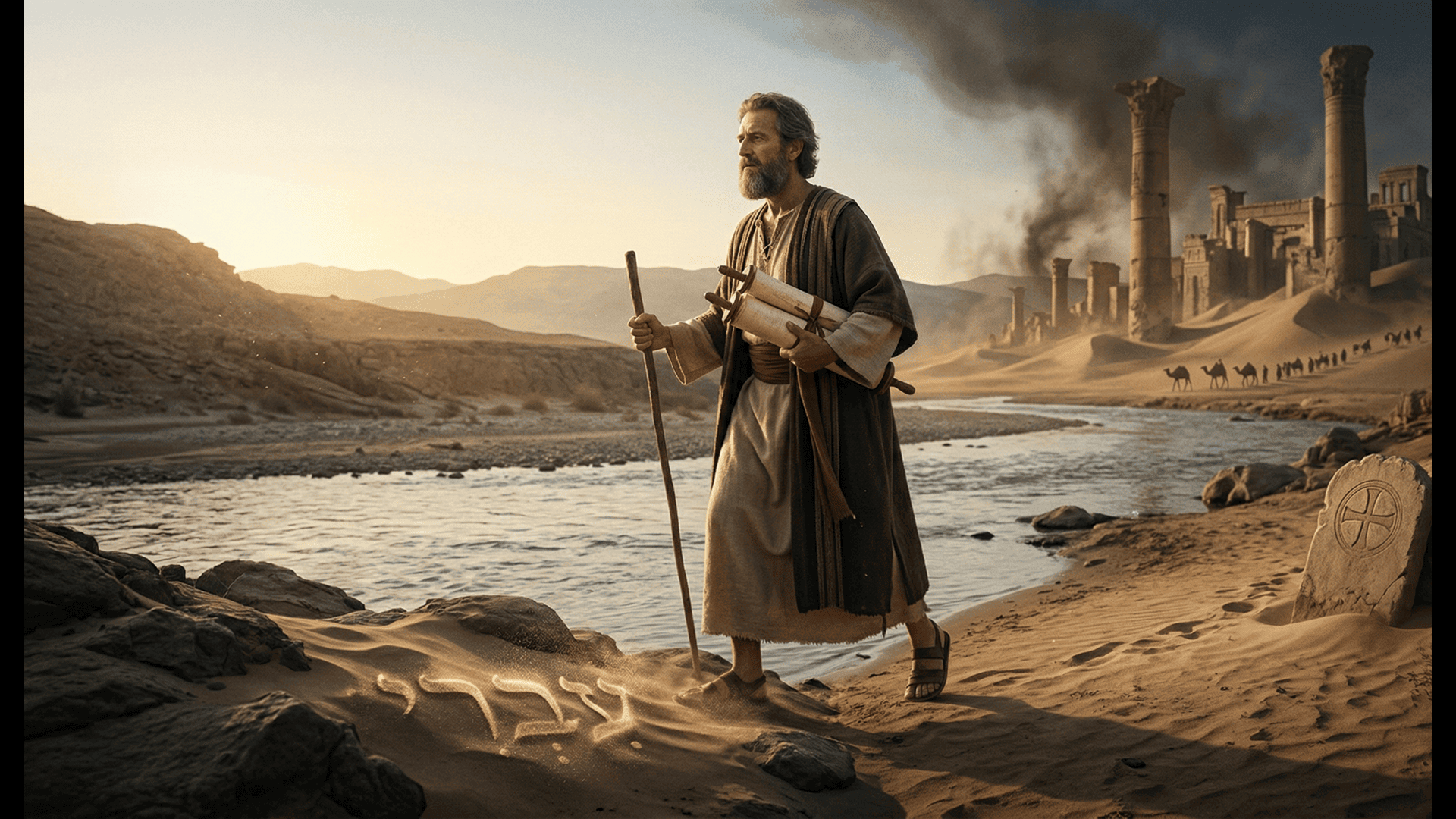
History is often told through the lives of giants—the Abrahams, the Moseses, the Jesuses, and the Muhammads. Their names echo through the corridors of time, their deeds forming the bedrock of the world’s great monotheistic religions. Yet, standing quietly in the shadows of these monumental figures are the “hidden” ancestors, the crucial links in the chain of humanity without whom the grand narratives would snap.
One such figure is Heber (most commonly known as Eber in Hebrew and English translations, and frequently identified with the Prophet Hud in Islamic tradition).
Though he speaks no lines in the biblical book of Genesis, his legacy is staggering. He is the namesake of the Hebrew people, the preserver of a sacred language, a pivotal ancestor in Christian theology, and a mighty prophet of monotheism in the Quran. Heber represents a fascinating intersection of theology, etymology, and ancient Near Eastern history.
This comprehensive exploration will take you on a journey through the ancient texts of Judaism, Christianity, and Islam to uncover the true identity, historical context, and enduring spiritual significance of Heber.
1. The Etymological Enigma: What Does “Heber” Mean?
Before we can understand the man, we must understand the name. In the ancient Near East, a name was never merely a label; it was a destiny, a description of character, or a monument to a historical event.
The name Eber (Hebrew: עֵבֶר, romanized: ʿĒḇer) is derived from the Hebrew root word ע-ב-ר (Ayin-Bet-Resh). This root is one of the most dynamic and spiritually rich in the entire Hebrew lexicon.
The Concept of “Crossing Over”
The primary meaning of the root ע-ב-ר is “to pass over,” “to cross,” or “to transition.” It is a verb of motion, implying a journey from one state, location, or paradigm to another.
- Geographical Meaning: Historically, it referred to the region “beyond” or “on the other side” of a major body of water, most likely the Euphrates River or the Jordan River. When the ancients spoke of “the people from across the river,” they used derivations of this root.
- Spiritual Meaning: Theologically, it implies a transition. To be a “crosser over” is to leave behind the old world (polytheism, idolatry, familiar lands) and step into a new reality (monotheism, the Promised Land).
When we look at the word Hebrew (Hebrew: עִבְרִי, ʿIvrī), it literally translates to “one who belongs to Eber” or “one who comes from the other side.” Therefore, the very identity of the Jewish people—and by extension, the spiritual roots of Christianity and Islam—is bound up in this concept of crossing boundaries and venturing into the unknown.
“To be a Hebrew is to be eternally in a state of crossing over—from captivity to freedom, from idolatry to truth, from the known to the unknown.”
2. Heber in Judaism: The Preserver of the Sacred Tongue
In the Jewish tradition, Heber (Eber) is far more than a mere name in a dusty genealogical register. He is a man of profound righteousness, a prophet, and the vital bridge between the ancient world of Noah and the new world of Abraham.
The Table of Nations (Genesis 10)
Eber is introduced in the Book of Genesis during the famous “Table of Nations,” which outlines the descendants of Noah after the Great Flood.
“To Shem also, the father of all the children of Eber, the elder brother of Japheth, children were born.”
— Genesis 10:21
This verse is incredibly significant. Shem is the father of many nations, yet the text specifically highlights him as the “father of all the children of Eber.” Eber is singled out. Why? Because from Eber’s line will eventually spring Abraham, Isaac, Jacob, and the entire nation of Israel.
Eber is the great-grandson of Shem. His genealogy reads: Noah -> Shem -> Arpachshad -> Shelah -> Eber.
The Division of the Earth: Peleg and the Tower of Babel
Eber had two sons, and the naming of his firstborn provides one of the most tantalizing clues about his life:
“To Eber were born two sons: the name of the one was Peleg, for in his days the earth was divided, and his brother’s name was Joktan.”
— Genesis 10:25
The name Peleg (פֶּלֶג) means “division.” But what division is Genesis referring to?
Rabbinic tradition, captured in texts like the Midrash and the Seder Olam Rabbah, explains that Eber was a great prophet. He foresaw the catastrophic event of the Tower of Babel.
According to the biblical narrative, humanity gathered in the plains of Shinar to build a tower to the heavens, an act of sheer hubris and defiance against God. As a consequence, God confused their languages and scattered them across the earth. This was the “division” of the world. Eber, acting under divine inspiration, named his son Peleg to memorialize this pivotal fracturing of the human family.
The Refusal to Build and the Gift of Hebrew
Jewish midrashic tradition provides a beautiful, albeit non-canonical, backstory to Eber’s life during the Tower of Babel crisis.
When the tyrannical king Nimrod conscripted the known world to build the tower, Eber allegedly refused to participate. He rejected the idolatry and arrogance of the builders. Because he refused to join the rebellion, God rewarded him.
When God struck the builders with the confusion of tongues (creating the myriad of languages we have today), He exempted Eber. Eber was allowed to retain the original, primordial language of Eden—the language God used to speak the universe into existence.
This language became known as Hebrew—the language of Eber.
Thus, in Jewish thought, the Hebrew language is not just an arbitrary human construct; it is a divine relic, preserved by the righteousness of one man who refused to follow the crowd. Eber represents the ultimate non-conformist, maintaining truth in an age of universal deception.
The Academy of Shem and Eber
Another fascinating element of Rabbinic literature is the concept of the Yeshiva (academy) of Shem and Eber.
According to tradition, Shem and his great-grandson Eber lived extraordinarily long lives (Eber lived 464 years according to Genesis 11:16-17). Their lifespans overlapped with that of Abraham, Isaac, and Jacob. The Midrash claims that Shem and Eber established a spiritual academy where the ancient traditions, laws, and knowledge of God were taught.
-
Rebecca’s Inquiry: When Rebecca (Isaac’s wife) was experiencing turmoil in her womb with the twins Jacob and Esau, Genesis 25:22 says she “went to inquire of the Lord.” The Midrash explains that she actually went to the Academy of Shem and Eber to seek the wisdom of the ancient prophets.
-
Jacob’s Studies: Before fleeing to the house of Laban, tradition dictates that Jacob spent 14 years hidden away, studying Torah in the tents of Eber.
Whether one views this as literal history or theological allegory, the meaning is clear: Eber represents the unbroken chain of divine truth. He is the custodian of faith between the destruction of the Flood and the covenant of Abraham.
3. The Birth of the “Hebrews”: Identity and Ethnicity
The transition from Eber the individual to the Hebrews as a people is a complex journey of linguistics and sociology.
When Abram (Abraham) is first introduced as a major actor in the biblical narrative, he is given a specific title. In Genesis 14:13, a messenger comes to tell him that his nephew Lot has been captured. The text refers to him as “Abram the Hebrew” (Avram Ha-Ivri).
This is the very first time the word “Hebrew” is used in the Bible. But what did it mean to Abraham’s contemporaries?
The Genealogical vs. Geographical Debate
- The Genealogical View: The traditional, literalist view is straightforward. Abram is the descendant of Eber. Therefore, he is an Eberite, or a Hebrew. It is a marker of family lineage, connecting him back to the righteous preserver of the original language.
- The Geographical View: Many modern biblical scholars point out that Abram had just crossed the Euphrates River to enter the land of Canaan. To the native Canaanites, Abram was literally “the man from the other side” (Ivri). In this view, “Hebrew” started as a geographical descriptor that eventually evolved into an ethnic identity.
The Mystery of the Habiru (Apiru)
To be fully candid about the historical realities, we must look beyond religious texts and into the sands of archaeology.
In the late 19th and early 20th centuries, archaeologists unearthing ancient Egyptian, Hittite, and Akkadian texts discovered repeated references to a group of people called the Habiru (or Apiru).
These texts, dating from the 2nd millennium BCE (around the time the Patriarchs would have lived), describe the Habiru not as a specific ethnic group or a unified nation, but rather as a social class. The Habiru were outcasts, mercenaries, nomads, runaway slaves, and marginalized peoples who lived on the fringes of settled society. They were often viewed with suspicion by the established city-states.
- The Linguistic Connection: Phonetically, Habiru and Hebrew (Ivri) are tantalizingly close.
- The Social Connection: The biblical Israelites often found themselves in “Habiru-like” situations: wandering as nomads, living as oppressed slaves in Egypt, and fighting as outsiders to conquer the land of Canaan.
The Academic Consensus today is nuanced. While most historians do not believe that all ancient Habiru were biblical Hebrews, they suggest that the early Hebrews might have been a subset of the wider Habiru social class. Over centuries, what began as a term for nomadic outsiders (those who “crossed over” borders) coalesced into the specific ethnic and religious identity of the Jewish people, traced retroactively to the eponymous ancestor, Eber.
Regardless of the secular archaeological debate, the spiritual reality remains: the identity of the Hebrew is rooted in being an outsider, a traveler, a person who crosses boundaries for the sake of a higher calling.
4. Heber in Christian Theology: The Typology of Crossing Over
While Christianity shares the Old Testament foundation of Judaism, the figure of Heber is viewed through the specific lens of the New Testament and the fulfillment of the Messianic lineage.
The Ancestor of the Christ
In the Christian scriptures, Heber’s most prominent appearance is in the Gospel of Luke. Luke chapter 3 provides a reverse genealogy of Jesus Christ, tracing his lineage from Joseph all the way back to Adam, and ultimately to God.
“the son of Serug, the son of Reu, the son of Peleg, the son of Eber, the son of Shelah, the son of Cainan, the son of Arphaxad, the son of Shem, the son of Noah…”
— Luke 3:35-36
In Christian theology, this genealogy is paramount. It proves that Jesus of Nazareth is fully integrated into the historical fabric of the human race. Unlike pagan gods who descended from the sky without context, the Christian Messiah is born of a specific lineage, fulfilling ancient promises.
By including Eber, Luke emphasizes that Jesus is the ultimate “Hebrew.” He is the culmination of the promises made to the line of Shem.
The Theological Typology: Baptism and Salvation
Christianity is a religion heavily reliant on typology—the idea that events and figures in the Old Testament foreshadow greater spiritual realities in the New Testament. The concept of Eber (crossing over) is thoroughly woven into Christian sacramental theology.
1. Crossing the Red Sea: The Israelites (the children of Eber) crossed the Red Sea to escape Egyptian slavery. In Christian theology (as articulated by the Apostle Paul in 1 Corinthians 10), this crossing is a “type” or foreshadowing of Christian Baptism. The believer passes through the waters, leaving the slavery of sin behind, and emerges on “the other side” as a new creation.
2. Crossing the Jordan: Later, the Israelites cross the Jordan River to enter the Promised Land. Christians view this as a metaphor for passing from earthly life, through the “river” of death, into the heavenly Promised Land.
3. The Epistle to the Hebrews: One of the most profound books of the New Testament is the Epistle to the Hebrews. The entire letter is an exhortation to Jewish Christians not to slide back into the familiar comforts of the old sacrificial system, but to press forward into the new covenant established by Christ. The writer is essentially telling them to live up to their namesake: to be true Hebrews, continuing to “cross over” into deeper faith, just as Abraham left his homeland to seek a city “whose designer and builder is God” (Hebrews 11:10).
In this light, every Christian is called to adopt the spiritual posture of Eber—living as a pilgrim and a sojourner in a world that is not their ultimate home.
5. Heber in Islam: The Prophet Hud and the Winds of Justice
If you thought Eber was a significant, albeit quiet, figure in the Judeo-Christian tradition, the Islamic tradition offers a breathtaking expansion of his story. In Islam, the figure traditionally associated with the biblical Eber is the mighty Prophet Hud (Arabic: هود).
Note: While some Islamic scholars draw a distinction between Eber and Hud, a vast majority of classical Islamic genealogists and historians (such as Ibn Kathir) identify Prophet Hud as the very same person as Eber from the biblical lineage. His lineage is often given as: Hud ibn Abd Allah ibn Ribah ibn Al-Khulud ibn ‘Ad ibn ‘Aus ibn Aram ibn Sam (Shem) ibn Nuh (Noah). Alternatively, a more direct mapping is Hud -> Shalikh (Shelah) -> Arfakhshand (Arpachshad) -> Sam (Shem).
In the Quran, Hud is not a quiet scholar sitting in a tent; he is a fearless warner, a powerful orator, and the central figure of an epic struggle against one of the most terrifyingly powerful civilizations of the ancient world.
The People of ‘Ad and Iram of the Pillars
Hud was sent as a prophet to the tribe known as ʿĀd (عاد). The people of ‘Ad lived in a region called Al-Ahqaf (the sand dunes), traditionally located in the southern part of the Arabian Peninsula, possibly near modern-day Yemen or Oman, bordering the vast Rub’ al Khali (the Empty Quarter).
The ‘Ad were not ordinary people. The Quran describes them as giants of men, blessed with immense physical strength and wealth. They were master builders, renowned for a magnificent city known as Iram of the Pillars (Iram Dhat al-Imad).
“Have you not considered how your Lord dealt with ‘Aad – [with] Iram – who had lofty pillars, The likes of whom had never been created in the land?”
— Quran, Surah Al-Fajr (89:6-8)
Blessed with abundant rain, fertile lands, and incredible engineering skills, the ‘Ad built massive fortresses and towering palaces. However, their physical elevation was matched only by their spiritual degradation. They became incredibly arrogant, believing themselves invincible. T.hey abandoned the monotheistic teachings of their ancestor Noah and began worshipping stone idols (named Sada, Samud, and Heba). They were ruthless, oppressing the weak and acting as brutal tyrants in the land.
The Message of Prophet Hud
God chose Hud, a man from their own brethren, to guide them back to the straight path. The Quran recounts the fiery dialogues between Hud and his people across several Surahs (chapters), most notably Surah Hud (Chapter 11) and Surah Al-A’raf (Chapter 7).
Hud’s message was the eternal message of Islam (Tawhid, or absolute monotheism):
“O my people, worship Allah; you have no deity other than Him. You are not but inventors [of falsehood]. O my people, I do not ask you for it any reward. My reward is only from the one who created me. Then will you not reason?”
— Quran, Surah Hud (11:50-51)
Hud reminded them that their immense wealth, their muscular frames, and their soaring architecture were gifts from God, not the result of their own innate divinity. He warned them that just as the people of Noah were destroyed for their arrogance, the ‘Ad were not immune to God’s justice.
The Arrogance of ‘Ad
The response of the ‘Ad was predictable. They mocked him. T.hey viewed Hud as a madman, possessed by one of their idols. They scoffed at the idea of resurrection and divine judgment.
“They said, ‘O Hud, you have not brought us clear evidence, and we are not ones to leave our gods on your say-so. Nor are we believers in you.’”
— Quran, Surah Hud (11:53)
They arrogantly challenged him, saying, “Who is greater than us in strength?” They dared him to bring about the punishment he promised.
The Devastating Climax: The Sarsar Wind
God’s patience eventually ran out. The punishment of the ‘Ad is one of the most chilling narratives in the Quran.
It began with a severe drought that lasted for three years. The lush gardens of Iram withered. Just when the people were desperate, they saw a massive, dark cloud approaching the valley. They rejoiced, crying out, “This is a cloud bringing us rain!”
But Hud knew better. It was not a cloud of mercy; it was the vehicle of divine wrath.
The cloud unleashed a screaming, violent, freezing wind—a Sarsar wind. This was not a normal storm. It was a targeted, devastating tempest that raged for seven nights and eight consecutive days.
“And as for ‘Aad, they were destroyed by a screaming, violent wind, which Allah imposed upon them for seven nights and eight days in succession, so you would see the people therein fallen as if they were hollow trunks of palm trees. Then do you see of them any remains?”
— Quran, Surah Al-Haqqah (69:6-8)
The wind was so powerful that it plucked the giants of ‘Ad from the ground and hurled them back down, snapping their necks. It destroyed their homes, eroded their mighty pillars, and buried their magnificent city beneath the sands of the desert.
Hud and a small group of believers were saved by God’s mercy, safely sheltered from the devastation. After the destruction, tradition says Hud migrated to the Hadhramaut region, where he eventually died. His tomb is still a site of visitation in Yemen today.
Through the figure of Hud, the Islamic tradition turns the genealogy of Eber into a profound moral epic. It serves as an eternal warning against the hubris of empire, the worship of material wealth, and the dangers of technological arrogance.
6. Comparative Analysis: The Three Faces of Heber
To truly appreciate the depth of this figure, we must look at how Judaism, Christianity, and Islam utilize him. While they share the same historical root, their theological applications diverge in fascinating ways.
| Feature / Tradition | Judaism (Eber) | Christianity (Eber) | Islam (Hud / Eber) |
| Primary Role | Preserver of language, righteous ancestor, prophet who foresaw division. | Genealogical link validating Christ’s humanity, typological symbol of salvation. | Active Prophet, warner, and leader of an epic struggle against idolatry. |
| Key Associated Event | The Tower of Babel and the division of humanity (Peleg). | The Incarnation (genealogy in Luke) and spiritual “crossing over” (baptism). | The destruction of the arrogant ‘Ad people via a devastating windstorm. |
| Theological Symbolism | The non-conformist; staying true to God when the rest of the world rebels. | The transition from the old covenant to the new; moving from death to life. | The fragility of human power/wealth compared to the ultimate power of God. |
| Linguistic Connection | Eponymous ancestor of the “Hebrews” and the Hebrew language. | Etymological root inspiring the Epistle to the Hebrews. | Sometimes linguistically linked, but primary focus is on his prophetic message (Tawhid). |
| Textual Source | Genesis 10-11, Midrash, Book of Jubilees. | Gospel of Luke 3, Book of Hebrews (thematically). | Quran (Surah Hud, Surah Al-A’raf, Surah Al-Fajr). |
A Candid Observation:
It is important to note the shift in narrative style. In the biblical text, Eber is entirely passive—a name in a list whose story is only fleshed out later by Rabbinic commentators trying to fill in the blanks. In the Quranic text, Hud is highly active, engaged in direct, quoted dialogue with his oppressors. This reflects the different purposes of the texts: Genesis uses genealogies to map the geopolitical world and Israel’s place within it, while the Quran uses prophetic narratives to demonstrate the repeating cycle of human arrogance and divine justice.
7. The Archaeological Quest: Finding the Shadows of History
While theology provides meaning, history seeks evidence. The quest to find secular, archaeological proof for Eber/Hud is fraught with challenges, typical of the ancient Near East.
The Habiru Inscriptions
As discussed earlier, the most substantial extrabiblical evidence relating to the name is the appearance of the Habiru/Apiru in Amarna letters and Egyptian steles. While these records do not confirm a single man named Eber, they definitively prove that a group of people identifying as “crossers over” or outsiders existed in the Levant during the 2nd millennium BCE. This lends massive historical credibility to the sociological backdrop of the Hebrew origins.
The Search for Iram of the Pillars
For centuries, Western scholars viewed the Quranic story of ‘Ad and the city of Iram as pure myth. How could a massive civilization simply vanish into the sand?
However, in the early 1990s, an amateur archaeologist named Nicholas Clapp, using NASA satellite imagery and ancient maps by Ptolemy, identified ancient caravan routes converging at a well in the Dhofar region of Oman. Excavations led by Juris Zarins revealed the lost city of Ubar (which many scholars equate with Iram).
They discovered a massive octagonal fortress with high walls and towering pillars. Fascinatingly, the archaeological evidence showed that the city met a sudden and catastrophic end. It did not fall to an invading army; rather, a massive sinkhole opened up beneath it, swallowing the fortress, likely triggered by a geological event or perhaps the severe atmospheric disturbances (like a devastating storm or cyclone) matching the Quranic description of a screaming wind.
While we cannot definitively prove a man named Hud stood in that specific city, the discovery of a pillar-rich, suddenly destroyed ancient civilization in the exact region described by Islamic tradition forces historians to take the ancient narratives with intense seriousness.
8. Lessons for the Modern Reader: The Enduring Legacy of Heber
Why does a man who lived thousands of years ago matter in the 21st century? Whether you view Heber/Hud as a literal historical figure, a composite patriarch, or a spiritual archetype, the lessons embedded in his story are strikingly relevant to the modern human condition.
1. The Courage of Non-Conformity
In the Jewish tradition of the Tower of Babel, Eber is the lone dissenter. In an age where the entire world is moving in one direction (building a monument to human ego), Eber refuses to pick up a brick. Today, in a hyper-connected world driven by viral trends, outrage culture, and the pressure to conform, Eber stands as a testament to the power of the individual conscience. He teaches us that preserving truth is more important than achieving popularity.
2. The Danger of Technological Hubris
The Islamic narrative of Hud and the ‘Ad is a chilling warning for the modern era. The ‘Ad thought their advanced architecture, their mighty pillars, and their engineering prowess made them gods. They thought they had conquered nature.
In our current era of artificial intelligence, genetic engineering, and unprecedented technological advancement, the story of Iram of the Pillars asks us a sobering question: Are we building our own towers of arrogance? The destructive wind that leveled ‘Ad reminds us that human civilization, no matter how advanced, remains profoundly fragile in the face of the natural world and the divine order.
3. The Power of “Crossing Over”
Finally, the very name Eber—to cross over—is the ultimate metaphor for human growth.
- We must cross over from childhood to maturity.
- We must cross over from ignorance to understanding.
- We must cross over from our comfortable prejudices into the difficult terrain of empathy.
The Christian interpretation of Eber reminds us that stagnation is spiritual death. We are meant to be travelers. To claim the identity of a “Hebrew” in the spiritual sense is to accept that you are a work in progress, constantly transitioning away from the bondage of your past and stepping bravely into the unknown future God has prepared.
Conclusion: The Man on the Bridge
History is not just the study of empires rising and falling; it is the study of the threads that connect us. Heber is one of those vital, golden threads.
He is the bridge between the catastrophic cleansing of the Flood and the covenantal promise of Abraham. He is the bridge between the ancient, primordial language of Eden and the living Hebrew spoken in the streets of Jerusalem today. Hee is the bridge connecting the prophetic lineages of Judaism, the redemptive theology of Christianity, and the epic moral warnings of Islam.
Though he may be a “hidden figure” in comparison to Moses or Abraham, his legacy is inescapable. Every time a Jewish person prays in the sacred tongue, every time a Christian speaks of crossing from death to life, and every time a Muslim recites the Quranic warnings against arrogance, the spirit of Heber is there.
He stands at the riverbank of history, eternally beckoning humanity to leave behind the old idols, to refuse the vanity of the crowd, and to boldly cross over to the other side.
Frequently Asked Questions About Heber (Eber/Hud)
1. Who exactly is Heber in the Bible?
Heber (most commonly translated as Eber in English Bibles) is a patriarch mentioned in the Book of Genesis. He is the great-grandson of Shem (Noah’s son) and a direct ancestor of Abraham. While he doesn’t have a speaking role in the biblical narrative, he is highly significant because he is the eponymous ancestor of the Israelites—the namesake of the “Hebrew” people.
2. Are Heber and the Islamic Prophet Hud the same person?
According to classical Islamic scholars and genealogists (such as Ibn Kathir), yes. The lineage of Prophet Hud maps directly to the biblical lineage of Eber, placing both figures in the exact same historical window between the Great Flood and the birth of Abraham. However, while the Bible focuses on his genealogical importance, the Quran details his active role as a prophet sent to warn the arrogant civilization of ‘Ad.
3. Did Heber invent the Hebrew language?
He didn’t invent it; rather, Jewish tradition states that he preserved it. According to the Midrash (ancient rabbinic commentaries), Eber refused to help build the Tower of Babel. Because he rejected this act of rebellion, God exempted him when He confused the languages of the earth. Eber was allowed to keep the original, primordial language of Eden, which subsequently became known as Hebrew—the language of Eber.
4. What does the word “Hebrew” actually mean?
The word Hebrew (Ivri in Hebrew) comes from the root word ע-ב-ר (Ayin-Bet-Resh), which means “to cross over” or “to pass through.” Historically, it likely referred to Abraham and his descendants as the people who “crossed over” the Euphrates River to enter Canaan. Spiritually, it signifies a people who crossed over from polytheism and idolatry into monotheism.
5. Is there archaeological evidence for Heber or the Prophet Hud?
While there is no direct physical evidence for a single man named Eber or Hud, there is fascinating historical context for both:
- The Habiru: Ancient Egyptian and Akkadian texts frequently mention a group of nomadic outsiders and mercenaries called the Habiru or Apiru. Many historians believe this social class is the historical origin of the term “Hebrew.”
- The City of Ubar: For centuries, the Quranic city of Iram (where Hud preached) was considered a myth. However, in the 1990s, satellite imagery helped uncover the lost city of Ubar in Oman. It featured the massive pillars described in the Quran and had collapsed into a massive sinkhole, mirroring the sudden, catastrophic destruction detailed in Islamic tradition.
6. Why is Heber mentioned in the Christian New Testament?
Heber is listed in the Gospel of Luke (Luke 3:35) in the genealogy of Jesus Christ. For Christians, this genealogy is crucial because it roots Jesus in literal human history and traces his lineage back through the ancient patriarchs, validating him as the fulfillment of God’s promises to the line of Shem and the Hebrew people.
7. How old was Heber when he died?
According to the genealogies in Genesis 11, Eber lived to be 464 years old. This incredibly long lifespan means that, according to biblical timelines, he actually outlived Abraham. This overlap is what inspired the Jewish tradition that Jacob studied at the “Academy of Shem and Eber” before fleeing to Haran.
Leave a Reply