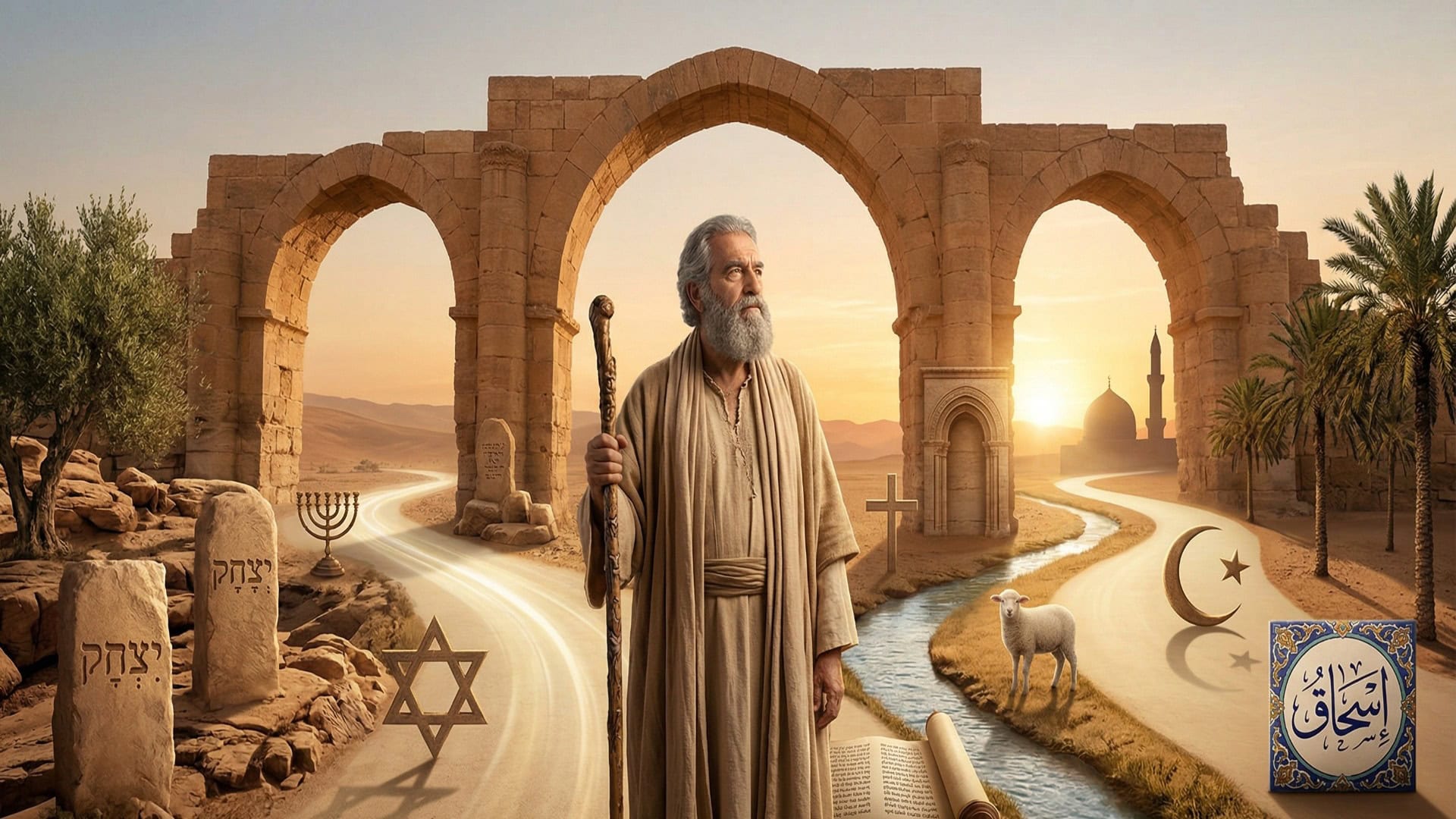
When we explore the shared roots of the world’s major monotheistic faiths, few figures are as central—and yet as distinctively interpreted—as the patriarch Isaac. Known as Yitzchak in Hebrew and Ishaq in Arabic, he serves as a crucial bridge in the historical and spiritual genealogies of Judaism, Christianity, and Islam.
Despite his pivotal role, Isaac is often overshadowed by his monumental father, Abraham, and his dynamic son, Jacob. However, a closer look at the sacred texts and traditions reveals a figure of immense spiritual depth, representing obedience, promise, and divine continuity.
This comprehensive guide explores how Isaac is described across the three Abrahamic religions, highlighting the unique theological perspectives, shared narratives, and inclusive spiritual lessons each tradition offers.
1. Introduction: The Patriarch of the Promise
To understand Isaac, we must first understand his context within the Abrahamic religions. Judaism, Christianity, and Islam all trace their spiritual lineage back to Abraham (Ibrahim), a man chosen by God to spread the message of monotheism.
Isaac is the miraculous child born to Abraham and his wife Sarah in their old age. His birth represents the fulfillment of a divine promise. However, how his life, his trials, and his legacy are interpreted varies significantly across the three faiths. By examining these perspectives side-by-side, we gain a richer understanding of religious history and the diverse ways humanity relates to the divine.
2. Isaac in Judaism: The Pillar of Strength and Discipline (Yitzchak)
In Jewish tradition, Isaac (Yitzchak) is the second of the three great Patriarchs (Abraham, Isaac, and Jacob). His story is primarily detailed in the Torah, specifically within the Book of Genesis (Bereshit).
The Miraculous Birth and the Meaning of His Name
The name Yitzchak translates to “he will laugh” or “laughter.” This name is deeply symbolic, deriving from the reactions of both Abraham and Sarah when God announced that they would have a child despite being well past childbearing age (Abraham was 100, and Sarah was 90). In Judaism, Isaac’s birth is the ultimate testament to God’s ability to transcend the laws of nature to fulfill a covenant.
The Akedah: The Binding of Isaac
The defining moment of Isaac’s life in Jewish theology is the Akedat Yitzchak, or the Binding of Isaac (Genesis 22). God commands Abraham to sacrifice his beloved son on Mount Moriah.
While popular culture often focuses on Abraham’s test of faith, Jewish Midrash (commentary) and Rabbinic tradition heavily emphasize Isaac’s role.
- A Willing Participant: According to traditional Jewish chronology, Isaac was not a small child during this event, but a grown man (often cited as 37 years old). Therefore, he was not a helpless victim but a willing participant who consciously accepted God’s decree.
- Lasting Merit (Zechut Avot): The Akedah is central to Jewish liturgy, particularly during Rosh Hashanah (the Jewish New Year). The blowing of the shofar (ram’s horn) is a direct callback to the ram that was sacrificed in Isaac’s place, invoking the merit of Isaac’s supreme obedience and asking God for mercy on his descendants.
The Earthbound Patriarch
Unlike Abraham, who journeyed from Ur to Canaan, and Jacob, who fled to Haran and later died in Egypt, Isaac never left the Promised Land (Canaan). In Judaism, Isaac is viewed as the “olah temimah” (a perfect, unblemished offering). Because he was offered on the altar, he was considered sanctified and forbidden to leave the holy land.
He is also closely associated with agriculture and digging wells. Digging wells is seen metaphorically in Kabbalah (Jewish mysticism) as a search for inner truth and spirituality.
Kabbalistic Perspective: Gevurah
In Jewish mysticism, the Patriarchs correspond to different divine attributes (Sefirot). While Abraham represents Chesed (loving-kindness and expansion), Isaac represents Gevurah (strength, discipline, justice, and restraint). Isaac’s life of passive endurance, his digging of wells (going deep into the earth rather than expanding outward), and his strict obedience epitomize the spiritual discipline required to maintain a relationship with the Divine.
3. Isaac in Christianity: The Child of Promise and Typology of Christ
Christianity inherits the historical narrative of Isaac from the Hebrew Bible (the Old Testament), but the New Testament writers and early Church Fathers reinterpreted his life through the lens of Jesus Christ’s life, death, and resurrection.
The Child of the Promise
In Christian theology, Isaac is fundamentally understood as the “Child of Promise.” The Apostle Paul makes a crucial theological point in his Epistle to the Galatians and Romans.
- Grace vs. Works: Paul contrasts Isaac (born of Sarah, a free woman, through a miraculous promise) with Ishmael (born of Hagar, a slave woman, through human effort).
- For Christians, Isaac represents those who are justified by faith and born of the Spirit, symbolizing the New Covenant.
Typology: Foreshadowing the Cross
The most profound significance of Isaac in Christianity lies in biblical typology—the study of how Old Testament figures and events foreshadow the New Testament. The Binding of Isaac is viewed as a direct parallel to the crucifixion of Jesus.
Consider these profound parallels drawn by Christian theologians:
- The Beloved Son: Just as God asked Abraham to sacrifice his “only son, whom you love” (Genesis 22:2), God the Father gave His only begotten Son, Jesus (John 3:16).
- Carrying the Wood: Genesis notes that Isaac carried the wood for his own sacrifice up the mountain. Christian tradition mirrors this with Jesus carrying his own wooden cross to Golgotha.
- The Resurrection Motif: In Hebrews 11:19, the author states that Abraham reasoned God could raise the dead, and figuratively speaking, he did receive Isaac back from death. This is seen as a foreshadowing of Christ’s literal resurrection.
- Mount Moriah: Many biblical scholars and traditions link Mount Moriah (where Isaac was bound) to the geographic location of Jerusalem and Mount Calvary, where Jesus was crucified.
The Genealogies
Isaac is also a critical link in the genealogy of Jesus. Both the Gospel of Matthew and the Gospel of Luke trace the lineage of Jesus back through King David, Judah, Jacob, Isaac, and Abraham, cementing Jesus’s messianic credentials as the fulfillment of the covenant God made with the Patriarchs.
4. Isaac in Islam: The Righteous Prophet (Ishaq)
In Islam, Isaac is revered as Ishaq, an esteemed Prophet (Nabi) and a righteous leader chosen by Allah to guide humanity. His story is found in the Quran, and his legacy is expanded upon in the Hadith (sayings of the Prophet Muhammad) and Tafsir (Quranic exegesis).
A Gift to Abraham
The Quran frequently mentions Ishaq alongside his father Ibrahim and his son Yaqub (Jacob). His birth is depicted as a joyous reward for Ibrahim’s unwavering faith.
“And We gave him Ishaq and Yaqub in addition, and all [of them] We made righteous.” (Quran 21:72)
When angels visit Ibrahim to deliver the news of a coming son, his wife (Sarah) laughs in astonishment, much like the biblical narrative, and she is given the glad tidings of Ishaq, and after him, Yaqub.
Prophet and Leader of the Israelites
In Islamic tradition, Ishaq is crucial because he is the patriarch from whom the entire line of Israelite prophets descends—including Musa (Moses), Dawud (David), and Isa (Jesus). He is described as a man of vision, power, and deep spiritual insight.
The Quran emphasizes that Ishaq was inspired with revelation and was commanded to establish prayer and give charity, serving as a beacon of monotheism in a polytheistic world.
The Narrative of the Sacrifice (Dhabih)
One of the most notable differences between the Judeo-Christian narrative and the Islamic narrative involves the story of the sacrifice.
In the Quran (Surah As-Saffat 37:99-113), Allah commands Ibrahim to sacrifice his son in a dream. The son willingly submits to the will of Allah, saying, “O my father, do as you are commanded. You will find me, if Allah wills, of the steadfast.” Who was the sacrificed son?
- The Quran itself does not explicitly name the son in this specific passage.
- In early Islamic history, there was a robust debate among scholars (such as Al-Tabari) regarding whether the son was Ishaq (Isaac) or Ismail (Ishmael).
- However, the prevailing consensus in mainstream Islamic theology today is that the sacrificed son was Ismail, the firstborn. The narrative follows that Ibrahim and Ismail were tested in Mecca, which ties into the Islamic pilgrimage (Hajj) and the festival of Eid al-Adha.
- Following the story of the sacrifice in the Quran, Allah immediately says, “And We gave him good tidings of Ishaq, a prophet from among the righteous.” Many Islamic scholars interpret this sequence to mean that Ishaq’s prophetic birth was a reward after the trial with Ismail.
Regardless of which son was involved in the sacrifice, Islam holds Ishaq in the highest esteem as a flawless prophet who continued the covenant of monotheism.
5. Comparative Summary: Common Threads and Divergences
Understanding Isaac across these three traditions requires appreciating both the harmonious overlaps and the distinct theological divergences.
What Connects Them?
- Reverence and Sanctity: All three faiths honor Isaac as a holy man, a patriarch, and an essential link in the chain of divine revelation.
- Miraculous Origins: The miraculous nature of his birth to elderly parents is universally accepted, symbolizing God’s omnipotence and faithfulness to His promises.
- Submission to the Divine: Whether through his willing participation in the Akedah in Judaism, his prefiguration of Christ’s submission in Christianity, or his righteous prophethood in Islam, Isaac’s defining characteristic is his steadfast submission to God.
Where Do They Diverge?
- Theological Function: In Judaism, he is the embodiment of Gevurah (discipline) and the first inheritor of the Land Covenant. In Christianity, he is a theological metaphor for grace and a type of Christ. In Islam, he is a distinct Prophet bringing revelation to the ancestors of the Israelites.
- The Sacrifice: The identity of the sacrificed son (Isaac in Judaism and Christianity vs. Ishmael in mainstream Islam) shapes significant cultural and liturgical practices in each religion today.
6. Frequently Asked Questions (FAQ)
Q1: Who was Isaac’s mother?
Isaac’s mother was Sarah. According to the foundational texts of all three Abrahamic religions, she conceived Isaac miraculously in her old age after God promised Abraham a son.
Q2: Does Islam recognize Isaac as a Prophet?
Yes. In Islam, Isaac is known as Ishaq and is highly revered as a Prophet (Nabi) who received revelation from Allah and guided his people in righteousness.
Q3: What does the name “Isaac” mean?
The name Isaac originates from the Hebrew word Yitzchak, which means “he will laugh.” This refers to the joyful and incredulous laughter of his parents when they were told they would have a child in their old age.
Q4: Who are the children of Isaac?
According to the Biblical and historical traditions, Isaac married Rebecca (Rivkah), and they had twin sons: Esau and Jacob (Yaqub). Jacob would go on to be renamed Israel, becoming the father of the Twelve Tribes.
Q5: Why is the Binding of Isaac (the Akedah) so important in Christianity?
Christians view the Binding of Isaac as a “typology” or foreshadowing of the New Testament. Isaac’s willing journey up the mountain with the wood for the sacrifice is seen as a parallel to Jesus carrying the cross to his own crucifixion, symbolizing God’s ultimate sacrifice for humanity.
7. Reference Links & Further Reading
To continue exploring the profound history and theology surrounding Isaac, consider visiting these authoritative resources:
-
Jewish Perspectives:
-
Chabad.org – The Life of Isaac – Comprehensive insights into Jewish Midrash, Kabbalistic interpretations, and Torah commentary regarding Yitzchak.
-
My Jewish Learning – The Patriarchs – Accessible articles on the historical and theological role of Isaac in Jewish history.
-
-
Christian Perspectives:
-
Bible Gateway – Genesis 22 – Read the biblical account of Isaac and explore various Christian commentaries and translations.
-
Catholic Encyclopedia – Isaac – Deep historical and theological analysis of Isaac’s role as a type of Christ from a Catholic perspective.
-
-
Islamic Perspectives:
-
Quran.com – Surah As-Saffat – Read the Quranic verses discussing the Prophets, including Ibrahim and Ishaq, with authentic translations and Tafsir.
-
Yaqeen Institute for Islamic Research – Academic and theological papers on the lineage of Prophets and the narrative of the sacrifice in Islamic tradition.
-
-
General/Historical:
-
Britannica – Isaac (Biblical Figure) – An encyclopedic overview of Isaac’s life from a secular, historical, and comparative religious standpoint.
-
Leave a Reply