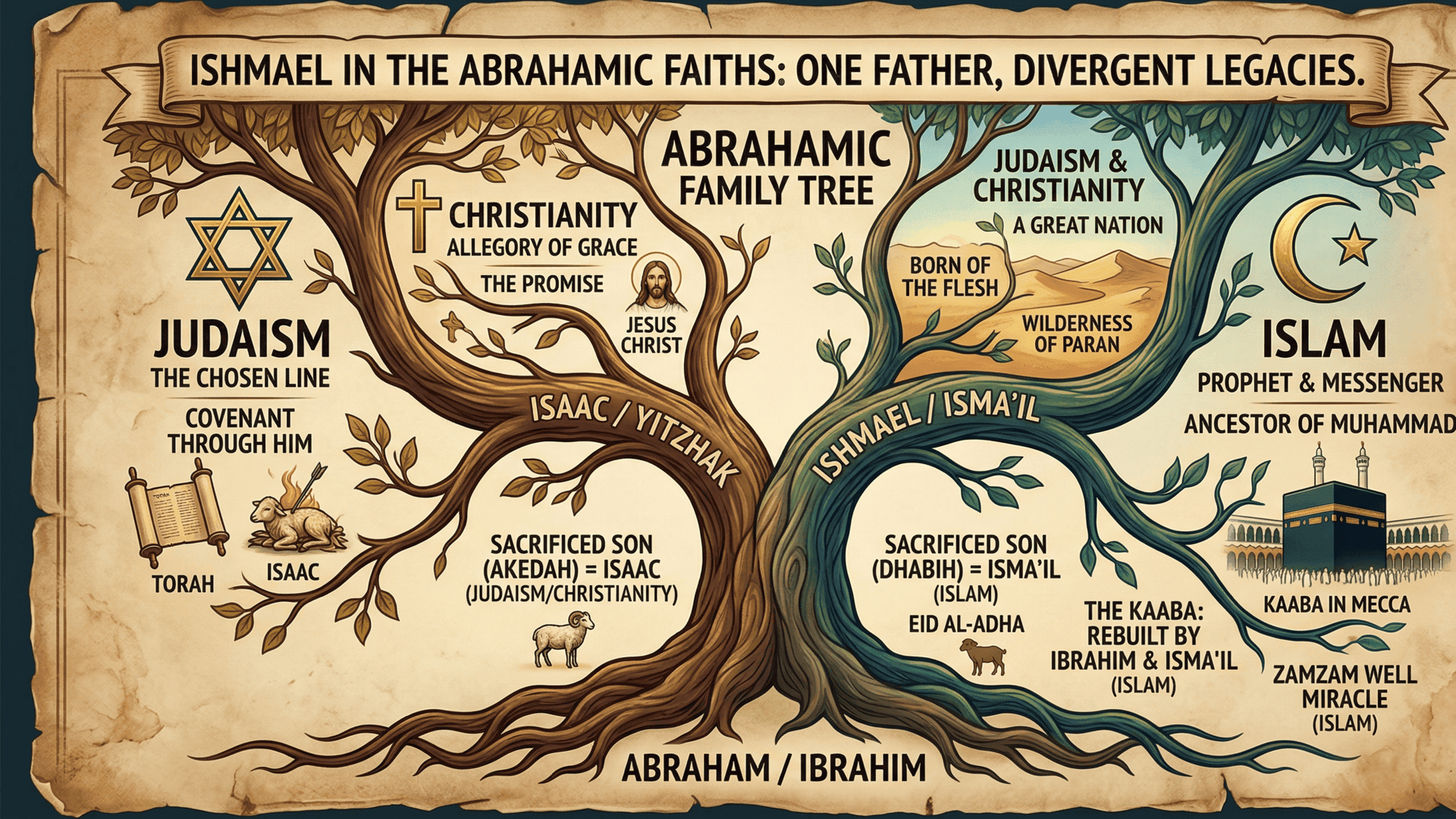
The figure of Abraham stands as a monumental pillar in the history of world religions, uniting billions of people under the umbrella of the “Abrahamic faiths.” However, the story of Abraham is not a solitary one. It is a complex family narrative woven with promises, trials, divine interventions, and complex family dynamics. At the heart of this ancient family tree sits a figure whose life, legacy, and spiritual significance diverge dramatically depending on which sacred text you are reading: Ishmael.
Known as Yishma’el in Hebrew (“God will hear”) and Isma’il in Arabic, Ishmael is universally recognized as the firstborn son of Abraham. Yet, the narrative trajectory of his life—his legitimacy, his divine covenant, and his role in the history of salvation—varies significantly across Judaism, Christianity, and Islam.
For the modern reader, student of theology, or anyone interested in interfaith dialogue, understanding the multifaceted figure of Ishmael is essential. He is not merely a historical or mythical character; he is a theological symbol, a patriarch of nations, and a lens through which three distinct worldviews interpret the will of the Divine.
This comprehensive guide will explore the textual origins, theological interpretations, and key differences surrounding the figure of Ishmael in Judaism, Christianity, and Islam.
Part 1: The Historical and Textual Foundation
Before delving into the specific interpretations of each faith, it is crucial to establish the foundational narrative. The primary textual sources for the story of Ishmael are the Hebrew Bible (specifically the Book of Genesis), the Christian New Testament (which inherits the Genesis account and adds theological commentary), and the Quran (alongside the Hadith, the recorded sayings and actions of the Prophet Muhammad).
The Shared Ancestry
All three traditions agree on the basic genealogical premise: Abraham (Abram/Ibrahim) was married to Sarah (Sarai), who was initially unable to conceive. To ensure an heir, Sarah offered her Egyptian handmaiden, Hagar (Hajar), to Abraham. From this union, Ishmael was born.
From this singular point of origin, the narratives begin to fracture. The disputes center around the nature of God’s covenant, the rightful heir to Abraham’s spiritual legacy, and the geographical focus of God’s interaction with humanity.
The Etymology of “Ishmael”
The name itself carries profound theological weight. In Genesis 16:11, an angel of the Lord tells Hagar, “You shall name him Ishmael, for the Lord has heard of your misery.” The root of the name comes from the Hebrew shama (to hear) and El (God). This establishes an immediate theme that resonates across all traditions: Ishmael is associated with a God who hears the cries of the marginalized, the exiled, and the faithful in the wilderness.
Part 2: Ishmael in Judaism
In Jewish tradition, the primary source of information regarding Ishmael is the Torah, specifically the Book of Genesis, supplemented by centuries of Rabbinic commentary (Midrash and Talmud). In Judaism, Ishmael’s story is fundamentally tied to the establishment of the Jewish covenant through his younger half-brother, Isaac.
The Biblical Narrative
1. The Birth and the Blessing According to Genesis 16, Hagar conceives Ishmael after Sarah gives her to Abraham. However, tension quickly arises between the two women. Hagar begins to despise Sarah, leading Sarah to treat her harshly. Hagar flees into the desert, where an angel meets her. The angel promises that her descendants will be too numerous to count and instructs her to return and submit to Sarah. Ishmael is born when Abraham is 86 years old.
God explicitly blesses Ishmael. In Genesis 17:20, God tells Abraham: “And as for Ishmael, I have heard you: I will surely bless him; I will make him fruitful and will greatly increase his numbers. He will be the father of twelve rulers, and I will make him into a great nation.”
2. The Covenant of Circumcision It is important to note that Ishmael is included in the covenant of circumcision. Genesis 17 records that Ishmael, at the age of 13, was circumcised alongside his father Abraham. However, God makes it clear that the eternal, spiritual covenant will be established through the miraculously conceived Isaac, not Ishmael.
3. The Expulsion into the Wilderness The defining moment of Ishmael’s biblical narrative occurs in Genesis 21. Following the birth and weaning of Isaac, Sarah observes Ishmael “mocking” or “playing” (the Hebrew word m’tzachek is ambiguous and heavily debated by scholars). Fearing for Isaac’s inheritance and safety, Sarah demands that Abraham cast out Hagar and Ishmael.
Though Abraham is distressed, God tells him to listen to Sarah, reassuring him that Ishmael will also become a great nation. Hagar and Ishmael are sent into the wilderness of Beersheba. When their water runs out, Hagar places the boy under a bush and walks away, unable to watch him die. God “hears the boy crying,” opens Hagar’s eyes to a well of water, and saves them. Ishmael grows up in the wilderness of Paran, becomes an expert archer, and marries an Egyptian woman.
Rabbinic Interpretations (Midrash and Talmud)
The Rabbinic perspective on Ishmael is nuanced and often ambivalent. Because the Biblical text focuses on the lineage of Isaac, Rabbinic literature frequently uses Ishmael as a foil to Isaac to highlight the distinctiveness of the Jewish covenant.
- The Nature of the “Mocking”: Rabbis debated what Ishmael was doing in Genesis 21. Some Midrashic interpretations suggest he was engaging in idolatry, sexual immorality, or even attempting to kill Isaac with his bow. This paints Ishmael as a spiritually dangerous figure who had to be removed to protect the holy lineage.
- The “Wild Donkey” of a Man: Genesis 16:12 prophesies that Ishmael will be a “wild donkey of a man; his hand will be against everyone and everyone’s hand against him.” Historically, some Jewish commentators viewed this as a prediction of the aggressive nature of the nomadic Arab tribes associated with Ishmael’s lineage.
- Repentance (Teshuvah): Despite the negative portrayals, Jewish tradition also offers a redemptive arc for Ishmael. The Talmud (Bava Batra 16b) suggests that Ishmael repented later in life. This is drawn from Genesis 25:9, which notes that both Isaac and Ishmael came together to bury their father, Abraham, in the Cave of Machpelah. The fact that Isaac’s name is listed first, and Ishmael allowed him to lead, is interpreted by rabbis as proof of Ishmael’s repentance and acceptance of Isaac’s spiritual primacy.
Ishmael as the Progenitor of the Arabs
In later Jewish tradition, particularly during the Middle Ages, “Ishmael” became synonymous with the Arab world and, by extension, Islam. Jewish thinkers like Maimonides referred to Muslims as “Ishmaelites.” While recognizing theological differences, Jewish law generally considers Muslims to be strict monotheists (unlike some views on Christianity’s Trinity), a theological kinship traced back to their shared Abrahamic root.
Part 3: Ishmael in Christianity
Christianity inherits the Old Testament, meaning the foundational Christian understanding of Ishmael is identical to the Genesis narrative. However, Christianity introduces a radical reinterpretation of the Ishmael and Isaac story through the writings of the New Testament, specifically the theology of the Apostle Paul. In Christianity, Ishmael transitions from a historical patriarch into a profound theological allegory.
The New Testament and Pauline Allegory
The most significant Christian text regarding Ishmael is found in the Apostle Paul’s Epistle to the Galatians (Galatians 4:21-31). In this letter, Paul addresses early Christians who were debating whether Gentile converts needed to follow Jewish law (the Torah), specifically circumcision, to be true followers of Christ.
Paul uses the story of Hagar/Ishmael and Sarah/Isaac as a complex allegory to explain the difference between the “Old Covenant” (the Law given at Mount Sinai) and the “New Covenant” (grace through Jesus Christ).
1. Flesh vs. Promise Paul emphasizes the circumstances of the two births. Ishmael was born “according to the flesh”—meaning he was the result of human effort and planning (Abraham and Sarah trying to fulfill God’s promise through their own intervention with Hagar). Isaac, conversely, was born “by the power of the Spirit” or “through the promise”—a miraculous birth resulting solely from God’s intervention in Sarah’s old age.
2. Slavery vs. Freedom Paul aligns Hagar, the slave woman, with the earthly city of Jerusalem and the Mosaic Law given at Mount Sinai. He argues that those who rely on the strict adherence to the Law are “slaves” to it, much like Ishmael was born into slavery. Sarah, the free woman, represents the “heavenly Jerusalem” and the freedom found in faith in Christ. Believers in Christ, Paul argues, are “children of promise, like Isaac.”
3. The Expulsion as Theological Necessity Paul quotes Genesis 21:10: “Get rid of the slave woman and her son, for the slave woman’s son will never share in the inheritance with the free woman’s son.” For Paul, this was not just a family dispute; it was a divine decree that the covenant of Law (symbolized by Ishmael) cannot co-inherit with the covenant of Grace (symbolized by Isaac).
The Christian Perspective on Ishmael’s Legacy
Because of Paul’s strong allegorical use of the story, Christian theology has historically placed less emphasis on the historical Ishmael and more on what he represents.
- A Symbol of Human Effort: In Christian homiletics and teachings, Ishmael often represents the human tendency to try and “help God out” or achieve righteousness through human works rather than trusting in divine grace.
- Outside the Messianic Line: Christianity, like Judaism, views Isaac as the exclusive bearer of the covenant that eventually leads to the Messiah. Jesus Christ’s genealogy is traced through Isaac, Jacob, and Judah, leaving Ishmael outside the central narrative of redemption.
- God’s Provision: Despite the theological distancing, Christian commentators still recognize God’s compassion toward Ishmael. The story of God hearing Ishmael’s cries in the desert is frequently used in Christian pastoral care to illustrate that God’s love and providential care extend to all people, even those outside the primary covenantal line. God still promised to make a great nation of him, a promise Christians acknowledge was historically fulfilled.
Part 4: Ishmael (Isma’il) in Islam
If Judaism views Ishmael as the displaced older brother, and Christianity views him as an allegory of the old law, Islam elevates him to the status of a major prophet, a patriarch, and the direct ancestor of the Prophet Muhammad. In Islamic tradition, the narrative shifts dramatically, placing Ishmael at the very center of God’s unfolding plan.
The Quranic Narrative: A Prophet and Messenger
In the Quran, Isma’il is mentioned by name 12 times. He is consistently praised for his righteousness, patience, and strict adherence to his promises.
- Surah Maryam (19:54-55): “And mention in the Book, Ishmael. Indeed, he was true to his promise, and he was a messenger and a prophet. And he used to enjoin on his people prayer and zakah [charity] and was to his Lord pleasing.”
- Surah Al-Anbiya (21:85): “And [mention] Ishmael and Idrees and Dhul-Kifl; all were of the patient.”
In Islam, there is no narrative of Ishmael being “cast out” due to mocking or illegitimacy. Hagar (Hajar) is deeply respected, not viewed as a mere concubine, but as a righteous wife of Ibrahim. The journey to the desert is not seen as an expulsion driven by family jealousy, but as a deliberate divine command given to Ibrahim to establish a new center of monotheistic worship.
The Miracle of Zamzam and the Hajj
The Islamic tradition provides a rich, detailed account of Hajar and Isma’il’s experience in the desert, which forms the basis for major Islamic rituals today.
According to Islamic tradition, Ibrahim left Hajar and the infant Isma’il in the barren valley of Mecca (Bakkah) under God’s strict orders. When their provisions ran out, the infant Isma’il began to cry from thirst. The desperate Hajar ran back and forth seven times between two hills, Safa and Marwa, searching for water or a passing caravan.
In response to their distress, God sent the Angel Jibril (Gabriel), who struck the ground (some traditions say Isma’il kicked the ground with his heel), causing a miraculous spring of water to gush forth. This well, known as Zamzam, saved their lives and attracted nomadic tribes (the Jurhum tribe) to settle in the area, leading to the foundation of the city of Mecca.
Millions of Muslims commemorate Hajar’s desperate search every year during the Hajj and Umrah pilgrimages by performing the Sa’i—walking and running seven times between the hills of Safa and Marwa.
The Great Sacrifice (Dhabih)
The most profound theological divergence between the Islamic and Judeo-Christian narratives involves the story of Abraham’s sacrifice.
In Genesis 22, God commands Abraham to sacrifice “your son, your only son, whom you love—Isaac.”
In the Quran (Surah As-Saffat 37:100-112), Ibrahim receives a vision that he must sacrifice his son. The Quran does not explicitly name the son in this passage, referring only to a “forbearing boy.” However, the overwhelming consensus among Islamic scholars and tradition is that the son to be sacrificed was Isma’il, not Isaac.
The Quranic narrative emphasizes the absolute submission (the root meaning of the word “Islam”) of both father and son: “And when he reached with him [the age of] exertion, he said, ‘O my son, indeed I have seen in a dream that I [must] sacrifice you, so see what you think.’ He said, ‘O my father, do as you are commanded. You will find me, if Allah wills, of the steadfast.’” (Quran 37:102).
As Ibrahim prepares to make the sacrifice, God intervenes, announcing that Ibrahim has fulfilled the vision, and replaces the boy with a “great sacrifice” (a ram). This event is commemorated globally by Muslims during Eid al-Adha (the Festival of Sacrifice).
Building the Kaaba
Islamic tradition asserts that Isma’il and Ibrahim were reunited later in life to fulfill a monumental divine task: rebuilding the Kaaba, the sacred house of worship in Mecca.
- Surah Al-Baqarah (2:127): “And [mention] when Abraham was raising the foundations of the House and Ishmael, [saying], ‘Our Lord, accept [this] from us. Indeed You are the Hearing, the Knowing.’”
This establishes Isma’il not just as a prophet, but as the co-founder of the most sacred site in Islam, orienting the spiritual geography of the Islamic world away from the Levant and toward the Arabian Peninsula.
The Ancestor of the Prophet
Finally, Isma’il is deeply revered as the patriarch of the Northern Arabs (the Adnanites). It is through Isma’il’s lineage that the Prophet Muhammad traces his ancestry, making Isma’il a vital link in the chain of prophetic revelation that culminates in the Quran.
Part 5: Comparative Analysis – Key Differences Summarized
To fully grasp the divergent views of Ishmael, it is helpful to look at the theological fault lines where the traditions separate.
1. The Question of Covenant and Legitimacy
- Judaism: Ishmael is a legitimate son and receives a blessing of earthly proliferation, but he is explicitly excluded from the spiritual, eternal covenant. That covenant is reserved solely for Isaac and his descendants.
- Christianity: Aligns with the Jewish view of the covenant but allegorizes it. Ishmael represents the bondage of the Old Law and works-based righteousness, while Isaac represents the freedom of the New Covenant and grace.
- Islam: Isma’il is fully legitimate, highly favored, and a prophet in his own right. He is a bearer of God’s light and covenant, tasked with building God’s house (the Kaaba) and acting as the patriarch of the final Prophet.
2. The Identity of the Sacrificed Son
- Judeo-Christianity: Isaac is undeniably the son placed on the altar (the Akedah). This underscores Isaac’s supreme importance and foreshadows (in Christianity) the sacrifice of Jesus.
- Islam: Isma’il is widely accepted as the son of the sacrifice (the Dhabih). This highlights his supreme faith and submission to God’s will, forming the basis for Eid al-Adha.
3. The Expulsion vs. The Divine Mission
- Judeo-Christianity: Hagar and Ishmael are driven into the wilderness primarily due to family strife, jealousy, and a divine command to protect Isaac’s inheritance. It is a story of exile, though tempered by God’s rescue.
- Islam: Ibrahim takes Hajar and Isma’il to Mecca not out of malice or to appease Sarah, but out of a direct divine command to populate the sacred valley and establish monotheism. It is a story of purposeful migration and trust in God.
4. Geographical Centers
- Judeo-Christianity: The narrative remains firmly rooted in the land of Canaan (modern-day Israel/Palestine). Ishmael is sent away from the promised land into the wilderness (Paran).
- Islam: The narrative physically shifts the focal point of God’s activity to the Arabian Peninsula. The wilderness is not a place of exile, but the future site of the Kaaba, the spiritual center of the world.
Part 6: Modern Implications and Interfaith Dialogue
Understanding the figure of Ishmael is more than an academic exercise in comparative religion; it has profound implications for how followers of the Abrahamic faiths view one another today.
The Danger of Exclusivity
Historically, the differing narratives have been used to justify theological superiority.
- In medieval times, Jewish and Christian polemics sometimes weaponized the biblical “wild donkey” prophecy to stereotype Arab and Islamic societies as inherently violent or lawless.
- Conversely, some Islamic interpretations have accused the Judeo-Christian texts of being corrupted (tahrif) by early scribes who allegedly altered the Torah to elevate Isaac and marginalize Isma’il out of ethnic bias.
Finding Common Ground
In recent decades, scholars and interfaith leaders have sought to use the figure of Ishmael not as a wedge, but as a bridge.
1. A Shared Reverence for the Patriarchs Regardless of who held the primary covenant, all three faiths honor Abraham as the quintessential man of faith. Recognizing that both Isaac and Ishmael called Abraham “father” provides a powerful metaphor for fraternity between Jews, Christians, and Muslims.
2. The Theme of God’s Care for the Vulnerable A unifying theological thread is the character of God in the wilderness. In both the Biblical and Islamic accounts, Hagar and Ishmael represent the ultimate marginalized figures: a foreign servant, a helpless infant, dying of thirst in an unforgiving desert. In both traditions, God hears, God sees, and God saves. This shared narrative promotes a universal ethic of compassion for the refugee, the outcast, and the vulnerable.
3. Textual Reconciliation Some modern Biblical scholars note that the Genesis text is surprisingly respectful of Ishmael. He is the first person in the Bible to be named by God before his birth. God’s promise to make him a great nation is fulfilled. Furthermore, the final mention of the two brothers in Genesis 25—standing shoulder to shoulder to bury their father—offers a powerful image of reconciliation that transcends historical grievances.
Conclusion
Ishmael is a profound and complex figure who sits at the crossroads of world history. To Judaism, he is the blessed but displaced brother, representing a divergence from the chosen path of Israel. Christianity, he serves as a powerful theological symbol contrasting human effort with divine grace. To Islam, he is Isma’il, the patient prophet, the obedient son of the sacrifice, and the ancestral key to the final revelation.
While the differences in his narrative—from the identity of the sacrificed son to the geographical center of his legacy—are deep and irreconcilable from a strict theological standpoint, they do not have to be a source of endless conflict. By studying these differences with respect and intellectual honesty, followers of Judaism, Christianity, and Islam can gain a deeper appreciation for their own traditions while recognizing the shared spiritual heritage that binds the children of Abraham together.
Frequently Asked Questions (FAQ)
1. Who is older: Ishmael or Isaac?
According to the foundational texts of all three Abrahamic religions, Ishmael is the older brother. The biblical account in Genesis states that Abraham was 86 years old when Hagar gave birth to Ishmael, and 100 years old when Sarah gave birth to Isaac. Therefore, Ishmael is 14 years older than Isaac.
2. Does the Quran explicitly say Ishmael was the son to be sacrificed?
Interestingly, the Quran does not explicitly mention the name of the son in the story of the sacrifice (Surah 37:100-112). It refers to him as a “forbearing boy.” However, the vast majority of Islamic scholars, historical tradition, and Hadith identify the boy as Isma’il. This interpretation is supported by the fact that the good tidings of Isaac’s birth are mentioned after the narrative of the sacrifice in the Quranic text.
3. Did Ishmael and Isaac ever meet again after the expulsion?
Yes, according to the Hebrew Bible. Genesis 25:9 records that when Abraham died at the age of 175, “his sons Isaac and Ishmael buried him in the cave of Machpelah.” This indicates that despite the geographical and familial separation, the brothers reunited to honor their father. Jewish Rabbinic tradition often views this peaceful reunion as evidence of Ishmael’s later repentance and reconciliation.
4. What does the name “Ishmael” mean?
The name Ishmael originates from Hebrew (Yishma’el) and translates to “God hears” or “God will hear.” This is a direct reference to the biblical and Islamic narratives where God hears the cries of Hagar and her son in their distress in the wilderness.
5. Why did Sarah want Ishmael sent away?
According to Genesis 21, Sarah observed Ishmael “mocking” or “playing” on the day Isaac was weaned. Fearing that Ishmael, as the firstborn, might claim a share of the inheritance that she believed belonged solely to her miraculous son Isaac, she demanded that Abraham expel Hagar and Ishmael. From a Christian theological perspective, this is interpreted by Paul as a necessary separation of the old covenant of flesh from the new covenant of promise.
6. Are Arabs descended from Ishmael?
In both Islamic tradition and later Jewish/Christian historical frameworks, Ishmael is considered the progenitor of various Arab tribes. Islamic genealogies specifically trace the lineage of the “Adnanite” Arabs of the northern, central, and western Arabian Peninsula back to Isma’il, and subsequently, trace the lineage of the Prophet Muhammad directly to him. The Bible also notes in Genesis 25 that Ishmael had twelve sons who became tribal rulers, settling in regions associated with the Arabian Peninsula.
Reference Links and Further Reading
To explore this topic further, consider consulting the following primary texts and academic resources:
- The Hebrew Bible (Tanakh): Specifically the Book of Genesis, Chapters 16, 17, 21, and 25. Sefaria: Genesis Online
- The New Testament: Specifically Paul’s Epistle to the Galatians, Chapter 4. Bible Gateway: Galatians 4
- The Quran: Specifically Surah Maryam (Chapter 19), Surah Al-Anbiya (Chapter 21), and Surah As-Saffat (Chapter 37). Quran.com
- Academic Journal: Ismael in the Bible and the Qur’an by various comparative theology authors. Available through JSTOR or university databases.
- Interfaith Dialogue Resource: The pluralism project at Harvard University offers comprehensive overviews of Abrahamic connections. Harvard Pluralism Project
- Book: Abraham: A Journey to the Heart of Three Faiths by Bruce Feiler. This provides a highly readable, journalistic exploration of how the three religions interpret the Abrahamic family tree.
Leave a Reply