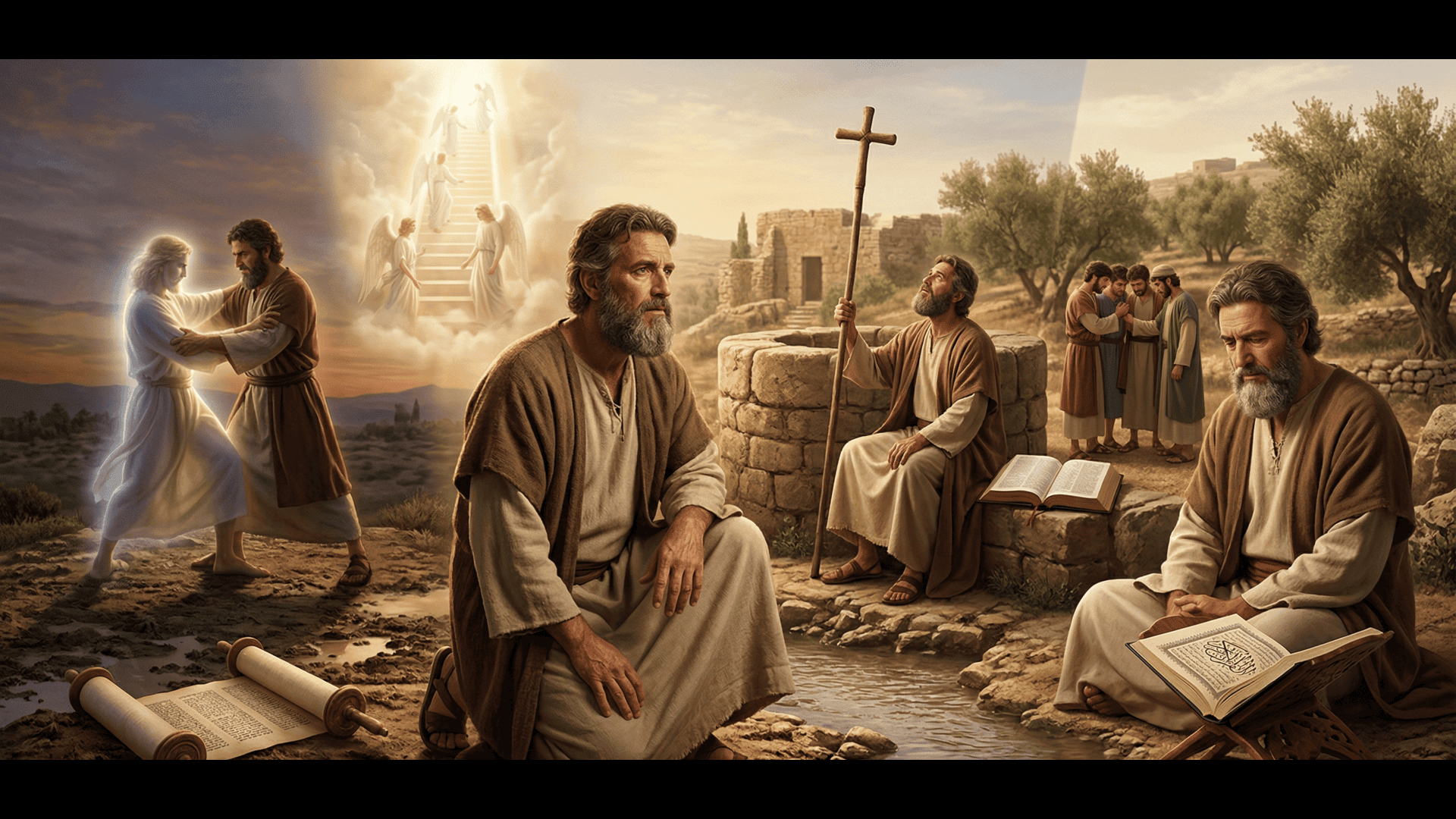
When we speak of the Abrahamic faiths, the focus inevitably falls on Abraham, the foundational monotheist. Yet, to understand the deeply intertwined, historically complex, and often divergent theologies of Judaism, Christianity, and Islam, one must look to his grandson: Jacob.
Known as Yaakov in Hebrew and Ya’qub in Arabic, Jacob is the crucible through which the promises made to Abraham are refined, tested, and ultimately realized. He is not merely a link in a genealogical chain; he is a defining archetype. However, the Jacob we meet in the Torah is not identical to the Jacob debated in the Epistles of the New Testament, nor is he exactly the same figure revered as a steadfast prophet in the Quran.
To explore Jacob across these three traditions is to hold up a mirror to the religions themselves. In Judaism, he is the wrestler, the imperfect man who struggles with God and humanity to forge a nation. Christianity, he is the vessel of divine grace, an instrument of God’s sovereign election and a prophetic shadow of Christ. In Islam, he is the epitome of Sabr (beautiful patience), an infallible prophet whose unwavering faith in God sustains him through unimaginable grief.
This article delves deep into the scriptures, traditions, and theologies of Judaism, Christianity, and Islam to explore how one ancient patriarch came to mean so many different things to billions of people.
Part 1: Jacob in Judaism (Yaakov) – The Wrestler and the Archetype
In the Jewish tradition, Jacob is arguably the most central of the three Patriarchs (Avot). While Abraham discovered God and Isaac was willing to be sacrificed to Him, it is Jacob who actually sires the Twelve Tribes. The Jewish people do not call themselves the “Children of Abraham”; they are Bnei Yisrael—the Children of Israel, the name bestowed upon Jacob.
In Judaism, Jacob’s narrative is found in the Book of Genesis (Bereshit), and it is a story of profound human struggle, moral ambiguity, exile, and ultimate redemption.
The Struggle from the Womb
Jacob’s life is defined by conflict from its very inception. Genesis records that he and his twin brother, Esau, “struggled together within” the womb of their mother, Rebekah. Jacob is born second, grasping Esau’s heel. His name, Yaakov, is derived from the Hebrew word for heel (akev), carrying connotations of one who supplants, overreaches, or deceives.
Rabbinic literature (Midrash) deeply enriches this rivalry. The sages often depict Esau as the archetype of the physical, aggressive world (later associated with Rome and the oppression of the Jews), while Jacob is characterized as an ish tam, yoshev ohalim—a “mild man, dwelling in tents,” which the Talmud interprets as the tents of Torah study. Jacob represents the intellectual and spiritual pursuit of God.
The Stolen Blessing and Exile
The defining controversy of Jacob’s early life is his acquisition of the birthright (bekhorah) for a bowl of lentil stew, and later, his deception of his blind father, Isaac, to steal the firstborn’s blessing (berakhah).
Unlike later theological interpretations that might seek to sanitize this event, Jewish exegesis wrestles openly with Jacob’s deceit. While some commentators argue that Jacob was reclaiming what was rightfully his (as Esau despised the birthright), others point out that Jacob paid a heavy price for his deception. He is forced to flee his home, entering a long, grueling exile in Haran under the thumb of his manipulative uncle, Laban.
This exile is viewed in Judaism as a prototype for the Jewish diaspora. Jacob’s struggle to survive, maintain his identity, and build a family in a hostile foreign land mirrors the historical experience of the Jewish people. As the famous Passover Haggadah declares, “A wandering Aramean was my father.”
The Ladder and the Covenant
Fleeing from Esau, Jacob stops at Luz (later Bethel) and has his famous dream of a ladder reaching to heaven, with angels ascending and descending. Here, God renews the Abrahamic covenant with him, promising him the land and innumerable descendants. In Jewish thought, this dream signifies the connection between the earthly and the divine. The angels ascending are often interpreted as the guardian angels of the nations that will oppress Israel, rising to power and eventually falling, while God remains eternally beside Jacob.
Peniel: From Jacob to Israel
The absolute climax of Jacob’s spiritual journey occurs on his way back to Canaan, on the eve of his terrifying reunion with the heavily armed Esau. Alone at the ford of the Jabbok River, Jacob wrestles with a mysterious “man” (traditionally understood as an angel, specifically the guardian angel of Esau, or a manifestation of the Divine) until daybreak.
Jacob is wounded in the hip, but he refuses to let go until he receives a blessing. The being declares: “Your name shall no longer be Jacob, but Israel, for you have striven with God and with humans, and have prevailed” (Genesis 32:28).
This is the theological bedrock of Judaism. The word Israel (Yisra-el) literally means “wrestles with God.” To be a Jew is not to possess a blind, unquestioning faith; it is to inherit Jacob’s struggle. It is to argue with God, to demand justice, to study fiercely, and to emerge limping but blessed. Jacob does not become perfect; he becomes deeply authentic. The prophet Micah later associates Jacob with the attribute of Emet (Truth), a truth earned through the arduous integration of his flaws and his divine purpose.
Part 2: Jacob in Christianity – The Heir of Promise and Typological Shadow
Christianity inherits the Hebrew Bible as its Old Testament, meaning Christians accept the historical and scriptural narrative of Jacob as presented in Genesis. However, the Christian lens fundamentally shifts the theological emphasis. In Christian theology, Jacob is less an archetype of a struggling nation and more a profound demonstration of God’s grace, sovereign election, and a “type” (a prophetic foreshadowing) of Jesus Christ.
Sovereign Election: “Jacob I Loved, But Esau I Hated”
The most significant theological deployment of Jacob in the New Testament is found in the Apostle Paul’s Epistle to the Romans. In Romans 9, Paul addresses a complex question: If the Jews are God’s chosen people, why have many rejected Jesus?
Paul uses the story of Jacob and Esau to explain the concept of Election—that God’s promises are fulfilled not by biological descent or human merit, but by God’s sovereign choice. Paul points out that before the twins were even born, before they had done anything good or bad, God chose Jacob over Esau. Paul quotes the prophet Malachi: “Jacob I loved, but Esau I hated.”
For Christians, particularly within the Reformed and Calvinist traditions, Jacob is the ultimate proof that salvation is a product of unmerited grace. Jacob was a deceiver and a supplanter, yet God chose him. He did not earn the blessing; God orchestrated it. Therefore, Christians view themselves as spiritual heirs to Jacob—chosen by grace, despite their sins.
Typology: Jacob as a Shadow of Christ
Early Church Fathers (Patristics) loved to read the Old Testament allegorically, looking for “types” of Christ. Jacob provided rich material for this endeavor:
- The Shepherd: Jacob was a shepherd who cared for his flock, foreshadowing Jesus, the “Good Shepherd.”
- The Bridegroom: Jacob’s journey to a foreign land to win a bride (and working for her) was seen as a parallel to Christ leaving heaven to win His bride, the Church.
- The Two Wives: In early Christian allegory, Leah (the older, weak-eyed sister) represented the Synagogue or the Old Covenant, while Rachel (the younger, beautiful sister) represented the Church or the New Covenant.
Jacob’s Ladder and Christ the Bridge
Perhaps the most famous Christian reinterpretation of Jacob’s life comes from the lips of Jesus Himself. In the Gospel of John, Jesus meets Nathanael and tells him, “Very truly I tell you, you will see ‘heaven open, and the angels of God ascending and descending on’ the Son of Man” (John 1:51).
Jesus takes the imagery of Jacob’s Ladder at Bethel and applies it directly to Himself. In Christian theology, the ladder is no longer a physical stairway or a metaphor for prayer; the ladder is Jesus. Christ, through the Incarnation, becomes the sole mediator—the bridge that connects heaven and earth.
Jacob’s Well and Supersession
In John chapter 4, Jesus rests at “Jacob’s Well” in Samaria and meets a Samaritan woman. The well, dug by the patriarch, represents the sustenance of the Old Covenant. Jesus offers her “living water,” stating that whoever drinks from Jacob’s well will thirst again, but whoever drinks the water Jesus gives will never thirst.
Here, Jacob is deeply respected as the patriarch, but Christianity establishes a clear hierarchy: Jesus is greater than Jacob. The physical heritage of Jacob is superseded by the spiritual reality of Christ. The New Testament honors Jacob’s faith—he is featured prominently in the “Hall of Faith” in Hebrews 11 for blessing Joseph’s sons while leaning on his staff—but views his entire life as a preamble to the Gospel.
Part 3: Jacob in Islam (Ya’qub) – The Infallible Prophet of Beautiful Patience
When we turn to the Quran and Islamic tradition, the portrait of Jacob undergoes a dramatic transformation. In Islam, Jacob is known as Ya’qub (and occasionally as Israil). He is universally revered as a Nabi (Prophet), a righteous man, and an essential link in the chain of prophetic revelation from Ibrahim (Abraham) to Ishaq (Isaac) to himself, and down to his son Yusuf (Joseph) and the Tribes (Al-Asbat).
The most striking difference between the Judeo-Christian Jacob and the Islamic Ya’qub is the concept of prophetic character.
The Concept of Ismah (Infallibility)
In mainstream Islamic theology, Prophets are protected by Allah from committing major sins or exhibiting flaws that would undermine their moral authority. This concept is known as Ismah (infallibility or impeccability).
Because of Ismah, the Islamic narrative entirely rejects or radically reinterprets the Genesis stories of Jacob’s deception. A Prophet of God would not steal a birthright, nor would he deceive his blind father. In Islam, Ya’qub is chosen by Allah from the beginning because of his inherent righteousness, not through a process of moral stumbling and eventual redemption. The wrestling match at the Jabbok River is completely absent from the Quran. The idea that a human could physically wrestle with God (or even an angel of God) and “prevail” is fundamentally incompatible with Islamic theology, which emphasizes the absolute majesty, transcendence, and un-anthropomorphic nature of Allah (Tawhid).
The Exemplar of Sabr (Patience)
If Judaism’s Jacob is defined by his wrestling, Islam’s Ya’qub is defined by his grief and his patience. Ya’qub’s story in the Quran is primarily told in Surah Yusuf (Chapter 12), which details the life of his beloved son Joseph.
When Ya’qub’s older sons throw Yusuf into a well and bring back his shirt stained with false blood, claiming a wolf ate him, Ya’qub knows they are lying. Yet, he does not wage war against his sons or curse God. Instead, he utters one of the most famous phrases in the Quran:
“Rather, your souls have enticed you to something, so patience is most fitting (Sabrun Jameel). And Allah is the one sought for help against that which you describe.” (Quran 12:18)
Sabrun Jameel (beautiful patience) is a patience devoid of panic, complaining to people, or losing faith in God. Ya’qub weeps for Yusuf for decades. His grief is so profound and prolonged that he literally cries himself blind. Yet, his mourning is private, directed only to Allah: “I only complain of my suffering and my grief to Allah, and I know from Allah that which you do not know” (Quran 12:86).
In Islam, Ya’qub is the ultimate role model for anyone facing devastating loss. He demonstrates that profound human sorrow is not mutually exclusive with perfect faith. He never loses hope in Allah’s mercy, continually instructing his sons to go back and search for Yusuf and his brother, warning them never to despair of the spirit of Allah.
The Father of Monotheism
While the Quran acknowledges that Ya’qub is the father of the Children of Israel (Bani Israil), his primary role is not ethno-national, but theological. He is a transmitter of Tawhid (pure monotheism).
This is beautifully encapsulated in his deathbed scene, recorded in Surah Al-Baqarah. Unlike the Genesis account where Jacob gathers his sons to prophesy over their tribal futures, the Quranic Ya’qub gathers his sons for a singular theological purpose:
“Or were you witnesses when death approached Ya’qub, when he said to his sons, ‘What will you worship after me?’ They said, ‘We will worship your God and the God of your fathers, Ibrahim and Isma’il and Ishaq – one God. And we are Muslims [in submission] to Him.’” (Quran 2:133)
In Islam, Ya’qub’s ultimate success is not securing a physical land, but ensuring that his descendants remain steadfastly submitted to the One God.
Part 4: A Comparative Analysis – Divergences and Convergences
When we place the three traditions side-by-side, the figure of Jacob acts as a theological prism, refracting a single ancient history into distinct worldview colors.
1. The Nature of the Hero: Humanity vs. Infallibility
- Judaism embraces Jacob’s flaws. His humanity, his fear, his cunning, and his physical limitations make his spiritual victories profound. He is relatable precisely because he is imperfect.
- Christianity acknowledges his flaws but uses them to highlight God’s grace. Jacob’s imperfections are necessary to prove that human merit cannot earn divine favor.
- Islam elevates Jacob above human frailty. To be a messenger of God requires an unblemished moral character. His struggles are external (the loss of his son) rather than internal moral failings.
2. The Meaning of “Israel”
- For Jews, “Israel” is a badge of honor earned through struggle. It is an active verb: to wrestle with the divine. It forms the identity of a nation that survives through tenacity.
- For Christians, “Israel” becomes spiritualized. The Church views itself as the “New Israel,” inheriting the promises of Jacob not through bloodline, but through faith in Christ.
- For Muslims, “Israil” is simply another name for Ya’qub. While the Bani Israil (Children of Israel) are addressed frequently in the Quran, Islam asserts that the covenant of God is tied to faith and submission (Islam), not to the specific lineage of Jacob.
3. The Divine Interaction
- Judaism’s God gets His “hands dirty” with humanity. God (or His messenger) literally descends to the dust of the Jabbok River to physically grapple with Jacob. It is an intimate, visceral relationship.
- Christianity’s God also descends, but perfectly and finally in the person of Jesus Christ, whom Jacob’s life merely shadowed and prophesied.
- Islam’s God is majestically transcendent. Allah communicates with Ya’qub through revelation (Wahy) and dreams, maintaining absolute sovereignty. The intimacy is found not in physical wrestling, but in Ya’qub’s tearful, internal reliance on Allah’s mercy.
Conclusion
Jacob, Yaakov, Ya’qub. He is a man of many names and many lives. He lived as a shepherd in the ancient Near East, but he survives today in the synagogues of Jerusalem, the cathedrals of Rome, and the mosques of Mecca.
To the Jew, he says: Do not be afraid to wrestle with God, for through struggle comes truth. To the Christian, he says: Look at me, a flawed man, and see the unmerited grace of a choosing God. To the Muslim, he says: When the world breaks your heart, hold fast to beautiful patience, for God’s mercy is near.
Ultimately, exploring Jacob across religions does not require us to flatten these theological differences into a homogenous, politically correct narrative. The differences are stark, deep, and deeply meaningful to the adherents of each faith. Yet, by understanding how each tradition views this shared patriarch, we gain profound insight into the spiritual DNA of our neighbors. In studying the diverse interpretations of his life, we are doing exactly what his name implies: we are wrestling with the divine text.
Frequently Asked Questions: Jacob Across Religions
Q: What does the name “Israel” actually mean, and why was it given to Jacob?
A: In the Hebrew Bible, the name Yisrael (Israel) is given to Jacob after he wrestles with a mysterious divine being until daybreak. It is traditionally translated from Hebrew as “he who wrestles/strives with God” or “God prevails.” In Jewish tradition, this name defines the identity of the Jewish people (Bnei Yisrael or Children of Israel) as a nation that actively engages, struggles, and questions the divine. In Islam, Israil is recognized as a title or alternate name for the Prophet Ya’qub, though the Quran does not tie the name to a wrestling match.
Q: Who was Jacob wrestling with at the Jabbok River?
A: Genesis intentionally leaves the identity of the figure ambiguous, referring to him simply as a “man.”
- Judaism: Rabbinic tradition often interprets the figure as an angel, frequently identifying him as the guardian angel of Jacob’s hostile brother, Esau.
- Christianity: Many early church fathers and Christian theologians interpret the figure as a “Christophany”—a pre-incarnate appearance of Jesus Christ.
- Islam: This event is not recognized in Islamic tradition. The concept of a human physically grappling with God or His angels contradicts the core Islamic tenet of Tawhid (the absolute majesty and un-anthropomorphic nature of God).
Q: If Jacob deceived his father in the Bible, how does Islam view him as a flawless prophet?
A: This comes down to the Islamic theological concept of Ismah (prophetic infallibility). Islamic tradition holds that God protects all His prophets from committing major sins or exhibiting profound moral flaws, ensuring their message and character remain entirely trustworthy. Therefore, Muslims believe the biblical accounts of Jacob stealing the birthright or deceiving his blind father, Isaac, are later human alterations to the text. In the Quran, Ya’qub is fundamentally righteous from the start.
Q: Why are Jacob’s twelve sons so important across all three religions?
A: Jacob’s sons are the foundation of the Twelve Tribes of Israel.
- Judaism, they are the literal and spiritual ancestors of the nation, each tribe carrying a specific blessing and role within the land of Canaan.
- Christianity, the twelve tribes are seen as the foundational structure of God’s people, later mirrored by Jesus choosing Twelve Apostles to build the “New Israel” (the Church).
- Islam, the tribes (Al-Asbat) are recognized as the descendants of Ya’qub. More specifically, his son Yusuf (Joseph) is elevated as a major prophet, and Surah Yusuf is one of the most detailed and revered chapters in the Quran.
Q: What is the significance of “Jacob’s Ladder”?
A: In Genesis, Jacob dreams of a ladder (or stairway) resting on the earth and reaching into heaven, with angels ascending and descending.
- Judaism views this as a powerful symbol of the constant interaction between the physical and spiritual realms, often interpreting the angels as representing the rise and fall of the nations that interact with Israel.
- Christianity reinterprets this dream through the Gospel of John, where Jesus identifies Himself as the ladder—He is the ultimate bridge and mediator between heaven and earth.
Leave a Reply