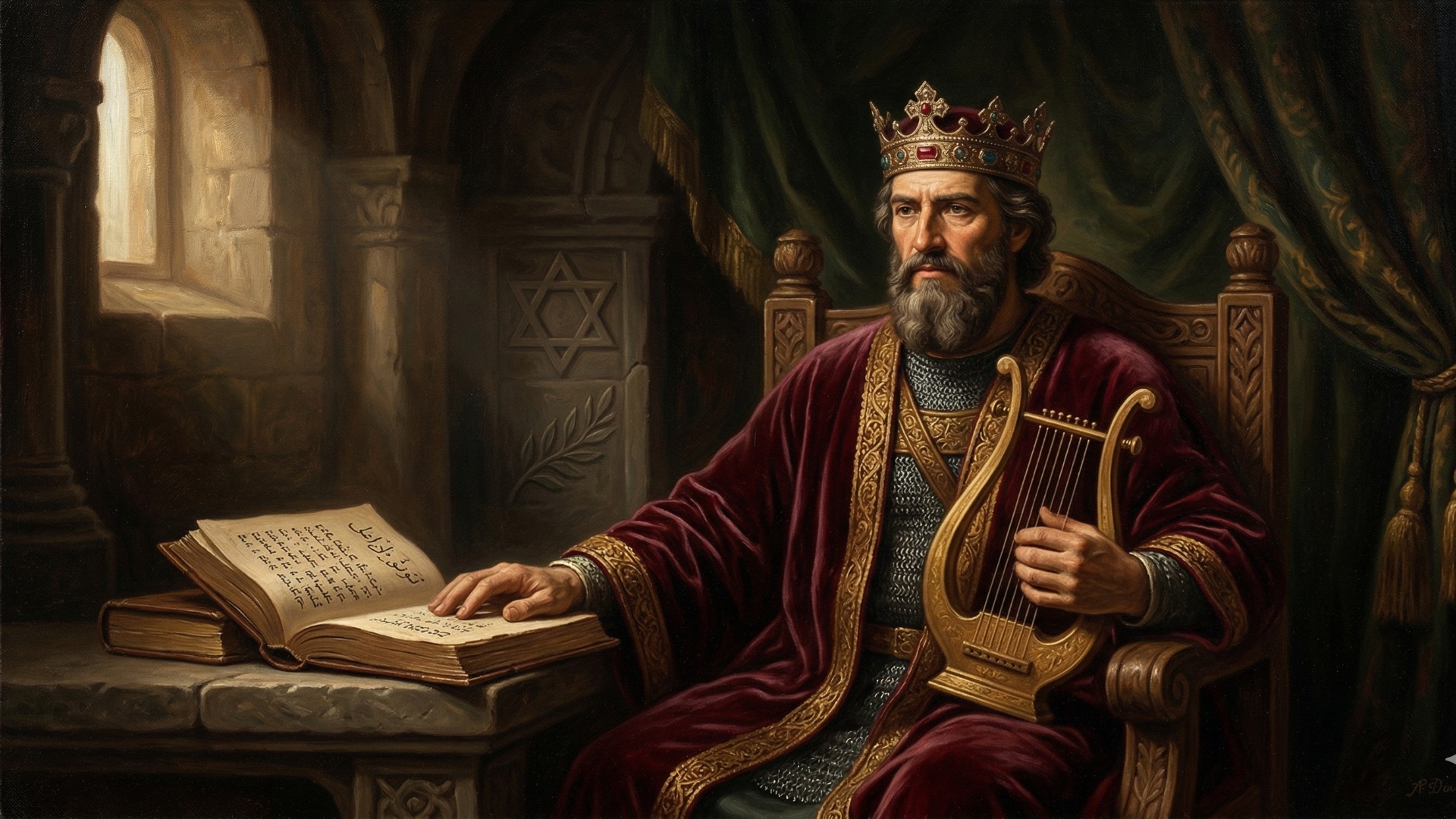
Of all the figures that populate the shared sacred geography of the Abrahamic faiths, few stand as tall—or as human—as David. He is the shepherd boy who became a warrior-king, the sweet psalmist whose words continue to comfort billions, and the flawed leader who became a model of repentance. Known as David in Judaism and Christianity, and Dawud in Islam, his story is etched into the foundational texts of these religions. Yet, a close examination reveals that the description of this monumental figure is not uniform. Each faith has shaped his image through the lens of its own theology, prioritizing different aspects of his complex character.
In Judaism, he is the foundational monarch of a united Israel and the forefather of the Messiah. In Christianity, he is the ancestral key to Jesus’s messianic identity and a model of devotion. In Islam, he is revered not just as a king, but as a righteous prophet and messenger, protected from the grave sins attributed to him in other traditions. Beyond these three, smaller faiths like Rastafari and Baháʼí have also woven David’s legacy into their unique spiritual tapestries. To understand the different faces of David across world religions is to understand the diverse ways in which humans have interpreted leadership, piety, and the divine-human relationship.
Part I: The Hebrew Context – David in Judaism
In Judaism, the description of David begins with a fundamental paradox: he is at once the “sweet singer of Israel” and its “man of blood.” No other figure, save perhaps Moses, has a larger impact on the religious consciousness of the Jewish people. His life, chronicled in exhaustive detail in the Books of Samuel and Chronicles, is a tapestry of extraordinary highs and crushing lows, a narrative of political astuteness, deep faith, and moral failure. To Judaism, he is the architect of the ultimate political and spiritual reality—the House of David.
The Shepherd and the Anointing
Judaism describes David’s early years as a humble shepherd, the youngest and most overlooked of Jesse of Bethlehem’s eight sons. The description emphasizes that he was not the natural choice for kingship, lacking the physical stature and status of his older brothers. This narrative serves to illustrate a key theological point: “God sees not as man sees; for man looks on the outward appearance, but the Lord looks on the heart” (1 Samuel 16:7).
The Talmud, the vast compendium of Jewish oral law, adds details about his mother, Nitzevet, further humanizing his origin story. His selection and secret anointing by the prophet Samuel are seen as divine interventions, bypassing human conventions to raise a leader whose primary qualification was his perceived “heart,” a metaphor for his capacity for devotion and relationship with God. This early description establishes David as an outsider, chosen and exalted by grace, a theme that resonates throughout the Jewish historical narrative.
The Warrior-Harpist
David’s entry into the public arena is twofold, blending the arts of peace and war. In one description, he is brought to King Saul’s court as a skilled musician whose lyre-playing has the power to soothe the king’s “evil spirit.” This musical talent establishes a connection between his kingship and the divine. The Talmud also credits him with inventing musical instruments and organizing the first temple choirs.
In another description, and his most iconic moment, he steps forward as the only Israelite brave enough to face the Philistine giant, Goliath. In Judaism, this battle is not interpreted as a triumph of physical prowess, but as a victory of faith. David explicitly rejects Saul’s heavy armor, proclaiming: “You come to me with sword, and spear, and javelin; but I come to you in the name of the Lord of Hosts, the God of the armies of Israel” (1 Samuel 17:45). This duel establishes the Davidic paradigm of leadership: power that derives not from military might alone, but from unwavering trust in the divine promise.
The King of a United Israel
Judaism depicts David’s reign (c. 1010-970 BCE) as the “Golden Age” of Israel. Following the death of Saul, he unified the fragmented tribes, transforming a loose confederation into a cohesive and formidable nation. His political and military astuteness is highly praised, with descriptions focusing on his conquest of the strategically located Jebusite city of Jerusalem, making it the capital of his united kingdom. He is celebrated for expanding Israel’s borders, securing its sovereignty, and ensuring peace for his people.
Crucially, David understood that for the political union to be complete, it had to have a spiritual heart. To this end, his most significant achievement was to bring the Ark of the Covenant, the supreme symbol of Israelite religion, to Jerusalem. Judaism describes David’s ecstatic dance before the Ark as it entered the city, an image of uninhibited devotion that exemplifies his passionate relationship with God. In Judaism, his legacy is not just the City of David but the Holy Temple which, though built by his son Solomon, was David’s vision, with detailed plans he prepared.
The Problem of Sins: Rabbinic Interpretation
The Jewish narrative does not flinch from David’s moral failures. His adultery with Bathsheba and the subsequent orchestrated death of her husband, Uriah the Hittite, are recounted in the Bible with devastating clarity. However, in later Jewish thought, particularly in the Talmud, the description of these acts is carefully nuanced to preserve David’s status as a righteous king and a man with a “perfect heart.”
The Talmud provides several interpretations to mitigate the severity of his sin:
- The Conditional Divorce: It explains that it was customary for Jewish soldiers, before going to war, to give their wives a conditional writ of divorce. This was to prevent the wife from being trapped in legal limbo if the husband went missing but his body wasn’t found (making her an agunah). Thus, Uriah would have given Bathsheba such a divorce, and, because he died, the divorce was retroactively valid from the time he left. Therefore, they argue, David technically did not commit adultery, but took a woman who was legally unmarried, albeit with sinful intent.
- The Unripe Fruit: Another Talmudic passage states that Bathsheba was destined for David “from the Six Days of Creation,” but he took her as “an unripe fruit,” meaning he enjoyed a permissible pleasure before the proper, ordained time.
- The Divine Test: The most remarkable interpretation, found in the Babylonian Talmud (Sanhedrin 107a), suggests that the entire test was a divine trap. David, eager to show his devotion like the Patriarchs (Abraham, Isaac, Jacob), asked God: “Master of the Universe! Why do people say, ‘The God of Abraham, the God of Isaac, and the God of Jacob,’ but not ‘The God of David’?” God answered: “I did not try them, but I will try you with a sexual matter.” Thus, David’s failure is framed as part of a divine plan to create the ultimate model of Teshuva, or repentance. The description focuses less on the sin itself and more on his total, crushing admission of guilt when confronted by the prophet Nathan. His legacy in Judaism, therefore, is not a perfect hero, but a broken and restored one, whose profound repentance became a path for all sinners.
The Davidic Covenant and Messianic Hope
David’s ultimate description in Judaism is as the bearer of the Davidic Covenant. God promised him, through the prophet Nathan, that his house and his kingdom would establish “a throne that would be established forever” (2 Samuel 7:16). This promise is the foundation of Jewish messianic hope. The description of the Mashiach (Messiah) in Judaism is not a divine-human entity, but a righteous, human descendant of David’s line, who will one day gather the Jewish people, rebuild the Temple, and usher in a time of universal peace. In every prayer, David is invoked, and in every expectation of the future, the House of David is central. In Judaism, David is not just a king of the past; his name is synonymous with the hope of the future.
Part II: The Gospel Context – David in Christianity
In Christianity, the description of David is built entirely upon the foundation of the Hebrew Bible, but with a radical new interpretation. For Christians, the promise of the Davidic Covenant is fulfilled not in a future king, but in the person of Jesus of Nazareth. David’s role, therefore, is one of typology and genealogy. He is the ancestor, forerunner, and foreshadower of Jesus Christ.
Typology: Prefiguring Christ
Christian theology often uses David as a “type” or figure who prefigures and points to Jesus. This description is based on several parallels in their lives:
- The Shepherd-King: Like David, Jesus is described as the “Good Shepherd” (John 10:11) who lays down his life for his flock, but also as the “King of Kings” (Revelation 19:16) who will rule over all nations. The description of David’s rejection by his brothers is seen to prefigure Jesus’s rejection by “his own” (John 1:11).
- The Innocent Sufferer: Many of the Psalms, traditionally attributed to David, contain rich language of suffering, persecution, and eventual exaltation. In Christian tradition, these Psalms (e.g., Psalm 22, “My God, my God, why have you forsaken me?”) are read not just as David’s personal laments, but as profound prophecies of the crucifixion of Jesus, who explicitly quoted these words on the cross.
- The Beloved Son: God’s description of the Davidic king as “My Son” (Psalm 2:7) is seen in Christian thought as the first articulation of the divine sonship that finds its ultimate expression in Jesus.
Ancestor of the Messiah: The “Son of David”
The most crucial description of David in Christianity is genealogical. The Gospels of Matthew and Luke make a determined, if divergent, effort to trace Jesus’s lineage back to King David. Matthew begins with the words: “A record of the genealogy of Jesus Christ, the son of David, the son of Abraham” (Matthew 1:1). Luke 3 similarly includes David in his line of begats.
The designation of Jesus as the “Son of David” is a potent title throughout the New Testament, signifying that he is the rightful heir to the Davidic throne and the promised Messiah. The public addresses to Jesus (e.g., by the blind beggars and the Syrophoenician woman) as “Lord, Son of David” are not just polite greetings but confessions of faith in his messianic identity. When Jesus enters Jerusalem on a donkey, the crowds shout: “Hosanna to the Son of David!” (Matthew 21:9), an action that directly connects him with David’s established royal identity in Judaism. The entire Christian narrative requires David to provide the legal and historical framework for Jesus’s claim.
“A Man After God’s Own Heart”
In Christianity, David’s character is frequently summed up by a powerful phrase attributed to God in the Book of Acts: “A man after God’s own heart” (Acts 13:22). This description points to David’s inner disposition, a deep and unyielding desire to align his will with the divine will, regardless of his flaws.
For Christians, the description emphasizes:
- Heartfelt Worship: David is seen as the prototypical worshiper, not a rigid ritualist. His legacy as the primary author of the Psalms is highly revered, and these poems form the core of Christian liturgies and personal devotion, providing a language for the soul to communicate with God in its deepest moments.
- The Path of Repentance: Unlike Judaism, which provides legal arguments to mitigate David’s sin, Christianity tends to accept the full description of his guilt with Bathsheba and Uriah. The focus in Christian thought is less on the legal technicality and more on the moral depravity of the act. David becomes the supreme example of God’s limitless grace. His fall is description as deep, but his rise is seen as higher, with Psalm 51 (“Have mercy on me, O God…”) serving as the ultimate model of heartfelt, shattering confession and restoration for the Christian. In Christianity, David proves that no one is beyond redemption if they turn back to God with a sincere heart.
The Limitations of Kingship
Christianity also describes David as a powerful, but imperfect, foreshadowing. The description of his “shed much blood” is given by God as the reason he was not allowed to build the Temple, a task reserved for his son Solomon, a figure of peace. For Christians, this points to the fundamental limitation of David’s earthly kingship. His kingdom was temporary, his life was mortal, and his rule was of this world. Christianity describes Jesus as a “greater than David” (cf. Matthew 12:42), whose kingdom is “not of this world” (John 18:36), and whose ultimate rule is over the hearts of humanity, bringing a eternal peace that Davidic military power could never achieve.
Part III: The Prophetic Context – David in Islam
In Islam, the description of David is known by his Arabic name, Dawud (AS). He is a monumental figure in the Quran, appearing 16 times across 9 chapters. The description of Dawud in Islam is distinct and highly revered. He is not primarily a king whose life is filled with political intrigue, but a prophet (Nabi) and messenger (Rasul) of Allah, righteous, divinely guided, and protected from the grave sins attributed to him in other traditions. To Islam, Dawud represents the perfect model of a khalifa (vicegerent), a ruler who administers justice in the world in accordance with divine law.
More Than a King: Prophet and Khalifa
Islam is emphatic that the descriptions of Dawud (AS) as a king must never overshadow his station as a prophet. His life, from the Islamic perspective, is not about the establishment of a political dynasty, but about the delivery of a divine message. He is included in lists of those who received wihy (revelation) from God, placed alongside seminal figures like Abraham, Moses, and Noah.
His description includes:
- Righteous King: Islam does not reject the idea that Dawud was a king, but it frames his rule as a divine gift, not a human achievement. The Quran states: “We made his kingdom strong and gave him wisdom and sound judgment” (Quran 38:20). His entire life as a monarch is described as a model of just, compassionate, and wise rule.
- Khalifa (Vicegerent): The Quran explicitly calls Dawud a khalifa on earth, a title also given to Adam. God commands him: “O David, indeed We have made you a vicegerent upon the earth, so judge between the people in truth and do not follow [your own] desire, for it would lead you astray from the way of Allah” (Quran 38:26). In Islam, this is the foundational description of David’s leadership: he is a representative of God, with a mandate to establish justice on earth.
Softening Iron: A Unique Attribute
One of the most striking and unique elements in the Islamic description of Dawud (AS) is his divinely granted ability to soften and shape iron without heat. The Quran states: “We made iron soft for him, commanding: ‘Make full coats of mail and measure the links well; and do good deeds. Indeed, I am All-Seeing of what you do’” (Quran 34:10-11).
This description has several meanings in Islam:
- Divine Intervention: It demonstrates Allah’s absolute power to override physical laws and highlights his special favor toward Dawud.
- Technological Stewardship: It is not description as a tool for conquest, but as a technological gift that allowed Dawud to provide his people with protective armor, ensuring their safety and stability, thus reinforcing his role as a just ruler.
- Practical Piety: It is combined with the command to “do good deeds.” In Islam, Dawud’s skill in metalwork is not an end in itself, but is linked to his piety and the maintenance of a just society.
The Recipient of the Zabur (Psalms)
Like Judaism and Christianity, Islam honors Dawud (AS) as the recipient of the Zabur, or the holy book of Psalms. The Quran explicitly says: “We gave David the Psalms” (Quran 17:55). The Zabur is considered one of the previous revealed scriptures of Islam.
Islamic tradition describes Dawud’s beautiful and melodious voice when reciting the Psalms. So powerful was his recitation that not only did humans weep, but even the mountains and the birds would join him in glorifying Allah. The Quran mentions: “We made the mountains glorify Us, along with David, evening and morning; and the birds also, assembled. Each to Him was turning in repentance” (Quran 38:18-19). In Islam, David is described not just as a king but as a spiritual cantor, whose voice was in perfect harmony with the rest of creation in the worship of God.
Preserving Prophetic Dignity: The Interpretation of “Sins”
The most significant and defining difference in the Islamic description of Dawud (AS) relates to the narrative of his sins. The majority of Islamic scholars, based on the principle of Ismah (prophetic sinlessness or protection from grave sins), do not accept the biblical stories of adultery with Bathsheba and the murder of Uriah. They believe such actions are fundamentally incompatible with the station of a prophet and messenger of Allah. To Islam, to accuse a prophet of such grave moral failures is to degrade the message they came to deliver.
The Quranic “test” that Islamic tradition focuses on is not about lust, but about the administration of justice. In Quran 38:21-25, two adversaries suddenly appear before Dawud (AS) in his private quarters, scaling the walls. Terrified, Dawud listens as one describes a parable: “This man is my brother. He has 99 ewes, and I have only one. Yet he says, ‘Entrust her to me,’ and has overcome me in speech.” Dawud (AS) immediately judges the brother with 99 ewes as having done wrong, without hearing his side.
Upon making this decision, Dawud (AS) immediately realizes that this was a test from Allah. The Islamic description emphasizes his swift, profound repentance for his failure to apply proper due process. He fell down in prostration and asked for forgiveness. God forgave him, and the description concludes with his station being exalted: “We forgave him for that, and indeed for him with Us is nearness and a beautiful place of return” (Quran 38:25).
In Islam, David proves not that a prophet can commit a grave sin, but that a just ruler can make an understandable human error in judgment, and that the true mark of divine guidance is the humility to recognize that error and turn back to God immediately. His entire narrative is a lesson in the fragility of power and the necessity of self-correction and divine mercy.
Part IV: Additional Perspectives – David in Other Faiths
David’s descriptions are not confined to the largest traditions. Other, smaller faiths have integrated his legacy into their unique spiritual frameworks.
Baháʼí Faith: A Unique Differentiation
The Baháʼí Faith, a 19th-century monotheistic religion that teaches the unity of religions and humanity, provides a fascinating, nuanced description of David. The Central Figure of the Baháʼí Faith, Bahá’u’lláh, in his seminal work, the Kitáb-i-Íqán (Book of Certitude), clarifies a complex theological point that dates back to the Báb, the forerunner of the Baháʼí movement.
The Baháʼí Faith makes a clear differentiation:
- The Second David: It states that the “David” referred to by the Báb, who allegedly preceded Moses, is not the same as King David, the father of Solomon and author of the Psalms. It confirms that King David lived centuries after Moses.
- Follower and Promoter: While the Baháʼí Faith views figures like Abraham, Moses, Jesus, and Muhammad as “Universal Manifestations of God” (messengers who bring new divine law), King David is not placed in this station. Instead, he is described as a follower and promoter of the law established by Moses, not a revealer of new law. He is honored as a great king, poet, and spiritual figure, but his primary description is one of a divinely supported servant and follower.
Rastafari: The African Connection and Royal Lineage
In the Rastafari movement, an Afrocentric religious and social movement that emerged in Jamaica in the 1930s, David’s description is profoundly woven into the core of their spiritual and political identity. The entire movement is based on the expectation of a crowned black king who would be a redeemer for the African people, a figure they identify as Emperor Haile Selassie I of Ethiopia.
Rastafari description of David emphasizes:
- The Solomonic Line: According to the Kebra Nagast (The Glory of the Kings), the ancient sacred text of Ethiopian Orthodox Christianity, King Solomon, the son of David, fathered a son, Menelik I, with the Queen of Sheba (associated with modern-day Ethiopia and Yemen). Ethiopian tradition has, for centuries, traced the royal lineage of its emperors back to Menelik, making them the direct descendants of the House of David.
- The Black King: For Rastafarians, this description of David and Solomon as part of a continuous black royal line is revolutionary. It rejects the stereotypical “white savior” image of Christianity and places the divine royal covenant directly in the heart of Africa. David’s legacy, therefore, provides the crucial genealogical proof that Haile Selassie is the “Root of David” and the fulfillment of the biblical messianic prophecies.
- Symbols and Rituals: Rastafari culture is infused with Davidic imagery. The downwards pointing triangle formed by the hand gesture, known as the “diamond hand gesture” or “Seal of Solomon”, is a direct connection to David’s lineage. There is also a legendary Rastafari belief that the first cannabis (ganja) plant, which they use as a spiritual sacrament to draw closer to Jah (God), grew on King David’s tomb, further hallowing his memory.
Part V: Comparative Analysis – Themes Across Traditions
While the descriptions of David across Judaism, Christianity, Islam, and other faiths are diverse, a remarkable synthesis reveals several enduring themes that unite them.
Humility and Repentance
Across every tradition, David is description as a human of profound humility. In Judaism, he is the broken repenter whose failure is the door to Teshuva. In Christianity, he is the model of an individual whose shattered self becomes a vessel for divine grace. In Islam, he is the just ruler whose errors lead to swift, prostrate submission to divine will. In the Rastafari “I and I” concept (meaning me and the God-within-me), Davidic lineage emphasizes that the individual connection to the divine is paramount. Humility, not power, is the common thread that makes David’s description universally compelling.
Just Rule and Vicegerency
In Judaism and Islam, in particular, the description of David as a king is central. But it is never power for its own sake. In Judaism, his rule is described as being description by alignment with the covenant. In Islam, he is the explicit model of vicegerency (Khalifa), a representative of God. The constant description is that of a ruler who administers justice and sound judgment, with the Quranic warning against following “vain desire” serving as a central tenet of Islamic description of leadership.
Music and Spiritual Intimacy
The descriptions of David in Judaism, Christianity, and Islam all revere him as a creator of sacred music and the primary author of the Psalms. In Judaism, his words are description as the language of the soul’s relationship with God. In Christianity, they become prophetic foreshadowing. In Islam, his melodious voice is so resonant that all of nature is described as joining in his glorification of Allah. David proved that music is a universal language, capable of transcending theological divisions and creating a direct, ecstatic pathway to spiritual intimacy with the divine.
The Problem of Contradiction: A Theological Difference
It is essential to acknowledge that the handling of David’s moral failures in the Bathsheba and Uriah incident represents a deep theological fracture. In Judaism and Christianity, the biblical description is, in essence, accepted, but interpreted in a way that emphasizes grace or provides a model for repentance. In contrast, in Islam, the narrative is rejected as incompatible with prophetic dignity. This represents a core descriptive difference:
- Judaism/Christianity: Description a flawed human who becomes great through repentance and grace.
- Islam: Description a preternaturally righteous prophet whose entire life is a model of piety, and whose errors are description as small and self-corrected.
Both descriptions serve a distinct and powerful theological purpose, and they highlight the different ways these faiths interpret human nature and the nature of prophetic revelation.
Conclusion: The Multifaceted Legacy of David
David’s life is a multifaceted prism, reflecting different hues depending on the religious light in which it is viewed. To describe him only as a king is to miss his prophetic and spiritual description. To describe him only as a sinner is to ignore his monumental acts of faith and repenter. To describe him only as a prophet is to overlook his profoundly human struggles for power and love.
Each religion has crafted a description of David that serves its own descriptive requirements. Yet, the overall effect is not one of contradiction, but of complement. He remains, for all, a universally human figure. He is the weak outsider who became strong; the artist who became a statesman; the broken repenter who was restored. David’s enduring description proves that leadership without heart is tyranny, that piety without humility is hypocrisy, and that there is always, regardless of the depth of the fall, a path back to the divine. His legacy is the hopeful reminder that the human story, though filled with error, can be, with a turned heart, an extraordinary narrative of restoration and relationship with God.
Leave a Reply