Author: yousufatik

  • Science vs. Myth: Debunking 10 Common Misconceptions You Probably Believe

    Science vs. Myth: Debunking 10 Common Misconceptions You Probably Believe

    Human beings are natural storytellers. For millennia, we have used myths, legends, and folklore to make sense of a complex and sometimes frightening world. However, as our understanding of the universe has evolved, the scientific method has provided us with a rigorous toolkit for separating fact from fiction.

    Despite the incredible advancements in modern science, certain myths and misconceptions remain deeply embedded in our collective consciousness. They are repeated by well-meaning friends, passed down by family members, and even taught in schools.

    In this comprehensive guide, we will explore the fascinating divide between science and myth. We will dismantle ten of the most prevalent scientific misconceptions, explore the actual facts, and examine exactly why these myths continue to persist in modern society.


    Why Do Scientific Myths Persist?

    Before diving into the specific misconceptions, it is helpful to understand why our brains hold onto incorrect information. Cognitive science tells us that a few key psychological phenomena are at play:

    • Confirmation Bias: We tend to seek out and remember information that confirms our pre-existing beliefs while ignoring data that contradicts them.
    • The Illusory Truth Effect: When we hear a statement repeated enough times, our brains begin to process it as true, simply because it is familiar.
    • Simplicity Over Complexity: Myths often provide simple, neat explanations for complex phenomena. The actual science is usually much more nuanced and requires more cognitive effort to understand.

    By recognizing these cognitive biases, we can approach information with a more critical, analytical mindset. Let us look at the facts behind some of the world’s most famous myths.


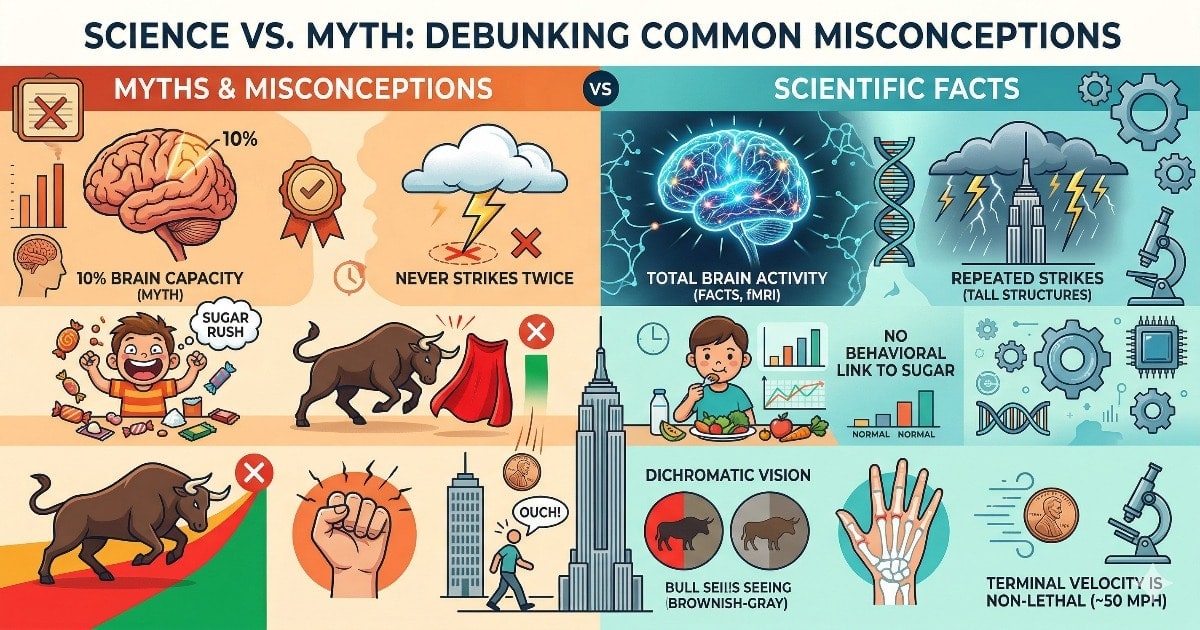
    Myth 1: We Only Use 10% of Our Brains

    The Misconception

    Perhaps one of the most widely circulated myths is the idea that human beings only utilize 10% of their brain capacity. The implication is that if we could somehow “unlock” the remaining 90%, we would possess superhuman intelligence, telekinesis, or perfect memory.

    The Scientific Reality

    Neurologists and neuroscientists have thoroughly debunked this claim. Through advanced imaging technologies like Functional Magnetic Resonance Imaging (fMRI) and Positron Emission Tomography (PET) scans, doctors can observe the brain in real-time. These scans consistently show that virtually every part of the brain is active at some point during the day, even while we are sleeping.

    The brain is an incredibly energy-hungry organ. While it accounts for only about 2% of the average human’s body weight, it consumes roughly 20% of the body’s daily energy expenditure. From an evolutionary standpoint, it would be highly inefficient for the human body to dedicate so many resources to an organ if 90% of it were useless tissue.

    Different regions of the brain are specialized for different tasks—from processing visual stimuli in the occipital lobe to executive decision-making in the frontal lobe. Even a minor brain injury can cause catastrophic, cascading failures in cognitive or motor function, which further proves that all areas of the brain are necessary and actively utilized.


    Myth 2: Sugar Causes Hyperactivity in Children

    The Misconception

    Ask almost any parent, and they will tell you that giving a child a sugary treat—like a cupcake, candy, or soda—will result in them bouncing off the walls with boundless energy.

    The Scientific Reality

    Despite widespread anecdotal claims, numerous double-blind, placebo-controlled studies have found absolutely no link between sugar consumption and hyperactive behavior in children.

    In a landmark 1994 study published in the New England Journal of Medicine, researchers gave children diets containing high amounts of sugar, artificial sweeteners, or placebos. The parents, who did not know which diet their child was on, were asked to rate their child’s behavior. The results showed no behavioral differences regardless of what the children consumed.

    So why does the myth persist? It largely comes down to context and confirmation bias. Children typically consume large amounts of sugar at highly stimulating events—birthday parties, holidays, and celebrations. The environment is already chaotic and exciting. When a parent expects their child to become hyperactive after eating cake at a party, they attribute the inevitable high energy to the sugar, rather than the exciting environment itself.


    Myth 3: The Seasons Are Caused by Earth’s Distance from the Sun

    The Misconception

    Because heat comes from the sun, it seems like common sense that summer occurs when the Earth is closest to the sun, and winter occurs when the Earth is furthest away.

    The Scientific Reality

    Earth’s orbit around the sun is elliptical, meaning our distance from the sun does vary slightly throughout the year. However, this distance has very little to do with the changing of the seasons. In fact, for people living in the Northern Hemisphere, the Earth is actually at its closest point to the sun (perihelion) in early January—right in the dead of winter!

    The seasons are entirely driven by the tilt of the Earth’s axis, which sits at an angle of roughly 23.5 degrees.

    As the Earth orbits the sun, this tilt causes different parts of the planet to receive varying angles of direct sunlight. During the Northern Hemisphere’s summer, the North Pole is tilted toward the sun. This results in the sun’s rays hitting the Northern Hemisphere more directly and for a longer duration each day, causing warmer temperatures. Six months later, the North Pole tilts away from the sun, resulting in shorter days, indirect sunlight, and the cold temperatures of winter.


    Myth 4: Lightning Never Strikes the Same Place Twice

    The Misconception

    This myth is often used as a comforting idiom to reassure someone that a rare, unfortunate event is unlikely to happen to them again. It implies that lightning has some sort of memory or avoids areas it has already hit.

    The Scientific Reality

    Lightning is a massive electrostatic discharge caused by unbalanced electrical charges in the atmosphere. It does not possess a memory, and it is simply seeking the path of least resistance to the ground.

    Not only can lightning strike the same place twice, but it often does. Tall, isolated structures are natural targets for lightning because they significantly reduce the distance the electrical charge must travel to reach the ground. For example, the Empire State Building in New York City is struck by lightning an average of 25 times per year. Similarly, tall trees, radio towers, and mountain peaks are routinely struck multiple times during a single intense thunderstorm.


    Myth 5: Swallowed Chewing Gum Takes Seven Years to Digest

    The Misconception

    Many of us were warned as children that if we swallowed our chewing gum, it would sit in our stomachs, undigested, for seven agonizing years, potentially causing blockages or health issues.

    The Scientific Reality

    The human digestive system is remarkably efficient, but it is true that your stomach cannot fully break down the synthetic rubber base used in modern chewing gum. The enzymes and stomach acids that easily dissolve proteins, carbohydrates, and fats are not equipped to break down the polymers in gum.

    However, just because it cannot be dissolved does not mean it stays in your body for seven years. The human digestive tract is essentially a continuous tube. Like other indigestible items (such as certain types of dietary fiber, seeds, or corn), the gum is simply pushed along by the muscular contractions of your intestines—a process called peristalsis.

    Within a matter of days, the swallowed gum will pass safely through your digestive system and be excreted. While making a habit of swallowing large wads of gum is not recommended (as it could theoretically cause a blockage in rare cases), a single swallowed piece is harmless and temporary.


    Myth 6: Cracking Your Knuckles Causes Arthritis

    The Misconception

    The sharp popping sound of someone cracking their knuckles is often met with the warning, “Stop doing that, you’ll give yourself arthritis!”

    The Scientific Reality

    There is no scientific evidence linking the cracking of knuckles to osteoarthritis.

    To understand why, we must look at the anatomy of our joints. Your knuckles are surrounded by a capsule filled with synovial fluid, which acts as a lubricant to help your joints move smoothly. This fluid contains dissolved gases, including oxygen, nitrogen, and carbon dioxide.

    When you stretch or bend your fingers to crack your knuckles, you are expanding the joint capsule. This sudden expansion decreases the pressure inside the capsule, causing the dissolved gases to rapidly form a bubble and burst. That bursting bubble is the “pop” you hear. It takes about 20 minutes for the gases to dissolve back into the fluid, which is why you cannot immediately crack the same knuckle twice.

    Medical studies, including a famous self-experiment by Dr. Donald Unger—who cracked the knuckles on his left hand but not his right hand every day for over 60 years—have shown no difference in arthritis development between knuckle-crackers and non-crackers.


    Myth 7: Bats Are Blind

    The Misconception

    The phrase “blind as a bat” suggests that these flying mammals navigate the world without any visual capabilities, relying entirely on sound.

    The Scientific Reality

    Bats are not blind. In fact, all of the over 1,400 species of bats have eyes and are capable of seeing.

    There are generally two types of bats: megabats (like fruit bats) and microbats. Megabats have excellent vision, which they use to spot fruit and flowers in the dark. They do not use echolocation at all.

    Microbats, which hunt insects at night, do rely heavily on echolocation—emitting high-frequency sound waves that bounce off objects to help them navigate and hunt in total darkness. However, even microbats have functional eyes. Their vision is tuned to low-light conditions, and they use their eyesight to navigate over long distances, spot landmarks, and detect the setting sun to synchronize their internal biological clocks.


    Myth 8: Bulls Get Angry at the Color Red

    The Misconception

    In traditional bullfighting, a matador waves a bright red cape (the muleta) to taunt the bull, causing the animal to charge aggressively. This has led to the widespread belief that bulls are enraged by the color red.

    The Scientific Reality

    Bulls, like all cattle, are dichromatic. This means their eyes only have two types of color-receptive cones, as opposed to the three types found in most humans. Because of this, cattle are essentially red-green colorblind. They cannot distinguish the color red from green, brown, or gray.

    What actually triggers the bull to charge is the rapid movement of the cape. In the highly stressful, noisy, and chaotic environment of a bullfighting ring, the bull perceives the snapping, swirling motion of the fabric as a threat and reacts defensively. If a matador were to wave a blue, green, or white cape with the same aggressive motion, the bull would react in exactly the same way. The color red is traditionally used simply because it masks the sight of blood and is highly visible and dramatic for the human audience.


    Myth 9: Eating Carrots Gives You Night Vision

    The Misconception

    Eating large quantities of carrots will significantly improve your eyesight, potentially allowing you to see flawlessly in the dark.

    The Scientific Reality

    Carrots are incredibly healthy and are an excellent source of beta-carotene, which the human body converts into Vitamin A. Vitamin A is crucial for maintaining good eye health and is a key component of rhodopsin, a protein in our eyes that allows us to see in low-light conditions.

    If a person has a severe Vitamin A deficiency, eating carrots will help restore their vision to a normal baseline. However, if you already have a healthy, balanced diet, eating extra carrots will not give you superhuman night vision or eliminate your need for prescription glasses. Your body will simply flush out the excess vitamins.

    The Origin of the Myth:

    This myth was popularized by brilliant World War II propaganda. When the British Royal Air Force developed a new, secret airborne radar system to intercept German bombers during night raids, they needed a cover story to explain their sudden, unnatural success. The British Ministry of Information spread the rumor that their pilots were consuming massive amounts of carrots, which gave them extraordinary night vision. The public, and even some enemy forces, bought into the lie, and the myth has endured ever since.


    Myth 10: A Penny Dropped from the Empire State Building Can Kill a Person

    The Misconception

    Because gravity accelerates falling objects, a penny dropped from the top of the 1,454-foot Empire State Building will gain so much speed that it will pierce a pedestrian’s skull like a bullet upon impact.

    The Scientific Reality

    While being struck by a falling penny would certainly be annoying, it is mathematically and physically impossible for it to be lethal.

    This is due to two factors: mass and air resistance (drag). A standard penny is incredibly light, weighing only about 2.5 grams. Its flat, circular shape also makes it highly un-aerodynamic. As the penny falls, it collides with air molecules. Eventually, the upward force of air resistance equals the downward pull of gravity. When this happens, the penny stops accelerating and reaches what is called its terminal velocity.

    For a penny, terminal velocity is roughly 25 to 50 miles per hour, depending on whether it falls flat or tumbling. While a piece of metal hitting you at 50 mph might sting and leave a small welt or bruise, it does not possess anywhere near the kinetic energy required to penetrate human skin or fracture a skull.


    Summary Table: Science vs. Myth

    The Common Myth The Scientific Reality
    We use 10% of our brains. We use 100% of our brains; brain scans show constant global activity.
    Sugar makes kids hyper. Studies show no link; hyperactivity is tied to the exciting environment.
    Summer means Earth is closer to the sun. Seasons are dictated by the 23.5-degree tilt of the Earth’s axis.
    Lightning never strikes twice. Lightning seeks the path of least resistance and often strikes tall objects repeatedly.
    Gum takes 7 years to digest. Gum cannot be broken down, but it passes through the body safely in a few days.
    Cracking knuckles causes arthritis. The pop is just gas bubbles bursting in synovial fluid; it does not harm joints.
    Bats are blind. All bats have functional eyes; many use vision in tandem with echolocation.
    Bulls hate red. Bulls are red-green colorblind; they charge at the aggressive movement of the cape.
    Carrots grant night vision. Carrots support baseline eye health, but extra carrots will not improve normal vision.
    A falling penny is lethal. Air resistance limits a penny’s terminal velocity to a non-lethal ~50 mph.

    Frequently Asked Questions (FAQ)

    1. How do scientific myths start in the first place?

    Myths often begin as genuine misunderstandings of early scientific observations, deliberate propaganda (like the carrot myth from WWII), or traditional folklore designed to enforce safety (like the gum-swallowing myth). Once a compelling story takes root in the culture, cognitive biases and repetition keep it alive.

    2. Are there any health myths that are actually true?

    Yes! Sometimes old wives’ tales are backed by science. For example, the idea that chicken soup helps you recover from a cold has scientific merit. Studies have shown that hot chicken soup can help clear nasal congestion and possesses mild anti-inflammatory properties that ease cold symptoms.

    3. How can I verify if a scientific claim is a myth or a fact?

    Look for consensus among reputable, peer-reviewed scientific journals or official institutional bodies (like the CDC, NASA, or the World Health Organization). Be skeptical of sensationalist headlines, anecdotal evidence (“it happened to a friend of a friend”), and claims that offer simple, miraculous solutions to complex problems.

    4. Why do intelligent people still believe in myths?

    Intelligence does not grant immunity to cognitive biases. Highly educated individuals can still fall victim to the Illusory Truth Effect or confirmation bias, especially regarding topics outside their specific field of expertise. Belief in myths is more about human psychology and the way our brains process information than raw intelligence.

    5. What is the difference between a theory and a myth?

    In science, a “theory” is a well-substantiated, rigorously tested explanation of an aspect of the natural world, supported by a vast body of evidence (e.g., the Theory of Gravity or the Theory of Evolution). A myth is a traditional story or widely held but false belief that lacks empirical evidence or scientific backing.


    References & Further Reading

    For those who wish to dive deeper into the actual science behind these concepts, the following resources provide excellent, peer-reviewed, and institutional information:

    • Brain Imaging and Usage: National Institutes of Health (NIH) – Brain Basics: Know Your Brain (www.ninds.nih.gov)

    • Diet and Child Behavior: The New England Journal of Medicine – Effects of Diets High in Sucrose or Aspartame on The Behavior and Cognitive Performance of Children (www.nejm.org)

    • Earth’s Axial Tilt: NASA Science – What Causes the Seasons? (spaceplace.nasa.gov)

    • Weather Phenomenon: National Weather Service (NWS) – Lightning Safety Myths and Facts (www.weather.gov)

    • Digestive Anatomy: Mayo Clinic – What happens to swallowed gum? (www.mayoclinic.org)

    • Joint Mechanics: Johns Hopkins Medicine – Understanding Arthritis and Joint Health (www.hopkinsmedicine.org)

    • Animal Vision (Bats and Bovines): The National Wildlife Federation – Debunking Animal Myths (www.nwf.org)

    • Physics of Falling Objects: Scientific American – Could a Penny Dropped From a Skyscraper Kill a Person? (www.scientificamerican.com)
  • The Indispensable Role of Science in Modern Society: Progress, Challenges, and the Future

    The Indispensable Role of Science in Modern Society: Progress, Challenges, and the Future

    Science is far more than a collection of facts enclosed in heavy textbooks; it is the fundamental framework through which we understand the universe and improve the human condition. The role of science in modern society is so deeply woven into the fabric of our daily lives that it is often taken for granted. From the moment we wake up to an alarm on our smartphones to the medical treatments that extend our lifespans, scientific inquiry drives human progress.

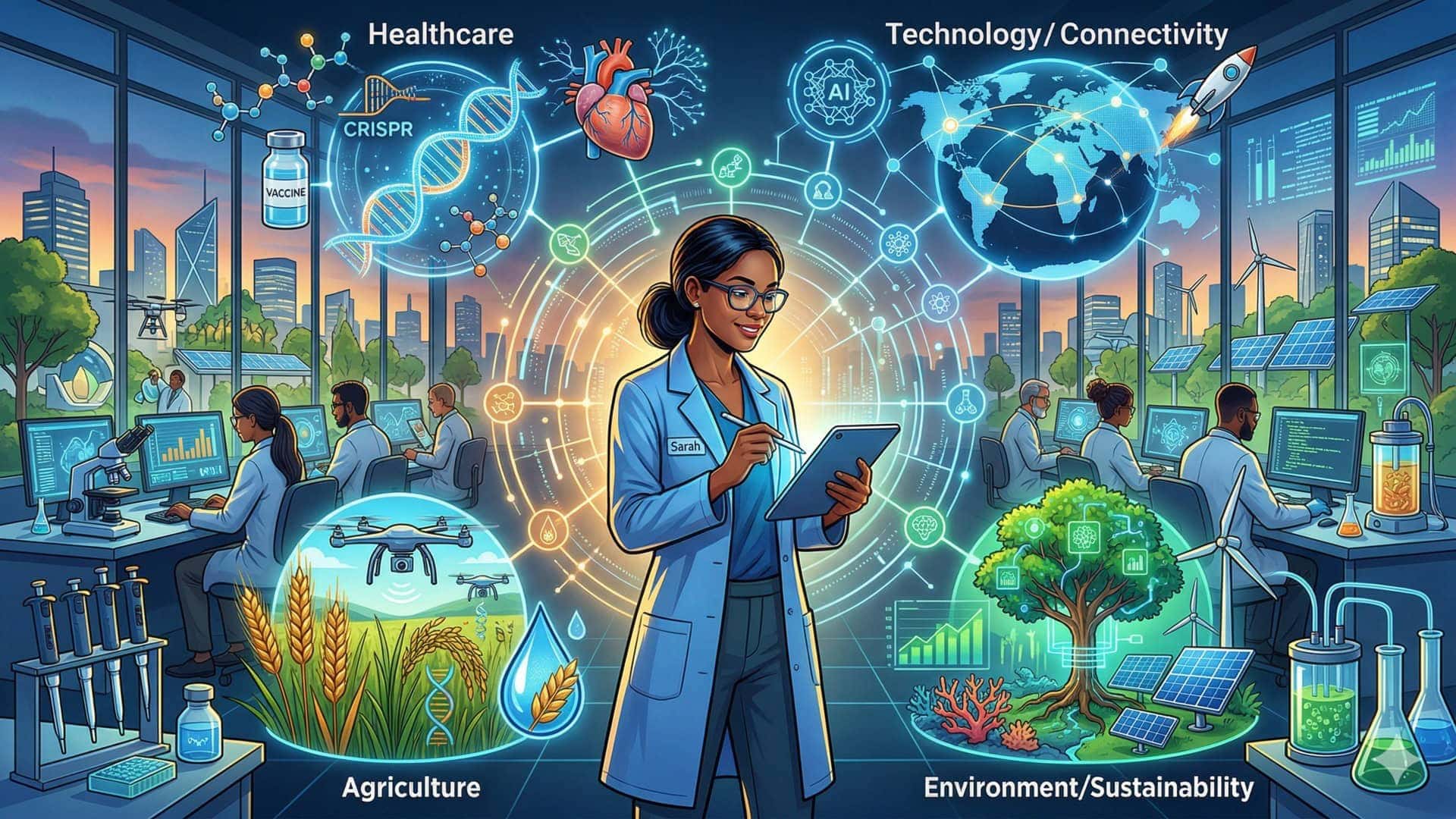
    In this comprehensive guide, we will explore how science impacts various facets of contemporary life. We will delve into healthcare, environmental sustainability, technology, and agriculture, while also examining the crucial ethical dimensions that must guide future discoveries. Whether you are a student, an educator, or simply a curious mind, understanding the impact of scientific research is essential for navigating the complexities of the 21st century.


    1. The Foundation of Modern Life: Understanding Scientific Impact

    Before diving into specific industries, it is important to understand what science represents in a broader societal context. At its core, science is a systematic enterprise that builds and organizes knowledge in the form of testable explanations and predictions about the universe.

    In modern society, science serves three primary functions:

    • A Tool for Problem-Solving: Identifying challenges—from local water shortages to global pandemics—and developing actionable, evidence-based solutions.
    • An Engine for Economic Growth: Fueling innovation that creates new industries, generates employment, and elevates global living standards.
    • A Lens for Truth: Providing a reliable method to distinguish fact from fiction, which is increasingly vital in the digital age of information overload.

    By fostering a society that values empirical evidence and critical thinking, we empower communities to make informed decisions that benefit everyone.


    2. Revolutionizing Healthcare and Medicine

    Perhaps the most universally appreciated role of science is its contribution to human health and longevity. The medical landscape has been entirely transformed by scientific research, turning once-fatal diseases into manageable conditions and eradicating others entirely.

    The Eradication and Management of Diseases

    Historically, infectious diseases were the leading cause of mortality. Today, thanks to the development of vaccines and antibiotics, the threat of diseases like polio, smallpox, and measles has been drastically reduced or eliminated. The rapid global scientific response to recent viral outbreaks further underscores the importance of a robust, well-funded scientific infrastructure.

    Advancements in Medical Imaging and Diagnostics

    The ability to look inside the human body without invasive surgery was once the realm of science fiction. Today, technologies such as X-rays, Magnetic Resonance Imaging (MRI), and Computed Tomography (CT) scans allow medical professionals to diagnose conditions early and accurately. Early detection is often the key to successful treatment, particularly in oncology and cardiology.

    Genomics and Personalized Medicine

    We are currently entering an era of personalized medicine. The mapping of the human genome has allowed scientists to understand how individual genetic variations affect health. This inclusive approach to medicine ensures that treatments can be tailored to the specific genetic makeup of a patient, maximizing efficacy and minimizing adverse side effects.

    Key Takeaway: Scientific advancements in healthcare do not just extend lifespans; they fundamentally improve the quality of life for billions of people across the globe.


    3. Technology and Global Connectivity

    It is impossible to discuss the role of science in modern society without addressing the technological boom. Applied science—engineering and technology—has revolutionized how we live, work, and communicate.

    The Digital Revolution

    The creation of the internet and the subsequent proliferation of digital devices have democratized information. Knowledge that was once confined to university libraries is now accessible to anyone with a smartphone. This connectivity has bridged geographical divides, allowing for global collaboration in business, education, and social activism.

    Artificial Intelligence and Automation

    As an artificial intelligence myself, I represent one of the rapidly evolving frontiers of computer science. AI and machine learning algorithms are being integrated into almost every sector. They help optimize supply chains, assist doctors in diagnosing diseases by analyzing medical imagery, and even help writers and researchers outline complex topics. While automation shifts the nature of work, it also holds the promise of relieving human workers from dangerous or highly repetitive tasks.

    Transportation and Logistics

    Scientific engineering has also transformed transportation. The transition from horse-drawn carriages to combustion engines took decades, but we are now seeing an even faster shift toward electric vehicles (EVs) and high-speed transit networks. These advancements not only make travel faster and safer but also pave the way for more sustainable global logistics.


    4. Environmental Sustainability and Climate Action

    As modern society has industrialized, it has placed unprecedented strain on the planet’s ecosystems. Fortunately, science is not only the lens through which we measure this impact but also the primary tool we have for mitigating it.

    Understanding Climate Change

    Climatologists, oceanographers, and atmospheric scientists have provided irrefutable data showing the impact of human activity on the global climate. By utilizing satellite imagery, ice core samples, and complex computer models, science has given humanity a clear warning about the consequences of unchecked greenhouse gas emissions.

    Developing Renewable Energy

    To combat climate change, science is driving the transition away from fossil fuels. Innovations in materials science have led to highly efficient solar panels and powerful wind turbines. Furthermore, advancements in battery storage technology are solving the intermittent nature of renewable energy, ensuring that homes and industries can be powered around the clock by sustainable sources.

    Conservation Biology and Ecology

    Science plays a vital role in protecting biodiversity. Conservation biologists track endangered populations, study ecosystem dynamics, and develop strategies to preserve natural habitats. Inclusive conservation efforts increasingly recognize the importance of integrating indigenous ecological knowledge with modern scientific methods to protect global ecosystems.


    5. Agriculture and Global Food Security

    With the global population projected to reach nearly 10 billion by the year 2050, feeding the world is one of the greatest challenges of our time. Agricultural science is at the forefront of ensuring global food security.

    Genetic Modification and Crop Resilience

    Genetically Modified Organisms (GMOs) often spark debate, but from a scientific standpoint, they are a crucial tool for survival. Scientists have developed crops that are resistant to pests, diseases, and harsh weather conditions like droughts. This resilience ensures stable food supplies in regions vulnerable to climate change.

    Precision Agriculture

    Modern farming is highly data-driven. Precision agriculture utilizes drones, satellite imagery, and soil sensors to monitor crop health and soil moisture in real-time. This allows farmers to apply water, fertilizers, and pesticides only where absolutely necessary, reducing environmental runoff and lowering the cost of food production.

    Alternative Proteins and Sustainable Diets

    Livestock farming is resource-intensive. Food scientists are actively developing plant-based and lab-grown meat alternatives. These innovations aim to provide the global population with high-quality protein while significantly reducing the land use and greenhouse gas emissions associated with traditional animal agriculture.


    6. Education and the Scientific Temperament

    The role of science extends beyond tangible inventions; it shapes how a society thinks. Cultivating a “scientific temperament”—a mindset that values logic, questioning, and evidence—is crucial for the healthy functioning of a modern democracy.

    • Promoting Critical Thinking: Science education teaches students how to formulate hypotheses, test them, and accept when they are wrong. This framework is essential for evaluating the barrage of information we face daily.
    • Combating Misinformation: In an era where fake news can spread rapidly across social networks, scientific literacy is our best defense. A public that understands basic scientific principles is less likely to fall prey to health scams, conspiracy theories, or environmental denialism.
    • Fostering Curiosity and Innovation: Science encourages us to ask “why” and “how.” This innate curiosity is the bedrock of all human innovation. By supporting STEM (Science, Technology, Engineering, and Mathematics) education for all demographics, we ensure a diverse pipeline of future problem-solvers.

    7. The Ethical Dimensions of Science

    As scientific capabilities expand, so do the ethical dilemmas associated with them. The role of science in modern society must be governed by strong moral frameworks to ensure that progress benefits humanity equitably.

    Data Privacy and Surveillance

    The technology that connects us also tracks us. The massive accumulation of personal data by tech companies and governments raises profound questions about privacy, consent, and autonomy. Societal regulations must keep pace with technological advancements to protect citizens from unwarranted surveillance.

    Genetic Engineering and Bioethics

    Tools like CRISPR allow scientists to edit the genetic code of living organisms with unprecedented precision. While this holds the cure for genetic diseases, it also opens the door to ethical controversies regarding “designer babies” and the irreversible alteration of human lineage. Inclusive and global dialogues are required to establish boundaries.

    Equitable Access to Innovations

    Scientific progress is often unevenly distributed. High-income nations frequently benefit from medical and technological breakthroughs long before low-income nations do. For science to truly serve humanity, global society must address the economic and systemic barriers that prevent marginalized communities from accessing life-saving medicines, clean energy, and digital infrastructure.


    8. The Future of Scientific Innovation

    Looking ahead, the trajectory of scientific discovery promises to be even more accelerating. Several emerging fields will define the next century:

    • Quantum Computing: Quantum computers have the potential to solve complex problems—such as chemical simulations and cryptography—millions of times faster than classical computers.
    • Space Exploration and Colonization: Agencies like NASA and private enterprises are pushing the boundaries of human presence in space. Missions to Mars and the establishment of lunar bases will drive innovations in life-support systems and resource management that will also benefit life on Earth.
    • Neurotechnology: Brain-computer interfaces could soon restore mobility to paralyzed individuals and offer new treatments for neurological disorders, fundamentally changing how humans interact with machines.

    Conclusion

    The role of science in modern society is profound, pervasive, and absolutely essential for our continued survival and prosperity. From the microscopic world of genetics to the vast expanse of space exploration, science provides the tools we need to understand our reality and shape our future.

    However, science is not a standalone entity; it is a human endeavor. Its benefits are maximized when guided by empathy, ethical considerations, and a commitment to inclusive progress. By fostering scientific literacy and supporting equitable research, society can ensure that the fruits of scientific labor are used to build a healthier, more sustainable, and more connected world for everyone.


    Frequently Asked Questions (FAQ)

    1. Why is science considered the most important factor in modern societal development?

    Science is foundational because it relies on empirical evidence and the scientific method to solve problems. Unlike subjective opinions, scientific inquiry provides objective, testable solutions that drive medical, technological, and environmental progress, directly improving the standard of living across the globe.

    2. How does science impact our daily lives?

    Science impacts almost every aspect of daily life. The electricity powering your home, the purified water you drink, the smartphone you use to communicate, and the weather forecasts you rely on are all products of scientific research and engineering.

    3. Can science solve the climate change crisis?

    While science alone cannot enforce political or economic change, it provides the necessary tools and knowledge to solve the crisis. Science has diagnosed the problem, and scientists have developed the solutions—such as solar and wind energy, carbon capture technologies, and sustainable agricultural practices. It requires societal and political will to implement these scientific solutions at scale.

    4. What is the relationship between science and technology?

    Science and technology are deeply interdependent. Science is the pursuit of knowledge for its own sake (understanding how the natural world works), while technology is the application of scientific knowledge for practical purposes. For example, the scientific discovery of electromagnetism led to the technological invention of electric motors.

    5. How can we ensure that scientific advancements benefit everyone equally?

    Ensuring equitable access to scientific advancements requires a combination of open-access research, international cooperation, and inclusive policy-making. Governments and global organizations must work to eliminate monopolies on life-saving technologies (like patents on essential medicines) and invest heavily in STEM education in underserved communities to ensure diverse voices are part of the scientific process.

    6. Are there negative impacts of scientific advancement?

    Yes, if left unchecked by ethical guidelines. For instance, the industrial revolution—driven by scientific progress—led to massive environmental degradation. Similarly, advancements in nuclear physics led to the creation of weapons of mass destruction. This is why bioethics, environmental regulations, and philosophical discourse are vital companions to scientific research.


    Reference Links for Further Read

    To learn more about the profound impact of science on society, explore the following reputable resources:

    1. National Science Foundation (NSF): Fostering research and education across all fields of science and engineering.

      https://www.nsf.gov/

    2. World Health Organization (WHO): Global health information, scientific research on diseases, and public health guidelines.

      https://www.who.int/

    3. Nature – Science in Society: A leading multidisciplinary science journal exploring the intersection of scientific discovery and social impact.

      https://www.nature.com/

    4. NASA – Climate Change: The latest scientific data, news, and evidence regarding global climate change.

      https://climate.nasa.gov/

    5. ScienceDaily: Breaking news and research articles covering medical, technological, and environmental sciences.

      https://www.sciencedaily.com/

  • Top 10 Scientific Breakthroughs That Shaped Humanity

    Top 10 Scientific Breakthroughs That Shaped Humanity

    Introduction: The Unending Quest for Knowledge

    Curiosity drives our species throughout human history. We look at stars, soil, and our bodies. We constantly ask why and how things work. This pursuit of understanding brings profound clarity. These paradigm shifts redefine what is possible. We call these moments scientific breakthroughs. They mark milestones of our collective progress.

    A true breakthrough is rarely a lone eureka moment. It involves decades of observation and global collaboration. It requires challenging established dogmas. Science is a deeply human, shared endeavor. It transcends borders, cultures, and generations. It is a heritage belonging to everyone.

    These discoveries did more than fill textbooks. They doubled human life expectancy. .They connected distant continents and cured ancient plagues. They allowed us to see the dawn of time. Breakthroughs reshaped our societies and economies. They changed our understanding of the cosmos.

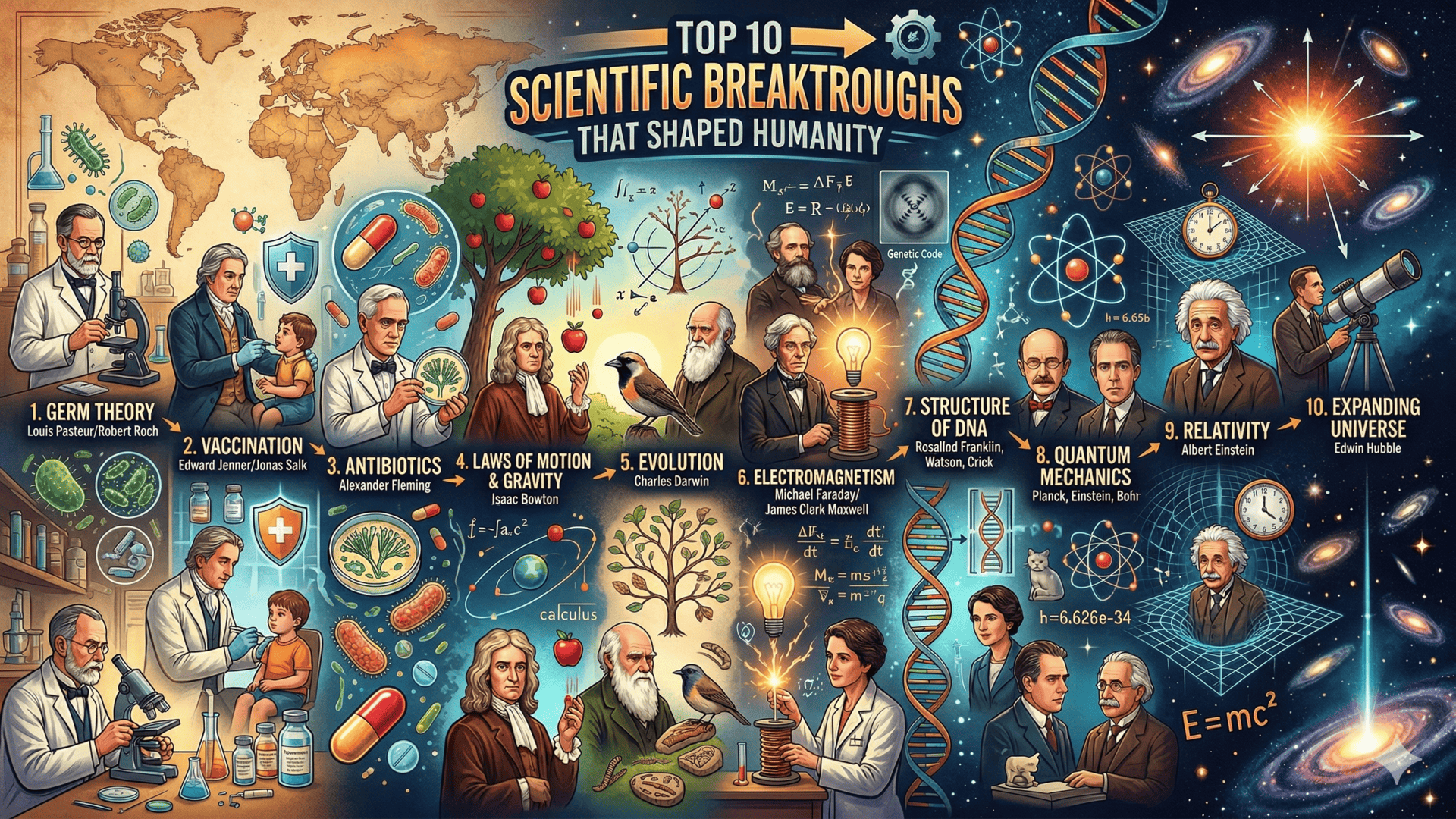
    This guide explores ten fundamental scientific breakthroughs. We will look at the visionaries behind them. We will examine their ongoing impact today.


    1. The Germ Theory of Disease

    Before the 19th century, illness causes were unknown. People believed “bad air” caused diseases like cholera. This misunderstanding left populations vulnerable to severe pandemics.

    The Breakthrough

    Louis Pasteur and Robert Koch pioneered the Germ Theory. Pasteur proved microorganisms cause fermentation and disease. He debunked the idea of spontaneous generation. Robert Koch developed criteria to identify specific microbes. He found the culprits behind tuberculosis and cholera.

    How It Shaped Humanity

    Microscopic pathogens cause many infectious diseases. This realization revolutionized public health and modern medicine. Sanitation improved with clean water and proper sewage disposal. Handwashing protocols drastically reduced mortality rates. Joseph Lister introduced antiseptic surgery techniques. Hospitals transformed into places of true healing. Infant mortality dropped significantly worldwide. The germ theory drastically increased global life expectancy.


    2. Vaccination and Immunization

    The germ theory identified the microscopic enemy. Vaccination provided humanity with a definitive shield. Diseases like smallpox and polio were universal terrors. They indiscriminately killed millions of people every year.

    The Breakthrough

    Edward Jenner pioneered basic immunology in 1796. He saw that cowpox protected milkmaids from smallpox. He inoculated a boy, proving early vaccination works. Jonas Salk and Albert Sabin later developed polio vaccines. Recently, scientists pioneered mRNA technology for COVID-19.

    How It Shaped Humanity

    Vaccines are incredibly impactful public health interventions. The World Health Organization eradicated smallpox in 1980. This remains one of our greatest collective achievements. Immunization programs protect vulnerable populations worldwide. They ensure children can survive and thrive. Vaccines maintain the economic stability of global healthcare systems. Preventive medicine is vital for societal flourishing.


    3. The Discovery of Penicillin and Antibiotics

    Bacterial infections remained highly lethal for centuries. A simple scratch could result in fatal blood poisoning. Strep throat was often a deadly diagnosis.

    The Breakthrough

    Alexander Fleming found mold contaminating his Petri dishes. This mold destroyed the surrounding Staphylococcus bacteria. Later, a diverse team isolated and mass-produced penicillin. Howard Florey and Ernst Chain led this crucial effort. Norman Heatley also provided vital contributions to this work.

    How It Shaped Humanity

    Antibiotics heralded a completely new era of medicine. Conditions like pneumonia and tuberculosis became highly treatable. Antibiotics made complex medical interventions possible today. Open-heart surgery and organ transplants rely on them. Cancer chemotherapy requires antibiotics to manage infection risks. We must use these vital drugs responsibly. Overuse leads to dangerous antimicrobial resistance. This resistance threatens our medical progress.


    4. The Laws of Motion and Universal Gravitation

    For centuries, Earth and sky seemed governed differently. Scientists lacked a unified physical theory.

    The Breakthrough

    Isaac Newton published his Principia Mathematica in 1687. He formulated three laws of motion and gravitation. He proved the exact same force pulls an apple. That same physical force keeps the Moon in orbit.

    How It Shaped Humanity

    Newton laid the mathematical foundation for classical mechanics. His physical principles fueled the massive Industrial Revolution. Engineers could calculate forces to build steam engines. Space exploration relies heavily on Newtonian physics. Satellite launches and moon landings use these precise calculations. Newton unified the cosmos philosophically for humankind. The universe operates by comprehensible, rational, and universal laws.


    5. The Theory of Evolution by Natural Selection

    Life’s incredible diversity was once considered an inexplicable mystery. It was generally attributed to separate divine creation. The relationships between species were entirely unknown.

    The Breakthrough

    Charles Darwin published On the Origin of Species. Alfred Russel Wallace independently developed the exact same theory. Populations evolve over generations through natural selection. Individuals with advantageous traits survive and reproduce successfully. They pass these specific traits to their offspring.

    How It Shaped Humanity

    Evolution is the unifying principle of all biological sciences. It fundamentally altered how humans view themselves entirely. We exist firmly within an interconnected tree of life. It provides a logical framework for genetics and ecology. It helps epidemiologists track how deadly viruses mutate. Understanding evolution is critical for active biodiversity conservation. It helps us protect vulnerable species from climate change.


    6. Electromagnetism

    We take electricity and instant communication for granted today. This reality stems entirely from understanding basic electromagnetism.

    The Breakthrough

    Scientists unraveled electricity and magnetism in the 19th century. Michael Faraday discovered crucial electromagnetic induction. A changing magnetic field actively creates an electric current. James Clerk Maxwell unified these observations mathematically. Electricity, magnetism, and light are the exact same phenomenon. They are manifestations of the electromagnetic field.

    How It Shaped Humanity

    Mastering electromagnetism literally built our modern world. Faraday’s principles created the modern electrical power grid. This power illuminates our homes and runs our industries. Maxwell paved the way for instant global communication. This includes the telegraph, radio, and mobile phones. The entire digital age depends on manipulating electrons. Computers and the internet require this fundamental knowledge.


    7. The Structure of DNA

    Physical traits reliably pass down through family generations. The actual physical mechanism remained unknown for nearly a century.

    The Breakthrough

    James Watson and Francis Crick proposed the double-helix structure. They relied heavily on Rosalind Franklin’s vital X-ray data. Maurice Wilkins also shared crucial structural information. They showed how DNA beautifully copies itself. DNA carries our highly complex genetic instructions.

    How It Shaped Humanity

    Decoding DNA birthed the new era of molecular biology. It paved the way for the massive Human Genome Project. This enables personalized medicine and vital genetic screening. DNA profiling completely revolutionized the modern criminal justice system. It precisely identifies perpetrators and exonerates innocent people. Understanding DNA allows for much better agricultural crops. This helps secure food for our growing global population.


    8. Quantum Mechanics

    Classical physics explained the large macroscopic world very well. However, tiny atoms and subatomic particles behaved bizarrely. Newton’s reliable laws completely fell apart here.

    The Breakthrough

    Brilliant physicists developed Quantum Mechanics in the early 1900s. This international group included Max Planck and Albert Einstein. Niels Bohr and Werner Heisenberg also contributed significantly. Energy comes in discrete, tiny packets called quanta. Particles can exist in multiple different states simultaneously. Particles can also link across vast cosmic distances.

    How It Shaped Humanity

    Quantum mechanics is deeply and surprisingly practical today. The entire global electronics industry relies on it completely. Microchips in modern smartphones use quantum electron behavior. Medical imaging like MRI relies on specific quantum properties. We are currently entering a second massive quantum revolution. Quantum computers promise to solve incredibly complex problems.


    9. General and Special Relativity

    Space and time were once thought to be absolutely rigid. A mile was always exactly a mile everywhere. A second was always exactly a second.

    The Breakthrough

    Albert Einstein published Special Relativity in 1905. The speed of light is completely constant everywhere. Space and time are relative to the specific observer. General Relativity later showed that massive gravity warps spacetime. Gravity is not a pull, but a curved surface.

    How It Shaped Humanity

    Einstein drastically reshaped our core understanding of reality. Global Positioning Systems (GPS) in our phones rely on relativity. Without necessary relativistic corrections, GPS would quickly fail completely. Relativity expertly explains black holes and massive gravitational waves. His famous equation demonstrated mass and energy are interchangeable. This foundational concept laid the groundwork for nuclear power.


    10. The Expanding Universe

    Humanity long assumed the universe was static and eternal. The Milky Way galaxy seemed to be absolutely everything.

    The Breakthrough

    Edwin Hubble made two monumental discoveries in the 1920s. Other massive galaxies exist far beyond our Milky Way. Distant galaxies are moving rapidly away from us. Georges Lemaître also theoretically proposed this universal expansion simultaneously. The universe was clearly not static at all.

    How It Shaped Humanity

    This vital observation led directly to the Big Bang Theory. The physical universe had a definitive beginning point. It originated from an incredibly dense, tiny singularity. This shifted our philosophical cosmic perspective fundamentally. We live in a highly dynamic, evolving universe. The atoms in our bodies forged in dying stars. We are truly and literally made of star stuff.


    Conclusion: The Journey Continues

    These ten scientific breakthroughs built our modern reality entirely. They represent humanity’s intense curiosity and incredible persistence. Science consistently expands our horizons and empowers us all.

    The scientific endeavor is far from complete today. We face unprecedented global challenges right now. Climate change severely threatens our delicate, interconnected biosphere. Emerging infectious diseases continually test our global resilience. We desperately need clean, truly sustainable energy sources.

    Solving these requires the next generation of scientific breakthroughs. We deeply need education, cooperation, and true global inclusivity. Diverse minds must have fair opportunities to contribute actively. We must fiercely support ongoing, robust scientific inquiry. Science will inevitably and profoundly shape our collective future.


    Frequently Asked Questions (FAQ)

    What is the greatest scientific breakthrough ever?

    Many historians point directly to Newton’s laws of motion. It launched the modern, mathematically driven scientific era entirely. The Germ Theory definitely saved the most human lives.

    How do scientific breakthroughs usually happen?

    Breakthroughs occur through decades of slow, cumulative research. Scientists constantly synthesize data and collaborate globally. They always build upon the vital work of others.

    Are major scientific breakthroughs still happening today?

    Yes, we are living through multiple scientific revolutions now. Recent examples include CRISPR gene editing and mRNA vaccines. Artificial intelligence is also advancing at a staggering pace.

    Who decides what counts as a breakthrough?

    The global scientific community constantly validates breakthroughs over time. They use strict peer review and safely reproduce experiments. Organizations like the Nobel Committee formally recognize impactful discoveries.

    Why is inclusive language important in science?

    Historically, contributions of marginalized groups were frequently ignored. Rosalind Franklin’s vital work on DNA is a prime example. Diversity absolutely leads to much better, creative problem-solving. It ensures scientific benefits are distributed equitably to everyone.


    References & Further Reading

  • The Scientific Method Explained Step-by-Step: A Complete Guide for Inquisitive Minds

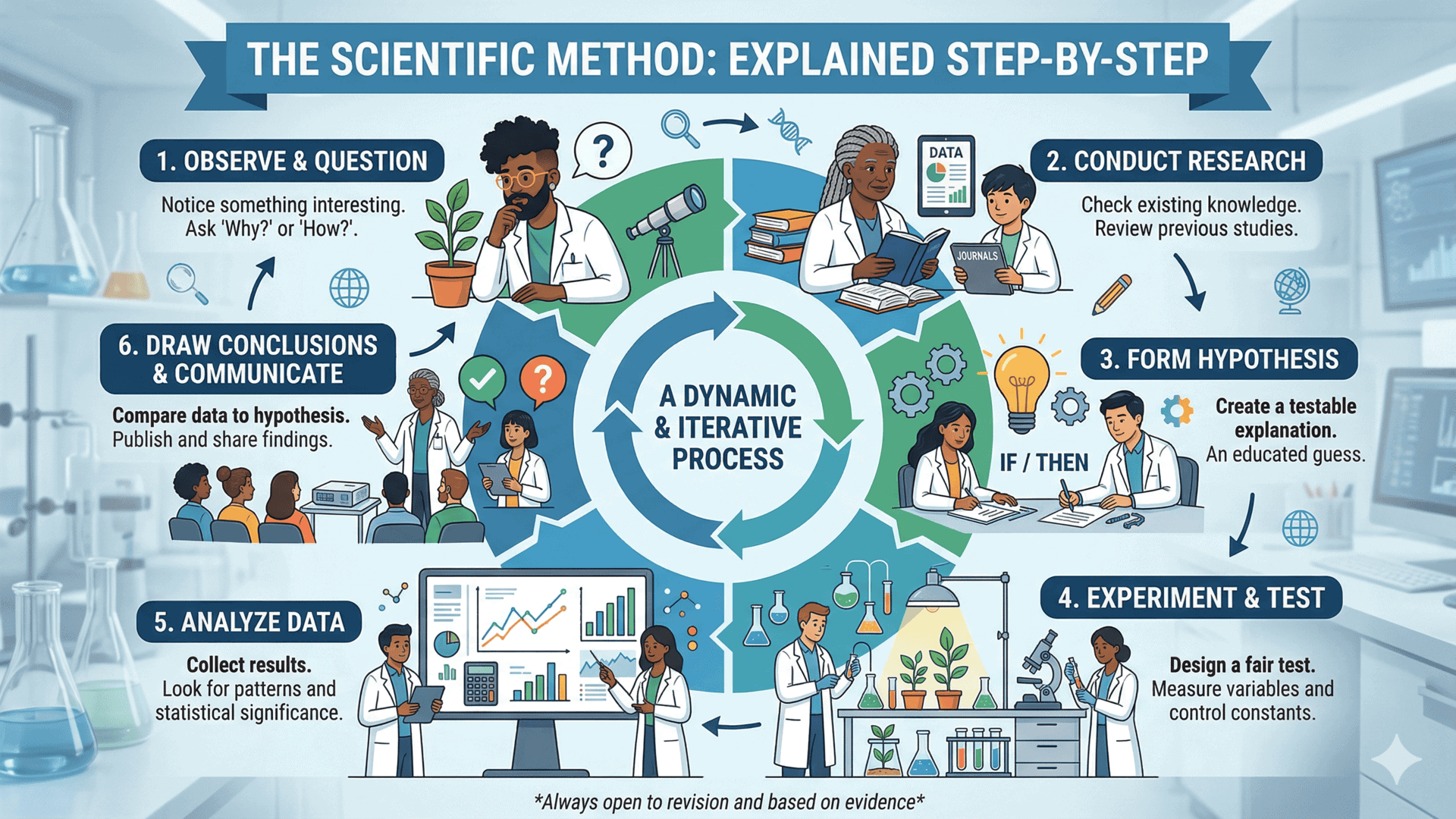
    The Scientific Method Explained Step-by-Step: A Complete Guide for Inquisitive Minds

    Whether you are a student preparing for a biology exam, a professional looking to improve your problem-solving skills, or simply a curious mind wondering how we know what we know about the universe, understanding the scientific method is essential.

    The scientific method is the backbone of all modern human discovery. It is not just a rigid set of rules used by researchers in white coats; it is a profound, logical, and universally accessible way of thinking. It empowers us to strip away bias, challenge assumptions, and uncover the truth about how our world operates.

    In this comprehensive guide, we will explore the scientific method explained step-by-step. We will break down its history, delve deep into each phase of the process, provide real-world examples, and answer the most frequently asked questions. By the end of this article, you will have a thorough understanding of how to apply this powerful framework to everything from complex research to everyday dilemmas.


    What is the Scientific Method?

    At its core, the scientific method is a systematic, empirical approach to answering questions and solving problems. It is a cyclical process of making observations, formulating explanations, testing those explanations through experiments, and refining our understanding based on the results.

    The beauty of the scientific method lies in its objectivity. Human beings are naturally prone to cognitive biases. We often see what we want to see or believe what is most comfortable. The scientific method acts as a safeguard against these biases. It demands evidence. It requires that results be reproducible. .It insists that if the data does not support a cherished idea, the idea must be discarded or revised.

    The Global Origins of Scientific Thinking

    While often associated with figures from the European Renaissance, the scientific method is the culmination of global human inquiry.

    • Ancient Roots: Ancient Egyptian and Babylonian astronomers recorded meticulous observational data. Greek philosophers like Aristotle emphasized empiricism (knowledge gained through observation), though they often relied more on deductive reasoning than rigorous experimentation.
    • The Islamic Golden Age: The true foundation for the modern experimental method was laid by scholars in the Middle East. Notably, the polymath Ibn al-Haytham (Alhazen) in the 11th century insisted that hypotheses must be tested through verifiable experiments, particularly in his groundbreaking work on optics.
    • The Scientific Revolution: In the 16th and 17th centuries, figures like Francis Bacon, Galileo Galilei, and René Descartes formalized these concepts. Bacon championed inductive reasoning, Galileo pioneered the use of mathematics to describe experimental results, and Descartes emphasized rigorous skepticism.

    Together, these diverse historical contributions forged the robust, globally recognized tool we use today.


    The Scientific Method Explained Step-by-Step

    While the scientific method is often taught as a linear path, it is actually a highly dynamic and iterative loop. Researchers frequently jump back and forth between steps as new information comes to light. However, to understand the framework, it is best to examine its standard six steps.

    Step 1: Make an Observation and Ask a Question

    Every journey of discovery begins with a sense of wonder. The scientific method kicks off when someone notices something intriguing about the natural world and asks, “Why?” or “How?”

    Observations can be spontaneous or the result of long-term monitoring. They can be:

    • Qualitative: Describing the quality or characteristics of something (e.g., “The leaves on this plant are turning yellow”).
    • Quantitative: Involving numbers and measurements (e.g., “The local river’s water level dropped by 4 inches this month”).

    Once an observation is made, it is channeled into a specific, measurable Question. A good scientific question is not based on opinion, morals, or the supernatural. It must be testable.

    • Poor Question: “Are roses the best flowers?” (Subjective)
    • Strong Question: “Does the amount of sunlight affect the growth rate of rose bushes?” (Testable and measurable)

    Step 2: Do Background Research

    Before attempting to answer the question, a responsible investigator looks at what is already known. Science is a collaborative, cumulative endeavor. Isaac Newton famously said, “If I have seen further, it is by standing on the shoulders of giants.”

    Background research involves reviewing existing literature, academic journals, books, and credible databases. This step is crucial for several reasons:

    1. Avoiding Duplication: Someone may have already answered your question.
    2. Refining the Question: Existing research might show that your initial question is too broad and needs to be narrowed down.
    3. Informing the Experiment: Learning how others have tested similar phenomena helps you design a better, safer, and more accurate experiment.

    Step 3: Construct a Hypothesis

    A hypothesis is often described as an “educated guess,” but it is much more than that. A hypothesis is a proposed explanation for an observation, grounded in background research, that can be tested.

    A robust hypothesis usually establishes a relationship between variables and is often written as an “If / Then” statement.

    • Example: “If I increase the amount of water given to the tomato plants, then they will produce more tomatoes.”

    In modern science, researchers also utilize the Null Hypothesis ($H_0$). The null hypothesis posits that there is no relationship or difference between the variables being tested. Scientists generally set out to reject the null hypothesis, thereby providing support for their alternative hypothesis.

    The Golden Rule of a Hypothesis: It must be falsifiable. There must be a possible outcome that proves the hypothesis wrong. If a statement cannot be proven false, it is not scientific.

    Step 4: Test with an Experiment

    This is where the rubber meets the road. An experiment is a procedure carefully designed to test the validity of the hypothesis. A well-designed experiment must be fair, unbiased, and capable of isolating the specific cause-and-effect relationship in question.

    To achieve this, researchers must carefully define and control their Variables:

    • Independent Variable: This is the factor that you (the experimenter) deliberately change or manipulate. It is the presumed cause. (e.g., The amount of water given to the plants).
    • Dependent Variable: This is the factor that you measure. It changes in response to the independent variable. It is the presumed effect. (e.g., The height of the plants or the number of tomatoes produced).
    • Controlled Variables (Constants): These are all the other factors that could possibly affect the outcome, which must be kept exactly the same across all tests to ensure fairness. (e.g., The type of soil, the amount of sunlight, the temperature, the size of the pots).

    The Importance of Control Groups

    A rigorous experiment divides subjects into at least two groups.

    • The Experimental Group receives the treatment (the manipulation of the independent variable).
    • The Control Group does not receive the treatment. It serves as a baseline to ensure that any changes observed in the experimental group are actually due to the independent variable, and not some outside factor.

    Step 5: Analyze Data and Draw Conclusions

    As the experiment runs, you collect data. This data must then be organized, often using tables, charts, and graphs, to make it easier to interpret.

    Data Analysis involves looking for patterns, trends, and correlations. In modern scientific research, this step heavily relies on statistics. Statistical analysis helps determine if the results are significant or if they could have simply occurred by random chance.

    Once the data is analyzed, you Draw a Conclusion by comparing your findings against your original hypothesis.

    • Scenario A: The data supports the hypothesis. You have found evidence that your proposed explanation is likely correct.
    • Scenario B: The data does NOT support the hypothesis. This is completely normal and highly valuable! A rejected hypothesis is not a “failed” experiment. It is new knowledge that eliminates a false explanation, guiding you closer to the truth.

    If the hypothesis is rejected, the scientific method loops back. You use the new data to form a new, revised hypothesis, and the cycle begins again.

    Step 6: Communicate Results

    Science does not exist in a vacuum. For a discovery to be meaningful, it must be shared with the broader community. This allows other researchers to evaluate the findings, attempt to replicate the experiment, and build upon the knowledge.

    Scientists communicate their results by publishing detailed reports in peer-reviewed journals. Peer review is a rigorous process where independent experts in the same field critically evaluate the methodology, data, and conclusions of a study before it is published. This acts as a quality control filter, catching errors, biases, or unsupported claims.

    When writing a report, a scientist must be completely transparent about their methods so that anyone else can perform the exact same experiment. If an experiment cannot be replicated by others with the same results, the original findings are heavily scrutinized.


    The Scientific Method in Everyday Life

    While it sounds highly academic, we all use a scaled-down version of the scientific method in our daily lives without even realizing it. The process of logical deduction is a universal human trait.

    Everyday Example: The Broken Wi-Fi

    1. Observation: You sit down to watch a movie, but Netflix won’t load.
    2. Question: Why is the internet not working on my TV?
    3. Research: You check your phone; it’s also disconnected. You look at the router; the “Internet” light is flashing red instead of solid green.
    4. Hypothesis: If I restart the router, then the internet connection will be restored because a simple reboot clears temporary software glitches.
    5. Experiment: You unplug the router, wait 30 seconds, and plug it back in.
    6. Analysis: You watch the lights on the router. The “Internet” light turns solid green. You check your TV, and Netflix loads.
    7. Conclusion: The data supports the hypothesis. Restarting the router fixed the issue.

    By structuring our problem-solving logically, we avoid wasting time (like buying a whole new TV when the router was the issue) and find solutions efficiently.


    Overcoming Common Misconceptions

    To truly master the scientific method, it is vital to unlearn some common misunderstandings about how science works.

    Misconception 1: “It’s just a theory.”

    In everyday language, people use the word “theory” to mean a guess or a hunch (e.g., “I have a theory about who stole my lunch”). In science, the word has a completely different meaning.

    A Scientific Theory is an explanation of an aspect of the natural world that has been repeatedly tested, verified, and corroborated through widespread observation and experimentation. Theories are the pinnacle of scientific understanding. Examples include the Theory of Gravity, the Theory of Evolution, and Germ Theory. They are not guesses; they are robust frameworks backed by mountains of evidence.

    Misconception 2: Science provides absolute “Proof.”

    Science rarely uses the word “proof,” which is a term better suited for mathematics and alcohol. Science provides evidence. Scientific knowledge is always provisional. This means that all scientific explanations are accepted as the best current understanding based on available evidence, but they are always open to revision if new, conflicting data emerges. This flexibility is science’s greatest strength, not a weakness.

    Misconception 3: The process is purely objective and emotionless.

    While the method strives for objectivity, the people conducting science are passionate humans. Intuition, creativity, and imagination play massive roles in the scientific method—specifically during the observation phase and when designing innovative experiments. Logic dictates the test, but creativity sparks the hypothesis.


    Why Inclusive and Ethical Science Matters

    As we apply the scientific method moving forward, the global community increasingly recognizes the need for inclusive and ethical practices.

    Historically, scientific studies often lacked diversity, both in the researchers conducting the work and the subjects being studied. For example, early medical trials frequently used only male subjects, leading to dangerous gaps in how certain medications affected women.

    Today, rigorous application of the scientific method requires inclusive design. This means ensuring that control and experimental groups in human studies accurately reflect diverse populations—spanning different ages, genders, ethnicities, and socioeconomic backgrounds. By ensuring the inputs of our experiments represent all of humanity, we ensure the conclusions are valid and beneficial for everyone.

    Furthermore, ethical oversight (such as Institutional Review Boards) ensures that the pursuit of knowledge never comes at the cost of human rights, animal welfare, or environmental degradation. The scientific method is a tool, and like all tools, it must be wielded responsibly.


    Frequently Asked Questions (FAQ)

    What is the most important step in the scientific method?

    While all steps are interconnected, many scientists argue that asking a testable question and forming a falsifiable hypothesis is the most crucial step. Without a clear, measurable foundation, an experiment will yield confusing or useless data.

    Can the scientific method be applied to the social sciences?

    Yes. Disciplines like psychology, sociology, and economics rely heavily on the scientific method. While human behavior is more difficult to isolate in controlled laboratory settings than chemical reactions, social scientists use rigorous statistical analysis, large sample sizes, and carefully designed surveys to test hypotheses and draw valid conclusions about human systems.

    What is the difference between a Hypothesis, a Theory, and a Law?

    • Hypothesis: A testable prediction or proposed explanation for a specific, narrow phenomenon before it has been thoroughly tested.
    • Theory: A broad, heavily substantiated explanation for how or why a natural phenomenon occurs, backed by extensive evidence.
    • Law: A statement based on repeated experimental observations that describes what happens in nature under certain conditions, often expressed as a mathematical formula (e.g., Newton’s Law of Universal Gravitation). Laws describe what, theories explain why.

    What happens if an experiment fails?

    In the scientific method, there are no “failed” experiments, only unpredicted results. If an experiment is conducted flawlessly but the hypothesis is proven wrong, that is a success. Eliminating an incorrect explanation is vital progress. The only true failure in science is a poorly designed experiment or falsified data.

    Is the scientific method a rigid, straight line?

    No. It is often a messy, looping web. An observation might lead to research, which leads to a new observation. Analyzing data might reveal a flaw in the experiment, forcing the researcher to go back and redesign the test. It is a flexible, cyclical process of constant refinement.


    Reference Links for Further Reading

    To continue expanding your knowledge on the philosophy and application of the scientific method, explore these authoritative resources:

    • Understanding Science (University of California, Berkeley): An incredibly detailed, accessible resource mapping out the real-world complexities of the scientific process. https://undsci.berkeley.edu/

    • The American Association for the Advancement of Science (AAAS): Insights into scientific integrity, peer review, and the communication of scientific discoveries. https://www.aaas.org/

    • National Center for Biotechnology Information (NCBI) – Research Methods: A deep dive into experimental design, clinical trials, and statistical analysis for those interested in the medical sciences. https://www.ncbi.nlm.nih.gov/

    • Stanford Encyclopedia of Philosophy – Scientific Method: For those who wish to explore the rich philosophical and historical debates surrounding empiricism and scientific reasoning. https://plato.stanford.edu/entries/scientific-method/

  • How Scientific Discoveries Have Changed the World: A Journey Through Human Progress

    How Scientific Discoveries Have Changed the World: A Journey Through Human Progress

    Introduction: The Engine of Human Evolution

    For the vast majority of human history, the world was a place of profound mystery and unpredictable danger. Natural disasters were attributed to the whims of angry deities, diseases were thought to be the result of “bad air” or moral failings, and the fundamental laws governing the universe were entirely unknown. Today, we live in a world that our ancestors would view as indistinguishable from magic. We communicate instantaneously across oceans, we cure once-fatal illnesses with a simple course of pills, and we have sent human beings to walk on the surface of the moon.

    What catalyzed this incredible transformation? The answer lies in the systematic, empirical pursuit of knowledge we call science.

    The story of how scientific discoveries have changed the world is not just a timeline of inventions; it is the narrative of human liberation. Science has liberated us from the dark ages of superstition, from the absolute limits of human physical strength, and from the devastating mortality rates that once kept the global population in check. By observing the natural world, forming hypotheses, conducting rigorous experiments, and sharing knowledge, humanity has built a compounding tower of innovation.

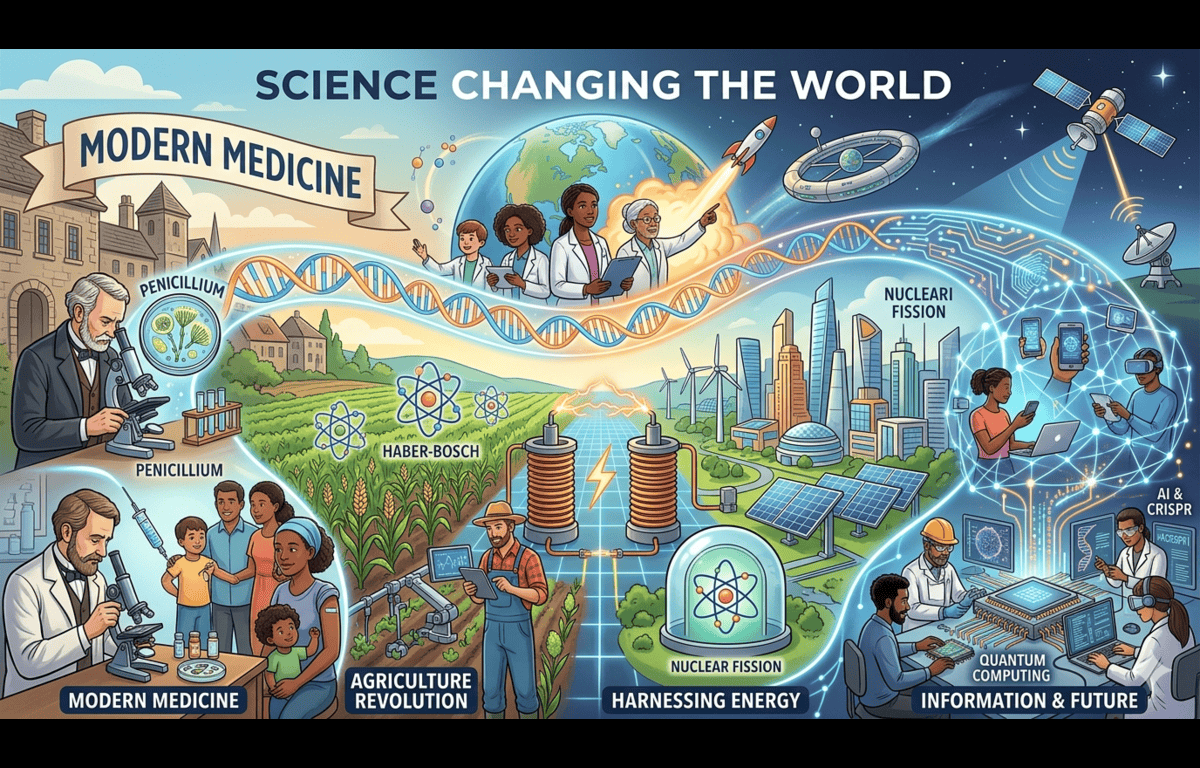
    This comprehensive guide explores the pivotal scientific breakthroughs that have reshaped our reality. We will journey through the realms of medicine, agriculture, energy, and communication, examining not only what these discoveries are, but how they have fundamentally altered the human experience, creating a more interconnected, healthier, and advanced global society.


    1. The Dawn of Modern Medicine: Redefining Human Health and Longevity

    Perhaps no field of scientific inquiry has had a more direct, intimate impact on human life than medicine. For millennia, average human life expectancy hovered around 30 to 40 years. Childhood mortality was staggeringly high, and a simple scratch could lead to a fatal infection. Today, global life expectancy has more than doubled, largely due to a handful of monumental scientific discoveries.

    The Miracle of Antibiotics

    Before the 20th century, bacterial infections like pneumonia, tuberculosis, and syphilis were largely untreatable death sentences. The discovery of penicillin by Alexander Fleming in 1928 marked the beginning of the antibiotic era. Fleming observed that a mold called Penicillium notatum secreted a substance that killed surrounding bacteria.

    However, it took the collaborative work of scientists Howard Florey and Ernst Chain in the 1940s to purify and mass-produce penicillin. The impact was immediate and staggering. During World War II, antibiotics saved countless soldiers from dying of infected wounds. In the civilian world, previously fatal illnesses became easily treatable. Antibiotics revolutionized not just treatment, but also medical procedures; modern surgeries, organ transplants, and cancer treatments would be impossible without antibiotics to prevent post-operative infections.

    Vaccines and the Eradication of Disease

    The concept of inoculation has roots in various ancient cultures, but the scientific development of vaccines fundamentally changed global public health. Edward Jenner’s pioneering work with the smallpox vaccine in 1796 laid the groundwork. Smallpox was one of the most devastating diseases in human history, killing hundreds of millions of people. Thanks to a coordinated global vaccination campaign led by the World Health Organization (WHO), smallpox was officially declared eradicated in 1980—one of the greatest triumphs in scientific history.

    Similarly, the development of the polio vaccine by Jonas Salk and Albert Sabin in the mid-20th century saved millions of children from paralysis and death. More recently, the unprecedented speed of the development of mRNA vaccines for COVID-19 showcased the incredible power of modern genomic science. By teaching the immune system to recognize and fight pathogens without exposing the body to the disease itself, vaccines have fundamentally altered the landscape of human survival.

    Medical Imaging: Looking Inside the Body

    For centuries, the only way to see inside the human body was through invasive surgery or post-mortem dissection. The discovery of X-rays by Wilhelm Conrad Roentgen in 1895 changed this overnight. Roentgen accidentally discovered that invisible electromagnetic radiation could pass through human tissue but not bone, creating an image on photographic plates.

    This discovery evolved into a massive field of diagnostic medicine. The subsequent inventions of Ultrasound, Computed Tomography (CT) scans, and Magnetic Resonance Imaging (MRI) have given physicians the ability to detect tumors, diagnose internal injuries, and monitor fetal development with incredible precision and without the need for a scalpel. This non-invasive diagnostic power has saved countless lives through early detection and accurate treatment planning.


    2. The Agricultural Revolution: Feeding a Growing Planet

    As human populations grew, the specter of mass starvation loomed large. Eighteenth-century economist Thomas Malthus famously predicted that human population growth would inevitably outpace our ability to produce food, leading to widespread famine. That this Malthusian catastrophe has largely been avoided is a testament to scientific discoveries in agriculture.

    The Haber-Bosch Process: Bread from the Air

    Nitrogen is an essential nutrient for plant growth, but while it makes up 78% of the Earth’s atmosphere, it exists in a form that most plants cannot use. Historically, agriculture was limited by the amount of naturally occurring nitrogen in the soil, which had to be replenished with manure or crop rotation.

    In the early 20th century, German chemists Fritz Haber and Carl Bosch developed a method to synthesize ammonia from atmospheric nitrogen and hydrogen gas under high heat and pressure. The Haber-Bosch process allowed for the mass production of synthetic fertilizers. It is estimated that without this discovery, the Earth could only support about half of its current population. Synthetic fertilizers initiated an agricultural boom that fed billions, fundamentally shifting human demographics and allowing societies to urbanize and industrialize.

    The Green Revolution and Crop Genetics

    In the mid-20th century, a series of research and technology transfer initiatives, collectively known as the Green Revolution, exponentially increased global agricultural production. Led by agronomist Norman Borlaug (often called the “father of the Green Revolution”), scientists developed high-yielding, disease-resistant varieties of wheat and rice.

    Combined with modern irrigation techniques and the aforementioned synthetic fertilizers, these new crop varieties transformed countries like India and Mexico from food-deficient nations into major agricultural exporters. Today, the science of agriculture continues to evolve with Genetically Modified Organisms (GMOs). By editing the genetic makeup of crops, scientists have created plants that are resistant to pests, tolerant of droughts, and fortified with essential vitamins (such as Golden Rice, engineered to combat Vitamin A deficiency). These advancements ensure global food security in the face of climate change and a population projected to reach nearly 10 billion by 2050.


    3. Harnessing Energy: Powering Modern Civilization

    Human progress is inextricably linked to our ability to harness and manipulate energy. From the mastery of fire to the combustion engine, energy transformations have driven societal change. However, specific scientific breakthroughs in the 19th and 20th centuries created the powered world we recognize today.

    Electromagnetism and the Electric Grid

    Before the 19th century, electricity was a mere scientific curiosity—a parlor trick involving static shocks. The theoretical and experimental work of scientists like Michael Faraday and James Clerk Maxwell fundamentally changed the world. Faraday’s discovery of electromagnetic induction—the principle that moving a magnet through a coil of copper wire generates an electric current—is the foundational mechanism for almost all modern power generation.

    The subsequent development of the electric lightbulb by Thomas Edison and the alternating current (AC) power grid championed by Nikola Tesla and George Westinghouse brought light to the night and power to factories. Electricity transformed human sleep patterns, drastically improved industrial productivity, and became the invisible nervous system of modern civilization, powering everything from life-saving hospital equipment to the device you are using to read this article.

    The Atom: Nuclear Fission

    In the early 20th century, physicists like Albert Einstein, Marie Curie, and Ernest Rutherford unlocked the secrets of the atom, revealing that immense amounts of energy were locked within its nucleus. The discovery of nuclear fission—the splitting of a heavy atomic nucleus, such as uranium—by Otto Hahn and Fritz Strassmann in 1938 ushered in the Atomic Age.

    While this discovery unfortunately led to the development of devastating nuclear weapons, it also gave rise to nuclear power. Nuclear energy provides a massive, reliable source of electricity without the greenhouse gas emissions associated with burning fossil fuels. Today, as the world grapples with climate change, the science of nuclear energy (and the ongoing pursuit of clean, limitless nuclear fusion) remains critical to our sustainable future.

    The Transition to Renewables

    Understanding the greenhouse effect—first quantified by scientist Svante Arrhenius in 1896—has led to a global push for sustainable energy. The scientific development of photovoltaic cells (solar panels) and advanced aerodynamics (wind turbines) has turned renewable energy from a niche environmental concept into the fastest-growing sector of the global energy market. Advancements in materials science, particularly in lithium-ion battery technology, have allowed us to store this energy efficiently, paving the way for electric vehicles and a decarbonized global grid.


    4. The Communication and Information Age: Connecting Humanity

    The ability to share information rapidly across vast distances has accelerated human progress more than any other factor in recent history. The transition from the industrial age to the information age was driven by breakthroughs in physics, mathematics, and computer science.

    The Transistor: The Building Block of the Digital World

    If you were to point to a single invention that created the modern world, the transistor would be a primary candidate. Invented in 1947 by John Bardeen, Walter Brattain, and William Shockley at Bell Labs, the transistor replaced bulky, fragile, and hot vacuum tubes.

    A transistor is a tiny semiconductor device used to amplify or switch electrical signals and power. By miniaturizing these components, engineers were able to pack millions, and eventually billions, of transistors onto a single silicon microchip. This is the foundation of all modern electronics. Without the transistor, there would be no personal computers, no smartphones, no modern aviation software, and no digital financial systems. It democratized access to computing power, taking it out of government laboratories and placing it in the hands of individuals globally.

    The Internet and the World Wide Web

    The creation of the internet was not a single “eureka” moment but a gradual evolution of computer networking protocols. Funded initially by the U.S. Department of Defense as ARPANET, scientists developed packet switching to allow computers to communicate across distributed networks.

    However, it was British computer scientist Tim Berners-Lee who, in 1989, invented the World Wide Web. By creating a system of interconnected, hyperlinked documents accessible via a browser, Berners-Lee made the internet navigable for the general public. The impact has been profound. The internet has democratized information, disrupted traditional media and commerce, created entirely new global economies, and allowed for the instant sharing of scientific data across borders, accelerating the pace of future discoveries.

    Space Exploration and Satellite Technology

    When the Soviet Union launched Sputnik 1 in 1957, humanity officially became a spacefaring species. The ensuing space race led to the Apollo moon landings, a pinnacle of human engineering. However, the scientific discoveries made for space exploration have deeply impacted life on Earth.

    Satellites orbiting our planet govern our daily lives. The Global Positioning System (GPS), originally designed for military use, now guides everything from commercial airliners to food delivery drivers. Weather satellites save lives by tracking hurricanes and monsoons days in advance. Communication satellites provide internet and television access to the most remote regions of the globe, ensuring that isolated populations are included in the global community.


    5. Looking Ahead: The Next Frontiers of Discovery

    The scientific method is a perpetual engine. As we look to the future, several emerging scientific discoveries are poised to change the world just as profoundly as antibiotics or the internet.

    • Artificial Intelligence (AI) and Machine Learning: Computer science has advanced to the point where algorithms can learn from massive datasets, recognizing patterns that humans cannot. AI is already revolutionizing medical diagnostics, autonomous transportation, and materials science. As AI models become more sophisticated, they will act as powerful collaborators in solving complex global challenges like climate modeling and drug discovery.
    • CRISPR and Gene Editing: The discovery of CRISPR-Cas9, a molecular tool adapted from the immune defense system of bacteria, allows scientists to edit DNA with unprecedented precision, speed, and affordability. This technology holds the potential to cure genetic diseases like sickle cell anemia, engineer crops that are virtually immune to climate change, and fundamentally alter the biological future of humanity.
    • Quantum Computing: While traditional computers use bits (0s and 1s), quantum computers use quantum bits (qubits), allowing them to exist in multiple states simultaneously. This means they can perform certain complex calculations exponentially faster than the most powerful supercomputers today. Quantum computing could revolutionize cryptography, discover new life-saving pharmaceuticals in days rather than years, and optimize global logistics systems.

    Conclusion: The Ongoing Journey of Progress

    To ask how scientific discoveries have changed the world is to ask how humanity has survived and thrived. Every aspect of our modern existence—the food we eat, the medicines we take, the vehicles we travel in, and the screens we look at—is the direct result of rigorous scientific inquiry.

    Science is an inclusive, collaborative endeavor. It relies on the cumulative knowledge of generations of curious individuals across all cultures and continents. While scientific advancements bring new challenges and ethical dilemmas—such as data privacy in the digital age or the implications of genetic editing—the scientific method itself remains our best tool for navigating these complexities.

    By fostering a society that values scientific literacy, funds basic research, and promotes inclusive education, we ensure that the engine of discovery continues to run. The next life-saving medicine, clean energy solution, or profound understanding of the universe is waiting to be uncovered, promising a brighter, more equitable future for all of humanity.


    Frequently Asked Questions (FAQ)

    Q1: What is considered the most important scientific discovery in history?

    While it is difficult to narrow down to just one, many historians and scientists point to the germ theory of disease (championed by Louis Pasteur and Robert Koch) and the subsequent discovery of penicillin (antibiotics). Before these discoveries, infectious diseases were the leading cause of human mortality. Germ theory fundamentally revolutionized public health, sanitation, and medicine, doubling the human lifespan.

    Q2: How did the discovery of electricity change daily life?

    The harnessing of electricity shifted society from a daylight-dependent, manual-labor economy to a 24-hour, industrialized, and interconnected global society. It allowed for the invention of artificial lighting, refrigeration (which revolutionized food safety and storage), mass communication (telegraph, radio, internet), and automated manufacturing, drastically raising the global standard of living.

    Q3: Are scientific discoveries always beneficial?

    Not inherently. Science is a tool, and like any tool, it can be used for immense good or immense destruction. For example, the discovery of nuclear fission led to both carbon-free nuclear energy and devastating atomic weapons. Similarly, the combustion engine drove industrial progress but also caused widespread environmental pollution and climate change. The application of science requires ethical guidelines and responsible societal oversight.

    Q4: What role does failure play in scientific discovery?

    Failure is a critical, unavoidable part of the scientific method. Every failed experiment provides valuable data, eliminating incorrect hypotheses and guiding researchers closer to the truth. Many great discoveries, such as Alexander Fleming’s discovery of penicillin or Wilson and Penzias’s discovery of cosmic microwave background radiation, were the results of “accidents” or unexpected anomalies during seemingly failed experiments.

    Q5: How is artificial intelligence considered a scientific discovery?

    While AI is heavily rooted in engineering and computer programming, the underlying principles are based on breakthroughs in mathematics, statistics, and neuroscience (such as understanding how neural networks function). The discovery of how to train algorithms to “learn” from data—rather than just executing pre-written commands—represents a fundamental leap in information science, allowing machines to approximate human cognitive tasks.

    Q6: How can individuals support ongoing scientific discoveries?

    You don’t need to be a laboratory researcher to support science. Individuals can contribute by staying informed through credible sources, advocating for science-based public policies and research funding, participating in “citizen science” projects (like data collection for environmental studies), and fostering a sense of curiosity and critical thinking in younger generations.


    Reference Links for Further Reading

    To learn more about the incredible scientific discoveries that have shaped our world, explore these highly respected resources:

    1. Nobel Prize Official Website: Explore the history of the greatest minds and discoveries in Physics, Chemistry, and Medicine.

    2. World Health Organization (WHO) – Global Health Histories: Read about the eradication of smallpox and the impact of modern vaccines.

    3. NASA – Benefits to You: Discover how space exploration technologies have been adapted for everyday use on Earth.

    4. Nature – News & Comment: Stay up to date with the latest scientific discoveries and their global impacts from one of the world’s leading multidisciplinary science journals.

    5. National Science Foundation (NSF): Learn about ongoing research and how fundamental discoveries drive the global economy.

  • The Invisible Thread: Why Science Matters in Everyday Life

    The Invisible Thread: Why Science Matters in Everyday Life

    When you hear the word “science,” what comes to mind? For many, it conjures images of individuals in stark white lab coats peering through microscopes, complex mathematical equations scribbled across chalkboards, or the sterile environment of a research facility. It is easy to compartmentalize science as an academic pursuit entirely separate from our daily routines. However, this perception could not be further from the truth.

    Science is not just an academic discipline; it is the fundamental framework of our existence. It is the invisible thread woven through every action we take, every breath we draw, and every convenience we enjoy. Understanding why science matters in everyday life is crucial for fostering a society that makes informed decisions, appreciates the world around us, and continues to drive human progress forward.

    In this comprehensive guide, we will explore the profound impact of scientific discovery on our daily routines, our health, our environment, and our future.


    1. The Science of the Morning Routine

    The integration of science into our lives begins before we even open our eyes. The alarm clock that wakes you is a marvel of modern electronics and physics. But let us look at the physical actions that make up a typical morning.

    The Chemistry of Cleanliness

    When you step into the shower, you are engaging in a chemical process. Soap is created through a chemical reaction called saponification, which allows water to mix with oils and dirt on your skin so they can be washed away.

    Similarly, brushing your teeth is a daily scientific intervention. Toothpaste contains fluoride, a naturally occurring mineral that has been scientifically proven to strengthen tooth enamel and prevent decay. By simply maintaining personal hygiene, you are relying on centuries of chemical and biological research designed to keep the human body healthy and free from bacterial infections.

    Thermodynamics in Your Coffee Cup

    If you brew a cup of coffee or tea to start your day, you are experimenting with thermodynamics and extraction chemistry. The temperature of the water determines which flavor compounds are extracted from the coffee grounds or tea leaves. If the water is too hot, it extracts bitter acids; if it is too cold, the beverage will be weak and underdeveloped.

    Furthermore, if you enjoy toast, you are experiencing the Maillard reaction. This is a chemical reaction between amino acids and reducing sugars that gives browned food its distinctive flavor. Whether you are searing a steak or toasting bread, you are performing a delicious chemical experiment in your kitchen.


    2. Health and Medicine: The Lifesaving Science

    Perhaps the most universally acknowledged area where science matters in everyday life is healthcare. Our understanding of human biology, disease, and pharmacology has revolutionized what it means to live a long, healthy life.

    The Eradication of Disease

    A little over a century ago, common infections were a leading cause of mortality. The discovery of penicillin by Alexander Fleming in 1928, and the subsequent development of antibiotics, fundamentally changed human history. Today, bacterial infections that were once death sentences are routinely treated with a simple prescription.

    Vaccines represent another monumental triumph of scientific application. By understanding how the immune system works, scientists have developed ways to train our bodies to fight off pathogens before they can cause severe illness. The near-eradication of polio and the complete eradication of smallpox are testaments to the power of public health science.

    Modern Medical Technology

    Beyond medication, the technology we use to diagnose and treat illnesses is deeply rooted in physics and engineering.

    • X-rays and MRI Machines: These allow doctors to look inside the human body without making a single incision, utilizing electromagnetic radiation and strong magnetic fields.
    • Wearable Health Tech: Today, many people wear smartwatches that track heart rates, blood oxygen levels, and sleep patterns. These devices use advanced optical sensors and algorithms to provide real-time biometric data, empowering individuals to take control of their cardiovascular health.

    3. Connecting the Globe: Technology and Communication

    The modern world is defined by connectivity. The fact that you can read this article on a screen, perhaps while sitting in a coffee shop or commuting to work, is the result of decades of intense scientific research in physics, computer science, and engineering.

    The Magic of the Smartphone

    Consider the smartphone in your pocket. It is essentially a supercomputer that relies on multiple branches of science to function:

    • Quantum Mechanics: The semiconductors and microchips inside your phone operate on principles of quantum physics. Without an understanding of how electrons behave at the microscopic level, modern computing would not exist.
    • Chemistry: The lithium-ion battery that powers your device is a carefully balanced electrochemical cell designed to store and release energy efficiently.
    • Relativity: The GPS (Global Positioning System) you use to navigate relies on satellites orbiting the Earth. Because these satellites are moving fast and are further away from Earth’s gravitational pull, time moves slightly differently for them compared to us on the ground. Engineers must apply Albert Einstein’s theory of relativity to adjust the satellites’ internal clocks; without this scientific correction, your GPS would drift by miles every single day.

    The Internet and Fiber Optics

    The internet, the vast network that houses human knowledge and facilitates global communication, runs on light. Fiber optic cables, made of meticulously engineered glass strands thinner than a human hair, transmit data across oceans using the principle of total internal reflection. This physics concept allows light pulses to travel thousands of miles with minimal signal loss, enabling instantaneous global communication.


    4. The Food on Our Tables: Agricultural Science

    As the global population continues to grow, feeding everyone is a monumental challenge. Science is the bedrock of modern agriculture, ensuring that food is abundant, safe, and nutritious.

    Enhancing Crop Yields

    Agricultural science involves biology, genetics, and ecology. Through selective breeding and, more recently, genetic modification, scientists have developed crop varieties that are resistant to pests, diseases, and harsh weather conditions. This ensures stable food supplies even in changing climates.

    Food Preservation and Safety

    Before the advent of modern refrigeration, food spoilage was a constant threat, leading to significant waste and foodborne illnesses. Understanding thermodynamics led to the invention of the refrigerator, a device that actively removes heat from an enclosed space, slowing down the biological decay of food.

    Furthermore, pasteurization—a process named after scientist Louis Pasteur—involves heating liquids like milk to a specific temperature to kill harmful bacteria without destroying the food’s nutritional value. This simple scientific process saves countless lives every year by preventing diseases like salmonella and E. coli.


    5. Transportation: Moving the World

    Whether you walk, bike, drive, or fly, science dictates how you move from point A to point B.

    Aerodynamics and Engineering

    The design of a modern car or airplane is heavily influenced by fluid dynamics. Engineers use wind tunnels and computer simulations to design vehicles that cut through the air with minimal resistance. This scientific application reduces fuel consumption and lowers carbon emissions, saving money and benefiting the environment.

    The Rise of Sustainable Transport

    As we look to the future, the science of alternative energy is transforming transportation. Electric vehicles (EVs) are becoming increasingly common, relying on advancements in battery chemistry and electric motor efficiency. Meanwhile, material scientists are constantly developing lighter, stronger materials—like carbon fiber—to make vehicles safer and more energy-efficient.


    6. Protecting Our Shared Home: Environmental Science

    Understanding our planet and how human activity impacts it is vital for our survival. Environmental science is an interdisciplinary field that combines ecology, geology, meteorology, and chemistry to address issues like climate change, pollution, and resource management.

    Understanding Climate Change

    Through meticulous data collection—from ice core samples in Antarctica to satellite imagery of deforestation—scientists have established a clear picture of how greenhouse gases are warming our planet. This scientific consensus is crucial because it informs international policies aimed at reducing emissions and mitigating the impacts of extreme weather.

    Renewable Energy Solutions

    Science does not just identify problems; it provides solutions. The transition to renewable energy is purely a scientific endeavor.

    • Solar Power: Photovoltaic cells convert sunlight directly into electricity by utilizing the photoelectric effect, a phenomenon explained by Albert Einstein.
    • Wind Power: Modern wind turbines are aerodynamic marvels that capture the kinetic energy of the wind and use electromagnetic induction to generate clean electricity.

    7. Critical Thinking: The Scientific Method as a Life Skill

    Perhaps the most underrated reason why science matters in everyday life is not found in physical objects or technologies, but in a way of thinking.

    The scientific method is a structured approach to problem-solving. It involves making an observation, asking a question, forming a hypothesis, conducting an experiment, and analyzing the results.

    While you may not be in a laboratory, you use this method constantly. If your desk lamp won’t turn on (observation), you might guess the bulb is dead (hypothesis). You replace the bulb (experiment). If it turns on, your hypothesis was correct; if not, you must form a new hypothesis—perhaps the outlet is broken.

    Navigating Misinformation

    In the digital age, we are constantly bombarded with information, some of it factual, much of it false. Scientific literacy equips individuals with the critical thinking skills necessary to evaluate claims, demand evidence, and distinguish between reliable information and pseudoscience. An inclusive, science-literate society is less vulnerable to scams, health hoaxes, and manipulative algorithms.


    Conclusion: Embracing the Scientific Worldview

    Science is not a distant, abstract concept reserved for a select few. It is the foundation of our modern world. From the hygiene practices that keep us healthy and the technology that connects us, to the food we eat and the critical thinking skills we rely on, science is the invisible infrastructure of everyday life.

    By fostering an appreciation for science, supporting scientific education, and maintaining a curious, evidence-based mindset, we empower ourselves to make better decisions for our health, our communities, and our planet. The next time you turn on a light, send a text message, or take a sip of clean water, take a moment to appreciate the centuries of scientific inquiry that made it possible.


    Frequently Asked Questions (FAQ)

    Q1: How does science help us in our daily life?

    Science helps us in countless ways every day. It provides the medical knowledge to keep us healthy, the engineering to build safe homes and transportation, the agricultural advancements to ensure a steady food supply, and the technology to communicate globally. Everything from your microwave to your mattress relies on scientific principles.

    Q2: What is the most important scientific discovery for daily life?

    While highly subjective, many experts point to the discovery of the germ theory of disease and the subsequent development of antibiotics and vaccines. Before these discoveries, life expectancy was significantly shorter, and minor infections could be fatal. The harnessing of electricity is another foundational discovery that underpins almost all modern convenience.

    Q3: Do I need to be good at math or chemistry to understand daily science?

    Not at all. While the underlying formulas can be complex, the core principles of how things work are accessible to everyone. Being scientifically literate simply means having a general understanding of the natural world and, more importantly, a willingness to ask questions and seek evidence-based answers.

    Q4: How does science affect the environment?

    Science plays a dual role. Historically, industrial science led to pollution and resource depletion. However, modern environmental science is our primary tool for understanding these impacts and reversing them. Science provides the data to track climate change and the technology (like solar panels and biodegradable materials) to build a sustainable future.

    Q5: Why is scientific literacy important for society?

    Scientific literacy empowers individuals to make informed decisions about their health, their communities, and their votes. In a world facing complex challenges like pandemics and climate change, a society that understands and values scientific consensus is better equipped to navigate crises and support policies that benefit humanity.


    Reference Links and Further Reading

    To continue exploring how science shapes our world, consider visiting these reputable scientific organizations and publications:

    1. National Science Foundation (NSF): An independent federal agency promoting the progress of science and funding research that impacts daily life. www.nsf.gov

    2. Science News: An excellent resource for readable, up-to-date reporting on scientific breakthroughs and how they affect society. www.sciencenews.org

    3. The World Health Organization (WHO): The definitive source for global public health information, vaccine science, and disease prevention. www.who.int

    4. NASA – Climate Change: A comprehensive, accessible resource detailing the science behind global warming and environmental changes. climate.nasa.gov

    5. Scientific American: A publication dedicated to making complex scientific concepts understandable and relevant to the general public. www.scientificamerican.com

  • What Is Science? A Beginner’s Guide to Understanding the Universe

    What Is Science? A Beginner’s Guide to Understanding the Universe

    Have you ever looked up at a night sky full of stars and wondered how far away they are? Have you ever watched a plant sprout from a tiny seed in the dirt and marveled at how it knew to grow toward the sun? Or perhaps you have simply baked a cake and watched liquid batter transform into a fluffy, solid dessert.

    If you have ever asked “how” or “why” about the world around you, you have already taken your first steps into the realm of science.

    For many of us, the word “science” brings up memories of memorizing the periodic table in a stuffy classroom, complicated mathematical formulas, or intimidating professionals in crisp white lab coats. But science is not just a subject in school, and it is certainly not an exclusive club. Science is a deeply human endeavor. It is a tool, a process, and a shared global journey to understand the universe and our place within it.

    This comprehensive, beginner-friendly guide will break down what science actually is, how the scientific method works, the different branches of scientific study, and why thinking like a scientist is something everyone can—and should—do.


    1. The Core Definition: What Exactly Is Science?

    To understand science, we can start by looking at the word itself. The word comes from the Latin word scientia, which translates simply to “knowledge.”

    However, defining science just as “knowledge” is incomplete. A library is full of knowledge, but a library is not science. Instead, it is better to think of science in two distinct but deeply connected ways:

    1. Science as a Body of Knowledge: This is the vast collection of facts, laws, and theories humanity has discovered over thousands of years. It is knowing that water freezes at 32 degrees Fahrenheit (0 degrees Celsius), that the Earth orbits the Sun, and that the human body is made up of billions of cells.
    2. Science as a Process: This is the more important definition. Science is a methodical, logical process for discovering how things in the universe work. It is an action. It is the act of observing, questioning, testing, and revising.

    Science is not a belief system. It does not ask you to take anything on faith. Instead, it asks for evidence. It relies on the idea that the natural world follows predictable patterns and that, through careful observation and experimentation, we can understand those patterns.

    Crucially, science is always a work in progress. It is self-correcting. When new evidence emerges that contradicts old knowledge, science updates its understanding. This willingness to be wrong and to learn from mistakes is what makes science the most reliable tool we have for finding the truth about our physical reality.


    2. The Blueprint of Discovery: The Scientific Method

    The engine that drives all scientific discovery is known as the Scientific Method. You do not need a multimillion-dollar laboratory to use it; in fact, you likely use variations of it in your everyday life without even realizing it.

    The scientific method is a standardized series of steps designed to minimize bias, reduce errors, and ensure that results are reliable and can be repeated by others. While scientists might sometimes bounce back and forth between these steps, the general blueprint looks like this:

    Step 1: Make an Observation

    Everything begins with noticing something. Let us use a highly relatable, everyday example: You walk into your living room and notice that your favorite houseplant is wilting, even though you watered it recently.

    Step 2: Ask a Question

    Observation naturally leads to curiosity. Why is the plant wilting? Is it getting too much sun? Not enough sun? Is the room too cold? Is there a draft?

    Step 3: Form a Hypothesis

    A hypothesis is often called an “educated guess,” but it is more accurately described as a testable explanation. It is a proposed answer to your question based on what you already know.

    • Your Hypothesis: “The plant is wilting because it is sitting too close to the air conditioning vent and the cold air is harming it.”

    Step 4: Conduct an Experiment

    This is where you test your hypothesis. A good experiment changes only one variable at a time so you can be sure of what caused the result.

    • Your Experiment: You move the plant to a different table, away from the cold air vent. You change absolutely nothing else—you keep the watering schedule and the amount of sunlight exactly the same.

    Step 5: Analyze the Data

    After a set period, you look at the results. What happened?

    • The Data: After one week, the plant’s leaves are perky and green again.

    Step 6: Draw a Conclusion

    Did the data support your hypothesis? In this case, yes. You can conclude that the cold air draft was likely causing the plant to wilt. If the plant had continued to wilt, your hypothesis would have been proven wrong, and you would go back to Step 3 to form a new hypothesis (e.g., “Maybe the soil needs fertilizer”).

    Step 7: Communicate and Peer Review

    In professional science, the final step is sharing your findings. Scientists publish their work in journals where other experts (peers) review the methods to ensure they were fair and accurate. If another scientist cannot replicate the experiment and get the same results, the original conclusion is called into question.


    3. The Tree of Knowledge: Major Branches of Science

    The universe is infinitely complex, so science is divided into different branches to make studying it manageable. Think of science as a massive tree. The trunk is the scientific method, and branching off from it are various disciplines.

    The Natural Sciences

    These branches study the physical, natural world and the events that occur within it.

    • Physics: The study of matter, energy, motion, and force. Physics asks the most fundamental questions about how the universe operates, from the behavior of tiny subatomic particles (quantum mechanics) to the massive gravitational pull of black holes (astrophysics).
    • Chemistry: The study of the composition, properties, and reactions of matter. If physics is the rulebook of the universe, chemistry is the study of the pieces on the board. Chemists look at how atoms and molecules interact to create everything from the plastic in your keyboard to the medicine in your cabinet.
    • Biology: The study of living organisms. Biology is incredibly diverse, encompassing genetics (how traits are passed down), ecology (how organisms interact with their environment), botany (plants), zoology (animals), and microbiology (bacteria and viruses).
    • Astronomy: The study of celestial objects and space. Astronomers study planets, stars, galaxies, and the origins of the universe itself.
    • Earth Science: The study of our home planet. This includes geology (rocks and the Earth’s physical structure), meteorology (weather and climate), and oceanography (the oceans).

    The Formal Sciences

    Unlike natural sciences, formal sciences do not rely on empirical observation of the physical world. Instead, they study formal systems and abstract concepts.

    • Mathematics: The study of numbers, quantities, shapes, and patterns. Math is often called the “language of science” because natural scientists use mathematical equations to express their findings.
    • Logic: The study of reasoning and valid inferences.
    • Computer Science: The study of computation, algorithms, and information processing.

    The Social Sciences

    These branches study human society and human behavior. Because human beings are unpredictable, social sciences rely heavily on statistics and large-scale observation.

    • Psychology: The study of the human mind and behavior.
    • Sociology: The study of human society, social structures, and institutions.
    • Economics: The study of how people, businesses, and governments allocate resources.
    • Anthropology: The study of human cultures, origins, and evolution.

    The Applied Sciences

    Applied sciences take the discoveries made in pure science and apply them to solve practical, real-world problems.

    • Medicine: Applying biology and chemistry to heal the sick and prevent disease.
    • Engineering: Applying physics, math, and materials science to build structures, machines, and software.

    4. Unpacking Misconceptions: Theory vs. Law

    One of the biggest barriers to understanding science for beginners is the terminology, specifically how scientists use certain words differently than the general public. The most common point of confusion revolves around the words “theory” and “law.”

    In everyday conversation, if someone says, “I have a theory about who stole the cookies,” they mean they have a hunch or a guess.

    In science, a Theory is the exact opposite of a guess. A scientific theory is a well-substantiated, highly tested, and widely accepted explanation for a natural phenomenon. It is the highest level of understanding in science. Theories pull together facts, laws, and tested hypotheses into a comprehensive framework.

    • Example: The Theory of Evolution by Natural Selection or the Germ Theory of Disease. These are not guesses; they are frameworks supported by mountains of evidence.

    A Scientific Law, on the other hand, is a statement based on repeated experimental observations that describes what happens in nature under certain conditions, usually expressed as a mathematical equation.

    • Example: Newton’s Law of Universal Gravitation calculates the force of gravity between two objects.

    The Key Difference: A law tells you what happens. A theory tells you why or how it happens. A theory never “grows up” to become a law; they serve two completely different purposes.


    5. Science Belongs to Everyone: The Importance of Inclusivity

    Historically, the image of a scientist has been narrow—often depicted as a solitary older man in a lab. This stereotype is not only inaccurate today, but it is also harmful because it makes science feel exclusionary.

    Science is a collective human heritage. It belongs to people of all genders, races, backgrounds, and abilities. In fact, science is strongest when it is inclusive. When people from diverse backgrounds bring different perspectives, they ask different questions and notice different problems, leading to richer, more comprehensive discoveries.

    Furthermore, empirical western science is increasingly recognizing the value of Indigenous knowledge systems. Communities that have lived in harmony with specific ecosystems for millennia hold deep, observational knowledge about sustainability, agriculture, and local biology that perfectly complements the scientific method.

    You do not need a Ph.D. to participate in science. Citizen Science is a growing movement where everyday people help professional scientists collect and analyze data. Whether it is tracking local bird populations, monitoring water quality in a nearby stream, or classifying galaxies using online photos from telescopes, people everywhere are contributing to our understanding of the universe.


    6. The Limits of Science: What It Cannot Do

    While science is an incredibly powerful tool, it is important to acknowledge its boundaries. Science is limited to the observable, measurable natural world.

    Here is what science cannot do:

    • Science cannot make moral judgments. Science can tell us how to split the atom to create immense energy, but it cannot tell us whether it is morally right to use that energy to build a weapon. Ethics and morality belong to the realms of philosophy, religion, and societal discourse.
    • Science cannot determine aesthetic value. Science can analyze the chemical composition of the paint on the Mona Lisa, and it can explain how our eyes process the colors, but it cannot tell us if the painting is beautiful.
    • Science cannot draw conclusions about the supernatural. Because science relies on testing and measuring the natural world, it has no tools to evaluate claims about gods, spirits, or anything outside of physical reality.

    Understanding these limits does not weaken science; it clarifies its purpose. Science is here to explain the how and the what of our reality.


    7. How to Think Like a Scientist Every Day

    You do not need be wearing a lab coat to engage in scientific thinking. Cultivating a scientific mindset is an excellent way to navigate a modern world filled with misinformation. Here is how you can think like a scientist:

    • Stay Curious: Keep asking “why.” Never lose the childlike wonder of looking at a rainbow or a complex machine and wanting to know how it works.
    • Embrace Skepticism: When presented with a claim—especially online—ask for the evidence. Where did this information come from? Is the source credible?
    • Be Willing to Change Your Mind: This is the hardest part, but it is the core of science. If you believe something, and you are presented with strong, credible evidence that you are wrong, have the humility to update your beliefs.
    • Look for Variables: When trying to solve a problem in your life (from fixing a broken lawnmower to improving your sleep schedule), change one thing at a time so you can accurately see what makes a difference.

    Conclusion

    Science is not a dusty textbook; it is a living, breathing, ongoing conversation about the universe. From the vast, swirling galaxies millions of light-years away to the microscopic bacteria living in our own bodies, science gives us the lenses through which we can see reality clearly.

    It is a process built on curiosity, fueled by evidence, and refined by time. Whether you are aiming to become a professional researcher, hoping to pass an upcoming exam, or simply looking to understand the news better, learning the basics of science equips you with a powerful toolkit for understanding the world. Keep exploring, keep questioning, and remember that the universe is waiting to be understood.


    Frequently Asked Questions (FAQ)

    Q: Is science ever completely “settled” or finished?

    A: Rarely. While many fundamental concepts (like gravity or the fact that the Earth is round) are supported by such overwhelming evidence that they are considered facts, the finer details are always being studied. Science is an ongoing process of refining and expanding our knowledge. New technology often allows us to see things we couldn’t before, which can lead to updates in our scientific understanding.

    Q: What is the difference between a hypothesis and a theory?

    A: A hypothesis is a testable, educated proposal meant to answer a specific question before an experiment is done. A theory is a broad, overarching explanation that has already been tested extensively and is supported by a massive amount of evidence and data from many different experiments.

    Q: Do scientists ever fail?

    A: All the time! In fact, “failure” is a vital part of the scientific method. When an experiment does not support a hypothesis, that is not a defeat; it is new data. Figuring out how something doesn’t work brings scientists one step closer to figuring out how it does work.

    Q: Can I trust scientific studies I read about in the news?

    A: It depends. News articles sometimes oversimplify complex studies or use sensational headlines to get clicks. It is always best to look for articles from reputable science journalists or, better yet, read the summary (abstract) of the actual peer-reviewed study if you can find it. Look out for studies that only used a very small number of test subjects or studies that have not been peer-reviewed yet.

    Q: What does “peer-reviewed” mean?

    A: Before a scientific paper is published in a credible journal, it is sent to a group of independent, anonymous experts in that specific field (the scientist’s “peers”). These experts scrutinize the study to ensure the methodology was sound, the math was correct, and the conclusions are backed by the data. If it fails this review, it is not published.

    Q: What is pseudoscience?

    A: Pseudoscience refers to beliefs or practices that claim to be scientific but do not adhere to the scientific method. Pseudoscience often relies on anecdotal evidence, lacks testable hypotheses, and cannot be proven wrong (falsified). Examples include astrology, crystal healing, and phrenology.


    Reference Links for Further Exploration

    To continue your journey into understanding science, check out these highly credible, beginner-friendly resources:

    1. Understanding Science (UC Berkeley): An incredibly comprehensive and accessible guide to how science really works. undsci.berkeley.edu

    2. Science News Explores: Dedicated to providing accurate, engaging science news for learners of all ages. snexplores.org

    3. NASA Knows! (For Students): Excellent breakdowns of physics, astronomy, and aerospace concepts. nasa.gov/stem

    4. National Science Foundation (NSF): News and articles on recent discoveries across all branches of science. nsf.gov

    5. Scientific American: One of the oldest and most respected magazines offering insights into current scientific research. scientificamerican.com

  • The Ultimate Guide to Strategic Planning for Long-Term Growth

    The Ultimate Guide to Strategic Planning for Long-Term Growth

    In today’s rapidly evolving business landscape, hoping for success is no longer a viable strategy. Whether you are leading a startup, managing a non-profit organization, or steering a multinational corporation, sustainable success requires a clear roadmap. That roadmap is your strategic plan.

    Strategic planning is more than just an annual corporate retreat or a dusty binder sitting on a manager’s shelf. It is a living, breathing framework that guides decision-making, aligns diverse teams, and ensures that your organization remains resilient in the face of change.

    In this comprehensive guide, we will explore actionable strategic planning tips for long-term growth. We will focus on creating strategies that are not only effective and agile but also inclusive and sustainable.


    What is Strategic Planning?

    At its core, strategic planning is the organizational management activity that leaders use to set priorities, focus energy and resources, strengthen operations, and ensure that employees and other stakeholders are working toward common goals.

    It is the process of defining your organization’s direction and making decisions on allocating resources to pursue that direction. While operational planning focuses on the “how” and the day-to-day tasks, strategic planning focuses on the “what” and the “why” over a longer time horizon—typically three to five years, or even a decade.

    Strategic vs. Operational Planning

    • Strategic Planning: Focuses on the big picture. It asks: Where are we going? What is our ultimate vision? How will we adapt to market changes?
    • Operational Planning: Focuses on the immediate future. It asks: Who is doing what today? How do we meet this month’s quota? What are our immediate project deadlines?

    Why Strategic Planning is Essential for Sustainable Growth

    Growth rarely happens by accident. When organizations experience growth without a strategy, it is often chaotic, unsustainable, and highly vulnerable to market shifts. Here is why prioritizing strategic planning is vital:

    1. Creates Alignment and Shared Purpose

    A well-communicated strategic plan ensures that everyone in the organization—from executive leadership to frontline customer support—understands the overarching goals. When people know why their work matters, engagement and productivity naturally increase.

    2. Optimizes Resource Allocation

    Every organization has finite resources: time, financial capital, and human talent. Strategic planning helps leaders make informed decisions about where to invest these resources for the highest return, preventing burnout and financial waste.

    3. Builds Resilience and Agility

    We live in a VUCA world (Volatile, Uncertain, Complex, and Ambiguous). A strong strategic plan doesn’t lock you into a rigid path; rather, it provides a foundational compass. When unexpected challenges arise, a strategic framework helps you pivot intentionally rather than react impulsively.

    4. Fosters Proactive Rather Than Reactive Management

    Instead of constantly putting out fires, strategic planning allows organizations to anticipate challenges and opportunities. It shifts the culture from crisis management to intentional design.


    Core Elements of a Winning Strategic Plan

    Before diving into specific growth tips, it is crucial to ensure your foundation is solid. Every effective strategic plan is built upon three core pillars:

    1. Vision Statement: Your organization’s North Star. This is an aspirational statement of what you ultimately want to achieve in the future.
    2. Mission Statement: The foundational purpose of your organization. It defines what you do, who you serve, and how you provide value today.
    3. Core Values: The fundamental beliefs and guiding principles that dictate behavior and action within the organization. Inclusive values ensure that diverse voices are respected and heard throughout the journey.

    8 Actionable Strategic Planning Tips for Long-Term Growth

    Building a strategy that endures requires intention, data, and a commitment to inclusivity. Here are eight actionable tips to guide your strategic planning process.

    Tip 1: Conduct a Comprehensive Environmental Scan

    You cannot chart a course to your destination if you do not know where you currently stand. An environmental scan provides a realistic view of your internal capabilities and the external market landscape.

    • SWOT Analysis: Evaluate your internal Strengths and Weaknesses, along with external Opportunities and Threats.
      • Inclusive Tip: Gather input for your SWOT analysis from people across all levels and departments of the organization. Frontline workers often perceive weaknesses and threats that executives might miss.

    • PESTLE Analysis: Look at the macro-environment by analyzing Political, Economic, Social, Technological, Legal, and Environmental factors. This is crucial for long-term growth, as social shifts and technological advancements can render existing business models obsolete overnight.

    Tip 2: Set SMARTIE Goals

    You are likely familiar with SMART goals (Specific, Measurable, Achievable, Relevant, and Time-bound). To foster true long-term, sustainable growth, upgrade your framework to SMARTIE goals by adding Inclusive and Equitable.

    • Inclusive: Does this goal bring traditionally marginalized or underrepresented voices into the process? Does the goal benefit a diverse range of stakeholders?
    • Equitable: Does this goal address systemic disparities? Are the resources required to achieve this goal distributed fairly?

    Example of a SMARTIE Goal: “Increase our software user base by 20% over the next 18 months (Specific, Measurable, Time-bound) by developing three new accessibility features for users with disabilities (Inclusive, Equitable) that align with our core expansion strategy (Relevant, Achievable).”

    Tip 3: Foster a Culture of Continuous Feedback and Collaboration

    Strategic planning should never be conducted in an isolated executive echo chamber. The best ideas often come from the people interacting directly with your clients, customers, and community.

    • Create Feedback Loops: Use anonymous surveys, town hall meetings, and focus groups to gather diverse perspectives.
    • Empower Cross-Functional Teams: When building your strategic initiatives, form committees that include members from different departments, backgrounds, and seniority levels. This prevents siloed thinking and ensures that the strategy is realistic to execute.

    Tip 4: Prioritize Agility and Scenario Planning

    A long-term strategy that spans five years will inevitably encounter unforeseen disruptions. The goal is not to predict the future perfectly, but to prepare for multiple possibilities.

    • Scenario Planning: Develop “What-If” scenarios. What if our main supplier goes out of business? What if a new competitor enters the market with a cheaper alternative? What if a global event disrupts our supply chain? * Build Contingency Plans: For each scenario, outline a high-level response. This ensures that when a crisis hits, your team isn’t starting from scratch—they are simply activating a pre-discussed plan.

    Tip 5: Align Resource Allocation with Strategic Priorities

    A strategy is only a wish list if it is not funded. One of the most common reasons strategic plans fail is the disconnect between the new strategy and the old budget.

    • Audit Current Spending: Are you investing time and money into projects that no longer align with your new long-term vision? Be prepared to cut legacy projects that do not serve the future.
    • Invest in Talent: Long-term growth requires the right people. Does your strategy require new skills? If so, your strategic plan must include a roadmap for training existing staff or hiring new, diverse talent.

    Tip 6: Establish Clear KPIs and Tracking Mechanisms

    To know if your strategic plan is working, you must measure your progress objectively. Key Performance Indicators (KPIs) act as the milestones on your journey.

    • Leading vs. Lagging Indicators: * Lagging indicators tell you what has already happened (e.g., last quarter’s revenue, customer churn rate).
      • Leading indicators help predict future success (e.g., number of new sales calls made, employee satisfaction scores, website traffic). A healthy strategic plan measures both.

    • Dashboarding: Create a centralized, accessible dashboard where all team members can see progress toward strategic goals in real-time. Transparency builds trust and accountability.

    Tip 7: Communicate the Vision Transparently to All Stakeholders

    Communication is the bridge between strategy and execution. If your team does not understand the plan, they cannot execute it.

    • Tailor the Message: While the overarching vision remains the same, how you communicate it should change based on the audience. An investor needs to hear about market share and ROI; a graphic designer needs to hear about brand evolution and creative direction.
    • Repetition is Key: Do not just announce the strategic plan once at an annual meeting. Incorporate the strategic goals into weekly team meetings, performance reviews, and company newsletters. Keep the vision front and center.

    Tip 8: Review, Reflect, and Refine Regularly

    A strategic plan is not carved in stone. It is a working document that must evolve as the organization and the market evolve.

    • Quarterly Reviews: Do not wait until the end of the year to check your progress. Hold quarterly strategy reviews to assess KPIs. If a goal is no longer relevant, have the courage to change it.
    • Celebrate the Wins: Long-term growth is a marathon. To keep morale high, take time to celebrate the small milestones and short-term wins along the way. Recognize the teams and individuals who are driving the strategy forward.

    Common Pitfalls to Avoid in Strategic Planning

    Even with the best intentions, organizations can stumble during the strategic planning process. Keep an eye out for these common traps:

    1. The “Set It and Forget It” Syndrome

    Investing months into creating a beautiful strategic plan, only to never look at it again, is the most common pitfall. To combat this, integrate strategic plan check-ins into your regular operational meetings.

    2. Lack of Inclusivity and Diversity

    When strategy is dictated entirely by a homogenous group of top-level executives, it suffers from severe blind spots. Without diverse perspectives regarding age, gender, cultural background, and organizational role, the plan will lack innovation and may alienate portions of your workforce or customer base.

    3. Strategy Overload

    Trying to do everything at once is a recipe for doing nothing well. If your strategic plan has 25 “top priorities,” you don’t actually have any priorities. Limit your focus to 3–5 core strategic pillars to ensure your team’s energy is concentrated and effective.

    4. Ignoring Organizational Culture

    Renowned management consultant Peter Drucker famously said, “Culture eats strategy for breakfast.” If your strategic plan requires high levels of cross-departmental collaboration, but your current culture is highly competitive and siloed, the strategy will fail. You must address cultural shifts alongside strategic shifts.


    The Role of Inclusive Leadership in Strategic Planning

    Long-term growth is deeply intertwined with inclusive leadership. As organizations expand globally and workforces become increasingly diverse, a leadership approach that values equity and belonging is no longer just a moral imperative—it is a strategic advantage.

    Inclusive leaders actively seek out dissenting opinions. They create psychological safety, ensuring that all team members feel comfortable pointing out potential flaws in a strategy without fear of retribution. When strategic planning is viewed through an inclusive lens, the resulting growth is more sustainable because it respects the human capital that drives the business forward. Ensure that your strategic initiatives include goals related to Diversity, Equity, Inclusion, and Accessibility (DEIA).


    Frequently Asked Questions (FAQ)

    To further clarify the strategic planning process, here are answers to some of the most common questions business leaders and team members ask.

    Q1: What is the difference between a strategy and a tactic?

    A: A strategy is the overarching plan or the destination you want to reach. A tactic is the specific, actionable step you take to get there. For example, if your strategy is to “become the leading eco-friendly apparel brand in Europe,” a tactic would be “launching a marketing campaign highlighting our zero-waste manufacturing process in Germany.” Strategy is the what and why; tactics are the how.

    Q2: How often should we update our strategic plan?

    A: While the overarching vision (e.g., a 5-year or 10-year goal) may remain consistent, the strategic plan itself should be reviewed at least quarterly and updated annually. In highly volatile industries like technology or fast-moving consumer goods, you may need to pivot your strategy even more frequently based on market feedback.

    Q3: Who should be involved in the strategic planning process?

    A: While executive leadership typically leads the process and makes final decisions, the planning process itself should be highly collaborative. Involve department heads, key stakeholders, and representatives from frontline staff. Using surveys or focus groups to gather input from the entire organization ensures a more robust and inclusive plan.

    Q4: How long does the strategic planning process take?

    A: The timeline varies depending on the size and complexity of the organization. For a small business, it might take a few weeks of dedicated meetings. For a large enterprise, gathering data, consulting stakeholders, drafting the plan, and getting board approval can take three to six months.

    Q5: What do we do if our market changes drastically in the middle of our strategic plan?

    A: This is where agility and scenario planning come in. If the market shifts drastically (e.g., a new regulation, an economic downturn), pause and assess. Revisit your environmental scan (PESTLE analysis). If the core assumptions of your plan are no longer valid, you must pivot. Clinging to an outdated strategy in a new reality is a fast track to failure.

    Q6: How can small businesses or startups with limited resources conduct strategic planning?

    A: Strategic planning does not require an expensive consulting firm. Small businesses can start by simply dedicating one full day away from daily operations to answer three questions: Where are we now? Where do we want to be in three years? What are the three biggest things we must do to get there? Keep it simple, document it, and review it monthly.


    Conclusion

    Strategic planning for long-term growth is an ongoing journey of discovery, alignment, and adaptation. It requires a willingness to look honestly at your current state, the audacity to envision a bold future, and the discipline to execute the steps in between.

    By conducting thorough environmental scans, setting SMARTIE goals, prioritizing inclusivity, and maintaining agility, you can create a strategic plan that not only survives market volatility but thrives in it. Remember, the goal of a strategic plan is not to predict the future with 100% accuracy; it is to prepare your organization to navigate whatever the future holds with confidence, unity, and purpose.

    Start small, remain consistent, and keep your communication transparent. Your future growth depends on the strategic seeds you plant today.


    References and Resources for Further Reading

    To continue expanding your knowledge on strategic planning and inclusive organizational growth, explore the following concepts and thought-leadership platforms:

    1. Harvard Business Review (HBR) – Strategy: A premier source for articles on competitive strategy, scenario planning, and leadership alignment. (Search: HBR Strategic Planning Basics)

    2. McKinsey & Company – Strategy & Corporate Finance: Offers deep-dive reports on macro-economic trends, agility, and long-term value creation. (Search: McKinsey The Strategy Map)

    3. Forbes – Business Strategy: Excellent for actionable advice, startup growth metrics, and leadership tips from industry experts. (Search: Forbes Building a Resilient Business Strategy)

    4. The Management Center: A fantastic resource for setting equitable and inclusive goals (SMARTIE goals) and managing diverse teams effectively. (Search: The Management Center SMARTIE Goals)

    5. Blue Ocean Strategy by W. Chan Kim and Renée Mauborgne: A foundational book on how to create uncontested market space and make the competition irrelevant.

  • The Ultimate Guide: How to Create a Scalable Business Strategy

    The Ultimate Guide: How to Create a Scalable Business Strategy

    In today’s fast-paced economic landscape, launching a company is only the first step. The true challenge—and the ultimate goal for most founders, leaders, and team members—is achieving sustainable, long-term growth. However, growth and scaling are not the same thing. While growth refers to increasing revenue alongside resources at an equal rate, scaling means increasing revenue exponentially while keeping operational costs relatively low.

    If you want your enterprise to thrive without burning out your workforce or exhausting your capital, you need a scalable business strategy.

    This comprehensive guide will walk you through the exact steps, core pillars, and potential pitfalls of building a business model designed for limitless growth. Whether you are leading a nimble tech startup, managing a retail brand, or offering digital services, these principles apply universally.


    What is a Scalable Business Strategy?

    A scalable business strategy is a comprehensive blueprint that allows an organization to expand its capacity, reach, and revenue without suffering a proportional increase in costs or a breakdown in operational efficiency.

    When a business is truly scalable, it can handle a sudden influx of new customers, larger order volumes, or expansion into new markets seamlessly. The systems, technology, and team structures are built to bend and expand, rather than break under pressure.

    Why is Scalability Crucial?

    • Profit Margin Expansion: Because your costs do not rise at the same rate as your revenue, your profit margins naturally increase as you scale.
    • Market Competitiveness: Scalable companies can adapt to market changes faster and outpace competitors who are bogged down by manual processes.
    • Investor Appeal: Venture capitalists and angel investors actively look for scalability. They want to know that an injection of capital will lead to exponential returns, not just linear, slow-moving progress.
    • Employee Well-being: A scalable system prevents team members from becoming overwhelmed during periods of high demand. It promotes a healthier work-life balance by relying on systems rather than endless overtime.

    The Core Pillars of a Scalable Business

    Before diving into the step-by-step strategy, it is essential to understand the foundational pillars that make scaling possible. If any of these pillars are weak, the entire structure is at risk of collapsing under the weight of rapid growth.

    1. Standardized and Streamlined Operations

    Every repetitive task in your workflow must be standardized. When operations rely on the unique knowledge of a single person, the business cannot scale. Standard Operating Procedures (SOPs) ensure that anyone joining the team can replicate success consistently. From onboarding new hires to processing customer returns, having a documented process is non-negotiable.

    2. An Adaptable, Inclusive Team Culture

    A scalable business requires a team that embraces change. As companies grow, roles shift, and new technologies are introduced. Fostering an inclusive culture where diverse perspectives are valued ensures that your team can creatively solve problems and adapt to new challenges. Hiring for adaptability and emotional intelligence is just as important as hiring for technical skill.

    3. Robust Financial Infrastructure

    Scaling requires capital, but more importantly, it requires cash flow visibility. You need real-time data on your customer acquisition cost (CAC), lifetime value (LTV), and burn rate. A robust financial infrastructure allows leaders to make data-driven decisions about when to invest in marketing, when to hire, and when to conserve resources.

    4. Scalable Technology and Automation

    Technology is the primary driver of scalability in the modern era. Leveraging cloud-based software, customer relationship management (CRM) tools, and automation allows a small group of people to do the work of a massive enterprise. Integrating Artificial Intelligence (AI) and machine learning can further optimize everything from supply chain logistics to personalized email marketing.


    Step-by-Step Guide to Crafting Your Scalable Business Strategy

    Creating a strategy for scale is not a one-time event; it is an iterative process. Follow these comprehensive steps to prepare your organization for exponential growth.

    Step 1: Conduct a Thorough Internal Audit

    Before you can build a roadmap to the future, you must understand exactly where you stand today. An internal audit involves analyzing every department to identify bottlenecks and inefficiencies.

    • Analyze Workflows: Track how a product or service moves from creation to the customer. Where are the delays?
    • Evaluate Tech Stacks: Are your current software tools communicating with each other? Are you paying for redundant platforms?
    • Assess Team Capacity: Are your team members currently working at full capacity? If sales doubled tomorrow, who would break first?

    Step 2: Define Clear, Measurable Growth Goals

    Vague goals like “increase sales” do not drive scalable strategies. You need specific, measurable, achievable, relevant, and time-bound (SMART) objectives.

    • Example of a poor goal: “Get more website traffic.”
    • Example of a scalable goal: “Increase organic website traffic by 40% over the next 12 months by publishing three highly optimized, inclusive content pieces per week, leading to a 15% increase in qualified leads.”

    Align your entire workforce around these core metrics. When everyone understands the North Star metric, decision-making becomes decentralized and significantly faster.

    Step 3: Automate and Outsource Relentlessly

    To scale, leadership must focus on high-impact, strategic work, not mundane administrative tasks.

    What to Automate:

    • Email marketing sequences and customer journeys.
    • Invoicing, payroll, and basic bookkeeping.
    • Social media scheduling and initial customer service inquiries (via chatbots).
    • Data entry and lead qualification.

    What to Outsource:

    • Specialized tasks that fall outside your core competencies (e.g., complex legal work, specific IT troubleshooting, or highly technical content creation).
    • By utilizing freelancers or specialized agencies, you maintain flexibility without the overhead costs of full-time, specialized salaries.

    Step 4: Build a Scalable Sales and Marketing Engine

    Your marketing cannot rely on the founder’s personal network or word-of-mouth alone. You need predictable, repeatable lead generation systems.

    • Inbound Marketing: Invest in SEO, content marketing, and thought leadership. These assets continue to generate leads long after they are created, offering an incredibly high return on investment (ROI).
    • Frictionless Funnels: Ensure that the journey from discovering your brand to making a purchase is as seamless as possible. Remove unnecessary form fields, offer multiple payment options, and ensure your website is fully optimized for mobile users.
    • Retention Strategies: It is drastically more expensive to acquire a new customer than to retain an existing one. A scalable business model heavily relies on recurring revenue, subscriptions, or high customer loyalty.

    Step 5: Secure the Right Talent and Empower Leadership

    As the organization expands, the founder can no longer make every decision. You must build a strong middle management tier and empower them with autonomy.

    • Hire Ahead of the Curve: Do not wait until your team is drowning to hire new talent. Anticipate growth and bring people on board so they are fully trained when the demand spikes.
    • Focus on Continuous Learning: Provide budgets for courses, workshops, and mentorship programs. A team that is constantly learning is a team that can handle the complexities of a growing enterprise.
    • Promote Inclusivity: Ensure your hiring practices attract talent from all backgrounds. Diverse teams are statistically proven to be more innovative and better at problem-solving, both of which are essential for scaling.

    Step 6: Monitor Key Performance Indicators (KPIs) and Pivot

    A scalable strategy must remain flexible. Market conditions shift, consumer preferences evolve, and new technologies emerge daily.

    Establish a dashboard of KPIs that you review weekly. Key metrics should include:

    • Customer Acquisition Cost (CAC): How much does it cost to get a new buyer?
    • Customer Lifetime Value (LTV): How much revenue does a customer bring in over their entire relationship with you? (Your LTV should ideally be at least three times your CAC).
    • Churn Rate: What percentage of customers are leaving you every month?
    • Monthly Recurring Revenue (MRR): The lifeblood of predictable scaling.

    If the data shows that a particular channel or product is not performing, do not let ego get in the way. Pivot quickly and reallocate resources to what is working.


    Common Pitfalls to Avoid When Scaling

    Even the most well-intentioned leaders can stumble when trying to scale. Keep an eye out for these common traps:

    1. Premature Scaling

    This is the number one reason startups fail. Premature scaling happens when you spend heavily on marketing, hire a massive team, or expand into new offices before you have achieved true Product-Market Fit. If your core product does not perfectly solve a distinct problem for a specific audience, scaling will only amplify your flaws and burn through your cash faster.

    2. Compromising on Quality

    When output increases, it is easy to let quality control slip. Whether it is a physical product, a software bug, or customer service response times, a drop in quality will destroy your brand reputation. Your SOPs and automated systems must include rigorous quality assurance checks.

    3. Losing the Company Culture

    When you grow from 10 to 100 employees, the intimate, collaborative culture of a small team can easily vanish. Internal communication breaks down, and silos form. Leadership must actively work to maintain culture through regular town halls, transparent communication, clear core values, and inclusive team-building initiatives.

    4. Underestimating Capital Requirements

    Scaling often requires a significant upfront investment in technology, infrastructure, and marketing before the revenue catches up. Many businesses run out of cash during this crucial gap. Ensure you have secured adequate funding, lines of credit, or a highly profitable core offering to sustain operations during the scaling phase.


    Conclusion

    Creating a scalable business strategy is a dynamic, ongoing journey. It requires a delicate balance of visionary leadership, rigorous operational discipline, and an unwavering commitment to your customers and your team. By standardizing your operations, leveraging modern technology, building a robust financial framework, and prioritizing an adaptable, inclusive culture, you lay the groundwork for limitless growth.

    Remember that scaling is not about working harder; it is about working smarter. It is about building a machine that operates efficiently, allowing you to amplify your impact on the world without burning out the people who make it possible. Take these steps, avoid the common pitfalls, and prepare your business for the exponential growth it deserves.


    Frequently Asked Questions (FAQ)

    Q1: What is the main difference between growing a business and scaling a business?

    Growing a business means adding resources (like new hires or larger offices) at the same rate that you are adding revenue. Scaling means adding revenue at a rapid, exponential rate while adding resources at a much slower, incremental rate. Scaling drastically improves profit margins.

    Q2: Can service-based businesses scale, or is this only for product and software companies?

    Service-based businesses can absolutely scale! The key is moving away from a strict “dollars-for-hours” model. Service businesses can scale by productizing their services (creating tiered packages), building proprietary software to speed up delivery, or creating digital products (like courses or templates) that can be sold infinitely with no extra labor.

    Q3: How do I know if my business is ready to scale?

    You are ready to scale when you have a proven Product-Market Fit (customers consistently want what you are selling and are highly satisfied), predictable and repeatable lead generation, documented Standard Operating Procedures (SOPs), and enough cash flow or funding to support the initial infrastructure investments.

    Q4: What is the most important metric to track when scaling?

    While many metrics are important, the ratio between Customer Lifetime Value (LTV) and Customer Acquisition Cost (CAC) is paramount. If your LTV is significantly higher than your CAC (aim for a 3:1 ratio or higher), your business model is highly sustainable and ready for scaling.

    Q5: How does inclusive language and diversity impact scalability?

    Scalability requires innovation, wide market appeal, and strong team retention. Diverse teams bring varied perspectives that solve complex problems faster. Furthermore, using inclusive language in your marketing ensures you do not alienate potential market segments, maximizing your total addressable market (TAM).


    Reference Links

    For further reading and deeper insights into building scalable operations, leadership, and financial modeling, explore the following reputable resources:

    • Harvard Business Review: The Strategy That Will Fix Health Care (and other industries via scaling): hbr.org

    • McKinsey & Company: The secrets of successful business scaling: mckinsey.com

    • Forbes: 10 Keys To Scaling A Business Effectively: forbes.com

    • Y Combinator Startup Library (Excellent resources on Product-Market Fit and Scaling): ycombinator.com/library

    • SBA (Small Business Administration) – Managing a Business for Growth: sba.gov

  • The Ultimate Guide: Business Model Canvas Explained (With Examples)

    The Ultimate Guide: Business Model Canvas Explained (With Examples)

    If you have ever tried to write a traditional business plan, you know how exhausting the process can be. You spend weeks researching, writing, and formatting a 50-page document, only to realize that by the time you finish, your market has already shifted, and your assumptions are outdated. In today’s fast-paced digital economy, agility is everything. Business leaders, startup founders, and corporate teams need a tool that allows them to map, discuss, and pivot their strategies in real-time.

    Enter the Business Model Canvas (BMC).

    Whether you are launching a cutting-edge artificial intelligence platform or opening a local coffee shop, the Business Model Canvas provides a clear, visual, and highly adaptable framework for understanding how your business creates, delivers, and captures value.

    In this comprehensive, 2000+ word guide, we will break down exactly what the Business Model Canvas is, explore its nine essential building blocks in deep detail, provide real-world examples, and answer the most frequently asked questions.


    What is the Business Model Canvas?

    The Business Model Canvas is a strategic management template used for developing new business models or documenting and improving existing ones. Created by Swiss business theorist Alexander Osterwalder and computer scientist Yves Pigneur, the canvas was introduced in their groundbreaking book, Business Model Generation.

    Instead of hiding your business strategy in a dense document that nobody reads, the BMC places your entire operational structure onto a single page. It is a visual chart featuring nine distinct elements that describe a company’s value proposition, infrastructure, customers, and finances.

    Why is the BMC so Popular?

    The beauty of the canvas lies in its simplicity and collaborative nature. It strips away the fluff of traditional business plans and forces teams to focus on the core drivers of success.

    • It creates a shared language: Everyone from the engineering team to the marketing department can look at the canvas and immediately understand the business goals.
    • It is inclusive and accessible: It removes confusing corporate jargon, making strategic planning accessible to everyone, regardless of their business background.
    • It promotes agility: Because it is a single page, you can easily erase, iterate, and update your strategy as market conditions change.

    The 9 Building Blocks of the Business Model Canvas

    To truly understand the Business Model Canvas, you need to understand its nine core building blocks. These blocks are divided into three main categories: Desirability (Customer-focused), Feasibility (Infrastructure-focused), and Viability (Finance-focused).

    Let’s break down each block in detail.

    1. Customer Segments (Who are you helping?)

    No business can survive without customers. This building block defines the different groups of people or organizations your enterprise aims to reach and serve. Because no product is for everyone, it is crucial to clearly define your target audience to ensure your messaging and product development are aligned with their needs.

    Types of Customer Segments:

    • Mass Market: Focusing on a broad group of people with similar needs (e.g., consumer electronics).
    • Niche Market: Catering to a specific, specialized customer segment (e.g., high-end camera equipment for professional filmmakers).
    • Segmented: Distinguishing between customer groups with slightly different needs and problems (e.g., a software company serving both small startups and large enterprise clients).
    • Diversified: Serving two completely unrelated customer segments with different needs.
    • Multi-Sided Platforms: Serving two or more interdependent customer segments (e.g., a credit card company needs both consumers to hold the cards and merchants to accept them).

    Questions to ask your team:

    • For whom are we creating value?
    • Who are our most important customers?
    • What are the specific demographics, behaviors, and pain points of our target audience?

    2. Value Propositions (What are you offering?)

    Your Value Proposition is the reason why customers turn to your company over your competitors. It solves a customer problem or satisfies a customer need. Each value proposition consists of a selected bundle of products and services that cater to the requirements of a specific Customer Segment.

    Elements that contribute to value creation:

    • Newness: Satisfying an entirely new set of needs that customers didn’t previously perceive because there was no similar offering (common in tech and AI innovations).
    • Performance: Improving the performance of an existing product or service.
    • Customization: Tailoring products to the specific needs of individual customers.
    • Design: Offering superior aesthetic design or usability.
    • Price: Offering similar value at a lower price point.
    • Cost/Risk Reduction: Helping customers reduce their own costs or minimize the risks they take when doing business.
    • Convenience: Making things easier to use or more accessible.

    Questions to ask your team:

    • What exact value do we deliver to the customer?
    • Which specific problem are we helping to solve?
    • What bundles of products or services are we offering to each Customer Segment?

    3. Channels (How do you reach them?)

    Channels describe how a company communicates with and reaches its Customer Segments to deliver its Value Proposition. .Channels are the customer touchpoints that play a critical role in the customer experience.

    Channel Phases:

    1. Awareness: How do we raise awareness about our products and services? (e.g., SEO blog posts, social media campaigns).
    2. Evaluation: How do we help customers evaluate our Value Proposition? (e.g., case studies, free trials).
    3. Purchase: How do we allow customers to purchase specific products? (e.g., web store, physical retail, app stores).
    4. Delivery: How do we deliver the Value Proposition? (e.g., instant digital download, courier shipping).
    5. After-Sales: How do we provide post-purchase customer support? (e.g., help desks, community forums).

    Types of Channels:

    • Direct: Sales force, online web sales, proprietary storefronts.
    • Indirect: Partner stores, wholesalers, affiliate networks.

    4. Customer Relationships (How do you interact with them?)

    This block describes the types of relationships a company establishes with specific Customer Segments. Relationships can range from highly personal to entirely automated, and they are driven by customer acquisition, customer retention, and upselling.

    Types of Customer Relationships:

    • Personal Assistance: Based on human interaction, such as speaking with a representative at the point of sale or via email.
    • Dedicated Personal Assistance: Assigning a specific representative to an individual client (e.g., key account managers for enterprise software clients).
    • Self-Service: Maintaining no direct relationship; providing all the means for customers to help themselves.
    • Automated Services: Mixing self-service with automated processes (e.g., recommending content based on past behavior).
    • Communities: Utilizing user communities to facilitate connections and solve problems collaboratively (e.g., a dedicated Discord server for users of a specific digital product).
    • Co-creation: Partnering with customers to create value (e.g., asking users to contribute content or feedback that shapes future product updates).

    5. Revenue Streams (How do you make money?)

    If customers are the heart of a business model, revenue streams are the arteries. This block represents the cash a company generates from each Customer Segment. A business must ask itself what value each customer segment is truly willing to pay for.

    Ways to Generate Revenue:

    • Asset Sale: Selling ownership rights to a physical product.
    • Usage Fee: Revenue generated by the use of a particular service (the more it is used, the more the customer pays).
    • Subscription Fees: Selling continuous access to a service (e.g., monthly access to an AI generation tool).
    • Lending/Renting/Leasing: Temporarily granting someone the exclusive right to use a particular asset for a fixed period in return for a fee.
    • Licensing: Giving customers permission to use protected intellectual property in exchange for licensing fees.
    • Brokerage Fees: Revenue derived from intermediation services performed on behalf of two or more parties.
    • Advertising: Revenue generated from fees for advertising a particular product, service, or brand.

    Pricing Mechanisms:

    • Fixed Pricing: Pre-defined prices based on static variables (list price, product feature dependent, customer segment dependent).
    • Dynamic Pricing: Prices change based on market conditions (negotiation, yield management, real-time market pricing).

    6. Key Resources (What assets do you need?)

    Key Resources describe the most important assets required to make your business model work. These are the inputs your organization needs to create your value proposition, reach your markets, and earn revenue.

    Types of Key Resources:

    • Physical: Manufacturing facilities, buildings, vehicles, point-of-sale systems, and distribution networks.
    • Intellectual: Brands, proprietary knowledge, patents, copyrights, partnerships, and customer databases.
    • Human: The workforce. Human resources are crucial in knowledge-intensive and creative industries (e.g., software engineers, content creators, data scientists).
    • Financial: Cash, lines of credit, or stock options needed to hire key employees or fund infrastructure.

    7. Key Activities (What do you need to do?)

    This block describes the most important things a company must do to make its business model successful. Just like Key Resources, Key Activities are required to create and offer a Value Proposition, reach markets, maintain Customer Relationships, and earn revenues.

    Types of Key Activities:

    • Production: Designing, making, and delivering a product in substantial quantities or of superior quality.
    • Problem Solving: Coming up with new solutions to individual customer problems (common in consultancies, hospitals, and service organizations).
    • Platform/Network: Activities related to maintaining and promoting a continuous platform (e.g., maintaining server uptime, updating algorithms, managing digital interfaces).

    8. Key Partnerships (Who will help you?)

    Companies rarely do everything on their own. The Key Partnerships block describes the network of suppliers and partners that make the business model work. Organizations forge partnerships to optimize their business models, reduce risk, or acquire resources.

    Types of Partnerships:

    • Strategic Alliances: Partnerships between non-competitors (e.g., an AI software company partnering with a major cloud hosting provider).
    • Coopetition: Strategic partnerships between competitors to grow the overall market or share massive infrastructure costs.
    • Joint Ventures: Partnerships to develop new businesses or enter new geographical markets.
    • Buyer-Supplier Relationships: Reliable relationships to guarantee access to necessary materials or services.

    Questions to ask your team:

    • Who are our key partners and suppliers?
    • Which Key Resources are we acquiring from partners?
    • Which Key Activities do partners perform better or more cost-effectively than we could?

    9. Cost Structure (What does it cost?)

    Creating and delivering value, maintaining customer relationships, and generating revenue all incur costs. This final building block describes all the financial consequences of operating under a particular business model.

    Classes of Business Structures:

    • Cost-Driven: Focuses on minimizing costs wherever possible (e.g., budget airlines). They feature lean structures, low-price value propositions, and maximum automation.
    • Value-Driven: Less concerned with the cost implications and more focused on value creation. High-end personalized service and premium materials characterize this approach.

    Characteristics of Cost Structures:

    • Fixed Costs: Costs that remain the same regardless of the volume of goods or services produced (e.g., salaries, rents, software subscriptions).
    • Variable Costs: Costs that vary proportionally with the volume of goods or services produced.
    • Economies of Scale: Cost advantages that a business enjoys as its output expands (e.g., bulk purchasing rates).
    • Economies of Scope: Cost advantages that a business enjoys due to a larger scope of operations.

    Business Model Canvas Examples

    To bring these concepts to life, let’s look at two detailed examples of how different organizations might map out their Business Model Canvas.

    Example 1: An AI Content Generation Platform

    Imagine a modern, tech-forward startup that provides users with advanced AI tools to generate high-quality images, videos, and digital content optimized for social media platforms like Twitter. Here is what their canvas might look like:

    • Customer Segments: Digital marketing agencies, independent content creators, social media managers, and tech-enthusiast hobbyists.
    • Value Propositions: Massive reduction in the time needed to create digital content; professional-grade, cinematic aesthetic without needing expensive graphic design software; rapid A/B testing capabilities for marketing campaigns.
    • Channels: Targeted social media advertising, SEO-optimized blog posts about content creation, community engagement on platforms like Discord and Reddit, and direct sales outreach for enterprise clients.
    • Customer Relationships: Primarily a self-service, automated SaaS relationship, bolstered by a strong, active community of users who share prompts and tips. Premium users get dedicated technical support.
    • Revenue Streams: Freemium model to acquire users, with tiered monthly subscriptions (e.g., Basic, Pro, Ultra) based on generation quotas and advanced feature access. API usage fees for enterprise integrations.
    • Key Resources: Proprietary AI models, massive computational server power, talented machine learning engineers, and user generation data to continuously train and improve the models.
    • Key Activities: Continuous model training and refinement, platform UI/UX maintenance, community management, and marketing content creation.
    • Key Partnerships: Cloud infrastructure providers (for server power), strategic partnerships with digital marketing agencies, and integrations with social media scheduling tools.
    • Cost Structure: High fixed costs for server and compute power, research and development payroll, marketing spend, and cloud hosting fees. It is a value-driven and scale-driven structure.

    Example 2: A Global Ride-Sharing App (e.g., Uber)

    For a contrast, let’s look at a multi-sided platform that connects two distinct groups of people in the physical world.

    • Customer Segments: 1. Passengers (people who need to get from point A to point B without owning a car).
    • 2. Drivers (people who own cars and want to earn flexible income).
    • Value Propositions: 1. For Passengers: Convenience, shorter wait times, cashless transactions, and clear pricing upfront.
    • 2. For Drivers: Flexible working hours, an easy way to earn money, and no need to find their own customers.
    • Channels: Mobile applications (iOS and Android stores), word-of-mouth, and local promotional events.
    • Customer Relationships: Highly automated self-service via the app. A rating system builds trust within the community, alongside automated customer support for ride issues.
    • Revenue Streams: Taking a percentage commission from every ride booked through the platform. Dynamic pricing (surge pricing) during high-demand times.
    • Key Resources: The proprietary software platform/algorithm, brand reputation, and the network of active drivers and passengers.
    • Key Activities: Platform development and maintenance, algorithmic optimization for routing and pricing, marketing to both drivers and riders, and regulatory lobbying.
    • Key Partnerships: Mapping technology providers, payment processing companies, and local insurance providers.
    • Cost Structure: Significant costs in marketing and customer acquisition, software development, legal and regulatory compliance, and customer support infrastructure.

    How to Create Your Own Business Model Canvas

    Now that you understand the blocks and have seen examples, it is time to build your own. Following a structured approach will ensure you get the most out of the exercise.

    Step 1: Gather the Right People

    Do not do this alone. The Business Model Canvas thrives on diverse perspectives. Bring together people from different departments—product development, marketing, sales, finance, and customer service. A cross-functional team will identify blind spots that a solo founder might miss.

    Step 2: Use the Right Medium

    While there are many digital tools available, the best way to start is often analog. Print a massive poster of the canvas and put it on a wall, or draw it on a large whiteboard. Use sticky notes and markers. Sticky notes are crucial because they can be easily moved or removed as your ideas evolve.

    Step 3: Start with Customers and Value

    Always begin by defining your Customer Segments and your Value Proposition. These two blocks are the core of your business. If you do not know who you are selling to and why they would buy from you, the rest of the canvas does not matter. Map out exactly how your product solves their specific pain points.

    Step 4: Work Through the Rest of the Blocks

    Once the core is established, move to Channels and Customer Relationships. Then, look at the back-end of your business: Key Resources, Activities, and Partnerships. Finally, calculate how the model makes financial sense by mapping out Revenue Streams and Cost Structure.

    Step 5: Review, Test, and Iterate

    Your first draft will be built heavily on assumptions. Do not treat the canvas as a final, static document. Take your canvas out into the real world. Talk to potential customers to validate your Value Proposition. Speak to potential partners to validate your costs. When you learn new information, go back to your canvas, rip off the old sticky notes, and replace them with validated facts.


    Common Mistakes to Avoid When Using the BMC

    Even with a straightforward tool like the canvas, teams can fall into several common traps. Keep an eye out for these pitfalls:

    • Mixing up Present and Future: Don’t put what your business currently is on the same canvas as what you hope it will be in five years. Create one canvas for the present state, and a separate one for the future state.
    • Being Too Vague: Writing “marketing” under Key Activities or “software” under Key Resources isn’t helpful. Be specific. Write “SEO content marketing” or “proprietary machine learning algorithms.”
    • Falling in Love with Your First Idea: The point of the canvas is rapid iteration. If the financial blocks show that the cost structure is higher than the revenue streams, don’t force it. Pivot and try a different model.
    • Orphaned Elements: Every element on the left side of the canvas (Infrastructure) must support an element on the right side (Value/Customers). If you list a Key Activity that doesn’t contribute to a Value Proposition, why are you doing it?

    Frequently Asked Questions (FAQ)

    What is the difference between a Business Model Canvas and a Lean Canvas?

    The Business Model Canvas was designed for existing businesses or well-funded startups to optimize and visualize their operations. The Lean Canvas is an adaptation created by Ash Maurya specifically for early-stage startups under conditions of extreme uncertainty. The Lean Canvas replaces elements like Key Partnerships and Customer Relationships with blocks focused on the Problem, Solution, Key Metrics, and Unfair Advantage.

    Who should use the Business Model Canvas?

    Everyone from solo entrepreneurs and small local business owners to executives at Fortune 500 companies can benefit from it. It is particularly useful for product managers, innovation teams, and startup founders who need to quickly align a team around a strategic vision.

    How often should I update my canvas?

    The canvas is a living document. You should update it whenever there is a significant shift in your market, when you introduce a new major product line, or when you learn new data that invalidates one of your previous assumptions. For active startups, reviewing the canvas quarterly is a good practice.

    Can the BMC be used for non-profits or charities?

    Absolutely. For non-profits, the “Revenue Streams” block is often reframed as “Funding Sources” (e.g., grants, donations), and “Customer Segments” might be split into “Beneficiaries” (who receives the help) and “Donors” (who funds the help). The logic of delivering value efficiently remains exactly the same.

    Does a Business Model Canvas replace a traditional business plan?

    In many modern contexts, yes. For internal alignment and fast-moving strategy, the BMC is superior. However, if you are applying for a traditional bank loan or pitching to certain conservative investors, they may still require a formal, written business plan alongside your financial projections. The BMC is often the best first step to outline the logic before writing the long-form document.


    References and Further Reading

    To continue expanding your knowledge on business modeling and strategic design, consider exploring the following highly authoritative resources:

    • Strategyzer: The official home of the Business Model Canvas. Strategyzer provides free downloads of the canvas, instructional videos, and advanced corporate innovation training. Visit their official site at Strategyzer.com

    • Business Model Generation: The foundational book by Alexander Osterwalder and Yves Pigneur. It is a highly visual, practical guide to designing tomorrow’s enterprises.

    • Harvard Business Review: HBR regularly publishes peer-reviewed articles and case studies on business model innovation, pivoting strategies, and value proposition design. Find relevant articles at hbr.org