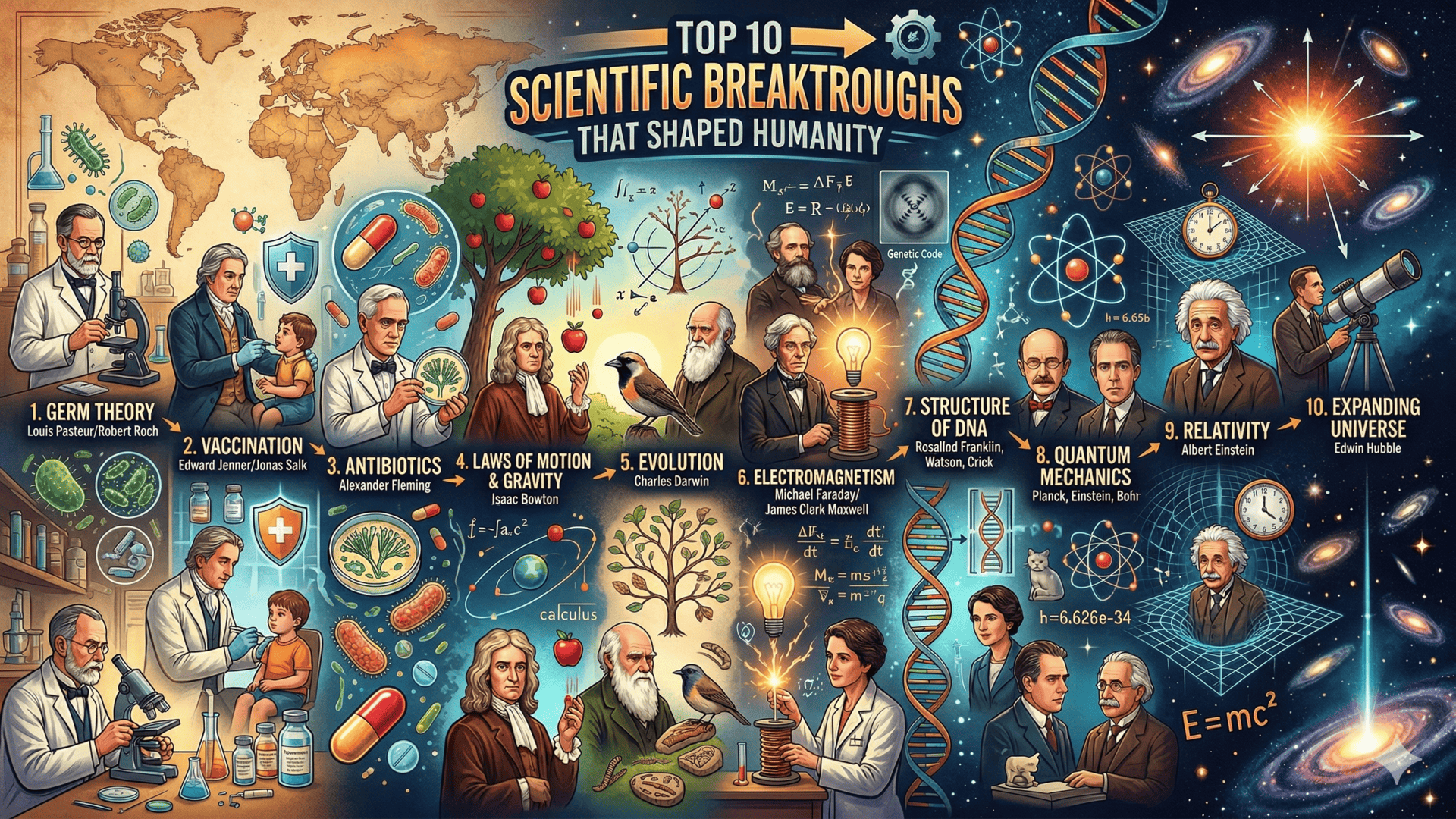
Introduction: The Unending Quest for Knowledge
Curiosity drives our species throughout human history. We look at stars, soil, and our bodies. We constantly ask why and how things work. This pursuit of understanding brings profound clarity. These paradigm shifts redefine what is possible. We call these moments scientific breakthroughs. They mark milestones of our collective progress.
A true breakthrough is rarely a lone eureka moment. It involves decades of observation and global collaboration. It requires challenging established dogmas. Science is a deeply human, shared endeavor. It transcends borders, cultures, and generations. It is a heritage belonging to everyone.
These discoveries did more than fill textbooks. They doubled human life expectancy. .They connected distant continents and cured ancient plagues. They allowed us to see the dawn of time. Breakthroughs reshaped our societies and economies. They changed our understanding of the cosmos.
This guide explores ten fundamental scientific breakthroughs. We will look at the visionaries behind them. We will examine their ongoing impact today.
1. The Germ Theory of Disease
Before the 19th century, illness causes were unknown. People believed “bad air” caused diseases like cholera. This misunderstanding left populations vulnerable to severe pandemics.
The Breakthrough
Louis Pasteur and Robert Koch pioneered the Germ Theory. Pasteur proved microorganisms cause fermentation and disease. He debunked the idea of spontaneous generation. Robert Koch developed criteria to identify specific microbes. He found the culprits behind tuberculosis and cholera.
How It Shaped Humanity
Microscopic pathogens cause many infectious diseases. This realization revolutionized public health and modern medicine. Sanitation improved with clean water and proper sewage disposal. Handwashing protocols drastically reduced mortality rates. Joseph Lister introduced antiseptic surgery techniques. Hospitals transformed into places of true healing. Infant mortality dropped significantly worldwide. The germ theory drastically increased global life expectancy.
2. Vaccination and Immunization
The germ theory identified the microscopic enemy. Vaccination provided humanity with a definitive shield. Diseases like smallpox and polio were universal terrors. They indiscriminately killed millions of people every year.
The Breakthrough
Edward Jenner pioneered basic immunology in 1796. He saw that cowpox protected milkmaids from smallpox. He inoculated a boy, proving early vaccination works. Jonas Salk and Albert Sabin later developed polio vaccines. Recently, scientists pioneered mRNA technology for COVID-19.
How It Shaped Humanity
Vaccines are incredibly impactful public health interventions. The World Health Organization eradicated smallpox in 1980. This remains one of our greatest collective achievements. Immunization programs protect vulnerable populations worldwide. They ensure children can survive and thrive. Vaccines maintain the economic stability of global healthcare systems. Preventive medicine is vital for societal flourishing.
3. The Discovery of Penicillin and Antibiotics
Bacterial infections remained highly lethal for centuries. A simple scratch could result in fatal blood poisoning. Strep throat was often a deadly diagnosis.
The Breakthrough
Alexander Fleming found mold contaminating his Petri dishes. This mold destroyed the surrounding Staphylococcus bacteria. Later, a diverse team isolated and mass-produced penicillin. Howard Florey and Ernst Chain led this crucial effort. Norman Heatley also provided vital contributions to this work.
How It Shaped Humanity
Antibiotics heralded a completely new era of medicine. Conditions like pneumonia and tuberculosis became highly treatable. Antibiotics made complex medical interventions possible today. Open-heart surgery and organ transplants rely on them. Cancer chemotherapy requires antibiotics to manage infection risks. We must use these vital drugs responsibly. Overuse leads to dangerous antimicrobial resistance. This resistance threatens our medical progress.
4. The Laws of Motion and Universal Gravitation
For centuries, Earth and sky seemed governed differently. Scientists lacked a unified physical theory.
The Breakthrough
Isaac Newton published his Principia Mathematica in 1687. He formulated three laws of motion and gravitation. He proved the exact same force pulls an apple. That same physical force keeps the Moon in orbit.
How It Shaped Humanity
Newton laid the mathematical foundation for classical mechanics. His physical principles fueled the massive Industrial Revolution. Engineers could calculate forces to build steam engines. Space exploration relies heavily on Newtonian physics. Satellite launches and moon landings use these precise calculations. Newton unified the cosmos philosophically for humankind. The universe operates by comprehensible, rational, and universal laws.
5. The Theory of Evolution by Natural Selection
Life’s incredible diversity was once considered an inexplicable mystery. It was generally attributed to separate divine creation. The relationships between species were entirely unknown.
The Breakthrough
Charles Darwin published On the Origin of Species. Alfred Russel Wallace independently developed the exact same theory. Populations evolve over generations through natural selection. Individuals with advantageous traits survive and reproduce successfully. They pass these specific traits to their offspring.
How It Shaped Humanity
Evolution is the unifying principle of all biological sciences. It fundamentally altered how humans view themselves entirely. We exist firmly within an interconnected tree of life. It provides a logical framework for genetics and ecology. It helps epidemiologists track how deadly viruses mutate. Understanding evolution is critical for active biodiversity conservation. It helps us protect vulnerable species from climate change.
6. Electromagnetism
We take electricity and instant communication for granted today. This reality stems entirely from understanding basic electromagnetism.
The Breakthrough
Scientists unraveled electricity and magnetism in the 19th century. Michael Faraday discovered crucial electromagnetic induction. A changing magnetic field actively creates an electric current. James Clerk Maxwell unified these observations mathematically. Electricity, magnetism, and light are the exact same phenomenon. They are manifestations of the electromagnetic field.
How It Shaped Humanity
Mastering electromagnetism literally built our modern world. Faraday’s principles created the modern electrical power grid. This power illuminates our homes and runs our industries. Maxwell paved the way for instant global communication. This includes the telegraph, radio, and mobile phones. The entire digital age depends on manipulating electrons. Computers and the internet require this fundamental knowledge.
7. The Structure of DNA
Physical traits reliably pass down through family generations. The actual physical mechanism remained unknown for nearly a century.
The Breakthrough
James Watson and Francis Crick proposed the double-helix structure. They relied heavily on Rosalind Franklin’s vital X-ray data. Maurice Wilkins also shared crucial structural information. They showed how DNA beautifully copies itself. DNA carries our highly complex genetic instructions.
How It Shaped Humanity
Decoding DNA birthed the new era of molecular biology. It paved the way for the massive Human Genome Project. This enables personalized medicine and vital genetic screening. DNA profiling completely revolutionized the modern criminal justice system. It precisely identifies perpetrators and exonerates innocent people. Understanding DNA allows for much better agricultural crops. This helps secure food for our growing global population.
8. Quantum Mechanics
Classical physics explained the large macroscopic world very well. However, tiny atoms and subatomic particles behaved bizarrely. Newton’s reliable laws completely fell apart here.
The Breakthrough
Brilliant physicists developed Quantum Mechanics in the early 1900s. This international group included Max Planck and Albert Einstein. Niels Bohr and Werner Heisenberg also contributed significantly. Energy comes in discrete, tiny packets called quanta. Particles can exist in multiple different states simultaneously. Particles can also link across vast cosmic distances.
How It Shaped Humanity
Quantum mechanics is deeply and surprisingly practical today. The entire global electronics industry relies on it completely. Microchips in modern smartphones use quantum electron behavior. Medical imaging like MRI relies on specific quantum properties. We are currently entering a second massive quantum revolution. Quantum computers promise to solve incredibly complex problems.
9. General and Special Relativity
Space and time were once thought to be absolutely rigid. A mile was always exactly a mile everywhere. A second was always exactly a second.
The Breakthrough
Albert Einstein published Special Relativity in 1905. The speed of light is completely constant everywhere. Space and time are relative to the specific observer. General Relativity later showed that massive gravity warps spacetime. Gravity is not a pull, but a curved surface.
How It Shaped Humanity
Einstein drastically reshaped our core understanding of reality. Global Positioning Systems (GPS) in our phones rely on relativity. Without necessary relativistic corrections, GPS would quickly fail completely. Relativity expertly explains black holes and massive gravitational waves. His famous equation demonstrated mass and energy are interchangeable. This foundational concept laid the groundwork for nuclear power.
10. The Expanding Universe
Humanity long assumed the universe was static and eternal. The Milky Way galaxy seemed to be absolutely everything.
The Breakthrough
Edwin Hubble made two monumental discoveries in the 1920s. Other massive galaxies exist far beyond our Milky Way. Distant galaxies are moving rapidly away from us. Georges Lemaître also theoretically proposed this universal expansion simultaneously. The universe was clearly not static at all.
How It Shaped Humanity
This vital observation led directly to the Big Bang Theory. The physical universe had a definitive beginning point. It originated from an incredibly dense, tiny singularity. This shifted our philosophical cosmic perspective fundamentally. We live in a highly dynamic, evolving universe. The atoms in our bodies forged in dying stars. We are truly and literally made of star stuff.
Conclusion: The Journey Continues
These ten scientific breakthroughs built our modern reality entirely. They represent humanity’s intense curiosity and incredible persistence. Science consistently expands our horizons and empowers us all.
The scientific endeavor is far from complete today. We face unprecedented global challenges right now. Climate change severely threatens our delicate, interconnected biosphere. Emerging infectious diseases continually test our global resilience. We desperately need clean, truly sustainable energy sources.
Solving these requires the next generation of scientific breakthroughs. We deeply need education, cooperation, and true global inclusivity. Diverse minds must have fair opportunities to contribute actively. We must fiercely support ongoing, robust scientific inquiry. Science will inevitably and profoundly shape our collective future.
Frequently Asked Questions (FAQ)
What is the greatest scientific breakthrough ever?
Many historians point directly to Newton’s laws of motion. It launched the modern, mathematically driven scientific era entirely. The Germ Theory definitely saved the most human lives.
How do scientific breakthroughs usually happen?
Breakthroughs occur through decades of slow, cumulative research. Scientists constantly synthesize data and collaborate globally. They always build upon the vital work of others.
Are major scientific breakthroughs still happening today?
Yes, we are living through multiple scientific revolutions now. Recent examples include CRISPR gene editing and mRNA vaccines. Artificial intelligence is also advancing at a staggering pace.
Who decides what counts as a breakthrough?
The global scientific community constantly validates breakthroughs over time. They use strict peer review and safely reproduce experiments. Organizations like the Nobel Committee formally recognize impactful discoveries.
Why is inclusive language important in science?
Historically, contributions of marginalized groups were frequently ignored. Rosalind Franklin’s vital work on DNA is a prime example. Diversity absolutely leads to much better, creative problem-solving. It ensures scientific benefits are distributed equitably to everyone.
References & Further Reading
-
World Health Organization (WHO): History of global immunization. https://www.who.int
-
The Nobel Prize: Biographies of famous scientific laureates. https://www.nobelprize.org
-
CDC: Overviews on antibiotics and antimicrobial resistance. https://www.cdc.gov
-
NASA: Resources regarding the expanding universe and relativity. https://www.nasa.gov
-
National Human Genome Research Institute: History of DNA. https://www.genome.gov
Leave a Reply