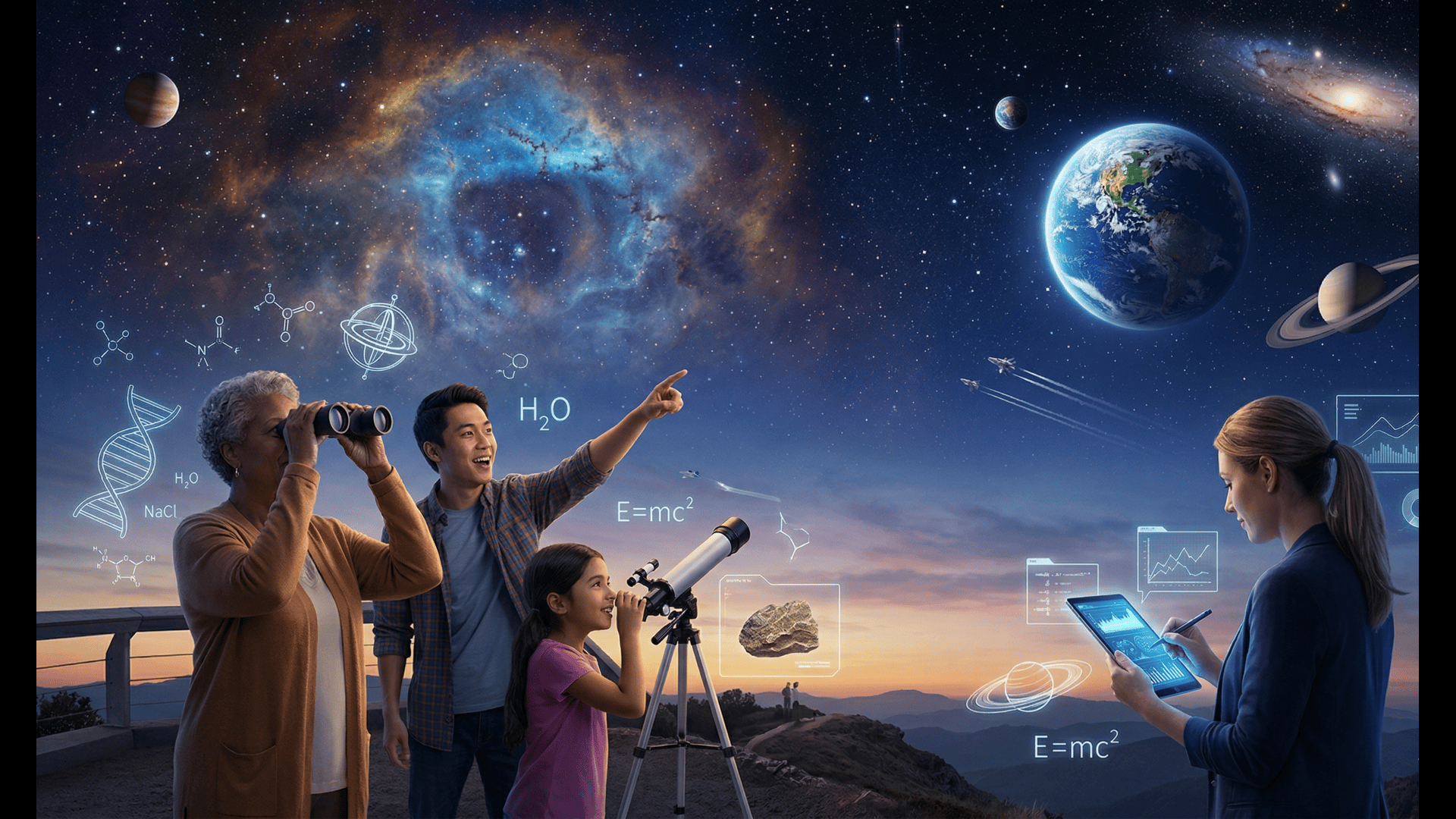
Have you ever looked up at a night sky full of stars and wondered how far away they are? Have you ever watched a plant sprout from a tiny seed in the dirt and marveled at how it knew to grow toward the sun? Or perhaps you have simply baked a cake and watched liquid batter transform into a fluffy, solid dessert.
If you have ever asked “how” or “why” about the world around you, you have already taken your first steps into the realm of science.
For many of us, the word “science” brings up memories of memorizing the periodic table in a stuffy classroom, complicated mathematical formulas, or intimidating professionals in crisp white lab coats. But science is not just a subject in school, and it is certainly not an exclusive club. Science is a deeply human endeavor. It is a tool, a process, and a shared global journey to understand the universe and our place within it.
This comprehensive, beginner-friendly guide will break down what science actually is, how the scientific method works, the different branches of scientific study, and why thinking like a scientist is something everyone can—and should—do.
1. The Core Definition: What Exactly Is Science?
To understand science, we can start by looking at the word itself. The word comes from the Latin word scientia, which translates simply to “knowledge.”
However, defining science just as “knowledge” is incomplete. A library is full of knowledge, but a library is not science. Instead, it is better to think of science in two distinct but deeply connected ways:
- Science as a Body of Knowledge: This is the vast collection of facts, laws, and theories humanity has discovered over thousands of years. It is knowing that water freezes at 32 degrees Fahrenheit (0 degrees Celsius), that the Earth orbits the Sun, and that the human body is made up of billions of cells.
- Science as a Process: This is the more important definition. Science is a methodical, logical process for discovering how things in the universe work. It is an action. It is the act of observing, questioning, testing, and revising.
Science is not a belief system. It does not ask you to take anything on faith. Instead, it asks for evidence. It relies on the idea that the natural world follows predictable patterns and that, through careful observation and experimentation, we can understand those patterns.
Crucially, science is always a work in progress. It is self-correcting. When new evidence emerges that contradicts old knowledge, science updates its understanding. This willingness to be wrong and to learn from mistakes is what makes science the most reliable tool we have for finding the truth about our physical reality.
2. The Blueprint of Discovery: The Scientific Method
The engine that drives all scientific discovery is known as the Scientific Method. You do not need a multimillion-dollar laboratory to use it; in fact, you likely use variations of it in your everyday life without even realizing it.
The scientific method is a standardized series of steps designed to minimize bias, reduce errors, and ensure that results are reliable and can be repeated by others. While scientists might sometimes bounce back and forth between these steps, the general blueprint looks like this:
Step 1: Make an Observation
Everything begins with noticing something. Let us use a highly relatable, everyday example: You walk into your living room and notice that your favorite houseplant is wilting, even though you watered it recently.
Step 2: Ask a Question
Observation naturally leads to curiosity. Why is the plant wilting? Is it getting too much sun? Not enough sun? Is the room too cold? Is there a draft?
Step 3: Form a Hypothesis
A hypothesis is often called an “educated guess,” but it is more accurately described as a testable explanation. It is a proposed answer to your question based on what you already know.
- Your Hypothesis: “The plant is wilting because it is sitting too close to the air conditioning vent and the cold air is harming it.”
Step 4: Conduct an Experiment
This is where you test your hypothesis. A good experiment changes only one variable at a time so you can be sure of what caused the result.
- Your Experiment: You move the plant to a different table, away from the cold air vent. You change absolutely nothing else—you keep the watering schedule and the amount of sunlight exactly the same.
Step 5: Analyze the Data
After a set period, you look at the results. What happened?
- The Data: After one week, the plant’s leaves are perky and green again.
Step 6: Draw a Conclusion
Did the data support your hypothesis? In this case, yes. You can conclude that the cold air draft was likely causing the plant to wilt. If the plant had continued to wilt, your hypothesis would have been proven wrong, and you would go back to Step 3 to form a new hypothesis (e.g., “Maybe the soil needs fertilizer”).
Step 7: Communicate and Peer Review
In professional science, the final step is sharing your findings. Scientists publish their work in journals where other experts (peers) review the methods to ensure they were fair and accurate. If another scientist cannot replicate the experiment and get the same results, the original conclusion is called into question.
3. The Tree of Knowledge: Major Branches of Science
The universe is infinitely complex, so science is divided into different branches to make studying it manageable. Think of science as a massive tree. The trunk is the scientific method, and branching off from it are various disciplines.
The Natural Sciences
These branches study the physical, natural world and the events that occur within it.
- Physics: The study of matter, energy, motion, and force. Physics asks the most fundamental questions about how the universe operates, from the behavior of tiny subatomic particles (quantum mechanics) to the massive gravitational pull of black holes (astrophysics).
- Chemistry: The study of the composition, properties, and reactions of matter. If physics is the rulebook of the universe, chemistry is the study of the pieces on the board. Chemists look at how atoms and molecules interact to create everything from the plastic in your keyboard to the medicine in your cabinet.
- Biology: The study of living organisms. Biology is incredibly diverse, encompassing genetics (how traits are passed down), ecology (how organisms interact with their environment), botany (plants), zoology (animals), and microbiology (bacteria and viruses).
- Astronomy: The study of celestial objects and space. Astronomers study planets, stars, galaxies, and the origins of the universe itself.
- Earth Science: The study of our home planet. This includes geology (rocks and the Earth’s physical structure), meteorology (weather and climate), and oceanography (the oceans).
The Formal Sciences
Unlike natural sciences, formal sciences do not rely on empirical observation of the physical world. Instead, they study formal systems and abstract concepts.
- Mathematics: The study of numbers, quantities, shapes, and patterns. Math is often called the “language of science” because natural scientists use mathematical equations to express their findings.
- Logic: The study of reasoning and valid inferences.
- Computer Science: The study of computation, algorithms, and information processing.
The Social Sciences
These branches study human society and human behavior. Because human beings are unpredictable, social sciences rely heavily on statistics and large-scale observation.
- Psychology: The study of the human mind and behavior.
- Sociology: The study of human society, social structures, and institutions.
- Economics: The study of how people, businesses, and governments allocate resources.
- Anthropology: The study of human cultures, origins, and evolution.
The Applied Sciences
Applied sciences take the discoveries made in pure science and apply them to solve practical, real-world problems.
- Medicine: Applying biology and chemistry to heal the sick and prevent disease.
- Engineering: Applying physics, math, and materials science to build structures, machines, and software.
4. Unpacking Misconceptions: Theory vs. Law
One of the biggest barriers to understanding science for beginners is the terminology, specifically how scientists use certain words differently than the general public. The most common point of confusion revolves around the words “theory” and “law.”
In everyday conversation, if someone says, “I have a theory about who stole the cookies,” they mean they have a hunch or a guess.
In science, a Theory is the exact opposite of a guess. A scientific theory is a well-substantiated, highly tested, and widely accepted explanation for a natural phenomenon. It is the highest level of understanding in science. Theories pull together facts, laws, and tested hypotheses into a comprehensive framework.
- Example: The Theory of Evolution by Natural Selection or the Germ Theory of Disease. These are not guesses; they are frameworks supported by mountains of evidence.
A Scientific Law, on the other hand, is a statement based on repeated experimental observations that describes what happens in nature under certain conditions, usually expressed as a mathematical equation.
- Example: Newton’s Law of Universal Gravitation calculates the force of gravity between two objects.
The Key Difference: A law tells you what happens. A theory tells you why or how it happens. A theory never “grows up” to become a law; they serve two completely different purposes.
5. Science Belongs to Everyone: The Importance of Inclusivity
Historically, the image of a scientist has been narrow—often depicted as a solitary older man in a lab. This stereotype is not only inaccurate today, but it is also harmful because it makes science feel exclusionary.
Science is a collective human heritage. It belongs to people of all genders, races, backgrounds, and abilities. In fact, science is strongest when it is inclusive. When people from diverse backgrounds bring different perspectives, they ask different questions and notice different problems, leading to richer, more comprehensive discoveries.
Furthermore, empirical western science is increasingly recognizing the value of Indigenous knowledge systems. Communities that have lived in harmony with specific ecosystems for millennia hold deep, observational knowledge about sustainability, agriculture, and local biology that perfectly complements the scientific method.
You do not need a Ph.D. to participate in science. Citizen Science is a growing movement where everyday people help professional scientists collect and analyze data. Whether it is tracking local bird populations, monitoring water quality in a nearby stream, or classifying galaxies using online photos from telescopes, people everywhere are contributing to our understanding of the universe.
6. The Limits of Science: What It Cannot Do
While science is an incredibly powerful tool, it is important to acknowledge its boundaries. Science is limited to the observable, measurable natural world.
Here is what science cannot do:
- Science cannot make moral judgments. Science can tell us how to split the atom to create immense energy, but it cannot tell us whether it is morally right to use that energy to build a weapon. Ethics and morality belong to the realms of philosophy, religion, and societal discourse.
- Science cannot determine aesthetic value. Science can analyze the chemical composition of the paint on the Mona Lisa, and it can explain how our eyes process the colors, but it cannot tell us if the painting is beautiful.
- Science cannot draw conclusions about the supernatural. Because science relies on testing and measuring the natural world, it has no tools to evaluate claims about gods, spirits, or anything outside of physical reality.
Understanding these limits does not weaken science; it clarifies its purpose. Science is here to explain the how and the what of our reality.
7. How to Think Like a Scientist Every Day
You do not need be wearing a lab coat to engage in scientific thinking. Cultivating a scientific mindset is an excellent way to navigate a modern world filled with misinformation. Here is how you can think like a scientist:
- Stay Curious: Keep asking “why.” Never lose the childlike wonder of looking at a rainbow or a complex machine and wanting to know how it works.
- Embrace Skepticism: When presented with a claim—especially online—ask for the evidence. Where did this information come from? Is the source credible?
- Be Willing to Change Your Mind: This is the hardest part, but it is the core of science. If you believe something, and you are presented with strong, credible evidence that you are wrong, have the humility to update your beliefs.
- Look for Variables: When trying to solve a problem in your life (from fixing a broken lawnmower to improving your sleep schedule), change one thing at a time so you can accurately see what makes a difference.
Conclusion
Science is not a dusty textbook; it is a living, breathing, ongoing conversation about the universe. From the vast, swirling galaxies millions of light-years away to the microscopic bacteria living in our own bodies, science gives us the lenses through which we can see reality clearly.
It is a process built on curiosity, fueled by evidence, and refined by time. Whether you are aiming to become a professional researcher, hoping to pass an upcoming exam, or simply looking to understand the news better, learning the basics of science equips you with a powerful toolkit for understanding the world. Keep exploring, keep questioning, and remember that the universe is waiting to be understood.
Frequently Asked Questions (FAQ)
Q: Is science ever completely “settled” or finished?
A: Rarely. While many fundamental concepts (like gravity or the fact that the Earth is round) are supported by such overwhelming evidence that they are considered facts, the finer details are always being studied. Science is an ongoing process of refining and expanding our knowledge. New technology often allows us to see things we couldn’t before, which can lead to updates in our scientific understanding.
Q: What is the difference between a hypothesis and a theory?
A: A hypothesis is a testable, educated proposal meant to answer a specific question before an experiment is done. A theory is a broad, overarching explanation that has already been tested extensively and is supported by a massive amount of evidence and data from many different experiments.
Q: Do scientists ever fail?
A: All the time! In fact, “failure” is a vital part of the scientific method. When an experiment does not support a hypothesis, that is not a defeat; it is new data. Figuring out how something doesn’t work brings scientists one step closer to figuring out how it does work.
Q: Can I trust scientific studies I read about in the news?
A: It depends. News articles sometimes oversimplify complex studies or use sensational headlines to get clicks. It is always best to look for articles from reputable science journalists or, better yet, read the summary (abstract) of the actual peer-reviewed study if you can find it. Look out for studies that only used a very small number of test subjects or studies that have not been peer-reviewed yet.
Q: What does “peer-reviewed” mean?
A: Before a scientific paper is published in a credible journal, it is sent to a group of independent, anonymous experts in that specific field (the scientist’s “peers”). These experts scrutinize the study to ensure the methodology was sound, the math was correct, and the conclusions are backed by the data. If it fails this review, it is not published.
Q: What is pseudoscience?
A: Pseudoscience refers to beliefs or practices that claim to be scientific but do not adhere to the scientific method. Pseudoscience often relies on anecdotal evidence, lacks testable hypotheses, and cannot be proven wrong (falsified). Examples include astrology, crystal healing, and phrenology.
Reference Links for Further Exploration
To continue your journey into understanding science, check out these highly credible, beginner-friendly resources:
-
Understanding Science (UC Berkeley): An incredibly comprehensive and accessible guide to how science really works. undsci.berkeley.edu
-
Science News Explores: Dedicated to providing accurate, engaging science news for learners of all ages. snexplores.org
-
NASA Knows! (For Students): Excellent breakdowns of physics, astronomy, and aerospace concepts. nasa.gov/stem
-
National Science Foundation (NSF): News and articles on recent discoveries across all branches of science. nsf.gov
-
Scientific American: One of the oldest and most respected magazines offering insights into current scientific research. scientificamerican.com
Leave a Reply