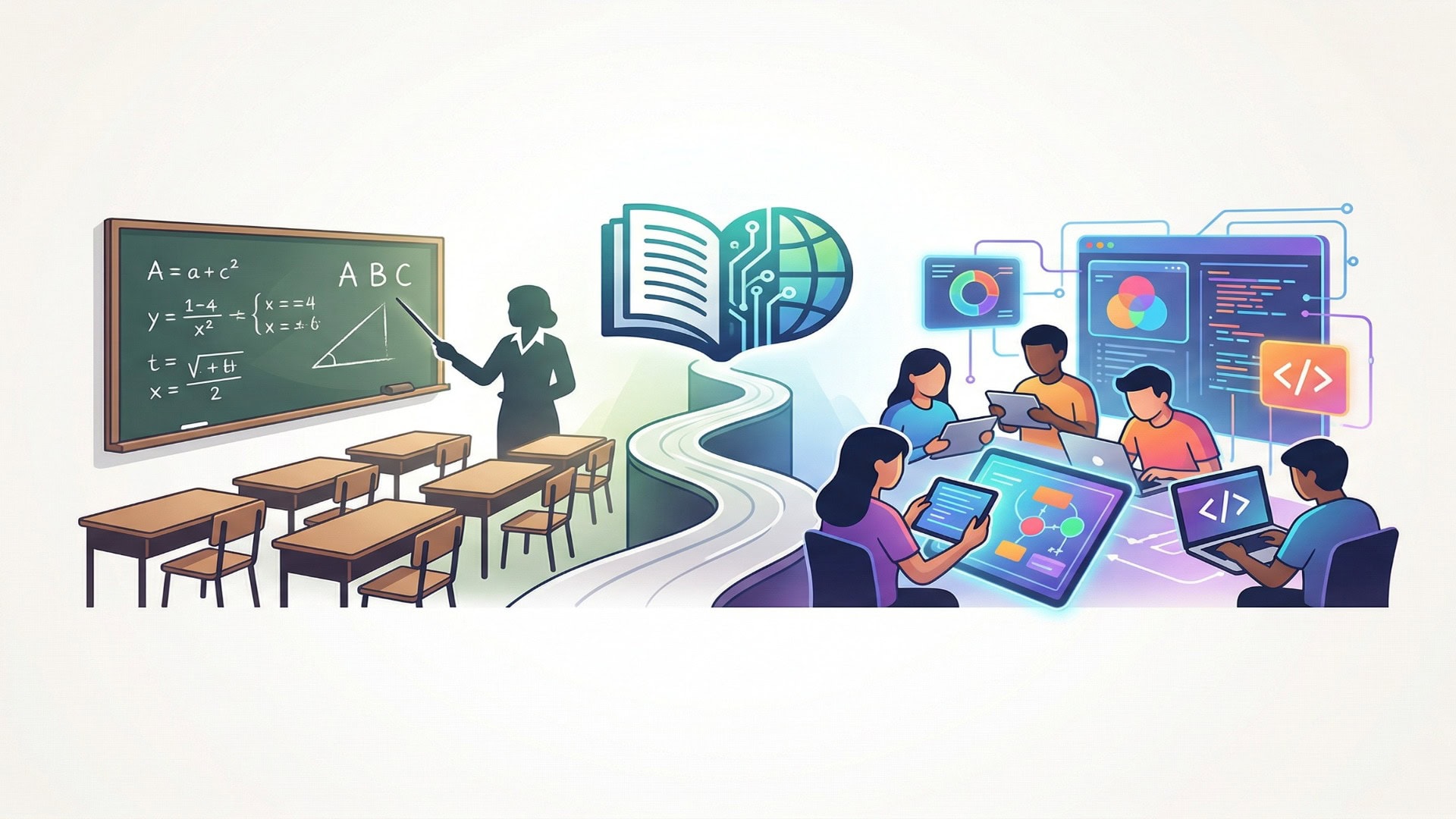
Education is the cornerstone of human progress, yet the methods we use to impart knowledge are in a constant state of evolution. For generations, the image of a teacher standing before a chalkboard, delivering lectures to rows of quietly taking-notes students, was the undisputed standard. Today, that image is rapidly being replaced by collaborative pods, interactive tablets, and global, digital classrooms.
The debate between traditional vs. modern education is one of the most significant conversations happening among educators, parents, and policymakers today. As society shifts toward a more complex, technology-driven future, we must ask: Are the old ways holding us back, or do they provide a necessary foundation? Conversely, does modern education offer a superior path, or does it sacrifice discipline for the sake of engagement?
In this comprehensive guide, we will explore the core philosophies, the distinct advantages, and the inherent drawbacks of both educational paradigms. By breaking down how each system impacts learners, educators, and the broader community, we aim to uncover what truly works best for the diverse minds of the 21st century.
1. The Foundations of Traditional Education
Traditional education, often referred to as conventional or customary education, has been the dominant model for centuries. Its roots can be traced back to the Industrial Revolution, a time when societies needed to educate large numbers of citizens efficiently to prepare them for standardized roles in a growing industrial economy.
Core Characteristics of the Traditional Model
- Teacher-Centered Instruction: The educator is the primary source of knowledge—the “sage on the stage.” Information flows in one direction: from the teacher to the learner.
- Standardized Curriculum: All students in a particular grade or course learn the same material, at the same pace, regardless of their individual interests or background.
- Rote Memorization: A heavy emphasis is placed on memorizing facts, formulas, and historical dates to build a baseline of general knowledge.
- Summative Assessment: Success is primarily measured through high-stakes, standardized testing and final exams.
- Physical and Structured Environment: Learning happens within a specific location (the brick-and-mortar classroom) and adheres to a rigid daily bell schedule.
The Strengths of Traditional Education
While it is easy to criticize older methods in the face of shiny new technologies, traditional education has survived for so long because it possesses undeniable strengths.
- A Strong Foundational Knowledge Base: By focusing on core subjects like mathematics, literature, and history through direct instruction, students often build a robust, shared foundation of general knowledge. This shared baseline is essential for societal cohesion and advanced academic pursuits.
- Discipline and Routine: The structured environment of a traditional classroom teaches punctuality, respect for authority, and the ability to adhere to a schedule. These soft skills are highly transferable to traditional workplace environments.
- Familiarity and Predictability: Because this system is universally understood, it creates a seamless transition for students moving between different schools, cities, or even countries.
- Equalization of Materials: In a purely traditional setting, every student is looking at the same textbook and listening to the same lecture, which can, in theory, create a baseline of equal opportunity (though socioeconomic factors often complicate this).
The Drawbacks of the Traditional Approach
The limitations of traditional education become apparent when we consider the diverse needs of modern learners and the demands of the contemporary workforce.
- The “One-Size-Fits-All” Fallacy: Traditional education assumes that everyone learns at the same pace and in the same way. This environment can severely marginalize students who are neurodivergent, those who need more time to process information, or gifted learners who are not adequately challenged.
- Passive Learning: When students are merely receptacles for information, they rarely develop critical thinking or problem-solving skills. They learn what to think, but not necessarily how to think.
- Test Anxiety: Tying a student’s worth and academic future to a few high-stakes exams can cause severe anxiety and fails to measure creativity, emotional intelligence, or collaborative skills.
2. The Rise of Modern Education
Modern education emerged as a response to the changing needs of the globalized, digital world. Influenced by psychological theories of constructivism—which suggest that learners actively construct knowledge rather than passively receiving it—modern education represents a fundamental paradigm shift.
Core Characteristics of the Modern Model
- Student-Centered Learning: The educator acts as a facilitator or the “guide on the side.” The curriculum is more flexible, allowing students to explore topics based on their interests and inquiries.
- Technological Integration: EdTech is a foundational pillar. Laptops, tablets, learning management systems, and educational software are used to enhance and personalize the learning experience.
- Skill-Based Focus: Rather than just memorizing facts, modern education emphasizes the “4 Cs”: Critical thinking, Communication, Collaboration, and Creativity.
- Formative Assessment: Continuous, low-stakes assessments—such as peer reviews, portfolio creations, and project-based assignments—are used to gauge understanding throughout the learning process, rather than just at the end.
- Personalized Learning Paths: Utilizing data and adaptive technologies, education is tailored to the individual learner’s strengths, weaknesses, and preferred pacing.
The Strengths of Modern Education
Modern educational practices align closely with the skills required to navigate the modern world, making it highly attractive to forward-thinking institutions.
- High Engagement and Motivation: When learners are given autonomy and allowed to connect their studies to real-world applications, their intrinsic motivation increases dramatically. Project-based learning makes education feel relevant.
- Preparation for the Modern Workforce: The modern economy values adaptability, digital literacy, and the ability to work in diverse teams. Modern education actively simulates these environments.
- Inclusivity and Accessibility: Modern education often champions frameworks like the Universal Design for Learning (UDL) guidelines by CAST, which aim to give all individuals equal opportunities to learn. Technologies like text-to-speech, closed captioning, and interactive visual aids make education far more accessible for students with diverse learning needs.
- Global Perspectives: Through the internet, a classroom is no longer confined by four walls. Students can collaborate with peers across the globe, fostering cultural awareness and empathy.
The Drawbacks of the Modern Approach
Despite its innovative appeal, the modern education system is not without its significant challenges.
- The Digital Divide: Modern education relies heavily on technology. Students from lower-income families or underfunded school districts may lack access to high-speed internet or personal devices, widening the educational inequality gap.
- Screen Fatigue and Distraction: Constant reliance on digital screens can lead to physical fatigue and opens the door to immense distractions. It can be difficult for a learner to focus on an educational module when social media or games are just a click away.
- Over-reliance on Self-Direction: While autonomy is great for many, some students—particularly younger ones or those who thrive on clear structure—can become lost or overwhelmed without the firm guidance provided by a traditional framework.
3. A Direct Comparison: Traditional vs. Modern
To truly understand what works better, it is helpful to contrast these two systems across several key educational dimensions.
Role of the Educator
- Traditional: The teacher is the absolute authority and the primary broadcaster of information.
- Modern: The teacher is a mentor, a curator of resources, and a facilitator who helps students navigate their own learning journeys.
The Classroom Environment
- Traditional: Desks are arranged in rows facing the front. The environment is generally quiet, emphasizing individual focus and minimal disruption.
- Modern: Flexible seating is common (bean bags, standing desks, collaborative pods). The environment is often buzzing with conversation, group work, and active movement.
Approach to Mistakes
- Traditional: Mistakes are often penalized through lower grades, fostering a fear of failure that can stifle intellectual risk-taking.
- Modern: Mistakes are reframed as essential components of the learning process. Iterative work, where a student drafts, receives feedback, and improves, is heavily encouraged.
Sourcing Information
- Traditional: Information is finite, coming primarily from approved textbooks, encyclopedias, and the teacher’s lectures.
- Modern: Information is infinite. Students are taught how to search the internet, evaluate the credibility of diverse sources, and synthesize information from multiple media formats.
4. The Inclusion Factor: Supporting Diverse Minds
One of the most vital lenses through which we must view this debate is that of inclusivity. Education must serve everyone, not just those who fit neatly into the middle of the bell curve.
Traditional education has historically struggled with inclusivity. By relying on a singular method of delivery (mostly auditory and text-based) and a singular method of expression (handwritten exams), it inadvertently disadvantages individuals with specific learning disabilities, such as dyslexia or ADHD, as well as those who are English Language Learners (ELL).
Modern education has made massive strides in this area. Through inclusive language, adaptive software, and a broader acceptance of neurodiversity, modern classrooms allow learners to engage with content in ways that suit their brains. If a student struggles with reading comprehension, they can listen to an audiobook version of the text. If they struggle with written exams, they might be allowed to demonstrate their knowledge by recording a podcast or creating a visual presentation.
However, it is also important to recognize that the highly structured, predictable nature of the traditional classroom is actually deeply comforting and necessary for some neurodivergent individuals, particularly those who experience anxiety in chaotic or overly flexible environments. Therefore, completely abandoning traditional structures can sometimes be just as exclusionary.
5. What Works Better? The Case for the Hybrid Approach
So, which system reigns supreme? The reality is that framing this as a strict binary—traditional versus modern—is a false dichotomy. The most effective educational framework is not one or the other, but a thoughtful synthesis of both.
This synthesis is often referred to as Blended Learning or a Hybrid Approach.
The Best of Both Worlds
A successful modern classroom does not throw out the foundational knowledge championed by traditional education; rather, it changes how that knowledge is acquired and applied.
- The Flipped Classroom: This is a perfect example of hybrid learning. Students acquire foundational knowledge at home (often through modern means, like watching a recorded video lecture or reading interactive articles). Then, they come to the physical classroom to do the “homework”—engaging in deep discussions, collaborative projects, and problem-solving under the guidance of the teacher. This respects the traditional need for direct instruction while utilizing the modern desire for active, collaborative application.
- Structured Flexibility: Educators can maintain the firm boundaries, clear expectations, and discipline of a traditional classroom, while offering choices within those boundaries. For example, a teacher might mandate that a specific historical event must be analyzed (traditional curriculum), but allow students to choose whether they write an essay, build a diorama, or code a simple timeline website to present their findings (modern execution).
- Balanced Assessment: A robust educational system uses both formative and summative assessments. Students need the low-stakes feedback loops of modern education to grow, but they also need the ability to synthesize their knowledge and perform under pressure, a skill that traditional exams can help cultivate.
Preparing for an Unpredictable Future
We are preparing students for jobs that do not yet exist, to use technologies that haven’t been invented, to solve problems we don’t yet know are problems.
Relying solely on traditional education leaves learners ill-equipped for a world that demands rapid adaptation and technological fluency. Conversely, an entirely modern approach that neglects foundational knowledge and discipline may produce highly creative individuals who lack the resilience and fundamental literacy to execute their ideas.
The approach that works better is the one that remains adaptable. Educators and institutions must be willing to leverage the efficiency and structure of the past alongside the inclusive, technologically empowered, and student-centered innovations of the present.
Conclusion
The evolution of education is not about discarding the past, but building upon it. Traditional education provided the scaffolding upon which our modern society was built, offering structure, discipline, and essential foundational knowledge. Modern education has expanded our horizons, teaching us to value creativity, celebrate diverse learning styles, and harness the power of technology.
By embracing a blended approach, we can foster environments that are both structured and flexible, demanding yet forgiving, and universally accessible. Ultimately, the system that works best is the one that prioritizes the holistic well-being and lifelong learning capacity of the individual student, empowering them to navigate whatever the future may hold.
Frequently Asked Questions (FAQ)
1. Is traditional education completely obsolete?
Not at all. The traditional model’s emphasis on foundational knowledge, classroom structure, and direct instruction still holds immense value, particularly when introducing entirely new and complex concepts where students lack prior context.
2. Does modern education rely too much on screen time?
This is a valid concern. Effective modern education integrates technology as a tool, not a crutch. The best modern classrooms balance screen time with hands-on activities, physical movement, and face-to-face peer collaboration to prevent digital fatigue.
3. Which approach is better for a student with ADHD?
There is no single answer, as ADHD presents differently in everyone. However, modern education’s flexibility, frequent shifts in activity, and interactive nature often keep an ADHD brain more engaged. Conversely, the strict routines of a traditional classroom can provide helpful boundaries for some. A blended approach with clear structures but flexible tasks is usually ideal.
4. Is modern education more expensive to implement?
Initially, yes. Equipping a school with high-speed internet, smartboards, and individual devices requires a significant upfront investment compared to buying textbooks and chalk. However, over time, digital resources can be updated more cheaply than replacing outdated physical textbooks.
5. How does the role of the teacher change in modern education?
In traditional settings, teachers are the primary source of all information. In modern settings, they act more like academic coaches or facilitators. They guide students toward credible resources, help them overcome hurdles in their projects, and facilitate group discussions rather than simply lecturing.
6. Can a traditional school transition to a modern approach easily?
It requires a significant cultural shift, not just the purchase of new technology. Teachers need professional development to change their pedagogical strategies, and administrators must be willing to adjust how they assess both student success and teacher performance. It is a gradual process rather than an overnight switch.
Leave a Reply