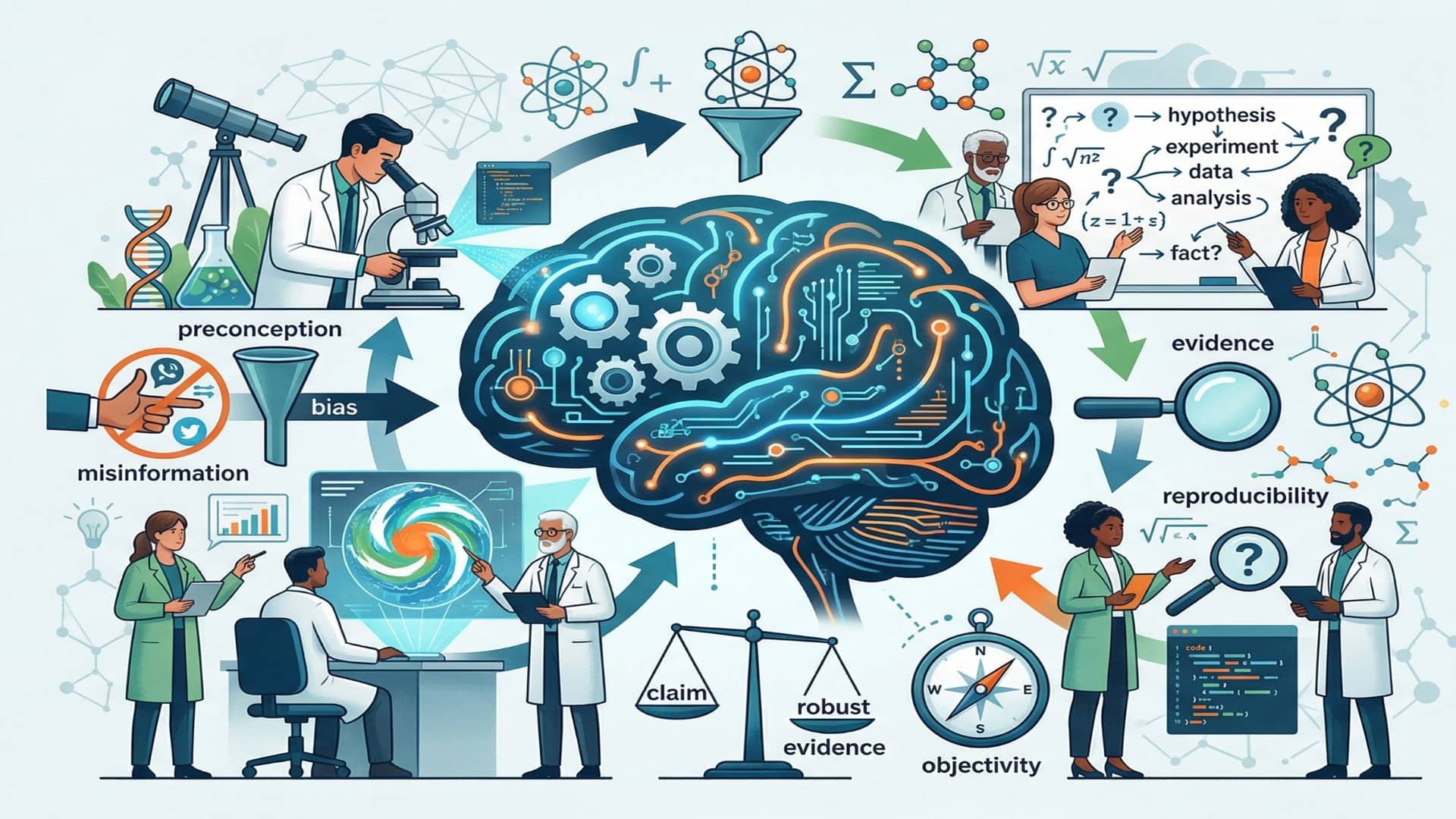
When we think of science, our minds often jump straight to the tangible tools of the trade: bubbling flasks, towering telescopes, complex algorithms, and pristine white coats. We envision a vast encyclopedia of facts, a collection of absolute truths about the universe. However, this perspective misses the forest for the trees. Science is not merely a static body of knowledge; it is a dynamic, rigorous, and self-correcting process. At the very core of this process—acting as its engine, its compass, and its most rigorous quality control mechanism—is critical thinking.
In an era characterized by an overwhelming flood of information, understanding the importance of critical thinking in science is more crucial than ever. Whether you are a dedicated researcher, a student embarking on your educational journey, or simply a curious citizen navigating the complexities of the modern world, mastering this skill is essential.
This comprehensive guide explores the symbiotic relationship between critical thinking and scientific inquiry, examining how we can cultivate these skills to foster a more informed, inclusive, and progressive society.
What is Critical Thinking in a Scientific Context?
At its most fundamental level, critical thinking is the objective analysis and evaluation of an issue in order to form a judgment. It requires a deliberate step back from our instinctual reactions and preconceived notions.
In the realm of science, critical thinking takes on a highly structured form. It is the practice of systematically questioning assumptions, rigorously evaluating evidence, recognizing cognitive biases, and remaining open to altering one’s conclusions when presented with new, robust data.
A scientific critical thinker does not ask, “How can I prove that my idea is right?” Instead, they ask, “What evidence would it take to prove that my idea is wrong?“
This subtle but profound shift in perspective is what separates dogmatic belief from scientific inquiry. It relies on the principle of falsifiability—the concept that for any hypothesis to have scientific validity, it must be inherently disprovable.
To dive deeper into the philosophical foundations of this concept, you can explore the comprehensive resources provided by the Stanford Encyclopedia of Philosophy on Critical Thinking.
The Core Pillars of Scientific Critical Thinking
To truly understand how critical thinking operates within science, we must break it down into its foundational pillars. These are the daily habits of mind that researchers use to navigate the unknown.
1. Rigorous Observation and Questioning
Science begins with observation, but critical thinking elevates everyday observation into scientific inquiry. It involves looking at the world and asking “Why?” and “How?” It requires distinguishing between what is actually happening and what we assume is happening. A critical thinker observes a phenomenon and immediately begins generating a web of questions, ensuring that those questions are specific, measurable, and relevant.
2. Hypothesis Generation and Falsifiability
A hypothesis is not a random guess; it is an educated, testable prediction. Critical thinking dictates that a hypothesis must be structured in a way that allows it to be proven false. If a claim is impossible to test or refute under any circumstances, it falls outside the realm of science. This intellectual humility—the willingness to design an experiment that could destroy your own brilliant idea—is the hallmark of a true scientific mindset.
3. Objective Data Analysis
Once data is collected, critical thinking serves as a shield against the human tendency to see patterns where none exist. It involves:
- Understanding Statistical Significance: Recognizing that a small data set might yield a result by pure chance.
- Distinguishing Correlation from Causation: Just because two events happen simultaneously does not mean one caused the other. (For example, ice cream sales and shark attacks both increase in the summer, but one does not cause the other; the hidden variable is warm weather).
- Identifying Anomalies: Instead of throwing out data points that don’t fit the expected curve, critical thinkers investigate them. Often, the most groundbreaking discoveries hide within the anomalies.
4. Recognizing and Mitigating Bias
Humans are naturally biased creatures. We are evolutionary wired to make quick judgments based on limited information. In science, critical thinking requires the active identification and mitigation of these mental shortcuts:
- Confirmation Bias: The tendency to search for, interpret, favor, and recall information in a way that confirms or supports one’s prior beliefs or values.
- Survivorship Bias: Concentrating on the people or things that “survived” some process and inadvertently overlooking those that did not because of their lack of visibility.
- Publication Bias: The trend where studies with positive or exciting results are more likely to be published than those with negative or inconclusive results, leading to a skewed perception of reality.
Why Critical Thinking is the Engine of Scientific Progress
Throughout history, scientific progress has rarely been a straight line. It is a series of fits, starts, errors, and paradigm shifts. Critical thinking is the force that propels these shifts forward.
Overturning Scientific Dogma
Consider the shift from the geocentric model of the universe (where the Earth is the center) to the heliocentric model (where the Earth orbits the Sun). For centuries, the geocentric model was accepted as absolute truth, supported by both the scientific establishment and religious institutions of the time.
It was the critical thinking of astronomers like Copernicus and Galileo—who meticulously analyzed astronomical data and dared to question the deeply ingrained assumptions of their era—that eventually overturned this dogma. They prioritized empirical evidence over established authority, a core tenet of scientific critical thought.
The Self-Correcting Nature of Science
One of the most powerful aspects of science is its ability to self-correct. This is largely driven by the peer-review process and the push for replication.
When a researcher publishes a finding, the broader scientific community uses critical thinking to dissect the methodology, analyze the data, and attempt to replicate the results. If the results cannot be replicated independently, the original claim is questioned, modified, or discarded. This mechanism ensures that, over time, the scientific consensus moves closer to the truth, stripping away errors, biases, and fraudulent claims.
Navigating Misinformation in the Digital Age
Today, we do not suffer from a lack of information; we suffer from a lack of filters. The internet democratized the sharing of knowledge, but it also democratized the sharing of pseudoscience, misinformation, and deliberate disinformation.
In this landscape, critical thinking is no longer just a tool for scientists in a laboratory; it is a fundamental survival skill for modern digital citizens.
The Pitfalls of “Doing Your Own Research”
The phrase “do your own research” has been co-opted in recent years, often used to justify ignoring scientific consensus in favor of fringe theories found on social media or obscure websites. True research is not typing a predetermined conclusion into a search engine and clicking the first link that agrees with you.
Applied critical thinking in the digital age involves:
- Evaluating the Source: Who is making the claim? What are their credentials? Do they have a financial or ideological conflict of interest?
- Checking the Consensus: What do the majority of independent experts in the relevant field say? While consensus can occasionally be wrong, it is the most reliable starting point for understanding complex issues.
- Analyzing the Methodology: Was the claim based on a robust, peer-reviewed study, or an anecdotal YouTube video?
By applying the scientific method to our daily media consumption, we can build intellectual immunity against the viruses of misinformation.
The Role of Inclusive Language and Diverse Perspectives in Science
A critical analysis of the scientific establishment itself reveals a historical flaw: for much of modern history, scientific inquiry was dominated by a homogenous group of people—primarily wealthy, Western men.
Critical thinking demands that we recognize how this lack of diversity has limited our understanding of the world. True scientific objectivity requires a multitude of subjective perspectives. When we foster diverse and inclusive scientific communities, we bring different life experiences, cultural backgrounds, and problem-solving approaches to the table. This diversity acts as a powerful safeguard against systemic biases. A blind spot for one researcher might be glaringly obvious to another from a different background.
Furthermore, using inclusive language in scientific communication is not a matter of “political correctness”; it is a matter of accuracy and clarity. Inclusive language avoids generalizations and stereotypes that can inadvertently skew research parameters or alienate communities. By ensuring that research considers humanity in all its diverse forms—across different genders, ethnicities, ages, and socioeconomic backgrounds—we produce science that is more robust, accurate, and beneficial to all.
How to Cultivate Critical Thinking Skills
Whether you are a professional researcher or an enthusiastic layperson, critical thinking is a muscle that must be continuously exercised. Here are actionable ways to strengthen it:
1. Embrace Intellectual Humility
Accept that you do not know everything, and more importantly, accept that your current beliefs might be wrong. When presented with compelling evidence that contradicts your views, view it not as a personal attack, but as an opportunity to upgrade your understanding.
2. Practice Active Skepticism
Do not accept claims at face value, even if they come from perceived authority figures. Ask for the evidence. Ask how that evidence was gathered. Active skepticism is not about being cynical and disbelieving everything; it is about requiring a proportional amount of evidence for the magnitude of the claim. (As the famous saying goes: Extraordinary claims require extraordinary evidence.)
3. Study Logical Fallacies
Familiarize yourself with common errors in reasoning. Understand what a “straw man” argument is, learn how to identify an “ad hominem” attack, and recognize the “appeal to nature” fallacy. By knowing the vocabulary of bad logic, you can spot it instantly in articles, debates, and even your own internal monologue.
4. Read Outside Your Echo Chamber
Algorithms are designed to feed us information that confirms our existing biases. Actively seek out reputable sources that challenge your worldview. Engaging with opposing viewpoints forces you to critically evaluate the strengths and weaknesses of your own arguments.
Conclusion
The importance of critical thinking in science cannot be overstated. It is the invisible scaffolding that supports the entire enterprise of human discovery. Without it, science devolves into dogma, and progress grinds to a halt.
As we face increasingly complex global challenges—from mitigating the effects of climate change to navigating the ethics of artificial intelligence and developing cures for emerging diseases—our collective ability to think critically will dictate our success as a species. By championing structured skepticism, demanding rigorous evidence, and fostering inclusive, diverse communities of thinkers, we ensure that the engine of discovery continues to propel humanity forward into a brighter, more understood future.
Frequently Asked Questions (FAQ)
1. What is the difference between the scientific method and critical thinking?
The scientific method is a specific, formalized process (observation, hypothesis, experiment, analysis, conclusion) used to investigate natural phenomena. Critical thinking is the broader cognitive skill set—evaluating evidence, identifying biases, and logical reasoning—that makes the scientific method function effectively. You use critical thinking to execute the scientific method.
2. Can someone be a successful scientist without being a good critical thinker?
It is highly unlikely. While someone might be technically skilled at running lab equipment or running algorithms, true scientific advancement requires interpreting what those results mean, recognizing when an experiment is flawed, and conceptualizing new hypotheses. All of these require high-level critical thinking.
3. How can I apply scientific critical thinking to my everyday life?
You can apply it by becoming a more discerning consumer of information. Before buying a product that makes bold health claims, check for peer-reviewed evidence. Before sharing a sensational news headline on social media, verify the source and read beyond the title. Always ask yourself: “What is the evidence supporting this, and is there an alternative explanation?”
4. What is ‘confirmation bias’ and why is it dangerous in science?
Confirmation bias is the human tendency to subconsciously seek out, favor, and remember information that confirms our pre-existing beliefs, while ignoring or dismissing information that contradicts them. In science, it is dangerous because a researcher might inadvertently design an experiment to produce the result they want, or they might ignore anomalous data that disproves their favorite theory, leading to false conclusions.
5. Why is peer review considered a critical thinking tool?
Peer review acts as a collective critical thinking filter. When a scientist submits research, it is evaluated by other anonymous experts in the same field. These peers actively look for methodological flaws, statistical errors, and leaps in logic. It is an institutionalized form of skepticism designed to ensure that only rigorous, well-supported science enters the established body of knowledge.
6. Does the use of inclusive language really impact the quality of science
Yes. Science relies on precision. Historically, using non-inclusive frameworks led to significant blind spots—such as early medical research being conducted almost exclusively on young, white men, leading to a dangerous lack of understanding of how certain drugs affected women or different ethnic groups. Inclusive language and frameworks ensure that research questions, data collection, and conclusions accurately reflect the diverse reality of the world, leading to more robust and applicable scientific outcomes.
Leave a Reply