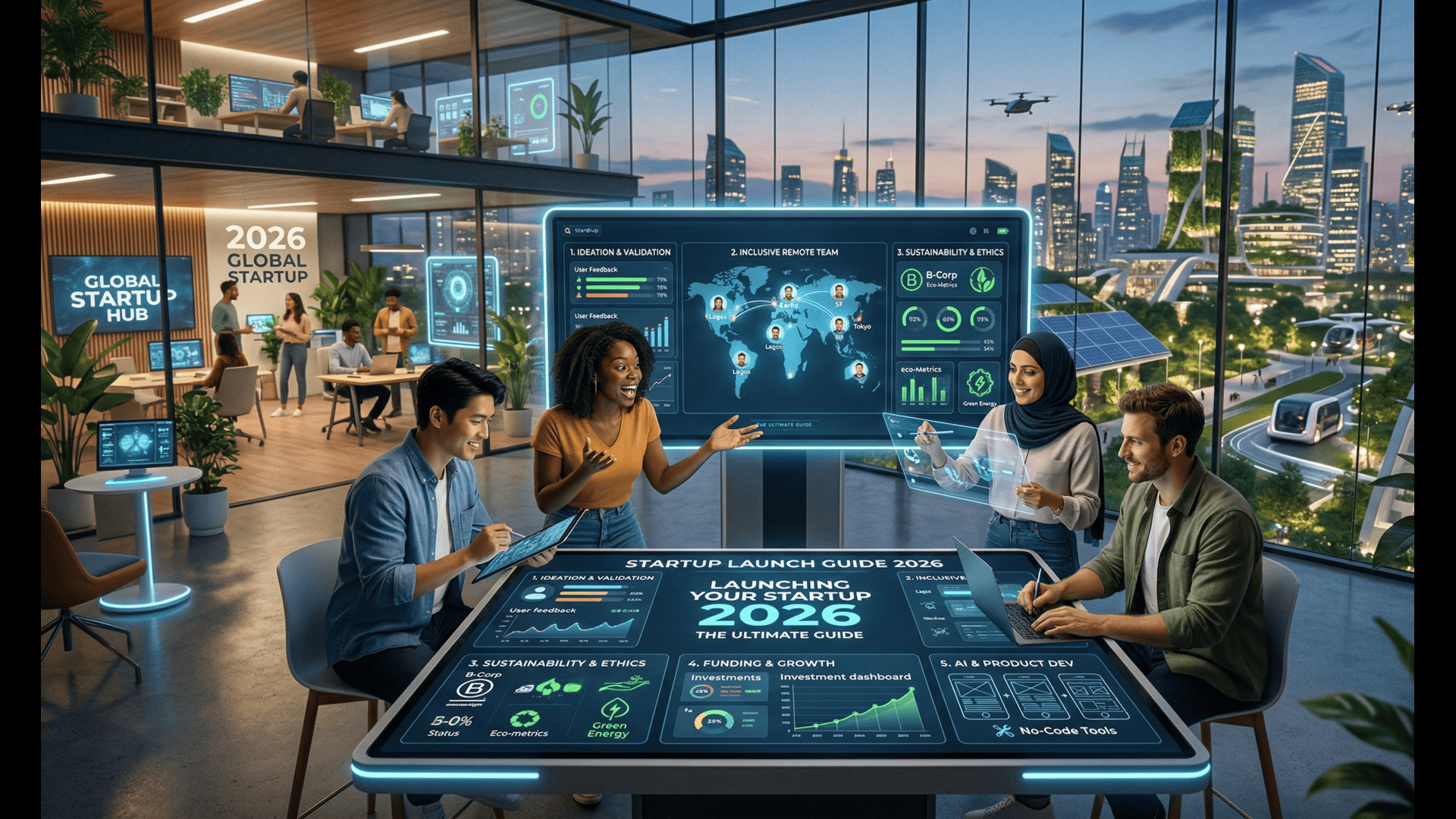
The entrepreneurial landscape is evolving faster than ever before. As we navigate through 2026, launching a startup looks vastly different than it did just a few years ago. The rapid democratization of artificial intelligence, a permanent shift toward globally distributed teams, and an undeniable consumer demand for sustainable, ethical business practices have entirely rewritten the playbook.
Whether you are a first-time founder or a seasoned entrepreneur looking to build something new, the barriers to entry have never been lower—but the bar for success has never been higher. Today’s most successful startups are those that prioritize inclusive design, leverage cutting-edge technology responsibly, and solve genuine human problems.
If you are ready to turn your vision into a reality, this comprehensive, step-by-step guide will walk you through exactly how to launch a startup in 2026.
Step 1: Ideation and Validation in a Hyper-Connected World
The best startups are born from a deep understanding of a specific problem. However, in 2026, simply having a good idea is not enough; you must validate it quickly and inclusively.
Find a Problem Worth Solving
Start by observing the world around you. What systems are broken? Who is being underserved by current market offerings? The most impactful startups often emerge from marginalized or overlooked communities. Look for problems that cause tangible friction in people’s daily lives or business operations.
Inclusivity in Market Research
When validating your idea, ensure your focus groups and survey demographics reflect the diverse reality of your potential user base.
- Broaden Your Reach: Do not just survey your immediate network. Use global research platforms to gather feedback from people of different ages, cultural backgrounds, and abilities.
- Empathy Interviews: Conduct one-on-one interviews. Ask open-ended questions and actively listen to the lived experiences of your potential customers.
- Accessibility as a Baseline: Ask yourself early on: How will individuals with visual, auditory, or cognitive disabilities interact with this solution? ### Leverage Predictive Analytics and AI
Use AI-driven market analysis tools to spot emerging trends before they peak. While human intuition is irreplaceable, predictive analytics can help you understand search intent, analyze competitor gaps, and validate whether the market for your solution is growing or shrinking.
Step 2: Building an Inclusive and Remote-First Team
The concept of a “headquarters” is largely a relic of the past. In 2026, the best talent is global, and your hiring strategy should reflect that. Building a diverse team is not just a moral imperative; it is a profound competitive advantage. Diverse teams build more robust, creative, and universally appealing products.
Adopting a Global Mindset
By removing geographic barriers, you open your startup to a wealth of perspectives.
- Hire for Culture Add, Not Culture Fit: Instead of looking for people who think exactly like you, seek out individuals who bring new viewpoints, experiences, and problem-solving approaches to the table.
- Equitable Compensation: Utilize modern global payroll platforms that help calculate fair, equitable salaries based on cost-of-living algorithms and local market rates, ensuring everyone is paid fairly regardless of their zip code.
Designing an Asynchronous Work Culture
To make a globally distributed team function smoothly, you must master asynchronous (async) communication.
- Documentation is Key: Maintain a central, accessible knowledge base where all decisions, processes, and meeting notes are recorded.
- Respect Boundaries: Implement strict policies regarding working hours and communication expectations to prevent burnout. Use scheduling features on messaging apps to ensure pings only arrive during a colleague’s working hours.
- Prioritize Mental Health: Startups are inherently stressful. Offer comprehensive mental wellness benefits, flexible time off, and create a psychologically safe environment where team members feel comfortable voicing concerns without fear of judgment.
Step 3: Crafting a Sustainable and Ethical Business Model
Investors and consumers in 2026 are highly skeptical of companies that prioritize growth at all costs. Modern startups must build environmental, social, and governance (ESG) principles directly into their DNA from day one.
The Shift Toward the Circular Economy
If you are building a physical product, how can you minimize waste? Consider a circular business model where products are designed for durability, repairability, and recycling.
- Eco-Friendly Supply Chains: Source materials ethically and transparently. Partner with vendors who share your commitment to a net-zero carbon footprint.
- Digital Sustainability: Even software companies have a carbon footprint. Optimize your code, choose green web hosting providers that run on renewable energy, and minimize unnecessary data storage.
Ethical AI and Data Privacy
If your startup utilizes artificial intelligence—which most now do—you must govern it ethically.
- Eliminate Bias: Regularly audit your AI models to ensure they are not perpetuating historical biases against marginalized groups.
- Data Sovereignty: Treat user data with the utmost respect. Adopt a “privacy-by-design” approach, collecting only the data you absolutely need and giving users complete control over their information in compliance with the latest global privacy frameworks.
Step 4: Funding Your Startup in 2026
The venture capital landscape has shifted toward sustainable growth and proven unit economics. While funding is abundant for the right ideas, the avenues to secure it have diversified.
Bootstrapping and Lean Operations
The proliferation of low-code and no-code tools means it has never been cheaper to build a Minimum Viable Product (MVP). Bootstrapping allows founders to retain equity and maintain control over the company’s direction. Focus on achieving early revenue to fund your own growth.
Venture Capital and Angel Investors
If you choose the VC route, look for partners who align with your core values.
- Diverse Investor Pools: Seek out funds that are led by or specifically support underrepresented founders.
- Focus on Profitability: Be prepared to show investors a clear, realistic path to profitability, not just user acquisition metrics.
Alternative Funding Mechanisms
- Crowdfunding: Platforms like Kickstarter or Wefunder remain excellent ways to validate your product while raising capital directly from your future customers.
- Web3 Grants and DAOs: For startups operating in decentralized technologies or open-source software, Decentralized Autonomous Organizations (DAOs) and protocol grants offer innovative, community-driven funding models.
- Government Grants: Many governments offer substantial non-dilutive grants for startups tackling climate change, healthcare, or educational inequity.
Step 5: Product Development and Rapid Prototyping
Speed to market is critical, but it should not come at the expense of usability or accessibility.
Leveraging Low-Code and No-Code Platforms
You no longer need a team of expensive engineers to launch version one of your product. Utilize platforms that allow you to drag-and-drop interfaces and connect databases visually. This significantly drastically reduces the time and cost required to test your assumptions in the real world.
Iterative Development (Agile Methodology)
Do not build in a vacuum. Release your MVP to a small, diverse group of early adopters as quickly as possible.
- Gather Feedback: Use integrated feedback tools to understand where users are getting stuck.
- Iterate Quickly: Implement changes based on real user data, not your own assumptions. Your product should be in a constant state of evolution.
Inclusive Design and Web Content Accessibility Guidelines (WCAG)
Your product must be usable by everyone. Adhere to the latest WCAG standards from the very beginning.
- Color Contrast: Ensure text is readable for those with color vision deficiencies.
- Screen Reader Compatibility: Structure your code so that visually impaired users can navigate your app seamlessly using screen readers.
- Simple Language: Write user interfaces and error messages in clear, jargon-free language that is easily understood by people of all cognitive abilities and language proficiencies.
Step 6: Go-to-Market Strategy and Community-Led Growth
Traditional interruption marketing (like aggressive pop-up ads and cold calling) is increasingly ineffective. Consumers in 2026 want authenticity, community, and connection.
Community-Led Growth
Instead of just acquiring “users,” focus on building a community around the problem you are solving.
- Create Safe Spaces: Host forums, Discord servers, or regular virtual town halls where your customers can connect with each other, share best practices, and interact directly with your team.
- Empower Advocates: Identify your most passionate community members and empower them to become brand ambassadors. People trust peer recommendations far more than corporate advertising.
Authentic and Inclusive Marketing
Your marketing materials should reflect the diverse world we live in without resorting to tokenism.
- Representative Imagery: Use photos and videos that feature people of different ages, races, body types, and abilities naturally interacting with your product.
- Accessible Content: Ensure all promotional videos have accurate closed captions, and all social media images include descriptive alt-text.
- Value-Driven Storytelling: Share the why behind your startup. Be transparent about your successes, your failures, and your ongoing efforts to be a socially responsible company.
Step 7: Navigating Legal, Compliance, and Administrative Setup
While it is the least glamorous part of launching a startup, establishing a solid legal foundation is critical to protecting your team and your intellectual property.
Entity Formation and IP Protection
- Choose the Right Structure: Consult with a legal professional to determine whether an LLC, C-Corp, or B-Corp is the best structure for your goals. (B-Corps are highly recommended for founders emphasizing social and environmental impact).
- Protect Your Ideas: File for trademarks on your brand name and logo early. If you have unique, proprietary technology, explore patent protection.
Compliance in a Borderless World
Operating globally means navigating a complex web of international regulations.
- Data Privacy Laws: Familiarize yourself with regulations like the GDPR in Europe, the CCPA in California, and emerging AI safety acts globally. Non-compliance can result in devastating fines.
- Labor Laws: If you are hiring internationally using an Employer of Record (EOR), ensure you are fully compliant with the labor laws, tax codes, and mandatory benefits of each employee’s home country.
Conclusion: The Journey Ahead
Launching a startup in 2026 requires a delicate balance of rapid technological adoption and profound human empathy. The blueprint for success is no longer just about disrupting markets; it is about elevating communities, solving real crises, and building sustainable systems that will outlast us.
Entrepreneurship is a marathon, not a sprint. There will be setbacks, pivot points, and moments of doubt. However, by centering your business around inclusive practices, remaining adaptable to technological shifts, and staying true to your core mission, you will be well-equipped to build a startup that not only succeeds financially but leaves a lasting, positive impact on the world.
Frequently Asked Questions (FAQ)
1. Do I need a technical co-founder to launch a tech startup in 2026?
Not necessarily. While having a technical co-founder is incredibly valuable, the rise of advanced no-code/low-code tools and AI-assisted programming allows non-technical founders to build fully functional Minimum Viable Products (MVPs) on their own. As you scale, you can hire technical talent or fractional CTOs to build out custom infrastructure.
2. How much money do I need to start?
The cost to launch has decreased significantly. Depending on your industry, you can launch a software MVP for less than $500 using cloud services and no-code tools. However, physical products, deep-tech (like advanced AI or biotech), and hardware still require substantial upfront capital for research, development, and manufacturing.
3. What is a B-Corp, and should I become one?
A Certified B Corporation (B-Corp) is a business that meets the highest standards of verified social and environmental performance, public transparency, and legal accountability to balance profit and purpose. If your startup is dedicated to sustainable and ethical practices, becoming a B-Corp can build immense trust with modern consumers and attract impact-focused investors.
4. How do I protect my startup from failing?
There is no guaranteed way to prevent failure, but you can drastically reduce the risk by validating your idea early with real people. Do not spend months building in secret. Talk to potential users immediately, test your assumptions with small experiments, and be willing to pivot if the data shows the market doesn’t want what you are building.
5. How can I ensure my hiring process is inclusive?
Start by standardizing your interview process so all candidates are evaluated against the exact same criteria. Use blind resume screening tools to remove unconscious bias regarding names or educational backgrounds. Ensure your job descriptions use gender-neutral language and explicitly state your commitment to building a diverse workplace. Finally, proactively source candidates from underrepresented professional networks and communities.
Helpful Reference Links for Founders
-
Y Combinator Startup Library: Comprehensive resources, essays, and templates for early-stage founders. ycombinator.com/library
-
Web Content Accessibility Guidelines (WCAG): The international standard for making web content more accessible to people with disabilities. w3.org/WAI/standards-guidelines/wcag/
-
B Corporation Certification: Information on how to measure your social and environmental impact and become a certified B-Corp. bcorporation.net
-
First Round Review: Excellent, in-depth articles on management, product development, and scaling a startup culture inclusively. review.firstround.com
-
Oyster / Deel: Resources and platforms for hiring and managing globally distributed, remote teams compliantly. (e.g., deel.com)
Leave a Reply