Category: Business

  • The Ultimate Guide to Small Business Ideas for Beginners in 2026

    The Ultimate Guide to Small Business Ideas for Beginners in 2026

    Stepping into the world of entrepreneurship is a thrilling, transformative journey. As we navigate through 2026, the landscape for small businesses is more dynamic, accessible, and exciting than ever before. Whether you are looking for financial independence, a creative outlet, or a flexible schedule that accommodates your unique lifestyle and abilities, starting a small business is a viable path for everyone.

    This comprehensive guide is designed specifically for beginners. We will explore the most promising, low-barrier-to-entry small business ideas tailored to the trends and demands of 2026. From leveraging user-friendly artificial intelligence to championing sustainable practices, there is a niche for your passions and skills.

    Grab a cup of your favorite beverage, get comfortable, and let’s explore how you can turn your entrepreneurial dreams into a tangible reality this year.


    Why 2026 is the Perfect Year to Start a Business

    Before we dive into the specific ideas, it is crucial to understand the current economic and social climate that makes 2026 an ideal launchpad for beginners.

    1. Unprecedented Access to Technology

    Technology is no longer a barrier; it is an equalizer. Tools that previously required thousands of dollars and specialized degrees—such as website building, graphic design, and bookkeeping—are now automated, affordable, and accessible to people of all skill levels.

    2. A Shift Toward Conscious Consumerism

    Consumers in 2026 care deeply about where their money goes. They actively seek out businesses that prioritize sustainability, ethical sourcing, and community impact. This shift gives small, transparent businesses a massive competitive edge over faceless corporations.

    3. The Normalization of Remote and Flexible Work

    The rigid 9-to-5 structure is no longer the only way to operate. Society has embraced flexible working hours, remote services, and asynchronous communication. This allows entrepreneurs from all walks of life—including caregivers, individuals with disabilities, and neurodivergent folks—to build businesses that fit their lives, rather than forcing their lives to fit a business.

    Pro Tip: You do not need to invent something entirely new to be successful. Often, the best small business simply takes an existing service and delivers it with better customer care, more accessibility, or a hyper-local focus.


    Category 1: Digital and AI-Assisted Services

    You do not need to be a software engineer to capitalize on the digital boom. Today’s tech-based businesses are about using existing tools to solve everyday problems for other people.

    1. AI Implementation Consultant for Local Businesses

    Artificial intelligence is everywhere in 2026, but many local business owners—like plumbers, boutique owners, or independent mechanics—feel overwhelmed by it. They know they should be using AI to save time, but they do not know how.

    • How it works: You learn the basics of user-friendly AI tools (like automated email drafters, inventory predictors, or social media caption generators) and set them up for local businesses. You act as the bridge between high-tech solutions and main-street businesses.
    • Initial Investment: Low (Mostly the cost of your own software subscriptions for testing).
    • Required Skills: Basic tech literacy, patience, and good communication skills to explain concepts without jargon.
    • Who this is perfect for: Individuals who love tinkering with new apps and enjoy helping others streamline their daily tasks.

    2. Micro-Niche Newsletter Creator

    The age of the generic lifestyle blog is fading. In 2026, people crave hyper-specific, curated content delivered straight to their inboxes.

    • How it works: You choose a highly specific topic you are passionate about—for example, “Indoor gardening for apartment dwellers in the Pacific Northwest,” or “Gluten-free baking for parents of toddlers.” You curate news, tips, and product recommendations, monetizing through sponsorships, affiliate links, or paid premium subscriptions.
    • Initial Investment: Very Low (Email marketing platforms often have free tiers for beginners).
    • Required Skills: Consistent writing, research abilities, and community building.
    • Who this is perfect for: Passionate hobbyists, introverted creators, and anyone who enjoys researching niche topics.

    3. Digital Decluttering Specialist

    Just as people hire organizers to clean their physical homes, a growing number of people are drowning in digital clutter: thousands of unread emails, disorganized cloud drives, and full phone storage.

    • How it works: You offer a secure, confidential service where you help clients organize their digital lives. This includes setting up folder structures, unsubscribing them from junk mail, backing up precious family photos, and implementing password managers.
    • Initial Investment: Low.
    • Required Skills: Extreme organization, trustworthiness, and knowledge of data privacy best practices.
    • Who this is perfect for: Highly organized individuals who find satisfaction in creating order out of chaos.

    Category 2: Sustainable and Eco-Conscious Ventures

    The green economy is booming. Starting a business that helps the planet is not just good karma; it is brilliant business strategy in 2026.

    4. Upcycled Clothing and Furniture Flipper

    Fast fashion and disposable furniture are losing their appeal. Consumers want unique pieces with history and a lower carbon footprint.

    • How it works: You source overlooked items from thrift stores, estate sales, or online marketplaces. You then repair, paint, or completely reimagine these items and sell them at a premium on platforms like Etsy, Facebook Marketplace, or at local craft fairs.
    • Initial Investment: Low to Medium (Cost of initial inventory, cleaning supplies, tools, and paint).
    • Required Skills: A good eye for design, basic repair skills, and patience.
    • Who this is perfect for: Creative individuals who enjoy hands-on work and have a passion for sustainability.

    5. Local Composting Service

    Many people want to compost their food scraps but lack the outdoor space, time, or knowledge to do it themselves.

    • How it works: You provide clients with a specialized bin. Once a week, you drive a route, collect their organic waste, and leave them a clean bin. You then compost the waste in a larger facility (or partner with a local farm) and optionally return the nutrient-rich soil to your clients in the spring.
    • Initial Investment: Medium (Requires a reliable vehicle, collection bins, and a space to compost).
    • Required Skills: Reliability, willingness to do physical labor, and basic knowledge of the composting process.
    • Who this is perfect for: Outdoorsy individuals who want to make a tangible, immediate impact on their local environment.

    6. Zero-Waste Home Goods Consultant

    Transitioning to a zero-waste lifestyle is intimidating. Many consumers want to reduce their plastic use but do not know which eco-friendly products actually work.

    • How it works: You offer in-home or virtual consultations to help families swap out their disposable items for sustainable alternatives. You can also sell starter kits containing items like reusable paper towels, beeswax wraps, and solid dish soap.
    • Initial Investment: Low.
    • Required Skills: Deep knowledge of sustainable products and empathetic communication.
    • Who this is perfect for: Eco-advocates who love sharing their lifestyle changes with others.

    Category 3: Health, Wellness, and Caregiving

    As life becomes increasingly digital, the demand for human connection, personalized care, and wellness services continues to skyrocket.

    7. Specialized Mobile Pet Care

    The pet industry is virtually recession-proof, but pet owners in 2026 are looking for more than just a standard dog walker. They want specialized care tailored to their pets’ unique needs.

    • How it works: Offer niche services such as mobility assistance for older dogs, anxiety-reducing play sessions for animals from shelters, or specialized care for unique pets (like reptiles or birds). By specializing, you can charge a premium and build a deeply loyal client base.
    • Initial Investment: Low (Marketing materials, basic pet first-aid certification).
    • Required Skills: Comfort and experience with animals, reliability, and empathy for pet parents.
    • Who this is perfect for: Animal lovers looking for an active, rewarding business that gets them out of the house.

    8. Digital Detox Guide

    With screen time at an all-time high, burnout is a modern epidemic. People are actively seeking ways to disconnect, but they struggle to do it alone.

    • How it works: You curate offline experiences. This could range from organizing tech-free weekend retreats in nature to offering one-on-one coaching to help clients establish healthier boundaries with their smartphones and social media.
    • Initial Investment: Low to Medium (Depending on if you host events or just offer coaching).
    • Required Skills: Coaching or counseling background is helpful, excellent active listening, and event planning skills.
    • Who this is perfect for: Wellness advocates, former corporate employees who have conquered burnout, and empathetic listeners.

    9. Virtual Assistant for Neurodivergent Entrepreneurs

    There is a massive rise in small businesses owned by individuals with ADHD, Autism, and other forms of neurodivergence. These brilliant creators often need help managing the executive functioning aspects of their business.

    • How it works: You act as a specialized Virtual Assistant. Instead of just doing standard admin work, you help create visual schedules, manage overwhelming inboxes, gently body-double during work sessions, and keep projects on track in a way that respects their unique working style.
    • Initial Investment: Very Low.
    • Required Skills: Empathy, deep understanding of neurodivergent traits, supreme organization, and non-judgmental communication.
    • Who this is perfect for: Naturally organized individuals who thrive in a supportive, care-oriented role.

    Category 4: The Creator Economy and Freelance Services

    The traditional boundaries between “freelancer” and “business owner” have blurred. If you have a skill, you can package it into a scalable business.

    10. Short-Form Video Editor

    Platforms like TikTok, Instagram Reels, and YouTube Shorts dominate the internet. Every brand, real estate agent, and local bakery knows they need short-form video content, but they lack the time or skill to edit it.

    • How it works: Clients send you their raw, unedited footage recorded on their phones. You trim the fluff, add engaging captions, trending audio, and pacing to make the videos highly watchable.
    • Initial Investment: Low (A reliable computer and video editing software like Premiere Pro or CapCut).
    • Required Skills: Understanding of social media trends, an eye for pacing, and technical editing skills.
    • Who this is perfect for: Visual thinkers, social media natives, and creative introverts.

    11. Accessible Document Creator

    In 2026, web accessibility is not just a moral obligation; it is often a legal requirement. Many businesses have PDF guides, menus, or forms that are completely unreadable by screen readers used by visually impaired individuals.

    • How it works: You learn the standards of document accessibility (like proper heading structures, alt-text for images, and logical reading orders). You then offer a service to businesses to audit and convert their existing documents into accessible formats.
    • Initial Investment: Low.
    • Required Skills: Attention to detail, basic understanding of accessibility guidelines (WCAG), and proficiency in software like Adobe Acrobat or Microsoft Word.
    • Who this is perfect for: Detail-oriented individuals who want to make the digital world more inclusive for everyone.

    12. “Done-for-You” Meal Prep Service for Niche Diets

    While large meal kit companies exist, they often fail to cater to highly specific dietary needs or locally sourced preferences.

    • How it works: You cook and deliver meals tailored to specific demographics in your community. Examples include: anti-inflammatory meals for people managing chronic health conditions, soft-food diets for older adults, or high-protein meals for people focused on strength and fitness.
    • Initial Investment: Medium (Requires commercial kitchen space rental, permits, ingredients, and packaging).
    • Required Skills: Excellent cooking skills, understanding of food safety regulations, and knowledge of nutrition.
    • Who this is perfect for: Culinary enthusiasts who love feeding people and understanding the science of food.

    Step-by-Step: How to Launch Your Small Business in 2026

    Having an idea is only ten percent of the journey. The magic lies in the execution. If you are a beginner, the process can feel intimidating, but breaking it down into manageable steps makes all the difference.

    Step 1: Validate Your Idea

    Do not spend money until you know people want what you are selling. Talk to people in your community. Ask them about their pain points. If you want to start a pet care business, ask local pet owners what they dislike about their current options. Validation saves you from creating a product no one wants to buy.

    Step 2: Create a Minimalist Business Plan

    You do not need a 50-page document. Write down one page covering:

    • The Problem: What are you solving?
    • The Solution: What is your specific service/product?
    • Target Audience: Exactly who is buying this? (Be specific—not “everyone”).
    • Pricing: How much will you charge, and what are your costs?
    • Marketing: How will your first 5 customers find you?

    Step 3: Handle the Legal and Financial Basics

    Keep your personal and business finances strictly separate. Open a dedicated business checking account. Depending on your location and business type, you may need to register an LLC or obtain local licenses.

    External Resource: For trusted, free guidance on legal structures, funding, and local regulations in the US, we highly recommend visiting the Small Business Administration (SBA). They offer incredible, step-by-step roadmaps for beginners.

    Step 4: Build a Simple Online Presence

    In 2026, if you are not online, you do not exist. However, you do not need a massive, expensive website. Start with a simple, clean landing page using tools like Carrd, Squarespace, or a well-optimized Google Business Profile. Ensure your contact information is clear and your pricing is transparent. Make sure your website is accessible to all users, utilizing high-contrast colors and readable fonts.

    Step 5: Leverage Your Immediate Network

    Your first customers are likely going to be people you already know, or people one degree of separation away. Announce your new venture proudly to your friends, family, and social media networks. Ask them to share your business with anyone who might need your services. Word-of-mouth remains the most powerful marketing tool on the planet.


    Overcoming Beginner’s Fear: Mindset Matters

    As you read through these ideas and steps, you might feel a familiar sense of imposter syndrome creeping in. “Am I qualified to do this?” “What if I fail?”

    These feelings are incredibly common and entirely valid. Every successful entrepreneur you admire started exactly where you are today—at the beginning.

    The secret to success in 2026 is not about being flawless; it is about being adaptable. Start small. It is perfectly acceptable to start your business as a “side hustle” working just a few hours a week while maintaining a primary job or caregiving responsibilities. Treat your first year as an experiment. You are simply gathering data on what works, what you enjoy, and what the market is willing to pay for. Give yourself the grace to make mistakes, because every mistake is just a lesson in disguise.


    Frequently Asked Questions (FAQ)

    To wrap up this ultimate guide, let’s address some of the most common questions beginners have when starting a small business in 2026.

    Q1: Do I need a lot of money to start a small business in 2026?

    Absolutely not. The rise of digital tools and service-based business models means you can often start with very little capital. Many of the ideas listed above, like digital decluttering or virtual assistance, require almost zero upfront financial investment—just your time, existing skills, and a reliable internet connection.

    Q2: I am not “tech-savvy.” Can I still run a modern business?

    Yes! While tech is helpful, business is fundamentally about human relationships and solving problems. If you excel at cooking, organizing, or caring for animals, technology is just a tool to help you reach people. Furthermore, the tech tools available in 2026 are designed to be incredibly intuitive and user-friendly, with massive amounts of free tutorials available online.

    Q3: How do I know if my business idea is actually good?

    The best way to know is through market validation. Try to pre-sell your service or product before you fully build it. Talk to your target audience. If people are willing to hand you money to solve their problem, you have a good business idea. If they only offer compliments but no cash, you may need to pivot.

    Q4: Should I quit my day job to start my business?

    For most beginners, the answer is a resounding “no.” Quitting your primary source of income immediately places immense, stressful pressure on your new business to perform right away. It is usually much safer and more sustainable to build your business on the side during evenings or weekends until it generates enough consistent revenue to support you.

    Q5: What is the most important skill for a beginner entrepreneur?

    Resilience. The ability to keep going when things get difficult, the humility to learn from your failures, and the flexibility to adapt to new situations. Skills like marketing and bookkeeping can be learned or outsourced, but a resilient mindset is the foundation of any successful business.


    Conclusion

    Starting a small business in 2026 is a journey of self-discovery, community building, and financial empowerment. Whether you choose to become an AI consultant, a sustainable furniture flipper, or a specialized caregiver, your unique perspective and skills have immense value in the marketplace.

    Remember that there is no single “right” way to build a business. The most successful venture is the one that aligns with your personal values, accommodates your needs, and brings you a sense of purpose. Take that first step, conduct your research, and trust in your ability to learn and grow along the way. The world is waiting for what you have to offer.

  • How to Turn Your Passion into a Profitable Business: A Comprehensive Guide

    How to Turn Your Passion into a Profitable Business: A Comprehensive Guide

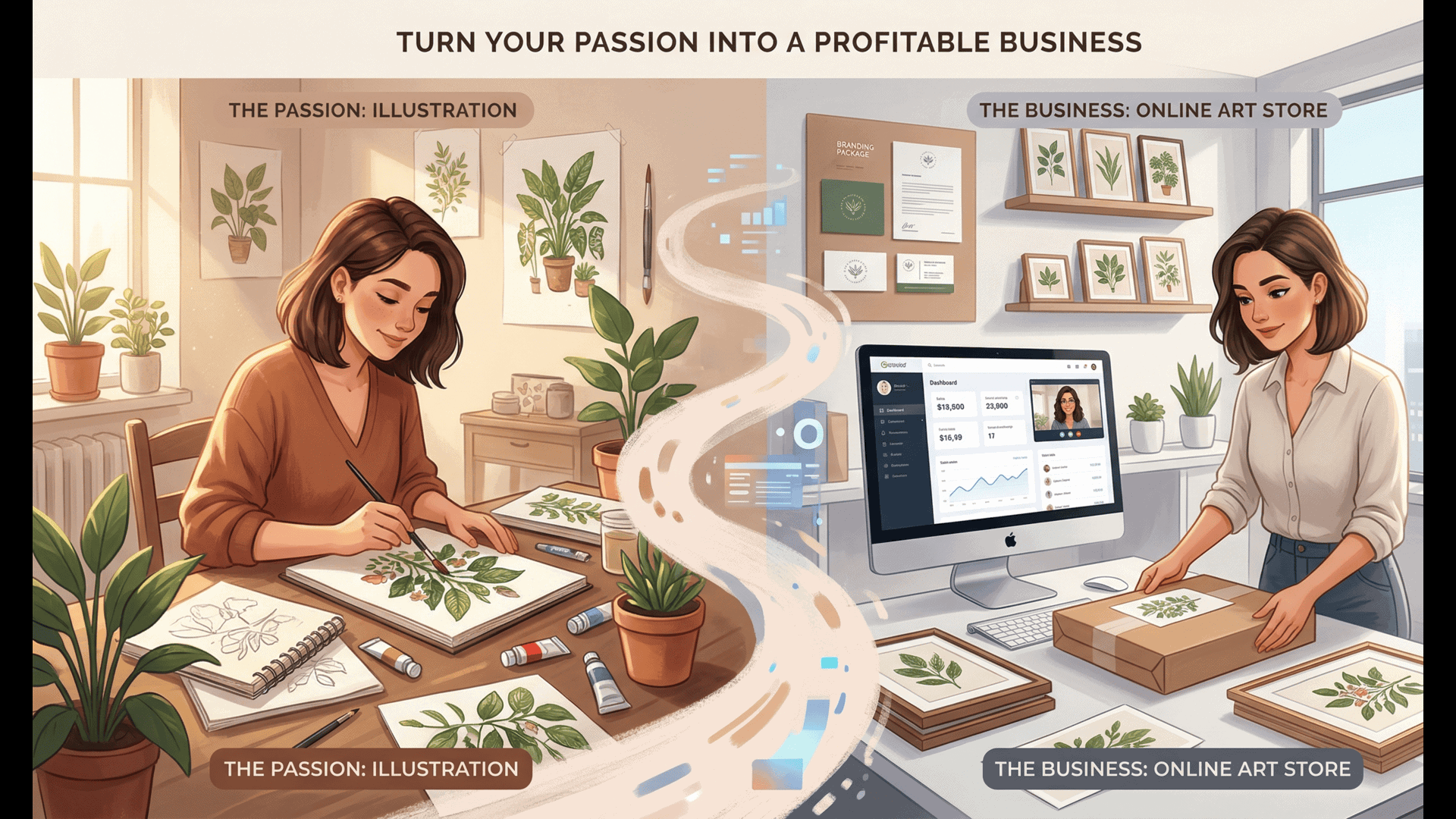
    Have you ever found yourself completely absorbed in a hobby, losing track of time, and thought, “I wish I could do this for a living?” You are not alone. Countless individuals dream of escaping the traditional 9-to-5 grind to build a life centered around what they genuinely love. Learning how to turn your passion into a profitable business is one of the most rewarding journeys an entrepreneur can embark upon.

    However, transitioning from a beloved hobby to a sustainable income stream requires more than just enthusiasm. It demands strategic planning, market awareness, resilience, and a deep understanding of your audience. Whether you are an artist, a tech enthusiast, a baker, or a fitness advocate, this guide will walk you through the essential steps to monetize your passion sustainably and inclusively.


    Phase 1: The Foundation – Discovery and Validation

    Before registering a domain name or designing a logo, you must lay a solid foundation. Passion is the fuel, but strategy is the engine that drives a profitable business.

    1. Evaluate Your Passion: Hobby vs. Business

    Not every passion is meant to be a business, and that is perfectly okay. When a hobby becomes a job, the dynamic changes. You will face deadlines, demanding clients, and administrative tasks.

    Ask yourself these foundational questions:

    • Will doing this under pressure diminish my love for it? If baking brings you peace, will fulfilling an order of 500 cupcakes by Friday morning cause insurmountable stress?
    • Am I willing to do the “un-fun” work? Running a business involves accounting, marketing, customer service, and legal compliance.
    • Is my passion solving a problem or fulfilling a need? A viable business must offer value to others.

    If you answered these questions positively, you are ready to move forward.

    2. Conduct Thorough Market Research

    Passion blinds us to market realities. To turn a passion into a profitable business, you need objective data. You must determine if there is a paying audience for your product or service.

    • Identify the Demand: Use tools like Google Trends, AnswerThePublic, and social media listening to see if people are actively searching for what you want to offer.
    • Analyze the Competition: Who else is doing this? Do not view competitors as enemies; view them as proof of market demand. Analyze their strengths and weaknesses. What are their customers complaining about? That gap is your entry point.
    • Read Industry Reports: Utilize resources like Statista or industry-specific publications to understand market growth and future trends.

    3. Define Your Target Audience Inclusively

    Who are you serving? “Everyone” is not a target audience. You need to create detailed buyer personas, but it is crucial to approach this with an inclusive mindset.

    When defining your audience, look beyond traditional demographic stereotypes. Focus on psychographics: their values, struggles, interests, and aspirations.

    • Accessibility: How can you make your product accessible to people with disabilities?
    • Representation: Does your target audience reflect the diverse world we live in?
    • Empathy: What genuine problems are you solving for your community?

    By building inclusivity into the core of your audience definition, you create a brand that welcomes a broader, more loyal customer base.


    Phase 2: Strategic Planning and Financial Readiness

    With a validated idea and a clear audience, it is time to map out the journey. A goal without a plan is just a wish, especially in entrepreneurship.

    4. Draft a Lean Business Plan

    You do not need a 50-page document to start, but you do need a roadmap. A lean business plan focuses on the core elements of your venture. The U.S. Small Business Administration (SBA) offers excellent templates for creating flexible business plans.

    Your plan should include:

    • Value Proposition: What makes your offering unique? Why should someone choose you over a competitor?
    • Revenue Model: How will you make money? (e.g., direct sales, subscriptions, consulting, affiliate marketing).
    • Marketing Strategy: How will people find out about you?
    • Key Metrics: What numbers will define your success in the first 90 days? (e.g., website traffic, email subscribers, first sale).

    5. Financial Planning: Bootstrapping vs. Funding

    Lack of capital is a primary reason new businesses fail. Before launching, evaluate your financial landscape.

    • Bootstrapping: Funding the business yourself using savings or current income. This approach allows you to retain 100% ownership and grow at your own pace. It is highly recommended for passion-based businesses in their infancy.
    • Keep Your Day Job: Consider starting your business as a side hustle. This reduces financial pressure, allowing you to make strategic decisions rather than desperate ones.
    • Understand Your Costs: Calculate your fixed costs (website hosting, software subscriptions) and variable costs (materials, shipping). Price your products or services to ensure a healthy profit margin. Do not undervalue your time or expertise.

    6. Choose the Right Business Model

    How you deliver your passion to the world matters. Depending on your skills, you might choose:

    • E-commerce/Product-Based: Selling physical goods you create or curate.
    • Service-Based: Offering your skills directly (e.g., freelance writing, photography, consulting).
    • Digital Products: Creating courses, eBooks, or templates. This model offers incredible scalability.
    • Community/Membership: Charging a recurring fee for access to exclusive content or a community.

    Phase 3: Building Your Brand and Online Presence

    Your brand is more than a logo; it is the emotional connection you build with your audience. It is how people feel when they interact with your business.

    7. Cultivate an Inclusive and Authentic Brand Voice

    Your brand voice should reflect your passion while remaining welcoming and accessible. Avoid industry jargon that alienates newcomers. Use language that respects all genders, cultures, and backgrounds.

    For instance, instead of using gendered terms like “hey guys” in your marketing videos, opt for “hi everyone,” “welcome friends,” or “hey folks.” Small shifts in language signal that your business is a safe, welcoming space for all consumers.

    8. Establish Your Digital Storefront

    In today’s digital age, your website is your storefront. Even if you run a local brick-and-mortar shop, an online presence is non-negotiable.

    • Secure a Domain Name: Choose a name that is memorable, easy to spell, and ideally includes a hint of what you do.
    • Build a User-Friendly Website: Platforms like Shopify, WordPress, or Squarespace make it easy to build professional websites without coding knowledge. Ensure your website is mobile-responsive and follows Web Content Accessibility Guidelines (WCAG) so users with visual or motor impairments can navigate it easily.
    • Start an Email List: Do not rely solely on social media algorithms. An email list is an asset you own. Offer a free resource (a lead magnet) in exchange for visitors’ email addresses.

    9. Leverage Social Media Strategically

    You do not need to be on every social media platform. Choose the one or two platforms where your target audience spends their time.

    • Visual Passions: (Art, food, fashion) thrive on Instagram, Pinterest, and TikTok.
    • B2B Services: (Consulting, writing) perform best on LinkedIn and Twitter.
    • Educational Content: YouTube is unparalleled for long-form, tutorial-style content.

    Share your journey, not just your products. People connect with the human behind the brand. Show behind-the-scenes footage, share your failures and triumphs, and engage authentically with your followers.


    Phase 4: Launching, Marketing, and Sales

    The moment of truth has arrived. It is time to introduce your passion project to the world and start generating revenue.

    10. Develop a Minimum Viable Product (MVP)

    Perfectionism is the enemy of progress. Do not wait until your product is flawless to launch. Develop a Minimum Viable Product (MVP)—the simplest version of your offering that still delivers value to the customer.

    By launching an MVP, you can:

    • Test the market without investing massive amounts of time and money.
    • Gather real-world feedback.
    • Generate early revenue to fund further development.

    For example, if your passion is cooking and you want to launch a meal prep service, start by offering three menu options to ten friends and neighbors. Learn from their feedback before renting a commercial kitchen.

    11. Implement Value-Driven Marketing

    Traditional “hard-sell” tactics rarely work for passion-based businesses. Instead, focus on value-driven marketing. Educate, entertain, and inspire your audience.

    • Content Marketing: Write blog posts, record podcasts, or create videos that answer your audience’s common questions. This improves your Search Engine Optimization (SEO) and establishes you as an authority. (Learn more about content marketing basics at the Content Marketing Institute).
    • Collaborations and Partnerships: Partner with other creators or businesses that share your target audience but are not direct competitors. This cross-pollination introduces your brand to a warm, receptive audience.
    • Leverage User-Generated Content: Encourage your early customers to share their experiences. Word-of-mouth remains the most powerful marketing tool.

    12. Master the Art of Selling Ethically

    Many passionate creators struggle with sales, feeling that asking for money taints their art or hobby. Reframing your mindset is crucial.

    If you truly believe that your product or service improves people’s lives, brings them joy, or solves a problem, then selling is simply offering a solution. Be transparent about your pricing, deliver exceptional customer service, and honor your commitments. Ethical selling builds long-term trust and recurring revenue.


    Phase 5: Scaling, Sustaining, and Overcoming Challenges

    Turning a profit is a massive milestone, but sustaining that profitability requires ongoing effort and adaptation.

    13. Listen to Customer Feedback and Iterate

    Your business is a living entity that must evolve. Actively seek feedback from your customers through surveys, direct messages, and reviews.

    • What do they love about your product?
    • What do they wish was different?
    • What new products are they asking for?

    Use this data to iterate and improve. The businesses that survive long-term are the ones that adapt to their customers’ changing needs.

    14. Outsource and Build a Team

    As your business grows, you will become the bottleneck. You cannot be the CEO, the marketer, the creator, and the customer service representative indefinitely.

    To scale, you must delegate. Identify the tasks that drain your energy or fall outside your zone of genius. Hire freelancers, virtual assistants, or part-time employees. By outsourcing administrative tasks, you free up your time to focus on the visionary work that fuels your passion.

    15. Protect Your Mental Health and Avoid Burnout

    When your passion becomes your job, the line between work and life blurs. This makes entrepreneurs highly susceptible to burnout.

    • Set Boundaries: Establish clear work hours. Just because you can work on your business at midnight does not mean you should.
    • Take Time Off: Schedule regular breaks and vacations. Stepping away from the business replenishes your creativity.
    • Find a New Hobby: If your previous hobby is now your job, you need a new outlet for stress relief—something you do purely for joy, with zero intention of monetizing it.

    16. Cultivate a Mindset of Continuous Learning

    The business landscape shifts rapidly. Algorithms change, new competitors emerge, and consumer behaviors evolve. Commit to being a lifelong learner. Read industry books, attend webinars, listen to entrepreneurial podcasts, and network with other business owners. Organizations like SCORE provide free business mentoring and education that can be invaluable for growing businesses.


    Conclusion: The Journey is the Reward

    Turning your passion into a profitable business is rarely a linear path. It is filled with exhilarating highs, frustrating setbacks, and moments of profound self-doubt. However, the reward of waking up every day to build something you deeply care about makes the challenges worthwhile.

    Remember that success does not happen overnight. It is the result of consistent effort, strategic planning, and a genuine desire to serve your audience. Stay true to your inclusive values, remain adaptable, and never lose sight of the joy that sparked your passion in the first place. You have the skills, the vision, and now the roadmap. It is time to take that first step.


    Frequently Asked Questions (FAQ)

    1. How do I know if my passion is profitable?

    You can determine profitability through market research. Look for existing demand by analyzing search trends, identifying competitors, and surveying potential customers. If people are already spending money on similar products or services, and you can offer a unique angle or better quality, your passion has profit potential.

    2. Can I start a business with no money?

    While starting with zero dollars is incredibly difficult, starting with very little money is entirely possible through bootstrapping. Service-based businesses (like freelance writing or consulting) require minimal startup capital. For product-based businesses, consider pre-selling items or utilizing print-on-demand services to avoid holding expensive inventory.

    3. Do I need to quit my job to start my passion business?

    No, and in most cases, you shouldn’t. Starting your business as a side hustle provides financial stability while you test the waters. Once your business revenue consistently matches or exceeds your day job income, you can confidently consider making the leap to full-time entrepreneurship.

    4. How do I price my products or services?

    Pricing is a balance of covering your costs, understanding market rates, and valuing your time. Calculate all materials, software, and overhead costs. Then, factor in an hourly wage for yourself. Research competitors, but do not race to the bottom by underpricing. Compete on value, quality, and customer experience, not just on price.

    5. What is the biggest mistake people make when monetizing a hobby?

    The most common mistake is skipping the market validation phase. Many passionate creators spend months building a product they love, only to discover that nobody else wants to buy it. Always test your idea with a Minimum Viable Product (MVP) before investing heavily in production or marketing.

    6. How do I handle competition in my niche?

    View competition as validation that there is a healthy market for your passion. Instead of copying competitors, find your Unique Value Proposition (UVP). Look for gaps in their offerings or customer complaints in their reviews, and tailor your business to solve those specific issues. Your unique personality and inclusive approach will also serve as a major differentiator.

    7. How do I ensure my business remains inclusive as it grows?

    Inclusivity must be intentional. Regularly audit your marketing materials to ensure diverse representation. Ensure your website and physical products are accessible. Use gender-neutral language in your communications, and actively seek feedback from diverse communities to understand how you can serve them better.

  • The Ultimate Guide to Strategic Planning for Long-Term Growth

    The Ultimate Guide to Strategic Planning for Long-Term Growth

    In today’s rapidly evolving business landscape, hoping for success is no longer a viable strategy. Whether you are leading a startup, managing a non-profit organization, or steering a multinational corporation, sustainable success requires a clear roadmap. That roadmap is your strategic plan.

    Strategic planning is more than just an annual corporate retreat or a dusty binder sitting on a manager’s shelf. It is a living, breathing framework that guides decision-making, aligns diverse teams, and ensures that your organization remains resilient in the face of change.

    In this comprehensive guide, we will explore actionable strategic planning tips for long-term growth. We will focus on creating strategies that are not only effective and agile but also inclusive and sustainable.


    What is Strategic Planning?

    At its core, strategic planning is the organizational management activity that leaders use to set priorities, focus energy and resources, strengthen operations, and ensure that employees and other stakeholders are working toward common goals.

    It is the process of defining your organization’s direction and making decisions on allocating resources to pursue that direction. While operational planning focuses on the “how” and the day-to-day tasks, strategic planning focuses on the “what” and the “why” over a longer time horizon—typically three to five years, or even a decade.

    Strategic vs. Operational Planning

    • Strategic Planning: Focuses on the big picture. It asks: Where are we going? What is our ultimate vision? How will we adapt to market changes?
    • Operational Planning: Focuses on the immediate future. It asks: Who is doing what today? How do we meet this month’s quota? What are our immediate project deadlines?

    Why Strategic Planning is Essential for Sustainable Growth

    Growth rarely happens by accident. When organizations experience growth without a strategy, it is often chaotic, unsustainable, and highly vulnerable to market shifts. Here is why prioritizing strategic planning is vital:

    1. Creates Alignment and Shared Purpose

    A well-communicated strategic plan ensures that everyone in the organization—from executive leadership to frontline customer support—understands the overarching goals. When people know why their work matters, engagement and productivity naturally increase.

    2. Optimizes Resource Allocation

    Every organization has finite resources: time, financial capital, and human talent. Strategic planning helps leaders make informed decisions about where to invest these resources for the highest return, preventing burnout and financial waste.

    3. Builds Resilience and Agility

    We live in a VUCA world (Volatile, Uncertain, Complex, and Ambiguous). A strong strategic plan doesn’t lock you into a rigid path; rather, it provides a foundational compass. When unexpected challenges arise, a strategic framework helps you pivot intentionally rather than react impulsively.

    4. Fosters Proactive Rather Than Reactive Management

    Instead of constantly putting out fires, strategic planning allows organizations to anticipate challenges and opportunities. It shifts the culture from crisis management to intentional design.


    Core Elements of a Winning Strategic Plan

    Before diving into specific growth tips, it is crucial to ensure your foundation is solid. Every effective strategic plan is built upon three core pillars:

    1. Vision Statement: Your organization’s North Star. This is an aspirational statement of what you ultimately want to achieve in the future.
    2. Mission Statement: The foundational purpose of your organization. It defines what you do, who you serve, and how you provide value today.
    3. Core Values: The fundamental beliefs and guiding principles that dictate behavior and action within the organization. Inclusive values ensure that diverse voices are respected and heard throughout the journey.

    8 Actionable Strategic Planning Tips for Long-Term Growth

    Building a strategy that endures requires intention, data, and a commitment to inclusivity. Here are eight actionable tips to guide your strategic planning process.

    Tip 1: Conduct a Comprehensive Environmental Scan

    You cannot chart a course to your destination if you do not know where you currently stand. An environmental scan provides a realistic view of your internal capabilities and the external market landscape.

    • SWOT Analysis: Evaluate your internal Strengths and Weaknesses, along with external Opportunities and Threats.
      • Inclusive Tip: Gather input for your SWOT analysis from people across all levels and departments of the organization. Frontline workers often perceive weaknesses and threats that executives might miss.

    • PESTLE Analysis: Look at the macro-environment by analyzing Political, Economic, Social, Technological, Legal, and Environmental factors. This is crucial for long-term growth, as social shifts and technological advancements can render existing business models obsolete overnight.

    Tip 2: Set SMARTIE Goals

    You are likely familiar with SMART goals (Specific, Measurable, Achievable, Relevant, and Time-bound). To foster true long-term, sustainable growth, upgrade your framework to SMARTIE goals by adding Inclusive and Equitable.

    • Inclusive: Does this goal bring traditionally marginalized or underrepresented voices into the process? Does the goal benefit a diverse range of stakeholders?
    • Equitable: Does this goal address systemic disparities? Are the resources required to achieve this goal distributed fairly?

    Example of a SMARTIE Goal: “Increase our software user base by 20% over the next 18 months (Specific, Measurable, Time-bound) by developing three new accessibility features for users with disabilities (Inclusive, Equitable) that align with our core expansion strategy (Relevant, Achievable).”

    Tip 3: Foster a Culture of Continuous Feedback and Collaboration

    Strategic planning should never be conducted in an isolated executive echo chamber. The best ideas often come from the people interacting directly with your clients, customers, and community.

    • Create Feedback Loops: Use anonymous surveys, town hall meetings, and focus groups to gather diverse perspectives.
    • Empower Cross-Functional Teams: When building your strategic initiatives, form committees that include members from different departments, backgrounds, and seniority levels. This prevents siloed thinking and ensures that the strategy is realistic to execute.

    Tip 4: Prioritize Agility and Scenario Planning

    A long-term strategy that spans five years will inevitably encounter unforeseen disruptions. The goal is not to predict the future perfectly, but to prepare for multiple possibilities.

    • Scenario Planning: Develop “What-If” scenarios. What if our main supplier goes out of business? What if a new competitor enters the market with a cheaper alternative? What if a global event disrupts our supply chain? * Build Contingency Plans: For each scenario, outline a high-level response. This ensures that when a crisis hits, your team isn’t starting from scratch—they are simply activating a pre-discussed plan.

    Tip 5: Align Resource Allocation with Strategic Priorities

    A strategy is only a wish list if it is not funded. One of the most common reasons strategic plans fail is the disconnect between the new strategy and the old budget.

    • Audit Current Spending: Are you investing time and money into projects that no longer align with your new long-term vision? Be prepared to cut legacy projects that do not serve the future.
    • Invest in Talent: Long-term growth requires the right people. Does your strategy require new skills? If so, your strategic plan must include a roadmap for training existing staff or hiring new, diverse talent.

    Tip 6: Establish Clear KPIs and Tracking Mechanisms

    To know if your strategic plan is working, you must measure your progress objectively. Key Performance Indicators (KPIs) act as the milestones on your journey.

    • Leading vs. Lagging Indicators: * Lagging indicators tell you what has already happened (e.g., last quarter’s revenue, customer churn rate).
      • Leading indicators help predict future success (e.g., number of new sales calls made, employee satisfaction scores, website traffic). A healthy strategic plan measures both.

    • Dashboarding: Create a centralized, accessible dashboard where all team members can see progress toward strategic goals in real-time. Transparency builds trust and accountability.

    Tip 7: Communicate the Vision Transparently to All Stakeholders

    Communication is the bridge between strategy and execution. If your team does not understand the plan, they cannot execute it.

    • Tailor the Message: While the overarching vision remains the same, how you communicate it should change based on the audience. An investor needs to hear about market share and ROI; a graphic designer needs to hear about brand evolution and creative direction.
    • Repetition is Key: Do not just announce the strategic plan once at an annual meeting. Incorporate the strategic goals into weekly team meetings, performance reviews, and company newsletters. Keep the vision front and center.

    Tip 8: Review, Reflect, and Refine Regularly

    A strategic plan is not carved in stone. It is a working document that must evolve as the organization and the market evolve.

    • Quarterly Reviews: Do not wait until the end of the year to check your progress. Hold quarterly strategy reviews to assess KPIs. If a goal is no longer relevant, have the courage to change it.
    • Celebrate the Wins: Long-term growth is a marathon. To keep morale high, take time to celebrate the small milestones and short-term wins along the way. Recognize the teams and individuals who are driving the strategy forward.

    Common Pitfalls to Avoid in Strategic Planning

    Even with the best intentions, organizations can stumble during the strategic planning process. Keep an eye out for these common traps:

    1. The “Set It and Forget It” Syndrome

    Investing months into creating a beautiful strategic plan, only to never look at it again, is the most common pitfall. To combat this, integrate strategic plan check-ins into your regular operational meetings.

    2. Lack of Inclusivity and Diversity

    When strategy is dictated entirely by a homogenous group of top-level executives, it suffers from severe blind spots. Without diverse perspectives regarding age, gender, cultural background, and organizational role, the plan will lack innovation and may alienate portions of your workforce or customer base.

    3. Strategy Overload

    Trying to do everything at once is a recipe for doing nothing well. If your strategic plan has 25 “top priorities,” you don’t actually have any priorities. Limit your focus to 3–5 core strategic pillars to ensure your team’s energy is concentrated and effective.

    4. Ignoring Organizational Culture

    Renowned management consultant Peter Drucker famously said, “Culture eats strategy for breakfast.” If your strategic plan requires high levels of cross-departmental collaboration, but your current culture is highly competitive and siloed, the strategy will fail. You must address cultural shifts alongside strategic shifts.


    The Role of Inclusive Leadership in Strategic Planning

    Long-term growth is deeply intertwined with inclusive leadership. As organizations expand globally and workforces become increasingly diverse, a leadership approach that values equity and belonging is no longer just a moral imperative—it is a strategic advantage.

    Inclusive leaders actively seek out dissenting opinions. They create psychological safety, ensuring that all team members feel comfortable pointing out potential flaws in a strategy without fear of retribution. When strategic planning is viewed through an inclusive lens, the resulting growth is more sustainable because it respects the human capital that drives the business forward. Ensure that your strategic initiatives include goals related to Diversity, Equity, Inclusion, and Accessibility (DEIA).


    Frequently Asked Questions (FAQ)

    To further clarify the strategic planning process, here are answers to some of the most common questions business leaders and team members ask.

    Q1: What is the difference between a strategy and a tactic?

    A: A strategy is the overarching plan or the destination you want to reach. A tactic is the specific, actionable step you take to get there. For example, if your strategy is to “become the leading eco-friendly apparel brand in Europe,” a tactic would be “launching a marketing campaign highlighting our zero-waste manufacturing process in Germany.” Strategy is the what and why; tactics are the how.

    Q2: How often should we update our strategic plan?

    A: While the overarching vision (e.g., a 5-year or 10-year goal) may remain consistent, the strategic plan itself should be reviewed at least quarterly and updated annually. In highly volatile industries like technology or fast-moving consumer goods, you may need to pivot your strategy even more frequently based on market feedback.

    Q3: Who should be involved in the strategic planning process?

    A: While executive leadership typically leads the process and makes final decisions, the planning process itself should be highly collaborative. Involve department heads, key stakeholders, and representatives from frontline staff. Using surveys or focus groups to gather input from the entire organization ensures a more robust and inclusive plan.

    Q4: How long does the strategic planning process take?

    A: The timeline varies depending on the size and complexity of the organization. For a small business, it might take a few weeks of dedicated meetings. For a large enterprise, gathering data, consulting stakeholders, drafting the plan, and getting board approval can take three to six months.

    Q5: What do we do if our market changes drastically in the middle of our strategic plan?

    A: This is where agility and scenario planning come in. If the market shifts drastically (e.g., a new regulation, an economic downturn), pause and assess. Revisit your environmental scan (PESTLE analysis). If the core assumptions of your plan are no longer valid, you must pivot. Clinging to an outdated strategy in a new reality is a fast track to failure.

    Q6: How can small businesses or startups with limited resources conduct strategic planning?

    A: Strategic planning does not require an expensive consulting firm. Small businesses can start by simply dedicating one full day away from daily operations to answer three questions: Where are we now? Where do we want to be in three years? What are the three biggest things we must do to get there? Keep it simple, document it, and review it monthly.


    Conclusion

    Strategic planning for long-term growth is an ongoing journey of discovery, alignment, and adaptation. It requires a willingness to look honestly at your current state, the audacity to envision a bold future, and the discipline to execute the steps in between.

    By conducting thorough environmental scans, setting SMARTIE goals, prioritizing inclusivity, and maintaining agility, you can create a strategic plan that not only survives market volatility but thrives in it. Remember, the goal of a strategic plan is not to predict the future with 100% accuracy; it is to prepare your organization to navigate whatever the future holds with confidence, unity, and purpose.

    Start small, remain consistent, and keep your communication transparent. Your future growth depends on the strategic seeds you plant today.


    References and Resources for Further Reading

    To continue expanding your knowledge on strategic planning and inclusive organizational growth, explore the following concepts and thought-leadership platforms:

    1. Harvard Business Review (HBR) – Strategy: A premier source for articles on competitive strategy, scenario planning, and leadership alignment. (Search: HBR Strategic Planning Basics)

    2. McKinsey & Company – Strategy & Corporate Finance: Offers deep-dive reports on macro-economic trends, agility, and long-term value creation. (Search: McKinsey The Strategy Map)

    3. Forbes – Business Strategy: Excellent for actionable advice, startup growth metrics, and leadership tips from industry experts. (Search: Forbes Building a Resilient Business Strategy)

    4. The Management Center: A fantastic resource for setting equitable and inclusive goals (SMARTIE goals) and managing diverse teams effectively. (Search: The Management Center SMARTIE Goals)

    5. Blue Ocean Strategy by W. Chan Kim and Renée Mauborgne: A foundational book on how to create uncontested market space and make the competition irrelevant.

  • The Ultimate Guide: How to Create a Scalable Business Strategy

    The Ultimate Guide: How to Create a Scalable Business Strategy

    In today’s fast-paced economic landscape, launching a company is only the first step. The true challenge—and the ultimate goal for most founders, leaders, and team members—is achieving sustainable, long-term growth. However, growth and scaling are not the same thing. While growth refers to increasing revenue alongside resources at an equal rate, scaling means increasing revenue exponentially while keeping operational costs relatively low.

    If you want your enterprise to thrive without burning out your workforce or exhausting your capital, you need a scalable business strategy.

    This comprehensive guide will walk you through the exact steps, core pillars, and potential pitfalls of building a business model designed for limitless growth. Whether you are leading a nimble tech startup, managing a retail brand, or offering digital services, these principles apply universally.


    What is a Scalable Business Strategy?

    A scalable business strategy is a comprehensive blueprint that allows an organization to expand its capacity, reach, and revenue without suffering a proportional increase in costs or a breakdown in operational efficiency.

    When a business is truly scalable, it can handle a sudden influx of new customers, larger order volumes, or expansion into new markets seamlessly. The systems, technology, and team structures are built to bend and expand, rather than break under pressure.

    Why is Scalability Crucial?

    • Profit Margin Expansion: Because your costs do not rise at the same rate as your revenue, your profit margins naturally increase as you scale.
    • Market Competitiveness: Scalable companies can adapt to market changes faster and outpace competitors who are bogged down by manual processes.
    • Investor Appeal: Venture capitalists and angel investors actively look for scalability. They want to know that an injection of capital will lead to exponential returns, not just linear, slow-moving progress.
    • Employee Well-being: A scalable system prevents team members from becoming overwhelmed during periods of high demand. It promotes a healthier work-life balance by relying on systems rather than endless overtime.

    The Core Pillars of a Scalable Business

    Before diving into the step-by-step strategy, it is essential to understand the foundational pillars that make scaling possible. If any of these pillars are weak, the entire structure is at risk of collapsing under the weight of rapid growth.

    1. Standardized and Streamlined Operations

    Every repetitive task in your workflow must be standardized. When operations rely on the unique knowledge of a single person, the business cannot scale. Standard Operating Procedures (SOPs) ensure that anyone joining the team can replicate success consistently. From onboarding new hires to processing customer returns, having a documented process is non-negotiable.

    2. An Adaptable, Inclusive Team Culture

    A scalable business requires a team that embraces change. As companies grow, roles shift, and new technologies are introduced. Fostering an inclusive culture where diverse perspectives are valued ensures that your team can creatively solve problems and adapt to new challenges. Hiring for adaptability and emotional intelligence is just as important as hiring for technical skill.

    3. Robust Financial Infrastructure

    Scaling requires capital, but more importantly, it requires cash flow visibility. You need real-time data on your customer acquisition cost (CAC), lifetime value (LTV), and burn rate. A robust financial infrastructure allows leaders to make data-driven decisions about when to invest in marketing, when to hire, and when to conserve resources.

    4. Scalable Technology and Automation

    Technology is the primary driver of scalability in the modern era. Leveraging cloud-based software, customer relationship management (CRM) tools, and automation allows a small group of people to do the work of a massive enterprise. Integrating Artificial Intelligence (AI) and machine learning can further optimize everything from supply chain logistics to personalized email marketing.


    Step-by-Step Guide to Crafting Your Scalable Business Strategy

    Creating a strategy for scale is not a one-time event; it is an iterative process. Follow these comprehensive steps to prepare your organization for exponential growth.

    Step 1: Conduct a Thorough Internal Audit

    Before you can build a roadmap to the future, you must understand exactly where you stand today. An internal audit involves analyzing every department to identify bottlenecks and inefficiencies.

    • Analyze Workflows: Track how a product or service moves from creation to the customer. Where are the delays?
    • Evaluate Tech Stacks: Are your current software tools communicating with each other? Are you paying for redundant platforms?
    • Assess Team Capacity: Are your team members currently working at full capacity? If sales doubled tomorrow, who would break first?

    Step 2: Define Clear, Measurable Growth Goals

    Vague goals like “increase sales” do not drive scalable strategies. You need specific, measurable, achievable, relevant, and time-bound (SMART) objectives.

    • Example of a poor goal: “Get more website traffic.”
    • Example of a scalable goal: “Increase organic website traffic by 40% over the next 12 months by publishing three highly optimized, inclusive content pieces per week, leading to a 15% increase in qualified leads.”

    Align your entire workforce around these core metrics. When everyone understands the North Star metric, decision-making becomes decentralized and significantly faster.

    Step 3: Automate and Outsource Relentlessly

    To scale, leadership must focus on high-impact, strategic work, not mundane administrative tasks.

    What to Automate:

    • Email marketing sequences and customer journeys.
    • Invoicing, payroll, and basic bookkeeping.
    • Social media scheduling and initial customer service inquiries (via chatbots).
    • Data entry and lead qualification.

    What to Outsource:

    • Specialized tasks that fall outside your core competencies (e.g., complex legal work, specific IT troubleshooting, or highly technical content creation).
    • By utilizing freelancers or specialized agencies, you maintain flexibility without the overhead costs of full-time, specialized salaries.

    Step 4: Build a Scalable Sales and Marketing Engine

    Your marketing cannot rely on the founder’s personal network or word-of-mouth alone. You need predictable, repeatable lead generation systems.

    • Inbound Marketing: Invest in SEO, content marketing, and thought leadership. These assets continue to generate leads long after they are created, offering an incredibly high return on investment (ROI).
    • Frictionless Funnels: Ensure that the journey from discovering your brand to making a purchase is as seamless as possible. Remove unnecessary form fields, offer multiple payment options, and ensure your website is fully optimized for mobile users.
    • Retention Strategies: It is drastically more expensive to acquire a new customer than to retain an existing one. A scalable business model heavily relies on recurring revenue, subscriptions, or high customer loyalty.

    Step 5: Secure the Right Talent and Empower Leadership

    As the organization expands, the founder can no longer make every decision. You must build a strong middle management tier and empower them with autonomy.

    • Hire Ahead of the Curve: Do not wait until your team is drowning to hire new talent. Anticipate growth and bring people on board so they are fully trained when the demand spikes.
    • Focus on Continuous Learning: Provide budgets for courses, workshops, and mentorship programs. A team that is constantly learning is a team that can handle the complexities of a growing enterprise.
    • Promote Inclusivity: Ensure your hiring practices attract talent from all backgrounds. Diverse teams are statistically proven to be more innovative and better at problem-solving, both of which are essential for scaling.

    Step 6: Monitor Key Performance Indicators (KPIs) and Pivot

    A scalable strategy must remain flexible. Market conditions shift, consumer preferences evolve, and new technologies emerge daily.

    Establish a dashboard of KPIs that you review weekly. Key metrics should include:

    • Customer Acquisition Cost (CAC): How much does it cost to get a new buyer?
    • Customer Lifetime Value (LTV): How much revenue does a customer bring in over their entire relationship with you? (Your LTV should ideally be at least three times your CAC).
    • Churn Rate: What percentage of customers are leaving you every month?
    • Monthly Recurring Revenue (MRR): The lifeblood of predictable scaling.

    If the data shows that a particular channel or product is not performing, do not let ego get in the way. Pivot quickly and reallocate resources to what is working.


    Common Pitfalls to Avoid When Scaling

    Even the most well-intentioned leaders can stumble when trying to scale. Keep an eye out for these common traps:

    1. Premature Scaling

    This is the number one reason startups fail. Premature scaling happens when you spend heavily on marketing, hire a massive team, or expand into new offices before you have achieved true Product-Market Fit. If your core product does not perfectly solve a distinct problem for a specific audience, scaling will only amplify your flaws and burn through your cash faster.

    2. Compromising on Quality

    When output increases, it is easy to let quality control slip. Whether it is a physical product, a software bug, or customer service response times, a drop in quality will destroy your brand reputation. Your SOPs and automated systems must include rigorous quality assurance checks.

    3. Losing the Company Culture

    When you grow from 10 to 100 employees, the intimate, collaborative culture of a small team can easily vanish. Internal communication breaks down, and silos form. Leadership must actively work to maintain culture through regular town halls, transparent communication, clear core values, and inclusive team-building initiatives.

    4. Underestimating Capital Requirements

    Scaling often requires a significant upfront investment in technology, infrastructure, and marketing before the revenue catches up. Many businesses run out of cash during this crucial gap. Ensure you have secured adequate funding, lines of credit, or a highly profitable core offering to sustain operations during the scaling phase.


    Conclusion

    Creating a scalable business strategy is a dynamic, ongoing journey. It requires a delicate balance of visionary leadership, rigorous operational discipline, and an unwavering commitment to your customers and your team. By standardizing your operations, leveraging modern technology, building a robust financial framework, and prioritizing an adaptable, inclusive culture, you lay the groundwork for limitless growth.

    Remember that scaling is not about working harder; it is about working smarter. It is about building a machine that operates efficiently, allowing you to amplify your impact on the world without burning out the people who make it possible. Take these steps, avoid the common pitfalls, and prepare your business for the exponential growth it deserves.


    Frequently Asked Questions (FAQ)

    Q1: What is the main difference between growing a business and scaling a business?

    Growing a business means adding resources (like new hires or larger offices) at the same rate that you are adding revenue. Scaling means adding revenue at a rapid, exponential rate while adding resources at a much slower, incremental rate. Scaling drastically improves profit margins.

    Q2: Can service-based businesses scale, or is this only for product and software companies?

    Service-based businesses can absolutely scale! The key is moving away from a strict “dollars-for-hours” model. Service businesses can scale by productizing their services (creating tiered packages), building proprietary software to speed up delivery, or creating digital products (like courses or templates) that can be sold infinitely with no extra labor.

    Q3: How do I know if my business is ready to scale?

    You are ready to scale when you have a proven Product-Market Fit (customers consistently want what you are selling and are highly satisfied), predictable and repeatable lead generation, documented Standard Operating Procedures (SOPs), and enough cash flow or funding to support the initial infrastructure investments.

    Q4: What is the most important metric to track when scaling?

    While many metrics are important, the ratio between Customer Lifetime Value (LTV) and Customer Acquisition Cost (CAC) is paramount. If your LTV is significantly higher than your CAC (aim for a 3:1 ratio or higher), your business model is highly sustainable and ready for scaling.

    Q5: How does inclusive language and diversity impact scalability?

    Scalability requires innovation, wide market appeal, and strong team retention. Diverse teams bring varied perspectives that solve complex problems faster. Furthermore, using inclusive language in your marketing ensures you do not alienate potential market segments, maximizing your total addressable market (TAM).


    Reference Links

    For further reading and deeper insights into building scalable operations, leadership, and financial modeling, explore the following reputable resources:

    • Harvard Business Review: The Strategy That Will Fix Health Care (and other industries via scaling): hbr.org

    • McKinsey & Company: The secrets of successful business scaling: mckinsey.com

    • Forbes: 10 Keys To Scaling A Business Effectively: forbes.com

    • Y Combinator Startup Library (Excellent resources on Product-Market Fit and Scaling): ycombinator.com/library

    • SBA (Small Business Administration) – Managing a Business for Growth: sba.gov

  • The Ultimate Guide: Business Model Canvas Explained (With Examples)

    The Ultimate Guide: Business Model Canvas Explained (With Examples)

    If you have ever tried to write a traditional business plan, you know how exhausting the process can be. You spend weeks researching, writing, and formatting a 50-page document, only to realize that by the time you finish, your market has already shifted, and your assumptions are outdated. In today’s fast-paced digital economy, agility is everything. Business leaders, startup founders, and corporate teams need a tool that allows them to map, discuss, and pivot their strategies in real-time.

    Enter the Business Model Canvas (BMC).

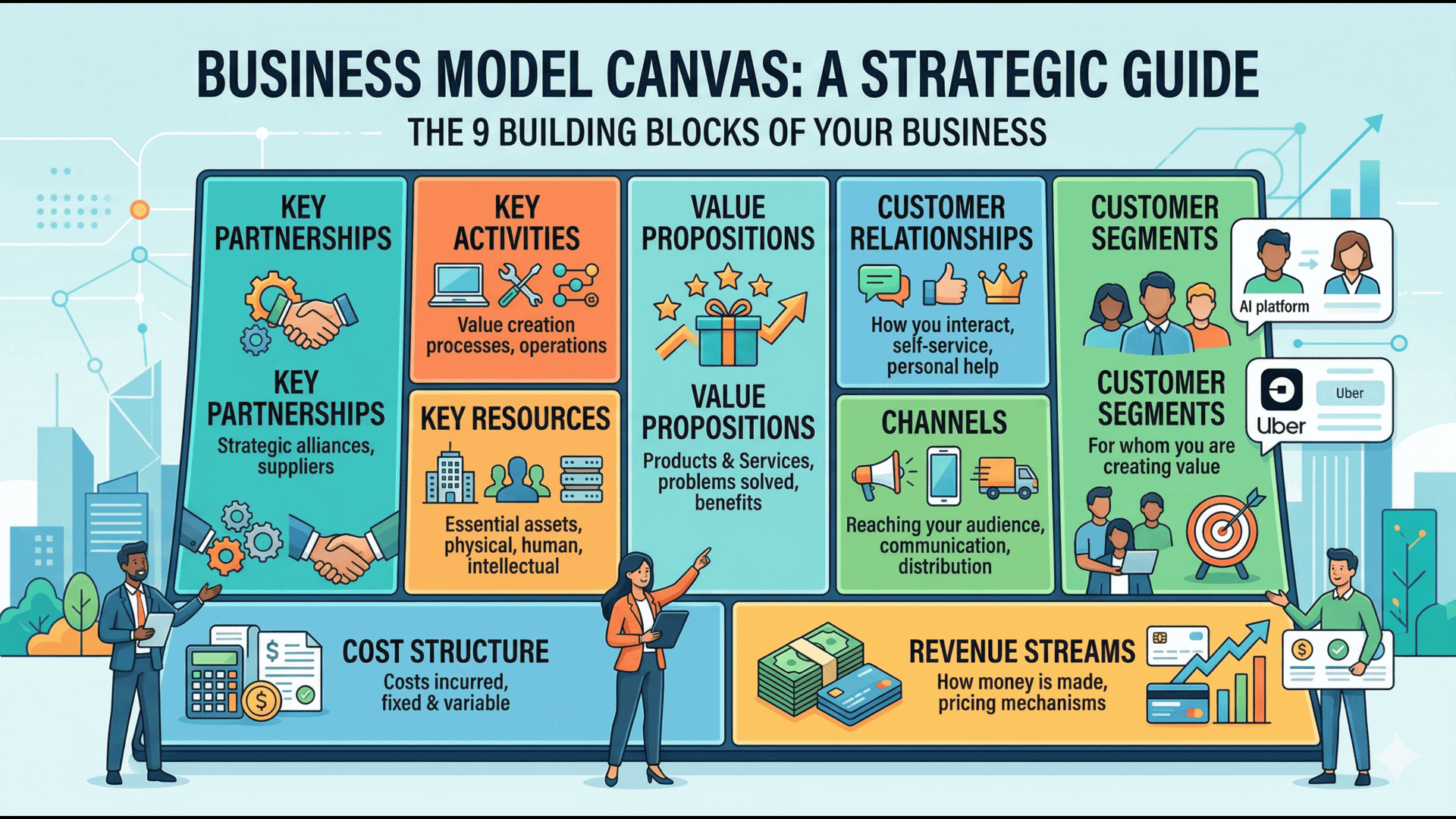
    Whether you are launching a cutting-edge artificial intelligence platform or opening a local coffee shop, the Business Model Canvas provides a clear, visual, and highly adaptable framework for understanding how your business creates, delivers, and captures value.

    In this comprehensive, 2000+ word guide, we will break down exactly what the Business Model Canvas is, explore its nine essential building blocks in deep detail, provide real-world examples, and answer the most frequently asked questions.


    What is the Business Model Canvas?

    The Business Model Canvas is a strategic management template used for developing new business models or documenting and improving existing ones. Created by Swiss business theorist Alexander Osterwalder and computer scientist Yves Pigneur, the canvas was introduced in their groundbreaking book, Business Model Generation.

    Instead of hiding your business strategy in a dense document that nobody reads, the BMC places your entire operational structure onto a single page. It is a visual chart featuring nine distinct elements that describe a company’s value proposition, infrastructure, customers, and finances.

    Why is the BMC so Popular?

    The beauty of the canvas lies in its simplicity and collaborative nature. It strips away the fluff of traditional business plans and forces teams to focus on the core drivers of success.

    • It creates a shared language: Everyone from the engineering team to the marketing department can look at the canvas and immediately understand the business goals.
    • It is inclusive and accessible: It removes confusing corporate jargon, making strategic planning accessible to everyone, regardless of their business background.
    • It promotes agility: Because it is a single page, you can easily erase, iterate, and update your strategy as market conditions change.

    The 9 Building Blocks of the Business Model Canvas

    To truly understand the Business Model Canvas, you need to understand its nine core building blocks. These blocks are divided into three main categories: Desirability (Customer-focused), Feasibility (Infrastructure-focused), and Viability (Finance-focused).

    Let’s break down each block in detail.

    1. Customer Segments (Who are you helping?)

    No business can survive without customers. This building block defines the different groups of people or organizations your enterprise aims to reach and serve. Because no product is for everyone, it is crucial to clearly define your target audience to ensure your messaging and product development are aligned with their needs.

    Types of Customer Segments:

    • Mass Market: Focusing on a broad group of people with similar needs (e.g., consumer electronics).
    • Niche Market: Catering to a specific, specialized customer segment (e.g., high-end camera equipment for professional filmmakers).
    • Segmented: Distinguishing between customer groups with slightly different needs and problems (e.g., a software company serving both small startups and large enterprise clients).
    • Diversified: Serving two completely unrelated customer segments with different needs.
    • Multi-Sided Platforms: Serving two or more interdependent customer segments (e.g., a credit card company needs both consumers to hold the cards and merchants to accept them).

    Questions to ask your team:

    • For whom are we creating value?
    • Who are our most important customers?
    • What are the specific demographics, behaviors, and pain points of our target audience?

    2. Value Propositions (What are you offering?)

    Your Value Proposition is the reason why customers turn to your company over your competitors. It solves a customer problem or satisfies a customer need. Each value proposition consists of a selected bundle of products and services that cater to the requirements of a specific Customer Segment.

    Elements that contribute to value creation:

    • Newness: Satisfying an entirely new set of needs that customers didn’t previously perceive because there was no similar offering (common in tech and AI innovations).
    • Performance: Improving the performance of an existing product or service.
    • Customization: Tailoring products to the specific needs of individual customers.
    • Design: Offering superior aesthetic design or usability.
    • Price: Offering similar value at a lower price point.
    • Cost/Risk Reduction: Helping customers reduce their own costs or minimize the risks they take when doing business.
    • Convenience: Making things easier to use or more accessible.

    Questions to ask your team:

    • What exact value do we deliver to the customer?
    • Which specific problem are we helping to solve?
    • What bundles of products or services are we offering to each Customer Segment?

    3. Channels (How do you reach them?)

    Channels describe how a company communicates with and reaches its Customer Segments to deliver its Value Proposition. .Channels are the customer touchpoints that play a critical role in the customer experience.

    Channel Phases:

    1. Awareness: How do we raise awareness about our products and services? (e.g., SEO blog posts, social media campaigns).
    2. Evaluation: How do we help customers evaluate our Value Proposition? (e.g., case studies, free trials).
    3. Purchase: How do we allow customers to purchase specific products? (e.g., web store, physical retail, app stores).
    4. Delivery: How do we deliver the Value Proposition? (e.g., instant digital download, courier shipping).
    5. After-Sales: How do we provide post-purchase customer support? (e.g., help desks, community forums).

    Types of Channels:

    • Direct: Sales force, online web sales, proprietary storefronts.
    • Indirect: Partner stores, wholesalers, affiliate networks.

    4. Customer Relationships (How do you interact with them?)

    This block describes the types of relationships a company establishes with specific Customer Segments. Relationships can range from highly personal to entirely automated, and they are driven by customer acquisition, customer retention, and upselling.

    Types of Customer Relationships:

    • Personal Assistance: Based on human interaction, such as speaking with a representative at the point of sale or via email.
    • Dedicated Personal Assistance: Assigning a specific representative to an individual client (e.g., key account managers for enterprise software clients).
    • Self-Service: Maintaining no direct relationship; providing all the means for customers to help themselves.
    • Automated Services: Mixing self-service with automated processes (e.g., recommending content based on past behavior).
    • Communities: Utilizing user communities to facilitate connections and solve problems collaboratively (e.g., a dedicated Discord server for users of a specific digital product).
    • Co-creation: Partnering with customers to create value (e.g., asking users to contribute content or feedback that shapes future product updates).

    5. Revenue Streams (How do you make money?)

    If customers are the heart of a business model, revenue streams are the arteries. This block represents the cash a company generates from each Customer Segment. A business must ask itself what value each customer segment is truly willing to pay for.

    Ways to Generate Revenue:

    • Asset Sale: Selling ownership rights to a physical product.
    • Usage Fee: Revenue generated by the use of a particular service (the more it is used, the more the customer pays).
    • Subscription Fees: Selling continuous access to a service (e.g., monthly access to an AI generation tool).
    • Lending/Renting/Leasing: Temporarily granting someone the exclusive right to use a particular asset for a fixed period in return for a fee.
    • Licensing: Giving customers permission to use protected intellectual property in exchange for licensing fees.
    • Brokerage Fees: Revenue derived from intermediation services performed on behalf of two or more parties.
    • Advertising: Revenue generated from fees for advertising a particular product, service, or brand.

    Pricing Mechanisms:

    • Fixed Pricing: Pre-defined prices based on static variables (list price, product feature dependent, customer segment dependent).
    • Dynamic Pricing: Prices change based on market conditions (negotiation, yield management, real-time market pricing).

    6. Key Resources (What assets do you need?)

    Key Resources describe the most important assets required to make your business model work. These are the inputs your organization needs to create your value proposition, reach your markets, and earn revenue.

    Types of Key Resources:

    • Physical: Manufacturing facilities, buildings, vehicles, point-of-sale systems, and distribution networks.
    • Intellectual: Brands, proprietary knowledge, patents, copyrights, partnerships, and customer databases.
    • Human: The workforce. Human resources are crucial in knowledge-intensive and creative industries (e.g., software engineers, content creators, data scientists).
    • Financial: Cash, lines of credit, or stock options needed to hire key employees or fund infrastructure.

    7. Key Activities (What do you need to do?)

    This block describes the most important things a company must do to make its business model successful. Just like Key Resources, Key Activities are required to create and offer a Value Proposition, reach markets, maintain Customer Relationships, and earn revenues.

    Types of Key Activities:

    • Production: Designing, making, and delivering a product in substantial quantities or of superior quality.
    • Problem Solving: Coming up with new solutions to individual customer problems (common in consultancies, hospitals, and service organizations).
    • Platform/Network: Activities related to maintaining and promoting a continuous platform (e.g., maintaining server uptime, updating algorithms, managing digital interfaces).

    8. Key Partnerships (Who will help you?)

    Companies rarely do everything on their own. The Key Partnerships block describes the network of suppliers and partners that make the business model work. Organizations forge partnerships to optimize their business models, reduce risk, or acquire resources.

    Types of Partnerships:

    • Strategic Alliances: Partnerships between non-competitors (e.g., an AI software company partnering with a major cloud hosting provider).
    • Coopetition: Strategic partnerships between competitors to grow the overall market or share massive infrastructure costs.
    • Joint Ventures: Partnerships to develop new businesses or enter new geographical markets.
    • Buyer-Supplier Relationships: Reliable relationships to guarantee access to necessary materials or services.

    Questions to ask your team:

    • Who are our key partners and suppliers?
    • Which Key Resources are we acquiring from partners?
    • Which Key Activities do partners perform better or more cost-effectively than we could?

    9. Cost Structure (What does it cost?)

    Creating and delivering value, maintaining customer relationships, and generating revenue all incur costs. This final building block describes all the financial consequences of operating under a particular business model.

    Classes of Business Structures:

    • Cost-Driven: Focuses on minimizing costs wherever possible (e.g., budget airlines). They feature lean structures, low-price value propositions, and maximum automation.
    • Value-Driven: Less concerned with the cost implications and more focused on value creation. High-end personalized service and premium materials characterize this approach.

    Characteristics of Cost Structures:

    • Fixed Costs: Costs that remain the same regardless of the volume of goods or services produced (e.g., salaries, rents, software subscriptions).
    • Variable Costs: Costs that vary proportionally with the volume of goods or services produced.
    • Economies of Scale: Cost advantages that a business enjoys as its output expands (e.g., bulk purchasing rates).
    • Economies of Scope: Cost advantages that a business enjoys due to a larger scope of operations.

    Business Model Canvas Examples

    To bring these concepts to life, let’s look at two detailed examples of how different organizations might map out their Business Model Canvas.

    Example 1: An AI Content Generation Platform

    Imagine a modern, tech-forward startup that provides users with advanced AI tools to generate high-quality images, videos, and digital content optimized for social media platforms like Twitter. Here is what their canvas might look like:

    • Customer Segments: Digital marketing agencies, independent content creators, social media managers, and tech-enthusiast hobbyists.
    • Value Propositions: Massive reduction in the time needed to create digital content; professional-grade, cinematic aesthetic without needing expensive graphic design software; rapid A/B testing capabilities for marketing campaigns.
    • Channels: Targeted social media advertising, SEO-optimized blog posts about content creation, community engagement on platforms like Discord and Reddit, and direct sales outreach for enterprise clients.
    • Customer Relationships: Primarily a self-service, automated SaaS relationship, bolstered by a strong, active community of users who share prompts and tips. Premium users get dedicated technical support.
    • Revenue Streams: Freemium model to acquire users, with tiered monthly subscriptions (e.g., Basic, Pro, Ultra) based on generation quotas and advanced feature access. API usage fees for enterprise integrations.
    • Key Resources: Proprietary AI models, massive computational server power, talented machine learning engineers, and user generation data to continuously train and improve the models.
    • Key Activities: Continuous model training and refinement, platform UI/UX maintenance, community management, and marketing content creation.
    • Key Partnerships: Cloud infrastructure providers (for server power), strategic partnerships with digital marketing agencies, and integrations with social media scheduling tools.
    • Cost Structure: High fixed costs for server and compute power, research and development payroll, marketing spend, and cloud hosting fees. It is a value-driven and scale-driven structure.

    Example 2: A Global Ride-Sharing App (e.g., Uber)

    For a contrast, let’s look at a multi-sided platform that connects two distinct groups of people in the physical world.

    • Customer Segments: 1. Passengers (people who need to get from point A to point B without owning a car).
    • 2. Drivers (people who own cars and want to earn flexible income).
    • Value Propositions: 1. For Passengers: Convenience, shorter wait times, cashless transactions, and clear pricing upfront.
    • 2. For Drivers: Flexible working hours, an easy way to earn money, and no need to find their own customers.
    • Channels: Mobile applications (iOS and Android stores), word-of-mouth, and local promotional events.
    • Customer Relationships: Highly automated self-service via the app. A rating system builds trust within the community, alongside automated customer support for ride issues.
    • Revenue Streams: Taking a percentage commission from every ride booked through the platform. Dynamic pricing (surge pricing) during high-demand times.
    • Key Resources: The proprietary software platform/algorithm, brand reputation, and the network of active drivers and passengers.
    • Key Activities: Platform development and maintenance, algorithmic optimization for routing and pricing, marketing to both drivers and riders, and regulatory lobbying.
    • Key Partnerships: Mapping technology providers, payment processing companies, and local insurance providers.
    • Cost Structure: Significant costs in marketing and customer acquisition, software development, legal and regulatory compliance, and customer support infrastructure.

    How to Create Your Own Business Model Canvas

    Now that you understand the blocks and have seen examples, it is time to build your own. Following a structured approach will ensure you get the most out of the exercise.

    Step 1: Gather the Right People

    Do not do this alone. The Business Model Canvas thrives on diverse perspectives. Bring together people from different departments—product development, marketing, sales, finance, and customer service. A cross-functional team will identify blind spots that a solo founder might miss.

    Step 2: Use the Right Medium

    While there are many digital tools available, the best way to start is often analog. Print a massive poster of the canvas and put it on a wall, or draw it on a large whiteboard. Use sticky notes and markers. Sticky notes are crucial because they can be easily moved or removed as your ideas evolve.

    Step 3: Start with Customers and Value

    Always begin by defining your Customer Segments and your Value Proposition. These two blocks are the core of your business. If you do not know who you are selling to and why they would buy from you, the rest of the canvas does not matter. Map out exactly how your product solves their specific pain points.

    Step 4: Work Through the Rest of the Blocks

    Once the core is established, move to Channels and Customer Relationships. Then, look at the back-end of your business: Key Resources, Activities, and Partnerships. Finally, calculate how the model makes financial sense by mapping out Revenue Streams and Cost Structure.

    Step 5: Review, Test, and Iterate

    Your first draft will be built heavily on assumptions. Do not treat the canvas as a final, static document. Take your canvas out into the real world. Talk to potential customers to validate your Value Proposition. Speak to potential partners to validate your costs. When you learn new information, go back to your canvas, rip off the old sticky notes, and replace them with validated facts.


    Common Mistakes to Avoid When Using the BMC

    Even with a straightforward tool like the canvas, teams can fall into several common traps. Keep an eye out for these pitfalls:

    • Mixing up Present and Future: Don’t put what your business currently is on the same canvas as what you hope it will be in five years. Create one canvas for the present state, and a separate one for the future state.
    • Being Too Vague: Writing “marketing” under Key Activities or “software” under Key Resources isn’t helpful. Be specific. Write “SEO content marketing” or “proprietary machine learning algorithms.”
    • Falling in Love with Your First Idea: The point of the canvas is rapid iteration. If the financial blocks show that the cost structure is higher than the revenue streams, don’t force it. Pivot and try a different model.
    • Orphaned Elements: Every element on the left side of the canvas (Infrastructure) must support an element on the right side (Value/Customers). If you list a Key Activity that doesn’t contribute to a Value Proposition, why are you doing it?

    Frequently Asked Questions (FAQ)

    What is the difference between a Business Model Canvas and a Lean Canvas?

    The Business Model Canvas was designed for existing businesses or well-funded startups to optimize and visualize their operations. The Lean Canvas is an adaptation created by Ash Maurya specifically for early-stage startups under conditions of extreme uncertainty. The Lean Canvas replaces elements like Key Partnerships and Customer Relationships with blocks focused on the Problem, Solution, Key Metrics, and Unfair Advantage.

    Who should use the Business Model Canvas?

    Everyone from solo entrepreneurs and small local business owners to executives at Fortune 500 companies can benefit from it. It is particularly useful for product managers, innovation teams, and startup founders who need to quickly align a team around a strategic vision.

    How often should I update my canvas?

    The canvas is a living document. You should update it whenever there is a significant shift in your market, when you introduce a new major product line, or when you learn new data that invalidates one of your previous assumptions. For active startups, reviewing the canvas quarterly is a good practice.

    Can the BMC be used for non-profits or charities?

    Absolutely. For non-profits, the “Revenue Streams” block is often reframed as “Funding Sources” (e.g., grants, donations), and “Customer Segments” might be split into “Beneficiaries” (who receives the help) and “Donors” (who funds the help). The logic of delivering value efficiently remains exactly the same.

    Does a Business Model Canvas replace a traditional business plan?

    In many modern contexts, yes. For internal alignment and fast-moving strategy, the BMC is superior. However, if you are applying for a traditional bank loan or pitching to certain conservative investors, they may still require a formal, written business plan alongside your financial projections. The BMC is often the best first step to outline the logic before writing the long-form document.


    References and Further Reading

    To continue expanding your knowledge on business modeling and strategic design, consider exploring the following highly authoritative resources:

    • Strategyzer: The official home of the Business Model Canvas. Strategyzer provides free downloads of the canvas, instructional videos, and advanced corporate innovation training. Visit their official site at Strategyzer.com

    • Business Model Generation: The foundational book by Alexander Osterwalder and Yves Pigneur. It is a highly visual, practical guide to designing tomorrow’s enterprises.

    • Harvard Business Review: HBR regularly publishes peer-reviewed articles and case studies on business model innovation, pivoting strategies, and value proposition design. Find relevant articles at hbr.org

  • The Ultimate Guide: How to Write a Winning Business Plan

    The Ultimate Guide: How to Write a Winning Business Plan

    Starting a new venture is an exciting journey, but without a clear roadmap, it is easy to lose your way. Whether you are launching a community-focused non-profit, a tech startup, or a local retail storefront, understanding how to write a winning business plan is your first critical step toward sustainable success.

    A business plan is much more than a document you hand to a bank or an investor. It is a living, breathing blueprint that guides your daily operations, clarifies your vision, and helps you anticipate challenges before they arise. In today’s dynamic economic landscape, a modern business plan must also reflect inclusivity, adaptability, and a deep understanding of diverse consumer needs.

    In this comprehensive, step-by-step guide, we will break down exactly how to craft a compelling, investor-ready business plan. We will cover everything from your executive summary to your financial projections, ensuring your ideas are communicated with clarity and confidence.


    Why Do You Need a Business Plan?

    Before diving into the “how,” it is vital to understand the “why.” Many aspiring founders believe that if their product is good enough, it will sell itself. However, reality dictates a different story. Here is why writing a business plan is non-negotiable:

    • To Secure Funding: Whether you are approaching venture capitalists, angel investors, or traditional financial institutions, nobody will fund an idea without a structured plan that proves profitability and scale.
    • To Mitigate Risk: The research required to write a business plan forces you to look at cold, hard facts. It helps you identify fatal flaws in your concept before you invest significant time and capital.
    • To Align Your Team: As you bring on co-founders, employees, and partners, your business plan serves as the ultimate source of truth, ensuring everyone is working toward the exact same goals.
    • To Establish Milestones: A good plan sets measurable, time-bound objectives, allowing you to track your progress and pivot when necessary.

    Traditional vs. Lean Startup Business Plans

    When deciding how to write a winning business plan, you must first choose a format. There is no universally correct way to format your plan, but most fall into one of two categories: traditional or lean startup.

    The Traditional Business Plan

    This is the most common format. It is highly detailed, comprehensive, and can range from 15 to 40 pages. Lenders and traditional investors generally expect this format. It requires deep research and outlines every conceivable aspect of your business operations up front.

    The Lean Startup Format

    If your business model is highly experimental, or if you need to launch quickly and iterate based on customer feedback, a lean startup plan might be better. This format focuses on summarizing only the most important points of the key elements of your business. It can often be condensed onto a single page and focuses on value propositions, infrastructure, customers, and finances.

    Tip: For the purpose of this guide, we will focus on the Traditional Business Plan, as it is the most rigorous and covers all the essential components you need to thoroughly understand your venture. If you can write a traditional plan, you can easily condense it into a lean format later.


    Step-by-Step: The 8 Essential Components of a Winning Business Plan

    A standard traditional business plan includes eight key sections. Follow these steps to build yours from the ground up.

    1. The Executive Summary

    Although this is the first section of your business plan, you should write it last. The executive summary is a high-level overview of everything else in the document. Its primary goal is to hook the reader and convince them that the rest of the plan is worth their time.

    What to include:

    • The Hook: A compelling opening statement about the problem you are solving.
    • Mission Statement: A clear, concise sentence explaining why your business exists.
    • Product/Service Summary: Briefly, what are you selling, and who are you selling it to?
    • Financial Highlights: If you are asking for money, state exactly how much you need and a brief summary of your projected growth over the next three years.
    • The Team: A quick highlight of why your founding team is uniquely equipped to succeed.

    Keep this section under two pages. Use active voice and inclusive language that demonstrates your business is forward-thinking and designed for a modern market.

    2. Company Description

    This section goes beyond the “what” and dives into the “who” and the “why.” Your company description provides detailed information about your business structure, your target market, and the specific problems your business solves.

    Key elements to define:

    • Business Structure: Are you a Sole Proprietorship, an LLC, a Corporation (C-Corp or S-Corp), or a Partnership?
    • Core Values: What principles guide your company? Modern winning business plans explicitly state commitments to ethical practices, environmental sustainability, and inclusive workspaces.
    • Vision Statement: Where do you see the company in five or ten years?
    • History (If applicable): If you are already operating, provide a brief history of your milestones, growth, and how you arrived where you are today.

    When describing your company, focus on your competitive advantages. Do you have a specialized workforce? Is your location strategically perfect? Do you hold patents? Highlight what makes you distinct.

    3. Market Research and Analysis

    You cannot build a winning business without deeply understanding the landscape in which you operate. A brilliant product will fail if there is no market demand for it. This section proves to the reader that you have done your homework.

    How to structure your market analysis:

    • Industry Overview: What is the current state of your industry? Is it growing or shrinking? What are the overarching trends? Use recent data and reference reputable sources.
    • Target Market (Demographics and Psychographics): Who is your ideal customer? Go beyond basic demographics (age, location, income). Include psychographics (values, interests, lifestyle). Ensure your market definition is inclusive; consider how accessible your product is to people of different abilities, backgrounds, and socioeconomic statuses.
    • Total Addressable Market (TAM): What is the total revenue opportunity available if you achieved 100% market share?
    • Competitor Analysis: Identify your direct and indirect competitors. Create a matrix that compares your business against theirs based on price, quality, customer service, and features. Be brutally honest about their strengths and your weaknesses.
    • Barriers to Entry: What obstacles will keep new competitors from popping up and stealing your market share? (e.g., high capital costs, proprietary technology, strong brand loyalty).

    4. Organization and Management

    Investors invest in people just as much as they invest in ideas. Use this section to showcase the talent, experience, and structure of your workforce.

    What to include:

    • Organizational Chart: A visual representation of your company’s hierarchy. Show who is in charge of what.
    • Leadership Profiles: Include brief resumes for your founders, executives, and key managers. Highlight their past successes and relevant industry experience.
    • Diversity and Inclusion Initiatives: Modern investors value diverse teams because diverse teams build better, more resilient products. Briefly outline your commitment to inclusive hiring practices and fostering a workplace where all voices are valued.
    • Advisors and Board Members: If you have an advisory board or a board of directors, list them here. Associating your business with experienced mentors adds immediate credibility.

    5. Service or Product Line

    Here is where you detail exactly what you are offering. Keep the jargon to a minimum; your reader might not be a technical expert in your field. Explain your product or service simply, focusing on the benefits to the end user rather than just the features.

    Detailing your offering:

    • The Value Proposition: How does your product solve the customer’s problem or improve their life?
    • Product Lifecycle: Where is your product right now? Is it an idea, a working prototype, or already in production? What are your plans for future iterations?
    • Intellectual Property (IP): Detail any copyrights, trademarks, or patents you hold or have applied for. If you have exclusive agreements with suppliers, mention them here.
    • Sourcing and Fulfillment: How is your product made? Who are your suppliers? Emphasize if you are prioritizing ethically sourced materials or partnering with fair-trade organizations, as this builds trust and brand equity.

    6. Marketing and Sales Strategy

    A great product needs a great strategy to reach its audience. Your marketing and sales strategy outlines how you will attract and retain customers. This section should directly correlate with the target audience you identified in your Market Analysis.

    Break this down into two parts:

    Marketing Strategy:

    • Positioning: How do you want the market to perceive your brand? Are you a luxury option, a budget-friendly alternative, or a highly specialized tool?
    • Promotion: What channels will you use to reach your audience? Will you rely on social media marketing, content marketing (SEO), paid advertising, PR, or community events?
    • Inclusive Marketing: Explain how your marketing efforts will resonate with a diverse audience. Ensure your messaging, imagery, and campaigns do not rely on stereotypes and actively welcome all communities.

    Sales Strategy:

    • The Sales Funnel: How will you convert a stranger into a paying customer? Walk the reader through the customer journey.
    • Sales Force: Will you have an internal sales team, use independent representatives, or rely on a self-serve e-commerce platform?
    • Pricing Strategy: How much will you charge? Are you using a subscription model, one-time purchases, or a freemium model? Justify your pricing based on your competitor analysis and cost of goods sold.

    7. Funding Request and Financial Projections

    This is arguably the most critical section for anyone seeking investment or a loan. You must translate all your previous strategies into numbers. Financial projections can be intimidating, but they are simply an educated forecast of your business’s financial health.

    If you are asking for funding, state clearly:

    • How much money you need right now.
    • How much money you will need in the future.
    • Exactly what you will use the funds for (e.g., equipment, marketing, salaries, research and development).
    • What type of funding you are seeking (debt vs. equity).

    The Financial Statements (Projections):

    You will need to provide forecasted financial statements for the next three to five years. For the first year, break these down month-by-month.

    • Income Statement (Profit & Loss): This shows your projected revenues, expenses, and whether you will make a profit or take a loss.
    • Cash Flow Statement: This tracks the actual cash coming in and going out of your business. Cash flow is different from profit. A business can be profitable on paper but still fail because it runs out of cash to pay its bills.
    • Balance Sheet: A snapshot of your company’s financial position at a specific point in time, detailing your assets, liabilities, and equity.
    • Break-Even Analysis: A calculation showing exactly how much revenue you need to generate to cover all your fixed and variable costs. This tells investors when the business will become self-sustaining.

    Important: Be realistic. It is tempting to project massive, exponential growth, but investors will see right through inflated numbers. Base your projections on the market research you conducted in Step 3.

    8. Appendix

    The appendix is the final section of your business plan. It is the designated place for any supporting documents, charts, or detailed data that would otherwise clutter the main body of your plan.

    Common items to include in an appendix:

    • Full resumes of key personnel.
    • Credit histories (personal and business).
    • Detailed market research data or survey results.
    • Copies of licenses, permits, or patents.
    • Legal documents and contracts.
    • Product pictures or blueprints.
    • Letters of reference from early customers or industry experts.

    Pro-Tips for a Winning Business Plan Document

    Writing the content is only half the battle. How you present your business plan matters significantly. Consider these best practices to ensure high readability and professionalism:

    1. Keep it Concise: While we are covering a lot of ground, your actual text should be punchy and direct. Avoid rambling. Use bullet points and short paragraphs to make the document highly scannable.
    2. Use Visuals: Break up walls of text with charts, graphs, and images. A well-designed pie chart showing your market breakdown is much easier to digest than a full paragraph explaining the same data.
    3. Proofread Relentlessly: Spelling and grammatical errors signal a lack of attention to detail—a major red flag for investors. Have multiple people review the document before you finalize it. Use inclusive language checkers to ensure your tone is appropriate and welcoming.
    4. Format Consistently: Use a clean, professional font (like Arial, Helvetica, or Garamond). Ensure your headings are consistent, and include a table of contents with page numbers.
    5. Treat It as a Living Document: A winning business plan is never truly “finished.” The market changes, your product evolves, and your team grows. Revisit and update your business plan at least once a year, or whenever you hit a major milestone.

    Frequently Asked Questions (FAQ)

    Q: How long should my business plan be?

    A: A traditional business plan typically ranges from 15 to 30 pages, excluding the appendix. The length depends on the complexity of your business. However, prioritize clarity over word count. An investor will prefer a concise 15-page plan over a repetitive 40-page one.

    Q: Can I write a business plan myself, or do I need to hire a professional?

    A: You absolutely can—and should—write the first draft yourself. Writing it forces you to deeply understand every aspect of your business. However, it is highly recommended to consult with an accountant or financial advisor to review your financial projections, as this is where most founders make critical errors.

    Q: What is the most common mistake people make in their business plans?

    A: Unrealistic financial projections and ignoring the competition. Founders often underestimate their expenses and overestimate their immediate market capture. Furthermore, claiming “we have no competition” shows a lack of market understanding; there are always direct or indirect competitors vying for your customer’s time and money.

    Q: Do I need a business plan if I am not looking for investors or a loan?

    A: Yes. Even if you are entirely self-funded, a business plan serves as your strategic roadmap. It helps you set milestones, align your team, and measure your success against your initial projections. It keeps you focused on your core mission when daily operations become chaotic.

    Q: How do I calculate the Total Addressable Market (TAM)?

    A: TAM represents the maximum potential revenue if you captured 100% of your target market. You can calculate it using a “top-down” approach (taking macroeconomic data and narrowing it down to your specific niche) or a “bottom-up” approach (multiplying your expected average sale price by the total number of potential customers). The bottom-up approach is generally considered more accurate and realistic by investors.

    Q: How often should I update my business plan?

    A: You should review your business plan quarterly and do a comprehensive update annually. You should also update it immediately if you pivot your business model, add a new major product line, or prepare for a new round of funding.


    References and Resources for Further Reading

    To continue your journey and refine your business plan further, explore these highly respected resources:

    • U.S. Small Business Administration (SBA): Provides comprehensive templates and free guides on writing traditional and lean startup business plans. Visit SBA.gov

    • SCORE: A nonprofit organization offering free, confidential business mentoring and a massive library of business planning templates. Visit SCORE.org

    • Harvard Business Review (HBR): An excellent resource for advanced articles on market analysis, strategic planning, and leadership structure. Visit HBR.org

    • Bplans: Offers a vast collection of free sample business plans across hundreds of different industries, which can be incredibly helpful for inspiration. Visit Bplans.com

    Building a winning business plan takes time, patience, and deep thought. However, the clarity it provides and the doors it opens are well worth the effort. By prioritizing structure, relying on solid data, and embracing inclusive, forward-thinking strategies, you will build a foundation that sets your business up for long-term success.

  • 15 Profitable Online Business Ideas That Actually Work

    15 Profitable Online Business Ideas That Actually Work

    Are you looking to break free from the traditional 9-to-5 workday? Do you dream of building a flexible lifestyle where you can work from anywhere, set your own hours, and be your own boss? If so, starting an online business might be the perfect path for you.

    The digital landscape has transformed dramatically, making it easier than ever for people from all walks of life to launch successful ventures from their living rooms. Whether you are a stay-at-home parent, a recent graduate, or a seasoned professional looking for a career pivot, the internet offers boundless opportunities to monetize your skills and passions.

    However, with so much information available, finding an online business idea that actually works can feel overwhelming. You do not need to invent the next tech giant to be successful. Often, the most profitable online businesses are built on simple concepts, executed exceptionally well.

    In this comprehensive guide, we will explore 15 proven online business ideas, how to get started, and answer some of the most frequently asked questions about digital entrepreneurship.


    Why Start an Online Business?

    Before diving into the ideas, it is helpful to understand why the online business model is so appealing:

    • Low Barrier to Entry: Unlike brick-and-mortar stores, many online businesses require very little upfront capital. You can often start with just a laptop and an internet connection.
    • Flexibility and Autonomy: You have the power to create a schedule that accommodates your personal life, health needs, and family commitments.
    • Global Reach: Your customer base is not limited to your local geographical area. You can connect with clients and customers around the world.
    • Scalability: Digital businesses can often grow exponentially without a proportional increase in overhead costs.

    15 Online Business Ideas to Start Today

    Here are 15 actionable, inclusive, and realistic online business ideas that have proven to be successful for countless entrepreneurs.

    1. Freelance Writing and Copywriting

    Every business needs words. From website copy and blog posts to email newsletters and social media captions, the demand for clear, engaging writing is endless. If you have a way with words, freelance writing is an excellent way to start an online business with zero overhead.

    • How it works: You offer your writing services to businesses, publications, or agencies on a contract basis.
    • Skills needed: Strong command of grammar, research skills, adaptability in tone, and an understanding of basic SEO (Search Engine Optimization).
    • Startup costs: Very low. You just need a computer, internet, and perhaps a portfolio website.
    • Pro tip: Pick a niche. Writers who specialize in technical writing, medical writing, or B2B (business-to-business) finance often command much higher rates than generalist writers.

    2. Virtual Assistant (VA) Services

    As more entrepreneurs and small business owners build their own companies, they quickly realize they cannot do everything themselves. Virtual assistants step in to handle administrative, technical, or creative tasks remotely.

    • How it works: You provide administrative support to clients from a remote location. Tasks can range from managing emails and scheduling appointments to basic bookkeeping and customer service.
    • Skills needed: Extreme organization, excellent communication, time management, and familiarity with digital tools like Google Workspace, Slack, and project management software (like Trello or Asana).
    • Startup costs: Low.
    • Pro tip: Focus on specialized VA services. For example, becoming a VA who specifically helps podcast hosts manage their guest bookings and audio editing can make you highly sought after.

    3. E-commerce and Dropshipping

    Selling physical products online remains a massive industry. Dropshipping is a specific e-commerce model where you sell products without ever holding inventory. When a customer buys from your store, a third-party supplier ships the item directly to them.

    • How it works: You set up a digital storefront (using platforms like Shopify or WooCommerce), market products, and forward orders to a supplier.
    • Skills needed: Digital marketing (especially social media and paid advertising), customer service, and an eye for trending products.
    • Startup costs: Moderate. You will need to pay for website hosting, an e-commerce platform subscription, and marketing campaigns.
    • Pro tip: Success in dropshipping relies heavily on finding reliable suppliers and providing excellent customer service to mitigate the longer shipping times often associated with this model.

    4. Affiliate Marketing

    If you enjoy creating content and building an audience, affiliate marketing can be a highly lucrative passive income stream.

    • How it works: You promote other companies’ products or services on your blog, social media, or YouTube channel. When someone makes a purchase using your unique affiliate link, you earn a commission.
    • Skills needed: Content creation, SEO, audience building, and digital marketing.
    • Startup costs: Low. You mainly need a platform to share your content, such as a blog or social media account.
    • Pro tip: Only promote products you genuinely believe in and that align with your audience’s interests. Authenticity builds trust, which leads to higher conversion rates.

    5. Creating and Selling Online Courses

    People are constantly looking to learn new skills, whether for career advancement or personal enrichment. If you possess deep knowledge in a specific area, you can package that expertise into an online course.

    • How it works: You record video lessons, create worksheets, and compile resources into a structured curriculum. You can host this on platforms like Teachable, Udemy, or Skillshare.
    • Skills needed: Expertise in a specific subject, video recording/editing basics, and instructional design.
    • Startup costs: Moderate. You may need a good microphone, a webcam, and a subscription to a course hosting platform.
    • Pro tip: Validate your course idea before spending months creating it. Offer a live, mini-version of the class via Zoom to gauge interest and gather feedback.

    6. Social Media Management

    Many business owners know they should be on social media, but they lack the time or understanding to manage it effectively.

    • How it works: You take over a brand’s social media presence. This includes creating content calendars, designing posts, engaging with followers, and analyzing metrics.
    • Skills needed: Understanding of different social media algorithms, basic graphic design (using tools like Canva), copywriting, and trend forecasting.
    • Startup costs: Low. Access to social media scheduling tools (like Buffer or Hootsuite) is helpful.
    • Pro tip: Specialize in one or two platforms where you excel (e.g., TikTok and Instagram) rather than trying to be a master of every single network.

    7. Graphic Design Services

    Visual communication is vital for modern brands. From logos and brand kits to website layouts and marketing materials, the need for skilled graphic designers is constant.

    • How it works: You work with clients to bring their visual ideas to life. You can find clients on freelance platforms, through networking, or via social media.
    • Skills needed: Proficiency in design software (like Adobe Creative Cloud), an understanding of typography and color theory, and strong client communication.
    • Startup costs: Moderate. You will need a capable computer and subscriptions to professional design software.
    • Pro tip: Create a strong digital portfolio showcasing your best work. Often, clients care more about your portfolio than your formal education.

    8. Web Development and Design

    Every new business needs a website. If you know how to build beautiful, functional, and responsive websites, you have a highly marketable skill.

    • How it works: You build and maintain websites for clients. This can range from simple WordPress setups to complex, custom-coded web applications.
    • Skills needed: Knowledge of coding languages (HTML, CSS, JavaScript) or deep expertise in content management systems (WordPress, Squarespace, Webflow).
    • Startup costs: Low to moderate.
    • Pro tip: Offer ongoing maintenance packages. Once you build a website, the client will likely need updates, security checks, and backups, creating a recurring revenue stream for you.

    9. SEO Consulting

    Search Engine Optimization (SEO) is the art and science of getting websites to rank higher on Google. Because high rankings translate to free traffic and revenue, businesses are willing to pay top dollar for SEO experts.

    • How it works: You audit client websites, conduct keyword research, optimize content, and build backlinks to improve their search engine visibility.
    • Skills needed: Deep understanding of search algorithms, data analysis, content strategy, and familiarity with SEO tools (like Ahrefs or SEMrush).
    • Startup costs: Moderate. Professional SEO tools can be expensive but are necessary for serious consulting.
    • Pro tip: SEO changes constantly. Commit to continuous learning and stay updated on the latest algorithm updates to provide the best value to your clients.

    10. Print-on-Demand (POD)

    Similar to dropshipping, print-on-demand allows you to sell custom merchandise without holding inventory.

    • How it works: You create designs for products like t-shirts, mugs, phone cases, and tote bags. When a customer orders an item from your online store, a third-party service prints your design on the product and ships it.
    • Skills needed: Graphic design (or the ability to hire designers) and digital marketing.
    • Startup costs: Low. You only pay for the product after you have made a sale.
    • Pro tip: Focus on specific niches or communities. Designs tailored to dog lovers, specific hobbies, or professions often sell much better than generic designs.

    11. Starting a Podcast

    Podcasting has exploded in popularity. While it takes time to monetize, a successful podcast can become a thriving business through sponsorships, listener support, and merchandise.

    • How it works: You record and publish audio episodes around a specific theme or topic. As your listenership grows, you can monetize the audience.
    • Skills needed: Excellent speaking and interviewing skills, audio editing, and consistent content planning.
    • Startup costs: Moderate. A high-quality microphone and good editing software are crucial for professional sound.
    • Pro tip: Consistency is key in podcasting. Commit to a regular publishing schedule so your audience knows when to expect new content.

    12. Selling Digital Products

    Digital products are items that can be downloaded or accessed online. This includes e-books, printable planners, Notion templates, stock photography, or digital art.

    • How it works: You create the product once and can sell it an infinite number of times. You can sell these on platforms like Etsy, Gumroad, or your own website.
    • Skills needed: Varies based on the product (e.g., writing for e-books, design for templates).
    • Startup costs: Very low.
    • Pro tip: Digital products have incredible profit margins. Focus your efforts on marketing and optimizing your sales pages to maximize conversions.

    13. Online Coaching or Consulting

    If you have successfully navigated a specific challenge or achieved a high level of success in your career, you can help others do the same.

    • How it works: You work one-on-one or in group settings to guide clients toward their goals. This could be life coaching, business consulting, career coaching, or fitness training.
    • Skills needed: Empathy, active listening, deep expertise in your field, and the ability to motivate others.
    • Startup costs: Low. You primarily need video conferencing software and a system for booking appointments.
    • Pro tip: Clearly define your target audience and the specific transformation you offer. “I help new moms transition back to the corporate workplace” is much more compelling than “I am a career coach.”

    14. Translation Services

    In our increasingly globalized world, the ability to bridge language barriers is incredibly valuable.

    • How it works: You translate written documents, audio, or video content from one language to another for businesses, authors, or content creators.
    • Skills needed: Fluency in at least two languages, cultural nuance understanding, and strong writing skills in the target language.
    • Startup costs: Very low.
    • Pro tip: Specialize in a specific industry. Legal, medical, or technical translators are often in higher demand and can charge premium rates due to the complex terminology involved.

    15. Subscription Box Service

    The subscription box industry curates specific products and delivers them to customers on a recurring basis (usually monthly).

    • How it works: You select a niche (e.g., gourmet coffee, eco-friendly beauty products, books), source the products, package them beautifully, and ship them to subscribers.
    • Skills needed: Product sourcing, branding, logistics/shipping management, and customer retention strategies.
    • Startup costs: High. You need capital to purchase inventory upfront, design custom packaging, and handle initial shipping costs.
    • Pro tip: The packaging and unboxing experience is just as important as the products inside. Make your boxes highly “Instagrammable” to encourage organic social media sharing.

    How to Choose the Right Online Business for You

    With 15 viable options, how do you decide? Consider the following framework:

    1. Assess Your Current Skills: What are you already good at? If you are highly organized, a Virtual Assistant business makes sense. If you are a natural storyteller, consider freelance writing or podcasting.
    2. Determine Your Budget: Be realistic about what you can invest. If you have zero capital, start a service-based business (like consulting or design). If you have some funds, you might explore e-commerce or subscription boxes.
    3. Evaluate Your Lifestyle Needs: Do you need a business that you can run purely on weekends? Affiliate marketing or digital products might be best. Are you looking for a full-time, client-facing career? Consider coaching or web development.
    4. Research the Market: Look at competitors in your chosen space. Is there demand? How can you differentiate yourself, provide better value, or serve an underrepresented audience?

    Frequently Asked Questions (FAQ)

    Q: Do I need a formal business degree to start an online business?

    A: Absolutely not. While a degree can be helpful, it is not a requirement. Countless successful online entrepreneurs are self-taught, utilizing free resources, online courses, and hands-on experience to build their companies.

    Q: How long does it take to make money with an online business?

    A: This varies wildly. Service-based businesses (like freelance writing) can generate income within a few weeks of landing your first client. Audience-based businesses (like blogging, podcasting, or affiliate marketing) can take 6 to 18 months of consistent effort before seeing significant financial returns.

    Q: Do I need to register my online business immediately?

    A: Regulations vary by country and region. In many places, you can operate as a “sole proprietor” initially. However, as your business grows and generates consistent income, it is highly recommended to consult with a legal or tax professional about registering your business (such as forming an LLC) to protect your personal assets.

    Q: How do I find my first clients or customers?

    A: Leverage your existing network first. Tell friends, family, and former colleagues about your new venture. Utilize social media platforms to showcase your expertise. For freelancers, platforms like Upwork or Fiverr can help you get initial experience, though networking and cold-pitching often yield higher-paying clients in the long run.

    Q: Is the online business market too saturated?

    A: While it is true that many markets are crowded, there is always room for high-quality work, unique perspectives, and exceptional customer service. The key is to narrow your focus, find a specific niche, and serve that audience better than anyone else.


    Conclusion

    Starting an online business is an empowering journey that offers incredible potential for financial independence and personal fulfillment. Remember that success rarely happens overnight. It requires patience, consistency, a willingness to learn from failures, and a commitment to providing real value to your customers or clients.

    Choose the idea that best aligns with your skills and resources, take that critical first step, and start building the digital career you envision.


    References and Resources for Further Reading

    To continue your journey, explore these trusted resources on online business and entrepreneurship:

  • The Ultimate Guide to Launching a Startup in 2026

    The Ultimate Guide to Launching a Startup in 2026

    The entrepreneurial landscape is evolving faster than ever before. As we navigate through 2026, launching a startup looks vastly different than it did just a few years ago. The rapid democratization of artificial intelligence, a permanent shift toward globally distributed teams, and an undeniable consumer demand for sustainable, ethical business practices have entirely rewritten the playbook.

    Whether you are a first-time founder or a seasoned entrepreneur looking to build something new, the barriers to entry have never been lower—but the bar for success has never been higher. Today’s most successful startups are those that prioritize inclusive design, leverage cutting-edge technology responsibly, and solve genuine human problems.

    If you are ready to turn your vision into a reality, this comprehensive, step-by-step guide will walk you through exactly how to launch a startup in 2026.


    Step 1: Ideation and Validation in a Hyper-Connected World

    The best startups are born from a deep understanding of a specific problem. However, in 2026, simply having a good idea is not enough; you must validate it quickly and inclusively.

    Find a Problem Worth Solving

    Start by observing the world around you. What systems are broken? Who is being underserved by current market offerings? The most impactful startups often emerge from marginalized or overlooked communities. Look for problems that cause tangible friction in people’s daily lives or business operations.

    Inclusivity in Market Research

    When validating your idea, ensure your focus groups and survey demographics reflect the diverse reality of your potential user base.

    • Broaden Your Reach: Do not just survey your immediate network. Use global research platforms to gather feedback from people of different ages, cultural backgrounds, and abilities.
    • Empathy Interviews: Conduct one-on-one interviews. Ask open-ended questions and actively listen to the lived experiences of your potential customers.
    • Accessibility as a Baseline: Ask yourself early on: How will individuals with visual, auditory, or cognitive disabilities interact with this solution? ### Leverage Predictive Analytics and AI

    Use AI-driven market analysis tools to spot emerging trends before they peak. While human intuition is irreplaceable, predictive analytics can help you understand search intent, analyze competitor gaps, and validate whether the market for your solution is growing or shrinking.


    Step 2: Building an Inclusive and Remote-First Team

    The concept of a “headquarters” is largely a relic of the past. In 2026, the best talent is global, and your hiring strategy should reflect that. Building a diverse team is not just a moral imperative; it is a profound competitive advantage. Diverse teams build more robust, creative, and universally appealing products.

    Adopting a Global Mindset

    By removing geographic barriers, you open your startup to a wealth of perspectives.

    • Hire for Culture Add, Not Culture Fit: Instead of looking for people who think exactly like you, seek out individuals who bring new viewpoints, experiences, and problem-solving approaches to the table.
    • Equitable Compensation: Utilize modern global payroll platforms that help calculate fair, equitable salaries based on cost-of-living algorithms and local market rates, ensuring everyone is paid fairly regardless of their zip code.

    Designing an Asynchronous Work Culture

    To make a globally distributed team function smoothly, you must master asynchronous (async) communication.

    • Documentation is Key: Maintain a central, accessible knowledge base where all decisions, processes, and meeting notes are recorded.
    • Respect Boundaries: Implement strict policies regarding working hours and communication expectations to prevent burnout. Use scheduling features on messaging apps to ensure pings only arrive during a colleague’s working hours.
    • Prioritize Mental Health: Startups are inherently stressful. Offer comprehensive mental wellness benefits, flexible time off, and create a psychologically safe environment where team members feel comfortable voicing concerns without fear of judgment.

    Step 3: Crafting a Sustainable and Ethical Business Model

    Investors and consumers in 2026 are highly skeptical of companies that prioritize growth at all costs. Modern startups must build environmental, social, and governance (ESG) principles directly into their DNA from day one.

    The Shift Toward the Circular Economy

    If you are building a physical product, how can you minimize waste? Consider a circular business model where products are designed for durability, repairability, and recycling.

    • Eco-Friendly Supply Chains: Source materials ethically and transparently. Partner with vendors who share your commitment to a net-zero carbon footprint.
    • Digital Sustainability: Even software companies have a carbon footprint. Optimize your code, choose green web hosting providers that run on renewable energy, and minimize unnecessary data storage.

    Ethical AI and Data Privacy

    If your startup utilizes artificial intelligence—which most now do—you must govern it ethically.

    • Eliminate Bias: Regularly audit your AI models to ensure they are not perpetuating historical biases against marginalized groups.
    • Data Sovereignty: Treat user data with the utmost respect. Adopt a “privacy-by-design” approach, collecting only the data you absolutely need and giving users complete control over their information in compliance with the latest global privacy frameworks.

    Step 4: Funding Your Startup in 2026

    The venture capital landscape has shifted toward sustainable growth and proven unit economics. While funding is abundant for the right ideas, the avenues to secure it have diversified.

    Bootstrapping and Lean Operations

    The proliferation of low-code and no-code tools means it has never been cheaper to build a Minimum Viable Product (MVP). Bootstrapping allows founders to retain equity and maintain control over the company’s direction. Focus on achieving early revenue to fund your own growth.

    Venture Capital and Angel Investors

    If you choose the VC route, look for partners who align with your core values.

    • Diverse Investor Pools: Seek out funds that are led by or specifically support underrepresented founders.
    • Focus on Profitability: Be prepared to show investors a clear, realistic path to profitability, not just user acquisition metrics.

    Alternative Funding Mechanisms

    • Crowdfunding: Platforms like Kickstarter or Wefunder remain excellent ways to validate your product while raising capital directly from your future customers.
    • Web3 Grants and DAOs: For startups operating in decentralized technologies or open-source software, Decentralized Autonomous Organizations (DAOs) and protocol grants offer innovative, community-driven funding models.
    • Government Grants: Many governments offer substantial non-dilutive grants for startups tackling climate change, healthcare, or educational inequity.

    Step 5: Product Development and Rapid Prototyping

    Speed to market is critical, but it should not come at the expense of usability or accessibility.

    Leveraging Low-Code and No-Code Platforms

    You no longer need a team of expensive engineers to launch version one of your product. Utilize platforms that allow you to drag-and-drop interfaces and connect databases visually. This significantly drastically reduces the time and cost required to test your assumptions in the real world.

    Iterative Development (Agile Methodology)

    Do not build in a vacuum. Release your MVP to a small, diverse group of early adopters as quickly as possible.

    • Gather Feedback: Use integrated feedback tools to understand where users are getting stuck.
    • Iterate Quickly: Implement changes based on real user data, not your own assumptions. Your product should be in a constant state of evolution.

    Inclusive Design and Web Content Accessibility Guidelines (WCAG)

    Your product must be usable by everyone. Adhere to the latest WCAG standards from the very beginning.

    • Color Contrast: Ensure text is readable for those with color vision deficiencies.
    • Screen Reader Compatibility: Structure your code so that visually impaired users can navigate your app seamlessly using screen readers.
    • Simple Language: Write user interfaces and error messages in clear, jargon-free language that is easily understood by people of all cognitive abilities and language proficiencies.

    Step 6: Go-to-Market Strategy and Community-Led Growth

    Traditional interruption marketing (like aggressive pop-up ads and cold calling) is increasingly ineffective. Consumers in 2026 want authenticity, community, and connection.

    Community-Led Growth

    Instead of just acquiring “users,” focus on building a community around the problem you are solving.

    • Create Safe Spaces: Host forums, Discord servers, or regular virtual town halls where your customers can connect with each other, share best practices, and interact directly with your team.
    • Empower Advocates: Identify your most passionate community members and empower them to become brand ambassadors. People trust peer recommendations far more than corporate advertising.

    Authentic and Inclusive Marketing

    Your marketing materials should reflect the diverse world we live in without resorting to tokenism.

    • Representative Imagery: Use photos and videos that feature people of different ages, races, body types, and abilities naturally interacting with your product.
    • Accessible Content: Ensure all promotional videos have accurate closed captions, and all social media images include descriptive alt-text.
    • Value-Driven Storytelling: Share the why behind your startup. Be transparent about your successes, your failures, and your ongoing efforts to be a socially responsible company.

    Step 7: Navigating Legal, Compliance, and Administrative Setup

    While it is the least glamorous part of launching a startup, establishing a solid legal foundation is critical to protecting your team and your intellectual property.

    Entity Formation and IP Protection

    • Choose the Right Structure: Consult with a legal professional to determine whether an LLC, C-Corp, or B-Corp is the best structure for your goals. (B-Corps are highly recommended for founders emphasizing social and environmental impact).
    • Protect Your Ideas: File for trademarks on your brand name and logo early. If you have unique, proprietary technology, explore patent protection.

    Compliance in a Borderless World

    Operating globally means navigating a complex web of international regulations.

    • Data Privacy Laws: Familiarize yourself with regulations like the GDPR in Europe, the CCPA in California, and emerging AI safety acts globally. Non-compliance can result in devastating fines.
    • Labor Laws: If you are hiring internationally using an Employer of Record (EOR), ensure you are fully compliant with the labor laws, tax codes, and mandatory benefits of each employee’s home country.

    Conclusion: The Journey Ahead

    Launching a startup in 2026 requires a delicate balance of rapid technological adoption and profound human empathy. The blueprint for success is no longer just about disrupting markets; it is about elevating communities, solving real crises, and building sustainable systems that will outlast us.

    Entrepreneurship is a marathon, not a sprint. There will be setbacks, pivot points, and moments of doubt. However, by centering your business around inclusive practices, remaining adaptable to technological shifts, and staying true to your core mission, you will be well-equipped to build a startup that not only succeeds financially but leaves a lasting, positive impact on the world.


    Frequently Asked Questions (FAQ)

    1. Do I need a technical co-founder to launch a tech startup in 2026?

    Not necessarily. While having a technical co-founder is incredibly valuable, the rise of advanced no-code/low-code tools and AI-assisted programming allows non-technical founders to build fully functional Minimum Viable Products (MVPs) on their own. As you scale, you can hire technical talent or fractional CTOs to build out custom infrastructure.

    2. How much money do I need to start?

    The cost to launch has decreased significantly. Depending on your industry, you can launch a software MVP for less than $500 using cloud services and no-code tools. However, physical products, deep-tech (like advanced AI or biotech), and hardware still require substantial upfront capital for research, development, and manufacturing.

    3. What is a B-Corp, and should I become one?

    A Certified B Corporation (B-Corp) is a business that meets the highest standards of verified social and environmental performance, public transparency, and legal accountability to balance profit and purpose. If your startup is dedicated to sustainable and ethical practices, becoming a B-Corp can build immense trust with modern consumers and attract impact-focused investors.

    4. How do I protect my startup from failing?

    There is no guaranteed way to prevent failure, but you can drastically reduce the risk by validating your idea early with real people. Do not spend months building in secret. Talk to potential users immediately, test your assumptions with small experiments, and be willing to pivot if the data shows the market doesn’t want what you are building.

    5. How can I ensure my hiring process is inclusive?

    Start by standardizing your interview process so all candidates are evaluated against the exact same criteria. Use blind resume screening tools to remove unconscious bias regarding names or educational backgrounds. Ensure your job descriptions use gender-neutral language and explicitly state your commitment to building a diverse workplace. Finally, proactively source candidates from underrepresented professional networks and communities.


    Helpful Reference Links for Founders

    • Y Combinator Startup Library: Comprehensive resources, essays, and templates for early-stage founders. ycombinator.com/library

    • Web Content Accessibility Guidelines (WCAG): The international standard for making web content more accessible to people with disabilities. w3.org/WAI/standards-guidelines/wcag/

    • B Corporation Certification: Information on how to measure your social and environmental impact and become a certified B-Corp. bcorporation.net

    • First Round Review: Excellent, in-depth articles on management, product development, and scaling a startup culture inclusively. review.firstround.com

    • Oyster / Deel: Resources and platforms for hiring and managing globally distributed, remote teams compliantly. (e.g., deel.com)

  • How to Start a Business with Little to No Money: The Ultimate Guide for Bootstrappers

    How to Start a Business with Little to No Money: The Ultimate Guide for Bootstrappers

    The age-old adage says, “You need money to make money.” For decades, this phrase has acted as a formidable gatekeeper, convincing countless aspiring entrepreneurs that without a rich relative, a massive bank loan, or a venture capital investor, their dreams of business ownership were impossible.

    We are here to tell you that this is a myth.

    In today’s digital age, the barrier to entry for entrepreneurship is lower than ever. You do not need a massive war chest to launch a successful, scalable, and profitable enterprise. Whether you are a student, a stay-at-home parent, a professional looking to pivot, or someone simply seeking financial independence, starting a business with little to no money is not just possible—it is a path taken by some of the most successful founders in the world.

    This comprehensive guide will walk you through the exact steps, mindsets, and strategies required to build a business from the ground up, utilizing resourcefulness over financial resources.


    1. The Bootstrapper’s Mindset: Resourcefulness Over Resources

    Before diving into business models and marketing tactics, it is crucial to address the foundation of any zero-capital business: your mindset. Starting a business without funding is called “bootstrapping.” Bootstrapping requires a fundamental shift in how you view problem-solving.

    Redefining Capital

    When people think of “capital,” they usually think of cash. However, capital comes in multiple forms:

    • Financial Capital: Money (which we are assuming you lack right now).
    • Human Capital: Your skills, knowledge, and experience.
    • Social Capital: Your network, relationships, and reputation.
    • Sweat Equity: Your time, energy, and hustle.

    When you start a business with no money, you must compensate for the lack of financial capital by heavily leveraging your human, social, and sweat equity. You become the developer, the marketer, the salesperson, and the customer support representative.

    Embracing the “Lean” Philosophy

    The lean startup methodology, popularized by Eric Ries, centers around building a Minimum Viable Product (MVP). Instead of spending months and thousands of dollars building a “perfect” product or service, you build the simplest version that solves a core problem for your target audience. You release it, gather feedback, and iterate. This approach inherently minimizes financial risk because you are not investing heavily upfront.


    2. Low-Cost and No-Cost Business Models

    If you have zero capital, you cannot start a manufacturing plant or a high-end retail boutique. You need to select a business model where the primary investment is your time. Here are the most viable models for bootstrappers:

    A. Service-Based Businesses

    The absolute fastest way to start generating revenue with zero dollars is to sell a service. You already possess skills that others are willing to pay for.

    • Freelancing: Writing, graphic design, web development, video editing, and social media management are in high demand. Platforms like Upwork or Fiverr allow you to create a profile for free, but reaching out directly to potential clients via LinkedIn or email is often more effective and costs nothing.
    • Consulting and Coaching: If you have expertise in a specific field (e.g., human resources, fitness, personal finance, organization), you can offer your knowledge as a consultant. Your only initial requirement is a way to communicate, like free video conferencing software.
    • Local Services: House cleaning, pet sitting, dog walking, lawn care, and tutoring require minimal supplies—often supplies the client already owns or that you have lying around the house.

    B. Dropshipping and Print-on-Demand

    If you are passionate about selling physical products but lack the funds for inventory, dropshipping is the answer.

    • How it works: You set up an online store. When a customer buys a product, the order is forwarded to a third-party supplier who manufactures, packs, and ships the item directly to the customer. You pocket the difference between your retail price and the supplier’s wholesale cost.
    • Print-on-Demand (POD): A variation of dropshipping where you design artwork for t-shirts, mugs, and posters. The items are only printed when someone makes a purchase.

    C. Digital Products and Information

    Creating a digital product requires an upfront investment of time, but the cost of replicating and distributing it is essentially zero.

    • E-books and Guides: Package your knowledge into a downloadable PDF.
    • Online Courses: Use free platforms like YouTube or low-cost platforms to host educational content.
    • Templates and Assets: Sell Notion templates, graphic design presets, or spreadsheet formulas.

    D. Audience Building (The Creator Economy)

    If you can build an audience around a specific niche, you can monetize that attention.

    • Blogging/Newsletters: Platforms like Substack allow you to start a newsletter for free and charge for premium subscriptions later.
    • Social Media/YouTube: Building a following through entertaining or educational content can lead to ad revenue, brand sponsorships, and affiliate marketing.

    3. Validating Your Idea Without Spending a Dime

    One of the biggest mistakes new entrepreneurs make is building something nobody wants. If you have no money to lose, you certainly cannot afford to waste your time. You must validate your idea before you build it.

    Talk to Your Target Audience

    Find out where your potential customers hang out—both online and offline. Are they in specific Facebook groups, Reddit communities, or local community centers? Engage with them.

    • Do not ask: “Would you buy this?” People will often say yes just to be polite.
    • Do ask: “How are you currently solving [Specific Problem]? What frustrates you the most about it?”

    The “Pre-Sale” Strategy

    The ultimate validation is someone handing you their money. You can sell a product or service before it fully exists.

    • If you are offering a service, pitch it to a client. If they say yes, you now have a deadline to figure out how to deliver it.
    • If you are creating a digital product, create a landing page explaining what you are building and offer a significant discount for those who “pre-order.” If nobody pre-orders, you know the demand isn’t there, and you haven’t wasted weeks writing an e-book nobody wants.

    Social Media Polling

    Leverage your existing network. Post on LinkedIn, Twitter, or Instagram describing the problem you want to solve and ask if anyone in your network struggles with it. The responses (or lack thereof) will give you immediate data.


    4. Crafting a Lean Business Plan

    Forget the 50-page business plans required by traditional banks. You need a one-page roadmap that keeps you focused. Consider using the Lean Canvas model, which breaks your business down into actionable blocks:

    1. Problem: What are the top three problems your target audience faces?
    2. Customer Segments: Who exactly is experiencing this problem? Be as specific as possible (e.g., “new mothers working from home,” not just “women”).
    3. Unique Value Proposition: Why should they choose you? What makes your solution different, better, or more accessible?
    4. Solution: What are the core features of your product or service?
    5. Channels: How will you reach your customers for free? (e.g., SEO, social media, cold email, local networking).
    6. Revenue Streams: How will you make money? (e.g., hourly rate, flat project fee, product sales).
    7. Cost Structure: What are your minimal running costs? (e.g., internet connection, free software tiers).

    Writing this down ensures clarity and prevents you from getting distracted by “shiny object syndrome.”


    5. The Bootstrapper’s Toolkit: Free and Low-Cost Tools

    You do not need expensive software subscriptions to run a professional business. The internet is filled with enterprise-grade tools that offer generous free tiers.

    Category Free Tool Recommendations What It Does
    Workspace & Documents Google Workspace (Docs, Sheets, Drive) Essential for word processing, spreadsheets, and file storage.
    Website / Landing Pages Carrd, WordPress.com, Google Sites Create professional-looking websites without knowing how to code.
    Graphic Design Canva, Figma Design logos, social media posts, and marketing materials easily.
    Email Marketing Mailchimp, MailerLite, Substack Build an email list and send newsletters to your audience.
    Project Management Trello, Notion, Asana Keep track of your tasks, client projects, and business documentation.
    Communication Slack, Discord, Google Meet Communicate with clients, collaborators, or future team members.
    Payment Processing Stripe, PayPal, Square Accept online payments securely (they charge a percentage per transaction, but no upfront cost).

    By utilizing these tools, your operational overhead remains strictly at zero dollars until you grow large enough to require premium features.


    6. Zero-Dollar Marketing Strategies

    Marketing without a budget requires creativity, consistency, and a willingness to put yourself out there.

    A. Content Marketing and SEO (Search Engine Optimization)

    Creating valuable content is the best way to attract inbound leads. Start a blog on your free website or post long-form articles on LinkedIn or Medium. By answering the questions your target audience is searching for on Google, you slowly build organic traffic. SEO takes time—often months to see results—but the traffic it generates is entirely free and highly targeted.

    B. Cold Outreach

    If inbound marketing is playing defense, cold outreach is playing offense. Identify your ideal clients and reach out to them directly.

    • Cold Emailing: Find the email addresses of decision-makers and send concise, personalized emails explaining how you can solve their specific problem.
    • Direct Messaging (DMs): Engage meaningfully with potential clients on Twitter, LinkedIn, or Instagram. Do not just spam them with a pitch; build rapport first by commenting on their content.

    C. Leveraging Communities

    Join communities where your target audience congregates. This could be Reddit subreddits, Facebook groups, or specialized forums.

    • The Rule of Thumb: Give 90% of the time, and ask 10% of the time. Answer questions, provide free advice, and establish yourself as an authority. When people see how helpful you are, they will naturally check out your profile and discover your business.

    D. Partnerships and Bartering

    Find other businesses that share your target audience but are not direct competitors. For example, if you are a freelance copywriter, partner with a freelance web designer. You can refer clients to each other.

    Alternatively, barter your services. Offer to do a project for a well-connected individual for free in exchange for a glowing testimonial and referrals to their network.

    E. Public Relations (PR)

    You do not need a PR agency to get featured in the media. Use platforms like HARO (Help A Reporter Out) or Connectively, where journalists post queries looking for expert sources. If you provide a great quote, you can get featured in major publications with a backlink to your site, boosting your SEO and credibility.


    7. Legalities and Structuring on a Budget

    Disclaimer: This guide provides general information and does not constitute legal or financial advice. Always consult with a professional in your jurisdiction.

    Many aspiring business owners freeze when it comes to the legalities of starting a business, assuming it costs thousands of dollars. While incorporating has costs, you can often start simpler.

    • Sole Proprietorship: In many countries (like the US and the UK), if you start doing business by yourself without registering as a corporation, you are automatically considered a sole proprietor. This is usually free to start, though you are personally liable for business debts.
    • DBA (Doing Business As): If you want to operate under a name different from your legal name, you can register a DBA or a Fictitious Business Name with your local government. This usually costs a nominal fee (often under $50-$100).
    • Reinvesting Profits: The smartest strategy for bootstrappers is to start as a sole proprietor to test the waters. Once the business generates its first few hundred or thousand dollars in profit, then use that money to legally form an LLC (Limited Liability Company) or a corporation to protect your personal assets. Let the business pay for its own legal structure.

    8. Navigating the Challenges of Bootstrapping

    Starting with no money is not a walk in the park. It requires immense discipline and emotional resilience. You must be prepared for the realities of the journey.

    The Trade-off: Time vs. Money

    When you don’t have money to pay for speed (e.g., buying ads, hiring experts), you have to pay with your time. Learning how to build a website, figure out SEO, or handle bookkeeping takes hours. You must be willing to become a relentless autodidact—a self-teacher.

    Imposter Syndrome

    Without fancy branding, an office space, or investor backing, it is easy to feel like you aren’t running a “real” business. Remember that a real business is defined by one thing: exchanging value for revenue. If you are solving a problem and someone is paying you for it, you are a valid, legitimate business owner.

    Avoiding Burnout

    Because you are wearing every hat in the business, burnout is a significant risk. Set strict boundaries for your working hours. Protect your sleep, maintain your relationships, and celebrate small, non-financial victories (like a great customer review or a successful cold email reply).


    Conclusion: Take the First Step Today

    The narrative that entrepreneurship is reserved for the wealthy is outdated. The tools to build, market, and scale a business are in your hands, mostly accessible for free. The determining factor of your success will not be the size of your bank account, but the depth of your resilience, the clarity of your vision, and your willingness to execute.

    You do not need a perfect website, a massive social media following, or a registered LLC to get started. You just need an idea, a willingness to solve a problem, and the courage to take the very first step. Choose your business model, validate your idea, leverage free tools, and start connecting with your future customers today. Your entrepreneurial journey begins now.


    Frequently Asked Questions (FAQ)

    What is the absolute easiest business to start with no money?

    Service-based businesses are the easiest to start. Freelancing skills you already possess—like writing, virtual assistance, tutoring, or social media management—require zero upfront capital. You can start reaching out to clients today and potentially generate revenue within the week.

    Can I legally start a business without registering an LLC?

    Yes. In many jurisdictions, you can operate as a Sole Proprietor automatically, simply by doing business. You report your business income on your personal tax return. However, it’s highly recommended to form an LLC later on using your business profits, as an LLC protects your personal assets from business liabilities. (Note: Always check your local and state laws).

    How do I market my business if I can’t afford advertising?

    Focus entirely on organic and guerrilla marketing. Utilize social media (TikTok, Instagram Reels, LinkedIn), optimize your website or profiles for SEO, engage in relevant online communities (Reddit, Facebook Groups), and use direct cold outreach (email or DMs). Word-of-mouth and building genuine relationships cost nothing but time.

    What if I need funding later to grow?

    Once you have bootstrapped your business, proven your concept, and have consistent revenue, securing funding becomes much easier. You can apply for small business loans, seek out angel investors, launch a crowdfunding campaign, or look into government grants specifically aimed at small businesses or underrepresented founders.

    Do I need a website to start?

    No, a website is not strictly necessary on day one. Many successful freelancers and service providers operate entirely through a well-optimized LinkedIn profile, an Instagram account, or a free directory listing. A website is a great asset to build eventually, but don’t let the lack of one stop you from acquiring your first customer.


    References & Further Reading

    To continue your education on bootstrapping and lean business practices, explore the following highly regarded resources:

    1. U.S. Small Business Administration (SBA): Provides comprehensive guides on funding, local assistance, and step-by-step business planning. Visit the SBA Website

    2. SCORE: A nonprofit organization offering free, confidential business mentoring and workshops for entrepreneurs. Visit SCORE

    3. The Lean Startup by Eric Ries: The definitive guide on how to build a business efficiently by testing concepts and adapting quickly. Learn about Lean Startup Methodology

    4. Harvard Business Review (HBR) – Entrepreneurship: Offers in-depth articles, case studies, and strategic advice for founders at all stages. Read HBR Entrepreneurship

    5. Coursera & edX: Both platforms offer free auditing options for business and entrepreneurship courses from top-tier universities. Explore Coursera | Explore edX

  • 10 Profitable Business Ideas You Can Start Today (2026 Guide)

    10 Profitable Business Ideas You Can Start Today (2026 Guide)

    Starting a business can feel daunting. You might be overwhelmed by the sheer volume of options, the fear of failure, or the misconception that you need a massive amount of startup capital. It is entirely valid to feel a mix of excitement and anxiety when taking this leap. However, the modern digital economy has significantly lowered the barriers to entry.

    In 2026, the most successful businesses are those that focus on solving specific problems, leveraging new technology, and creating authentic connections with their communities. You don’t need a million-dollar venture capital investment to start; you need a strategic approach, a willingness to learn, and a commitment to delivering value.

    This guide breaks down 10 profitable business ideas you can start today. It is designed to be highly readable, actionable, and grounded in the reality of today’s market trends. We will cover why each model works, who it is best for, and how you can take your first steps.


    At a Glance: 10 High-Margin Business Ideas for 2026

    For quick reference, here is a summary of the business models we will explore.

    Business Idea Primary Skill Required Startup Cost Income Model
    1. AI Automation Consulting Tech-savviness, Problem Solving Low Service / Retainer
    2. UGC Content Studio Video Editing, Creativity Low Project / Retainer
    3. Niche Print-on-Demand Design, Trend Forecasting Low Product Sales
    4. No-Code Micro-SaaS Logic, UI/UX Basics Low-Medium Recurring Subscription
    5. Health & Wellness Coaching Empathy, Subject Expertise Low Service / Membership
    6. Local Lead Generation SEO, Digital Marketing Low Service / Retainer
    7. Subscription Box Services Curation, Logistics Planning Medium Recurring Subscription
    8. Online Educational Hubs Teaching, Community Building Low One-time / Subscription
    9. Premium Pet Care Reliability, Animal Handling Low-Medium Service / Product
    10. Sustainable E-Commerce Sourcing, Brand Building Medium Product Sales

    1. AI Automation Consulting for Small Businesses

    The Concept

    While global corporations are investing billions into Artificial Intelligence, everyday small businesses—like local dental offices, plumbing companies, and boutique retail shops—are often left behind, still doing manual data entry and customer service. As an AI Automation Consultant, your job is to bridge this gap by implementing straightforward, existing AI tools into their daily workflows.

    Why It’s Profitable Today

    Global AI spending is soaring, but the “boots on the ground” implementation is lagging. You do not need to be a software engineer to do this; you simply need to understand how to connect tools like ChatGPT, Zapier, and AI-driven CRM platforms to save a business owner 10 to 20 hours a week. By selling time and efficiency, you can easily charge premium retainer fees.

    Who It’s For

    People who are naturally curious, love tinkering with new software, and possess excellent communication skills to explain technical concepts simply to non-technical business owners.

    Step-by-Step Launch Plan

    1. Learn the Tools: Master platforms like Zapier, Make, and basic AI chatbots.
    2. Build a Prototype: Create an automated customer intake system for a hypothetical local business.
    3. Outreach: Contact 10 to 15 local businesses and offer a free workflow audit.
    4. The Offer: Pitch a setup fee plus a small monthly retainer for maintenance.

    Estimated Startup Cost: Under $100 (mostly for your own software subscriptions to practice).


    2. UGC (User-Generated Content) & Short-Form Studio

    The Concept

    Brands are rapidly shifting their advertising budgets away from traditional polished commercials and toward “authentic,” creator-style vertical videos for TikTok, Instagram Reels, and YouTube Shorts. A UGC studio creates these short, engaging, native-looking videos for e-commerce brands to use in their paid advertising.

    Why It’s Profitable Today

    Consumers trust other consumers more than they trust faceless brands. The demand for relatable video content is astronomical. Because this is a business-to-business (B2B) service, brands are willing to pay handsomely for a steady stream of content that actively drives sales and engagement.

    Who It’s For

    Creative individuals who understand social media trends, have basic video editing skills (using tools like CapCut or Premiere), and feel comfortable either being on camera or directing others.

    Step-by-Step Launch Plan

    1. Build a Portfolio: Film 3 to 5 high-quality, engaging videos reviewing products you already own.
    2. Package Your Services: Create a pricing tier (e.g., 5 videos for a set price, or a monthly retainer of 15 videos).
    3. Pitch Brands: Reach out to small-to-medium e-commerce brands on Instagram or via email with your portfolio.
    4. Estimated Startup Cost: $0 to $200 (using your smartphone and affordable lighting/audio gear).

    3. Niche Print-on-Demand Microbrands

    The Concept

    Print-on-Demand (POD) allows you to sell custom-designed products (t-shirts, mugs, tote bags, home decor) without holding any inventory. When a customer buys an item from your online store, a third-party supplier prints and ships it directly to them.

    Why It’s Profitable Today

    The secret to POD in 2026 is hyper-niching. Generic t-shirt stores no longer work. However, creating a brand specifically for “introverted software engineers who love indoor gardening” or “vintage-style astrology decor” taps into passionate communities willing to buy personalized goods. With zero upfront inventory risk, profit margins are solid.

    Who It’s For

    Graphic designers, artists, and trend-spotters who want to run an e-commerce business without the logistical headache of packing and shipping boxes.

    Step-by-Step Launch Plan

    1. Identify a Hungry Niche: Use tools like Google Trends or Pinterest to find passionate subcultures.
    2. Create Designs: Use design software (or AI image generators if applicable to your workflow) to create compelling graphics.
    3. Set Up Shop: Connect a free Printify or Printful account to a Shopify or Etsy storefront.
    4. Market Sensibly: Use Pinterest and Instagram to drive organic traffic to your listings.

    Estimated Startup Cost: $50 to $100 (platform hosting fees and sample products).


    4. No-Code Micro-SaaS (Software as a Service)

    The Concept

    A Micro-SaaS is a software tool designed to solve one very specific problem for a very specific target audience. Thanks to “no-code” builders like Bubble, FlutterFlow, or Softr, you no longer need to know how to write complex code to build functional software applications.

    Why It’s Profitable Today

    Instead of trying to build the next massive social network, you can build a highly profitable tool like a “shift scheduler for independent coffee shops” or a “compliance tracker for freelance truck drivers.” Because it’s subscription-based (recurring revenue) and maintenance is low once built, the profit margins are incredibly high.

    Who It’s For

    Logical thinkers and problem-solvers who can identify pain points in specific industries and map out straightforward solutions.

    Step-by-Step Launch Plan

    1. Find a Problem: Talk to professionals in a specific industry to find tedious, manual tasks they hate doing.
    2. Wireframe a Solution: Sketch out how an app could automate this process.
    3. Build the MVP (Minimum Viable Product): Use a no-code tool to build a basic, functional version.
    4. Onboard Beta Testers: Offer the tool for free to 5 businesses in exchange for feedback, then transition to a paid model.

    Estimated Startup Cost: $100 to $300 (no-code platform subscriptions and domain names).


    5. Health & Wellness Coaching / Virtual Communities

    The Concept

    More people than ever are prioritizing their mental, physical, and holistic well-being. Health and wellness coaching involves guiding clients through lifestyle changes, stress management, fitness routines, or nutritional habits via remote consultations or private online communities.

    Why It’s Profitable Today

    The industry has shifted from one-off appointments to subscription-based models. By offering monthly memberships that include weekly group calls, personalized plans, and community support (via platforms like Skool or Mighty Networks), you build a stable, recurring income stream.

    Who It’s For

    Certified health professionals, fitness enthusiasts, nutritionists, and empathetic listeners who have a proven track record of helping people improve their lifestyles.

    Step-by-Step Launch Plan

    1. Define Your Specialty: Choose a specific focus (e.g., postpartum fitness, digital detox coaching, stress management for entrepreneurs).
    2. Build a Framework: Create a signature 90-day transformation program.
    3. Launch a Community: Use platforms like Teachable or Skool to host your content and group discussions.
    4. Content Marketing: Share valuable, actionable wellness tips on platforms like YouTube or LinkedIn to attract clients.

    Estimated Startup Cost: $100 to $400 (certification costs, website hosting, and community platform fees).


    6. Local Lead Generation & SEO Agency

    The Concept

    Every local business (roofers, landscapers, dentists) needs one thing to survive: new customers. A local lead generation agency helps these businesses rank higher on Google Maps and search engines, capturing the attention of local people actively searching for those services.

    Why It’s Profitable Today

    While digital marketing is competitive globally, it is still surprisingly easy to rank for local search terms (e.g., “best emergency plumber in Austin”). Local business owners are happy to pay a monthly retainer of $1,000+ if you can consistently bring them 10 to 20 new high-paying jobs each month.

    Who It’s For

    Analytical minds, marketers, and individuals willing to learn Search Engine Optimization (SEO) and digital advertising.

    Step-by-Step Launch Plan

    1. Learn Local SEO: Understand how Google Business Profiles and local directory citations work.
    2. Pick a Niche: Focus on one high-ticket industry (e.g., roofing or cosmetic dentistry).
    3. Offer a Trial: Optimize a business’s Google profile for free or at a massive discount in exchange for a case study.
    4. Scale with Retainers: Once you prove you can bring in leads, charge a flat monthly fee for ongoing SEO and ad management.

    Estimated Startup Cost: $150 to $500 (website hosting, SEO software tools).


    7. Niche Subscription Box Services

    The Concept

    A subscription box business curates a selection of physical products and ships them to customers on a recurring basis (usually monthly).

    Why It’s Profitable Today

    Consumers love the “unboxing” experience and the joy of discovering new products. By focusing on highly passionate niches—such as organic gardening seeds, global hot sauces, or sensory toys for neurodivergent children—you foster immense brand loyalty and predictable, recurring revenue.

    Who It’s For

    Detail-oriented organizers, curators, and individuals with a great eye for branding and packaging.

    Step-by-Step Launch Plan

    1. Choose a Hyper-Specific Niche: The more specific, the better the customer retention.
    2. Source Products: Reach out to small brands and wholesalers to negotiate bulk rates for sample items.
    3. Set Up the Tech: Use platforms like Cratejoy or Shopify to handle recurring billing.
    4. Pre-Sell Your First Box: Market the concept and secure 50 to 100 subscribers before ordering inventory to avoid upfront losses.

    Estimated Startup Cost: $500 to $2,000 (inventory for the first box, custom packaging, and marketing).


    8. Subscription-Based Educational Hubs

    The Concept

    Gone are the days of selling a single online course for $2,000. The modern online education model revolves around accessible, subscription-based learning hubs where members pay a smaller monthly fee ($20 to $100) for access to a library of courses, live Q&A sessions, and a supportive community.

    Why It’s Profitable Today

    People value continuous learning and community over static information. If you have specialized knowledge—whether it’s advanced Excel modeling, watercolor painting, or real estate investing—you can monetize it globally. The overhead is virtually zero once the initial content is recorded.

    Who It’s For

    Subject matter experts, former teachers, and anyone with a passion for helping others learn a specific skill.

    Step-by-Step Launch Plan

    1. Outline Your Curriculum: Break down your expertise into digestible, actionable modules.
    2. Record the Content: Use simple screen recording software or a smartphone to create the lessons.
    3. Host the Hub: Set up a community on platforms like Patreon, Kajabi, or Discord.
    4. Drive Traffic: Build an audience by giving away 10% of your best advice for free on social media.

    Estimated Startup Cost: $100 to $300 (microphone, hosting platform).


    9. Premium Pet Care & Services

    The Concept

    The pet care industry is highly resilient. Premium pet care extends beyond standard dog walking to include specialized services such as mobile pet grooming, small-batch organic pet treats, pet photography, and high-end pet sitting for a wide range of animals.

    Why It’s Profitable Today

    Pet owners increasingly view their animals as family members and are willing to spend premium prices for their care and comfort. By positioning yourself as a luxury or highly specialized service provider, you can command higher rates than generic competitors.

    Who It’s For

    Animal lovers, patient individuals, and those who enjoy being active and outdoors (for service-based businesses).

    Step-by-Step Launch Plan

    1. Identify the Premium Gap: Look at what is missing in your local area (e.g., a lack of holistic pet food delivery).
    2. Get Certified/Insured: Ensure you have the proper licensing and liability insurance.
    3. Create a Brand: Build a trustworthy, high-quality brand image that appeals to affluent pet owners.
    4. Local Networking: Partner with local veterinarians and pet boutiques for referrals.

    Estimated Startup Cost: $200 to $1,000 (insurance, branding, and equipment depending on the service).


    10. Sustainable & Eco-Friendly E-Commerce

    The Concept

    Consumers are more environmentally conscious than ever. Starting a business that offers sustainable alternatives to everyday items—such as bamboo toothbrushes, biodegradable phone cases, or zero-waste laundry detergent strips—caters directly to this growing market.

    Why It’s Profitable Today

    Governments and consumers are actively pushing away from single-use plastics. Building a brand with a strong ethical foundation not only helps the planet but also creates fierce brand advocates who will choose your products over cheaper, less sustainable alternatives.

    Who It’s For

    Eco-conscious entrepreneurs, strong brand builders, and those passionate about environmental advocacy.

    Step-by-Step Launch Plan

    1. Source Responsibly: Find manufacturers that offer genuinely sustainable and ethically sourced products.
    2. Build the Brand Narrative: Transparency is key. Tell your audience exactly how and where the products are made.
    3. Set Up E-commerce: Build a clean, user-friendly Shopify store.
    4. Leverage PR & Influencers: Send products to eco-conscious influencers in exchange for honest reviews.

    Estimated Startup Cost: $500 to $2,500 (inventory, sustainable packaging, and website setup).


    Frequently Asked Questions (FAQ)

    What is the most profitable business to start with little money?

    Service-based businesses generally offer the highest profit margins with the lowest startup costs. AI Automation Consulting, Freelance Digital Marketing, and UGC Content Creation require little to no financial capital—only your time, skills, and internet access.

    How do I know if my business idea will work?

    The best way to validate an idea is to pre-sell it. Before spending months building a product or website, try to get a commitment from a paying customer. Offer your service to a local business or launch a simple landing page for a physical product to gauge genuine interest and collect pre-orders.

    Do I need to quit my full-time job to start?

    Absolutely not. In fact, it is safer to start these businesses as a “side hustle.” Dedicate your evenings and weekends to building the foundation. Once the business generates enough consistent income to replace your primary salary, you can make a calculated transition.

    How important is a business plan?

    While a traditional 50-page business plan is rarely necessary for small online businesses, a clear strategic outline is vital. You should clearly define your target audience, your core offer, your pricing structure, and your initial marketing strategy.

    Can I start an online business from anywhere in the world?

    Yes. Most of the digital ideas listed above (like No-Code Micro-SaaS, Print-on-Demand, and Online Educational Hubs) are location-independent. You simply need a reliable internet connection and a payment gateway that operates in your country.


    Conclusion

    Starting a profitable business in 2026 is less about inventing something entirely new and more about observing the market, finding friction points, and offering elegant, accessible solutions. Whether you lean toward the highly technical world of software or the empathetic world of wellness coaching, the opportunity is there.

    Remember to start small, validate your ideas quickly, and prioritize profitability and customer satisfaction over perfection. The most important step you can take is the first one. Choose the idea that aligns best with your natural skills and interests, and begin building today.


    Reference Links & Tools

    To help you get started, here are several widely recognized tools and platforms relevant to the business ideas discussed above: