The pace of technological advancement has never been faster. We are standing on the brink of a technological revolution that will fundamentally alter the way we live, work, and relate to one another. For business leaders, developers, and everyday individuals alike, understanding these shifts is no longer optional—it is a necessity for navigating the digital transformation of our society.
As we look toward the horizon, emerging technologies are converging to create unprecedented opportunities. From the cognitive leaps in artificial intelligence to the foundational shifts in data privacy and decentralized networks, the tech ecosystem is undergoing a massive paradigm shift.
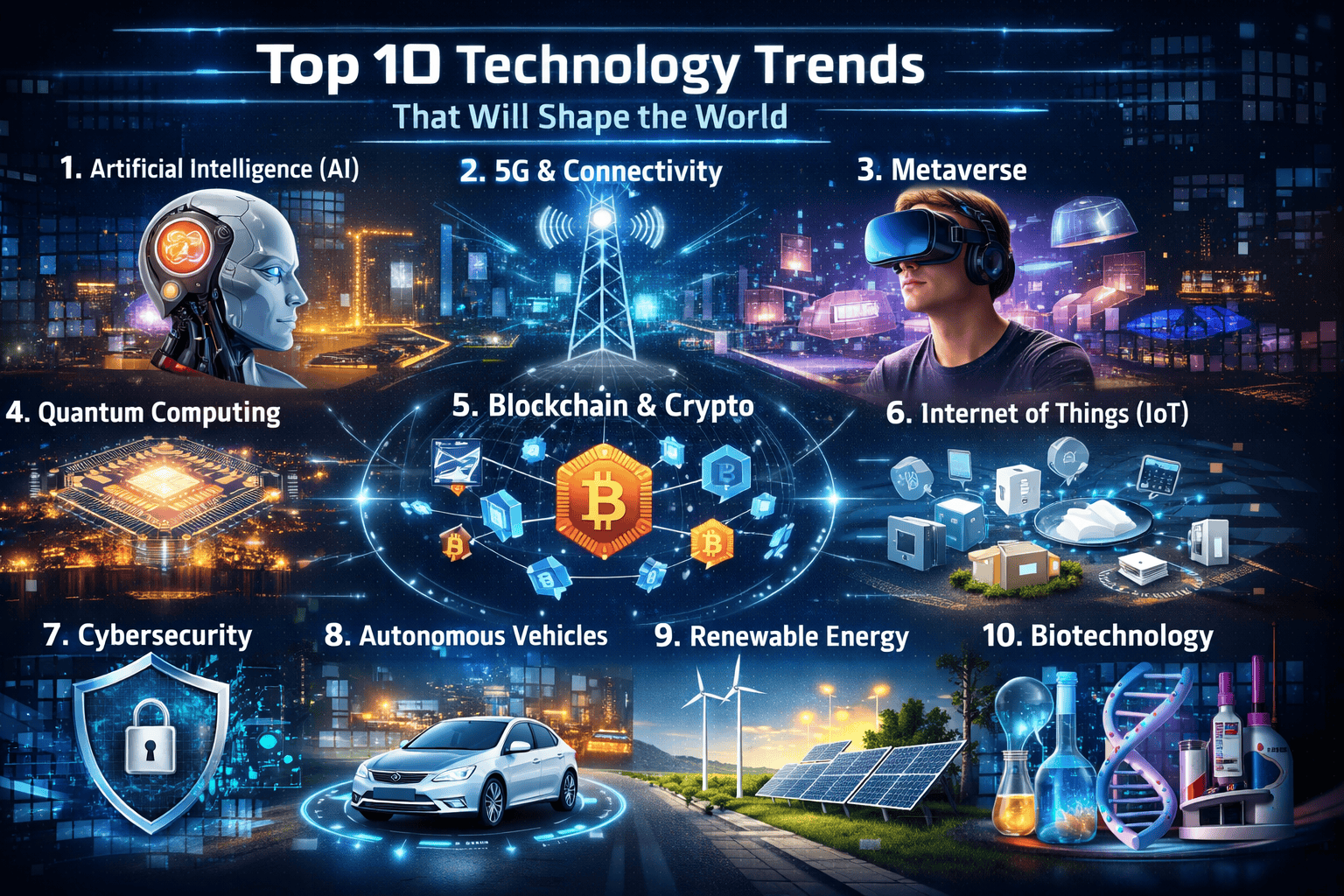
In this comprehensive guide, we will explore the top 10 technology trends that will shape the world in the coming years. Whether you are looking to future-proof your career, optimize your business strategies, or simply understand the digital ecosystem, these are the technological advancements you need to watch.
1. Generative AI and Decentralized Artificial Intelligence
Artificial Intelligence (AI) is no longer a distant sci-fi concept; it is the foundational layer of modern digital infrastructure. However, the next major leap isn’t just about making large language models (LLMs) smarter—it is about how we generate, govern, and distribute AI capabilities.
The Evolution of Generative Models
Generative AI has democratized digital content creation, allowing anyone to generate high-fidelity images, cinematic videos, and complex code with simple natural language prompts. This is radically transforming creative industries, marketing, and software development, allowing for rapid prototyping and unprecedented personalization.
The Rise of Decentralized AI
As AI becomes more powerful, the concentration of computing power in the hands of a few tech giants poses a risk. Enter decentralized AI networks. We are seeing a surge in platforms that allow communities to contribute computing power and data to train AI models collaboratively. By utilizing decentralized infrastructures to train agents and process data, the tech community is building a more equitable, transparent, and censorship-resistant AI ecosystem. This ensures that AI agents can operate autonomously while retaining verifiable and unbiased data sources.
[Internal Link: Read our in-depth guide on the evolution of Generative AI and its impact on content creation here.]
2. Web3 and High-Performance Blockchain Architectures
The conversation around blockchain has matured far beyond simple cryptocurrency speculation. Today, Web3 represents a fundamental restructuring of the internet, moving from centralized platforms to decentralized, user-owned networks.
Overcoming the Scalability Trilemma
Historically, blockchains struggled with scalability, forcing developers to choose between security, decentralization, and speed. Now, a new generation of high-performance blockchains and Layer-2 scaling solutions are breaking these barriers. Utilizing advanced execution environments and localized state management, these networks can process hundreds of thousands of transactions per second with sub-millisecond latency.
The Impact on Digital Ownership
This massive increase in throughput enables real-time, on-chain applications that were previously impossible. From complex decentralized finance (DeFi) protocols to fully on-chain gaming and decentralized physical infrastructure networks (DePIN), high-performance blockchains are providing the robust, frictionless infrastructure needed for the mass adoption of digital ownership and smart contracts.
3. Edge Computing and the Intelligent IoT
The Internet of Things (IoT) has connected billions of devices, but sending all that data back to a centralized cloud for processing creates latency, consumes massive bandwidth, and raises privacy concerns. The solution is edge computing.
Processing at the Source
Edge computing pushes data processing and storage closer to the source of data generation—the “edge” of the network. Whether it is an autonomous vehicle making split-second braking decisions, a smart factory monitoring assembly line robotics, or a wearable health device analyzing vital signs, edge computing ensures real-time responsiveness.
Synergy with AI
When you combine edge computing with AI (Edge AI), devices become incredibly autonomous. They no longer need a constant internet connection to recognize patterns or make decisions. This trend is crucial for building smart cities, resilient supply chains, and advanced mobile applications where low latency is non-negotiable.
4. Privacy-Enhancing Computation and Advanced Cryptography
As our lives become increasingly digital, data privacy has emerged as a fundamental human right. However, businesses and researchers still need to analyze large datasets to build better products and advance scientific discoveries. Privacy-Enhancing Computation (PEC) solves this paradox.
Fully Homomorphic Encryption (FHE)
One of the most exciting breakthroughs in this space is Fully Homomorphic Encryption. FHE allows data to be processed and analyzed while it remains encrypted. This means a healthcare provider could send encrypted patient data to a cloud-based AI for analysis, and the AI could return encrypted results without ever “seeing” the actual health records.
Zero-Knowledge Proofs (ZKPs)
Similarly, Zero-Knowledge Proofs allow one party to prove to another that a statement is true without revealing any information beyond the validity of the statement itself. These cryptographic advancements are paramount for the future of digital identity, secure voting systems, and confidential business analytics, ensuring that user data remains entirely secure.
[Internal Link: Discover how zero-knowledge technology is transforming decentralized identity and security.]
5. Extended Reality (XR) and Spatial Computing
Extended Reality (XR)—an umbrella term encompassing Virtual Reality (VR), Augmented Reality (AR), and Mixed Reality (MR)—is fundamentally changing how we interact with digital environments. We are moving away from flat screens and entering the era of spatial computing.
Blending the Physical and Digital
Spatial computing seamlessly blends digital content with the physical world. With the advent of advanced headsets and smart glasses, users can overlay digital interfaces onto their physical surroundings. This has profound implications for industries like architecture, where designers can walk through a 3D hologram of a building before construction begins, or healthcare, where surgeons can view overlaid patient vitals and anatomical guides during complex procedures.
The Future of Remote Collaboration
For the modern workforce, XR offers a solution to the limitations of video conferencing. Immersive virtual workspaces allow globally distributed teams to collaborate on 3D models, brainstorm on infinite virtual whiteboards, and experience a sense of shared presence that 2D screens simply cannot replicate.
6. Quantum Computing: The Next Computational Paradigm
While classical computers process information in bits (0s and 1s), quantum computers use quantum bits, or qubits. Through the principles of superposition and entanglement, quantum computers can perform complex calculations at speeds that are exponentially faster than today’s most powerful supercomputers.
Solving the Unsolvable
Quantum computing is not going to replace your laptop; rather, it is designed to solve specific, highly complex problems that are currently impossible for classical systems. This includes simulating molecular structures for rapid drug discovery, optimizing global logistics networks to reduce carbon emissions, and developing new, highly efficient materials for battery storage.
The Cryptographic Threat and Opportunity
It is important to note that quantum computing also poses a theoretical threat to current encryption standards. Consequently, another massive trend within this space is the development of “post-quantum cryptography”—creating new cryptographic algorithms that are secure against quantum attacks, ensuring the digital economy remains safe in the future.
7. Sustainable Technology and Climate Tech
In the face of global climate change, technology must be part of the solution. Sustainable technology refers to innovations designed to reduce environmental degradation and promote ecological balance.
The Green Tech Ecosystem
This trend encompasses a wide array of developments. We are seeing AI utilized to optimize energy grids and reduce waste in manufacturing. Breakthroughs in materials science are leading to more efficient solar panels and next-generation solid-state batteries that could revolutionize electric vehicles.
ESG and Circular Economies
Furthermore, businesses are increasingly adopting technologies to track and report their Environmental, Social, and Governance (ESG) metrics. Blockchain technology is being deployed to create transparent supply chains, allowing consumers to verify the ethical sourcing of products and supporting the transition toward a circular economy where waste is minimized and resources are continuously repurposed.
8. Biotechnology and Precision Medicine
The intersection of technology and biology is unlocking unprecedented advancements in human health. We are moving away from a “one-size-fits-all” approach to healthcare and entering an era of highly personalized, proactive medicine.
Gene Editing and CRISPR
Technologies like CRISPR-Cas9 allow scientists to edit DNA with incredible precision. This has the potential to cure genetic diseases, create disease-resistant crops, and develop highly targeted therapies for cancer.
Wearables and Digital Biomarkers
On a consumer level, the proliferation of advanced wearable health technology means individuals have access to clinical-grade health data on their wrists. Machine learning algorithms can analyze these continuous data streams (digital biomarkers) to detect anomalies—such as irregular heartbeats or sleep apnea—long before physical symptoms manifest, enabling early intervention and preventive care.
9. Autonomous Systems and Advanced Robotics
Robotics has long been a staple of manufacturing, but today’s robots are no longer confined to safety cages on factory floors. Powered by computer vision, AI, and edge computing, modern robots are highly autonomous and capable of operating safely alongside human workers.
Redefining the Supply Chain
Autonomous mobile robots (AMRs) are transforming logistics, seamlessly navigating warehouses to fulfill orders with incredible speed. In the broader world, we are witnessing the gradual but steady rollout of autonomous delivery drones and self-driving commercial fleets, which promise to radically improve the efficiency and safety of global supply chains.
Collaborative Robots (Cobots)
In the workplace, the focus is on “cobots”—collaborative robots designed to assist humans rather than replace them. By handling physically demanding, repetitive, or dangerous tasks, cobots free up human workers to focus on complex problem-solving, strategic planning, and creative endeavors.
10. 5G Advanced and the Dawn of 6G Connectivity
None of the aforementioned trends—from edge computing to autonomous vehicles—can function without robust, high-speed, and reliable connectivity. The global rollout of 5G has provided the bandwidth and low latency required for these technologies to flourish.
The Capabilities of 5G Advanced
As 5G networks mature, we are entering the phase of “5G Advanced,” which offers even greater capacity, better energy efficiency, and enhanced positioning accuracy. This is critical for supporting massive IoT deployments in smart cities and ensuring the seamless operation of industrial automation.
Looking Toward 6G
Even as 5G expands, the telecommunications industry is already defining the standards for 6G. Anticipated for commercial rollout in the early 2030s, 6G is expected to integrate sensing capabilities directly into the network and provide microsecond latency. This will enable applications we can scarcely imagine today, such as highly realistic holographic communications and true brain-computer interfaces.
Conclusion: Embracing the Digital Transformation
The top 10 technology trends outlined above do not exist in isolation; they are deeply interconnected. AI empowers advanced robotics; 5G enables edge computing; and Web3 infrastructure utilizes advanced cryptography to secure the entire ecosystem.
As these emerging technologies continue to evolve, they will demand adaptability from both organizations and individuals. The future belongs to those who view technological advancement not as a threat, but as an expansive toolkit for solving complex problems, building equitable systems, and enhancing the human experience. By staying informed and open to digital transformation, we can actively participate in shaping a world that is more connected, sustainable, and prosperous for everyone.
[Internal Link: Explore our services to see how we can help your business integrate these emerging technologies.]
Frequently Asked Questions (FAQ)
1. What is the difference between AI and Generative AI?
Traditional Artificial Intelligence is primarily analytical—it is trained on data to recognize patterns, make predictions, or classify information (e.g., a spam filter). Generative AI, utilizing large language models and neural networks, goes a step further by creating entirely new, original content—such as text, images, video, or code—based on the patterns it has learned.
2. How will decentralized tech and Web3 affect everyday internet users?
Web3 aims to shift power away from centralized tech monopolies back to the users. For the everyday user, this could mean true ownership of digital assets (like in-game items or digital art), improved privacy since you control your own data, and the ability to interact with financial services without relying on traditional banks as intermediaries.
3. Is Quantum Computing a threat to my current passwords and data?
Eventually, yes, but not immediately. Quantum computers possess the potential to break current RSA encryption methods. However, the technology is still in its infancy. In preparation, the cybersecurity industry and government agencies are already actively developing and standardizing “post-quantum cryptography” to ensure digital security remains intact before quantum computing becomes mainstream.
4. Will autonomous robots and AI take away human jobs?
Technological shifts inevitably disrupt the labor market. While AI and robotics will automate routine, repetitive, and dangerous tasks, they are also expected to create new categories of jobs focused on AI management, tech ethics, robotics maintenance, and creative strategy. The consensus among experts is that AI will augment human capabilities rather than completely replace the workforce, making continuous learning and upskilling vital.
5. How does technology contribute to sustainability?
Technology plays a dual role in sustainability. While the tech industry itself must work to reduce its carbon footprint (e.g., through energy-efficient data centers), green technologies are crucial for fighting climate change. Innovations include smart grid software that optimizes renewable energy distribution, AI that helps farmers reduce water usage, and advanced materials that make electric vehicle batteries more efficient and recyclable.
6. What exactly is Edge Computing?
Imagine you touch a hot stove; your hand pulls away instantly because the reflex is processed in your spinal cord, not your brain. Edge computing works similarly. Instead of sending data from a smart device all the way to a distant cloud server for processing (which takes time), the data is processed locally, “at the edge” of the network, right where it is generated. This is essential for applications requiring instant reaction times, like self-driving cars.
References & Further Reading
-
MIT Technology Review: 10 Breakthrough Technologies 2024 – Comprehensive insights into the year’s most impactful technological advancements.
-
Gartner: Top Strategic Technology Trends for 2024 – Industry analysis on how technology is driving business strategy.
-
World Economic Forum: Global Technology Governance Report – Exploring the intersection of emerging technologies, sustainability, and global policy.