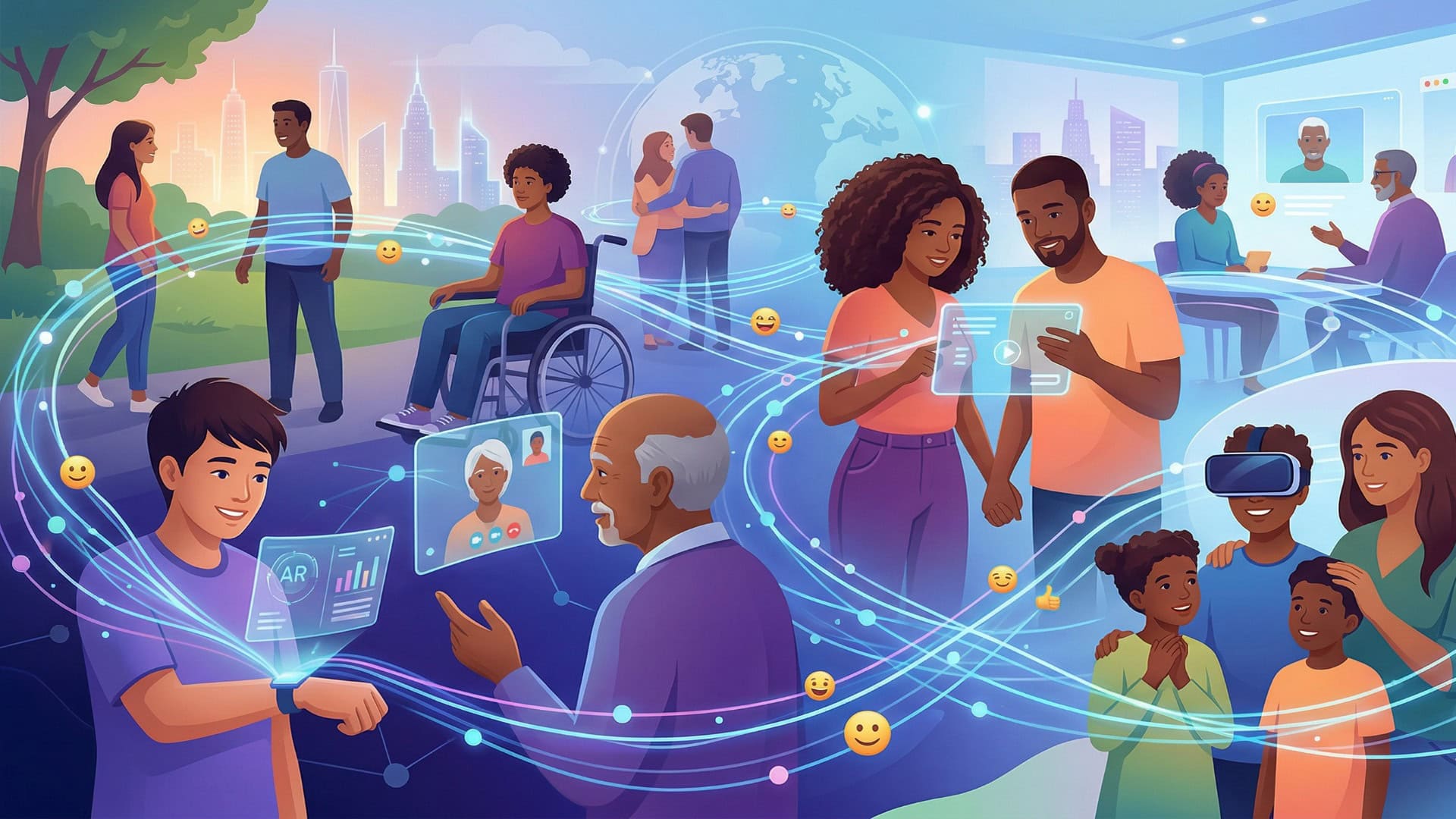
From the way we find romantic partners and maintain friendships to how we collaborate in the workplace and engage with our broader communities, digital communication tools have fundamentally altered the landscape of human relationships. This comprehensive guide explores the multifaceted ways technology is changing our social dynamics, highlighting both the remarkable benefits and the complex challenges we face in an increasingly connected world.
1. The Evolution of Connection: From Proximity to Global Reach
To understand how technology is reshaping human interaction today, it is helpful to look at how we got here. Historically, human interaction was entirely bound by physical proximity. You communicated with the people in your immediate vicinity—your family, your tribe, your village.
The invention of the written word, followed by the postal system, allowed for the first asynchronous, long-distance communication. However, it was slow. The telegraph and the telephone revolutionized this, introducing the concept of instant, long-distance connection. Suddenly, a voice could travel across continents.
Yet, the true paradigm shift occurred with the advent of the internet and, subsequently, the smartphone. We moved from technology being a tool we occasionally used to connect, to an environment in which we constantly live. The internet removed the barriers of geography, time zones, and physical borders. Today, we carry the ability to instantly reach almost anyone on the planet in our pockets. This shift from proximity-based relationships to network-based relationships is the foundation of modern human interaction.
2. Social Media: The Double-Edged Sword of the Digital Age
No technology has impacted human interaction more profoundly in the 21st century than social media. Platforms like Facebook, Instagram, X (formerly Twitter), TikTok, and LinkedIn have created a global digital town square.
The Power of Finding Your Tribe
One of the most beautifully inclusive aspects of social media is its ability to foster niche communities. In the past, if you had a unique interest, identified with a marginalized group, or lived with a rare medical condition, finding peers who understood your experience could be nearly impossible.
Today, technology allows people of all backgrounds, identities, and abilities to find their “tribes” online. Social media provides safe havens for LGBTQ+ youth, supportive networks for neurodivergent individuals, and vibrant spaces for people to celebrate shared cultural heritage. It has democratized community building, ensuring that fewer people have to feel isolated in their offline lives.
The Illusion of Connection and the Comparison Trap
However, the architecture of social media also introduces significant challenges to genuine interaction. We often engage in what sociologists call “parasocial interactions”—one-sided relationships where we feel intimately connected to influencers or acquaintances who may not even know we exist.
Furthermore, social media interaction is largely performative. We curate our digital lives, sharing the highlights, the successes, and the flattering angles. This constant exposure to the idealized lives of others can breed the “comparison trap,” leading to feelings of inadequacy, jealousy, and isolation. While we may have hundreds of digital “friends,” the depth of those interactions is often shallow, leaving many feeling deeply lonely despite being constantly connected.
3. The Transformation of the Modern Workplace
The professional realm has been completely rewired by communication technologies. The transition was already underway, but the global events of 2020 vastly accelerated the adoption of remote and hybrid work models.
The Rise of Asynchronous Communication
We have moved away from the necessity of being in the same room at the same time. Tools like Slack, Microsoft Teams, Asana, and Google Workspace have made asynchronous communication the norm. We leave comments on shared documents, send voice notes, and update project boards. This offers incredible flexibility, allowing individuals to work during their most productive hours and accommodating diverse lifestyles and caregiving responsibilities.
Accessibility and Global Talent
From an inclusive standpoint, remote work technologies have been revolutionary. They have broken down geographical barriers, allowing companies to hire diverse talent from around the globe. Moreover, digital workspaces can be highly beneficial for people with disabilities or chronic illnesses who may find traditional office environments challenging or inaccessible. Screen readers, closed captioning on video calls, and the ability to control one’s physical environment make the digital workplace highly adaptable.
The Loss of the “Watercooler” Moment
Conversely, technology has fundamentally changed the texture of workplace relationships. The spontaneous “watercooler” conversations—the casual chats in the hallway or the shared laughs over coffee—are difficult to replicate digitally. These informal interactions are where trust is built, mentorship often begins, and team cohesion is solidified. Organizations are now challenged to deliberately engineer moments of social connection to prevent employee isolation and burnout.
4. Romance and Relationships in the Digital Era
Technology has completely rewritten the script for how we find and maintain romantic partnerships.
The Gamification of Dating
Dating apps have turned the search for a partner into a highly accessible, albeit sometimes overwhelming, digital experience. We are no longer limited to meeting people through friends, at work, or in local social settings. Algorithms now introduce us to strangers based on shared interests and proximity.
While this creates unprecedented opportunities to meet diverse individuals, it also introduces a paradox of choice. The sheer volume of potential partners can lead to a “swiping culture” where people are treated as disposable commodities, and interactions can become superficial. The focus on heavily curated profiles can also obscure genuine compatibility, which relies heavily on in-person chemistry and shared values.
Maintaining Long-Distance and Everyday Intimacy
For established relationships, technology is a vital lifeline. Video calls, instant messaging, and photo sharing allow couples separated by distance to maintain a sense of daily intimacy. Even for couples living together, texting has become a primary “love language”—a way to check in, share a joke, or coordinate daily life. However, couples must also navigate the pitfalls of “phubbing” (phone snubbing), where the constant presence of a screen can detract from the quality of face-to-face time.
5. Empathy, Conflict, and the “Online Disinhibition Effect”
One of the most critical ways technology is reshaping human interaction is in how we handle disagreements and express empathy.
Text-based communication strips away the rich tapestry of non-verbal cues that humans rely on to understand intent. Tone of voice, facial expressions, and body language account for a massive percentage of human communication. When these are absent, text is easily misinterpreted, leading to unnecessary conflicts.
Furthermore, screens create a psychological barrier. This leads to the “Online Disinhibition Effect.” When people feel anonymous or physically distanced from their conversation partner, they are often willing to say things they would never say face-to-face. This effect is a primary driver of cyberbullying, polarized online debates, and the rapid spread of toxic discourse on social platforms. Reclaiming empathy in digital spaces is one of the greatest behavioral challenges of our time.
6. The Impact on Mental Health and Digital Well-being
As human interaction becomes increasingly digitized, the impact on our collective mental health is a subject of intense study.
The Dopamine Loop
Social media platforms and messaging apps are designed using behavioral psychology principles to keep us engaged. The “ping” of a notification, the validation of a “like,” or the unpredictability of a social media feed triggers a release of dopamine in the brain. This creates a compulsion to constantly check our devices, fracturing our attention and pulling us away from present-moment, real-world interactions.
FOMO and Digital Fatigue
The Fear Of Missing Out (FOMO) is amplified by our digital connections. Seeing friends gathering without us or constantly consuming news and social updates can lead to anxiety and a sense of inadequacy. Additionally, “Zoom fatigue”—the exhaustion associated with constant video conferencing—is a real phenomenon. The cognitive load of processing digital faces, combined with the stress of seeing oneself on camera, alters how we experience interaction, making it more draining than natural physical presence.
Building “digital boundaries” and practicing intentional digital detoxes are becoming essential skills for maintaining mental well-being in the modern era.
7. The Next Frontier: VR, AR, and AI-Mediated Interaction
We are currently standing on the precipice of the next major shift in human interaction, driven by Artificial Intelligence (AI), Virtual Reality (VR), and Augmented Reality (AR).
Spatial Computing and The Metaverse
VR and AR are introducing the concept of “spatial computing.” Rather than interacting through a flat screen, we are beginning to interact within digital environments. In the metaverse or immersive virtual workspaces, digital avatars can share a sense of spatial presence. We can hear a colleague’s voice coming from their specific location in a virtual room, and we can read their avatar’s gestures. This technology promises to bridge the gap between a simple phone call and physical presence, offering a deeper, more embodied form of digital interaction.
Interacting with Artificial Intelligence
Perhaps the most profound shift is the introduction of non-human entities into our social spheres. Advanced AI chatbots and digital companions are now capable of holding deeply nuanced, highly contextual conversations. People are using AI for brainstorming, therapy-like reflections, language learning, and even companionship.
As these AI models become more sophisticated, the line between human-to-human and human-to-machine interaction will blur. We will need to navigate the ethical and psychological implications of forming emotional attachments to artificial entities, and ensure that AI supplements, rather than replaces, our fundamental need for human connection.
8. Navigating the Future: The Call for Intentionality
Technology is neither inherently good nor entirely bad; it is a powerful amplifier of human intent. It has the power to bridge oceans, amplify marginalized voices, and create unparalleled efficiencies. Yet, it also possesses the power to isolate us, polarize our communities, and distract us from the physical world right in front of us.
The goal is not to reject technology, but to cultivate digital intentionality. We must consciously choose how and when we use these tools. This means prioritizing deep, uninterrupted conversations over fragmented text chains, establishing tech-free zones in our homes, and using digital platforms to facilitate real-world meetups rather than replacing them.
By understanding how technology reshapes our interactions, we can take control of the digital tapestry we are weaving, ensuring that our tools serve to enhance our humanity, rather than diminish it.
Frequently Asked Questions (FAQ)
Q1: Is technology making us more isolated or more connected?
This is the ultimate paradox of the digital age. Technology makes us more connected on a surface level—we can reach anyone, anywhere, at any time. However, excessive reliance on digital communication can lead to profound emotional isolation. When we substitute deep, face-to-face interactions with shallow, performative social media engagement or quick text messages, we miss out on the emotional resonance, body language, and physical presence required to build deep trust and alleviate loneliness. The key is balance: using technology to facilitate and maintain relationships, but ensuring it doesn’t replace in-person connection.
Q2: How does screen time affect children’s social skills?
Research indicates that excessive screen time, especially during early developmental years, can impact a child’s ability to read non-verbal cues, such as facial expressions and body language. Because digital communication lacks these elements, children who spend too much time on screens may struggle with empathy and conflict resolution in real life. However, interactive technology (like video chatting with relatives or playing collaborative, age-appropriate video games) can have positive social benefits. Pediatricians generally recommend setting strict limits on passive screen time and prioritizing physical play and face-to-face interaction.
Q3: What is the “Online Disinhibition Effect” and why does it happen?
The “Online Disinhibition Effect” refers to the way people behave differently—often more aggressively or more candidly—online compared to how they would act in person. This happens for several reasons:
- Anonymity: People feel their actions cannot be traced back to their real-world identity.
- Invisibility: Not having to look someone in the eye removes the immediate empathetic response we naturally feel when seeing someone’s reaction.
- Asynchronicity: You can post a mean comment and immediately close the app, running away from the immediate consequences of the interaction.
Q4: How can I maintain a healthy relationship with technology?
Maintaining digital well-being requires intentionality. Some practical steps include:
- Establish Tech-Free Zones: Keep phones away from the dinner table and out of the bedroom.
- Turn Off Non-Essential Notifications: Stop your device from constantly demanding your attention; check apps on your own schedule.
- Prioritize In-Person Plans: Use messaging apps to set up real-world coffees, walks, or dinners, rather than letting the text thread become the entire relationship.
- Audit Your Social Media: Unfollow accounts that make you feel inadequate or stressed, and curate a feed that inspires and educates you.
Q5: Will AI eventually replace human interaction?
While AI is becoming incredibly adept at simulating human conversation, it is unlikely to replace the fundamental need for human-to-human interaction. AI lacks consciousness, lived physical experience, and genuine emotional vulnerability—the core ingredients of human empathy. AI will likely serve as an augmentative tool—helping us draft emails, practice languages, or brainstorm—and even provide a baseline of interaction for those feeling isolated. However, the deeply biological human need to be truly seen and understood by another living person cannot be synthesized by code.
Leave a Reply