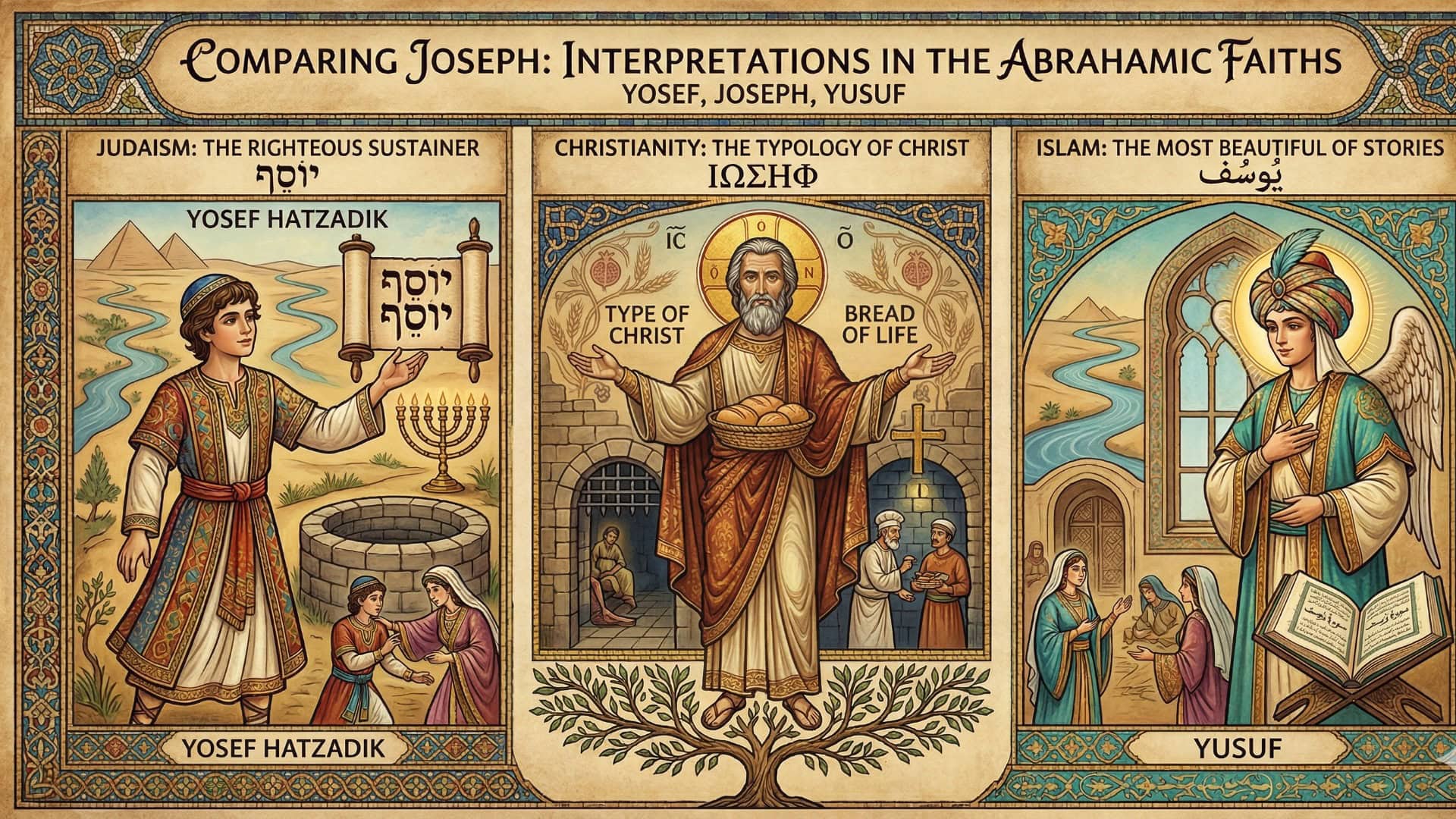
The story of Joseph—known as Yosef in Hebrew and Yusuf in Arabic—is one of the most profound, captivating, and intricately woven narratives shared across the Abrahamic faiths. As a figure who bridges the ancestral era of the patriarchs with the foundational era of national exodus and revelation, Joseph occupies a monumental space in Judaism, Christianity, and Islam. Yet, while the skeletal framework of his story remains remarkably consistent across the Torah, the Christian Bible, and the Quran, the theological lenses through which he is viewed diverge in fascinating ways.
This comprehensive exploration delves into how Judaism, Christianity, and Islam interpret the life, trials, and triumphs of Joseph. By analyzing the sacred texts, commentaries, and theological traditions of these three world religions, we can uncover how a single historical and spiritual figure is utilized to teach deeply distinct lessons about divine providence, prophetic infallibility, redemptive suffering, and the human condition.
Part I: Joseph in Judaism – The Righteous Sustainer and Prototype of Exile
In Judaism, the story of Joseph (Yosef) is primarily found in the Book of Genesis (Bereshit), spanning chapters 37 through 50. It is the longest continuous narrative in the Torah, reflecting its critical importance. In the Jewish tradition, Joseph is the crucial link that explains how the Israelites transitioned from a small family of herdsmen in Canaan to a massive population enslaved in Egypt. However, beyond his historical role, Joseph represents an archetype of survival, moral fortitude, and divine providence.
The Biblical Narrative in Genesis
The Genesis account presents Joseph as the favored son of Jacob (Israel) and Rachel, born in Jacob’s old age. His father’s favoritism is symbolized by the gift of an ornate tunic, often translated as a “coat of many colors” (ketonet passim). This favoritism, combined with Joseph’s prophetic dreams wherein his brothers and parents bow down to him, breeds intense jealousy among his ten older half-brothers.
The ensuing betrayal is stark: his brothers plot to kill him but ultimately sell him into slavery to passing Ishmaelite and Midianite merchants. Joseph is taken to Egypt and sold to Potiphar, a captain of Pharaoh’s guard. Through intellect and divine blessing, Joseph rises to manage Potiphar’s household, only to be falsely accused of attempted rape by Potiphar’s wife after he righteously rejects her advances.
Thrown into the royal dungeon, Joseph remains steadfast. He successfully interprets the dreams of the Pharaoh’s cupbearer and baker, which eventually leads to him interpreting the Pharaoh’s own disturbing dreams of seven fat and seven lean cows. Recognizing Joseph’s divine wisdom, Pharaoh appoints him as the Vizier of Egypt. When a severe regional famine strikes, Joseph’s estranged brothers come to Egypt for food. In a dramatic, multi-chapter sequence of testing and revelation, Joseph eventually reveals his identity, forgives his brothers, and reunites with his grieving father, moving the entire family to the land of Goshen in Egypt.
Yosef HaTzadik: The Righteous One
In Jewish Rabbinic literature (the Talmud and Midrash), Joseph is bestowed with a unique title: Yosef HaTzadik (Joseph the Righteous). He is the only patriarch explicitly given this title. This designation is primarily rooted in his unwavering moral restraint during the episode with Potiphar’s wife.
The Midrash expands on the Genesis narrative, detailing the intense psychological and emotional pressure Potiphar’s wife exerted on Joseph. According to Jewish tradition, her attempts to seduce him were relentless and daily. Joseph’s ability to resist temptation, especially as a young, isolated slave in a morally permissive foreign culture, elevates him to the pinnacle of righteous behavior. The Talmud (Sotah 36b) suggests that at the very moment Joseph was about to succumb, the image of his father Jacob’s face appeared to him in the window, giving him the spiritual strength to flee.
Divine Providence (Hashgacha Pratit)
The foundational theological theme of the Joseph narrative in Judaism is Hashgacha Pratit (Divine Providence). The text masterfully demonstrates how God operates not through overt, sea-splitting miracles, but through the seemingly mundane and tragic events of human history.
Joseph himself articulates this theology at the climax of the narrative. When his brothers fear he will enact revenge after Jacob’s death, Joseph reassures them: “Although you intended me harm, God intended it for good, so as to bring about the present result—the survival of many people” (Genesis 50:20). In Judaism, Joseph teaches that even in the darkest pits of human malice and betrayal, God’s ultimate, benevolent plan is actively unfolding.
The Prototype of the Jewish Exile
For centuries of Jewish thinkers, Joseph has served as the ultimate prototype for the Diaspora Jew. He is stripped of his home, sold into an alien land, and forced to navigate the highest echelons of a foreign, pagan government. Yet, despite adopting Egyptian dress, taking an Egyptian name (Zaphenath-paneah), and marrying an Egyptian woman (Asenath), Joseph fundamentally retains his Israelite identity and morality.
He demonstrates how a Jew can successfully engage with and even lead a secular society without assimilating spiritually. Before his death, he makes his brothers swear to carry his bones out of Egypt when God eventually redeems them, proving that his ultimate allegiance remained with the Promised Land and the covenant of Abraham.
The Tension Between Joseph and Judah
Rabbinic tradition also heavily focuses on the dynamic between Joseph and Judah (Yehuda). Joseph represents physical sustenance, administrative brilliance, and success in the material world. Judah represents leadership, repentance, and the eventual Davidic monarchy. In later Jewish eschatology, this dichotomy evolves into the concept of two messiahs: Mashiach ben Yosef (the Messiah son of Joseph), a practical, worldly leader who prepares the way and fights the physical battles of Israel, and Mashiach ben David (the Messiah son of David, descending from Judah), who brings about the ultimate spiritual redemption.
Part II: Joseph in Christianity – The Ultimate Typology of Christ
While Christianity fully inherits and venerates the Hebrew Bible’s account of Joseph, the Christian theological framework fundamentally shifts the interpretive lens. In the Christian tradition, Joseph is celebrated not only as a historical patriarch and moral exemplar but, most importantly, as a profound “type” or prefiguration of Jesus Christ.
The Concept of Biblical Typology
To understand the Christian interpretation of Joseph, one must understand typology. Typology is a method of biblical interpretation wherein Old Testament historical figures, events, or institutions (types) are viewed as prophetic foreshadowing of New Testament realities, specifically the life, death, and resurrection of Jesus Christ (the antitype).
While Joseph is never explicitly named as a type of Christ by Jesus himself in the Gospels, the early Church Fathers (such as Augustine, Ambrose, and John Chrysostom) and centuries of Christian theologians have pointed to the staggering number of parallels between the two figures.
Parallels Between Joseph and Jesus
The Christological reading of Joseph outlines a narrative of suffering, betrayal, descent, and glorious exaltation that mirrors the Gospel accounts perfectly. Key parallels include:
- The Beloved Son: Just as Joseph was the beloved son of his father Jacob, Jesus is the beloved Son of God the Father (Matthew 3:17).
- Betrayal by Brethren: Joseph was rejected and envied by his own brothers. The Gospel of John (1:11) notes of Jesus: “He came to his own, and his own people did not receive him.”
- The Plot and the Price: Joseph’s brothers plotted to kill him and ultimately sold him for 20 pieces of silver. Jesus was plotted against by the religious leaders and betrayed by Judas (the Greek translation of Judah, the brother who suggested selling Joseph) for 30 pieces of silver.
- Descent into the “Pit”: Joseph was thrown into an empty well (a pit) and later placed in an Egyptian dungeon. In Christian theology, this mirrors Christ’s death, his descent into the grave, and the harrowing of hell.
- Between Two Sinners: In the Egyptian dungeon, Joseph was placed between the chief baker and the chief cupbearer. He prophesied life for one and death for the other. Jesus was crucified between two thieves, granting salvation to the repentant thief and judgment to the unrepentant one.
- Exaltation at Age Thirty: Genesis 41:46 notes that Joseph was thirty years old when he entered the service of Pharaoh. The Gospel of Luke (3:23) notes that Jesus was about thirty years old when he began his earthly ministry.
- Sustainer of the World: Joseph became the savior of the known world, providing bread to starving nations during a severe famine. Jesus declares himself the “Bread of Life” (John 6:35), providing spiritual salvation and the Eucharist to a spiritually starving world.
- Forgiveness and Reconciliation: Just as Joseph forgave his brothers and wept with them, Jesus forgave his executioners from the cross (“Father, forgive them, for they know not what they do”) and offers reconciliation to all of humanity who rebelled against him.
New Testament References and Moral Example
Beyond typology, Joseph is explicitly praised in the New Testament. In the Book of Acts (7:9-16), Stephen the Martyr summarizes Joseph’s story during his defense before the Sanhedrin, using Joseph’s rejection by his brothers as a historical precedent for the contemporary Jewish rejection of Jesus.
In the Epistle to the Hebrews (11:22), Joseph is enshrined in the “Hall of Faith.” The author specifically highlights Joseph’s dying moments: “By faith Joseph, when his end was near, spoke about the exodus of the Israelites from Egypt and gave instructions concerning the burial of his bones.” This highlights Joseph’s unwavering faith in God’s promises, looking beyond his immediate Egyptian glory to the eternal promises made to Abraham.
Furthermore, in Christian moral theology, Joseph serves as a supreme example of purity and chastity. Throughout the Middle Ages and the Renaissance, sermons and Christian literature frequently pointed to Joseph fleeing from Potiphar’s wife as the definitive blueprint for how believers should actively flee from sexual immorality and temptation, adhering strictly to the Pauline injunction to “flee from sexual immorality” (1 Corinthians 6:18).
Part III: Joseph in Islam – The Infallible Prophet and the Beautiful Story
In Islam, Joseph is known as Yusuf, and his status is elevated to that of a chosen Prophet (Nabi) of Allah. The narrative of Yusuf holds a totally unique position within the Quran. Unlike other prophets (such as Musa/Moses or Isa/Jesus) whose stories are scattered in fragments across various chapters, the story of Yusuf is told in a single, continuous, highly detailed narrative in Chapter 12 of the Quran, naturally named Surah Yusuf.
Ahsan al-Qasas: The Most Beautiful of Stories
The Quran itself introduces the narrative of Yusuf as Ahsan al-Qasas, “the most beautiful of stories” or “the best of narratives” (Quran 12:3). Revealed in Mecca during a period of immense sorrow and persecution for the Prophet Muhammad (often called the Year of Sorrow), the story of Yusuf was revealed to comfort Muhammad. It served as a divine reassurance that just as Yusuf was persecuted by his own brethren, exiled, and eventually made victorious by God, so too would Muhammad endure rejection by his tribe (the Quraysh) only to eventually return in triumph.
Prophetic Infallibility (‘Ismah)
A critical difference between the Judeo-Christian perspective and the Islamic perspective is the concept of ‘Ismah, or prophetic infallibility. In the Bible, prophets and patriarchs are deeply flawed human beings capable of grave sins. In Islam, prophets are divinely protected from committing major sins. Therefore, the Islamic telling of Yusuf’s story removes or alters elements that might suggest moral failing on his part.
For example, in the Biblical account, Joseph’s youthful boasting about his dreams could be interpreted as arrogant. In the Quran, Yusuf is a respectful, spiritually mature youth. When he tells his father Yaqub (Jacob) about his dream of the sun, moon, and eleven stars bowing to him, Yaqub immediately recognizes Yusuf’s prophetic destiny and warns him not to tell his brothers, knowing Satan will stir their envy.
The Motif of the Shirt (Qamis)
The Quran uses the motif of Yusuf’s shirt (qamis) as a powerful literary and symbolic device throughout the Surah, marking three critical transitions in the story:
- The Bloody Shirt (Deception): The brothers bring Yusuf’s shirt stained with false blood to their father as “proof” that a wolf ate him.
- The Torn Shirt (Proof of Innocence): During the seduction attempt by the wife of the Al-Aziz (the Quranic title for Potiphar), she chases Yusuf as he flees and tears his shirt from behind. When her husband confronts them, a witness points out that if the shirt is torn from the front, she is telling the truth, but if it is torn from the back, Yusuf is innocent. The shirt torn from the back serves as undeniable physical proof of Yusuf’s chastity.
- The Healing Shirt (Reconciliation): When Yusuf reveals himself to his brothers in Egypt, he gives them his shirt to cast over their father Yaqub’s face, miraculously curing Yaqub of the blindness he had developed from years of weeping over Yusuf.
Zuleikha and the Women of the City
The Quran also provides more psychological depth to the character of the minister’s wife, traditionally named Zuleikha in Islamic lore. When the women of the city begin to gossip about her infatuation with her slave, she invites them to a banquet and hands each woman a knife to cut fruit. She then orders Yusuf to walk into the room. The women are so struck by his blinding, angelic beauty that they unknowingly slice their own hands, declaring, “God preserve us! This is no human being. This is but a noble angel!” (Quran 12:31). Zuleikha uses this to justify her overwhelming passion, though Yusuf still chooses prison over committing a sin against God.
Yaqub’s Beautiful Patience (Sabr Jamil)
The portrayal of Jacob (Yaqub) in the Quran is vastly different from Genesis. In the Bible, Jacob is utterly deceived by the bloody coat, tearing his clothes and refusing to be comforted, sinking into a decades-long depression.
In Islam, Yaqub is a Prophet who knows that his sons are lying. When presented with the bloody shirt, he notes the absurdity of a wolf eating his son but leaving the shirt completely intact. Yaqub says, “Rather, your souls have enticed you to something, so beautiful patience [sabr jamil] is most fitting. And Allah is the one sought for help against that which you describe” (Quran 12:18). Yaqub never loses his faith in Allah’s promise, representing the ultimate model of spiritual resilience.
Dawah (Proselytizing) in Prison
Another unique Islamic element is Yusuf’s behavior in prison. Before he interprets the dreams of his two cellmates, Yusuf uses the opportunity to preach the oneness of God (Tawhid). He delivers a sermon denouncing idolatry, asking, “O my two companions of prison, are diverse lords better or Allah, the One, the Prevailing?” (Quran 12:39). This cements his status not just as a dreamer, but as an active, preaching Prophet calling people to the truth.
Part IV: Comparative Analysis – Intersecting Themes and Divergent Emphases
When we place the Torah, the Christian Bible, and the Quran side by side, the story of Joseph serves as a magnificent case study in how the same narrative bedrock is sculpted into different theological monuments.
Humanity vs. Prophetic Perfection
The most glaring difference lies in characterization. The Jewish and Christian traditions are comfortable with the humanity of their patriarchs. The biblical Joseph is brilliant and righteous, but he can also be perceived as a slightly arrogant youth who later plays a highly manipulative psychological game with his brothers (planting silver cups in sacks, keeping Simeon hostage).
Islam, bound by the doctrine of ‘Ismah, smooths these edges. Yusuf’s actions with his brothers are guided by divine revelation, not personal vengeance or psychological testing. He is a perfectly polished mirror reflecting divine attributes from his youth to his death.
The Role of the Father
The divergence in Jacob/Yaqub’s character is equally profound. The biblical Jacob is a tragic, heavily burdened father who is easily duped by his sons—a cosmic irony, given that Jacob himself duped his own father, Isaac, with a goat skin in his youth. The Genesis narrative uses Jacob to show that actions have generational consequences.
The Quranic Yaqub is fully aware of the deception. He is a prophet who possesses knowledge from God that his sons do not have. His grief is not born of a lack of faith or deception, but of deep paternal love and the painful waiting for Allah’s plan to unfold.
The Focus of Divine Providence
All three traditions agree that the ultimate lesson of Joseph’s life is divine providence. However, the application differs:
- In Judaism, providence is applied to the nation. Joseph’s suffering is the necessary mechanism to move the children of Israel to Egypt, setting the stage for the Exodus, the giving of the Torah, and the birth of the Jewish nation.
- In Christianity, providence is applied to salvation history. Joseph’s suffering and exaltation are the mechanism God uses to teach humanity how to recognize the ultimate Savior, Jesus Christ, who will suffer and be exalted to save the whole world from spiritual famine.
- In Islam, providence is applied to the individual soul and the nature of God’s decree (Qadar). The story is a timeless manifesto declaring that whoever maintains Taqwa (God-consciousness) and Sabr (patience), Allah will never let their reward be lost. It is a direct comfort to the Prophet Muhammad and all believers facing hardship.
Forgiveness as a Universal Thread
Despite the theological divergences, the climax of the story remains universal and identical across all three faiths: radical, unconditional forgiveness. When Joseph finally has the power to destroy the men who tore him from his father and threw him into darkness, he chooses mercy.
In Genesis, he weeps so loudly that the Egyptians hear it, telling his brothers, “Do not be distressed… for God sent me before you to preserve life.” In the Quran, Yusuf tells his terrified brothers, “No blame will there be upon you today. Allah will forgive you; and He is the most merciful of the merciful” (Quran 12:92). In Christianity, this moment of grace is viewed as the ultimate reflection of the divine grace offered to sinners.
Conclusion
The figure of Joseph stands as a towering monolith at the intersection of Judaism, Christianity, and Islam. By analyzing his narrative through the distinct lenses of these three traditions, we do not merely learn about a historical figure; we gain insight into the very core of each faith’s theology.
For the Jewish people, Joseph is the righteous sustainer, the prototype of surviving exile while maintaining identity, and the embodiment of Hashgacha Pratit. For Christians, he is the radiant type of Christ, a flawless foreshadowing of a betrayed savior who rises from the pit to feed a dying world. For Muslims, Yusuf is the infallible Prophet, the epitome of physical beauty and spiritual purity, whose story provides the ultimate blueprint for beautiful patience in the face of adversity.
Yet, beyond the theological boundaries, Joseph’s endurance lies in his humanity. The themes of family dysfunction, jealousy, false accusation, the feeling of being abandoned in the dark, and the ultimate triumph of integrity and forgiveness are universally resonant. Whether read from a Torah scroll, a printed Bible, or a beautifully illuminated Quran, the story of Joseph continues to speak to the human heart, reminding us that even in the deepest pits, the threads of a divine and beautiful tapestry are being woven.
Leave a Reply