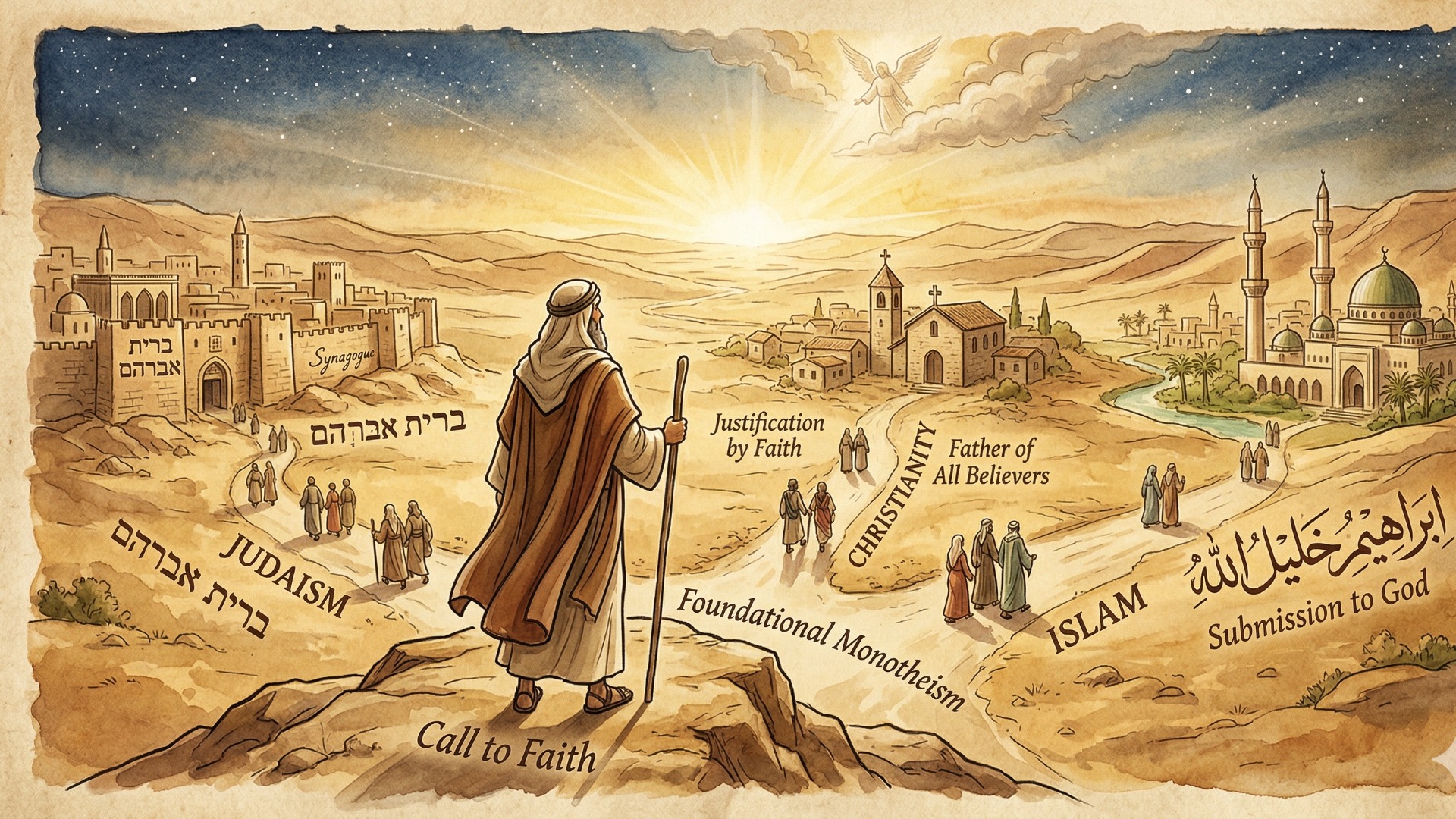
The figure of Abraham stands as a monumental pillar in the religious landscape of the world, serving as the foundational patriarch for Judaism, Christianity, and Islam—collectively known as the Abrahamic faiths. While each tradition interprets his life, covenant, and significance through its own unique theological lens, the shared reverence for this ancient figure is undeniable. This exhaustive exploration will delve into the narrative of Abraham as portrayed across scriptures and traditions, dissecting his pivotal role in each of the three major monotheistic religions and examining both the profound commonalities and distinctive interpretations that shape believers’ understanding of him.
Section 1: The Historical and Biblical Narrative: Roots of a Shared Heritage
To comprehend Abraham’s multifaceted significance, one must first explore the core narrative primarily rooted in the Hebrew Bible (Genesis 11-25) and interwoven into Christian and Islamic texts and traditions. This section will recount key aspects of his journey and covenantal relationship with God.
Origins and the Divine Call
According to Genesis, Abraham (originally Abram) was born in Ur of the Chaldeans, a city steeped in idolatry. The narrative describes a divine call where God commands him, “Go from your country, your people and your father’s household to the land I will show you.” This summons is not merely a geographic relocation but a spiritual departure—a profound act of faith that forms the bedrock of Abraham’s character across all traditions. Abram, along with his wife Sarai (later Sarah) and nephew Lot, travels to Haran and eventually into the land of Canaan (modern-day Israel and Palestine).
The Everlasting Covenant
Central to the entire Abrahamic narrative is the covenant (Brit in Hebrew) established between God and Abraham. God makes several promises:
- Numerous Descendants: Abraham is promised a progeny as numerous as the stars, through whom he will become the “father of many nations.”
- Land Promise: The land of Canaan is promised to Abraham and his descendants as an everlasting possession.
- Universal Blessing: Through Abraham and his seed, all the families of the earth will be blessed.
This covenant is sealed through a symbolic and dramatic ritual described in Genesis 15, and later, the physical sign of circumcision (Genesis 17) is commanded for Abraham and all male descendants, signifying a perpetual relationship with God.
Narrative Nuances: Hagar and Ishmael, Sarah and Isaac
The story of Abraham is intertwined with complex family dynamics. Sarah, unable to conceive for many years, offers her Egyptian handmaid Hagar to Abraham so he might father children through her. Hagar gives birth to Ishmael. This narrative element introduces themes of human agency attempting to fulfill divine promises and the subsequent domestic friction.
Later, as promised by God, the seemingly impossible occurs: Sarah, well past childbearing age, becomes pregnant and gives birth to Isaac, the child of the promise through Sarah. This birth highlights God’s power and faithfulness. Subsequent events, however, lead to the emotional expulsion of Hagar and Ishmael into the wilderness, where God, demonstrating universal care, promises to bless Ishmael as well and make him a great nation. This narrative of two sons, Isaac and Ishmael, lays the groundwork for different theological and genealogical interpretations in later Abrahamic traditions.
The Ultimate Test: The Akedah (Binding)
Undoubtedly the most powerful and challenging episode in Abraham’s life is the command from God to sacrifice his “only son,” Isaac (Genesis 22). This event, known in Judaism as the Akedah (the Binding of Isaac), is the supreme test of Abraham’s faith and obedience. Abraham’s unquestioning willingness to comply, up to the very moment God provides a ram as a substitute, cements his status as the exemplar of faith. [Mental check: This narrative detail – Isaac as the intended sacrifice – is explicit in Genesis, forming the standard Jewish and Christian view, but is a significant point of divergence in Islamic tradition, though the Quran itself is less explicit about which son. I must acknowledge this nuance carefully here and elaborate on the Islamic interpretation later.] [Refinement: In this shared narrative section, I will describe the Genesis account focusing on Isaac, and implicitly state that this is one perspective, explicitly preparing for the different Islamic tradition later.]
Death and Legacy
Abraham dies at a ripe old age, and, in a significant concluding detail, both his sons, Isaac and Ishmael, come together to bury him in the Cave of Machpelah in Hebron, alongside Sarah. This cave remains a profoundly sacred and contested site for all three faiths.
This rich and foundational narrative provides the raw material from which Judaism, Christianity, and Islam construct their unique theological frameworks around Abraham. The subsequent sections will examine how each tradition interprets and elevates this shared patriarch.
Section 2: Abraham in Judaism: Avraham Avinu, the National Father and Monotheistic Pioneer
In Jewish thought, Abraham is not just a figure; he is the figure—Avraham Avinu (Abraham our Father). He is the literal biological ancestor of the Jewish people and the unparalleled archetype of faith and righteousness.
The First National Jew and Monotheist
Judaism views Abraham as the person who, amidst widespread idolatry, discovered and embraced the existence of the one true God through reason and intuition (as embellished in rabbinic literature with stories like Abraham smashing his father’s idols). While monotheism’s full expression comes later with Moses and the Torah, Abraham is seen as its crucial pioneer on a national scale. He is not just an individual believer; he establishes a people dedicated to God’s service. [Potential image suggestion: [Diagram illustrating Abraham’s rejection of idolatry as the beginning of national monotheism] – NO, NO VISUALS]
The Covenant of Circumcision (Brit Milah) and the Land
The Brit (covenant) between God and Abraham is fundamental. The specific sign of Brit Milah (circumcision) is observed to this day by Jewish males, a physical mark identifying them as descendants of Abraham and participants in the everlasting covenant. The land promise—Eretz Yisrael (the Land of Israel)—is seen as part of this covenant, inextricably linking the Jewish people’s identity and history to a specific place promised to their patriarch. Jewish prayers and liturgy consistently invoke the “God of Abraham, God of Isaac, and God of Jacob,” emphasizing the genealogical and spiritual connection.
A Model of Faith, Obedience, and Chesed (Loving-kindness)
Abraham’s faith, as exemplified by his immediate obedience to God’s calls and tests, is a cornerstone of Jewish theology. Jewish tradition emphasizes his proactive approach to divine service, suggesting he observed the principles of the Torah even before they were given at Mount Sinai, driven by intrinsic righteousness.
Furthermore, Abraham is revered for his Chesed (loving-kindness) and hospitality, famously described in Genesis 18 where he rushes to welcome and feed strangers (who reveal themselves as divine messengers). This character trait is deeply ingrained in Jewish ethics.
The Akedah and Isaac: The Covenant Through Isaac
Judaism unequivocally identifies Isaac as the promised son of Sarah and the sole ancestor through whom the specific national covenant with the Jewish people is continued (Genesis 21:12: “for it is through Isaac that your offspring will be reckoned“). Consequently, the Akedah is viewed overwhelmingly as the binding and near-sacrifice of Isaac.
The Akedah is a central theme in Jewish thought, serving as:
- A powerful demonstration of ultimate devotion to God.
- A meritorious act for which God remembers Abraham and his descendants with mercy.
- A core element of the Rosh Hashanah (New Year) liturgy, where the shofar (ram’s horn) blast is said to evoke the ram substituted for Isaac.
- A theological point emphasizing God’s prohibition of human sacrifice and ultimate desire for life.
While acknowledging Ishmael’s existence and potential greatness, Jewish tradition firmly establishes Isaac and Jacob as the primary conduits of the covenantal promise, particularly concerning the land and the distinct spiritual mission of the Jewish people. [Mental check: This firmly contrasts with Islam’s emphasis on Ishmael. I’m building this difference up.]
Section 3: Abraham in Christianity: The Model of Faith, Spiritual Fatherhood, and Messianic Precursor
For Christians, Abraham remains a highly revered and influential figure, although their understanding of his significance shifts from a primarily national and genealogical focus to one that is profoundly theological, faith-centered, and messianic.
Abraham: The Apostle of Faith and Justification
The primary Christian lens through which Abraham is viewed is crafted by Saint Paul, particularly in his letters to the Romans and Galatians. Paul uses Abraham as the paramount example of justification by faith apart from works of the law or circumcision. [Mental check: [Diagram of Paul’s argument: Faith -> Righteousness -> Circumcision (Genesis timeline)] – NO, NO VISUALS]
Paul points to Genesis 15:6: “Abram believed the LORD, and he credited it to him as righteousness.” Crucially, this event occurs before Abraham receives the command for circumcision or the explicit promises about land and nation. For Paul, this demonstrates that right relationship with God comes through faith—specifically, faith in God’s promises—and that Abraham is righteous in God’s eyes while still in uncircumcision. This concept is revolutionary, arguing that all people who believe, not just circumcised Jews, can share in Abraham’s righteousness and the promises made to him.
Father of All Believers (Spiritual Lineage)
Building on this, Christianity emphasizes Abraham as the spiritual father of all who believe in God, regardless of ethnicity or adherence to Jewish law. The true children of Abraham are not necessarily those born of his physical lineage (though the distinction isn’t always sharp) but those who follow in his footsteps of faith. This interpretation universalizes Abraham’s legacy, opening up the covenantal relationship to the entire world through Christ, thus directly fulfilling the promise that “all the families of the earth will be blessed” through him.
Promises Fulfilled in Christ
Christian theology connects Abraham directly to Jesus Christ. Jesus is seen as the specific seed through whom the universal blessing to all nations is ultimately and perfectly fulfilled (Galatians 3:16). Christians interpret the promises to Abraham through a messianic perspective, understanding the historical lineage (often traced through Isaac in Christian thought as well) as leading to Christ. The ultimate “great nation” and “inheritance” are seen in spiritual terms—the body of Christ, the Church, and the kingdom of God—accessible to everyone through faith in Jesus, the descendant and fulfillment of Abraham’s promise.
Isaac as Typology and prefigurement of Christ
While Christianity generally identifies Isaac as the promised son in the historical narrative, the Akedah (sacrifice of Isaac) often receives a christological interpretation known as typography. Christian thinkers have seen parallels between Abraham offering his beloved son and God the Father offering His only-begotten Son, Jesus, on the cross. In this view:
- Abraham prefigures God the Father.
- Isaac prefigures Jesus (both submissive sons, both seemingly destined for sacrifice, though Isaac is spared and Jesus is resurrected).
- The ram provided by God is seen as prefiguring Christ’s ultimate substitutionary sacrifice.
Thus, Abraham for Christians is the unparalleled model of faith, the father of a universal spiritual community, and a pivotal figure whose lineage and narrative are illuminated by the life, death, and resurrection of Jesus Christ.
Section 4: Abraham in Islam: Ibrahim, Khalil Allah, and the Model Muslim
In Islam, Abraham—known as Ibrahim—is one of the most prominent, revered, and foundational prophets, mentioned explicitly and with great honor numerous times throughout the Quran. His significance is multifaceted, depicting him as the ideal monotheist, the Friend of God, and a crucial figure in Islamic history and practice.
Ibrahim: The Pure Monotheist and Khalil Allah (Friend of God)
The Quran presents Ibrahim as the quintessential Hanif—a pure monotheist who submitted himself entirely to God, rejecting all idolatry even before the revelations of Judaism or Christianity. [Mental check: [Calligraphy image: Ibrahim Khalil Allah] – NO, NO VISUALS] One Quranic passage dramatically describes a youthful Ibrahim reasoning his way to monotheism by observation of celestial bodies, sequentially rejecting star-worship, moon-worship, and sun-worship in favor of the Creator of them all (Quran 6:74-79).
Ibrahim is distinguished by the unique title Khalil Allah (the Friend of God), reflecting an intensely close, intimate, and loving relationship with the Divine, established through his unwavering devotion, trust, and submission.
Submission (Islam) and Martyrdom
The Arabic word “Islam” literally means “submission” or “surrender” to the will of God, and Ibrahim is depicted as the supreme example of this state long before it became the name of a specific religion. He is described as a Muslim (one who submits) throughout the Quran (e.g., Quran 3:67: “Abraham was not a Jew, nor a Christian, but he was one who turns away from all that is false to the truth and submits (to God alone)…“). [Mental check: [Calligraphy image: Ibrahim Muslim Hanif] – NO, NO VISUALS]
The Quran recounts numerous instances of Ibrahim’s submission and courageous stand against idolatry, including an incident where he is thrown into a blazing fire by his people but is miraculously saved by God, who commands the fire to be “cool and a means of safety” (Quran 21:68-69). This narrative, while not detailed in the shared section, showcases Ibrahim’s willingness to face martyrdom for his monotheistic beliefs.
Establishing the Center: The Kaaba and Hajj
One of the most significant and distinctively Islamic contributions to the Abrahamic legacy is the connection of Ibrahim and his son Ishmael to the founding of the sacred sanctuary in Mecca. Islamic tradition holds that Ibrahim and Ishmael were commanded by God to build (or rebuild) the Kaaba, the cube-shaped house of worship, and to call humanity to pilgrimage (Hajj). [Mental check: [Map showing Mecca and surrounding regions] – NO, NO VISUALS] [Diagram showing Hajj rituals and their connection to Abrahamic story] – NO, NO VISUALS]
This narrative emphasizes:
- Monotheism’s Center: The Kaaba, built by two great monotheistic prophets, becomes the central focal point (Qibla) toward which all Muslims pray daily, symbolising the unity of monotheistic faith and worship across generations.
- Hajj Rituals: Virtually all the core rituals of the Hajj pilgrimage (performed annually by millions of Muslims) are explicitly or implicitly linked to the narratives of Ibrahim, Hajar, and Ishmael:
- Sa’i (running between Safa and Marwa hills): Remembers Hajar’s desperate search for water for infant Ishmael.
- Zamzam Well: The miraculous well that appeared, seen as God’s mercy to Hajar and Ishmael.
- Ramy al-Jamarat (stoning the devil): Symbolises Ibrahim’s rejection of Satan’s temptations during the sacrifice test.
- Eid al-Adha (Festival of Sacrifice): Commemorates Ibrahim’s willingness to sacrifice his son (as detailed below) and involves the sacrifice of an animal as a reflection of his substitute ram.
This deep integration into the pillar of Hajj profoundly embeds the memory and example of Ibrahim and his Meccan family into the lived experience and spiritual practice of all Muslims.
The Sacrifice Test: Ishmael as the Intended Son
The Quran narrates the sacrifice story but crucially without explicitly naming which son. Quran 37:99-111 describes Ibrahim’s vision of sacrificing his son, the son’s submissive response (“O my father! Do as you are commanded. You will find me, God willing, one of the steadfast“), and God’s intervention, substituting a “great sacrifice” and praising Ibrahim for fulfilling his vision. [Mental check: – NO, NO VISUALS]
Despite the Quranic silence on the specific son, overwhelming Islamic tradition and majority scholarly opinion strongly identify the intended sacrifice with Ishmael. This identification has profound theological and symbolic significance in Islam:
- Genealogical Fulfillment: It connects the crucial sacrifice test and blessing specifically to the lineage through Ishmael, the firstborn, reinforcing God’s universal care and the importance of this non-Israelite branch of Abraham’s family.
- Link to Prophet Muhammad: Since Islamic tradition firmly traces Prophet Muhammad’s lineage back to Ishmael, this interpretation reinforces Muhammad’s connection to Abraham through the specific line associated with the sacrifice test, submission, and the establishment of the Meccan sanctuary.
- Eid al-Adha Focus: The Festival of Sacrifice is universally understood by Muslims as commemorating the test concerning Ishmael, further reinforcing this identification within the core of Islamic practice.
While respecting Isaac as a prophet in his own right, Islamic tradition thus shifts the narrative focus significantly towards Ishmael, elevating his role within the foundational story and embedding him deeply within the theology and practices surrounding Ibrahim and monotheism. [Mental check: I have clearly highlighted the differences: Judaism/Christianity focus on Isaac and identify him as the Akedah sacrifice. Islam acknowledges Isaac but intensely focuses on Ishmael, the Meccan connection, and identifying him with the Quranic sacrifice narrative. This is the crucial point.]
Section 5: Comparison, Interconnectedness, and the “Abrahamic Faiths”
Having explored Abraham within each distinct tradition, it is essential to step back and examine the profound commonalities and subtle yet significant differences that define this complex shared heritage.
The Unifying Thread: Common Reverence
Despite theological variations, Abraham remains an indisputably powerful and unifying figure. All three monotheistic religions share:
- Foundational respect: He is the indispensable patriarch/prophet in all three faiths.
- Monotheistic core: He is universally seen as the great champion of belief in one God, whether as the first national Jew, the apostle of faith pre-law, or the pure Hanif.
- Model of faith and obedience: His life, characterized by total trust in God, immediate obedience to divine commands, and willingness to undergo intense trials, serves as a timeless example of spiritual devotion for believers across all three traditions.
- Covenantal significance: The concept of a special relationship (covenant) between Abraham and God is foundational, though interpreted differently (national/land, spiritual, submission/pure monotheism).
- Universal blessing (potentially): While interpretations vary on how it’s fulfilled, the promise that Abraham will be a blessing to all nations is acknowledged and seen to have universal implications across all three faiths.
The Divergent Perspectives: Interpretations that Distinctly Shape Each Faith
The nuances and specific interpretations, however, create significant differences in how each religion perceives Abraham and its own relationship to him:
The Term “Abrahamic Faiths”
The collective designation “Abrahamic faiths” reflects this shared patriarch and the common thread of monotheistic belief traced back to him. This concept has:
- Positive dimensions: It can foster interfaith dialogue, promote understanding of shared values (e.g., hospitality, obedience, trust in God), and emphasize common origins, potentially mitigating conflict and fostering respect.
- Limitations: The term, if used naively, can obscure the significant theological and scriptural differences, downplay distinct interpretations, and sometimes be perceived as minimizing the unique identities and claims of each individual tradition.
It is crucial to embrace the concept with nuance, appreciating the genuine connectedness while respectfully acknowledging the distinctiveness that makes each faith unique.
Conclusion: The Enduring Legacy of a Universal Patriarch
Abraham, through the myriad interpretations of Judaism, Christianity, and Islam, remains one of the most remarkable and influential figures in human history. He is at once the national father, the ultimate exemplar of faith, and the consummate submitter to the Divine. Whether seen through the lens of genealogy, theology, prophecy, or spiritual fatherhood, his name resonates across millennia and continents.
Understanding Abraham requires navigating a complex tapestry of shared scripture, distinct traditions, and theological nuances. It demands recognizing both the unifying thread of devotion to one God and the specific interpretations that differentiate and sometimes separate these great religions. The differences, particularly concerning the identity of the sacrificial son and the genealogical continuities of the covenant, are not merely minor details but reflections of each faith’s core understanding of itself, its relationship to God, and its unique historical narrative.
Ultimately, the figure of Abraham, in all his multifaceted interpretations, offers a compelling study of the power of a shared heritage. While theological convergence may be unattainable and unnecessary, the shared reverence for this ancient patriarch can be a source of mutual understanding, respect, and dialogue. In a world often fractured by religious difference, reflecting on the commonalities and respectful differences surrounding this “Friend of God” serves as a poignant reminder of our interconnectedness and the potential for shared values to bridge divides, encouraging all to explore the richness and complexity of a legacy that belongs, in diverse ways, to billions across the globe.
Suggestions for Further Exploration:
- Scriptural Study: Deeply engage with Genesis (chapters 11-25) and relevant sections of Christian scripture (especially Romans 4, Galatians 3, Hebrews 11) and the Quran (e.g., Surahs 2, 3, 4, 6, 11, 14, 19, 21, 37, 87) to read the foundational texts directly.
- Theological Research: Explore commentaries, historical analyses, and comparative religion studies that dissect the interpretations of Abraham within and across the three faiths.
- Interfaith Dialogue: Seek opportunities to learn directly from adherents of Judaism, Christianity, and Islam about their personal understanding and reverence for Abraham.
- Historical Geography: Learn more about the ancient Near East, the regions mentioned in the narratives (Ur, Canaan, Mecca, Hebron), and the historical context surrounding the formation of each tradition.
- Art and Literature: Discover how Abraham has been depicted in art, literature, and culture throughout the centuries across all three Abrahamic worlds, exploring different artistic styles and symbolic representations. (Mentally considering visualizations, but not including any text links or placemakers).
- Specific Sub-topics: Delve into deeper explorations of sub-topics like “Abrahamic Ethics in Practice,” “The Sacrifice Story Across Traditions (Comparative Akedah),” “Hagar and Ishmael in Islamic and Jewish thought,” or “Saint Paul’s View of Abraham and Justification.”
Leave a Reply