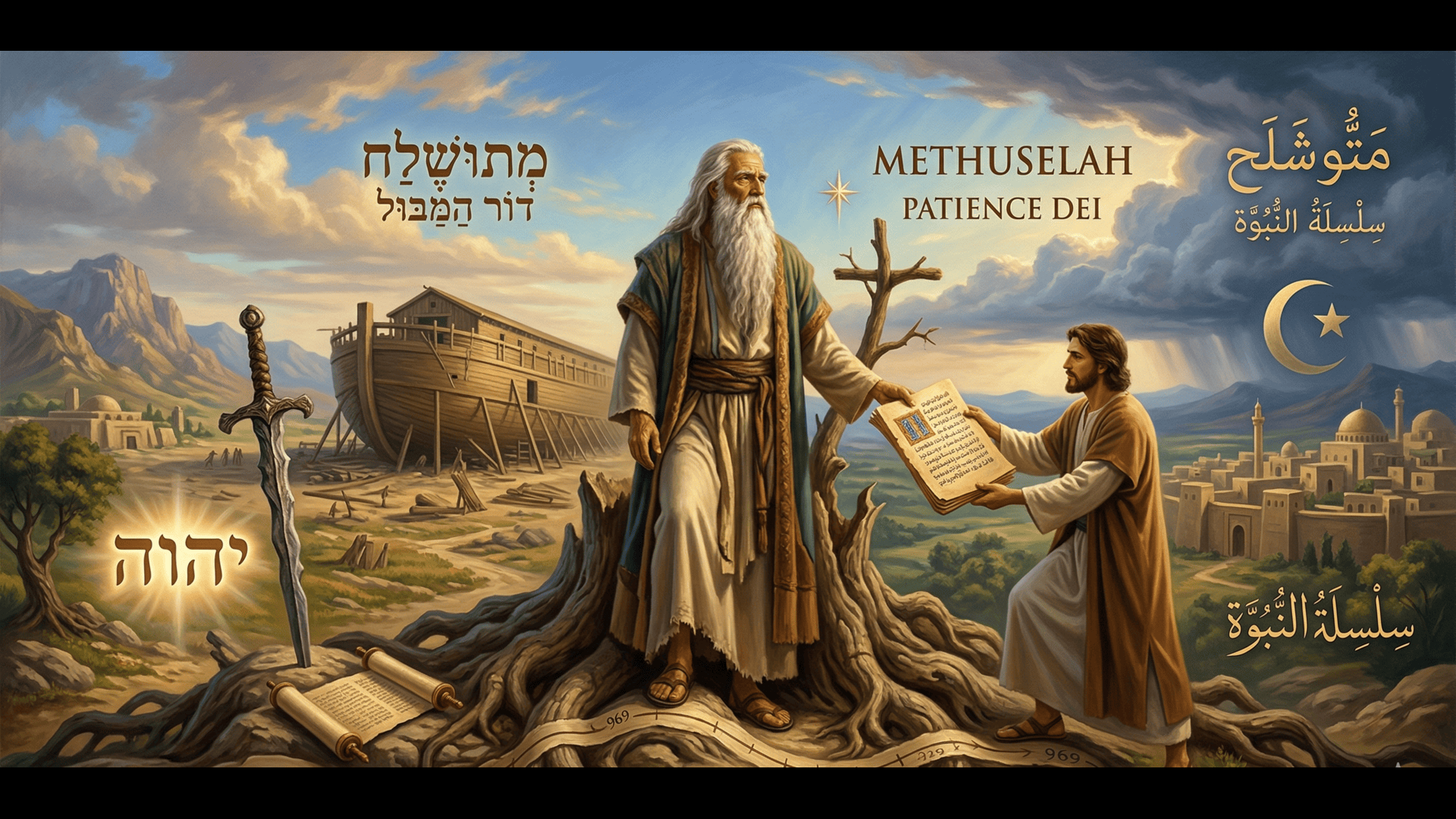
When contemplating the ancient figures of the Abrahamic faiths, certain names evoke immediate imagery: Adam, the first man; Noah, the survivor of the deluge; Abraham, the patriarch of monotheism. Yet, nestled within the intricate genealogies of the antediluvian (pre-flood) world lies a figure whose primary claim to fame is simply the sheer duration of his existence.
Methuselah, the son of Enoch and the grandfather of Noah, is universally recognized as the longest-lived human being in biblical history, purportedly reaching the astonishing age of 969 years. However, to reduce Methuselah to a mere trivia question or a biological anomaly is to miss the profound theological, historical, and narrative significance he holds across Judaism, Christianity, and Islam.
In all three major monotheistic traditions, the pre-flood world is viewed as an era of profound spiritual decay coupled with extraordinary human vitality. Methuselah stands at the precipice of this world, serving as a transitional figure between the idyllic origins of humanity in Eden and the catastrophic reset of the Great Flood. He is a symbol of divine patience, a preserver of esoteric wisdom, and a living monument to a lost age.
This comprehensive exploration will delve deep into the texts, traditions, and theological interpretations surrounding Methuselah in Judaism, Christianity, and Islam, revealing how a man known primarily for his age became a pillar of ancient religious consciousness.
1. Etymology and the Mystery of His Name
Before examining the specific traditions of each faith, it is essential to understand the linguistic roots of Methuselah’s name, as ancient names often carried prophetic or descriptive significance.
In Hebrew, the name is מְתוּשֶׁלַח (Məṯūšélaḥ). Scholars and theologians have debated its exact meaning for centuries, primarily settling on two dominant interpretations, both of which cast a prophetic shadow over his life.
- “Man of the Dart” or “Man of the Spear”: The word math can mean “man,” and shelach can mean “dart,” “spear,” or “weapon.” Under this interpretation, Methuselah is viewed as a warrior figure, a concept that aligns surprisingly well with certain rabbinic traditions that depict him fighting against demons or the wicked generations of his time.
- “His Death Shall Bring” or “When He Dies, It Shall Be Sent”: This is the more common theological interpretation. The root muth means “death,” and shalach means “to send.” According to this translation, Enoch (who walked with God and possessed prophetic foresight) named his son with the knowledge that the Great Flood would be withheld as long as Methuselah lived. The very year Methuselah died, the floodwaters were “sent.”
This dual meaning—the warrior who defends righteousness and the living hourglass counting down to the apocalypse—forms the foundation of how Methuselah is understood across the various religious traditions.
2. Methuselah in Judaism: The Righteous Pillar of the Antediluvian World
In Jewish tradition, Methuselah is far more than a name on a genealogical list. He is fleshed out in the Midrash (rabbinic exegesis), the Aggadah (narrative lore), and mystical texts as a paragon of righteousness in an increasingly corrupt world.
The Genesis Record
The foundational text for Methuselah is Genesis 5:21–27, part of the Toledot (generations) of Adam. The text is highly formulaic, establishing the rhythm of life and death in the early world:
“When Enoch had lived 65 years, he fathered Methuselah. Enoch walked with God after he fathered Methuselah 300 years and had other sons and daughters. Thus all the days of Enoch were 365 years. Enoch walked with God, and he was not, for God took him. When Methuselah had lived 187 years, he fathered Lamech. Methuselah lived after he fathered Lamech 782 years and had other sons and daughters. Thus all the days of Methuselah were 969 years, and he died.” (Genesis 5:21-27)
This text establishes a crucial chronological fact that shapes Jewish theology: Methuselah lived right up to the very year of the Flood.
Midrashic and Aggadic Traditions
The rabbis of the Talmud and Midrash were deeply fascinated by the juxtaposition of Methuselah’s long life and the wickedness of his contemporaries. Why did God allow him to live so long?
The Delay of the Flood According to the Midrash (specifically Genesis Rabbah), God intentionally delayed the Great Flood to honor Methuselah. The text suggests that the flood was held back for seven days after Methuselah’s passing to allow for the traditional Jewish mourning period (Shiva). Genesis 7:10 states, “And after the seven days the floodwaters came on the earth.” The rabbis interpret these “seven days” not as an arbitrary countdown, but as the days of mourning for Methuselah, the last truly righteous man of his generation aside from Noah. His immense lifespan was a manifestation of God’s extreme patience, offering humanity nearly a millennium to repent.
The Sword of Methuselah One of the most fascinating aspects of Jewish folklore regarding Methuselah is his depiction as a warrior. Elaborating on the “Man of the Dart” etymology, the midrashic text Yalkut Shimoni and other medieval collections tell the legend of the Sword of Methuselah.
According to this lore, Methuselah wielded a magnificent sword inscribed with the Ineffable Name of God (the Tetragrammaton). With this sword, he fought against the shedim (demons) and the wicked descendants of Cain who were filling the earth with violence. He reportedly slew thousands of demons, acting as a militant defender of righteousness. When he died, the sword passed to Noah, though the era of open, miraculous warfare against such entities came to an end with the deluge.
Kabbalistic Perspectives
In Kabbalah (Jewish mysticism), the extreme lifespans of the early patriarchs are often viewed through the lens of spiritual vitality. The souls of the antediluvian generations were considered “closer to the Source.” They had not yet suffered the spiritual degradation that would follow the flood. Methuselah, living the longest, possessed a soul capacity that allowed his physical vessel to endure for nearly a millennium. His life represents the maximum potential of the physical body when infused with a primal, uncorrupted soul-state.
3. The Expansive Lore of the Pseudepigrapha: The Book of Enoch
To fully grasp the ancient understanding of Methuselah, one must look beyond the canonical Hebrew Bible to the Pseudepigrapha, particularly the Book of Enoch (1 Enoch). While 1 Enoch is only canonical in the Ethiopian Orthodox Tewahedo Church and Beta Israel (Ethiopian Jewish) traditions, it was widely read by Second Temple Jews and early Christians, profoundly shaping their worldview.
In the Enochic literature, Methuselah transforms from a passive genealogical link into a crucial protagonist.
The Conduit of Revelation
Because “God took” Enoch relatively early (at 365 years old), Enoch needed a reliable successor to preserve the divine visions and warnings he had received regarding the coming judgment. Methuselah serves as Enoch’s scribe and primary confidant.
In 1 Enoch, Enoch takes his son on a visionary tour, explaining the movements of the stars, the origins of evil (the fallen angels, or Watchers), and the impending flood. Methuselah is commanded to preserve these writings and pass them down to future generations. He is the bridge of esoteric knowledge, ensuring that the wisdom of heaven survives the watery destruction of the earth.
The Miraculous Birth of Noah
Perhaps the most dramatic narrative involving Methuselah occurs in 1 Enoch 106, which details the birth of his grandson, Noah.
According to the text, when Lamech’s wife gave birth to Noah, the baby was born extraordinary. His skin was “whiter than snow and redder than the bloom of a rose,” his hair was white, and when he opened his eyes, they illuminated the entire house like the sun. The infant immediately stood up and began to praise the Lord of Righteousness.
Lamech was terrified, believing his wife had been unfaithful with one of the fallen angels (the Nephilim/Watchers). In a panic, Lamech ran to his father, Methuselah.
Methuselah, recognizing the gravity of the situation, traveled to the ends of the earth to consult his own father, Enoch, who was residing with the angels. Enoch reassured Methuselah that the child was indeed human, but was specially chosen by God to be the savior of humanity during the coming destruction. Methuselah returned to Lamech, brought him the comforting news, and named the child Noah.
This story elevates Methuselah to a patriarchal intercessor. He is the stabilizing elder, the one who seeks out divine truth when the younger generations are panicked by the supernatural.
2 Enoch and the Priesthood
In another pseudepigraphal text, 2 Enoch (also known as Slavonic Enoch), Methuselah is explicitly appointed as a priest. Following Enoch’s final assumption into heaven, the people ask Methuselah to take up his father’s mantle. Under divine instruction, Methuselah constructs an altar, offers animal sacrifices, and leads the people in worship, serving as the high priest of the antediluvian world until his death.
4. Methuselah in Christianity: Grace, Lineage, and the Septuagint Crisis
In Christianity, Methuselah’s significance is heavily tied to his place in the lineage of Jesus Christ, as well as complex theological debates held by the Early Church Fathers regarding the nature of the pre-flood world.
The New Testament Lineage
Methuselah’s only explicit mention in the New Testament is in the Gospel of Luke. Luke 3 traces the genealogy of Jesus backward from Joseph all the way to Adam.
“…the son of Cainan, the son of Arphaxad, the son of Shem, the son of Noah, the son of Lamech, the son of Methuselah, the son of Enoch, the son of Jared, the son of Mahalaleel, the son of Cainan…” (Luke 3:36-37)
For Christian theology, this lineage is vital. It establishes Jesus not merely as a descendant of Abraham (the Jewish Messiah, as emphasized in Matthew), but as a descendant of Adam—the savior of all humanity. Methuselah, as the longest-lived link in this chain, is a vital conduit through which the promise of the “seed of the woman” (Genesis 3:15) was preserved through the darkest era of human history.
The Septuagint Chronology Crisis
One of the most fascinating, yet often overlooked, controversies in early Christian biblical scholarship revolves around Methuselah’s age and the timing of the flood. This debate stems from differences between the Masoretic Text (the standard Hebrew text) and the Septuagint (the Greek translation of the Old Testament used by the early Church).
The Septuagint numbers created a massive theological and logical crisis for early Christian scholars. If Methuselah lived 14 years past the flood, where was he? He was not on the Ark with Noah. Did he tread water for 14 years? Did God preserve him miraculously outside the Ark?
Patristic Interpretations: St. Augustine’s Dilemma
Saint Augustine of Hippo tackled this exact “Methuselah Problem” in his magnum opus, The City of God (Book XV, Chapter 13). Augustine, recognizing the infallibility of scripture, struggled deeply with this mathematical contradiction.
Augustine rejected the idea that Methuselah survived the flood outside the Ark. He eventually concluded that the Septuagint translators had made an early scribal error that was subsequently copied. He leaned on the Hebrew texts (championed by his contemporary, Jerome) to resolve the timeline, affirming that Methuselah died before the deluge. This debate highlights how Methuselah was central to early Christian efforts to synchronize biblical chronologies.
Theological Symbolism: The Long-Suffering of God
Beyond mathematical debates, early Christians viewed Methuselah’s longevity as an allegory for God’s grace. In 1 Peter 3:20, the Apostle Peter speaks of how “God’s patience waited in the days of Noah.” Christian theologians applied this directly to Methuselah. Every extra decade added to Methuselah’s impossibly long life was viewed as God extending an olive branch to a wicked world, begging them to repent. His eventual death signaled that God’s grace, while vast, is not infinite, and judgment ultimately comes.
5. Methuselah in Islam: Mattūshalakh and the Chain of Prophets
While Methuselah is not mentioned by name in the Quran, he holds a respected place in Islamic tradition, particularly in the Qisas al-Anbiya (Tales of the Prophets) and the historical writings of renowned Islamic scholars like Al-Tabari and Ibn Kathir. In Arabic, he is known as متوشلخ (Mattūshalakh).
The Chain of Prophetic Light
In Islamic theology, the history of humanity is guided by an unbroken chain of prophets and righteous men who transmit the Tawhid (monotheism) from one generation to the next. Methuselah serves as a critical link between two great prophets: his father Idris (often identified with Enoch) and his grandson Nuh (Noah).
According to Ibn Kathir in his Al-Bidayah wa’n-Nihayah (The Beginning and the End), when Idris was raised to heaven by God, the spiritual leadership of humanity fell to his son, Mattūshalakh. Islamic tradition portrays him not necessarily as a prophet (Nabi) in his own right, but as a deeply righteous patriarch who maintained the laws of God and preached against the creeping idolatry and corruption that was spreading among the descendants of Qabil (Cain).
The Mu’ammarun (The Long-Lived Ones)
Islamic literature contains a specific genre or concept known as the Mu’ammarun—individuals blessed by Allah with extraordinarily long lives. Mattūshalakh is universally cited as the chief of the Mu’ammarun prior to the flood.
In Islamic thought, the longevity of these early generations is often accepted literally, attributed to several factors:
- Divine Will: Allah simply decreed longer lifespans for the early generations to populate the earth and establish the foundations of human civilization.
- Purity of Creation: The human body, being closer to its original creation from clay, possessed greater physical resilience and vitality.
- Absence of Disease: The environment and human genetics had not yet been corrupted by centuries of sin and environmental degradation.
Historical Accounts in Islamic Tradition
Al-Tabari, the great Persian scholar and historian, details the chronology of the pre-flood patriarchs. He aligns closely with the biblical narrative regarding Mattūshalakh’s age, recording that he lived for 969 years.
Islamic narratives also echo the Jewish tradition that Mattūshalakh died right before the flood. Tabari notes that when Mattūshalakh passed away, the people of the earth had become entirely reprobate. Nuh, who had been preaching to his people for 950 years (as stated in Quran 29:14), finally received the command to build the Ark. The death of Mattūshalakh is seen in Islamic historical texts as the final withdrawal of God’s protective grace over the pre-flood world.
6. The Enigma of Extreme Longevity: Theological and Rational Interpretations
Across all three faiths, the sheer number—969 years—presents a profound intellectual and theological challenge. How do modern and classical scholars within Judaism, Christianity, and Islam reconcile this extreme longevity with the known biological limits of the human body? Several distinct schools of thought have emerged over the millennia.
The Literal Interpretation
Traditional, orthodox believers in all three faiths generally accept the 969 years literally. This view argues that biological realities in the antediluvian world were fundamentally different from today.
- Genetic Purity: Adam and Eve were created perfect. As genetic mutations and degradation accumulated over successive generations, human lifespans naturally shortened. Methuselah, living relatively close to the dawn of creation, retained a high degree of this genetic purity.
- Environmental Factors: Some interpretations refer to a “canopy theory,” based on the waters “above the firmament” in Genesis. According to this idea, the pre-flood earth may have experienced conditions such as reduced exposure to cosmic radiation, increased atmospheric pressure, and higher oxygen levels, which could have contributed to slower aging. The flood destroyed this optimal environment, leading to the rapid decline in lifespans seen in the generations after Noah.
The Metaphorical/Mathematical Interpretations
For those who find the literal interpretation incompatible with science, several alternative theories have been proposed by ancient commentators and modern scholars alike.
1. The Lunar Month Theory One of the oldest rationalizations, even addressed and debunked by St. Augustine in the 5th century, is that the “years” mentioned in early Genesis were actually lunar months. If Methuselah’s 969 “years” were actually 969 months, his true age would be a highly realistic 78.5 years.
-
The Theological Problem: While this solves the biological issue for Methuselah, it destroys the rest of the timeline. If years were months, it means Enoch fathered Methuselah at the age of 65 months (a 5-and-a-half-year-old child), which is biologically absurd. Thus, this theory is generally rejected by serious scriptural scholars.
2. The Dynasty or Clan Theory A more robust academic theory suggests that names like “Methuselah,” “Enoch,” and “Lamech” did not just represent single individuals, but entire tribes, dynasties, or familial epochs. Therefore, the statement “Methuselah lived 969 years” might mean that the tribal authority or dynasty founded by Methuselah ruled or existed for nearly a millennium before being assimilated or destroyed by the flood.
3. Numerological Symbolism Ancient Near Eastern cultures, including the Sumerians and Babylonians, frequently used inflated numbers to express greatness, honor, or divine favor rather than literal chronological data. The Sumerian King List, for example, records kings who ruled for tens of thousands of years. In this context, Methuselah’s 969 years might be a symbolic Hebrew way of saying he was supremely blessed, deeply wise, and highly favored by God.
The Theological Concept of Lifespan Decay
Regardless of whether one takes the number literally or symbolically, all three faiths observe a theological narrative in the decay of the human lifespan. In Genesis 6:3, just before the flood, God declares: “My Spirit shall not abide in man forever, for he is flesh: his days shall be 120 years.” This represents a divine curtailing of human potential. Extreme longevity had not led humanity to greater wisdom or repentance; instead, it had allowed evil men to accumulate power, violence, and corruption over centuries. By shortening the human lifespan, God limited the amount of damage any single tyrant or wicked generation could inflict upon the earth. Methuselah stands as the high-water mark of human endurance, a peak from which humanity steadily descended to our current mortal constraints.
7. Methuselah as a Cultural and Scientific Archetype
The religious significance of Methuselah has deeply permeated secular culture, literature, and even modern science. His name has transcended its theological roots to become a universal shorthand for extreme age and endurance.
Linguistic Idioms and Literature
The phrase “as old as Methuselah” is a common idiom in the English language, used to hyperbolically describe something of great antiquity. In literature, figures who live unusually long lives or possess ancient, arcane knowledge are often compared to him. He appears as a character in works ranging from George Bernard Shaw’s Back to Methuselah, which explores the concept of extended human lifespans, to modern science fiction, where the “Methuselah syndrome” might refer to slowed aging or immortality.
Scientific Metaphors
In the scientific community, Methuselah’s name is frequently borrowed to describe organisms or celestial bodies of exceptional age.
- The Methuselah Tree: A Great Basin bristlecone pine located in the White Mountains of California is named Methuselah. For many years, it was considered the oldest known living non-clonal organism on Earth, with an estimated age of over 4,800 years.
- The Methuselah Star: HD 140283, a subgiant star located about 190 light-years away, is informally known as the Methuselah star. It is one of the oldest known stars in the universe, with an estimated age that borders on the estimated age of the universe itself, posing fascinating challenges for astronomers.
- Genetics and Anti-Aging: In biology, the “Methuselah gene” (specifically the mth gene discovered in fruit flies) is a genetic mutation that significantly extends lifespan. Furthermore, the Methuselah Foundation is a non-profit medical charity focused on tissue engineering and regenerative medicine, with the explicit goal of extending healthy human lifespans.
In all these secular usages, the shadow of the biblical patriarch remains intact. He is the ultimate benchmark against which all longevity is measured.
Conclusion: The Enduring Legacy of the Oldest Man
Methuselah’s presence in Judaism, Christianity, and Islam serves a remarkably similar, yet beautifully nuanced, purpose across the divides of theology.
To the Jewish sages, he was the righteous warrior whose very breath held back the apocalypse, his death serving as the tragic catalyst for the world’s watery unmaking. The early Christians, his genealogy was a vital thread connecting the Savior to the dawn of creation, while his age was a testament to the agonizing, heart-breaking patience of a God waiting for a corrupted humanity to return to Him. To Islamic scholars, he was the faithful preserver of monotheism, carrying the light of his father Idris through a darkening world until it could be safely passed to Nuh.
In a modern era obsessed with youth, health spans, and biological preservation, the ancient figure of Methuselah continues to resonate. He forces the reader of ancient texts to confront the brevity of their own existence. Whether one views his 969 years as literal biology, ancient dynastic history, or profound theological poetry, Methuselah remains a towering monolith in the landscape of human faith. He is the quiet sentinel standing at the edge of the old world, a man who watched centuries rise and fall, serving as the ultimate witness to both the height of human vitality and the depth of human frailty.
Frequently Asked Questions About Methuselah
Q: Did Methuselah really live to be 969 years old?
A: This depends on the interpretive lens you use. Orthodox and traditional believers across Judaism, Christianity, and Islam generally accept the 969 years literally, attributing it to purer human genetics, a different pre-flood environment, or specific divine grace. However, many modern scholars and theologians suggest the number might be symbolic (representing a dynasty or clan), a translation of a different timekeeping method (like lunar cycles, though this creates mathematical issues), or a numerological ancient Near Eastern convention used to denote greatness and extreme divine favor.
Q: Did Methuselah die in the Great Flood?
A: No, traditional texts indicate he died before the floodwaters came. According to the standard Hebrew text (the Masoretic Text), he died in the exact year the flood began. Jewish Midrash actually teaches that God delayed the flood by seven days specifically to allow humanity to mourn Methuselah’s passing.
Q: Why was there a controversy about his death in the Early Christian Church?
A: The controversy stemmed from a mathematical discrepancy in the Septuagint (the ancient Greek translation of the Hebrew Bible). The numbers in that specific translation accidentally placed Methuselah’s death 14 years after the flood began. Since he wasn’t on Noah’s Ark, this created a major logical and theological headache for early Church fathers like St. Augustine, who eventually concluded it was a scribal error and deferred to the Hebrew timeline.
Q: Who was Methuselah’s family?
A: Methuselah was part of the pivotal antediluvian (pre-flood) patriarchal line. His father was Enoch (the man who “walked with God” and was taken to heaven without dying), his son was Lamech, and his grandson was Noah (the builder of the Ark).
Q: If he only gets a few lines in Genesis, why is he so important?
A: While his biblical real estate is small, his theological footprint is massive. He acts as the ultimate bridge between the creation of humanity and its destruction/reboot in the flood. Theologically, his incredibly long life is viewed as the ultimate symbol of God’s patience and long-suffering, giving a wicked world nearly a millennium to repent before the floodwaters were unleashed.
Q: Are there any other books that talk about him besides the Bible?
A: Yes! He is a major character in the pseudepigraphal Book of Enoch (1 Enoch), where he acts as a scribe, a preserver of heavenly secrets, and an intercessor for his family. He also features prominently in Jewish Midrashic lore (where he is sometimes depicted as a demon-fighting warrior) and Islamic historical texts by scholars like Al-Tabari.
Leave a Reply