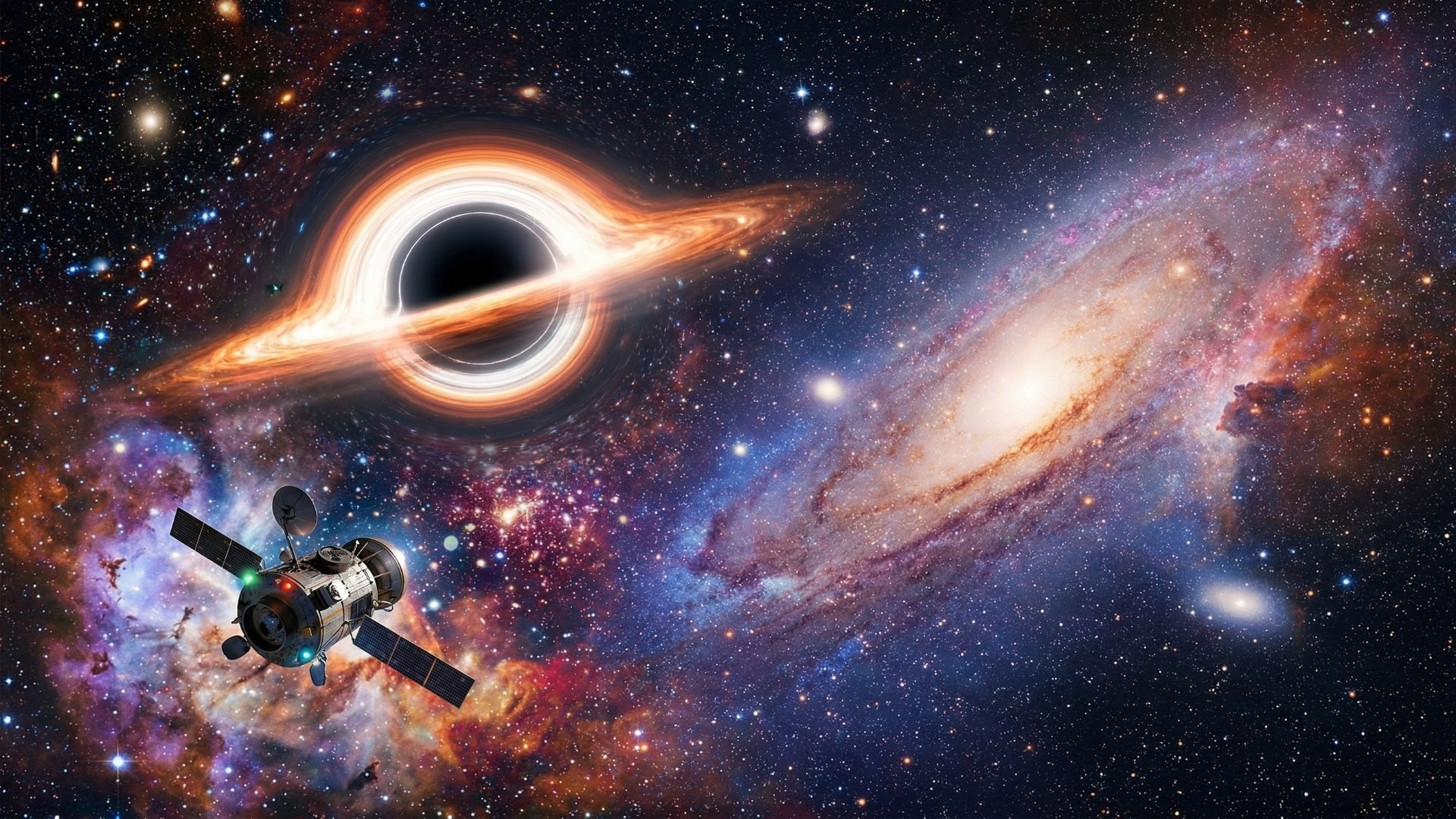
When you step outside on a clear, moonless night and look up at the star-studded canopy above, what do you feel? For most of humanity, across all cultures and eras, the response is a profound sense of awe. The cosmos is vast, silent, and brimming with secrets. For millennia, we have looked to the stars to navigate our oceans, track our seasons, and understand our place in the grand scheme of existence.
Today, we are no longer just looking; we are actively exploring. With the advent of groundbreaking technology, crewed space missions, and powerful orbital observatories, we are peeling back the cosmic curtain. Yet, for every question we answer, a dozen more emerge.
In this comprehensive guide, we will embark on a journey through space and time, exploring the mysteries of the universe—from the invisible forces that shape our galaxies to the mind-bending reality of black holes, and the eternal question: Are we alone?
1. The Invisible Universe: Dark Matter and Dark Energy
When we think of the universe, we typically picture planets, glowing stars, sweeping nebulas, and swirling galaxies. However, everything we can see, touch, and interact with—every star, every planet, and every person on Earth—makes up a mere 5% of the universe.
The rest is shrouded in shadow, composed of two deeply mysterious phenomena: Dark Matter and Dark Energy.
What is Dark Matter?
Accounting for roughly 27% of the universe, dark matter is the cosmic glue holding galaxies together.
In the mid-20th century, astronomer Vera Rubin observed that galaxies were spinning so fast that the gravity generated by their visible matter (stars and gas) wasn’t enough to keep them from flying apart. There had to be an invisible, massive substance exerting a gravitational pull. Because this substance does not emit, reflect, or absorb light, it earned the moniker “dark matter.”
While scientists have yet to directly observe a dark matter particle, we know it exists because of its gravitational effects on visible light. When light from distant galaxies passes through a cluster of dark matter, the light bends and magnifies—a phenomenon known as gravitational lensing.
What is Dark Energy?
If dark matter pulls the universe together, dark energy tears it apart. Making up roughly 68% of the cosmos, dark energy is the driving force behind the accelerating expansion of the universe.
In the 1990s, astrophysicists studying distant supernovas expected to find that the expansion of the universe was slowing down due to the inward pull of gravity. Instead, they discovered the exact opposite: the expansion was accelerating. Dark energy remains one of the greatest unsolved mysteries in modern physics. We know how it acts, but its true nature remains entirely elusive.
(To learn more about ongoing research into the dark universe, you can explore the European Space Agency’s Euclid Mission, a telescope designed specifically to map dark geometry).
2. Black Holes: The Gravity Behemoths
Few celestial objects capture the human imagination quite like black holes. They are the universe’s ultimate point of no return—regions of spacetime where gravity is so incredibly intense that nothing, not even light, can escape its grasp.
How Are Black Holes Formed?
Most stellar-mass black holes are born from the violent deaths of massive stars. When a star at least three times the mass of our Sun runs out of nuclear fuel, its core can no longer support the weight of its outer layers. The star collapses inward, triggering a massive explosion called a supernova, while the core continues to compress into an infinitely dense point known as a singularity.
The Anatomy of a Black Hole
- The Singularity: The very center of the black hole, where all its mass is concentrated into a space of zero volume. Here, the laws of physics as we understand them break down entirely.
- The Event Horizon: This is the boundary around the singularity. It is the “point of no return.” Once anything crosses the event horizon, it requires a velocity greater than the speed of light to escape—which is physically impossible.
- The Accretion Disk: Many black holes are surrounded by a swirling disk of superheated gas and dust. As this material spirals inward, it accelerates and heats up, emitting brilliant X-rays that telescopes can detect.
Supermassive Black Holes
While stellar-mass black holes dot our galaxy, monstrously large black holes lurk at the centers of nearly every large galaxy, including our own Milky Way. Our resident giant, Sagittarius A*, is four million times more massive than our Sun. In 2019, the Event Horizon Telescope collaboration made history by capturing the first-ever image of a black hole in the galaxy M87, providing stunning visual proof of Albert Einstein’s General Theory of Relativity.
3. The Origins of Everything: The Big Bang and Beyond
How did we get here? For much of human history, this was a question reserved for philosophy and theology. Today, it is the realm of cosmology.
The Big Bang Theory
The prevailing cosmological model suggests that the universe began approximately 13.8 billion years ago. It did not explode into pre-existing space; rather, space itself expanded from an infinitely hot, infinitely dense point.
In the first fractions of a second following the Big Bang, the universe underwent a period of rapid, exponential expansion known as Cosmic Inflation. As the universe expanded, it cooled. Energy transformed into matter, creating the first subatomic particles, which eventually bound together to form simple atoms like hydrogen and helium.
The Cosmic Microwave Background
For the first 380,000 years, the universe was a superhot, opaque fog of plasma. As it cooled enough for electrons to attach to nuclei, light was finally able to travel freely through space. The remnant glow of this first light is still detectable today as the Cosmic Microwave Background (CMB). Discovered accidentally in 1965, the CMB is effectively the “baby picture” of our universe, providing critical evidence for the Big Bang.
The Fate of the Universe
If the Big Bang is how it started, how will it end? Cosmologists propose a few scenarios based on the ongoing struggle between gravity and dark energy:
- The Big Freeze: The most likely scenario based on current data. The universe continues to expand forever, stars burn out, galaxies drift apart, and the cosmos approaches absolute zero.
- The Big Crunch: If gravity eventually overpowers dark energy, the universe’s expansion could reverse, causing everything to collapse back into a fiery singularity.
- The Big Rip: If dark energy accelerates aggressively, it could eventually tear apart galaxies, star systems, planets, and ultimately, atoms themselves.
4. Are We Alone? The Search for Extraterrestrial Life
Of all the mysteries of the universe, none is more profound than the search for life beyond Earth. If we find evidence of biology elsewhere, it will fundamentally change our understanding of our place in the cosmos.
The Hunt for Exoplanets
For a long time, we didn’t know if other stars had planets. That changed in the 1990s. Today, astronomers have confirmed the existence of over 5,000 exoplanets (planets orbiting stars outside our solar system).
Scientists search for these distant worlds primarily using two methods:
- The Transit Method: Observing the tiny dip in a star’s brightness when a planet passes (or transits) in front of it.
- The Radial Velocity Method: Detecting the slight “wobble” of a star caused by the gravitational tug of an orbiting planet.
The Habitable Zone
A key focus in the search for life is finding planets situated in the Habitable Zone (often called the “Goldilocks Zone”). This is the region around a star where the temperature is “just right”—neither too hot nor too cold—for liquid water to exist on a planet’s surface. Water is the universal solvent and a necessary ingredient for all life as we know it.
Extremophiles and Ocean Worlds
We don’t necessarily have to look outside our solar system for life. Astrobiologists are incredibly interested in environments right here in our cosmic backyard.
- Mars: Rovers like NASA’s Perseverance are currently scouring the Jezero Crater for fossilized signs of ancient microbial life.
- Europa and Enceladus: These icy moons of Jupiter and Saturn, respectively, hide massive, liquid-water oceans beneath their frozen crusts. Hydrothermal vents at the bottom of these alien oceans could potentially support ecosystems, much like the extremophiles found in the deep oceans of Earth.
5. The Tools of Discovery: Eyes in the Sky
Our understanding of the universe is only as good as the tools we use to observe it. Over the last few decades, technological leaps have revolutionized astrophysics.
The Hubble Space Telescope
Launched in 1990, Hubble changed the way humanity views the cosmos. Unencumbered by Earth’s blurring atmosphere, Hubble captured crystal-clear images of towering nebulas, ancient galaxies, and stellar nurseries. Its most profound contribution was the Hubble Deep Field, an image that revealed thousands of galaxies in a seemingly empty patch of sky, proving just how densely packed the universe is.
The James Webb Space Telescope (JWST)
The successor to Hubble, the JWST is a marvel of modern engineering. Launched in late 2021, Webb is optimized to view the universe in the infrared spectrum. Because the universe is expanding, light from the earliest galaxies is stretched out (redshifted) into infrared wavelengths.
Webb acts like a cosmic time machine, allowing us to see the first stars and galaxies that formed shortly after the Big Bang. Additionally, Webb’s sensitive instruments can analyze the atmospheres of distant exoplanets, searching for biosignatures—chemical imbalances like methane and oxygen that could indicate the presence of biological life.
6. The Future of Cosmic Exploration
We are living in a golden age of space exploration. The transition from government-exclusive agencies to the inclusion of private aerospace companies has rapidly accelerated humanity’s push into the stars.
The Artemis Generation
Through the Artemis program, humanity is returning to the Moon—but this time, we intend to stay. The goal is to establish a sustainable human presence on the lunar surface, including building a lunar gateway (a space station orbiting the Moon). This lunar infrastructure will serve as a proving ground for the technologies and biological research necessary for the next giant leap.
Mars and Beyond
A crewed mission to Mars is the ultimate goal of contemporary space exploration. Sending humans to the Red Planet will test the absolute limits of our engineering, psychology, and physiology. Unlike the Moon, which is a few days away, a mission to Mars involves a months-long transit and requires extreme self-sufficiency.
Looking even further ahead, scientists are conceptualizing interstellar travel. Initiatives like Breakthrough Starshot aim to send tiny, light-propelled nanocrafts to Alpha Centauri, our nearest neighboring star system, at 20% the speed of light. While human interstellar travel remains firmly in the realm of science fiction for now, the groundwork for unmanned exploration of neighboring stars is already being laid.
Conclusion: A Universe Waiting to be Known
Exploring the mysteries of the universe is not just an academic exercise; it is a fundamental expression of human curiosity. Every time we solve a cosmic puzzle, we gain a deeper appreciation for the delicate, miraculous nature of our own existence on this pale blue dot.
From the unseen forces of dark energy to the crushing depths of black holes, the cosmos reminds us that there is always more to learn. As our telescopes look further and our spacecraft fly faster, we continue the ancient, noble tradition of looking up and daring to ask: Why?
Frequently Asked Questions (FAQ)
1. How old is the universe?
Based on measurements of the cosmic microwave background and the expansion rate of space, astrophysicists estimate the universe is approximately 13.8 billion years old.
2. What is a black hole, simply put?
A black hole is an area in space where gravity pulls so intensely that nothing, not even light, can escape. They are usually formed when a massive star collapses in on itself at the end of its life cycle.
3. Is there sound in space?
No, space is a near-perfect vacuum. Sound waves require a medium (like air, water, or metal) to travel through. Because there are no air molecules in the vacuum of space to vibrate and carry sound waves, space is completely silent.
4. What is the difference between Dark Matter and Dark Energy?
Dark matter is an invisible mass that pulls matter together, providing the gravity needed to hold galaxies intact. Dark energy is a mysterious repulsive force that pushes space apart, causing the universe’s expansion to accelerate.
5. What is the James Webb Space Telescope (JWST)?
The JWST is currently the largest and most powerful space telescope ever built. Unlike Hubble, which sees mostly visible light, JWST observes in the infrared, allowing it to peer through thick cosmic dust clouds and look further back in time than any previous instrument.
6. Will the sun eventually become a black hole?
No. Our Sun does not have enough mass to collapse into a black hole. In about 5 billion years, it will expand into a red giant, shed its outer layers, and leave behind a dense, glowing core known as a white dwarf.
Leave a Reply