When we look up at the night sky, the shimmering dots of light seem eternal and unchanging. However, the universe is a dynamic, ever-shifting canvas. Just like living beings on Earth, stars are born, they live out their lives, and eventually, they die. This incredible process, known as stellar evolution, is responsible for creating the very elements that make up our planet and our bodies.
Understanding the life cycle of stars is not just about astronomy; it is about understanding our own origins. Every atom of carbon in our cells and every atom of iron in our blood was forged in the fiery heart of a dying star.
In this comprehensive guide, we will journey through the cosmos to explore the life cycle of stars, breaking down the complex science into accessible, easy-to-understand stages.
Stage 1: The Stellar Nursery (Birth of a Star)
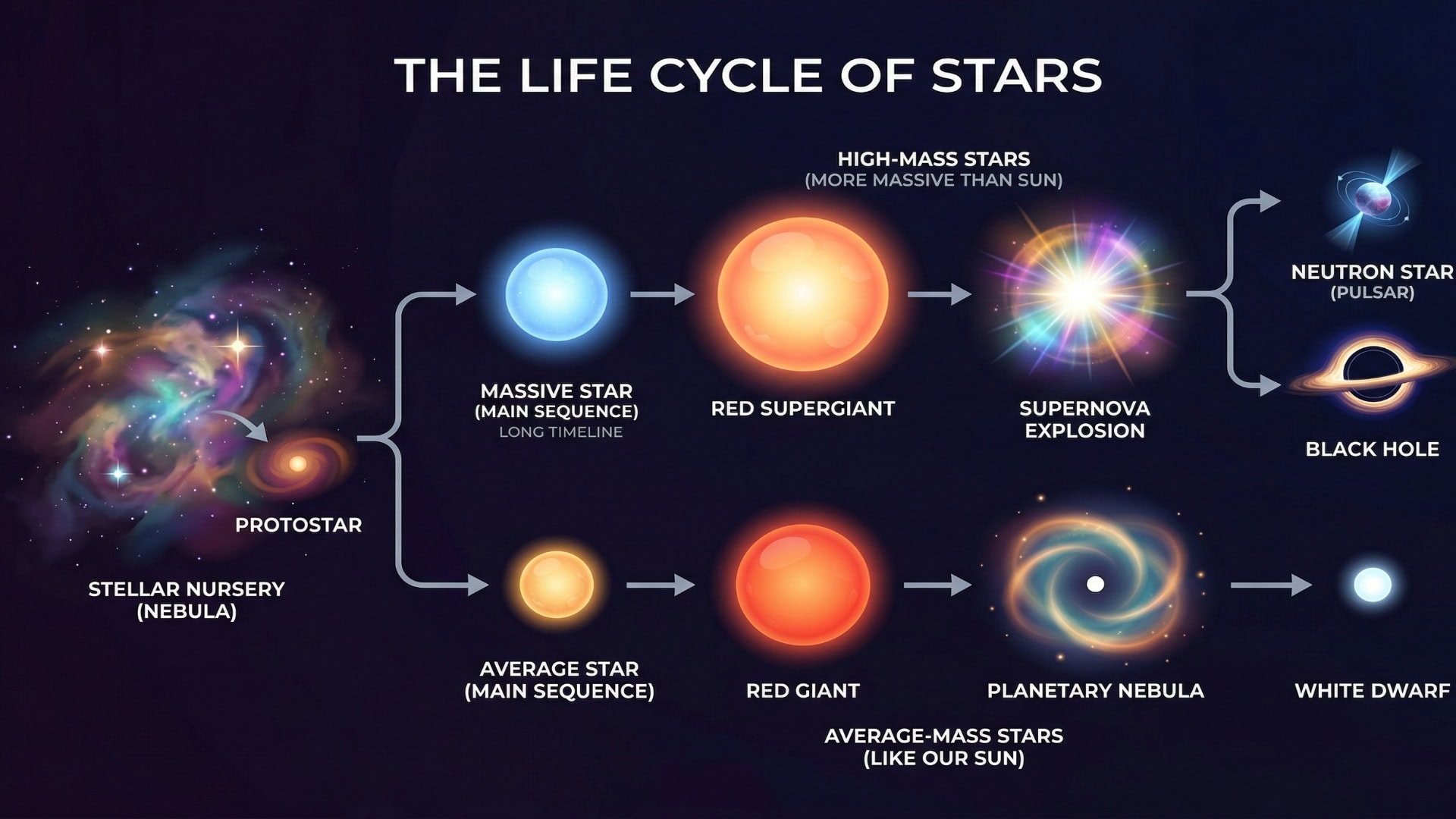
The story of every star begins in the deep, freezing vacuum of space, within colossal clouds of gas and dust known as nebulae (or stellar nurseries). These clouds are incredibly vast, sometimes stretching across hundreds of light-years, and are primarily composed of hydrogen—the most abundant element in the universe—along with some helium and traces of heavier elements.
The Spark of Creation: Gravity vs. Pressure
Within a nebula, gas and dust are not distributed perfectly evenly. Some regions become slightly denser than others. Over millions of years, gravity begins to pull this dense matter together. As more material clumps together, the gravitational pull grows stronger, drawing in even more gas and dust.
As the matter collapses inward, it begins to spin and heat up due to friction and immense pressure. This swirling, heating core of gas is known as a protostar.
The Protostar Phase
A protostar is essentially a star in the making. It is incredibly hot and bright, but it is not yet a true star because nuclear fusion has not yet ignited in its core. The protostar continues to gather mass from its surrounding envelope of dust. This phase can last anywhere from 100,000 to 10 million years, depending on the mass of the gathering material.
Eventually, if the protostar gathers enough mass, the temperature and pressure at its core reach a critical tipping point—around 15 million degrees Celsius. At this unimaginable temperature, hydrogen atoms are forced together with such immense force that they fuse.
Stage 2: The Main Sequence (The Prime of Life)
When nuclear fusion ignites, a true star is born. This marks the beginning of the Main Sequence phase, the longest and most stable period in the life cycle of stars.
The Grand Tug-of-War: Hydrostatic Equilibrium
During the main sequence, a star operates as a giant nuclear furnace. It fuses hydrogen atoms into helium atoms in its core. This fusion process releases a tremendous amount of outward energy, which we see as starlight.
To survive, a star must maintain a delicate, continuous balance known as hydrostatic equilibrium. This is a cosmic tug-of-war between two opposing forces:
- Gravity: Constantly trying to pull all the star’s mass inward to crush it.
- Nuclear Fusion (Radiation Pressure): Constantly pushing outward from the core.
As long as the star has enough hydrogen fuel to maintain fusion, these two forces remain balanced, and the star remains stable. Our own Sun is currently in its main sequence phase and has been for about 4.6 billion years. It has enough hydrogen to remain stable for another 5 billion years.
Size Determines Destiny
How long a star spends in the main sequence depends entirely on its mass:
- Low-Mass Stars (Red Dwarfs): These sip their hydrogen fuel very slowly. They can remain in the main sequence for trillions of years—longer than the current age of the universe!
- Average-Mass Stars (Like our Sun): These burn through their fuel at a moderate pace, lasting roughly 10 billion years.
- High-Mass Stars (Blue Giants): These are cosmic gluttons. Despite having much more fuel, they burn incredibly hot and fast, exhausting their hydrogen in just a few million years.
Stage 3: The Aging Star (Diverging Paths)
Eventually, every star runs out of hydrogen fuel in its core. When this happens, the outward pressure of nuclear fusion drops, and gravity temporarily wins the tug-of-war. The core begins to collapse inward. What happens next depends entirely on the star’s original mass. The stellar life cycle splits into two distinct paths.
Path A: The Fate of Low and Average-Mass Stars
For stars roughly the size of our Sun, the core collapse generates intense heat—so much heat that the outer layers of the star expand outward rapidly.
The Red Giant Phase
As the outer layers expand, they cool down and take on a reddish hue. The star has now become a Red Giant. It can grow to hundreds of times its original size. When our Sun enters this phase, it will expand so much that it will likely swallow Mercury, Venus, and possibly Earth.
Meanwhile, back in the collapsing core, the temperature eventually gets high enough to start fusing the newly created helium into heavier elements, like carbon and oxygen. However, this helium fuel is a temporary fix and burns out relatively quickly.
Planetary Nebula
Once the helium is exhausted, a star like our Sun does not have enough mass (and therefore not enough gravitational pressure) to heat the core enough to fuse carbon. The core collapses for the final time.
The outer layers of the star become unstable and are gently puffed away into space, creating a beautiful, glowing shell of gas known as a planetary nebula. (Note: Despite the name, this has nothing to do with planets; early astronomers simply thought they looked like round planets through early telescopes).
White Dwarf and Black Dwarf
Once the outer layers dissipate, all that remains is the star’s exposed, glowing core. This is a White Dwarf. It is incredibly dense—packing the mass of a star into a sphere roughly the size of Earth. It no longer undergoes nuclear fusion; it simply radiates its leftover heat into space.
Over tens of billions of years, the white dwarf will eventually cool down and fade entirely, becoming a theoretical Black Dwarf—a cold, dark, dead ember floating in space. Because the universe is only 13.8 billion years old, we believe no black dwarfs exist yet; the oldest white dwarfs are still cooling.
Path B: The Fate of Massive Stars
Stars that are significantly larger than our Sun (at least 8 times more massive) experience a much more dramatic and violent conclusion to their lives.
The Red Supergiant Phase
When a massive star exhausts its hydrogen, it expands just like an average star, but on a much grander scale, becoming a Red Supergiant. These are the largest stars in the universe in terms of volume.
Because massive stars have so much gravity, their cores can reach the temperatures necessary to fuse progressively heavier elements. The core becomes layered like an onion. The outer shell fuses hydrogen, the next shell fuses helium, then carbon, oxygen, neon, silicon, and so on.
The Iron Barrier and Core Collapse
This fusion chain continues until the core begins to produce iron. Iron is the ultimate stellar killer. Fusing elements lighter than iron releases energy, which supports the star. However, fusing iron absorbs energy.
The moment iron is created, the outward radiation pressure plummets to zero. Gravity wins instantly and decisively. The entire immense weight of the star crashes down on the iron core at a significant fraction of the speed of light.
The Supernova Explosion
The core collapses until the atoms themselves are crushed. Protons and electrons are smashed together to form neutrons. The core becomes so dense that it physically cannot be compressed any further.
The infalling outer layers of the star hit this ultra-dense, unyielding core and bounce off, triggering one of the most powerful explosions in the universe: a Supernova. For a brief moment, a single supernova can outshine an entire galaxy of hundreds of billions of stars. This explosion scatters the heavy elements forged in the star out into deep space.
Neutron Stars and Black Holes
After the supernova clears, the incredibly dense core is left behind. Its final form depends on how much mass survived the explosion:
-
Neutron Star: If the remaining core is between 1.4 and 3 times the mass of our Sun, it stabilizes as a neutron star. These objects are mind-bogglingly dense; a single teaspoon of neutron star material would weigh billions of tons on Earth. Some neutron stars spin rapidly, emitting beams of radiation, and are known as pulsars.
-
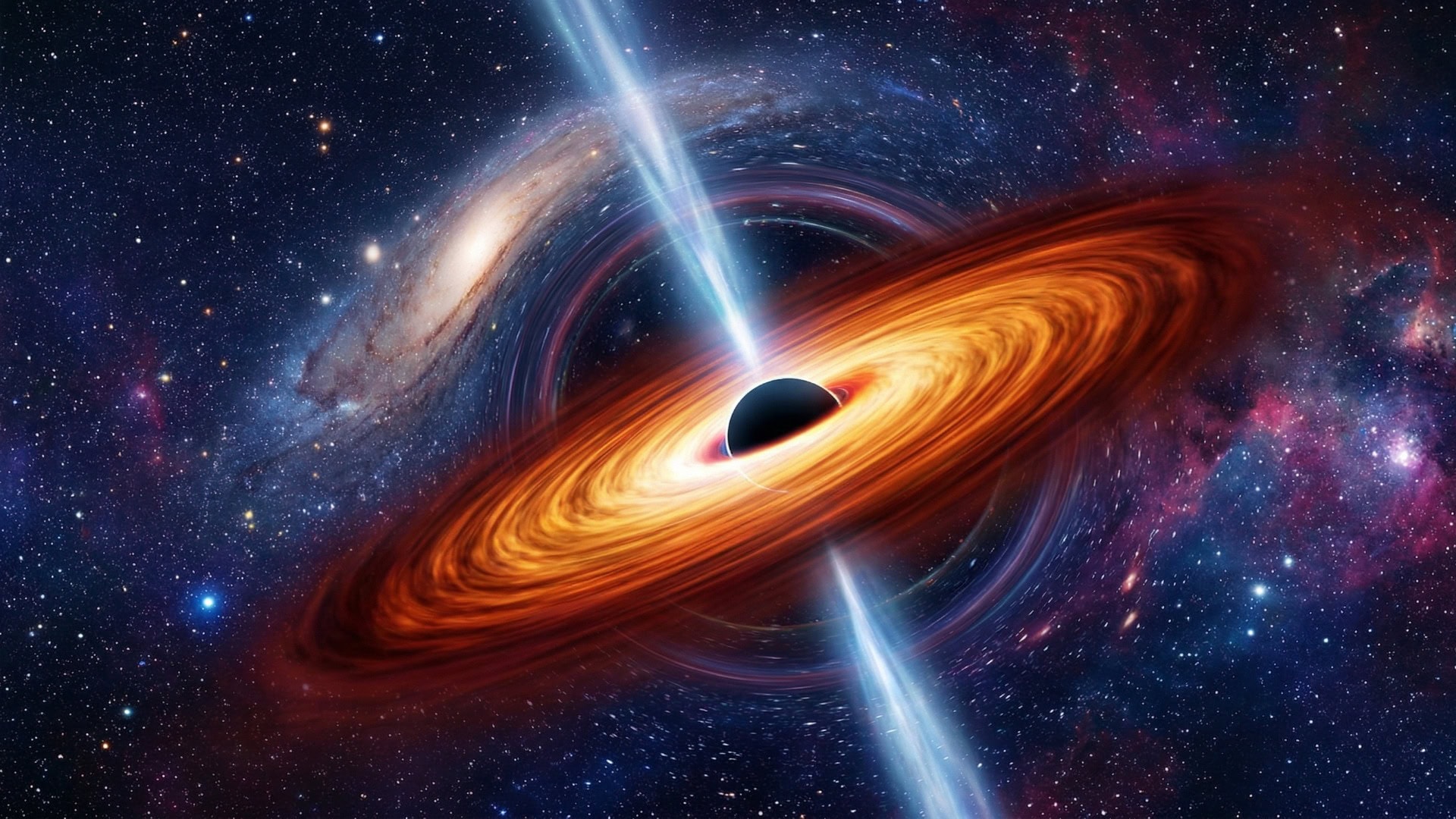
Black Hole: If the remaining core is more than 3 times the mass of our Sun, not even the density of neutrons can stop the gravitational collapse. The core collapses into an infinitely small, infinitely dense point known as a singularity. The gravitational pull is so intense that nothing, not even light, can escape it. A Black Hole is born.
The Cycle Continues: Stardust and New Beginnings
The death of a star is not just an end; it is a vital beginning. The violent explosions of supernovae and the gentle shedding of planetary nebulae cast immense clouds of gas and heavy elements back into the interstellar medium.
These enriched clouds wander through the galaxy until, eventually, gravity takes hold again. The gas and dust—now containing carbon, oxygen, iron, and gold—will clump together to form a new nebula.
From this recycled “stardust,” a new generation of stars will be born. Surrounding these new stars, the heavier elements will clump together to form rocky planets, moons, asteroids, and perhaps, eventually, the building blocks for life itself.
To explore more about how the cosmos recycles its materials, you can read NASA’s guide on stellar evolution.
Frequently Asked Questions (FAQ)
1. How long do stars live?
A star’s lifespan is entirely determined by its mass. Extremely massive stars burn hot and fast, living for only a few million years. Average stars like our Sun live for about 10 billion years. Small, low-mass stars known as red dwarfs can live for trillions of years.
2. Will our Sun eventually become a black hole?
No, our Sun does not have enough mass to become a black hole. When the Sun reaches the end of its life, it will expand into a red giant, shed its outer layers as a planetary nebula, and leave behind a small, dense core called a white dwarf.
3. Are all stars in the night sky the same age?
No. The universe is constantly giving birth to new stars while older ones die. When you look at the night sky, you are seeing a mix of stellar “infants,” middle-aged main sequence stars, and dying giants.
4. What is a supernova?
A supernova is the explosive death of a massive star. It occurs when a star exhausts its nuclear fuel and its core collapses under its own immense gravity. The resulting explosion is so powerful that it can briefly outshine an entire galaxy and is responsible for creating heavy elements like gold and uranium.
5. What does it mean when scientists say “we are made of stardust”?
Elements lighter than iron (like hydrogen and helium) were mostly created during the Big Bang. However, almost all the heavier elements—including the carbon in our DNA, the calcium in our bones, and the iron in our blood—were forged inside the cores of dying stars and spread across the universe by supernova explosions. Without the life cycle of stars, life as we know it could not exist.