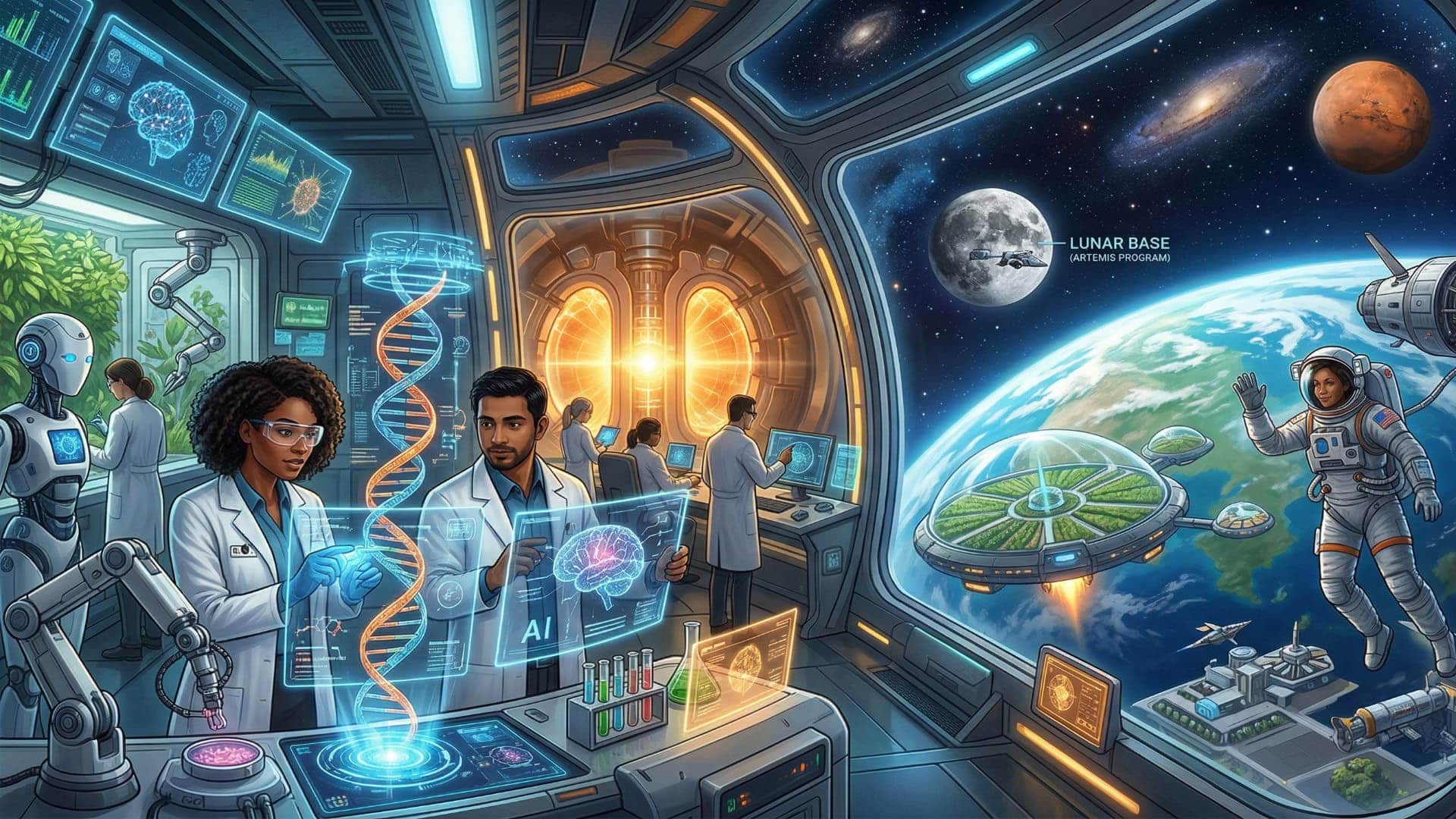
Human discovery moves incredibly fast today. We map genomes and peer into the early universe. This pursuit reshapes how we live and work. What does the future of science hold? What lies ahead for humanity? This guide explores exciting scientific frontiers. We cover AI, biotechnology, and quantum mechanics. These tools help build a thriving, equitable world.
1. Artificial Intelligence: The Best Research Partner
AI is now a powerful tool for scientists. It collaborates with humans to speed up discovery.
Revolutionizing Drug Discovery
Making new drugs used to take decades. Machine learning now predicts molecular interactions quickly. Google DeepMind’s AlphaFold mapped many protein structures. This lets scientists design life-saving, tailored medications.
Automating the Laboratory
Self-driving labs are rising fast. Robots run thousands of experiments at once. They adjust parameters without human help. This democratizes data for researchers everywhere.
Navigating Big Data
Scientists are drowning in massive datasets. Advanced AI sifts through this informational flood. It finds new physics signals and genetic markers.
2. The Genomic Revolution and Biotechnology
Biology and genes define the 21st century. Our ability to edit life’s code is advancing. This solves health and environmental challenges.
Precision Medicine for All
Future healthcare will be deeply personal. Treatments will match your unique genetic makeup. Cheaper sequencing makes this accessible to everyone. This helps historically marginalized groups get better care.
CRISPR and Synthetic Biology
CRISPR-Cas9 has changed biology forever. We might cure genetic disorders at their source. Conditions like cystic fibrosis could be eradicated. Synthetic biology lets us engineer helpful microbes. They can eat plastic or make clean fuels. Read WHO guidelines on ethical genetic technologies.
3. Climate Science and Sustainable Energy
Addressing the climate crisis is incredibly urgent. Our future relies on a carbon-neutral civilization.
The Promise of Nuclear Fusion
Nuclear fusion is the holy grail of energy. It produces no long-lived radioactive waste. Projects like ITER are making huge strides. Fusion could provide limitless, clean energy for all.
Next-Generation Energy Storage
Renewable energy requires advanced battery technology. Solid-state batteries promise faster charging times. They also rely less on unethical mining practices.
Carbon Dioxide Removal
We must remove historical carbon from the air. Direct Air Capture facilities vacuum CO2 safely. Ethical oversight is crucial for these global interventions.
4. Quantum Computing and New Physics
Classical computers use normal bits. Quantum computers use qubits for complex calculations. They calculate exponentially faster than supercomputers.
Breaking Computational Barriers
Quantum computers will simulate atomic interactions perfectly. This leads to better solar cells and materials. They will also require new, quantum-safe security protocols.
Unraveling Universe Mysteries
Dark matter and dark energy remain huge mysteries. Future particle accelerators will test the Standard Model. They might reveal new cosmic forces.
5. Space Exploration: A Multi-Planetary Future
Humanity is looking upward with huge ambition. Agencies and commercial companies are working together.
The Artemis Era
NASA’s Artemis program will return humans to the Moon. This time, we are building permanent lunar habitats. The astronaut generation is the most diverse ever.
The Journey to Mars
The Moon prepares us for exploring Mars. We must overcome immense engineering challenges first. Humans might reach Mars by the 2040s.
Finding Extraterrestrial Life
Telescopes are searching exoplanets for signs of life. Missions will explore subsurface oceans on Jupiter’s moons.
6. Neurotechnology and the Human Brain
The brain is incredibly complex. Neurotechnology helps untangle its neural networks.
Restoring Agency
Brain-Computer Interfaces connect brains to machines. Paralyzed individuals can control robotic limbs with thoughts. This greatly improves their quality of life.
Understanding Mental Health
Neuroscience is changing mental health treatments. We use targeted neural interventions for depression. We might soon unlock the biological basis of consciousness.
7. Ethics and Inclusive Science
Science is a very human endeavor. We must guide our growing capabilities ethically.
Mitigating AI Bias
We must eliminate algorithmic bias in AI. AI must use diverse, representative training data.
Open Science Access
Science must be open and collaborative. Developing nations need access to new technologies. Science must benefit humankind as a whole.
Conclusion
The future holds immense promise and responsibility. We must actively build a better world. Let us embrace ethical, inclusive scientific discovery. Science can uplift, heal, and unite us all.
Frequently Asked Questions (FAQ)
What is the next big breakthrough?
Quantum computing and CRISPR therapies are highly anticipated. They will revolutionize computing and medicine soon.
Will AI replace human scientists?
No, AI is a helpful collaborative tool. It speeds up work but lacks human creativity.
How does science fight climate change?
Science develops better batteries and carbon capture methods. It also pursues clean energy like nuclear fusion.
Why is diversity important in science?
Diversity ensures research addresses everyone’s unique needs. It leads to safer, more equitable innovations.
Will everyday people travel to space?
Spaceflight is currently very expensive. Reusable rockets will lower costs in the future.
Where can I find reliable science news?
Read Nature or Science for updates. Visit NASA or IPCC for official data.
Leave a Reply