Whether you are a student preparing for a biology exam, a professional looking to improve your problem-solving skills, or simply a curious mind wondering how we know what we know about the universe, understanding the scientific method is essential.
The scientific method is the backbone of all modern human discovery. It is not just a rigid set of rules used by researchers in white coats; it is a profound, logical, and universally accessible way of thinking. It empowers us to strip away bias, challenge assumptions, and uncover the truth about how our world operates.
In this comprehensive guide, we will explore the scientific method explained step-by-step. We will break down its history, delve deep into each phase of the process, provide real-world examples, and answer the most frequently asked questions. By the end of this article, you will have a thorough understanding of how to apply this powerful framework to everything from complex research to everyday dilemmas.
What is the Scientific Method?
At its core, the scientific method is a systematic, empirical approach to answering questions and solving problems. It is a cyclical process of making observations, formulating explanations, testing those explanations through experiments, and refining our understanding based on the results.
The beauty of the scientific method lies in its objectivity. Human beings are naturally prone to cognitive biases. We often see what we want to see or believe what is most comfortable. The scientific method acts as a safeguard against these biases. It demands evidence. It requires that results be reproducible. .It insists that if the data does not support a cherished idea, the idea must be discarded or revised.
The Global Origins of Scientific Thinking
While often associated with figures from the European Renaissance, the scientific method is the culmination of global human inquiry.
- Ancient Roots: Ancient Egyptian and Babylonian astronomers recorded meticulous observational data. Greek philosophers like Aristotle emphasized empiricism (knowledge gained through observation), though they often relied more on deductive reasoning than rigorous experimentation.
- The Islamic Golden Age: The true foundation for the modern experimental method was laid by scholars in the Middle East. Notably, the polymath Ibn al-Haytham (Alhazen) in the 11th century insisted that hypotheses must be tested through verifiable experiments, particularly in his groundbreaking work on optics.
- The Scientific Revolution: In the 16th and 17th centuries, figures like Francis Bacon, Galileo Galilei, and René Descartes formalized these concepts. Bacon championed inductive reasoning, Galileo pioneered the use of mathematics to describe experimental results, and Descartes emphasized rigorous skepticism.
Together, these diverse historical contributions forged the robust, globally recognized tool we use today.
The Scientific Method Explained Step-by-Step
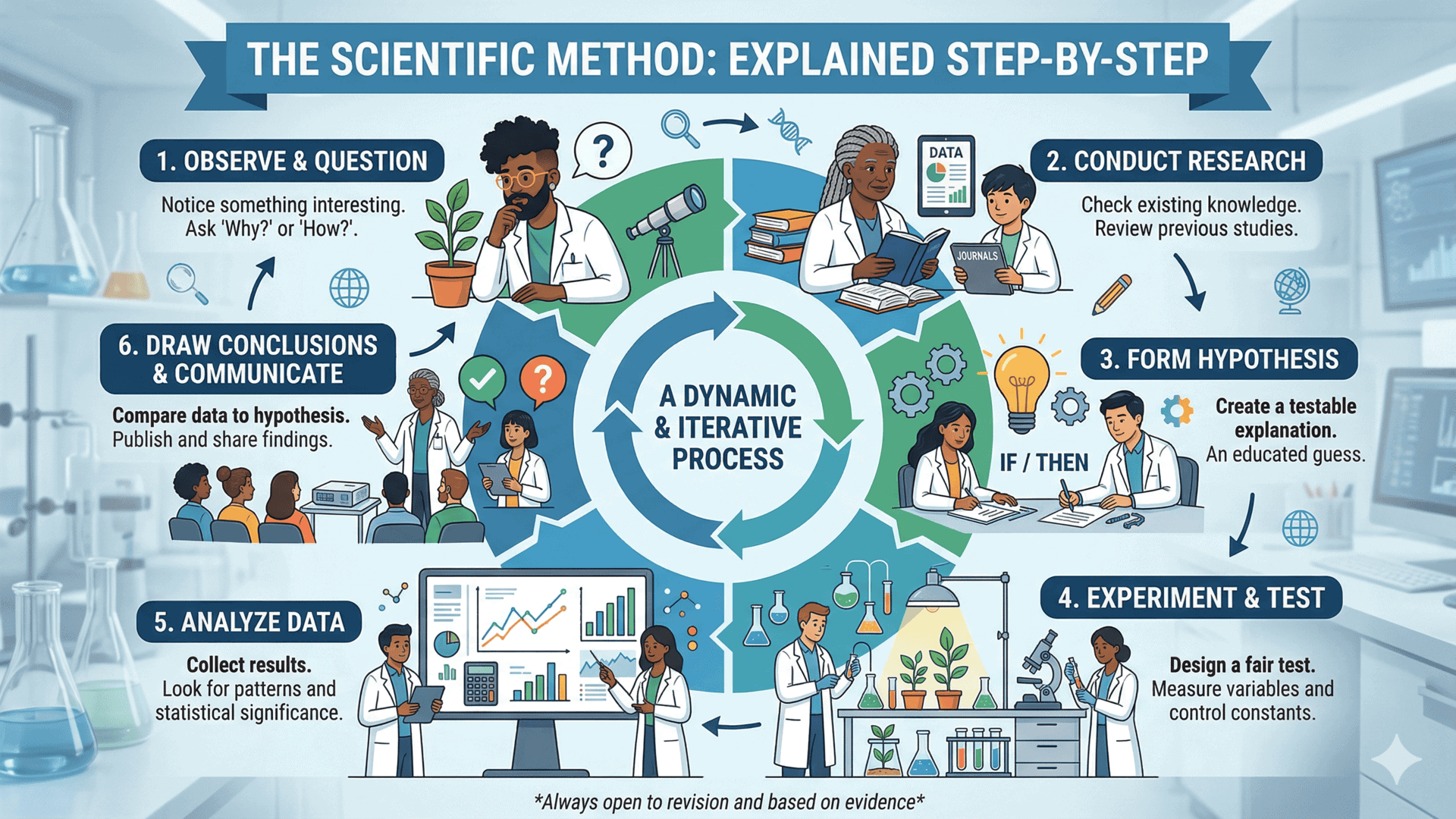
While the scientific method is often taught as a linear path, it is actually a highly dynamic and iterative loop. Researchers frequently jump back and forth between steps as new information comes to light. However, to understand the framework, it is best to examine its standard six steps.
Step 1: Make an Observation and Ask a Question
Every journey of discovery begins with a sense of wonder. The scientific method kicks off when someone notices something intriguing about the natural world and asks, “Why?” or “How?”
Observations can be spontaneous or the result of long-term monitoring. They can be:
- Qualitative: Describing the quality or characteristics of something (e.g., “The leaves on this plant are turning yellow”).
- Quantitative: Involving numbers and measurements (e.g., “The local river’s water level dropped by 4 inches this month”).
Once an observation is made, it is channeled into a specific, measurable Question. A good scientific question is not based on opinion, morals, or the supernatural. It must be testable.
- Poor Question: “Are roses the best flowers?” (Subjective)
- Strong Question: “Does the amount of sunlight affect the growth rate of rose bushes?” (Testable and measurable)
Step 2: Do Background Research
Before attempting to answer the question, a responsible investigator looks at what is already known. Science is a collaborative, cumulative endeavor. Isaac Newton famously said, “If I have seen further, it is by standing on the shoulders of giants.”
Background research involves reviewing existing literature, academic journals, books, and credible databases. This step is crucial for several reasons:
- Avoiding Duplication: Someone may have already answered your question.
- Refining the Question: Existing research might show that your initial question is too broad and needs to be narrowed down.
- Informing the Experiment: Learning how others have tested similar phenomena helps you design a better, safer, and more accurate experiment.
Step 3: Construct a Hypothesis
A hypothesis is often described as an “educated guess,” but it is much more than that. A hypothesis is a proposed explanation for an observation, grounded in background research, that can be tested.
A robust hypothesis usually establishes a relationship between variables and is often written as an “If / Then” statement.
- Example: “If I increase the amount of water given to the tomato plants, then they will produce more tomatoes.”
In modern science, researchers also utilize the Null Hypothesis ($H_0$). The null hypothesis posits that there is no relationship or difference between the variables being tested. Scientists generally set out to reject the null hypothesis, thereby providing support for their alternative hypothesis.
The Golden Rule of a Hypothesis: It must be falsifiable. There must be a possible outcome that proves the hypothesis wrong. If a statement cannot be proven false, it is not scientific.
Step 4: Test with an Experiment
This is where the rubber meets the road. An experiment is a procedure carefully designed to test the validity of the hypothesis. A well-designed experiment must be fair, unbiased, and capable of isolating the specific cause-and-effect relationship in question.
To achieve this, researchers must carefully define and control their Variables:
- Independent Variable: This is the factor that you (the experimenter) deliberately change or manipulate. It is the presumed cause. (e.g., The amount of water given to the plants).
- Dependent Variable: This is the factor that you measure. It changes in response to the independent variable. It is the presumed effect. (e.g., The height of the plants or the number of tomatoes produced).
- Controlled Variables (Constants): These are all the other factors that could possibly affect the outcome, which must be kept exactly the same across all tests to ensure fairness. (e.g., The type of soil, the amount of sunlight, the temperature, the size of the pots).
The Importance of Control Groups
A rigorous experiment divides subjects into at least two groups.
- The Experimental Group receives the treatment (the manipulation of the independent variable).
- The Control Group does not receive the treatment. It serves as a baseline to ensure that any changes observed in the experimental group are actually due to the independent variable, and not some outside factor.
Step 5: Analyze Data and Draw Conclusions
As the experiment runs, you collect data. This data must then be organized, often using tables, charts, and graphs, to make it easier to interpret.
Data Analysis involves looking for patterns, trends, and correlations. In modern scientific research, this step heavily relies on statistics. Statistical analysis helps determine if the results are significant or if they could have simply occurred by random chance.
Once the data is analyzed, you Draw a Conclusion by comparing your findings against your original hypothesis.
- Scenario A: The data supports the hypothesis. You have found evidence that your proposed explanation is likely correct.
- Scenario B: The data does NOT support the hypothesis. This is completely normal and highly valuable! A rejected hypothesis is not a “failed” experiment. It is new knowledge that eliminates a false explanation, guiding you closer to the truth.
If the hypothesis is rejected, the scientific method loops back. You use the new data to form a new, revised hypothesis, and the cycle begins again.
Step 6: Communicate Results
Science does not exist in a vacuum. For a discovery to be meaningful, it must be shared with the broader community. This allows other researchers to evaluate the findings, attempt to replicate the experiment, and build upon the knowledge.
Scientists communicate their results by publishing detailed reports in peer-reviewed journals. Peer review is a rigorous process where independent experts in the same field critically evaluate the methodology, data, and conclusions of a study before it is published. This acts as a quality control filter, catching errors, biases, or unsupported claims.
When writing a report, a scientist must be completely transparent about their methods so that anyone else can perform the exact same experiment. If an experiment cannot be replicated by others with the same results, the original findings are heavily scrutinized.
The Scientific Method in Everyday Life
While it sounds highly academic, we all use a scaled-down version of the scientific method in our daily lives without even realizing it. The process of logical deduction is a universal human trait.
Everyday Example: The Broken Wi-Fi
- Observation: You sit down to watch a movie, but Netflix won’t load.
- Question: Why is the internet not working on my TV?
- Research: You check your phone; it’s also disconnected. You look at the router; the “Internet” light is flashing red instead of solid green.
- Hypothesis: If I restart the router, then the internet connection will be restored because a simple reboot clears temporary software glitches.
- Experiment: You unplug the router, wait 30 seconds, and plug it back in.
- Analysis: You watch the lights on the router. The “Internet” light turns solid green. You check your TV, and Netflix loads.
-
Conclusion: The data supports the hypothesis. Restarting the router fixed the issue.
By structuring our problem-solving logically, we avoid wasting time (like buying a whole new TV when the router was the issue) and find solutions efficiently.
Overcoming Common Misconceptions
To truly master the scientific method, it is vital to unlearn some common misunderstandings about how science works.
Misconception 1: “It’s just a theory.”
In everyday language, people use the word “theory” to mean a guess or a hunch (e.g., “I have a theory about who stole my lunch”). In science, the word has a completely different meaning.
A Scientific Theory is an explanation of an aspect of the natural world that has been repeatedly tested, verified, and corroborated through widespread observation and experimentation. Theories are the pinnacle of scientific understanding. Examples include the Theory of Gravity, the Theory of Evolution, and Germ Theory. They are not guesses; they are robust frameworks backed by mountains of evidence.
Misconception 2: Science provides absolute “Proof.”
Science rarely uses the word “proof,” which is a term better suited for mathematics and alcohol. Science provides evidence. Scientific knowledge is always provisional. This means that all scientific explanations are accepted as the best current understanding based on available evidence, but they are always open to revision if new, conflicting data emerges. This flexibility is science’s greatest strength, not a weakness.
Misconception 3: The process is purely objective and emotionless.
While the method strives for objectivity, the people conducting science are passionate humans. Intuition, creativity, and imagination play massive roles in the scientific method—specifically during the observation phase and when designing innovative experiments. Logic dictates the test, but creativity sparks the hypothesis.
Why Inclusive and Ethical Science Matters
As we apply the scientific method moving forward, the global community increasingly recognizes the need for inclusive and ethical practices.
Historically, scientific studies often lacked diversity, both in the researchers conducting the work and the subjects being studied. For example, early medical trials frequently used only male subjects, leading to dangerous gaps in how certain medications affected women.
Today, rigorous application of the scientific method requires inclusive design. This means ensuring that control and experimental groups in human studies accurately reflect diverse populations—spanning different ages, genders, ethnicities, and socioeconomic backgrounds. By ensuring the inputs of our experiments represent all of humanity, we ensure the conclusions are valid and beneficial for everyone.
Furthermore, ethical oversight (such as Institutional Review Boards) ensures that the pursuit of knowledge never comes at the cost of human rights, animal welfare, or environmental degradation. The scientific method is a tool, and like all tools, it must be wielded responsibly.
Frequently Asked Questions (FAQ)
What is the most important step in the scientific method?
While all steps are interconnected, many scientists argue that asking a testable question and forming a falsifiable hypothesis is the most crucial step. Without a clear, measurable foundation, an experiment will yield confusing or useless data.
Can the scientific method be applied to the social sciences?
Yes. Disciplines like psychology, sociology, and economics rely heavily on the scientific method. While human behavior is more difficult to isolate in controlled laboratory settings than chemical reactions, social scientists use rigorous statistical analysis, large sample sizes, and carefully designed surveys to test hypotheses and draw valid conclusions about human systems.
What is the difference between a Hypothesis, a Theory, and a Law?
- Hypothesis: A testable prediction or proposed explanation for a specific, narrow phenomenon before it has been thoroughly tested.
- Theory: A broad, heavily substantiated explanation for how or why a natural phenomenon occurs, backed by extensive evidence.
- Law: A statement based on repeated experimental observations that describes what happens in nature under certain conditions, often expressed as a mathematical formula (e.g., Newton’s Law of Universal Gravitation). Laws describe what, theories explain why.
What happens if an experiment fails?
In the scientific method, there are no “failed” experiments, only unpredicted results. If an experiment is conducted flawlessly but the hypothesis is proven wrong, that is a success. Eliminating an incorrect explanation is vital progress. The only true failure in science is a poorly designed experiment or falsified data.
Is the scientific method a rigid, straight line?
No. It is often a messy, looping web. An observation might lead to research, which leads to a new observation. Analyzing data might reveal a flaw in the experiment, forcing the researcher to go back and redesign the test. It is a flexible, cyclical process of constant refinement.
Reference Links for Further Reading
To continue expanding your knowledge on the philosophy and application of the scientific method, explore these authoritative resources:
-
Understanding Science (University of California, Berkeley): An incredibly detailed, accessible resource mapping out the real-world complexities of the scientific process. https://undsci.berkeley.edu/
-
The American Association for the Advancement of Science (AAAS): Insights into scientific integrity, peer review, and the communication of scientific discoveries. https://www.aaas.org/
-
National Center for Biotechnology Information (NCBI) – Research Methods: A deep dive into experimental design, clinical trials, and statistical analysis for those interested in the medical sciences. https://www.ncbi.nlm.nih.gov/
-
Stanford Encyclopedia of Philosophy – Scientific Method: For those who wish to explore the rich philosophical and historical debates surrounding empiricism and scientific reasoning. https://plato.stanford.edu/entries/scientific-method/
Leave a Reply