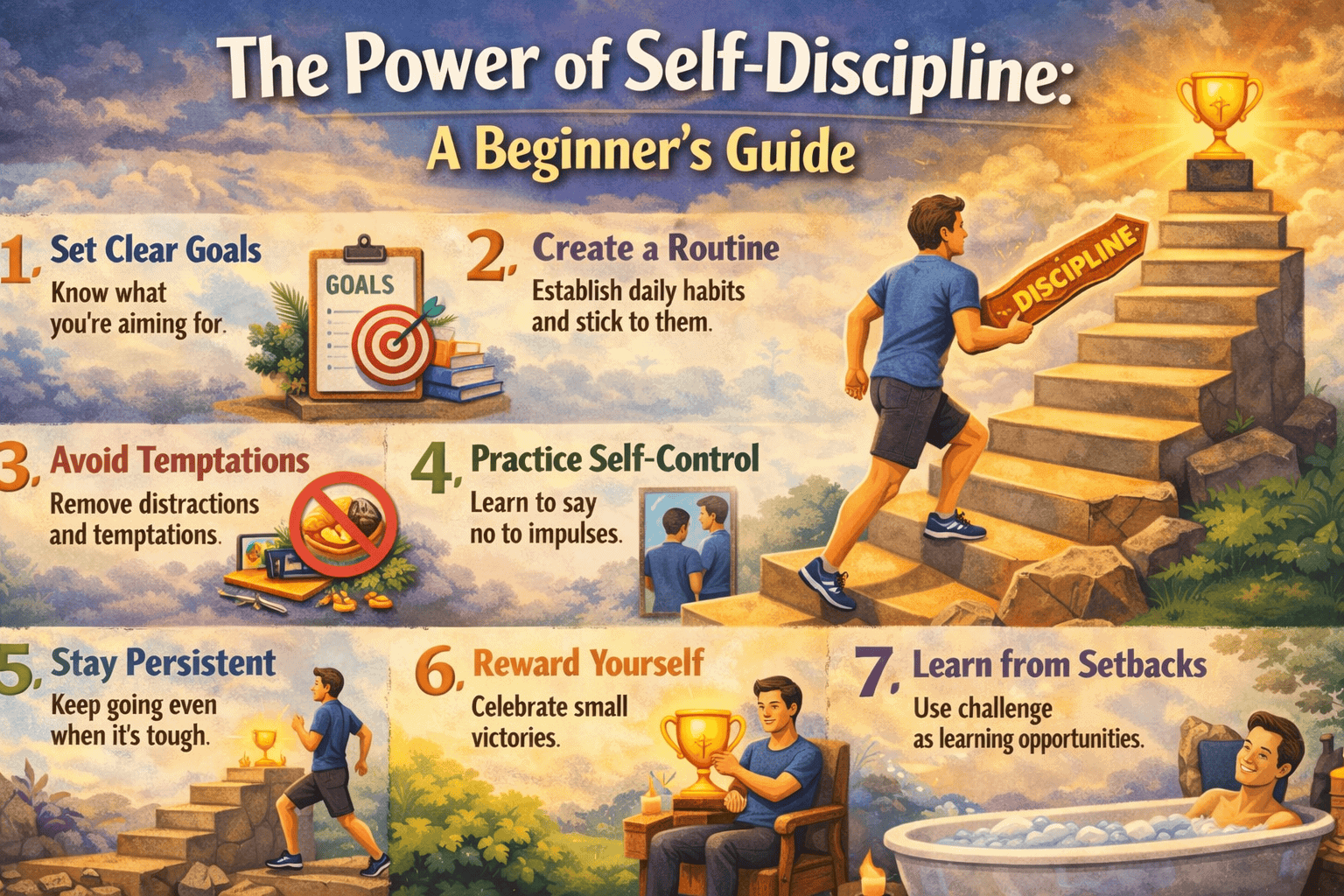
Have you ever set a New Year’s resolution, only to abandon it by the second week of February? Or perhaps you have stared at a daunting project, feeling a wave of motivation that suddenly vanishes the moment you sit down to work. If this sounds familiar, you are not alone. In a world designed to constantly capture our attention, staying on track is harder than ever.
The secret ingredient that separates those who achieve their goals from those who simply dream about them is not raw talent, inherited wealth, or endless motivation. The defining factor is self-discipline.
This comprehensive beginner’s guide will explore the power of self-discipline, exploring what it really means, the science behind it, and actionable, inclusive strategies to help you build it from the ground up. Whether you are aiming to improve your physical health, advance in your career, or simply cultivate more peace in your daily life, this guide is your starting point.
What Exactly is Self-Discipline?
At its core, self-discipline is the ability to push forward, stay motivated, and take action, regardless of how you are feeling physically or emotionally in the moment. It is the bridge between your goals and your accomplishments.
Many people confuse self-discipline with punishment or strict deprivation. However, true self-discipline is the exact opposite: it is the highest form of self-care. When you practice self-discipline, you are prioritizing your future self over your present impulses. You are saying “no” to a fleeting distraction so that you can say “yes” to a deeply held value or long-term goal.
Motivation vs. Self-Discipline
It is crucial to understand the difference between motivation and self-discipline.
- Motivation is a feeling. It is the initial spark that gets you excited about a new project. However, feelings are notoriously fickle. They come and go based on your mood, the weather, your blood sugar levels, or how well you slept.
- Self-Discipline is a system. It is the engine that keeps you moving when the spark of motivation burns out. Motivation gets you started, but self-discipline keeps you going.
Why Self-Discipline is Your Greatest Asset
Building self-discipline permeates every aspect of your life. When you strengthen this single trait, you often see a ripple effect that improves your overall well-being. Here is a look at why the power of self-discipline is so transformative:
1. Achievement of Long-Term Goals
Great achievements rarely happen overnight. Writing a book, earning a degree, building a business, or saving for a home requires consistent, daily effort. Self-discipline allows you to break massive, overwhelming goals into manageable daily tasks and actually execute them, day after day.
2. Improved Mental Health and Reduced Anxiety
Procrastination is a massive driver of anxiety. When you delay important tasks, the mental weight of what you “should” be doing hangs over you, creating chronic stress. By practicing self-discipline, you clear your plate and your mind. You build trust with yourself, which fosters deep self-esteem and confidence.
3. Greater Freedom
This often sounds counterintuitive to beginners. How can discipline equal freedom? When you lack discipline, you are a slave to your moods, your impulses, and your external environment. When you have discipline, you control your actions. Financial discipline leads to financial freedom; health discipline leads to physical freedom; time-management discipline leads to free time.
4. Better Relationships
Self-discipline extends to how we interact with others. It is the ability to pause before reacting in anger, the commitment to show up for a friend when you promised you would, and the focus required to actively listen to a partner instead of scrolling on a phone.
The Science of Self-Control
To effectively build self-discipline, it helps to understand how it works in the brain. You are not fighting a moral failing; you are often navigating biology.
The Role of the Prefrontal Cortex
Self-discipline lives in the prefrontal cortex, the area of the brain located right behind your forehead. This region is responsible for executive functions: planning, decision-making, and moderating social behavior.
When you are tempted by a short-term reward (like eating a donut or watching another episode of a show), your brain’s reward center (the basal ganglia) lights up, craving an immediate dopamine hit. Self-discipline is essentially your prefrontal cortex stepping in and saying, “Wait, we have a bigger goal.”
The Muscle Metaphor and Willpower Depletion
Psychologists have long debated the concept of “Ego Depletion”—the idea that willpower is a finite resource that drains throughout the day, much like a battery. While modern psychology suggests that willpower isn’t as strictly limited as we once thought (our beliefs about our own willpower heavily influence our capacity), the metaphor of self-discipline as a muscle remains highly accurate.
If you try to lift a 200-pound weight on your first day at the gym, you will fail and likely injure yourself. If you start with 10 pounds and lift consistently, you will eventually be able to lift heavier weights. Self-discipline works the exact same way.
Busting Common Myths About Self-Discipline
Before we dive into the steps to build self-discipline, we need to unlearn a few toxic myths that hold beginners back.
Myth 1: “You either have it, or you don’t.”
Fact: Self-discipline is a learned skill, not an innate genetic trait. No one is born waking up at 5:00 AM to go for a run. People who appear naturally disciplined have simply spent years building systems and habits that make disciplined choices easier.
Myth 2: “Self-discipline means having no fun.”
Fact: Discipline allows for better fun. When you work diligently during your designated work hours, your time off is completely guilt-free. You can fully relax and enjoy your hobbies because you know your responsibilities have been handled.
Myth 3: “It requires ignoring your physical needs.”
Fact: Hustle culture has popularized the idea that discipline means sacrificing sleep, skipping meals, and working until burnout. This is completely false. True self-discipline involves prioritizing your physical well-being because you cannot function optimally—or maintain long-term focus—on an empty tank.
A Beginner’s Guide: 7 Steps to Build Self-Discipline
Building self-discipline is a journey. It requires patience, strategy, and self-compassion. Here is a step-by-step guide to help you cultivate this essential skill.
Step 1: Define a Crystal-Clear “Why”
If your reason for wanting to be disciplined is vague—like “I want to be better”—you will struggle when things get difficult. You need a compelling “Why.”
- Instead of: “I want to exercise to get fit.”
- Try: “I want to build a consistent exercise routine so I have the energy to keep up with my children and live a long, pain-free life.”
When the temptation to quit arises, connecting deeply to your specific, emotional “Why” will serve as your anchor.
Step 2: Start Incredibly Small
The most common mistake beginners make is overhauling their entire life overnight. They vow to wake up at 5 AM, work out for an hour, meditate, and read a book, all on day one. This leads to rapid burnout.
- The Fix: Pick one habit. Make it so small that it is impossible to fail. If you want to start reading more, commit to reading just two pages a night. If you want to floss, commit to flossing just one tooth. Building the identity of someone who shows up consistently is more important at the start than the magnitude of the action.
Step 3: Design Your Environment for Success
Willpower is unreliable; environment is everything. If you want to build self-discipline, you must make the “good” behaviors easy and the “bad” behaviors difficult.
- Digital Distractions: If you want to focus on studying, put your phone in another room. Do not rely on willpower to ignore the notifications; remove the temptation entirely.
- Healthy Eating: If you want to eat better, do not keep junk food in your pantry. If you have to drive to the store to get a cookie, you are much less likely to eat one.
Your environment should do the heavy lifting for your willpower.
Step 4: Utilize the “Two-Minute Rule”
Popularized by productivity expert David Allen, the Two-Minute Rule states that if a task takes less than two minutes to complete, do it immediately. Wash the single dish, reply to the quick email, hang up your coat. This prevents small, nagging tasks from piling up and draining your mental energy, helping you build a bias toward action.
Step 5: Practice Self-Compassion (The Antidote to Quitting)
Many people believe that if they fail at their habit one day, all progress is lost, and they might as well give up. This “all-or-nothing” thinking is the enemy of self-discipline.
Research shows that self-compassion—treating yourself with the same kindness you would offer a friend—actually increases accountability and the likelihood of returning to your habit. If you miss a workout, acknowledge it, forgive yourself, and resolve to try again tomorrow. A lapse is just data, not a character flaw.
Step 6: Shift Your Identity
True behavior change is identity change. If you are trying to quit smoking, there is a distinct difference between saying, “No thanks, I’m trying to quit,” and saying, “No thanks, I’m not a smoker.” The former implies you are still a smoker trying to be something else. The latter signals a shift in who you are. Start speaking to yourself as the disciplined person you are becoming.
Step 7: Track Your Progress Visually
We are highly visual creatures. Seeing your progress provides a hit of dopamine that reinforces the habit. Use a wall calendar and put a red “X” on the days you complete your habit. After a few days, you will have a chain. Your only job is to not break the chain.
Navigating Roadblocks: An Inclusive Perspective
It is vital to acknowledge that building self-discipline is not a level playing field. Advice that works for a neurotypical person without chronic health conditions might not work for someone navigating different realities.
Addressing Executive Dysfunction
For individuals with ADHD, autism, or those experiencing depression, executive dysfunction can make starting tasks feel physically impossible. It is not a lack of willpower; it is a neurological hurdle.
- Strategy: Remove the stigma of “laziness.” Lean heavily on body doubling (working alongside someone else), visual timers, and immediate external rewards to bridge the dopamine gap.
Managing Chronic Fatigue and Energy Deficits
If you live with chronic illness, burnout, or are a new parent, your energy reserves are inherently lower.
- Strategy: Practice “flexible discipline.” Instead of demanding 100% effort every day, create a tiered system.
-
-
High-energy days: A 45-minute workout.
-
Low-energy days: A 10-minute stretch.
Showing up at your baseline level is an act of immense self-discipline.
-
Practical Tools to Support Your Journey
To help you operationalize the power of self-discipline, here are three highly effective, evidence-based tools:
1. The Pomodoro Technique
This time-management method is brilliant for overcoming procrastination. You set a timer for 25 minutes and commit to focusing on a single task. When the timer goes off, you take a 5-minute break. After four cycles, you take a longer break. It makes daunting tasks feel manageable by breaking them into short, focused sprints.
2. Time Blocking
Instead of keeping a running to-do list, schedule your tasks directly into your calendar. Allocate specific blocks of time for deep work, emails, exercise, and rest. When you know exactly what you are supposed to be doing at any given hour, you reduce the decision fatigue that often leads to undisciplined choices.
3. Habit Stacking
A concept popularized by James Clear, habit stacking involves pairing a new habit you want to build with a current habit you already do effortlessly.
- Formula: “After [CURRENT HABIT], I will [NEW HABIT].”
- Example: “After I pour my morning coffee, I will meditate for three minutes.”
By anchoring the new behavior to an established one, you drastically increase your chances of follow-through.
Conclusion
The power of self-discipline is not about achieving absolute perfection; it is about cultivating consistency. It is about understanding that your actions do not always have to be dictated by your immediate feelings.
By starting small, designing an environment that supports your goals, and treating yourself with compassion when you stumble, you can build the self-discipline necessary to reclaim your focus and build a life you are genuinely proud of. Remember, every master was once a beginner. Choose one small habit today, and take that first step.
Frequently Asked Questions (FAQ)
Q: How long does it actually take to build self-discipline?
A: While a popular myth states it takes 21 days to build a habit, modern psychological research suggests it takes an average of 66 days for a new behavior to become automatic. However, this varies wildly depending on the complexity of the habit and the individual. The goal is consistency over time, not a specific deadline.
Q: What should I do if I keep failing at my goals?
A: Reassess your goals. Are they too big? Are they too vague? If you are consistently failing, it means your current system is flawed, not you. Shrink the goal down until it is so easy you cannot say no. Focus on building consistency first, and intensity second.
Q: Can I build self-discipline if I have ADHD?
A: Absolutely, but your approach will need to look different. Traditional advice often relies heavily on internal motivation. Individuals with ADHD typically need to externalize their motivation through visual cues, alarms, body doubling, and breaking tasks down into microscopic steps.
Q: Is it possible to be too disciplined?
A: Yes. When self-discipline becomes rigid, inflexible, and punishing, it can lead to burnout, anxiety, and an inability to enjoy life. Healthy self-discipline serves your well-being and allows for rest, spontaneity, and joy.
Q: How do I get back on track after a long break or a major slip-up?
A: Do not try to make up for lost time by doing twice the work. Acknowledge the break without self-judgment, return to your original “start small” plan, and focus only on winning today.
References and Further Readin
-
Clear, J. (2018). Atomic Habits: An Easy & Proven Way to Build Good Habits & Break Bad Ones. Avery. (A foundational text on how small changes compound into remarkable results).
-
American Psychological Association (APA). (n.d.). Willpower: What it is and how to get more of it. (Provides peer-reviewed insights into the science of self-control and ego depletion theories). apa.org
-
McGonigal, K. (2012). The Willpower Instinct: How Self-Control Works, Why It Matters, and What You Can Do to Get More of It. Avery. (Explores the neuroscience behind self-discipline and why self-compassion is crucial).
-
Neff, K. (2011). Self-Compassion: The Proven Power of Being Kind to Yourself. William Morrow. (Essential reading on why forgiving yourself leads to better long-term discipline than punishing yourself).
-
Allen, D. (2001). Getting Things Done: The Art of Stress-Free Productivity. Penguin Books. (The origin of the “Two-Minute Rule” and excellent systems for managing overwhelming task loads).
Leave a Reply