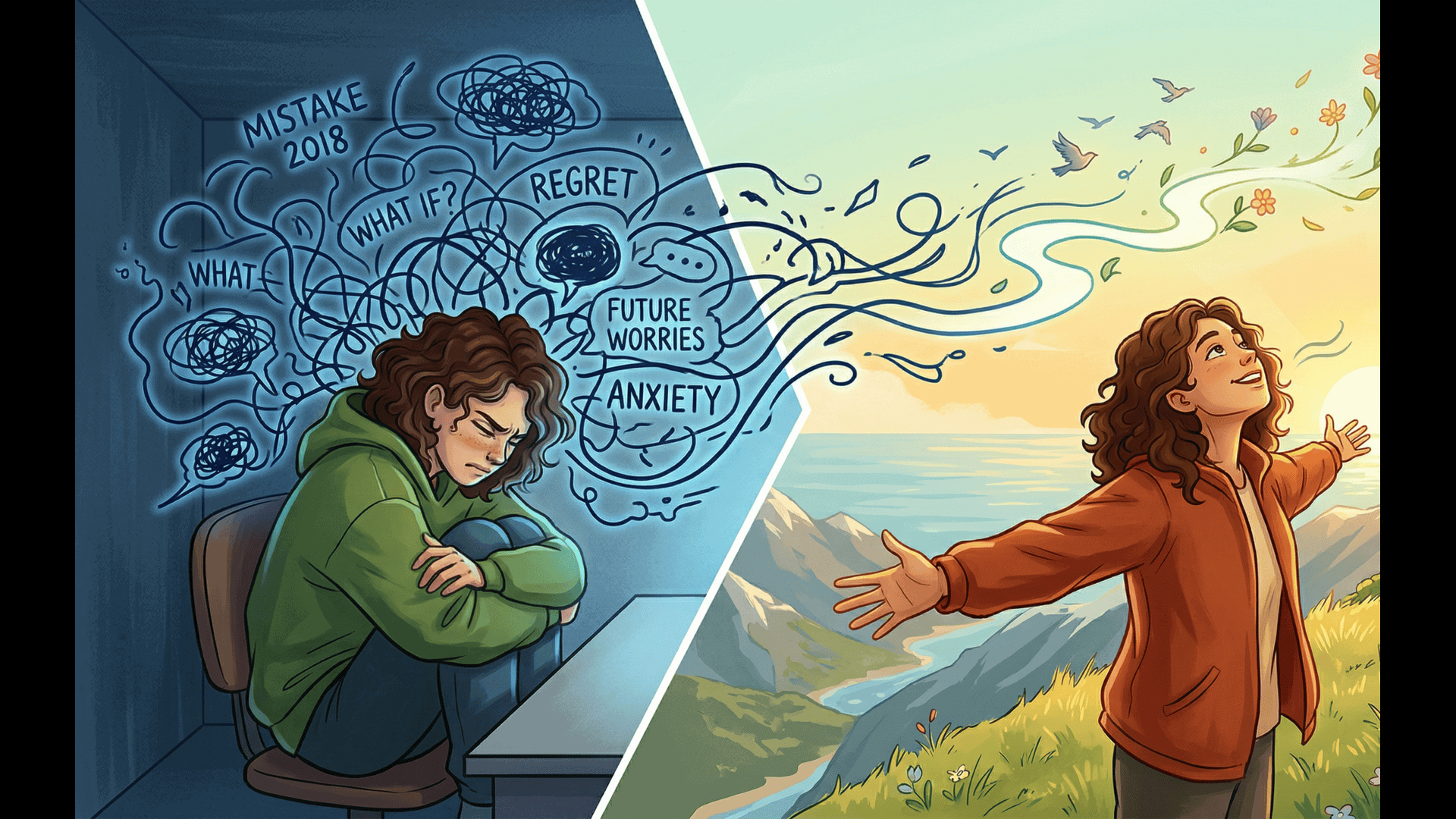
Let’s be entirely real for a second. Have you ever found yourself staring blankly at the ceiling at 3:00 AM, mentally replaying a slightly awkward conversation you had in 2018? Or perhaps you’ve spent forty-five minutes drafting, deleting, and redrafting a simple two-sentence email to a colleague, terrified that a misplaced exclamation point will somehow ruin your career?
If you are nodding your head right now, take a deep breath and relax your shoulders. You are in excellent company.
Overthinking is the ultimate joy-thief. It is a heavy, invisible backpack we lug around every single day. It drains our energy, steals our present moments, and tricks us into believing that if we just analyze a situation from forty-seven different angles, we can somehow control the outcome. But here is the truth: you can’t.
If you are exhausted from living exclusively inside your own head, you have come to the right place. This guide is all about how to stop overthinking and start living. We are going to break down why our brains do this, how to short-circuit the overthinking loop, and most importantly, how to step back into the real, vibrant, messy world.
What Actually Is Overthinking?
Before we can fix the problem, we need to name it. Overthinking isn’t just “thinking a lot.” It’s an exhausting cycle of repetitive, unproductive thoughts. It usually falls into two main camps:
- Rumination: This is when your brain gets stuck in the past. It looks like beating yourself up over past mistakes, replaying old conversations, or obsessing over things you “should have” done differently.
- Worrying: This is when your brain gets stuck in the future. It involves catastrophizing, predicting worst-case scenarios, and stressing over things that haven’t even happened yet (and likely never will).
There is a massive difference between problem-solving and overthinking. Problem-solving leads to an action plan. Overthinking leads to analysis paralysis, where you spin your wheels in the mud until the engine burns out.
Why Do We Overthink? (Spoiler: It’s Not Your Fault)
If overthinking makes us so miserable, why on earth do we do it?
First, give yourself some grace. Our brains are biologically wired to keep us safe, not necessarily to keep us happy. From an evolutionary standpoint, the humans who hyper-fixated on the rustling in the bushes (thinking it was a tiger) survived. The ones who didn’t overthink it got eaten. Your brain is just trying to protect you by anticipating danger.
However, we no longer live in a world where we need to constantly scan the horizon for predators. Instead, our modern “tigers” are performance reviews, social media algorithms, and complex relationships.
Additionally, we need to recognize that everyone’s brain is wired differently. For folks navigating anxiety, trauma, or neurodivergence (like ADHD or Autism), overthinking isn’t just a bad habit; it can be a deeply ingrained coping mechanism or a symptom of how their brain processes information.
If you want to dive deeper into the science of anxiety and thought patterns, the National Institute of Mental Health (NIMH) has some incredible, accessible resources that explain the biology behind why our brains get stuck on high alert.
8 Actionable Strategies to Stop Overthinking
Okay, enough theory. How do we actually stop the mental spiral? You can’t just tell your brain to “stop thinking.” (If you’ve ever tried to force yourself not to think about a pink elephant, you know exactly how well that works).
Instead, you have to reroute your brain’s energy. Here are eight practical, inclusive, and proven strategies to quiet the noise.
1. Name It to Tame It (The Power of Awareness)
You cannot change a habit you are not aware of. Often, we are twenty minutes deep into an overthinking spiral before we even realize we’ve left the present moment.
Start by simply noticing when you are doing it. When you catch yourself spiraling, say it out loud (or in your head): “I am overthinking right now.” Or, “I am noticing that I am worrying about tomorrow.” By labeling the behavior, you create a tiny sliver of distance between you and the thought. You are no longer the thought; you are the observer of the thought.
2. The 5-4-3-2-1 Grounding Technique
When your mind is racing into the future or the past, the quickest way to pull it back is through your physical body. The 5-4-3-2-1 technique is a sensory mindfulness trick that forces your brain to process your immediate environment.
Look around you and name:
-
5 things you can see (the texture of the wall, a coffee cup, a plant).
-
4 things you can physically feel (the chair beneath you, the fabric of your shirt).
-
3 things you can hear (the hum of the fridge, birds outside).
-
2 things you can smell (coffee, fresh air, a candle).
-
1 thing you can taste (mint, leftover lunch, or just the feeling of your own breath).
This acts as a gentle reboot button for a panicked nervous system.
3. Do a “Brain Dump”
Overthinking often happens because our brains are trying to juggle too many tabs at once. When you hold thoughts in your head, they feel massive and chaotic.
Grab a physical piece of paper and a pen (typing works, but writing by hand engages different parts of the brain). Write down absolutely everything that is in your head. Do not edit it. Do not worry about spelling, grammar, or logic. Just dump it all out.
Once it is on paper, it instantly loses half its power. You can literally look at the list and say, “Okay, half of this is out of my control, and the other half I can deal with tomorrow.”
4. Schedule “Worry Time”
This sounds counterintuitive, but it is a game-changer recommended by cognitive-behavioral therapists. Instead of letting worry bleed into every hour of your day, give it an itinerary.
Schedule 15 minutes a day (say, at 4:30 PM) specifically for worrying. When an anxious thought pops up at 10:00 AM, you don’t fight it. You just tell yourself, “I see you, but we aren’t dealing with you until 4:30.” When 4:30 rolls around, sit down and worry your heart out. Write it down, stress about it, analyze it. But when the 15-minute timer goes off? You are done. You get up, physically shake it off, and move on with your evening.
5. The “Control vs. No Control” Venn Diagram
A massive chunk of overthinking is dedicated to things we have absolutely zero power over. What other people think of us, how the economy will shift, or whether it will rain on our vacation.
Draw a circle on a piece of paper. Inside the circle, write down everything regarding your current stressor that you can control (your attitude, your effort, your boundaries, your words). Outside the circle, write down everything you cannot control (other people’s reactions, the past, the future).
Force your brain to focus exclusively on the inside of that circle. Let the rest go.
6. Challenge Your Inner Critic
Overthinking is notorious for lying to us. It tells us that everyone hates us, that we are going to fail, and that disaster is imminent.
When you catch a negative thought looping, put it on trial. Ask yourself:
- Is this thought actually 100% true?
- What is the factual evidence that supports this thought?
- What is the evidence against it?
- What would I tell a friend who was having this exact same thought?
Usually, you will find that your brain is making massive leaps in logic based on fear, not facts.
7. Move Your Body (Change Your State)
Emotions and anxious thoughts get trapped in the physical body. When you are stuck in your head, the fastest way out is to get into your body.
You don’t need to run a marathon. Just change your physiological state. Do 10 jumping jacks. Put on a song you love and dance around your kitchen. Go for a brisk 10-minute walk without your phone. Splash ice-cold water on your face (this actually triggers the mammalian dive reflex, which instantly slows down your heart rate). By moving the stagnant energy, you break the cognitive loop.
8. Call in the Professionals
There is a massive stigma around mental health, but let’s clear the air: going to therapy is like going to the gym for your brain. If you have been overthinking for years and it is impacting your sleep, your relationships, or your career, you do not have to fix it alone.
A licensed therapist can help you identify your specific triggers and give you personalized tools to re-wire your thought patterns. If you don’t know where to start, the Psychology Today Therapist Directory is a fantastic resource to find inclusive, verified professionals in your area.
The Pivot: How to Actually Start Living
Stopping the overthinking is only half the battle. If you create a vacuum by removing all those racing thoughts, you have to fill that space with something beautiful, or the anxiety will just creep right back in.
Here is how you transition from just surviving in your head to actively living in the world.
Embrace “Good Enough”
Perfectionism is overthinking’s best friend. We overthink because we want everything to be perfect before we take a step. But life isn’t perfect; it’s messy, chaotic, and beautifully flawed.
Adopt the mantra: “Done is better than perfect.” Send the email with a typo. Start the hobby even if you are terrible at it. Wear the outfit even if you haven’t lost those 10 pounds. Give yourself permission to be a gloriously imperfect human being.
Find Your “Flow State”
When was the last time you were doing something and completely lost track of time? That is called a “flow state.” It happens when you are fully immersed in an activity that challenges you just enough to keep you engaged, but not so much that you get frustrated.
Flow states are the antidote to overthinking because they demand your full, present attention. Whether it’s gardening, painting, coding, baking bread, playing video games, or writing, make time for activities that anchor you entirely in the now.
Practice Radical Gratitude
Our overthinking brains are biased toward negativity. We remember the one critical comment and forget the ten compliments. We focus on what is missing rather than what is present.
Combat this by rewiring your brain for gratitude. This doesn’t mean toxic positivity—you don’t have to pretend everything is awesome when it’s not. It just means intentionally noticing the good. The warmth of your coffee mug. A text from a friend. The fact that your legs carried you out of bed today. When you focus on what is good right here, right now, the anxiety of the future begins to fade.
Say ‘Yes’ to the Messy, Scary Things
Overthinking keeps us in our comfort zones. It tells us it’s safer to stay home, to not apply for the job, to not tell that person how we feel.
Starting to live means feeling the fear and doing it anyway. Start small. Say yes to a social invitation even if your brain is analyzing all the ways it could be awkward. Try a new restaurant. Take a different route to work. Living is an active verb. It requires participation. You have to step out of the bleachers of your mind and get onto the playing field of your life.
Frequently Asked Questions (FAQ)
Is overthinking a mental illness?
Overthinking itself is not a diagnosable mental illness; it is a symptom or a behavior. However, severe and chronic overthinking can be a key symptom of underlying conditions like Generalized Anxiety Disorder (GAD), Obsessive-Compulsive Disorder (OCD), Depression, or ADHD. If overthinking is severely impacting your daily life, it’s worth speaking to a mental health professional.
How do I stop overthinking in a relationship?
Relationship overthinking usually stems from a fear of abandonment or insecurity. The best remedy is clear, open communication. Instead of trying to mind-read your partner (“Why did they text ‘ok’ with a period? Are they mad?”), ask them directly. Focus on building your own self-worth outside of the relationship, so you don’t rely entirely on your partner for validation.
Can overthinking cause physical symptoms?
Absolutely. Your brain and body are deeply connected. Chronic overthinking keeps your nervous system in a constant state of “fight or flight,” pumping cortisol and adrenaline into your bloodstream. This can lead to headaches, muscle tension, digestive issues, fatigue, insomnia, and a weakened immune system.
How long does it take to stop overthinking?
There is no set timeline, because rewiring your brain takes practice. It is like building a muscle. At first, redirecting your thoughts will feel exhausting and difficult. But with consistent practice (using mindfulness, grounding, and boundary-setting), you can start to notice a significant shift in your mental clarity within a few weeks to a few months. Be patient with yourself.
Conclusion: Your Life is Waiting For You
Quitting the habit of overthinking is not about achieving some monk-like state of permanent mental silence. You are a human being; you are always going to have thoughts, worries, and moments of doubt.
The goal isn’t to never overthink again. The goal is to catch yourself doing it faster, unhook yourself from the spiral quicker, and spend less time living in the imaginary future and more time living in the actual present.
Your life isn’t happening tomorrow. It’s not happening in the mistakes of five years ago. It is happening right now, in this exact second, as you read these words. Take a deep breath, close this tab, and go do something that makes you feel alive.
Leave a Reply