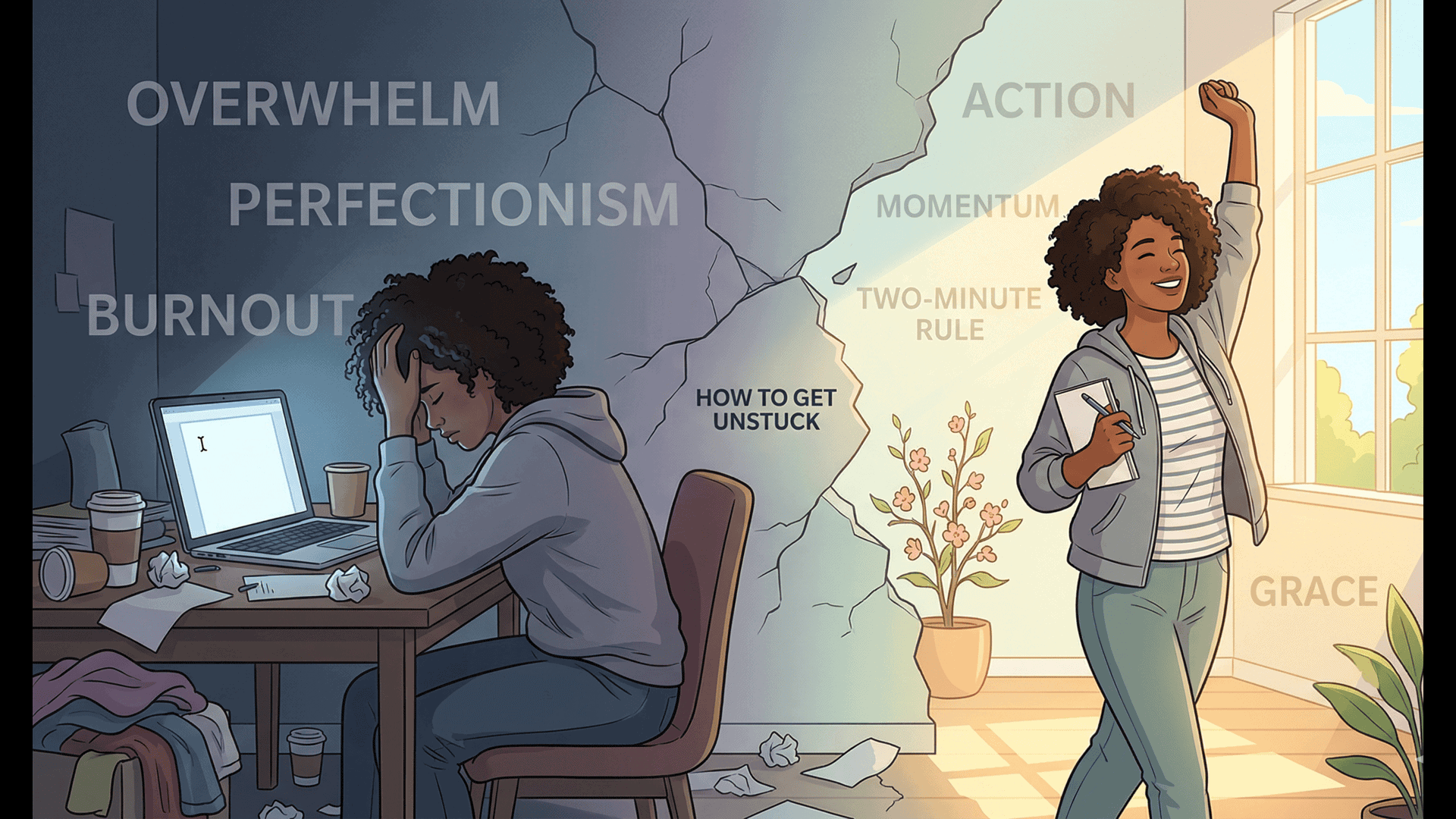
We’ve all been there. You’re staring at a blinking cursor, a pile of laundry, or a half-finished project, and your brain is just… refusing to cooperate. You know you should do the thing. You might even want to do the thing. But the gap between where you are and actually starting feels like a massive, uncrossable canyon.
If you’re currently dealing with this, take a deep breath. You are not broken, you are not lazy, and you are definitely not alone. Feeling stuck is a universally human experience. It happens to the most productive folks out there, from CEOs and artists to stay-at-home parents and students.
In this guide, we are going to break down exactly why this happens and, more importantly, how to stay motivated when you feel stuck. We’ll explore actionable, compassionate, and realistic strategies to help you get your groove back—without burning yourself out in the process.
Part 1: Why Do We Get Stuck in the First Place?
Before we try to fix the problem, we need to understand what’s actually going on under the hood. Treating a lack of motivation as a character flaw is a one-way ticket to a shame spiral. Instead, let’s look at the real culprits behind the “stuck” feeling.
1. The Overwhelm Factor
Often, we lose motivation because the task ahead feels too enormous. When our brains perceive a project as massive or complicated, the amygdala (our brain’s threat-detection center) can actually trigger a freeze response. You aren’t procrastinating because you don’t care; you’re freezing because your nervous system is overwhelmed.
2. Perfectionism Paralysis
Perfectionism is the enemy of progress. If you believe that your work has to be flawless right out of the gate, starting becomes terrifying. The fear of making a mistake or creating something “bad” outweighs the desire to create anything at all.
3. Misaligned Values
Sometimes, we feel stuck because we are pushing ourselves down a path that doesn’t actually align with our core values or interests. If you are pursuing a goal purely because society, your family, or your peers say you “should,” your internal motivation tank is going to run dry very quickly.
4. Physical and Emotional Burnout
We live in a hustle culture that glorifies exhaustion. But here is a reality check: you cannot run a car on an empty tank, and you cannot run a brain on zero sleep and high stress. If you are physically exhausted, dealing with chronic illness, or managing mental health hurdles like depression or ADHD, a lack of motivation isn’t a mindset issue—it’s an energy capacity issue.
Part 2: The Myth of “Endless Motivation”
One of the biggest misconceptions in the self-help world is that highly successful people feel motivated all the time. They don’t. Motivation is a feeling, and like all feelings, it is fleeting. It comes and goes like the weather. Relying purely on motivation to get things done is like relying on a sunny day to grow a garden in the desert; it’s just not a sustainable strategy.
Instead of waiting for motivation to strike like lightning, we need to build systems, cultivate habits, and practice self-compassion to keep us moving forward even when the skies are gray. Action actually precedes motivation. Once you start moving, the momentum generates the motivation to keep going.
Part 3: Actionable Strategies to Get Unstuck
Alright, let’s get into the practical stuff. How do we actually bridge the gap between being stuck on the couch and making progress? Here are some tried-and-true, accessible strategies.
1. Embrace the “Two-Minute Rule”
When a task feels too big, shrink it. The Two-Minute Rule, popularized by productivity experts like James Clear in his book Atomic Habits (you can read more about his philosophy on building habits here), is a game-changer.
The rule is simple: scale your habit or task down until it takes two minutes or less to do.
- Instead of “write a blog post,” make it “open a Google Doc and write one sentence.”
- Instead of “fold all the laundry,” make it “fold three pairs of socks.”
- Instead of “do a 45-minute workout,” make it “put on my sneakers and stretch.”
Why does this work? Because the hardest part is almost always starting. Once you’ve written that one sentence or folded those three socks, the friction of starting is gone, and you’ll likely keep going. Even if you stop after two minutes, you still did something, which is a win.
2. Lower the Bar (Then Lower It Again)
Give yourself permission to do a terrible job. Tell yourself, “I am going to write the absolute worst first draft in human history,” or “I am going to do the clumsiest, lowest-effort workout ever.”
By deliberately lowering the bar, you strip away the pressure of perfectionism. You remove the expectation of greatness, which allows you to just exist and do the thing. You can always edit a bad page, but you can’t edit a blank one.
3. Change Your Environment
Our brains build associations with our surroundings. If you’ve been sitting at the same desk, staring at the same wall, feeling frustrated for three hours, your brain has linked that environment to the feeling of being stuck.
Break the physical pattern to break the mental pattern.
- Move to a different room.
- Take your laptop to a local coffee shop or library.
- Go for a 10-minute walk outside (getting sunlight in your eyes is fantastic for regulating your dopamine levels).
- If you can’t leave your house, simply switch up the lighting, light a candle, or put on a different genre of music.
4. Create a “Done” List
We are all obsessed with To-Do lists. But when you are feeling stuck, staring at a massive list of things you haven’t done is incredibly demoralizing.
Instead, flip the script. Create a “Done” list. Grab a piece of paper and write down everything you have accomplished today, no matter how small.
- Drank a glass of water.
- Fed the cat.
- Sent that one annoying email.
- Took a shower.
Seeing a visual representation of your accomplishments releases a small hit of dopamine, which is the brain’s motivation chemical. It reminds you that you are capable of taking action, which builds momentum for the next task.
5. Reconnect with Your “Why”
When we are stuck in the weeds of a project, it is easy to forget why we planted the garden in the first place. Zoom out. Why does this task matter to you?
If you’re studying for an exam that feels impossible, remind yourself of the career you want to build. .If you’re struggling to stick to a budget, picture the peace of mind you’ll have when you reach your savings goal.
If you can’t find a meaningful “why,” it might be time to evaluate if this is a goal you actually want to pursue, or if it’s something you can delegate, delay, or drop entirely.
Part 4: Motivation and Inclusive Realities
It is incredibly important to acknowledge that typical productivity advice doesn’t work for everyone. “Just push through it” is harmful advice if you are navigating a world that wasn’t built for your brain or body.
Navigating Neurodivergence
For folks with ADHD, Autism, or other forms of neurodivergence, executive dysfunction is a very real barrier. It’s not a lack of willpower; it’s a difference in how the brain manages dopamine, task initiation, and working memory. If this is you, traditional advice might fall flat. Instead, lean into your unique brain wiring. Try body doubling (working alongside someone else, either in person or virtually), gamifying your tasks, or using tools like visual timers.
Chronic Illness and Mental Health
If you are dealing with chronic fatigue, depression, anxiety, or a physical flare-up, your “stuck” feeling is your body communicating a need for rest. You cannot life-hack your way out of an illness. In these moments, staying motivated means staying motivated to care for yourself. Your daily goal might simply be resting without guilt. That is a valid and necessary accomplishment.
When capacity is low, practice radical self-compassion. Speak to yourself the way you would speak to a friend who is struggling. Demanding high output during a low-capacity season will only prolong the burnout.
Part 5: Build a Support System
You do not have to figure this out in isolation. Human beings are social creatures, and we thrive in community.
- Find an Accountability Buddy: Pair up with a friend or colleague who is also working on a goal. Check in with each other daily or weekly. Knowing someone else is cheering you on (and waiting for your update) provides excellent external motivation.
- Join a Community: Look for online forums, local clubs, or social media groups dedicated to your specific interest or challenge. Shared struggles make the burden lighter.
- Seek Professional Help: If your feeling of being stuck is persistent, overwhelming, and accompanied by feelings of hopelessness, please reach out to a mental health professional. Therapy can provide incredible tools for uncovering the root causes of our blocks.
Conclusion: Give Yourself Grace
Staying motivated when you feel stuck is less about forcing yourself to grind harder, and more about understanding your own mind and body. It requires a blend of clever strategies, environmental tweaks, and a heavy dose of self-compassion.
Remember that progress is rarely a straight, upward-trending line. It is messy, it loops back on itself, and it includes plenty of pauses. The next time you find yourself staring at a wall, feeling totally paralyzed, try out the Two-Minute Rule. Lower your standards. Change your scenery.
You haven’t lost your spark. It’s just buried under a little ash right now. Be gentle with yourself, take one tiny step, and watch the fire slowly start to catch again.
Frequently Asked Questions (FAQ)
What is the difference between being lazy and feeling stuck?
This is a crucial distinction! “Laziness” implies a conscious, apathetic choice to avoid work because you simply don’t care. Feeling “stuck” (or experiencing executive dysfunction) is entirely different. When you are stuck, you want to do the task. You might even be agonizing over the fact that you aren’t doing it. You care deeply, but a mental, emotional, or energetic barrier is preventing you from starting.
How do I stay motivated when I’m not seeing any results?
This is one of the hardest parts of any journey. When results are slow, you have to decouple your motivation from the outcome and attach it to the process. Celebrate the fact that you showed up. Track your habits rather than your results (e.g., celebrate the fact that you went to the gym 3 days this week, rather than focusing on the scale). Remind yourself of the “Plateau of Latent Potential”—often, our efforts are building a foundation, and the visible results will follow later, like a bamboo tree that grows underground for years before suddenly shooting up.
Is doomscrolling killing my motivation?
In short: yes. Social media and short-form content are designed to give your brain massive, effortless spikes of dopamine. When you spend hours scrolling, you are essentially exhausting your dopamine receptors. Afterward, tasks that require effort (like reading, working, or cleaning) feel completely unappealing because they don’t provide that instant, high-level chemical reward. Try setting app timers or physically placing your phone in another room when you need to focus.
What should I do if my lack of motivation lasts for weeks or months?
If your lack of motivation is prolonged and begins interfering with your daily life, relationships, or hygiene, it may be a sign of something deeper, such as burnout, depression, or an underlying medical issue. At this point, the best course of action is to speak with a healthcare provider or a licensed therapist. They can help you determine if there is a medical or psychological root cause that needs to be addressed.
How can I help a friend who is feeling stuck without sounding preachy?
The best approach is empathy over advice. Instead of saying, “You just need to try this productivity hack,” say, “I see that you’re going through a tough time right now. It makes sense that you’re feeling overwhelmed.” Validate their feelings first. Then, you can offer low-pressure support, like asking, “Would it help if I sat with you on a video call while you tackle your inbox for 20 minutes?” Often, your presence is far more helpful than a lecture.
Leave a Reply