If you have ever tried to write a traditional business plan, you know how exhausting the process can be. You spend weeks researching, writing, and formatting a 50-page document, only to realize that by the time you finish, your market has already shifted, and your assumptions are outdated. In today’s fast-paced digital economy, agility is everything. Business leaders, startup founders, and corporate teams need a tool that allows them to map, discuss, and pivot their strategies in real-time.
Enter the Business Model Canvas (BMC).
Whether you are launching a cutting-edge artificial intelligence platform or opening a local coffee shop, the Business Model Canvas provides a clear, visual, and highly adaptable framework for understanding how your business creates, delivers, and captures value.
In this comprehensive, 2000+ word guide, we will break down exactly what the Business Model Canvas is, explore its nine essential building blocks in deep detail, provide real-world examples, and answer the most frequently asked questions.
What is the Business Model Canvas?
The Business Model Canvas is a strategic management template used for developing new business models or documenting and improving existing ones. Created by Swiss business theorist Alexander Osterwalder and computer scientist Yves Pigneur, the canvas was introduced in their groundbreaking book, Business Model Generation.
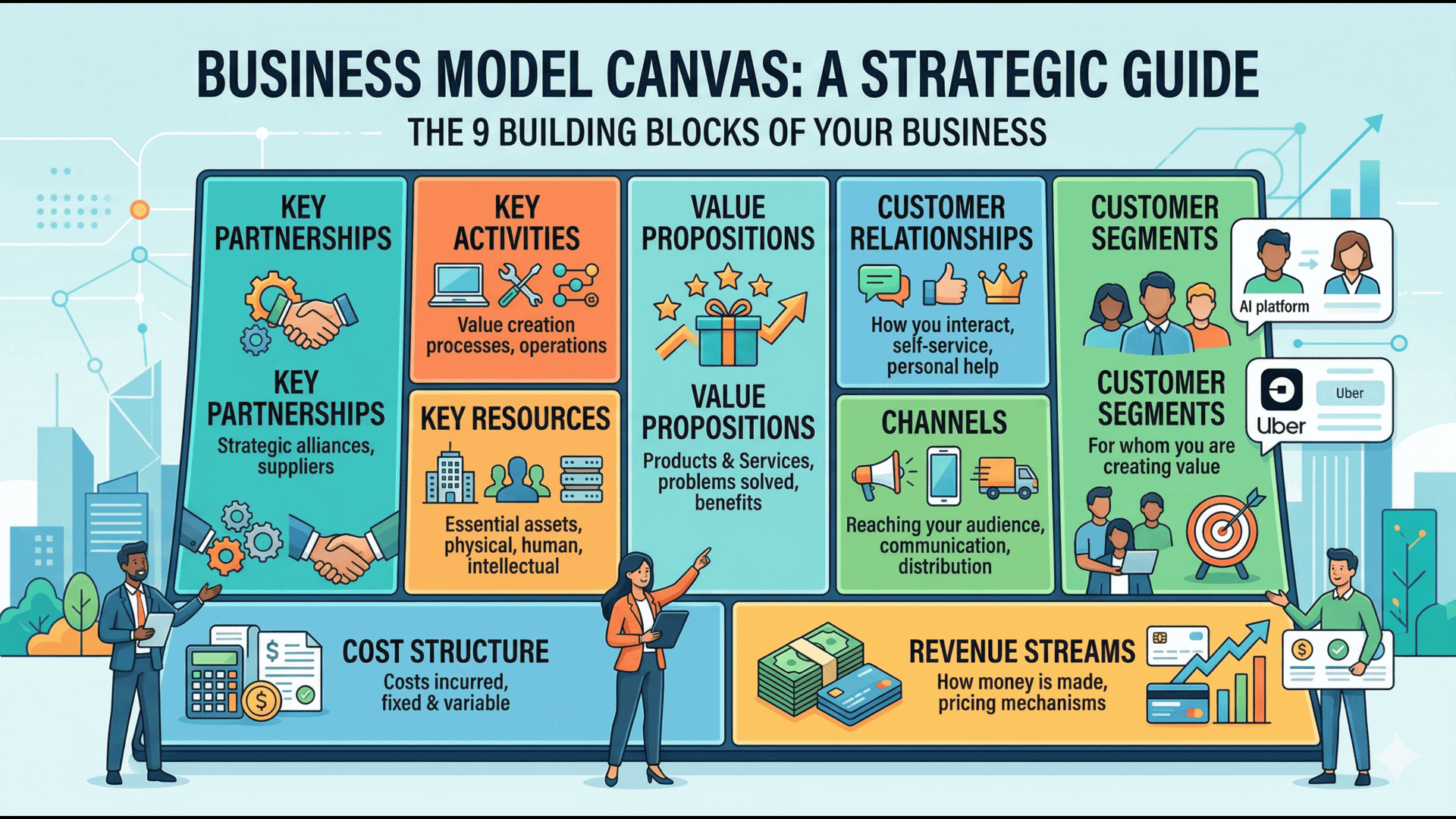
Instead of hiding your business strategy in a dense document that nobody reads, the BMC places your entire operational structure onto a single page. It is a visual chart featuring nine distinct elements that describe a company’s value proposition, infrastructure, customers, and finances.
Why is the BMC so Popular?
The beauty of the canvas lies in its simplicity and collaborative nature. It strips away the fluff of traditional business plans and forces teams to focus on the core drivers of success.
- It creates a shared language: Everyone from the engineering team to the marketing department can look at the canvas and immediately understand the business goals.
- It is inclusive and accessible: It removes confusing corporate jargon, making strategic planning accessible to everyone, regardless of their business background.
- It promotes agility: Because it is a single page, you can easily erase, iterate, and update your strategy as market conditions change.
The 9 Building Blocks of the Business Model Canvas
To truly understand the Business Model Canvas, you need to understand its nine core building blocks. These blocks are divided into three main categories: Desirability (Customer-focused), Feasibility (Infrastructure-focused), and Viability (Finance-focused).
Let’s break down each block in detail.
1. Customer Segments (Who are you helping?)
No business can survive without customers. This building block defines the different groups of people or organizations your enterprise aims to reach and serve. Because no product is for everyone, it is crucial to clearly define your target audience to ensure your messaging and product development are aligned with their needs.
Types of Customer Segments:
- Mass Market: Focusing on a broad group of people with similar needs (e.g., consumer electronics).
- Niche Market: Catering to a specific, specialized customer segment (e.g., high-end camera equipment for professional filmmakers).
- Segmented: Distinguishing between customer groups with slightly different needs and problems (e.g., a software company serving both small startups and large enterprise clients).
- Diversified: Serving two completely unrelated customer segments with different needs.
- Multi-Sided Platforms: Serving two or more interdependent customer segments (e.g., a credit card company needs both consumers to hold the cards and merchants to accept them).
Questions to ask your team:
- For whom are we creating value?
- Who are our most important customers?
- What are the specific demographics, behaviors, and pain points of our target audience?
2. Value Propositions (What are you offering?)
Your Value Proposition is the reason why customers turn to your company over your competitors. It solves a customer problem or satisfies a customer need. Each value proposition consists of a selected bundle of products and services that cater to the requirements of a specific Customer Segment.
Elements that contribute to value creation:
- Newness: Satisfying an entirely new set of needs that customers didn’t previously perceive because there was no similar offering (common in tech and AI innovations).
- Performance: Improving the performance of an existing product or service.
- Customization: Tailoring products to the specific needs of individual customers.
- Design: Offering superior aesthetic design or usability.
- Price: Offering similar value at a lower price point.
- Cost/Risk Reduction: Helping customers reduce their own costs or minimize the risks they take when doing business.
- Convenience: Making things easier to use or more accessible.
Questions to ask your team:
- What exact value do we deliver to the customer?
- Which specific problem are we helping to solve?
- What bundles of products or services are we offering to each Customer Segment?
3. Channels (How do you reach them?)
Channels describe how a company communicates with and reaches its Customer Segments to deliver its Value Proposition. .Channels are the customer touchpoints that play a critical role in the customer experience.
Channel Phases:
- Awareness: How do we raise awareness about our products and services? (e.g., SEO blog posts, social media campaigns).
- Evaluation: How do we help customers evaluate our Value Proposition? (e.g., case studies, free trials).
- Purchase: How do we allow customers to purchase specific products? (e.g., web store, physical retail, app stores).
- Delivery: How do we deliver the Value Proposition? (e.g., instant digital download, courier shipping).
- After-Sales: How do we provide post-purchase customer support? (e.g., help desks, community forums).
Types of Channels:
- Direct: Sales force, online web sales, proprietary storefronts.
- Indirect: Partner stores, wholesalers, affiliate networks.
4. Customer Relationships (How do you interact with them?)
This block describes the types of relationships a company establishes with specific Customer Segments. Relationships can range from highly personal to entirely automated, and they are driven by customer acquisition, customer retention, and upselling.
Types of Customer Relationships:
- Personal Assistance: Based on human interaction, such as speaking with a representative at the point of sale or via email.
- Dedicated Personal Assistance: Assigning a specific representative to an individual client (e.g., key account managers for enterprise software clients).
- Self-Service: Maintaining no direct relationship; providing all the means for customers to help themselves.
- Automated Services: Mixing self-service with automated processes (e.g., recommending content based on past behavior).
- Communities: Utilizing user communities to facilitate connections and solve problems collaboratively (e.g., a dedicated Discord server for users of a specific digital product).
- Co-creation: Partnering with customers to create value (e.g., asking users to contribute content or feedback that shapes future product updates).
5. Revenue Streams (How do you make money?)
If customers are the heart of a business model, revenue streams are the arteries. This block represents the cash a company generates from each Customer Segment. A business must ask itself what value each customer segment is truly willing to pay for.
Ways to Generate Revenue:
- Asset Sale: Selling ownership rights to a physical product.
- Usage Fee: Revenue generated by the use of a particular service (the more it is used, the more the customer pays).
- Subscription Fees: Selling continuous access to a service (e.g., monthly access to an AI generation tool).
- Lending/Renting/Leasing: Temporarily granting someone the exclusive right to use a particular asset for a fixed period in return for a fee.
- Licensing: Giving customers permission to use protected intellectual property in exchange for licensing fees.
- Brokerage Fees: Revenue derived from intermediation services performed on behalf of two or more parties.
- Advertising: Revenue generated from fees for advertising a particular product, service, or brand.
Pricing Mechanisms:
- Fixed Pricing: Pre-defined prices based on static variables (list price, product feature dependent, customer segment dependent).
- Dynamic Pricing: Prices change based on market conditions (negotiation, yield management, real-time market pricing).
6. Key Resources (What assets do you need?)
Key Resources describe the most important assets required to make your business model work. These are the inputs your organization needs to create your value proposition, reach your markets, and earn revenue.
Types of Key Resources:
- Physical: Manufacturing facilities, buildings, vehicles, point-of-sale systems, and distribution networks.
- Intellectual: Brands, proprietary knowledge, patents, copyrights, partnerships, and customer databases.
- Human: The workforce. Human resources are crucial in knowledge-intensive and creative industries (e.g., software engineers, content creators, data scientists).
-
Financial: Cash, lines of credit, or stock options needed to hire key employees or fund infrastructure.
7. Key Activities (What do you need to do?)
This block describes the most important things a company must do to make its business model successful. Just like Key Resources, Key Activities are required to create and offer a Value Proposition, reach markets, maintain Customer Relationships, and earn revenues.
Types of Key Activities:
- Production: Designing, making, and delivering a product in substantial quantities or of superior quality.
- Problem Solving: Coming up with new solutions to individual customer problems (common in consultancies, hospitals, and service organizations).
- Platform/Network: Activities related to maintaining and promoting a continuous platform (e.g., maintaining server uptime, updating algorithms, managing digital interfaces).
8. Key Partnerships (Who will help you?)
Companies rarely do everything on their own. The Key Partnerships block describes the network of suppliers and partners that make the business model work. Organizations forge partnerships to optimize their business models, reduce risk, or acquire resources.
Types of Partnerships:
- Strategic Alliances: Partnerships between non-competitors (e.g., an AI software company partnering with a major cloud hosting provider).
- Coopetition: Strategic partnerships between competitors to grow the overall market or share massive infrastructure costs.
- Joint Ventures: Partnerships to develop new businesses or enter new geographical markets.
- Buyer-Supplier Relationships: Reliable relationships to guarantee access to necessary materials or services.
Questions to ask your team:
- Who are our key partners and suppliers?
- Which Key Resources are we acquiring from partners?
- Which Key Activities do partners perform better or more cost-effectively than we could?
9. Cost Structure (What does it cost?)
Creating and delivering value, maintaining customer relationships, and generating revenue all incur costs. This final building block describes all the financial consequences of operating under a particular business model.
Classes of Business Structures:
- Cost-Driven: Focuses on minimizing costs wherever possible (e.g., budget airlines). They feature lean structures, low-price value propositions, and maximum automation.
- Value-Driven: Less concerned with the cost implications and more focused on value creation. High-end personalized service and premium materials characterize this approach.
Characteristics of Cost Structures:
- Fixed Costs: Costs that remain the same regardless of the volume of goods or services produced (e.g., salaries, rents, software subscriptions).
- Variable Costs: Costs that vary proportionally with the volume of goods or services produced.
- Economies of Scale: Cost advantages that a business enjoys as its output expands (e.g., bulk purchasing rates).
- Economies of Scope: Cost advantages that a business enjoys due to a larger scope of operations.
Business Model Canvas Examples
To bring these concepts to life, let’s look at two detailed examples of how different organizations might map out their Business Model Canvas.
Example 1: An AI Content Generation Platform
Imagine a modern, tech-forward startup that provides users with advanced AI tools to generate high-quality images, videos, and digital content optimized for social media platforms like Twitter. Here is what their canvas might look like:
- Customer Segments: Digital marketing agencies, independent content creators, social media managers, and tech-enthusiast hobbyists.
- Value Propositions: Massive reduction in the time needed to create digital content; professional-grade, cinematic aesthetic without needing expensive graphic design software; rapid A/B testing capabilities for marketing campaigns.
- Channels: Targeted social media advertising, SEO-optimized blog posts about content creation, community engagement on platforms like Discord and Reddit, and direct sales outreach for enterprise clients.
- Customer Relationships: Primarily a self-service, automated SaaS relationship, bolstered by a strong, active community of users who share prompts and tips. Premium users get dedicated technical support.
- Revenue Streams: Freemium model to acquire users, with tiered monthly subscriptions (e.g., Basic, Pro, Ultra) based on generation quotas and advanced feature access. API usage fees for enterprise integrations.
- Key Resources: Proprietary AI models, massive computational server power, talented machine learning engineers, and user generation data to continuously train and improve the models.
- Key Activities: Continuous model training and refinement, platform UI/UX maintenance, community management, and marketing content creation.
- Key Partnerships: Cloud infrastructure providers (for server power), strategic partnerships with digital marketing agencies, and integrations with social media scheduling tools.
- Cost Structure: High fixed costs for server and compute power, research and development payroll, marketing spend, and cloud hosting fees. It is a value-driven and scale-driven structure.
Example 2: A Global Ride-Sharing App (e.g., Uber)
For a contrast, let’s look at a multi-sided platform that connects two distinct groups of people in the physical world.
- Customer Segments: 1. Passengers (people who need to get from point A to point B without owning a car).
- 2. Drivers (people who own cars and want to earn flexible income).
- Value Propositions: 1. For Passengers: Convenience, shorter wait times, cashless transactions, and clear pricing upfront.
- 2. For Drivers: Flexible working hours, an easy way to earn money, and no need to find their own customers.
- Channels: Mobile applications (iOS and Android stores), word-of-mouth, and local promotional events.
- Customer Relationships: Highly automated self-service via the app. A rating system builds trust within the community, alongside automated customer support for ride issues.
- Revenue Streams: Taking a percentage commission from every ride booked through the platform. Dynamic pricing (surge pricing) during high-demand times.
- Key Resources: The proprietary software platform/algorithm, brand reputation, and the network of active drivers and passengers.
- Key Activities: Platform development and maintenance, algorithmic optimization for routing and pricing, marketing to both drivers and riders, and regulatory lobbying.
- Key Partnerships: Mapping technology providers, payment processing companies, and local insurance providers.
- Cost Structure: Significant costs in marketing and customer acquisition, software development, legal and regulatory compliance, and customer support infrastructure.
How to Create Your Own Business Model Canvas
Now that you understand the blocks and have seen examples, it is time to build your own. Following a structured approach will ensure you get the most out of the exercise.
Step 1: Gather the Right People
Do not do this alone. The Business Model Canvas thrives on diverse perspectives. Bring together people from different departments—product development, marketing, sales, finance, and customer service. A cross-functional team will identify blind spots that a solo founder might miss.
Step 2: Use the Right Medium
While there are many digital tools available, the best way to start is often analog. Print a massive poster of the canvas and put it on a wall, or draw it on a large whiteboard. Use sticky notes and markers. Sticky notes are crucial because they can be easily moved or removed as your ideas evolve.
Step 3: Start with Customers and Value
Always begin by defining your Customer Segments and your Value Proposition. These two blocks are the core of your business. If you do not know who you are selling to and why they would buy from you, the rest of the canvas does not matter. Map out exactly how your product solves their specific pain points.
Step 4: Work Through the Rest of the Blocks
Once the core is established, move to Channels and Customer Relationships. Then, look at the back-end of your business: Key Resources, Activities, and Partnerships. Finally, calculate how the model makes financial sense by mapping out Revenue Streams and Cost Structure.
Step 5: Review, Test, and Iterate
Your first draft will be built heavily on assumptions. Do not treat the canvas as a final, static document. Take your canvas out into the real world. Talk to potential customers to validate your Value Proposition. Speak to potential partners to validate your costs. When you learn new information, go back to your canvas, rip off the old sticky notes, and replace them with validated facts.
Common Mistakes to Avoid When Using the BMC
Even with a straightforward tool like the canvas, teams can fall into several common traps. Keep an eye out for these pitfalls:
- Mixing up Present and Future: Don’t put what your business currently is on the same canvas as what you hope it will be in five years. Create one canvas for the present state, and a separate one for the future state.
- Being Too Vague: Writing “marketing” under Key Activities or “software” under Key Resources isn’t helpful. Be specific. Write “SEO content marketing” or “proprietary machine learning algorithms.”
- Falling in Love with Your First Idea: The point of the canvas is rapid iteration. If the financial blocks show that the cost structure is higher than the revenue streams, don’t force it. Pivot and try a different model.
- Orphaned Elements: Every element on the left side of the canvas (Infrastructure) must support an element on the right side (Value/Customers). If you list a Key Activity that doesn’t contribute to a Value Proposition, why are you doing it?
Frequently Asked Questions (FAQ)
What is the difference between a Business Model Canvas and a Lean Canvas?
The Business Model Canvas was designed for existing businesses or well-funded startups to optimize and visualize their operations. The Lean Canvas is an adaptation created by Ash Maurya specifically for early-stage startups under conditions of extreme uncertainty. The Lean Canvas replaces elements like Key Partnerships and Customer Relationships with blocks focused on the Problem, Solution, Key Metrics, and Unfair Advantage.
Who should use the Business Model Canvas?
Everyone from solo entrepreneurs and small local business owners to executives at Fortune 500 companies can benefit from it. It is particularly useful for product managers, innovation teams, and startup founders who need to quickly align a team around a strategic vision.
How often should I update my canvas?
The canvas is a living document. You should update it whenever there is a significant shift in your market, when you introduce a new major product line, or when you learn new data that invalidates one of your previous assumptions. For active startups, reviewing the canvas quarterly is a good practice.
Can the BMC be used for non-profits or charities?
Absolutely. For non-profits, the “Revenue Streams” block is often reframed as “Funding Sources” (e.g., grants, donations), and “Customer Segments” might be split into “Beneficiaries” (who receives the help) and “Donors” (who funds the help). The logic of delivering value efficiently remains exactly the same.
Does a Business Model Canvas replace a traditional business plan?
In many modern contexts, yes. For internal alignment and fast-moving strategy, the BMC is superior. However, if you are applying for a traditional bank loan or pitching to certain conservative investors, they may still require a formal, written business plan alongside your financial projections. The BMC is often the best first step to outline the logic before writing the long-form document.
References and Further Reading
To continue expanding your knowledge on business modeling and strategic design, consider exploring the following highly authoritative resources:
-
Strategyzer: The official home of the Business Model Canvas. Strategyzer provides free downloads of the canvas, instructional videos, and advanced corporate innovation training. Visit their official site at Strategyzer.com
-
Business Model Generation: The foundational book by Alexander Osterwalder and Yves Pigneur. It is a highly visual, practical guide to designing tomorrow’s enterprises.
-
Harvard Business Review: HBR regularly publishes peer-reviewed articles and case studies on business model innovation, pivoting strategies, and value proposition design. Find relevant articles at hbr.org
Leave a Reply