In today’s rapidly evolving business landscape, hoping for success is no longer a viable strategy. Whether you are leading a startup, managing a non-profit organization, or steering a multinational corporation, sustainable success requires a clear roadmap. That roadmap is your strategic plan.
Strategic planning is more than just an annual corporate retreat or a dusty binder sitting on a manager’s shelf. It is a living, breathing framework that guides decision-making, aligns diverse teams, and ensures that your organization remains resilient in the face of change.
In this comprehensive guide, we will explore actionable strategic planning tips for long-term growth. We will focus on creating strategies that are not only effective and agile but also inclusive and sustainable.
What is Strategic Planning?
At its core, strategic planning is the organizational management activity that leaders use to set priorities, focus energy and resources, strengthen operations, and ensure that employees and other stakeholders are working toward common goals.
It is the process of defining your organization’s direction and making decisions on allocating resources to pursue that direction. While operational planning focuses on the “how” and the day-to-day tasks, strategic planning focuses on the “what” and the “why” over a longer time horizon—typically three to five years, or even a decade.
Strategic vs. Operational Planning
- Strategic Planning: Focuses on the big picture. It asks: Where are we going? What is our ultimate vision? How will we adapt to market changes?
- Operational Planning: Focuses on the immediate future. It asks: Who is doing what today? How do we meet this month’s quota? What are our immediate project deadlines?
Why Strategic Planning is Essential for Sustainable Growth
Growth rarely happens by accident. When organizations experience growth without a strategy, it is often chaotic, unsustainable, and highly vulnerable to market shifts. Here is why prioritizing strategic planning is vital:
1. Creates Alignment and Shared Purpose
A well-communicated strategic plan ensures that everyone in the organization—from executive leadership to frontline customer support—understands the overarching goals. When people know why their work matters, engagement and productivity naturally increase.
2. Optimizes Resource Allocation
Every organization has finite resources: time, financial capital, and human talent. Strategic planning helps leaders make informed decisions about where to invest these resources for the highest return, preventing burnout and financial waste.
3. Builds Resilience and Agility
We live in a VUCA world (Volatile, Uncertain, Complex, and Ambiguous). A strong strategic plan doesn’t lock you into a rigid path; rather, it provides a foundational compass. When unexpected challenges arise, a strategic framework helps you pivot intentionally rather than react impulsively.
4. Fosters Proactive Rather Than Reactive Management
Instead of constantly putting out fires, strategic planning allows organizations to anticipate challenges and opportunities. It shifts the culture from crisis management to intentional design.
Core Elements of a Winning Strategic Plan
Before diving into specific growth tips, it is crucial to ensure your foundation is solid. Every effective strategic plan is built upon three core pillars:
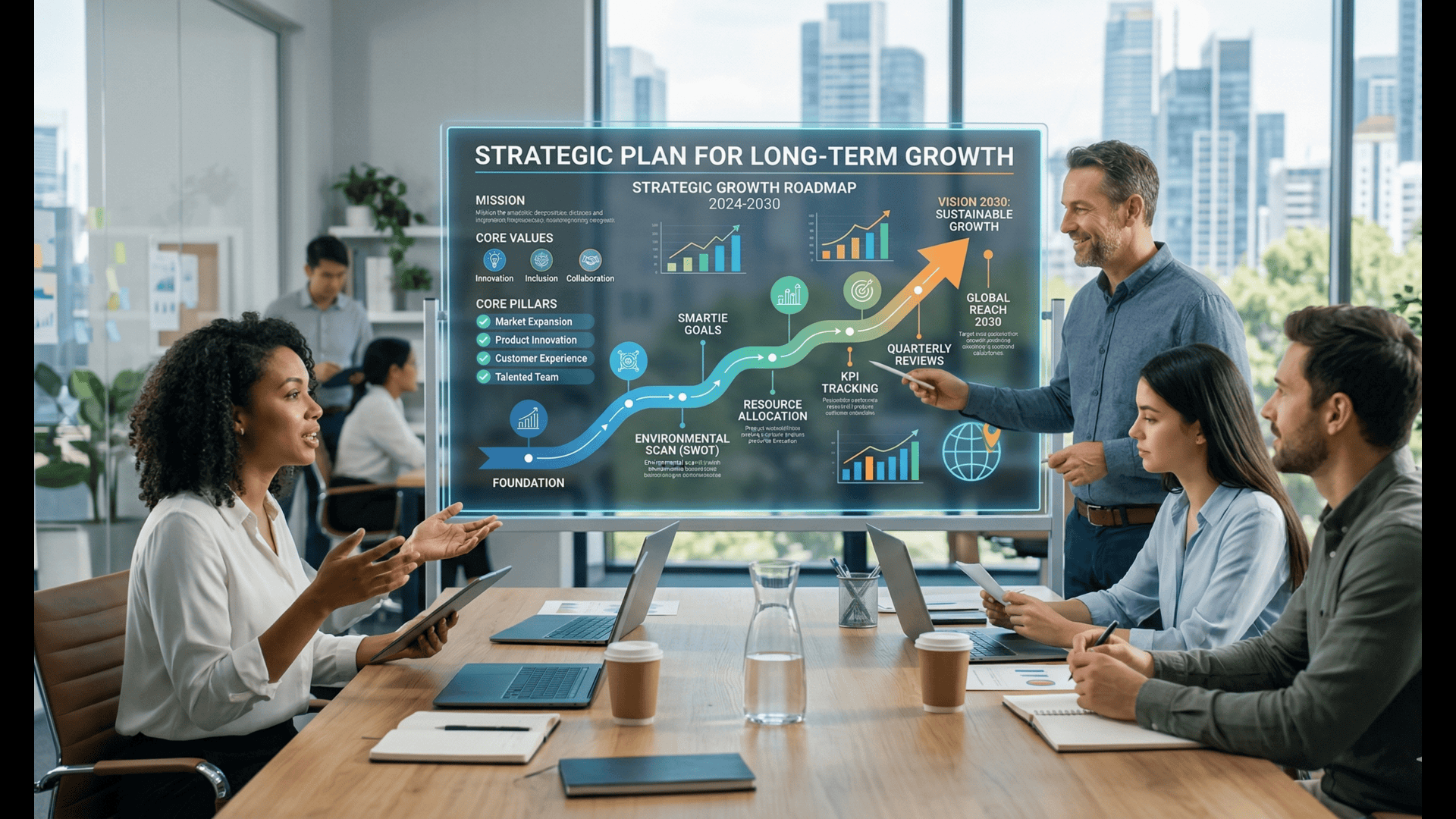
- Vision Statement: Your organization’s North Star. This is an aspirational statement of what you ultimately want to achieve in the future.
- Mission Statement: The foundational purpose of your organization. It defines what you do, who you serve, and how you provide value today.
- Core Values: The fundamental beliefs and guiding principles that dictate behavior and action within the organization. Inclusive values ensure that diverse voices are respected and heard throughout the journey.
8 Actionable Strategic Planning Tips for Long-Term Growth
Building a strategy that endures requires intention, data, and a commitment to inclusivity. Here are eight actionable tips to guide your strategic planning process.
Tip 1: Conduct a Comprehensive Environmental Scan
You cannot chart a course to your destination if you do not know where you currently stand. An environmental scan provides a realistic view of your internal capabilities and the external market landscape.
- SWOT Analysis: Evaluate your internal Strengths and Weaknesses, along with external Opportunities and Threats.
-
Inclusive Tip: Gather input for your SWOT analysis from people across all levels and departments of the organization. Frontline workers often perceive weaknesses and threats that executives might miss.
-
- PESTLE Analysis: Look at the macro-environment by analyzing Political, Economic, Social, Technological, Legal, and Environmental factors. This is crucial for long-term growth, as social shifts and technological advancements can render existing business models obsolete overnight.
Tip 2: Set SMARTIE Goals
You are likely familiar with SMART goals (Specific, Measurable, Achievable, Relevant, and Time-bound). To foster true long-term, sustainable growth, upgrade your framework to SMARTIE goals by adding Inclusive and Equitable.
- Inclusive: Does this goal bring traditionally marginalized or underrepresented voices into the process? Does the goal benefit a diverse range of stakeholders?
- Equitable: Does this goal address systemic disparities? Are the resources required to achieve this goal distributed fairly?
Example of a SMARTIE Goal: “Increase our software user base by 20% over the next 18 months (Specific, Measurable, Time-bound) by developing three new accessibility features for users with disabilities (Inclusive, Equitable) that align with our core expansion strategy (Relevant, Achievable).”
Tip 3: Foster a Culture of Continuous Feedback and Collaboration
Strategic planning should never be conducted in an isolated executive echo chamber. The best ideas often come from the people interacting directly with your clients, customers, and community.
- Create Feedback Loops: Use anonymous surveys, town hall meetings, and focus groups to gather diverse perspectives.
- Empower Cross-Functional Teams: When building your strategic initiatives, form committees that include members from different departments, backgrounds, and seniority levels. This prevents siloed thinking and ensures that the strategy is realistic to execute.
Tip 4: Prioritize Agility and Scenario Planning
A long-term strategy that spans five years will inevitably encounter unforeseen disruptions. The goal is not to predict the future perfectly, but to prepare for multiple possibilities.
- Scenario Planning: Develop “What-If” scenarios. What if our main supplier goes out of business? What if a new competitor enters the market with a cheaper alternative? What if a global event disrupts our supply chain? * Build Contingency Plans: For each scenario, outline a high-level response. This ensures that when a crisis hits, your team isn’t starting from scratch—they are simply activating a pre-discussed plan.
Tip 5: Align Resource Allocation with Strategic Priorities
A strategy is only a wish list if it is not funded. One of the most common reasons strategic plans fail is the disconnect between the new strategy and the old budget.
- Audit Current Spending: Are you investing time and money into projects that no longer align with your new long-term vision? Be prepared to cut legacy projects that do not serve the future.
- Invest in Talent: Long-term growth requires the right people. Does your strategy require new skills? If so, your strategic plan must include a roadmap for training existing staff or hiring new, diverse talent.
Tip 6: Establish Clear KPIs and Tracking Mechanisms
To know if your strategic plan is working, you must measure your progress objectively. Key Performance Indicators (KPIs) act as the milestones on your journey.
- Leading vs. Lagging Indicators: * Lagging indicators tell you what has already happened (e.g., last quarter’s revenue, customer churn rate).
-
Leading indicators help predict future success (e.g., number of new sales calls made, employee satisfaction scores, website traffic). A healthy strategic plan measures both.
-
- Dashboarding: Create a centralized, accessible dashboard where all team members can see progress toward strategic goals in real-time. Transparency builds trust and accountability.
Tip 7: Communicate the Vision Transparently to All Stakeholders
Communication is the bridge between strategy and execution. If your team does not understand the plan, they cannot execute it.
- Tailor the Message: While the overarching vision remains the same, how you communicate it should change based on the audience. An investor needs to hear about market share and ROI; a graphic designer needs to hear about brand evolution and creative direction.
- Repetition is Key: Do not just announce the strategic plan once at an annual meeting. Incorporate the strategic goals into weekly team meetings, performance reviews, and company newsletters. Keep the vision front and center.
Tip 8: Review, Reflect, and Refine Regularly
A strategic plan is not carved in stone. It is a working document that must evolve as the organization and the market evolve.
- Quarterly Reviews: Do not wait until the end of the year to check your progress. Hold quarterly strategy reviews to assess KPIs. If a goal is no longer relevant, have the courage to change it.
- Celebrate the Wins: Long-term growth is a marathon. To keep morale high, take time to celebrate the small milestones and short-term wins along the way. Recognize the teams and individuals who are driving the strategy forward.
Common Pitfalls to Avoid in Strategic Planning
Even with the best intentions, organizations can stumble during the strategic planning process. Keep an eye out for these common traps:
1. The “Set It and Forget It” Syndrome
Investing months into creating a beautiful strategic plan, only to never look at it again, is the most common pitfall. To combat this, integrate strategic plan check-ins into your regular operational meetings.
2. Lack of Inclusivity and Diversity
When strategy is dictated entirely by a homogenous group of top-level executives, it suffers from severe blind spots. Without diverse perspectives regarding age, gender, cultural background, and organizational role, the plan will lack innovation and may alienate portions of your workforce or customer base.
3. Strategy Overload
Trying to do everything at once is a recipe for doing nothing well. If your strategic plan has 25 “top priorities,” you don’t actually have any priorities. Limit your focus to 3–5 core strategic pillars to ensure your team’s energy is concentrated and effective.
4. Ignoring Organizational Culture
Renowned management consultant Peter Drucker famously said, “Culture eats strategy for breakfast.” If your strategic plan requires high levels of cross-departmental collaboration, but your current culture is highly competitive and siloed, the strategy will fail. You must address cultural shifts alongside strategic shifts.
The Role of Inclusive Leadership in Strategic Planning
Long-term growth is deeply intertwined with inclusive leadership. As organizations expand globally and workforces become increasingly diverse, a leadership approach that values equity and belonging is no longer just a moral imperative—it is a strategic advantage.
Inclusive leaders actively seek out dissenting opinions. They create psychological safety, ensuring that all team members feel comfortable pointing out potential flaws in a strategy without fear of retribution. When strategic planning is viewed through an inclusive lens, the resulting growth is more sustainable because it respects the human capital that drives the business forward. Ensure that your strategic initiatives include goals related to Diversity, Equity, Inclusion, and Accessibility (DEIA).
Frequently Asked Questions (FAQ)
To further clarify the strategic planning process, here are answers to some of the most common questions business leaders and team members ask.
Q1: What is the difference between a strategy and a tactic?
A: A strategy is the overarching plan or the destination you want to reach. A tactic is the specific, actionable step you take to get there. For example, if your strategy is to “become the leading eco-friendly apparel brand in Europe,” a tactic would be “launching a marketing campaign highlighting our zero-waste manufacturing process in Germany.” Strategy is the what and why; tactics are the how.
Q2: How often should we update our strategic plan?
A: While the overarching vision (e.g., a 5-year or 10-year goal) may remain consistent, the strategic plan itself should be reviewed at least quarterly and updated annually. In highly volatile industries like technology or fast-moving consumer goods, you may need to pivot your strategy even more frequently based on market feedback.
Q3: Who should be involved in the strategic planning process?
A: While executive leadership typically leads the process and makes final decisions, the planning process itself should be highly collaborative. Involve department heads, key stakeholders, and representatives from frontline staff. Using surveys or focus groups to gather input from the entire organization ensures a more robust and inclusive plan.
Q4: How long does the strategic planning process take?
A: The timeline varies depending on the size and complexity of the organization. For a small business, it might take a few weeks of dedicated meetings. For a large enterprise, gathering data, consulting stakeholders, drafting the plan, and getting board approval can take three to six months.
Q5: What do we do if our market changes drastically in the middle of our strategic plan?
A: This is where agility and scenario planning come in. If the market shifts drastically (e.g., a new regulation, an economic downturn), pause and assess. Revisit your environmental scan (PESTLE analysis). If the core assumptions of your plan are no longer valid, you must pivot. Clinging to an outdated strategy in a new reality is a fast track to failure.
Q6: How can small businesses or startups with limited resources conduct strategic planning?
A: Strategic planning does not require an expensive consulting firm. Small businesses can start by simply dedicating one full day away from daily operations to answer three questions: Where are we now? Where do we want to be in three years? What are the three biggest things we must do to get there? Keep it simple, document it, and review it monthly.
Conclusion
Strategic planning for long-term growth is an ongoing journey of discovery, alignment, and adaptation. It requires a willingness to look honestly at your current state, the audacity to envision a bold future, and the discipline to execute the steps in between.
By conducting thorough environmental scans, setting SMARTIE goals, prioritizing inclusivity, and maintaining agility, you can create a strategic plan that not only survives market volatility but thrives in it. Remember, the goal of a strategic plan is not to predict the future with 100% accuracy; it is to prepare your organization to navigate whatever the future holds with confidence, unity, and purpose.
Start small, remain consistent, and keep your communication transparent. Your future growth depends on the strategic seeds you plant today.
References and Resources for Further Reading
To continue expanding your knowledge on strategic planning and inclusive organizational growth, explore the following concepts and thought-leadership platforms:
-
Harvard Business Review (HBR) – Strategy: A premier source for articles on competitive strategy, scenario planning, and leadership alignment. (Search: HBR Strategic Planning Basics)
-
McKinsey & Company – Strategy & Corporate Finance: Offers deep-dive reports on macro-economic trends, agility, and long-term value creation. (Search: McKinsey The Strategy Map)
-
Forbes – Business Strategy: Excellent for actionable advice, startup growth metrics, and leadership tips from industry experts. (Search: Forbes Building a Resilient Business Strategy)
-
The Management Center: A fantastic resource for setting equitable and inclusive goals (SMARTIE goals) and managing diverse teams effectively. (Search: The Management Center SMARTIE Goals)
-
Blue Ocean Strategy by W. Chan Kim and Renée Mauborgne: A foundational book on how to create uncontested market space and make the competition irrelevant.