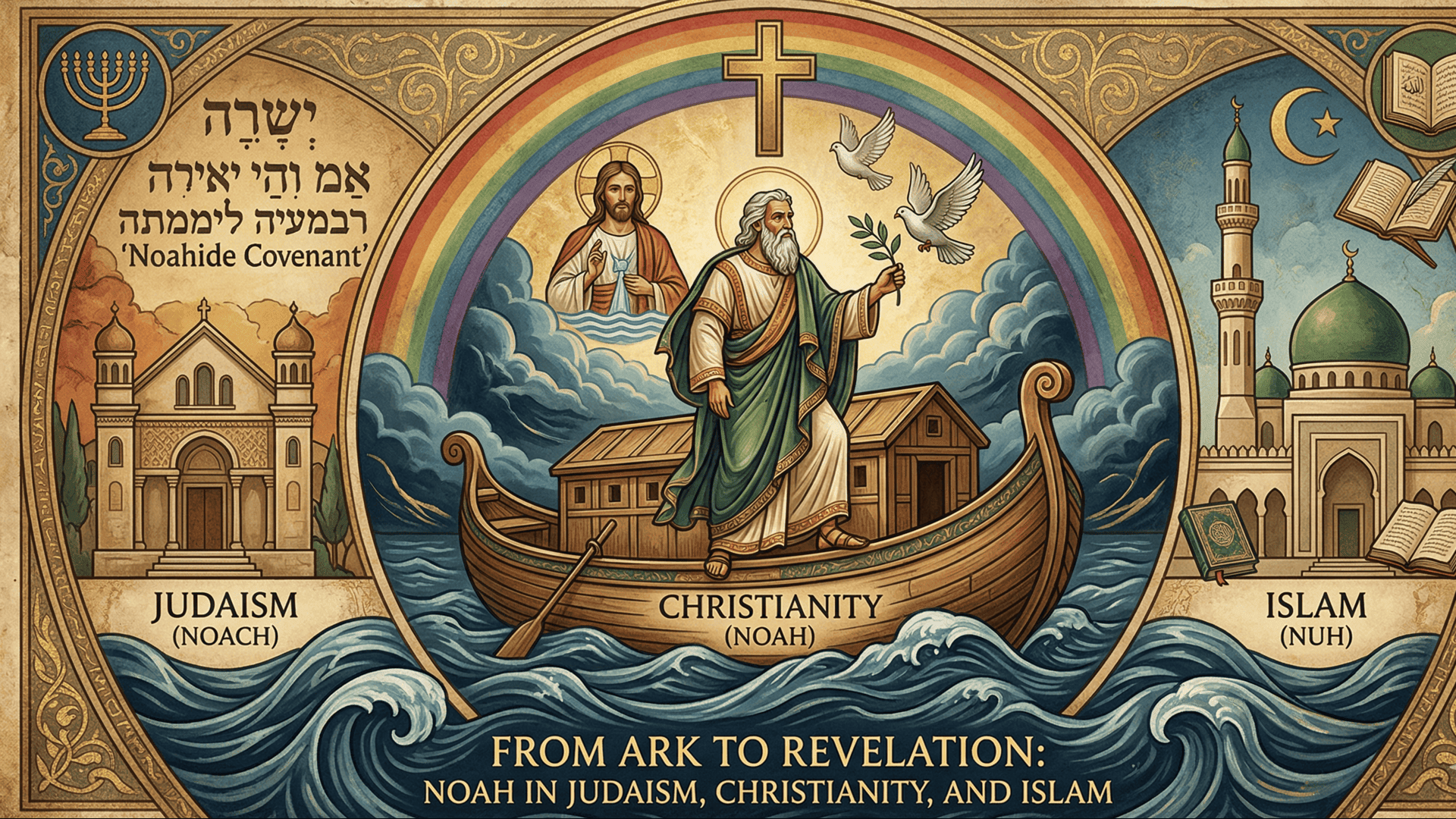
Few narratives in the tapestry of human history possess the enduring resonance of the great flood and the man chosen to survive it. Noah—known as Noach in Hebrew and Nuh in Arabic—stands as a monumental figure at the crossroads of the three great Abrahamic faiths: Judaism, Christianity, and Islam. While the basic architecture of his story remains recognizable across all three traditions—a righteous man, a divinely mandated vessel, a cataclysmic deluge, and the salvation of a remnant of life—the theological nuances, characterizations, and ultimate lessons drawn from his life vary remarkably.
This comprehensive exploration delves into the figure of Noah across Judaism, Christianity, and Islam. By examining ancient scriptures, scholarly commentaries, and theological interpretations, we can trace how a single ancient mariner navigates the diverse spiritual waters of these three world religions, moving from a patriarch of a new humanity to a prefiguration of ultimate salvation, and finally, to an archetype of prophetic endurance.
Part I: The Primordial Waters and Historical Context
Before exploring the specific religious texts, it is essential to contextualize the narrative of Noah within the broader ancient Near East. The story of a global deluge was not born in a vacuum. Long before the codification of the Hebrew Bible, ancient Mesopotamian cultures circulated epic poems detailing catastrophic floods brought on by the gods.
The Epic Precursors
The most famous of these is the Epic of Gilgamesh, wherein the character Utnapishtim is instructed by the god Ea to build a boat to survive a flood decreed by the chief god, Enlil, who was simply annoyed by the noise of humanity. Similarly, the Atrahasis Epic details a flood sent to curb human overpopulation.
The Monotheistic Shift
When the Abrahamic traditions adapted the flood narrative, they enacted a profound theological revolution. The flood was no longer the result of capricious, irritated deities. Instead, it became a deeply moral event—a divine response to pervasive human wickedness, violence, and corruption. Noah is not saved because of a divine loophole or favoritism by a trickster god; he is saved because of his righteousness, his faith, and his obedience to a singular, moral Creator. This shift lays the foundation for how Judaism, Christianity, and Islam approach the figure of Noah.
Part II: Noah in Judaism – The Righteous Man in His Generation
In the Hebrew Bible (the Tanakh), Noah’s story is found primarily in the Book of Genesis (Chapters 6–9). Here, Noah is introduced as the bridge between the antediluvian (pre-flood) world and the world as we know it today. He is the second father of humanity, succeeding Adam.
“Righteous in His Generation”
Genesis 6:9 introduces him with a powerful but debated description:
“These are the generations of Noah: Noah was a just man and perfect in his generations, and Noah walked with God.”
The phrase “in his generations” (b’dorotav) has sparked centuries of profound Rabbinic debate, captured extensively in the Midrash and the Talmud.
- The Relative View: Some rabbis, such as the great medieval commentator Rashi, noted that compared to the extreme wickedness of his contemporaries, Noah was righteous. However, had he lived in the generation of Abraham, he might have been considered merely ordinary. This view paints Noah as a man who managed to hold onto his morality in a dark time, but who lacked the proactive, world-changing faith of later patriarchs.
- The Absolute View: Conversely, other sages argue that the phrase amplifies his praise. If Noah could maintain his righteousness in a generation so utterly corrupt that God chose to wipe it out, how much more righteous would he have been in a generation of good people!
Unlike Abraham, who famously argued with God to save the wicked city of Sodom, Noah accepts God’s decree regarding the flood in silence. He builds the Ark, but the text does not record him pleading for the lives of his neighbors. This silence is a defining characteristic of the Jewish Noah—an obedient servant, but perhaps lacking the intercessory compassion of later prophets.
The Ark (Tevah) and the Flood
God commands Noah to build an Ark (in Hebrew, Tevah, which translates closer to “box” or “chest” rather than a shaped ship). The dimensions are precise: 300 cubits long, 50 cubits wide, and 30 cubits high. The building of this colossal structure—a process that Jewish tradition suggests took 120 years—was itself a sermon. It was a prolonged opportunity for humanity to observe, inquire, and repent, though none did.
The floodwaters erupt from the “fountains of the great deep” and pour from the “windows of heaven.” For 40 days and 40 nights, the earth is submerged. Noah, his wife, his three sons (Shem, Ham, and Japheth), and their wives, along with the pairs of animals, endure a year-long confinement. The sending out of the raven and then the dove—which finally returns with a freshly plucked olive leaf—serves as one of the most enduring symbols of peace and divine reconciliation in human history.
The Noahide Covenant and the Seven Laws
Upon exiting the Ark, Noah builds an altar and offers sacrifices. God smells the “pleasing odor” and makes a unilateral, unconditional covenant with Noah, his descendants, and all living creatures: never again will a flood destroy the earth. The sign of this eternal covenant is the rainbow (keshet).
Crucially, in Judaism, Noah is the recipient of a universal moral code. While the Torah later gives 613 commandments to the Jewish people at Mount Sinai, the Talmud (Sanhedrin 56a) identifies the Seven Laws of Noah (the Sheva Mitzvot B’nei Noach) as the bedrock moral obligations for all of humanity. These are:
- Not to worship idols.
- Not to curse God.
- Not to commit murder.
- Not to commit adultery or sexual immorality.
- Not to steal.
- Not to eat flesh torn from a living animal (respect for life).
- To establish courts of justice.
In Jewish theology, any non-Jew who adheres to these seven laws is considered a “Righteous Gentile” and has a place in the World to Come. Thus, Noah is the foundational figure for universal human ethics.
The Fall of Noah
The Genesis narrative of Noah ends on a tragic, sobering note. Genesis 9 records that Noah, the man who survived the apocalypse, became a “man of the soil” and planted a vineyard. He drank of the wine, became intoxicated, and lay uncovered in his tent.
His son Ham “saw the nakedness of his father” and told his brothers. Shem and Japheth respectfully walked backward with a garment to cover Noah. Upon waking, Noah curses Ham’s son, Canaan, condemning him to servitude, while blessing Shem and Japheth.
For Jewish commentators, this episode underscores the frailty of human nature. The same man who could withstand a global cataclysm and the mockery of a wicked generation was undone by the comforts of the post-flood world. It serves as a stark warning about the dangers of losing one’s spiritual vigilance in times of peace and plenty.
Part III: Noah in Christianity – Typology, Baptism, and the Preacher of Righteousness
Christianity inherits the Hebrew scriptures, and thus accepts the entire Genesis account of Noah. However, through the lens of the New Testament and the writings of the early Church Fathers, the figure of Noah undergoes a profound typological and eschatological transformation. In Christianity, Noah is not just a historical patriarch; he is a prophetic shadow of Jesus Christ, and the Ark is a blueprint for Christian salvation.
The Eschatological Warning: The “Days of Noah”
In the Gospels, Jesus uses the story of Noah as a direct parallel to the end of the world and his own eventual return (the Parousia). In Matthew 24:37-39, Jesus warns:
“But as the days of Noah were, so shall also the coming of the Son of man be. For as in the days that were before the flood they were eating and drinking, marrying and giving in marriage, until the day that Noah entered into the ark, And knew not until the flood came, and took them all away; so shall also the coming of the Son of man be.”
Here, Noah’s generation represents spiritual apathy and distraction. The people were not necessarily condemned just for violence, but for being entirely consumed by the mundane aspects of life, ignoring the impending judgment. Noah stands as the model of the vigilant believer who prepares for divine judgment while the rest of the world remains blind.
Faith and the “Preacher of Righteousness”
The New Testament writers elevate Noah’s spiritual status, addressing the Rabbinic critique of his “silence.” In the Epistle to the Hebrews, Chapter 11 (often called the “Hall of Faith”), Noah is celebrated for his profound, active trust in God:
“By faith Noah, being warned of God of things not seen as yet, moved with fear, prepared an ark to the saving of his house; by the which he condemned the world, and became heir of the righteousness which is by faith.” (Hebrews 11:7)
Furthermore, the Apostle Peter explicitly labels Noah a “preacher of righteousness” (2 Peter 2:5). Christian tradition assumes that during the decades of building the Ark, Noah was actively preaching repentance to his contemporaries, warning them of the wrath to come. His failure to convert anyone is not seen as a lack of effort, but as proof of the utter hardness of human hearts.
The Typology of the Ark and the Flood
Perhaps the most significant Christian contribution to the Noah narrative is the use of typology—the theological concept where Old Testament figures, events, and objects prefigure (or serve as a “type” for) New Testament realities.
1. The Ark as the Church: Early Church Fathers, such as St. Augustine and St. Cyprian, heavily utilized the Ark as a symbol for the Christian Church. Just as there was no salvation from the floodwaters outside the physical structure of the Ark, the early theologians argued that there was no spiritual salvation outside the Church (Extra Ecclesiam nulla salus). The wood of the Ark was frequently compared to the wood of the Cross—both being instruments of salvation crafted from trees.
2. The Floodwaters as Baptism: The Apostle Peter draws a direct, explicit theological line between the waters of the flood and the sacrament of Christian baptism. In 1 Peter 3:20-21, he writes about those who were disobedient “in the days of Noah, while the ark was a preparing, wherein few, that is, eight souls were saved by water. The like figure whereunto even baptism doth also now save us…”
In this striking reversal of imagery, the water that was an instrument of death and judgment in Genesis becomes the instrument of purification and new life in Christianity. Just as the flood washed the earth clean of its violent corruption, the waters of baptism wash the believer clean of original sin. Noah emerging from the Ark onto a cleansed earth prefigures the Christian rising from the baptismal font as a “new creation.”
Part IV: Noah (Nuh) in Islam – The Arch-Prophet of Firm Resolve
When we turn to the Quran and Islamic tradition, the portrait of Noah (known as Nuh) shifts dramatically from the Biblical account. In Islam, Nuh is a figure of monumental importance. He is not merely a righteous survivor; he is the first of the Rasul (Messengers sent with a specific law) and one of the five Ulu’l Azm (Arch-Prophets of Firm Resolve), alongside Abraham (Ibrahim), Moses (Musa), Jesus (Isa), and Muhammad.
His story is dispersed throughout the Quran, with several chapters detailing his struggles, including an entire chapter named after him (Surah Nuh, Chapter 71).
The 950-Year Struggle
While the Bible mentions Noah’s age, the Quran specifically emphasizes the duration of his prophetic mission. Surah Al-‘Ankabut (29:14) states:
“And We certainly sent Noah to his people, and he remained among them a thousand years minus fifty years, and the flood seized them while they were wrongdoers.”
For 950 years, Nuh preached the message of Tawhid (the absolute oneness of God) to a fiercely polytheistic and idolatrous society. The Quran provides vivid details of his preaching. He preached to them day and night, in public and in secret. He reasoned with them using the beauty of the natural world and the promise of God’s forgiveness and bounty.
Unlike the silent builder of Genesis, the Islamic Nuh is a desperate, weeping, exhausted, yet entirely unyielding orator. He faces mockery, physical abuse, and threats of stoning. The elites of his society dismiss him because his followers are only the poorest and lowest classes—a common theme in the struggles of all Islamic prophets.
The Building of the Ark and the Mockery
When God finally reveals to Nuh that no more of his people will believe, He commands Nuh to build the Ark under divine supervision. As he builds it, the societal mockery intensifies. The Quran notes that every time the chiefs of his people passed by him, they scoffed. Nuh’s response is one of supreme confidence in God: “If you ridicule us, then we will ridicule you just as you ridicule.” (Surah Hud, 11:38).
The Heartbreak of the Drowning Son
One of the most profound and uniquely Islamic elements of the Noah narrative is the story of his unnamed son (often called Canaan or Yam in Islamic tradition).
In Genesis, Noah’s immediate family is saved entirely. In the Quran, faith—not bloodline—dictates salvation. As the waters rise, in a heartbreaking scene captured in Surah Hud (11:42-43), Nuh calls out to his son, who has separated himself from the believers:
And it sailed with them through waves like mountains, and Noah called to his son who was apart [from them], “O my son, come aboard with us and be not with the disbelievers.” But he said, “I will take refuge on a mountain to protect me from the water.” [Noah] said, “There is no protector today from the decree of Allah, except for whom He gives mercy.” And the waves came between them, and he was among the drowned.
Nuh, grieving, calls out to God, reminding Him of His promise to save his family. God’s response provides a foundational theological lesson in Islam regarding spiritual kinship versus biological kinship:
He said, “O Noah, indeed he is not of your family; indeed, he is [one whose] work was other than righteous, so ask Me not for that about which you have no knowledge…” (Surah Hud 11:46).
Prophetic Infallibility (Ismah) and the Absence of the Vineyard
Crucially, the Islamic narrative ends with the Ark resting on Mount Judi (rather than the Biblical Ararat) and Nuh disembarking with God’s blessings.
There is no mention whatsoever in the Quran or authentic Hadith of Noah planting a vineyard, getting drunk, or cursing his grandson. In Islamic theology, prophets are protected by God from committing major sins (Ismah). A prophet of God, an Ulu’l Azm, getting intoxicated and lying naked is considered entirely incompatible with the dignity, purity, and divinely protected status of prophethood. Thus, the Islamic Nuh remains an unblemished paragon of patience, endurance, and unwavering submission to the Divine will from beginning to end.
Part V: Comparative Analysis and Theological Synthesis
By placing these three traditions side-by-side, we can observe fascinating divergences and convergences that highlight the distinct theological priorities of Judaism, Christianity, and Islam.
1. The Nature of Salvation and Covenant
- Judaism emphasizes the legal and universal outcome of the flood. Noah is the anchor for the Noahide Laws, establishing a baseline of morality for all of civilization. The rainbow signifies a binding legal covenant between God and the physical earth.
- Christianity spiritualizes the salvation. The physical rescue from the flood is secondary to what it represents: the spiritual rescue from sin through Jesus Christ. The Ark is the Church, and the water is Baptism. The focus moves from earthly preservation to eternal salvation.
- Islam focuses on the theological boundary of salvation. Salvation is strictly a matter of Tawhid (monotheism) and obedience. The drowning of Nuh’s son serves as the ultimate proof that neither wealth, nor status, nor even being the biological child of an Arch-Prophet can save a soul that rejects God.
2. The Character of the Man
- Judaism presents a deeply human Noah. He is uniquely righteous in a dark time, but he is fundamentally flawed. His post-flood drunkenness serves as a poignant, realistic psychological portrait of survivor’s guilt or human frailty. He is a great man, but he is not elevated beyond human weakness.
- Christianity smooths over some of his later flaws to emphasize his faith. The writer of Hebrews and the Apostle Peter lift him up as an exemplar of believing the unseen and preaching the truth. He becomes a heroic type of Christ.
- Islam elevates Nuh to an almost superhuman level of endurance. Preaching for 950 years in the face of relentless abuse requires a fortitude that makes him one of the greatest human beings to ever live. His character is utterly spotless, fiercely protective of God’s message, and devoid of the moral failings depicted in Genesis.
3. Justice versus Intercession
The Rabbinic critique of Noah—that he did not pray for his generation like Abraham prayed for Sodom or Moses prayed for Israel—stands in stark contrast to the Islamic Nuh. In the Quran, Nuh does eventually pray against his people, but only after nearly a millennium of rejection, and only after God explicitly reveals to him that no one else will believe. In Surah Nuh, he finally prays: “My Lord, leave not upon the earth of the disbelievers an inhabitant.” This is not seen as a lack of compassion in Islam, but rather as perfect alignment with Divine justice after all human avenues for repentance have been exhausted.
Conclusion: The Enduring Legacy of the Ark Builder
From the ancient cuneiform tablets of Mesopotamia to the scrolls of the Torah, the epistles of the New Testament, and the recitation of the Quran, the figure of Noah has sailed through millennia of human consciousness.
FFor the Jew, Noah is the righteous survivor who grounds the world in fundamental moral law, teaching us the fragility of human nature even after profound spiritual victories.
For the Christian, Noah is the voice of warning in the wilderness, the builder of the wooden vessel that points forward to the cross, teaching us that faith in the unseen is the only refuge from the coming storm.
For the Muslim, Nuh is the ultimate symbol of Sabr (patient endurance), a man who stood against the tide of an entire world for centuries without yielding, teaching us that true allegiance belongs to God alone, superseding even the deepest bonds of blood.
Despite these differing theological lenses, the core of the Noahic narrative remains universally potent. The story of the flood confronts humanity with the uncomfortable realities of divine justice and human corruption. Yet, simultaneously, it offers the ultimate message of hope. Whether symbolized by a rainbow in the clouds, the cleansing waters of a baptismal font, or the peaceful resting of a ship on Mount Judi, Noah’s story assures us that even in the face of absolute catastrophe, divine mercy preserves the righteous, and a new beginning is always possible.
Leave a Reply