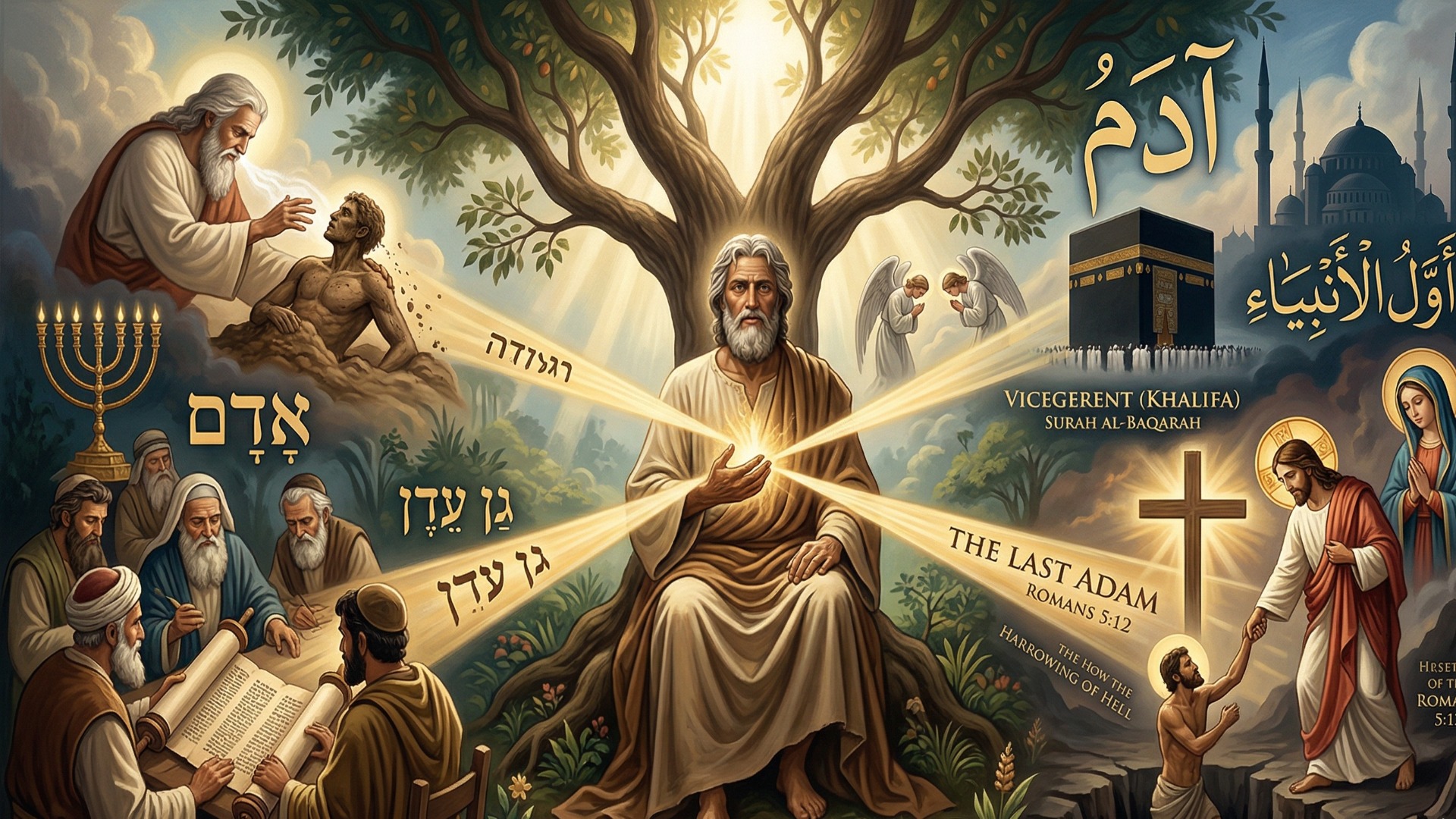
The name “Adam” resonates through the corridors of human history, echoing across millennia, across continents, and across the boundaries of disparate faith traditions. More than just a character in an ancient text, Adam is the ultimate archetype of humanity. To speak of Adam is to speak of ourselves—our origins, our inherent flaws, our capacity for profound divine connection, and our ultimate destiny.
Whether viewed as a literal historical figure, a profound theological metaphor, or a prophetic pioneer, Adam serves as the foundation stone for the Abrahamic faiths—Judaism, Christianity, and Islam—as well as occupying crucial roles in several other religious traditions. Exploring how different religions understand Adam reveals not only how these faiths differ in their theology but also how they uniquely define the human condition, the nature of sin, the concept of free will, and the mechanics of divine redemption.
In this comprehensive exploration, we will dissect the figure of Adam through the lenses of the world’s major religions, tracing his evolution from the clay of the earth to a symbol of cosmic significance.
1. The Linguistic and Cultural Origins of “Adam”
To truly understand Adam, we must first look at the linguistic roots of his name and the cultural milieu from which his story emerged in the ancient Near East.
The Hebrew Etymology
In the Hebrew Bible, the word ‘adam (אָדָם) is fascinatingly multifaceted. It is used in several distinct ways:
- As a generic term for humanity: It often translates simply as “mankind” or “human being.” When the text says God created ‘adam, it is initially speaking of humanity as a collective species.
- As a proper noun: It eventually transitions into the specific name of the first individual man, Adam.
- Its connection to the earth: The word ‘adam is inextricably linked to the Hebrew word ‘adamah (אֲדָמָה), which means “ground,” “soil,” or “earth.” Furthermore, both words share a root with ‘adom (אָדֹם), meaning “red.”
This linguistic triad—humanity, earth, and red—paints a vivid theological picture. Adam is the “earthling,” the one pulled from the red dirt. This etymology immediately establishes the dual nature of the human being in Abrahamic thought: we are profoundly physical, tethered to the dirt from which we were formed, yet we are animated by the divine breath (ruach) of the Creator. This tension between the mud and the divine breath is the crucible of the human experience.
Ancient Near Eastern Parallels
The biblical narrative of Adam did not emerge in a cultural vacuum. Ancient Mesopotamian cultures possessed their own creation myths that share intriguing thematic similarities with the Genesis account, though their theological conclusions are vastly different.
The most famous parallel is the myth of Adapa, a sage from the ancient Sumerian city of Eridu. According to the myth, Adapa was endowed with immense wisdom by the god Enki but was denied immortality. In a pivotal scene, Adapa is offered the “food of life” and the “water of life” by the high god Anu. However, having been tricked by Enki into believing the food was poisoned, Adapa refuses to eat it, thereby losing the chance for immortality for himself and all of humanity.
While the stories of Adam and Adapa are distinct—Adam disobeys by eating forbidden food, while Adapa obeys (a deceptive command) by refusing divine food—both narratives grapple with the same existential questions: Why do humans possess god-like wisdom yet suffer mortal deaths? Why are we barred from the realm of the eternal? The story of Adam, therefore, serves as the distinctively monotheistic answer to the ancient world’s most pressing existential anxieties.
2. Adam in Judaism: The Progenitor and the Prototype
In Judaism, Adam is the foundational patriarch, but the theological emphasis placed upon him differs significantly from the later Christian interpretations. To Jewish sages, rabbis, and mystics, Adam is the prototype of moral responsibility.
The Genesis Narrative
The Hebrew Bible (Tanakh) contains two distinct creation accounts in the book of Genesis.
- Genesis 1: The first account is cosmic and poetic. God creates humanity in His own image (Tzelem Elohim), both male and female simultaneously, giving them dominion over the earth.
- Genesis 2-3: The second account is intimate and narrative-driven. God forms Adam from the dust, breathes the breath of life into his nostrils, and places him in the Garden of Eden to cultivate and keep it. Finding that it is “not good for man to be alone,” God creates Eve from Adam’s side (often translated as “rib”).
The central drama occurs when Adam and Eve violate God’s single prohibition: eating from the Tree of the Knowledge of Good and Evil. They are subsequently expelled from the Garden. In Judaism, this event is profoundly tragic, as it introduces death, painful labor, and separation from the immediate presence of God into the human experience. However, Judaism does not view this event as the creation of an inescapable “Original Sin” that taints the souls of all future generations.
The Rejection of “Original Sin”
In Jewish theology, while Adam’s disobedience altered the conditions of human existence (bringing about mortality and hardship), it did not corrupt human nature itself. Every human being is born with a clean slate, possessing two inclinations:
- Yetzer HaTov: The good inclination, the desire to follow God’s laws and act altruistically.
- Yetzer Hara: The “evil” or selfish inclination, the base drives for survival, reproduction, and acquisition (which are not inherently evil but can lead to sin if left unchecked).
Adam’s story is a cautionary tale about the misuse of free will. He is the first to sin, but his guilt is his own. The prophet Ezekiel explicitly counters the idea of inherited guilt: “The child will not share the guilt of the parent, nor will the parent share the guilt of the child” (Ezekiel 18:20).
Rabbinic Literature: The Cosmic Adam
The Talmud and the Midrash (rabbinic commentaries) expand upon the brief Genesis narrative, elevating Adam to a figure of staggering cosmic proportions before the Fall.
- Physical Stature: Midrashic traditions suggest that before the sin, Adam’s physical body stretched from the earth to the firmament of heaven, and from one end of the earth to the other. His beauty outshone the sun. When he sinned, God “placed His hand upon him” and diminished his stature, reflecting the spiritual diminution of humanity.
- The First Repentance: Rabbinic tradition heavily emphasizes Adam’s repentance. Unlike later Christian narratives that often focus solely on the Fall, Jewish Midrash portrays Adam as the first penitent. He is said to have fasted, sat in the freezing waters of the Gihon river, and wept for 130 years in deep remorse for his transgression. Adam thus becomes the model not just for sin, but for Teshuvah (repentance and return to God).
Kabbalah: Adam Kadmon
In Jewish mysticism (Kabbalah), the concept of Adam takes on a purely metaphysical dimension through the idea of Adam Kadmon (the Primordial Man).
Adam Kadmon is not the physical Adam of Genesis. Rather, Adam Kadmon is the first spiritual emanation of the infinite God (Ein Sof) into the finite universe. This Primordial Man represents the divine blueprint of creation, embodying the ten Sefirot (divine attributes or emanations) through which God interacts with the world. The physical Adam created in the Garden of Eden is viewed as a microcosm, a physical reflection of this massive spiritual blueprint. The mystic’s ultimate goal is to repair the brokenness of the physical world (Tikkun Olam) and restore the spiritual alignment of the universe, bringing it back to the perfection of Adam Kadmon.
3. Adam in Christianity: The Fall and the Need for a Savior
While Judaism views Adam as a cautionary archetype of free will, mainstream Christianity places Adam at the very center of its soteriology (the theology of salvation). In Christian thought, understanding Adam is the absolute prerequisite for understanding Jesus Christ.
The Doctrine of Original Sin
The concept of Original Sin, primarily formulated by St. Augustine of Hippo in the 4th and 5th centuries, is the cornerstone of Western Christian theology regarding Adam.
According to this doctrine, Adam was created in a state of grace and original righteousness. However, his decision to rebel against God by eating the forbidden fruit was an act of cosmic treason. Because Adam was the federal head and biological progenitor of all humanity, his sin had catastrophic, inherited consequences.
- Inherited Guilt: Augustine argued that all humanity was “seminally present” in Adam’s loins. Therefore, when Adam sinned, humanity sinned. We are all born guilty of Adam’s transgression.
- Corrupted Nature: Adam’s sin fundamentally broke human nature. Humans lost their original righteousness and became totally depraved, naturally inclined toward sin and incapable of saving themselves. This inherent spiritual sickness is passed down from generation to generation like a genetic disease.
Because of Adam’s Fall, humanity is alienated from God, subject to physical and spiritual death, and deserving of damnation. It is this desperate, inescapable predicament that necessitates a divine Savior.
The Pauline Typology: The First and Second Adam
The Christian understanding of Adam was largely codified by the Apostle Paul in the New Testament, specifically in his epistles to the Romans and the Corinthians. Paul establishes a profound theological contrast between Adam and Jesus Christ, creating a framework known as typology (where a figure in the Old Testament foreshadows a greater reality in the New Testament).
Paul writes in Romans 5:12, “Therefore, just as sin entered the world through one man, and death through sin, and in this way death came to all people, because all sinned.”
He then establishes Christ as the “Second Adam” or the “Last Adam”:
- 1 Corinthians 15:22: “For as in Adam all die, so in Christ all will be made alive.”
- 1 Corinthians 15:45: “So it is written: ‘The first man Adam became a living being’; the last Adam, a life-giving spirit.”
In Pauline theology, Adam and Christ act as the two great representatives of humanity.
- The First Adam brought disobedience, condemnation, sin, and death. He failed the test in the paradise of Eden.
- The Second Adam (Christ) brought perfect obedience, justification, righteousness, and eternal life. He passed the test in the wilderness and the agony of the Garden of Gethsemane.
Christ’s sacrificial death on the cross and subsequent resurrection are viewed as the mechanism that undoes the curse brought about by the First Adam. Where Adam severed the bridge between God and humanity, Christ rebuilds it.
Eastern Orthodox Perspectives: Ancestral Sin
It is vital to note that not all of Christianity adopted Augustine’s strict view of inherited guilt. The Eastern Orthodox Church holds to a concept known as Ancestral Sin rather than Original Sin.
Orthodox theology agrees that Adam’s sin brought corruption, sickness, and death into the world. Humanity inherits this fallen, mortal condition—the disease of death and a propensity to sin—but they do not inherit Adam’s personal guilt. We are guilty only of our own actual sins, not the sin of our ancestor.
In Eastern Orthodoxy, the Fall is often viewed less as a legal crime requiring a penal sacrifice, and more as a spiritual illness requiring a Great Physician. Furthermore, early church fathers like St. Irenaeus viewed Adam and Eve not as perfect beings who fell from a great height, but as spiritual children who were immature and made a mistake, requiring Christ to bring humanity to its ultimate, intended maturity.
The Harrowing of Hell
One of the most powerful Christian traditions involving Adam is the “Harrowing of Hell.” According to ancient Christian tradition (prominent in both Orthodox iconography and the Catholic Apostles’ Creed), between His crucifixion and resurrection, Jesus descended into Hades (the realm of the dead). There, Christ broke down the gates of hell and rescued the righteous souls of the Old Testament who had been waiting for redemption—chief among them, Adam and Eve.
In traditional Orthodox resurrection icons, the central image is not Christ walking out of an empty tomb, but rather Christ standing on the shattered gates of hell, reaching down and pulling a frail Adam by one wrist and Eve by the other, pulling humanity out of the grave.
4. Adam in Islam: The First Prophet and the Vicegerent
In Islam, the figure of Adam (آدم) is treated with immense reverence. The Islamic narrative of Adam corrects and refines the prior biblical narratives from a strict monotheistic (Tawhid) perspective. In Islam, Adam is not the catalyst for a fallen human nature; rather, he is the first human, the first Muslim (one who submits to God), and crucially, the First Prophet (Nabi).
Creation and the Vicegerent (Khalifa)
The Quranic narrative of Adam is scattered across several chapters (Surahs), most notably in Surah Al-Baqarah (The Cow), Surah Al-A’raf (The Heights), and Surah Ta-Ha.
The story begins in the heavenly realms before Adam’s creation. Allah (God) announces to the angels His intention to create a human being: “Indeed, I will make upon the earth a successive authority (Khalifa)” (Quran 2:30). The term Khalifa means vicegerent, steward, or deputy. Adam was not created as an afterthought; he was explicitly designed to be God’s representative on Earth, tasked with ruling and maintaining it according to divine will.
The angels, perhaps foreseeing the capacity of human free will, question God: “Will You place upon it one who causes corruption therein and sheds blood, while we declare Your praise and sanctify You?” God simply replies, “Indeed, I know that which you do not know.”
God then forms Adam from a handful of clay gathered from all the different soils of the earth (explaining the different colors and natures of mankind) and breathes His spirit (Ruh) into him.
The Superiority of Knowledge
To prove Adam’s worth to the angels, God teaches Adam “the names of all things” (Quran 2:31). God then asks the angels to name these things, but they cannot. Adam steps forward and names them all.
This is a profound theological statement in Islam: humanity’s distinct superiority over the angels does not lie in our inherent purity (angels are perfectly obedient), but in our intellect, our capacity for knowledge, language, conceptual thought, and free will.
The Refusal of Iblis (Satan)
Following this demonstration, God commands all the angels to prostrate themselves before Adam out of respect for God’s creation. All the angels obey, except one entity: Iblis (who becomes Shaitan, or Satan).
Iblis, who in Islamic theology is a Jinn (a creature made of smokeless fire) rather than a fallen angel, refuses out of sheer arrogance. He declares, “I am better than him. You created me from fire and created him from clay” (Quran 7:12).
This introduces the concept of racism, arrogance, and prejudice as the original sins of the cosmos—committed not by man, but by Satan. Iblis is cast out of God’s presence, but he begs for respite until the Day of Judgment to prove that humanity is ungrateful and easily led astray.
The Slip (Zallah) and the Forgiveness of God
Adam and his wife, Hawa (Eve), are placed in Jannah (the Garden/Paradise). As in the biblical account, they are told they may eat of anything except one specific tree. Shaitan whispers to them, deceiving them by swearing that eating from the tree will turn them into angels or grant them immortality.
They eat, their nakedness becomes apparent to them, and they are sent down to Earth. However, the Islamic interpretation of this event diverges drastically from Christianity:
- No Original Sin: Islam vehemently rejects the concept of Original Sin. The Quran states explicitly that no bearer of burdens can bear the burden of another (Quran 53:38). Adam’s mistake was a “slip” (zallah). It does not taint the souls of his descendants.
- Immediate Repentance and Forgiveness: Unlike the prolonged separation in Christian theology, the Quran emphasizes Adam’s immediate and perfect repentance. God actually teaches Adam the words with which to ask for forgiveness: “Our Lord, we have wronged ourselves, and if You do not forgive us and have mercy upon us, we will surely be among the losers” (Quran 7:23).
- God Forgives Him: God accepts Adam’s repentance entirely. “Then his Lord chose him and turned to him in forgiveness and guided him” (Quran 20:122).
- Descent was Destined: The expulsion to Earth is not seen merely as a punishment. Remember, God told the angels He was making a deputy for the Earth before Adam was even created. The experience in the Garden, the deception of Satan, and the subsequent repentance were a divine training program. Adam arrived on Earth not as a fallen, condemned creature, but as a forgiven prophet, ready to fulfill his role as Khalifa.
Sufi Interpretations
In Islamic mysticism (Sufism), Adam is viewed as the perfect mirror of the Divine Names. The great Sufi philosopher Ibn Arabi wrote that while every part of the universe reflects a specific attribute of God, only the “Perfect Man” (Insan al-Kamil), of which Adam was the first, reflects all the divine names and attributes in their totality. Adam is the pupil of the eye through which God looks at His creation.
5. Adam in Other Faith Traditions
While the Abrahamic faiths provide the most extensive theologies surrounding Adam, he also plays a significant role in several other world religions, often taking on unique metaphysical characteristics.
The Latter-day Saints (Mormonism)
The Church of Jesus Christ of Latter-day Saints (LDS) possesses one of the most unique theological frameworks regarding Adam. In LDS theology, Adam is not merely the first mortal man; he is also the Archangel Michael in his pre-mortal existence. As Michael, he led the armies of heaven against Satan in the pre-mortal war.
Furthermore, Mormonism views the Fall of Adam not as a tragic disaster, but as a necessary and glorious step in the eternal progression of humanity. The Book of Mormon states: “Adam fell that men might be; and men are, that they might have joy” (2 Nephi 2:25).
In this view, if Adam and Eve had remained in the Garden of Eden, they would have remained in a state of innocent stasis. They could not have had children, nor could they have experienced true joy because they knew no sorrow. The Fall was a conscious choice by Adam and Eve to step into mortality, allowing billions of spirit children to gain physical bodies, experience opposition, learn to choose good over evil, and ultimately progress toward exaltation (becoming like God).
The Baha’i Faith
The Baha’i Faith, a monotheistic religion founded in the 19th century that emphasizes the spiritual unity of all mankind, interprets the story of Adam allegorically rather than literally.
Baha’u’llah, the founder of the Baha’i Faith, taught that religious truth is revealed by God progressively through a series of divine messengers (Manifestations of God). In Baha’i belief, Adam is recognized as the first of these Manifestations of God recorded in known history.
However, Baha’is do not believe Adam was the first human being to exist on planet Earth. Science and evolution are respected in Baha’i theology. Instead, Adam represents the beginning of the “Adamic Cycle,” a 6,000-year prophetic cycle that began with his revelation and culminated in the mid-19th century with the coming of the Báb and Baha’u’llah. The story of the Garden of Eden, the tree, and the serpent are entirely symbolic, representing the spiritual awakening of humanity and the detachment from the “animal” nature.
Mandaeism and the Druze Faith
- Mandaeism: In this ancient, gnostic, John the Baptist-venerating religion, Adam is the founder of the faith. He is humanity’s first ancestor and the first to receive the divine revelation and the saving knowledge (gnosis) from the World of Light.
- The Druze Faith: An esoteric religion rooted in the Levant, the Druze believe in a cyclical history of the world. They view Adam as a figure who initiated a new cycle of human consciousness. Interestingly, some Druze texts differentiate between an “Adam of Safa” (the spiritual Adam) and an “Adam of the bodies” (the physical progenitor).
6. Adam in Modern Thought: Beyond Theology
As humanity has transitioned into the modern era, the figure of Adam has transcended strict religious dogma to become a focal point in science, psychology, and literature.
The Biological “Adam”
With the advent of evolutionary biology and genetics, the literal interpretation of Adam as a singular man created 6,000 years ago from whom all humans descend biologically has been abandoned by mainstream science and many progressive religious denominations.
However, science has borrowed his name. In human genetics, Y-chromosomal Adam is the name given to the most recent common ancestor from whom all currently living human males are descended patrilineally. It is important to note that Y-chromosomal Adam was not the only man alive at his time, nor did he live at the same time as “Mitochondrial Eve.” He simply represents a genetic convergence point hundreds of thousands of years ago. Yet, the use of the name “Adam” demonstrates the inescapable cultural power of the biblical narrative.
The Psychological Archetype
Pioneering psychoanalyst Carl Jung viewed figures like Adam and Eve as expressions of the “collective unconscious.” In Jungian psychology, Adam is the archetype of the Primal Man (Anthropos).
The story of the Garden of Eden is viewed psychologically as the story of human maturation. The Garden represents the unconscious innocence of childhood (or the animal state). Eating the fruit represents the dawn of self-consciousness, the painful realization of mortality, and the awakening of the ego. Expulsion from the garden is the necessary pain of growing up—leaving behind the safety of ignorance to face the harsh realities of independent, conscious existence.
Literary Masterpieces
Adam has been the subject of countless works of art and literature, most notably John Milton’s 17th-century epic poem, Paradise Lost. Milton expands the Genesis narrative into a sweeping psychological drama. His Adam is intelligent, deeply philosophical, and ultimately tragic. In Milton’s telling, Adam chooses to eat the fruit not out of a desire for godhood, but out of an overwhelming love for Eve, deciding he would rather share in her mortal doom than live in Paradise without her. This romanticizes the Fall, presenting Adam’s choice as profoundly human.
Conclusion: The Mirror of Humanity
To the Jew, he is the pioneer of moral choice, demonstrating the weight of human free will and the beauty of heartfelt repentance. To the Christian, he is the federal head of a broken humanity, the man whose tragic fall necessitated the glorious, saving grace of Jesus Christ, the Second Adam. To the Muslim, he is the honored vicegerent of God, the first prophet whose slip was forgiven, demonstrating that God’s mercy precedes His wrath. To the mystic, he is the cosmic blueprint of the universe. To the psychologist, he is the agonizing dawn of human consciousness.
The endurance of Adam’s story across millennia is no accident. We continue to debate, analyze, and tell the story of Adam because, ultimately, it is a story about looking in the mirror.
Adam embodies the paradox of the human condition. We are made of mud, yet we contain the breath of the divine. We are capable of profound wisdom, yet prone to foolish mistakes. We long for the peace of Paradise, yet we are destined to struggle in the thorns and thistles of the real world. Adam’s successes are our potential; his failures are our daily reality.
Understanding Adam in all his religious complexities doesn’t just teach us about theology; it teaches us how human beings have historically answered the terrifying question: Why are we the way we are?
Leave a Reply