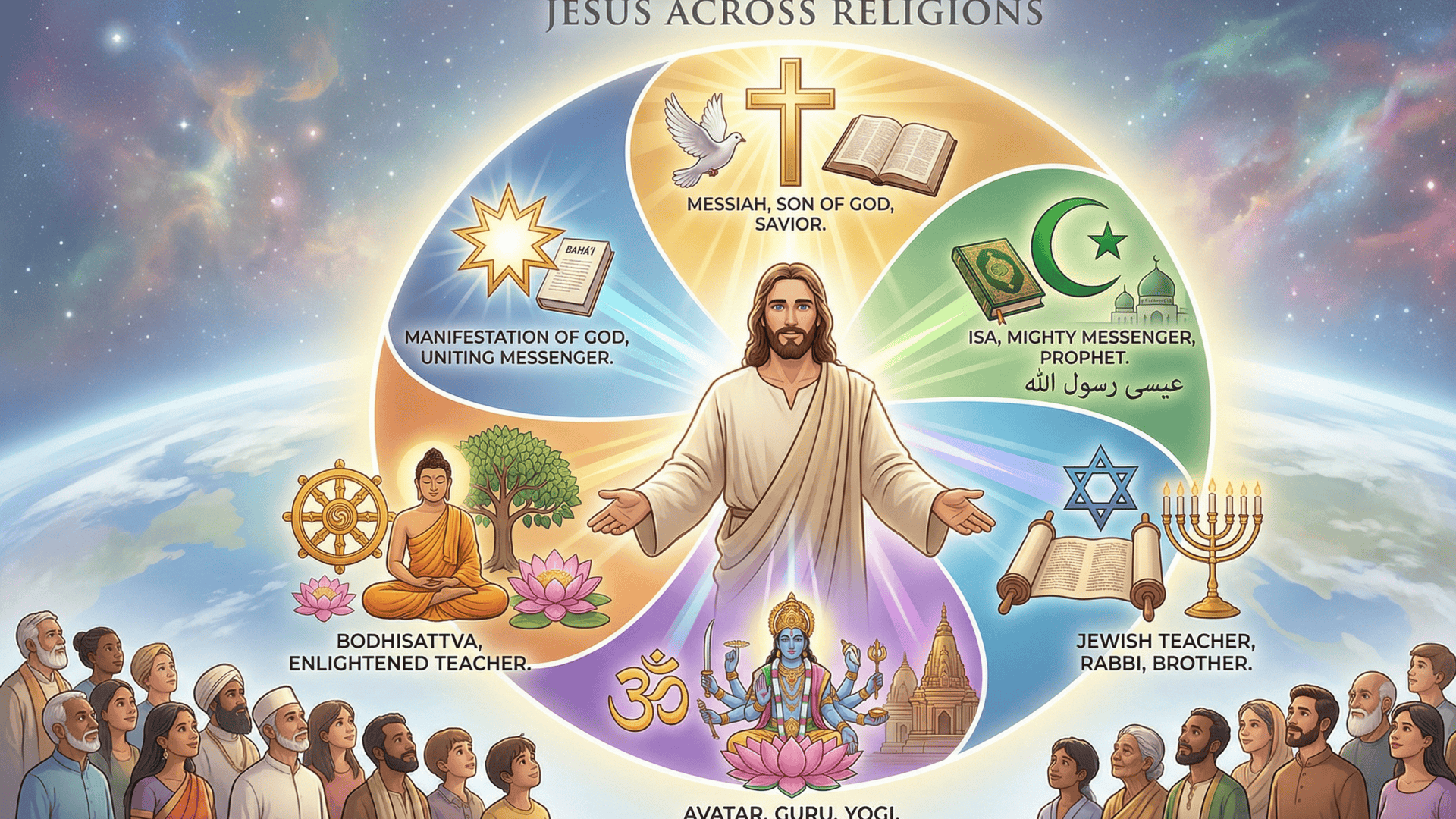
For two millennia, the figure of Jesus of Nazareth has stood as a colossus, striding across the landscape of human history. To Christians, he is the unique Son of God, the Savior of humanity, and part of the divine Trinity. This single perspective, while the most numerically common, is by no means the only way the world perceives this enduring historical figure. Beyond the walls of the Church, Jesus is revered, analyzed, and integrated into diverse theological frameworks, from the ‘Mighty Messenger’ of Islam to the ‘Avatar’ of Hinduism, and the ‘Bodhisattva’ of Buddhism. This article embarks on a comprehensive, respectful journey to explore how the world’s major religions—Christianity, Islam, Judaism, Hinduism, Buddhism, and the Bahá’í Faith—view Jesus, answering the fundamental question: Is he a Prophet, the Messiah, or something infinitely more?
Our exploration is not about establishing a single ‘correct’ view, but about appreciating the rich tapestry of human faith and the unique ways different cultures and theologies have wrestled with the enigma of a first-century Jewish teacher who continues to reshape the spiritual destiny of billions.
1. Christianity: The Cornerstone—Jesus as ‘God Incarnate’
We must begin our journey within the faith that defines itself through Jesus. To understand any other perspective, we must first understand the benchmark set by Christian orthodoxy.
The Divine Son and the Trinity
The heart of Christian belief is that Jesus is not merely a prophet, nor even the greatest of men, but God the Son. He is the second person of the Trinity, which posits that God is one essence subsisting in three co-equal, co-eternal, and distinct persons: the Father, the Son, and the Holy Spirit. This concept is central to the Nicene Creed, a foundational statement of faith for most Christian denominations.
Christian theology asserts the unique doctrine of Incarnation: that the eternal, divine Word (or Logos) “became flesh and dwelt among us” (John 1:14). This makes Jesus fully God and fully human, a complex concept defined at the Council of Chalcedon in 451 CE as a single person with two natures, united “without confusion, without change, without division, without separation.”
The Messiah and fulfillment of Prophecy
While the term “Messiah” (meaning ‘anointed one’ and transliterated into Greek as Christos) is shared, Christianity gives it a unique, cosmic significance. Christians believe Jesus is the literal, physical fulfillment of the Old Testament prophecies concerning a coming king, priest, and suffering servant who would redeem Israel and, ultimately, the world.
Key aspects of this fulfillment include:
- The Virgin Birth: Believed to be a miracle, where Jesus was conceived by the Holy Spirit in the womb of the Virgin Mary, as prophesied by Isaiah (Isaiah 7:14) and confirmed in the Gospels of Matthew and Luke.
- The Line of David: Prophesied to be a descendant of King David, Jesus’s genealogy in the Gospels traces him through this direct line.
- The Suffering Servant: Isaiah’s vivid description of a “man of sorrows” who “bears our griefs” (Isaiah 53) is seen as a precise prophecy of Jesus’s betrayal, crucifixion, and atonement.
The Atonement, Resurrection, and Salvation
Jesus’s mission was not merely to teach or rule, but to save. Christian doctrine teaches that all human beings are separated from God by sin. Jesus’s death on the cross is viewed as a sacrificial atonement, a universal act of substitution where he, the sinless Lamb of God, paid the penalty for human transgression.
His literal, physical resurrection on the third day is the pivot point of the Christian faith, demonstrating his victory over sin and death and offering the promise of eternal life to all believers. Christianity is, therefore, a religion of more: more than a teacher, more than a king—he is the Savior.
2. Islam: The Mighty Messenger—Isa (Jesus) the Prophet
To step from Christianity into Islam is to find not a rejection, but a profound and distinct reverence for Jesus. In the Quran, Jesus is called Isa and is a revered, central figure, mentioned over 25 times by name. However, the Islamic view diverges critically from the Christian, framing Jesus as a great man of God, but absolutely not divine.
The Station of a Prophet
In Islam, Jesus is one of the highest-ranking Prophets and Messengers of God (Allah). He is considered a “Mighty Messenger,” part of an elite group of five, along with Noah, Abraham, Moses, and Muhammad, known as the Ulul ‘Azm (“the possessors of strong will”). His purpose was to guide the Children of Israel back to the correct path, reaffirming the oneness of God.
The Virgin Birth and Miracles
Islam confirms several key Christian events with a different theological lens. The Quran vividly describes the virgin birth (Surah Maryam, 19), presenting it as a miracle demonstrating the unique power of God. Unlike the Christian concept, this is not seen as evidence of Jesus’s divinity, but rather as a special creation, similar to how Adam was created without a father.
Furthermore, the Quran confirms that Jesus performed extraordinary miracles “by God’s leave,” including:
- Speaking from the Cradle: Proclaiming his prophethood as an infant to defend his mother, Maryam (Mary), from false accusations.
- Healing: Giving sight to the blind, curing lepers, and raising the dead.
- Breathing Life into Clay Birds: Creating a bird from clay and breathing into it to make it fly.
The Title “Al-Masih” (The Messiah)
The Quran specifically gives Jesus the title Al-Masih, or The Messiah (Surah 3:45, 4:157, 4:171, 4:172). In the Islamic context, this term signifies an “anointed one” or a specialized role, distinct from the Christian Savior who atones for sin. As Messiah, Jesus is a key figure in Islamic eschatology, who will return before the Day of Judgment to fight the Dajjal (Antichrist) and restore righteousness.
The Critical Divergence: Not the Son of God
The absolute, unyielding divide between Islam and Christianity is the nature of Jesus. Islam rejects the concept of the Trinity and the “Son of God” title as a form of Shirk (associating partners with God) and a violation of the foundational Islamic principle of Tawhid—the absolute, indivisible oneness of God.
The Quran is explicit: “It does not befit God to take for Himself a son. He is glory to Him! When He determines a matter, He only says to it, ‘Be,’ and it is.” (Surah 19:35). In the Islamic view, Jesus is a created, human servant of God, not God himself.
The Crucifixion Question
Another major divergence involves the crucifixion. The Quran asserts, “they did not kill him, nor did they crucify him; but it was made to appear to them so” (Surah 4:157). The general Islamic consensus (though with some variation) is that Jesus was not crucified, but rather God raised him to heaven before his arrest, and a substitute, potentially Judas Iscariot or a volunteer disciple, was made to look like him and was crucified in his place.
3. Judaism: A Jewish Brother—Rejected as Messiah, Not as Brother
Jesus was a first-century Jew. He lived, taught, and died in a context steeped in Jewish scripture, tradition, and hope. To understand how Judaism views him, we must recognize this original context and the subsequent theological, cultural, and political chasm that opened between the mother faith and its largest daughter.
Rejection as the Messiah
For 2,000 years, mainstream Judaism has consistently and uniformly rejected Jesus as the Messiah (Mashiach). The core of this rejection is not animosity, but scriptural and eschatological unfulfillment. In Jewish prophecy, the Messiah is a human descendant of King David who will usher in a tangible, specific Messianic Age characterized by:
- Universal Peace: An end to all war and suffering, where “nation shall not lift up sword against nation, neither shall they learn war any more” (Isaiah 2:4).
- The Ingathering of the Exiles: All Jewish people will return to the Land of Israel from the corners of the earth.
- The Third Temple: The Temple in Jerusalem will be rebuilt, and all nations will worship God there.
Jesus did not achieve these things. In the Jewish view, he died while Israel remained under Roman occupation, war continued, and the exiles were not gathered. Since he did not fulfill the job description, he could not be the Messiah.
Historic Jesus vs. Theological Christ
Many modern Jewish scholars and theologians distinguish between the “Historical Jesus”—a charismatic, reformist first-century rabbi—and the “Theological Christ”—the divine Savior constructed by Christian theology.
From a historical perspective, Jesus is seen as a Jewish figure who critiqued the establishment, focused on radical inner transformation, and likely used parables and healings, which was consistent with other charismatic Jewish figures of the time. However, the claims of divinity, the miracles presented as proof of that divinity, and the notion of atonement were alien concepts that emerged from Greek thought and were rejected as idolatry by strict Jewish monotheism.
The Chasm of Divinity and Idolatry
The absolute theological divide is Judaism’s strict monotheism and the rejection of the divinity of Jesus. To view any human being as “God Incarnate,” part of a Trinity, or an object of worship is a fundamental violation of the first of the Ten Commandments and the foundational Jewish prayer, the Shema: “Hear, O Israel: The LORD our God, the LORD is one” (Deuteronomy 6:4).
For Judaism, a Messiah who is also God is not a Messiah, but an idol.
Modern Jewish Re-evaluations
In recent decades, a significant “re-evaluation” has occurred, particularly within Progressive and some Conservative Jewish circles. This is not a shift in theology, but a shift in relationship. Many Jewish people today view Jesus as a brother, a fellow Jew whose teachings, when stripped of later theological additions, align with key Jewish ethical principles.
Rabbi Milton Steinberg, in his classic Basic Judaism, wrote that “while we cannot accept Jesus as the Christ, we are happy to claim him as a Jew, a rabbi, and a great ethical teacher.” This re-evaluation seeks to reclaim the shared history and ethics while maintaining a distinct, mutually respectful theological boundary.
4. Hinduism: A Spectrum of Inclusion—Avatar or Guru?
To step into the Eastern faiths is to enter a fundamentally different conceptual universe. Hinduism, with its vast, pluralistic tradition and lack of a single, central scripture or prophet, does not have one unified “view” on Jesus. Instead, it offers a spectrum of interpretations, ranging from integration and inclusion to distinct theological distance.
The Concept of Avatar
A key tool for understanding the Hindu view of Jesus is the doctrine of Avatar—a Sanskrit word meaning “descent.” An Avatar is a temporary incarnation of divinity, typically the god Vishnu, who descends to earth to restore dharma (order and righteousness) when it has declined. This concept of cyclical incarnation (Krishna in the Bhagavad Gita says, “For the protection of the good, for the destruction of evil-doers, and for the sake of firmly establishing righteousness, I am born from age to age”) is fundamentally different from the one-time, linear Incarnation of Christianity.
Jesus as an Avatar
Many modern Hindu movements and individual Hindus are happy to view Jesus as an Avatar, part of the vast pantheon of divine manifestations. This view was championd by 19th and 20th-century movements like the Brahmo Samaj and teachers like Swami Vivekananda, who brought dynamic Hinduism to the West. He spoke of Jesus with profound reverence, seeing him as a divine realization, a person who had realized the ultimate truth, much like the great sages and Avatars of the Hindu tradition.
This view is often popularized by figures like Paramahansa Yogananda, author of Autobiography of a Yogi, who integrated the teachings of Jesus with Kriya Yoga, presenting them as essentially compatible with the timeless truths of the Vedas.
Jesus as Guru or Yogi
For Hindus who do not accept the specific Avatar designation, Jesus is still deeply revered as a Guru (a spiritual teacher) or a Yogi (a person who has achieved self-realization). His teachings on non-violence, compassion, and detachment align closely with core Hindu concepts like Ahimsa and Vairagya. His ability to perform miracles (Siddhis) is also seen through a yogic lens as the natural outcome of a person who has mastered inner spiritual forces.
A Contested Scripture: The Bhavishya Purana
A fascinating, if controversial, example of inclusion is found in a section of the Bhavishya Purana, a Hindu text that purports to contain prophecies about the future. It contains a dialogue between a king, Shakuni, and a “white-robed man,” “Isha putra” (son of Isha/God), who has “returned from the mountain where he performed austerities for ten years” to “preach the message of truth to the Mlecchas” (non-believers). Many Hindus and early Western scholars saw this as a clear prophecy of Jesus. While most modern scholars dismiss it as a 19th-century addition, its presence highlights the Hindu impulse to find a place for this global figure within its complex narrative.
The Divergence: Polytheism/Panentheism vs. Monotheism
The challenge is integrating this reverence with a fundamentally different worldview. Hinduism operates within a framework of cyclical time, multiple gods (polytheism or panentheism, where all is God), and a focus on inner self-realization (Atman) rather than outward salvation from sin. Christianity, by contrast, is linear (creation, sin, atonement, judgment), monotheistic, and centers salvation on an external act.
While a Hindu can revere Jesus, they cannot accept the exclusivity of the Christian claim—that he is the only Son of God and the only way to salvation. For a Hindu, this exclusive “more” is a limitation on the infinite ways the Divine can manifest.
5. Buddhism: A Confluence of Ethic—Teacher or Bodhisattva?
Like Hinduism, Buddhism is an ancient Eastern tradition with distinct branches (Theravada, Mahayana, Vajrayana) and does not have a single scripture that mentions Jesus. The view of Jesus in Buddhism is not a doctrinal position but an interpretive one, filtered through the key principles of the Buddha’s teaching (Dharma). This creates a fascinating confluence of ethic, alongside a significant philosophical divide.
Jesus as a Teacher of Ethics and Compassion
Most Buddhists, regardless of tradition, view Jesus with deep respect as a great moral and ethical teacher, a person whose teachings on love, non-retaliation, non-violence, and care for the suffering align perfectly with the fundamental Buddhist virtue of Karuna (compassion) and the code of moral conduct (Sila). His parables are often compared to the Buddha’s skill in using expedient means (Upaya) to teach according to the listener’s capacity.
The Mahayana Ideal: The Bodhisattva
In Mahayana Buddhism, which emphasizes the path to full enlightenment for the benefit of all beings, a powerful redemptive analogy exists: the Bodhisattva. A Bodhisattva is a being on the path to Buddhahood who, out of immense compassion, postpones their own final, total liberation (Nirvana) to remain in the cycle of suffering (Samsara) and help all other beings achieve enlightenment.
This ideal, with its focus on radical self-sacrifice, universal love, and being a force of redemption, presents a striking structural parallel to the Christian concept of the Savior. Many Mahayana Buddhists would view Jesus as a highly realized Bodhisattva, a divine force of compassion, potentially even a “Pure Land Buddha” like Amitabha, who offers a path of salvation through faith. This view is embraced by some within Gnostic and esoteric Christian circles, and even by some Mahayana teachers who see Jesus as a Convergent evolution of spiritual truth.
Convergence: Christ in You, Buddha Nature
Buddhism speaks of Tathagatagarbha, or Buddha Nature—the inherent potential for full enlightenment that dwells within all sentient beings. This concept finds resonance with the mystical Christian teaching of Christ in you, which focuses on the presence of the divine within the believer rather than as an external, historical force. This convergent spiritual perspective allows for dialogue about inner transformation that transcends historical and doctrinal boundaries.
The Philosophical Chasm
Despite these structural parallels and ethical confluences, the philosophical chasm is vast. Buddhism is essentially a non-theistic tradition. It focuses on Dependent Origination (the idea that all things arise in a web of cause and effect, not through a creator god) and the doctrine of Anatta (non-self, or the lack of an eternal, independent soul).
Christianity, by contrast, centers on a personal Creator God, an external act of salvation from sin (a concept alien to Buddhism), and the promise of eternal personal resurrection in a heavenly body. The core Christian “more”—the Savior who atones for sin and brings an external salvation—creates a fundamental incompatibility with a tradition that sees liberation as an inner, self-actualized realization of the truth of reality.
6. Bahá’í Faith: Progression of Revelation—Jesus as a Manifestation of God
Our journey concludes with the Bahá’í Faith, the youngest of the independent world religions, founded in the 19th century. The Bahá’í view of Jesus is not a compromise or a selective reverence, but a cornerstone of its unique theology. It frames Jesus as a pivotal figure within a process called Progressive Revelation.
The Concept of Manifestation of God
The heart of Bahá’í theology is that God, who is in His essence an ineffable, transcendent Being, reveals His will to humanity through a series of divine messengers, who are called Manifestations of God. These are not ordinary prophets, nor are they God Himself, but rather unique beings who possess a twofold station:
- Station of Unity: In their innermost reality, they are an extension of the same divine light, part of an “essential unity,” so that to know one is to know them all.
- Station of Distinction: As they are born into different times and cultures, they have distinct human personalities and bring revelations suited for their age.
They are like perfect mirrors (Surah 7:1) that perfectly reflect the light of the Sun (God), so that while the mirror is not the Sun, looking at the mirror is the only way for a human to see the Sun.
Progression of Revelation and Unity of Religion
Bahá’ís believe this revelation is unified and progressive, with each Manifestation building upon the work of the previous ones. The chain includes Abraham, Moses, Zoroaster, Krishna, Buddha, Jesus, Muhammad, the Báb, and Bahá’u’lláh. This creates a powerful Unity of Religion, where Bahá’ís revere all great religious founders and their scriptures.
Jesus in the Bahá’í Writings
Jesus holds a deeply revered and central place in the extensive Bahá’í writings. They speak of his unique station, reaffirming key Christian events, but often with a spiritual, not physical, interpretation:
- Son of God: Accepted as a spiritual description, a title that signifies the exceptional closeness and quality of his relationship with the divine, not a unique ontological state that elevates him above other Manifestations.
- Crucifixion: A real historical event, a supreme act of sacrifice where Jesus laid down his life. However, Bahá’ís interpret his resurrection spiritually, not as a physical reanimation of his body, but as the triumphant and continuous life of his spirit in the world.
Reinterpreting Core Concepts
The Bahá’í Faith seeks to integrate Jesus by reinterpreting the exclusive claims of Christianity. For a Bahá’í, the answer to the core question is clear: Jesus is a Manifestation of God, a figure who, like the other great figures in this sacred history, is part of a grander, universal “more” that transcends the unique boundaries of any single faith tradition. The aim is not a “melting pot” but a “unity in diversity,” where all reflections are valued as genuine expressions of the same divine light.
Conclusion: The Global Icon—Prophet, Messiah, and More
A 3,000-word journey through the global tapestry of interpretation reveals a profound truth: Jesus of Nazareth is a figure who cannot be contained by any single definition or confined to any single faith. The global icon that stands before us is a figure of complex and layered identity.
- To the Christian, he is the unique Son of God, part of the Trinity, the specific fulfillment of Jewish prophecy, the single Atonement for Sin, and the literal Savior who will return to judge the living and the dead. This “more” is an absolute, non-negotiable definition of divinity.
- To the Muslim, he is a revered, high-ranking Prophet and Messenger of God, born of a virgin and Messiah-anointed figure who performed miracles, but is explicitly and absolutely not divine, a figure who will return not as a god, but as a righteous servant of Allah.
- To the Jew, he is a fellow Jew, a historical brother and potentially a great ethical teacher and charismatic rabbi, but is definitively not the Messiah, whose prophecies remain unfulfilled, and is not divine, a claim that would be idolatrous to Jewish monotheism.
- To the Hindu, he is a Yogi, a Guru, or even a temporary divine Avatar, part of the vast, pluralistic expression of the sacred, whose teachings align with core virtues like non-violence, but whose claim to exclusivity is rejected as a limiting concept.
- To the Buddhist, he is a revered teacher of ethics and compassion, whose life of radical self-offering presents a powerful Bodhisattva analogy, and a potential converging point for mystical self-realization, though within a philosophical framework that has no place for a creator or external atonement.
- To the Bahá’í, he is a Manifestation of God, part of a unified and progressive chain of revelation, like a perfect mirror reflecting the same divine light, whose uniqueness is acknowledged, but whose exclusivism is integrated into a larger, universal “unity.”
Our final conclusion must be one of synthesis and shared respect. While the theologies diverge critically on the nature of divinity, the value of his ethical core—love, compassion, non-violence, forgiveness, and care for the suffering—stands as a unifying force. Jesus is a global figure who is honored not despite his diverse interpretations, but through them, standing as an enduring symbol of humanity’s shared and varied pursuit of the sacred. The true answer to “how different religions view Jesus” is that he is viewed as a mirror, reflecting the depth, the beauty, and the profound diversity of the human spiritual heart.
Leave a Reply