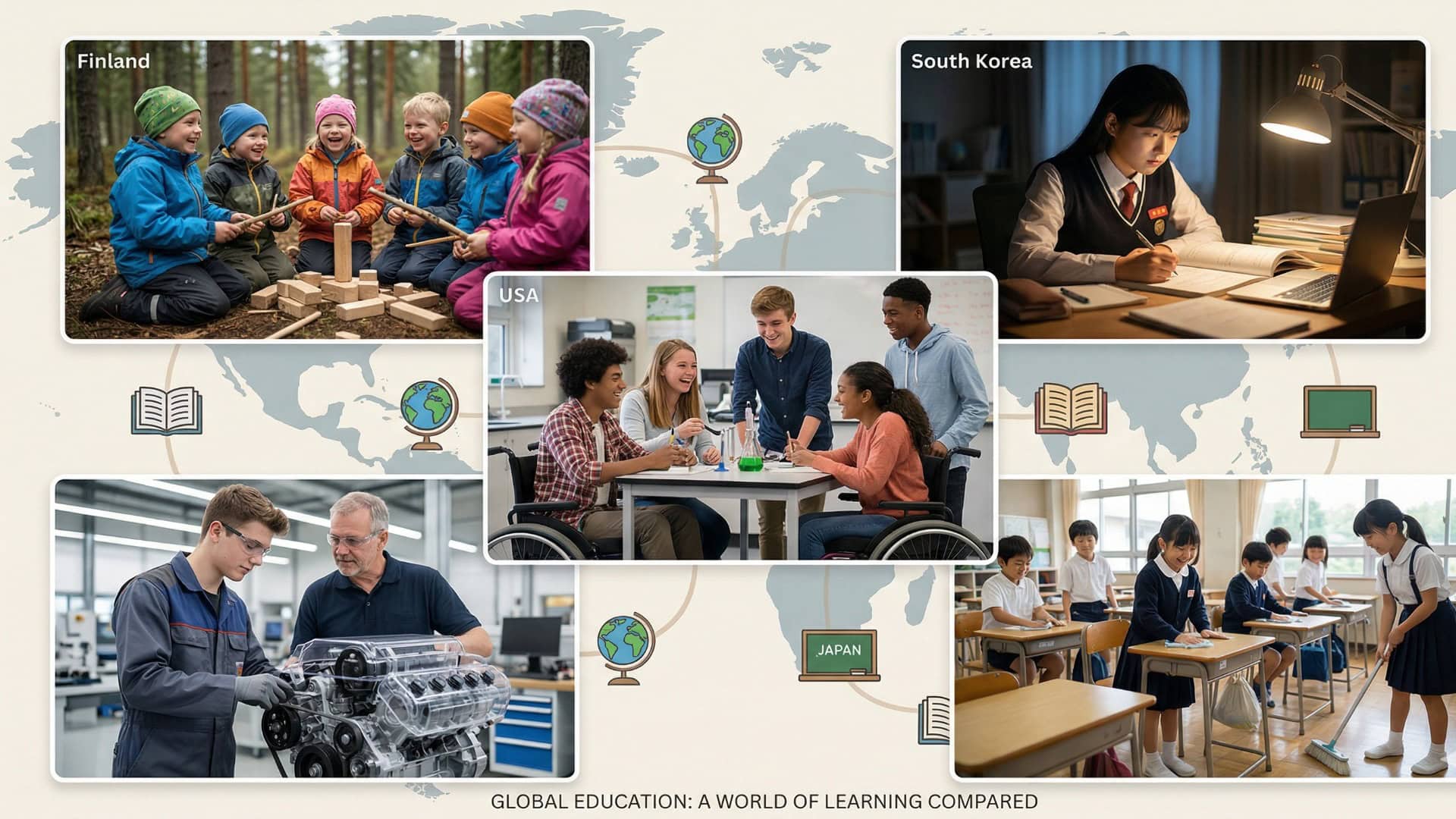
Education is the cornerstone of societal progress. It shapes the minds of future generations, drives economic innovation, and fosters cultural empathy. However, there is no universal blueprint for how learning should happen. When we look at education systems around the world compared, we see a fascinating tapestry of philosophies, methodologies, and cultural priorities.
Some nations prioritize rigorous standardized testing to drive academic excellence, while others emphasize play-based learning, emotional well-being, and vocational pathways. As our world becomes increasingly interconnected, understanding how diverse cultures approach schooling can help educators, policymakers, and parents advocate for more inclusive, effective, and holistic learning environments for students of all backgrounds.
In this comprehensive guide, we will explore the varied educational landscapes across the globe, examining the unique strengths, challenges, and core philosophies of several prominent systems.
The Core Philosophies of Global Education
Before diving into specific countries, it is helpful to understand the broad philosophical spectrums that define global education. Most systems lean toward one side of the following concepts:
- Standardization vs. Individualization: Does the system require all students to meet the exact same benchmarks at the exact same time (standardization), or does it adapt to the unique pace and interests of each learner (individualization)?
- Academic Rigor vs. Holistic Development: Is the primary goal to achieve high scores in core subjects like math, science, and literacy, or is the focus equally distributed among emotional intelligence, physical health, the arts, and social skills?
- Centralized vs. Decentralized Control: Are curriculum and funding decisions made at the national level by a single governing body, or are they left to local states, provinces, or municipalities?
Understanding these spectrums helps us critically analyze why certain countries succeed in specific areas—such as high test scores—while perhaps struggling in others, like student mental health or educational equity.
Finland: The Champion of Equity and Play-Based Learning
When education experts discuss the best systems globally, Finland is almost always at the top of the list. The Finnish approach is radically different from many Western and Asian models, focusing heavily on equity, well-being, and trust rather than competition and testing.
Early Childhood and Play
In Finland, formal academic schooling does not begin until a child is seven years old. Before that, early childhood education is heavily subsidized and focuses entirely on play, socialization, and emotional development. The belief is that children must first learn how to be children—how to interact with others and explore their environment—before they are subjected to sitting at desks and learning arithmetic.
Equity Over Excellence
The Finnish system prioritizes equity. There are no private schools allowed to charge tuition fees, meaning children from affluent families and children from low-income families attend the exact same schools, share the same classrooms, and eat the same free, universally provided school meals. This creates a deeply inclusive environment where resources are distributed evenly.
Teacher Autonomy and Respect
Teachers in Finland are highly respected. Teaching is a prestigious, highly competitive profession, requiring a master’s degree funded by the government. Because teachers are so well-trained, the government trusts them to design their own lesson plans and assessments. There is no mandated standardized testing until the very end of high school.
Read more about the Finnish educational model from the World Economic Forum.
South Korea: The High-Pressure Powerhouse
In stark contrast to Finland, South Korea represents a system driven by intense academic rigor, high stakes, and a deep cultural reverence for education as the primary vehicle for social mobility.
The Pursuit of Academic Excellence
South Korea consistently ranks at the very top of international assessments, such as the Programme for International Student Assessment (PISA), particularly in mathematics and reading. The system is highly centralized, with a rigorous national curriculum. From a young age, students are conditioned to focus heavily on academics, driven by the belief that hard work and perseverance trump innate talent.
The Role of “Hagwons” (Shadow Education)
A defining—and highly controversial—feature of the South Korean system is the reliance on hagwons, or private cram schools. After a full day of regular public school, a vast majority of students attend hagwons late into the evening for tutoring in English, math, science, and test preparation. This “shadow education” system places a significant financial burden on families and creates an exhausting schedule for young learners.
The Suneung Exam
The culmination of a South Korean student’s educational journey is the College Scholastic Ability Test (CSAT), known as the Suneung. This singular, nine-hour exam dictates university admissions and, by extension, future career prospects and social standing. The pressure surrounding this exam is so immense that on test day, flights are grounded to prevent noise pollution, and police officers escort late students to testing centers. While the system produces highly capable graduates, there are ongoing national conversations about the urgent need to address student mental health and reduce academic burnout.
Germany: The Leader in Vocational Pathways
Germany offers a highly structured education system that is globally renowned for its emphasis on vocational training and its success in keeping youth unemployment remarkably low.
The Tracking System
Unlike countries where all students follow a general curriculum through high school, Germany begins tracking students into different educational pathways relatively early—often around age 10 or 12, depending on the state.
- Gymnasium: Designed for highly academic students, preparing them for the Abitur (the exam required for university entrance).
- Realschule: Offers a broader general education for students likely to pursue mid-level white-collar careers.
- Hauptschule: Prepares students for the trades and blue-collar professions.
While this tracking system is highly efficient, it has faced criticism for potentially locking students into career paths too early, sometimes disproportionately affecting students from immigrant or lower-income backgrounds. However, recent reforms have made it easier for students to move between tracks later in their academic careers.
The Dual Vocational Education and Training (VET) System
Germany’s crowning educational achievement is the Dual VET system. Students in this pathway split their time between classroom learning at a vocational school and paid, on-the-job training at a company. This inclusive approach ensures that students who do not wish to pursue a traditional university degree are equipped with highly marketable skills, earning potential, and a direct pipeline into the workforce.
Explore global vocational trends via the OECD Education Directorate.
The United States: Decentralization and Diversity
The education system in the United States is vast, diverse, and fundamentally decentralized, making it difficult to define with a single brushstroke.
Local Control and Funding Disparities
Unlike countries with a strict national curriculum, the U.S. federal government has relatively limited control over day-to-day schooling. Decisions regarding curriculum, textbooks, and hiring are largely made at the state and local district levels.
A critical aspect of the U.S. system is how it is funded. Public schools are heavily reliant on local property taxes. This creates significant disparities: schools in wealthy, high-property-value neighborhoods benefit from state-of-the-art facilities, advanced placement courses, and highly paid teachers, while schools in economically disadvantaged areas often struggle with underfunding and resource shortages. Addressing this funding gap remains one of the most pressing civil rights issues in American education.
The Holistic Approach to the Student Experience
Despite its challenges with equity, the U.S. system excels in its holistic approach to student life. American schools place a massive emphasis on extracurricular activities, including athletics, theater, debate clubs, and student government. The philosophy is that education is not just about academics, but about fostering leadership, teamwork, and well-rounded citizens. Furthermore, the U.S. higher education system remains one of the most prestigious in the world, drawing millions of international learners annually.
Singapore: The Focused Meritocracy
Singapore, a small island city-state, has rapidly transformed itself into a global educational superpower over the last few decades.
A Culture of Meritocracy
Singapore’s system is deeply rooted in meritocracy. The government invests heavily in education, viewing its human capital as its most valuable resource. The curriculum is rigorous, particularly in STEM (Science, Technology, Engineering, and Mathematics) subjects. The “Singapore Math” method—which focuses heavily on conceptual understanding and problem-solving rather than rote memorization—has been so successful that it has been exported to schools worldwide.
Bilingual Policy
Inclusivity and global readiness are baked into the curriculum through Singapore’s bilingual policy. All students are taught in English (the primary language of instruction) but are also required to study their “Mother Tongue” (Mandarin, Malay, or Tamil). This ensures that learners remain connected to their cultural heritage while being fully prepared to participate in the global economy.
Evolving the System: “Teach Less, Learn More”
Historically, Singapore relied heavily on streaming (tracking students based on ability) and high-stakes exams. Recognizing the immense stress this placed on children, the Ministry of Education has recently shifted toward a “Teach Less, Learn More” initiative. This approach reduces the sheer volume of syllabus content to allow more time for engaged, active learning, critical thinking, and character development, showing a willingness to adapt and prioritize student well-being.
Canada: High Performance Through Inclusivity
Canada frequently flies under the radar in global education discussions, yet it consistently ranks among the top-performing nations, particularly in reading and science.
Provincial Autonomy
Similar to the United States, Canada has no federal department of education. Each of its 10 provinces and 3 territories administers its own education system. Despite this decentralization, educational outcomes across the country are remarkably consistent and high.
A Focus on Integration and Equity
Canada’s true strength lies in its commitment to equity and its inclusive approach to a highly diverse, immigrant-rich population. Canadian schools are highly successful at integrating children of immigrants; within a few years of arrival, these learners typically perform at the same academic level as their native-born peers.
The system provides robust support for students with diverse learning needs, emphasizing differentiated instruction over rigid standardized testing. Teachers are well-compensated and highly trained, and there is a strong cultural consensus on the value of public education, resulting in very low rates of private school enrollment compared to the U.S. or U.K.
Japan: Cultivating Character and Community
Education in Japan is about much more than academic acquisition; it is fundamentally about shaping the moral and social character of the individual to benefit the community.
The Three Pillars of Learning
The Japanese curriculum is built on three pillars: chiiku (intellectual education), tokuiku (moral education), and taiiku (physical education). Moral education is an official, graded subject where students learn about empathy, responsibility, justice, and how to function harmoniously within a group.
O-Soji: Responsibility Through Cleaning
One of the most unique and inclusive aspects of Japanese schooling is o-soji, or the daily cleaning period. There are very few janitors in Japanese schools. Instead, students—from kindergarten through high school—are responsible for sweeping the classrooms, cleaning the hallways, and even serving lunch to their peers. This practice instills a profound sense of respect for their environment, teaches humility, and reinforces the idea that everyone is equally responsible for the community’s well-being.
Learn more about global educational statistics and data via the World Bank Education Overview.
The Future of Global Education: Shared Challenges and Trends
While the approaches differ wildly, education systems around the world are facing similar challenges and shifting toward common trends as we navigate the 21st century.
- The Integration of Artificial Intelligence: From personalized tutoring algorithms to AI-assisted grading, technology is fundamentally changing how instruction is delivered. Systems globally are grappling with how to integrate AI ethically and equitably, ensuring that the digital divide does not widen.
- Prioritizing Mental Health: As seen in the reforms in Singapore and South Korea, there is a global awakening to the crisis of student burnout. Schools are increasingly incorporating social-emotional learning (SEL) and mental health resources into their standard offerings.
- Lifelong Learning: The traditional model of front-loading education in the first two decades of life is becoming obsolete. With the rapid pace of technological change, systems are looking at how to foster “lifelong learners” who can continuously upskill and adapt to new industries.
- Inclusive Education: There is a growing movement worldwide to move away from segregated special education models, instead bringing students with diverse physical, neurological, and cognitive needs into mainstream classrooms with the appropriate support systems in place.
Conclusion
When we view education systems around the world compared side-by-side, it becomes clear that there is no perfect model. Finland shows us the power of play and equity; South Korea demonstrates the results of rigorous dedication; Germany highlights the value of respecting all career paths; and Canada proves that diverse, inclusive environments can yield incredible academic results.
The future of global education relies on our willingness to look beyond our own borders. By sharing best practices, addressing systemic inequalities, and prioritizing the holistic well-being of all learners, we can build educational frameworks that truly prepare the next generation for a complex, beautiful, and interconnected world.
Frequently Asked Questions (FAQ)
1. Which country has the “best” education system in the world?
There is no single “best” system, as success is measured differently depending on cultural values. If the metric is standardized test scores in math and science, Asian nations like Singapore, China, and South Korea usually rank highest. If the metric is student well-being, equity, and lack of systemic stress, Nordic countries like Finland and Estonia are generally considered the global leaders.
2. What is the PISA test, and why does it matter?
PISA stands for the Programme for International Student Assessment. It is a worldwide study conducted by the OECD (Organisation for Economic Co-operation and Development) every three years. It measures 15-year-old students’ scholastic performance in mathematics, science, and reading. Policymakers use PISA rankings to compare their nation’s educational effectiveness against global peers and to identify areas for reform.
3. How does funding affect educational equity globally?
Funding mechanisms drastically impact educational inclusivity and quality. In countries where schools are funded by a central national government (like Finland or Japan), resources are distributed relatively equally regardless of a neighborhood’s wealth. In systems reliant on local property taxes (like the United States), wealthy areas naturally generate more school funding than impoverished areas, often perpetuating cycles of inequality.
4. Why is there a growing global focus on Early Childhood Education (ECE)?
Extensive global research shows that the first five years of a child’s life are critical for brain development. Quality ECE programs improve a child’s cognitive, social, and emotional skills, leading to better outcomes in primary school and beyond. Many forward-thinking systems are investing heavily in universal, subsidized ECE to level the playing field for children from lower-income backgrounds before formal schooling even begins.
5. What is the difference between “tracking” and “streaming” in education?
Both terms refer to the practice of separating students based on their perceived academic ability or future career goals. “Tracking” (common in Germany) usually refers to placing students into entirely different types of schools (e.g., vocational vs. academic) based on early assessments. “Streaming” (previously common in Singapore and the UK) often happens within the same school, where students are placed into different difficulty levels for specific subjects based on their test scores. Both practices are highly debated regarding their impact on educational equity.
Leave a Reply