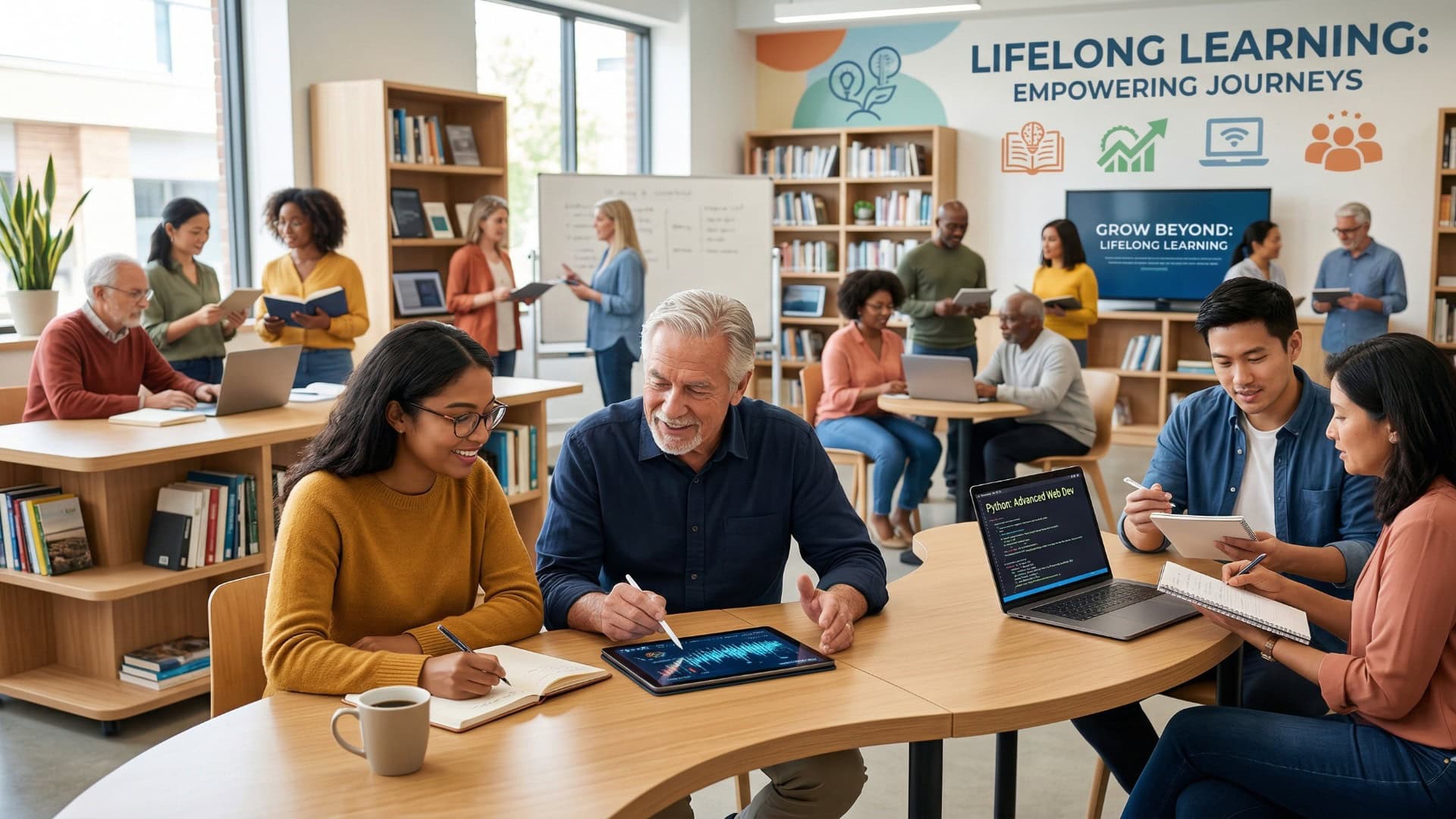
The world is evolving at an unprecedented pace. Between rapid technological advancements, shifting cultural landscapes, and dynamic global economies, the idea that education ends the moment we receive a diploma is not just outdated—it is actively holding us back. Today, thriving requires a commitment to continuous growth. This is where lifelong learning steps in.
Lifelong learning is not just a buzzword for corporate seminars; it is a fundamental approach to personal and professional development that empowers everyone, regardless of age, background, or ability. Whether you are aiming to pivot in your career, keep your mind sharp as you age, or simply discover a new passion, adopting a continuous learning mindset is your greatest asset.
In this comprehensive guide, we will explore why lifelong learning matters, how it benefits your brain, career, and personal life, and how you can seamlessly integrate it into your daily routine. We will also address common barriers and provide actionable solutions to help you become a resilient, self-directed learner.
What Exactly is Lifelong Learning?
Lifelong learning is the self-motivated, voluntary, and ongoing pursuit of knowledge for either personal or professional reasons.
Historically, education was viewed as a linear path: you went to school, learned a trade or earned a degree, and then entered the workforce to apply those specific skills until retirement. That model is no longer sufficient. Today, the “half-life” of a learned skill—the time it takes for a skill to become half as valuable—is shrinking rapidly.
Lifelong learning breaks the traditional mold by embracing the idea that education is a continuous, lifelong journey. It encompasses several different types of education:
- Formal Learning: Structured educational programs, such as university degrees, vocational training, or certificated online courses.
- Informal Learning: Unstructured, spontaneous learning that happens in daily life. This could be watching a tutorial on YouTube, reading an insightful article, or having a deep conversation with a mentor.
- Non-formal Learning: Organized learning that falls outside the formal educational system, such as community workshops, book clubs, or fitness classes.
“Intellectual growth should commence at birth and cease only at death.” — Albert Einstein
At its core, lifelong learning is about curiosity. It is the recognition that there is always something new to discover, understand, and master.
The Cognitive Benefits: Fuel for the Human Brain
One of the most compelling reasons to embrace continuous education is the profound impact it has on cognitive health. The human brain is not a static organ; it is highly adaptable, a characteristic scientists refer to as neuroplasticity.
1. Harnessing Neuroplasticity
Neuroplasticity is the brain’s ability to reorganize itself by forming new neural connections throughout life. When we learn a new language, pick up a musical instrument, or struggle through a complex puzzle, we are actively strengthening these neural pathways. This continuous “mental gymnastics” builds a cognitive reserve, which helps the brain become more resilient to stress and the natural effects of aging. You can read more about neuroplasticity and brain health from resources like the Harvard Medical School.
2. Delaying Cognitive Decline
Numerous studies have shown that engaging in mentally stimulating activities can delay the onset of cognitive decline and conditions such as Alzheimer’s disease and dementia. Learning keeps the mind sharp, improves memory retention, and enhances our ability to focus. It is, quite literally, exercise for your brain.
3. Enhancing Problem-Solving Skills
Exposing yourself to new subjects and diverse perspectives forces your brain to think outside its usual patterns. This cross-pollination of ideas enhances creativity and problem-solving abilities. A software engineer who takes a class on psychology, for instance, might suddenly understand user experience in a profoundly new way.
Career Advancement and Economic Resilience
In the modern workforce, adaptability is the ultimate currency. Automation, artificial intelligence, and globalization are reshaping industries overnight. According to the World Economic Forum’s Future of Jobs Report, millions of jobs will be displaced by technology, while millions of new roles will be created.
1. Upskilling and Reskilling
To remain relevant, professionals must engage in upskilling (improving current skills) and reskilling (learning entirely new skills). Lifelong learners are agile; they do not wait for their employers to mandate training. They proactively seek out certifications, master new software, and study industry trends. This makes them indispensable to their current employers and highly attractive to future ones.
2. Standing Out in a Competitive Market
When hiring, modern recruiters look beyond just degrees. They look for a growth mindset. Demonstrating that you are a continuous learner signals to employers that you are adaptable, motivated, and capable of handling future challenges that the company hasn’t even anticipated yet.
3. Navigating Career Pivots
The days of working for a single company for forty years are largely behind us. Many people will change careers—not just jobs, but entirely different fields—several times in their lives. Lifelong learning provides the bridge to cross from one industry to another. It allows individuals to reinvent themselves economically, ensuring they are never permanently trapped in a declining industry.
Personal Fulfillment, Well-being, and Inclusion
While the cognitive and economic benefits are immense, the personal and emotional rewards of lifelong learning are equally vital. Education should not just be about economic output; it should be about human flourishing.
1. Boosting Self-Confidence
There is a unique sense of pride that comes from mastering a difficult concept or completing a challenging project. Every time we learn something new, we prove to ourselves that we are capable of growth. This builds a deep, intrinsic self-confidence that permeates other areas of our lives.
2. Finding Purpose and Meaning
Many individuals find that their primary career does not fulfill all their passions. Lifelong learning allows people to explore hobbies and interests—such as painting, creative writing, or urban gardening—that bring joy and meaning to their lives. This is especially crucial for individuals approaching retirement, providing a renewed sense of purpose and structure.
3. Fostering Connection and Community
Learning is rarely a solitary endeavor. Joining a coding bootcamp, attending a pottery class, or participating in an online forum connects us with like-minded individuals. This fosters a sense of belonging and helps combat the modern epidemic of loneliness.
4. Expanding Worldviews and Empathy
Continuous education exposes us to different cultures, histories, and perspectives. By learning about the experiences of people who are different from us, we cultivate empathy and become more inclusive, socially aware global citizens. Lifelong learning challenges our biases and helps us understand the complex, intersectional world we live in.
How to Cultivate a Lifelong Learning Mindset
Knowing the importance of lifelong learning is one thing; making it a habit is another. Here are practical, actionable strategies to weave continuous education into the fabric of your daily life.
1. Identify Your “Why”
Before diving into courses and books, figure out your motivation. Are you looking to get a promotion? Do you want to communicate better with family members from another culture? Are you simply curious about astronomy? Having a clear “why” will keep you motivated when the learning process gets difficult.
2. Embrace Microlearning
You do not need to dedicate three hours a day to see results. Microlearning involves consuming information in small, manageable chunks.
- Listen to an educational podcast during your daily commute.
- Read one chapter of a non-fiction book before bed.
- Watch a 10-minute TED Talk while drinking your morning coffee.
3. Utilize Accessible, High-Quality Resources
We live in the golden age of accessible information. Financial barriers to education are lower than ever before. Take advantage of platforms offering free or low-cost learning:
- Massive Open Online Courses (MOOCs): Platforms like Coursera and edX partner with top universities to offer courses on everything from data science to philosophy.
- Public Libraries: Libraries are incredible hubs for free resources, including audiobooks, online language software (like Mango or Rosetta Stone), and community workshops.
- YouTube and Podcasts: Countless experts share their knowledge for free on digital platforms.
4. Adopt a Growth Mindset
Psychologist Carol Dweck popularized the concept of the “growth mindset”—the belief that abilities and intelligence can be developed through dedication and hard work. Embrace mistakes as part of the learning process. If you struggle to learn a new coding language, do not say, “I’m just not good at tech.” Instead, say, “I haven’t mastered this yet.”
5. Teach What You Learn
One of the most effective ways to solidify your own understanding of a topic is to teach it to someone else. This is known as the Feynman Technique. Write a blog post about what you just learned, explain it to a friend over lunch, or mentor a junior colleague.
Overcoming Common Barriers to Learning
Even with the best intentions, we all face obstacles. Recognizing these barriers is the first step to overcoming them in a way that respects different life circumstances and neurodivergent needs.
Barrier 1: “I Don’t Have Enough Time”
The Solution: Audit your time. Many people spend hours scrolling through social media or binge-watching television. Try replacing just 30 minutes of passive consumption with active learning. Schedule learning time on your calendar just as you would a doctor’s appointment. Remember, consistency is more important than volume.
Barrier 2: “Education is Too Expensive”
The Solution: While formal degrees can be prohibitively expensive, learning is largely free. As mentioned above, lean into open-source materials, free community classes, library resources, and digital platforms. Many prestigious universities offer their entire course catalogs online for free via OpenCourseWare.
Barrier 3: “I’m Too Old to Learn Something New”
The Solution: This is a persistent and harmful myth. While learning speed might change as we age, the capacity to learn never vanishes. In fact, older adults often have better crystallized intelligence (the ability to use learned knowledge and experience) which can make connecting complex ideas easier.
Barrier 4: Imposter Syndrome and Fear of Failure
The Solution: Many people stop learning because they are afraid of looking foolish as a beginner. Give yourself permission to be a novice. Everyone starts at zero. Focus on the process of learning rather than comparing your chapter one to someone else’s chapter twenty.
Conclusion
The importance of lifelong learning cannot be overstated. It is the engine of personal growth, the armor against economic uncertainty, and the key to a vibrant, engaged, and empathetic life. By shifting our perspective from “learning as a chore” to “learning as a lifelong privilege,” we open doors to opportunities we never knew existed.
You do not need to go back to university to be a lifelong learner. You simply need to nurture your curiosity, ask questions, and take small, consistent steps toward expanding your horizons. The world is full of fascinating things waiting to be understood. What will you learn today?
Frequently Asked Questions (FAQ)
What is an example of lifelong learning?
An example of lifelong learning could be anything from a graphic designer taking an online course in AI prompt engineering, a retiree learning conversational Spanish to prepare for a trip, or a parent reading books about child psychology to better support their neurodivergent child. It spans formal certifications to casual, self-directed hobbies.
How does lifelong learning improve mental health?
Engaging in continuous learning can significantly boost mental health by providing a sense of purpose and achievement, which increases dopamine levels. It helps build confidence, reduces feelings of stagnation, and, when done in a group setting, alleviates social isolation and loneliness.
Is lifelong learning necessary for everyone?
While the type of learning will vary wildly from person to person, the act of learning is essential for everyone who wishes to adapt to a changing world. Even if you are completely satisfied with your career, learning new things protects your cognitive health, enhances your personal relationships, and keeps you engaged with the world around you.
What is the difference between lifelong learning and continuous training?
Continuous training is usually structured, mandated, and career-specific, often provided by an employer to ensure employees are up to date on specific tools or compliance protocols. Lifelong learning is a broader, self-directed philosophy. It encompasses continuous training but also includes learning for personal fulfillment, hobbies, and general knowledge outside of one’s professional life.
How can employers support lifelong learning in the workplace?
Employers can build a culture of learning by offering educational stipends, providing access to online learning platforms (like LinkedIn Learning or Udemy), allowing employees time during the workweek to dedicate to study, and rewarding individuals who proactively upskill. Cultivating psychological safety—where employees feel safe asking questions and admitting they don’t know something—is also a crucial foundation.
I have ADHD and find self-directed learning incredibly difficult. What can I do?
Traditional learning methods don’t work for everyone, and that is completely okay. If you have ADHD or other neurodivergent traits, try leaning into “hyperfocus” on topics that genuinely excite you. Use gamified learning apps that offer immediate dopamine rewards, keep sessions very short (10-15 minutes), and try kinesthetic or hands-on learning rather than just reading text. Body doubling—learning alongside someone else, even silently over a video call—can also help maintain focus and accountability.
Leave a Reply