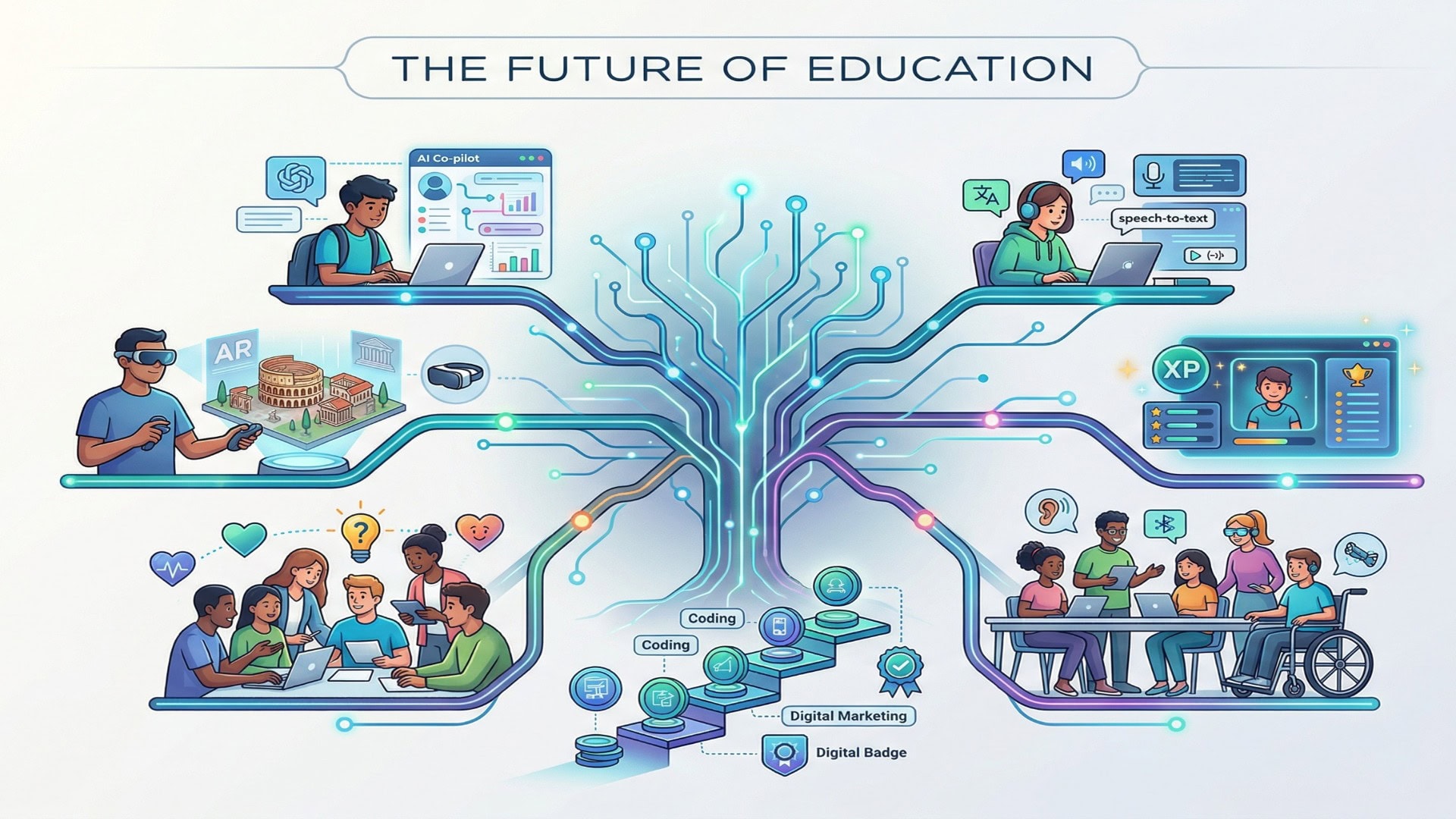
The landscape of education is undergoing a seismic shift. For centuries, the traditional classroom model—rows of desks, a single educator delivering standardized lectures, and a curriculum built around rote memorization—remained largely unchallenged. However, the rapid acceleration of technology, shifting economic landscapes, and a growing understanding of cognitive diversity have catalyzed a global rethinking of how we learn, teach, and grow.
As we look toward the future, the focus is shifting from a rigid, “one-size-fits-all” approach to a dynamic, continuous, and highly individualized learning journey. Education is no longer a destination you reach in your early twenties; it is a lifelong expedition. Whether you are an educator, a student, a policymaker, or a professional looking to upskill, understanding these emerging paradigms is critical for navigating the decades ahead.
In this comprehensive guide, we will explore the core trends shaping the future of education, examining how technology, inclusive practices, and a renewed focus on human-centric skills are coming together to create an educational ecosystem that empowers every learner.
1. Artificial Intelligence (AI) as the Ultimate Co-Pilot
Artificial Intelligence is arguably the most transformative technology entering the educational sphere today. However, the narrative that “AI will replace teachers” is fundamentally flawed. Instead, AI is emerging as an invaluable co-pilot, designed to augment human instruction and alleviate administrative burdens so educators can focus on what they do best: connecting with students.
Automated Administration and Grading
Educators historically spend countless hours grading standardized assignments, managing schedules, and responding to routine questions. AI-driven platforms can now automate the grading of multiple-choice and short-answer assessments with near-perfect accuracy. Advanced natural language processing tools are even beginning to assist in evaluating essays, providing instant, baseline feedback on grammar, structure, and coherence. This saves thousands of hours, allowing instructors to reinvest their energy into lesson planning, one-on-one mentoring, and emotional support for their learners.
Intelligent Tutoring Systems
For students, AI acts as an ever-patient, 24/7 tutor. Intelligent tutoring platforms can engage students in Socratic dialogue, walking them through complex mathematical problems or coding challenges step-by-step. If a learner struggles with a specific concept, the AI can detect the knowledge gap and present the information in a new format—perhaps swapping a text-heavy explanation for a visual analogy—until comprehension is achieved.
Early Intervention and Predictive Analytics
By analyzing data points such as attendance, assignment completion rates, and quiz scores, predictive AI models can flag when a student is at risk of falling behind or dropping out long before it becomes obvious to the human eye. This allows counselors and teachers to intervene proactively, offering targeted support exactly when the learner needs it most.
Actionable Takeaway for Educators: Begin integrating low-barrier AI tools into your daily workflow to handle routine tasks, and encourage students to use AI responsibly as a brainstorming or peer-review partner, focusing heavily on teaching them digital literacy and prompt-engineering skills.
2. Hyper-Personalized Learning Pathways
The industrialized model of education assumed that all students of the same age learned at the exact same pace. Modern pedagogy recognizes that this is simply not true. Driven by big data and adaptive algorithms, hyper-personalized learning is dismantling the traditional academic calendar in favor of competency-based progression.
Adaptive Learning Technologies
Imagine a digital textbook that rewrites itself based on how well you understand the previous chapter. Adaptive learning platforms assess a learner’s proficiency in real-time. If a student breezes through basic algebra, the system immediately introduces more complex calculus concepts, preventing boredom. Conversely, if a student struggles with reading comprehension, the system slows down, providing foundational vocabulary exercises before advancing.
Fostering Student Agency
Personalized learning is not just about the pace of learning; it is also about the path. Future educational models will increasingly allow students to curate their own curricula. A learner interested in environmental science might learn mathematics through ecological modeling, while another might learn the exact same math concepts through the lens of computer game design. This relevance-driven approach drastically increases intrinsic motivation.
Moving Beyond the Report Card
In a personalized system, traditional letter grades are losing their meaning. Instead, we are seeing a shift toward comprehensive digital portfolios and mastery-based assessments. Rather than getting a “C” in history, a student’s profile might show they have mastered “Historical Source Analysis” but are still developing “Chronological Reasoning.”
Actionable Takeaway for Educators: Shift away from whole-class pacing where possible. Utilize adaptive software like Khan Academy or specialized LMS (Learning Management Systems) to allow students to master core competencies at their own speed, using class time for collaborative projects.
3. Immersive Experiences: Virtual and Augmented Reality (VR/AR)
The concepts of VR and AR have been buzzwords for years, but decreasing hardware costs and vastly improved software have finally made them viable tools for the everyday classroom. Immersive technologies transition students from passive observers to active participants in their education.
Breaking Physical Boundaries
A school’s geographical location no longer dictates a student’s access to the world. Through Virtual Reality, a history class can “walk” the streets of ancient Rome, a biology class can shrink down to explore the human circulatory system from the inside, and an astronomy class can stand on the surface of Mars. These visceral, memorable experiences cement knowledge far more effectively than reading text from a page.
Risk-Free Vocational and Medical Training
In higher education and vocational training, VR is revolutionary. Medical students can perform highly complex virtual surgeries repeatedly without risking a patient’s life. Aspiring welders, electricians, and mechanics can practice in simulated environments that mimic the physics of the real world, building muscle memory and technical proficiency safely and cost-effectively.
Augmented Reality in Everyday Environments
While VR requires headsets, AR utilizes the screens we already have—smartphones and tablets—to overlay digital information onto the physical world. A student can point their tablet at a complex machine in an engineering lab, and AR software can project labels, safety warnings, and step-by-step operational instructions directly onto the physical object.
Actionable Takeaway for Educators: Start small. You do not need expensive headsets to utilize AR. Explore free AR applications available on standard tablets that allow students to visualize 3D geometry or explore interactive maps.
Learn more about how technology is shaping global learning at the World Economic Forum.
4. Microlearning and Stackable Credentials
The traditional four-year degree is no longer the sole gatekeeper to professional success. The modern workforce is evolving so rapidly that skills learned in the first year of a university program may be obsolete by graduation. Enter microlearning and the modularization of education.
The Science of Microlearning
Microlearning involves delivering content in small, highly focused, and easily digestible bursts—typically ranging from two to ten minutes. This approach aligns perfectly with cognitive science regarding human attention spans and memory retention. By focusing on a single, specific objective per module, learners experience reduced cognitive overload and can more easily integrate learning into their busy lives.
Nano-Degrees and Digital Badges
Major tech companies and industries are increasingly shifting to skills-based hiring over pedigree-based hiring. To support this, educational institutions and corporate training programs are offering nano-degrees, professional certificates, and digital badges. These are verifiable micro-credentials that prove a candidate has mastered a specific, highly relevant skill—such as cloud computing architecture, digital marketing analytics, or crisis communication.
The Concept of “Stackability”
The future of higher education will look less like a fixed menu and more like a buffet. Learners will “stack” various micro-credentials over time. A professional might combine a certificate in graphic design, a digital badge in Python programming, and a nano-degree in project management to create a highly customized, unique skill profile that no traditional college major could perfectly encompass.
Actionable Takeaway for Educators: Break down long lectures into bite-sized, thematic videos or interactive modules. When designing professional development or higher-ed courses, clearly define the specific skills gained and consider how they can be certified digitally.
5. A Renewed Emphasis on Human-Centric “Soft” Skills
As artificial intelligence and automation take over routine cognitive tasks and manual labor, the value of strictly technical skills is shifting. The skills that will be most prized in the future economy are those that are inherently human—skills that machines currently cannot replicate.
Emotional Intelligence (EQ) and Empathy
The ability to read a room, understand diverse perspectives, and manage human relationships is becoming the most critical currency in the modern workplace. Education systems are increasingly integrating social-emotional learning (SEL) directly into the curriculum. Students are taught how to manage their emotions, practice active listening, and navigate conflicts productively.
Complex Problem Solving and Critical Thinking
While AI can generate information rapidly, it requires human critical thinking to determine if that information is accurate, ethical, and applicable to a nuanced real-world problem. Future curricula will focus heavily on inquiry-based learning, where students are given messy, unstructured problems and asked to devise multifaceted solutions, teaching them how to think, rather than what to think.
Adaptability and Resilience
The only constant in the future of work is change. Education must instill resilience—the capacity to bounce back from failure—and adaptability—the willingness to unlearn outdated concepts and learn new ones. Schools are moving away from penalizing failure and instead framing it as a necessary step in the iterative design process.
Actionable Takeaway for Educators: Transition from standardized testing to project-based learning (PBL). Grade students not just on the final product, but on their collaboration, communication, and creative problem-solving processes along the way.
6. Radical Accessibility and Inclusive Education
A truly modern education system must be universally accessible. The future of education relies heavily on dismantling systemic barriers—whether they are physical, geographical, cognitive, or socioeconomic—to ensure every learner has an equitable opportunity to succeed.
Universal Design for Learning (UDL)
UDL is a framework focused on providing multiple means of engagement, representation, and action for all students. This means moving away from a text-only curriculum. A lesson built on UDL principles will offer the information via written text, audio recording, video with closed captions, and interactive diagrams. It allows neurodivergent learners, such as those with ADHD or dyslexia, to engage with the material in the format that best suits their cognitive profile.
Assistive Technologies
The integration of assistive technologies is becoming seamless. Screen readers, voice-to-text software, and braille displays are empowering visually impaired and physically disabled students to navigate digital learning environments independently. Furthermore, real-time AI translation and captioning are breaking down language barriers, allowing international students and non-native speakers to participate fully in global classrooms.
Bridging the Digital Divide
The future of education cannot be realized if millions of learners lack basic internet access. Global initiatives aimed at expanding broadband infrastructure, satellite internet (such as Starlink), and the distribution of affordable mobile devices are critical trends. Governments and NGOs are recognizing that internet access is no longer a luxury, but a fundamental educational right.
Actionable Takeaway for Educators: Audit your teaching materials. Ensure all videos have closed captions, documents are readable by screen readers, and that your curriculum reflects diverse cultures and perspectives. Adopt inclusive language that makes all students feel seen and valued.
For more insights on global educational equity, visit UNESCO’s Education Initiatives.
7. Gamification and Interactive Learning Ecosystems
Gamification is not about simply playing video games in the classroom; it is about extracting the core psychological elements that make games so engaging and applying them to educational content. This trend is revolutionizing student motivation and engagement levels.
Leveraging Intrinsic and Extrinsic Motivation
Games masterfully utilize dopamine loops—the neurochemical reward we feel when we achieve a goal. Educational platforms are adopting features like experience points (XP), leaderboards, levels, and unlockable achievements. When a student correctly answers a math problem, they earn points to upgrade their digital avatar. This provides immediate, tangible rewards that keep learners engaged through challenging material.
“Serious Games” and Simulations
Beyond points and badges, we are seeing the rise of “serious games”—complex simulations designed specifically for education. Students might play a game where they must manage the economy, natural resources, and diplomatic relations of a virtual country. This requires them to apply principles of economics, political science, and environmental sustainability in a highly engaging, low-stakes environment.
Failing Forward
One of the most important aspects of gamification is its relationship with failure. In a video game, if your character fails a level, you simply try again, using the knowledge gained from your failure to succeed the next time. Gamified education encourages this “fail forward” mentality, drastically reducing the anxiety typically associated with academic testing.
Actionable Takeaway for Educators: Introduce gamified elements gradually. Use platforms like Kahoot! or Quizizz for formative assessments, or create a simple “experience point” system for homework completion and classroom participation.
Conclusion: Embracing the Future of Lifelong Learning
The future of education is a vibrant, deeply interconnected ecosystem. It is shifting away from isolated classrooms and rigid curricula toward an environment that is fluid, technology-enhanced, and radically inclusive. Artificial intelligence will personalize our pathways, VR will expand our physical boundaries, and microlearning will keep our skills sharp in a rapidly evolving economy.
However, at the very heart of this technological revolution remains the human element. The most successful educational environments of the future will be those that balance cutting-edge tools with a profound commitment to developing empathy, critical thinking, and emotional resilience. By embracing these trends, we can build a future where education is not just a phase of life, but a continuous, empowering journey accessible to all.
Frequently Asked Questions (FAQ)
Q1: Will AI eventually replace human teachers?
Absolutely not. While AI is excellent at delivering information, grading, and identifying data patterns, it completely lacks the human empathy, emotional intelligence, and inspirational capacity that great educators possess. AI will handle the administrative and foundational tasks, allowing teachers to act as advanced mentors and facilitators.
Q2: What is the difference between personalized learning and traditional learning?
Traditional learning generally forces all students to learn the same material at the exact same pace, regardless of their individual understanding. Personalized learning uses technology and flexible pedagogy to adjust the pace, content, and delivery method to match the unique needs, strengths, and interests of each specific learner.
Q3: Are micro-credentials and digital badges actually recognized by employers?
Yes, increasingly so. Major global corporations like Google, IBM, and Apple have already dropped four-year degree requirements for many technical roles. Employers are shifting toward skills-based hiring, meaning they often value a verified micro-credential demonstrating proficiency in a specific, up-to-date skill over a generalized traditional degree.
Q4: Is Virtual Reality (VR) safe for younger children in schools?
While VR is generally safe, most hardware manufacturers recommend headset use only for children aged 13 and older due to developing vision and the potential for motion sickness. For younger students, educators heavily rely on Augmented Reality (AR) on tablets or interactive smartboards, which provide immersive benefits without the physical concerns of headsets.
Q5: How can educators ensure technology doesn’t widen the inequality gap?
This is a critical concern. Educators and school districts must prioritize the implementation of accessible technologies (like screen readers and offline-capable software) and advocate for infrastructural investments that bridge the digital divide. Furthermore, technology should always be paired with inclusive pedagogical frameworks like Universal Design for Learning (UDL).
Q6: What are “soft skills” and why are they suddenly so important?
Soft skills, also known as human-centric or interpersonal skills, include empathy, complex problem-solving, adaptability, and communication. They are becoming paramount because hard, technical skills are increasingly being automated by algorithms and robotics. The uniquely human ability to collaborate and innovate will be the primary differentiator in the future workforce.
Leave a Reply