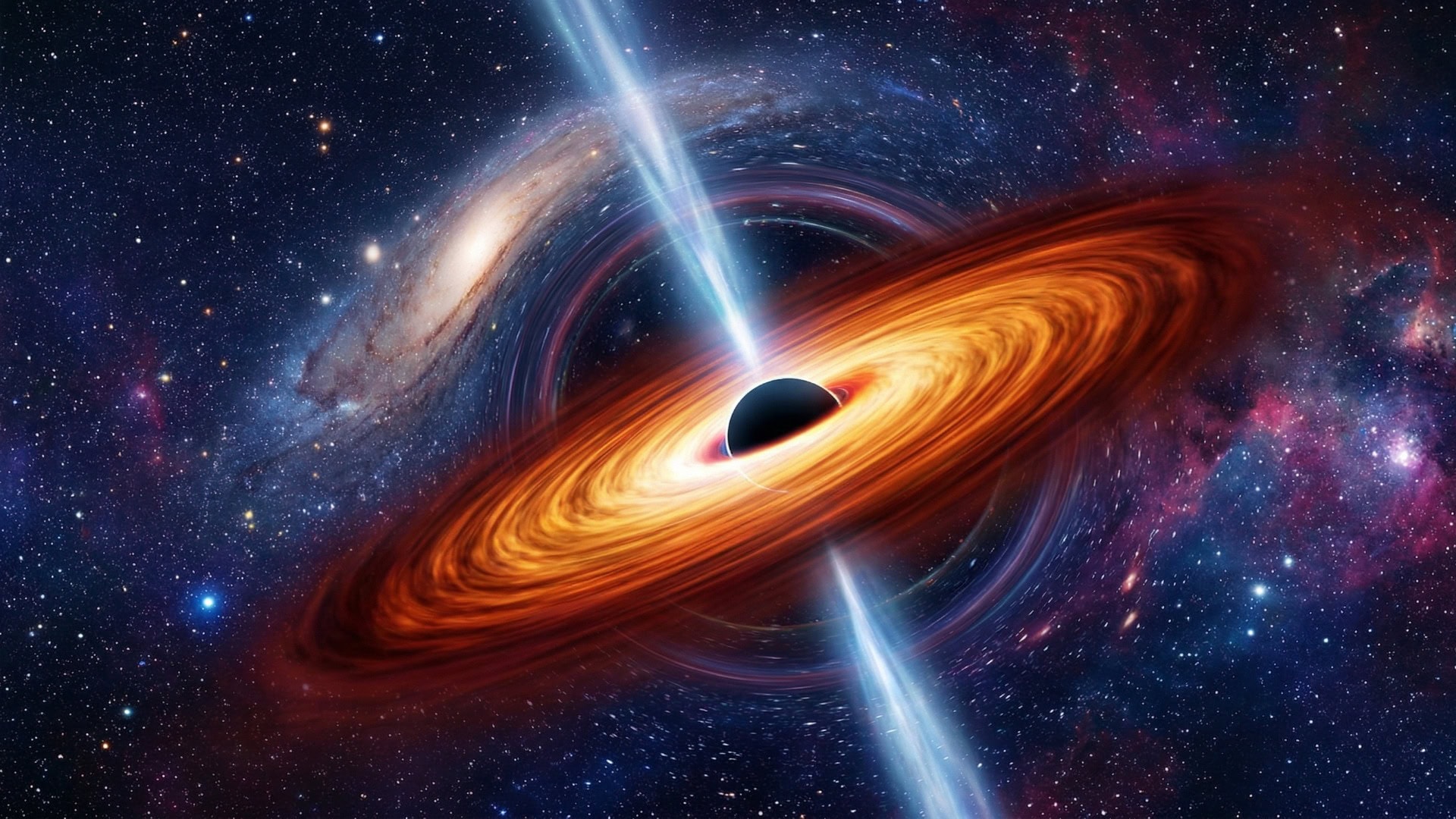
When we look up at the night sky, we are witnessing a tapestry of light—stars, galaxies, and nebulae shining across vast distances. Yet, some of the most fascinating objects in our universe are defined not by the light they emit, but by the light they trap. For decades, black holes have captured the collective imagination of humanity. They are the ultimate cosmic enigma, featured in science fiction blockbusters and complex theoretical physics alike.
But stripped of the Hollywood dramatization, what are black holes, and how do they actually work?
Whether you are a lifelong astronomy enthusiast or someone simply curious about the universe we all share, this comprehensive guide is designed for you. We will break down the complex physics into readable, accessible concepts, explore how these cosmic titans are born, and answer some of the most frequently asked questions about the dark heart of space.
1. What Exactly is a Black Hole?
To understand a black hole, we first have to rethink our everyday understanding of empty space. A black hole is not an empty “hole” or a cosmic tear in the fabric of the universe. In fact, it is the exact opposite. A black hole is a region of space where an incredible amount of mass has been packed into a microscopically small area.
Because gravity is directly related to mass and distance, packing so much matter into such a tiny space creates a gravitational pull so intense that nothing—not even light, the fastest moving thing in the universe—can escape it.
To visualize this, we need to understand the anatomy of a black hole, which is primarily made up of two key features:
- The Singularity: At the very center of a black hole lies the singularity. This is a point of infinite density where all the mass of the black hole is concentrated. Current laws of physics break down at the singularity. It is a place where matter is crushed to a point of zero volume, and our traditional understanding of space and time ceases to exist.
- The Event Horizon: This is the “point of no return.” The event horizon is the invisible boundary surrounding the singularity. If you are outside the event horizon, you could theoretically escape the black hole’s pull if you were moving fast enough. However, the moment anything crosses the event horizon, the escape velocity required to leave exceeds the speed of light. Since nothing can travel faster than light, anything that crosses this boundary is forever trapped.
2. How Are Black Holes Formed?
Black holes are not just randomly placed throughout the universe; they are the result of stellar evolution—specifically, the dramatic death of very massive stars. Here is how the process works:
The Delicate Balance of a Star
For millions or billions of years, a star is engaged in an epic, continuous tug-of-war. Gravity is constantly pulling all the star’s matter inward toward its core. To counteract this crushing force, the star relies on nuclear fusion. Deep within its core, the star crushes hydrogen atoms together to form helium. This process releases a massive amount of outward-pushing energy. As long as the outward push of nuclear fusion balances the inward pull of gravity, the star remains stable.
Running Out of Fuel
Eventually, a star runs out of hydrogen fuel. To keep fighting gravity, it begins fusing heavier and heavier elements: helium into carbon, carbon into oxygen, oxygen into silicon, and eventually, silicon into iron. However, fusing iron does not release energy; it requires energy. Suddenly, the outward pressure stops.
The Core Collapse and Supernova
With no outward pressure to fight it, gravity wins the tug-of-war in a fraction of a second. The core of the star collapses in on itself at a significant fraction of the speed of light. This sudden, violent collapse creates a shockwave that blows the outer layers of the star into space in a brilliant explosion known as a supernova.
The Birth of a Black Hole
If the original star was massive enough (generally more than 20 times the mass of our Sun), the collapsing core cannot be stopped by any known physical force. It continues to crush inward until it becomes a point of infinite density—a singularity. A stellar-mass black hole is born.
3. The Different Types of Black Holes
Just as stars come in different sizes, so do black holes. Astronomers categorize them primarily by their mass.
Stellar-Mass Black Holes
These are the most common type of black hole, formed from the collapse of massive stars as described above. They typically contain anywhere from 5 to 100 times the mass of our Sun, yet all that mass is compressed into a sphere perhaps only a few dozen miles across. Our Milky Way galaxy alone is estimated to contain tens of millions of stellar-mass black holes.
Supermassive Black Holes (SMBHs)
These are the true titans of the cosmos. Supermassive black holes contain between millions and billions of times the mass of our Sun. Unlike stellar-mass black holes, their origins are still a bit of a mystery. Scientists believe they may have formed from giant clouds of gas collapsing in the early universe, or through the merging of thousands of smaller black holes over billions of years. What we do know is that a supermassive black hole resides at the center of virtually every large galaxy in the universe, including our own Milky Way (an SMBH named Sagittarius A*).
Intermediate Black Holes
For a long time, scientists only found evidence of the small stellar-mass black holes and the giant supermassive ones. Intermediate black holes are the “missing link”—ranging from hundreds to tens of thousands of solar masses. Recent observations using advanced telescopes have finally started providing evidence that these medium-sized black holes do exist, likely forming when multiple stellar-mass black holes merge in crowded star clusters.
Primordial Black Holes
These are entirely theoretical. Scientists hypothesize that primordial black holes could have formed in the first fraction of a second after the Big Bang. During this time, the universe was incredibly dense and chaotic. Small pockets of ultra-dense matter could have collapsed under their own gravity to form tiny black holes, some no larger than a single atom, yet possessing the mass of a large mountain.
4. How Do Black Holes “Work”? The Physics Made Simple
To understand how black holes operate, we have to look through the lens of Albert Einstein’s Theory of General Relativity.
Before Einstein, gravity was thought of simply as a magnetic-like pull between two objects. Einstein proposed something radically different: gravity is actually the curving of space and time.
Imagine space as a stretched, flexible trampoline. If you place a heavy bowling ball in the middle, the trampoline sags, creating a deep curve. If you roll a marble across the trampoline, it won’t travel in a straight line; it will spiral down toward the bowling ball. The bowling ball is not “pulling” the marble; it has warped the surface the marble is traveling on.
A black hole is like placing a bowling ball of near-infinite weight on that trampoline. It creates a well in spacetime so steep and deep that nothing can climb out of it.
Time Dilation
One of the most mind-bending ways black holes “work” is their effect on time. Because gravity bends spacetime, it also bends time itself. The stronger the gravitational pull, the slower time moves relative to an outside observer.
If you were to watch a robotic probe fall toward a black hole from a safe distance, you would see the probe appear to slow down as it approached the event horizon. To the probe itself, time would feel normal. But to you, watching from afar, the probe’s clock would tick slower and slower. This phenomenon, known as gravitational time dilation, means that if a person could safely hang out near a black hole for a few hours and return to Earth, decades or even centuries might have passed for the rest of humanity.
5. How Do We Find Black Holes If They Are Invisible?
By definition, black holes do not emit light, making them the ultimate cosmic hide-and-seek champions. So, how do astronomers know they are there? We find them by observing the chaotic environment they create around themselves.
- Observing Orbits: If astronomers see a star orbiting what appears to be empty space at incredibly high speeds, they can calculate the mass of the invisible object the star is orbiting. If the mass is high enough, a black hole is the only logical explanation.
- Accretion Disks: When a black hole feeds on nearby gas, dust, or a companion star, that material doesn’t fall straight in. It spirals around the black hole, forming a flat, spinning ring called an accretion disk. The intense gravity and friction heat this material to millions of degrees, causing it to emit brilliant X-rays and other forms of radiation that our telescopes can detect.
- Gravitational Waves: When two black holes collide and merge, they create such a violent disruption in spacetime that they send out invisible ripples, much like tossing a stone into a pond. Observatories like LIGO (Laser Interferometer Gravitational-Wave Observatory) can detect these microscopic ripples washing over Earth.
- Direct Imaging: In 2019, humanity achieved the impossible. The Event Horizon Telescope (EHT)—a global network of synchronized radio observatories—captured the first-ever image of a black hole’s silhouette in the galaxy M87. In 2022, they captured an image of Sagittarius A*, the supermassive black hole at the center of our own galaxy.
For a deeper dive into the ongoing missions mapping the cosmos, you can visit NASA’s official guide to Black Holes, which outlines the latest astronomical discoveries.
6. Myths vs. Reality: Debunking Black Hole Fiction
Because black holes are so extreme, they are often misunderstood. Let’s clear up some common misconceptions.
Myth: Black holes are cosmic vacuum cleaners that will eventually suck up the entire universe.
Reality: Black holes do not actively “suck” things in. They simply have a gravitational field, just like a star or a planet. If you replaced our Sun with a black hole of the exact same mass, Earth would not get sucked in. It would continue to orbit the black hole exactly as it orbits the Sun now (though Earth would quickly freeze without the Sun’s light). Things only fall into a black hole if they wander too close to the event horizon.
Myth: Our Sun will eventually become a black hole.
Reality: Our Sun is simply not massive enough to become a black hole. When it runs out of fuel in about 5 billion years, it will expand into a red giant, shed its outer layers, and leave behind a dense, glowing core known as a white dwarf. It lacks the tremendous weight required to collapse into a singularity.
Myth: Black holes are portals to other universes or times.
Reality: While wormholes are mathematically possible in the equations of general relativity, there is absolutely zero observational evidence that they exist, or that black holes act as portals. According to our current understanding of physics, anything that falls into a black hole is crushed into the singularity.
Frequently Asked Questions (FAQ)
Q: What would happen if a human fell into a black hole?
A: The scientific term for this is, incredibly, “spaghettification.” If you fell feet-first toward a stellar-mass black hole, the gravitational pull on your feet would be significantly stronger than the pull on your head. This difference in gravity would stretch your body out into a long, thin noodle of atoms long before you ever crossed the event horizon. Interestingly, if you fell into a supermassive black hole, the tidal forces are much gentler at the event horizon, meaning you might survive the crossing—only to be crushed as you approached the singularity inside.
Q: Do black holes live forever?
A: Surprisingly, no. The famed physicist Stephen Hawking theorized that black holes actually leak a tiny amount of thermal radiation, now known as “Hawking Radiation.” Over incredibly long, unimaginable stretches of time (trillions of years), black holes will slowly evaporate and eventually vanish completely.
Q: What is the closest black hole to Earth?
A: As of recent discoveries, the closest known black hole is Gaia BH1. It is located about 1,560 light-years away in the constellation Ophiuchus. While that sounds close in astronomical terms, it is safely far away from our solar system and poses absolutely no threat to Earth.
Q: Can a black hole be destroyed?
A: We currently have no technology or theoretical physics model that suggests a black hole can be destroyed by an outside force. The only way a black hole “dies” is through the incredibly slow process of Hawking radiation evaporation mentioned above.
Q: Are black holes made of dark matter?
A: No. Black holes are made of normal matter (like stars and gas) that has been crushed to an extreme density. Dark matter is a completely different, invisible substance that makes up about 27% of the universe. While black holes do have a gravitational pull, there are not nearly enough of them to account for the missing mass in the universe that dark matter explains.
The Future of Black Hole Exploration
Humanity’s quest to understand black holes is far from over. These incredibly dense objects represent the absolute limits of our understanding of physics. By studying them, scientists are trying to bridge the gap between the physics of the very large (General Relativity) and the physics of the very small (Quantum Mechanics).
With next-generation tools like the James Webb Space Telescope peering deep into the early universe, and advanced gravitational wave observatories listening for cosmic collisions, we are entering a golden age of astronomy. Every new discovery about black holes brings us one step closer to understanding the fundamental nature of reality, space, time, and our place within this vast, beautiful universe.
Leave a Reply