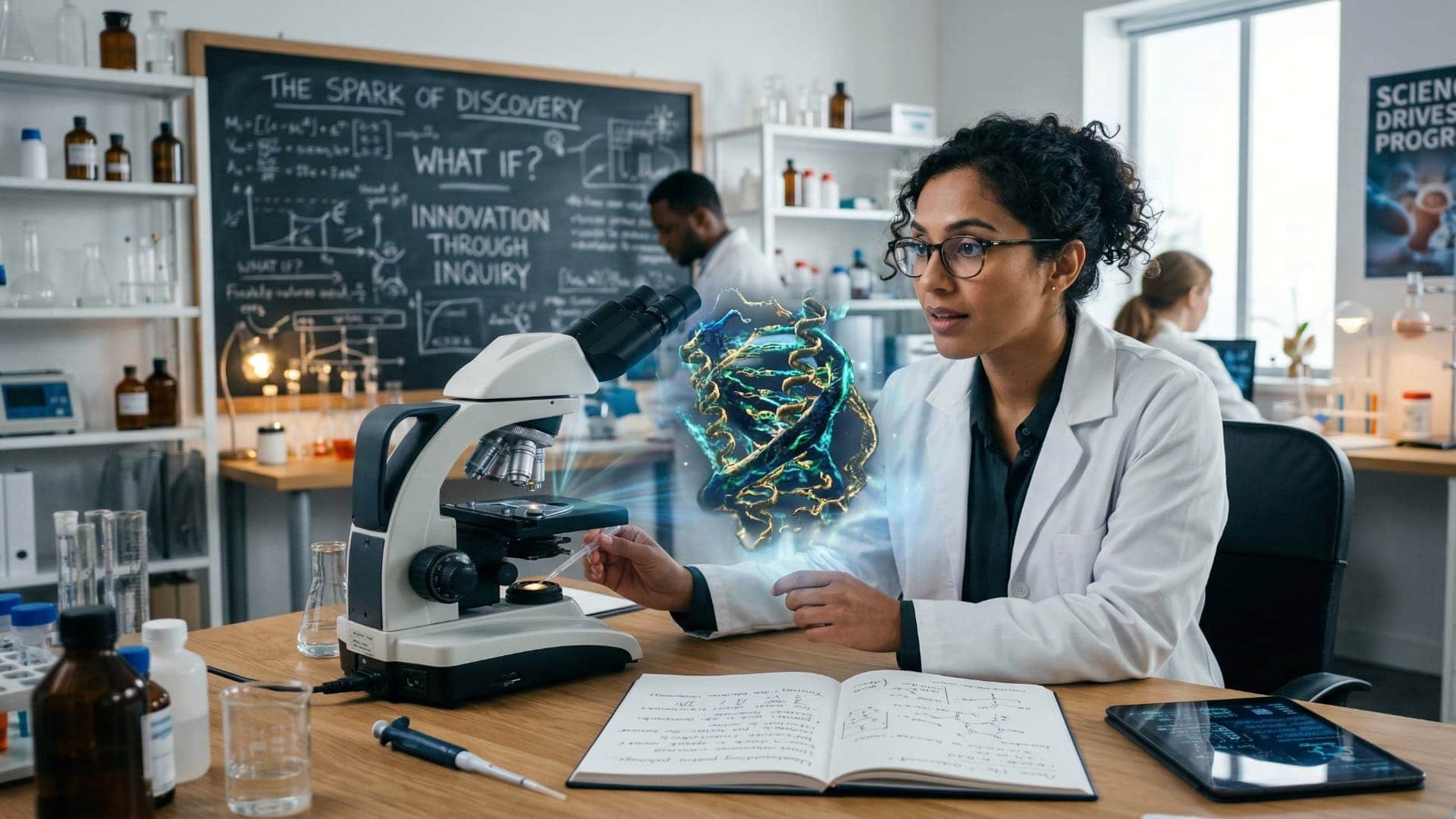
Have you ever looked up at the night sky and wondered what makes the stars shine? Or watched a leaf fall and questioned why it drifted downward instead of floating up? If so, you have tapped into the exact same cognitive mechanism that has propelled human progress for millennia. Before there were laboratories, supercomputers, or electron microscopes, there was simply the human mind, armed with an insatiable desire to understand.
Curiosity is the unsung engine of scientific innovation. While we often celebrate the final product—the life-saving vaccine, the smartphone in our pockets, or the rover on Mars—we frequently overlook the seemingly ordinary “what if” or “why” that started it all.
In this comprehensive guide, we will explore how curiosity acts as the catalyst for scientific breakthroughs, examine the delicate balance between basic and applied research, and discuss why fostering an inclusive, questioning environment is essential for the future of global innovation.
The Anatomy of Scientific Curiosity
To understand how curiosity drives innovation, we must first understand what curiosity actually is. Psychologists often categorize this drive into different types, but the one most relevant to science is epistemic curiosity.
Epistemic curiosity is the intrinsic desire for knowledge. It is the psychological itch that arises when we perceive a gap in our understanding—a gap we feel compelled to close. Unlike perceptual curiosity, which is a fleeting reaction to something novel or surprising (like a loud noise or a bright flash), epistemic curiosity is sustained, deliberate, and deeply cognitive.
The “Information Gap” Theory
In the 1990s, behavioral economist George Loewenstein proposed the “Information Gap Theory” of curiosity. He suggested that when people become aware of a discrepancy between what they know and what they want to know, they experience a state of mild psychological discomfort. The only way to alleviate this discomfort is to seek out the missing information.
For a scientist, this “discomfort” is the starting point of the scientific method. It is the observation that does not quite fit the established paradigm. It is the unexpected variable in an experiment. When a researcher encounters this gap, curiosity compels them to formulate hypotheses, design experiments, and analyze data. Without this initial intrinsic drive, the rigorous and often tedious processes of scientific inquiry would be nearly impossible to sustain.
Historical Milestones Fueled by “What If?”
History is replete with examples of world-changing innovations born not out of a mandate to invent a specific product, but from a researcher pulling on a thread of pure curiosity.
1. Alexander Fleming and the Accidental Mold
The discovery of penicillin is perhaps the most famous example of serendipity meeting a prepared, curious mind. In 1928, bacteriologist Alexander Fleming returned from a vacation to find that one of his Petri dishes containing Staphylococcus bacteria had been contaminated by a mold (Penicillium notatum).
Many people might have simply thrown the ruined dish away. But Fleming’s curiosity was piqued. He noticed that the bacteria immediately surrounding the mold had been destroyed. He asked himself, “What is this mold producing that is killing the bacteria?” That singular question led to the development of the world’s first widely used antibiotic, saving countless lives and revolutionizing modern medicine.
2. Tu Youyou and the Secrets of the Past
Scientific innovation does not only look forward; sometimes, curiosity requires looking back. In the 1960s and 70s, during a global effort to find a cure for chloroquine-resistant malaria, pharmaceutical chemist Tu Youyou turned her curiosity toward traditional herbal medicine.
Rather than relying solely on modern synthetic chemicals, she exhaustively researched ancient texts. Her inquisitive approach led her to a 1,600-year-old recipe mentioning sweet wormwood (Artemisia annua). By combining this historical curiosity with rigorous modern extraction techniques, she discovered artemisinin. This breakthrough therapy has since saved millions of lives across the globe and earned her the Nobel Prize in Physiology or Medicine in 2015.
3. Albert Einstein and the Light Beam
Theoretical physics is perhaps the ultimate playground for epistemic curiosity. Albert Einstein famously relied on Gedankenexperimente (thought experiments) to formulate his theories. As a teenager, he simply wondered what it would be like to chase after a beam of light and travel alongside it.
This purely imaginative, curiosity-driven question about the nature of the universe eventually led to the Special Theory of Relativity. There was no immediate commercial application for this theory in 1905. Yet, decades later, the principles of relativity are essential for the functioning of GPS technology, which guides everything from commercial airplanes to the mapping applications on our smartphones.
The Mechanics of Discovery: Basic vs. Applied Research
To fully appreciate the role of curiosity, it is crucial to understand the symbiotic relationship between basic research (also known as fundamental or pure research) and applied research.
Basic Research: The Realm of Pure Curiosity
Basic research is driven entirely by curiosity and the desire to expand human knowledge. Researchers in this field are not looking to invent a specific widget or cure a specific disease. They are asking fundamental questions about how the universe, biology, or chemistry works.
Historically, basic research has been difficult to fund because it rarely offers an immediate return on investment. Critics often ask, “Why are we spending millions of dollars studying the mating habits of fruit flies or the behavior of subatomic particles?” The answer lies in the unpredictable nature of innovation.
Applied Research: Solving the Puzzle
Applied research, on the other hand, is designed to solve practical, specific problems. It takes the foundational knowledge generated by basic research and uses it to develop new technologies, medicines, or methodologies.
The Innovation Pipeline
The reality is that applied science cannot exist without the foundation of basic science. You cannot build a house without bricks, and you cannot engineer a solution without understanding the underlying mechanisms of the problem.
A prime modern example is the development of mRNA vaccines during the COVID-19 pandemic. The rapid deployment of these vaccines was hailed as an unprecedented medical miracle. However, this miracle was built on decades of basic research. Scientists like Katalin Karikó spent years studying messenger RNA simply because they were curious about its biological potential, often struggling to secure funding because the research had no immediate commercial application. When a global crisis emerged, the foundational knowledge driven by their curiosity was waiting to be applied, ultimately altering the course of the pandemic.
Fostering Inclusive Innovation Through Diverse Curiosity
If curiosity is the engine of innovation, then diversity is the fuel that allows it to run at maximum efficiency. Science is not a monolithic enterprise; it is a collective human endeavor. The questions we ask are inherently shaped by our backgrounds, our environments, and our lived experiences.
Why Diversity Matters in STEM
When the scientific community is homogeneous, the scope of curiosity is inherently limited. People from similar backgrounds tend to notice the same “information gaps” and ask the same types of questions. By actively fostering inclusion and equity in STEM (Science, Technology, Engineering, and Mathematics), we exponentially expand the types of questions being asked.
- Diverse perspectives lead to better problem-solving: Research consistently shows that diverse teams outperform homogeneous ones. People with different cognitive approaches bring unique problem-solving frameworks to the table.
- Addressing overlooked issues: Historically, many medical and technological advancements were designed with only a narrow demographic in mind (often able-bodied men). When women, people of color, and individuals with disabilities are empowered to lead scientific inquiries, their curiosity drives innovations that benefit a much broader swath of humanity—from more accurate medical diagnostics to accessible technology design.
Language and Accessibility
Creating an inclusive environment also means using accessible, welcoming language in scientific discourse. Moving away from unnecessarily dense jargon and utilizing inclusive phrasing ensures that scientific spaces are welcoming to all inquisitive minds, regardless of their background. True innovation requires dismantling the barriers that have historically kept marginalized groups out of the laboratory.
The Role of Failure in the Curious Mind
In the pursuit of innovation, failure is not the opposite of success; it is a stepping stone. Curiosity completely reframes how scientists interact with failure.
When an experiment yields negative results or a prototype collapses, a researcher driven solely by external metrics (like publishing a paper or securing a patent) might feel defeated. However, a researcher driven by curiosity views that failure as a vital piece of data.
Reframing the Hypothesis
Thomas Edison famously noted regarding his thousands of failed attempts to create a viable lightbulb, “I have not failed. I’ve just found 10,000 ways that won’t work.” This is the epitome of a curious mindset. When a hypothesis is disproven, the epistemic gap remains, and the desire to close it grows stronger. Curiosity prompts the critical questions: Why did this fail? Was the methodology flawed? Is the underlying assumption incorrect?
This resilience is vital. The path to groundbreaking innovation is rarely a straight line; it is a labyrinth of dead ends, pivots, and unexpected detours. Curiosity provides the psychological stamina required to navigate that labyrinth.
Nurturing the Next Generation of Inquisitive Minds
If human progress relies on curiosity-driven innovation, how do we ensure that the next generation is prepared to take up the mantle? The answer lies in how we approach education and mentorship.
Moving Beyond Rote Memorization
For decades, many educational systems have prioritized rote memorization and standardized testing. While foundational knowledge is necessary, a system that only rewards the “correct” answer actively suppresses curiosity. It teaches students that the goal of learning is to pass a test, rather than to understand the world.
To foster innovation, educational paradigms must shift toward:
- Inquiry-Based Learning: Encouraging students to ask questions and design their own experiments to find the answers.
- Embracing the “I Don’t Know”: Educators must model comfort with uncertainty. When a student asks a difficult question, “I don’t know, let’s find out together” is a far more powerful response than an overly simplified answer.
- Interdisciplinary Exploration: The most exciting innovations often happen at the intersection of different fields. Encouraging students to mix art with science, or history with technology, breeds a more holistic type of curiosity.
The Importance of Unstructured Play
We must also recognize the value of unstructured play and exploration, both for children and adult researchers. Providing spaces where individuals can tinker, experiment, and follow their interests without the pressure of a looming deadline or a graded rubric is essential for cultivating the “what ifs” that lead to tomorrow’s breakthroughs.
Conclusion
Curiosity is far more than a fleeting emotion; it is the fundamental architecture of human progress. From the accidental discovery of life-saving antibiotics to the theoretical physics that guide our satellites, the relentless desire to understand the unknown has consistently driven scientific innovation.
By championing basic research, embracing diverse perspectives, reframing failure as feedback, and restructuring our educational systems to prioritize inquiry, we can ensure that the spark of discovery continues to burn bright. The greatest innovations of the 21st century will not come from people who simply followed instructions—they will come from those who looked at the world as it is, and bravely asked, why?
Frequently Asked Questions (FAQ)
What is the difference between basic research and applied research?
Basic research (or pure research) is driven by a curiosity to expand knowledge without a specific immediate use in mind (e.g., studying how cells divide). Applied research uses the foundational knowledge gained from basic research to solve practical, real-world problems (e.g., developing a cancer drug to stop abnormal cell division).
How does curiosity improve problem-solving?
Curiosity encourages open-mindedness and cognitive flexibility. When faced with a problem, a curious mind explores multiple angles, questions underlying assumptions, and views setbacks as learning opportunities rather than outright failures, leading to more creative and robust solutions.
Can scientific curiosity be taught, or is it an innate trait?
While all humans are born with a baseline level of perceptual curiosity, sustained scientific (epistemic) curiosity is a skill that can be cultivated. Environments that encourage questioning, reward exploration, and provide the freedom to fail safely actively nurture and develop this trait.
Why is diversity and inclusive language important in scientific innovation?
Diversity brings a wider range of lived experiences and perspectives to the table. This means a broader variety of questions are asked and different “information gaps” are identified. Inclusive language ensures that STEM environments are welcoming and accessible, allowing the brightest minds from all backgrounds to contribute to global innovation.
How do researchers get funding for curiosity-driven (basic) research if it has no immediate profit?
Funding for basic research primarily comes from government agencies (like the National Science Foundation or the National Institutes of Health in the US), academic institutions, and philanthropic organizations. These entities recognize that funding foundational, curiosity-driven science is essential for the long-term pipeline of applied technologies and medical breakthroughs.
Reference Links for Further Reading
To explore the concepts of scientific curiosity, basic research, and inclusive innovation further, please consult the following authoritative resources:
-
National Science Foundation (NSF) – The Broader Impacts of Basic Research: Explore how government-funded, curiosity-driven science impacts society.
-
Nature: The Importance of Curiosity-Driven Research: Peer-reviewed perspectives on the necessity of pure science.
https://www.nature.com/ (Search: “Curiosity Driven Research”)
-
American Psychological Association (APA) – The Psychology of Curiosity: An overview of the cognitive mechanics behind why humans seek out the unknown.
-
Scientific American – Diversity in STEM: Articles and studies detailing how diverse teams drive better scientific outcomes.
Leave a Reply