Human beings are natural storytellers. For millennia, we have used myths, legends, and folklore to make sense of a complex and sometimes frightening world. However, as our understanding of the universe has evolved, the scientific method has provided us with a rigorous toolkit for separating fact from fiction.
Despite the incredible advancements in modern science, certain myths and misconceptions remain deeply embedded in our collective consciousness. They are repeated by well-meaning friends, passed down by family members, and even taught in schools.
In this comprehensive guide, we will explore the fascinating divide between science and myth. We will dismantle ten of the most prevalent scientific misconceptions, explore the actual facts, and examine exactly why these myths continue to persist in modern society.
Why Do Scientific Myths Persist?
Before diving into the specific misconceptions, it is helpful to understand why our brains hold onto incorrect information. Cognitive science tells us that a few key psychological phenomena are at play:
- Confirmation Bias: We tend to seek out and remember information that confirms our pre-existing beliefs while ignoring data that contradicts them.
- The Illusory Truth Effect: When we hear a statement repeated enough times, our brains begin to process it as true, simply because it is familiar.
- Simplicity Over Complexity: Myths often provide simple, neat explanations for complex phenomena. The actual science is usually much more nuanced and requires more cognitive effort to understand.
By recognizing these cognitive biases, we can approach information with a more critical, analytical mindset. Let us look at the facts behind some of the world’s most famous myths.
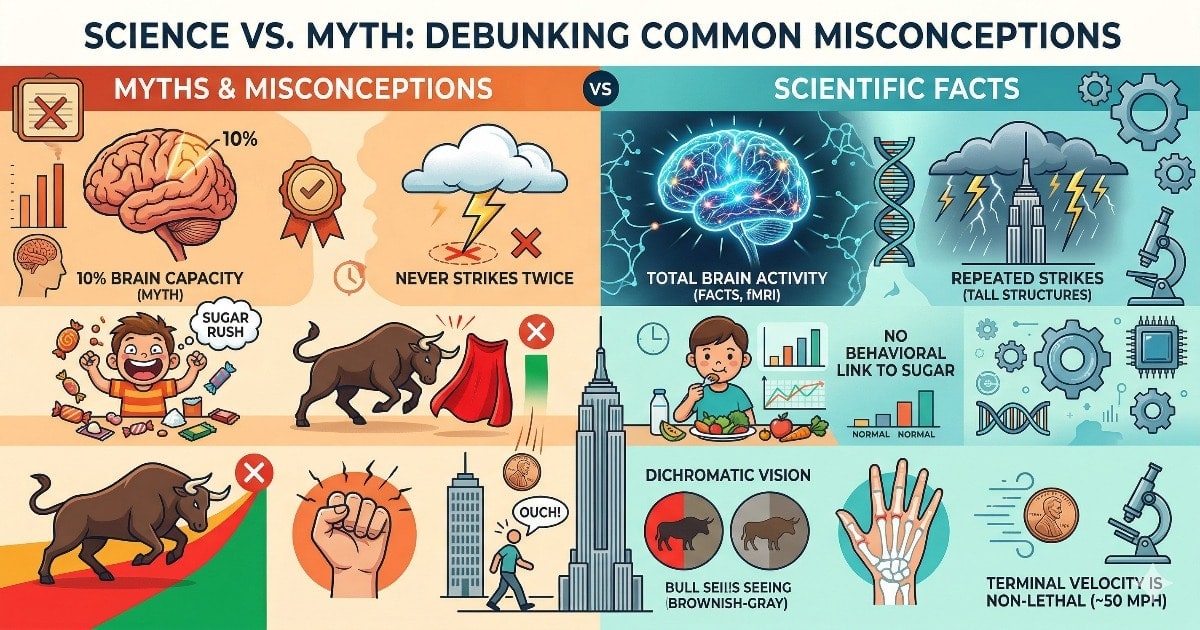
Myth 1: We Only Use 10% of Our Brains
The Misconception
Perhaps one of the most widely circulated myths is the idea that human beings only utilize 10% of their brain capacity. The implication is that if we could somehow “unlock” the remaining 90%, we would possess superhuman intelligence, telekinesis, or perfect memory.
The Scientific Reality
Neurologists and neuroscientists have thoroughly debunked this claim. Through advanced imaging technologies like Functional Magnetic Resonance Imaging (fMRI) and Positron Emission Tomography (PET) scans, doctors can observe the brain in real-time. These scans consistently show that virtually every part of the brain is active at some point during the day, even while we are sleeping.
The brain is an incredibly energy-hungry organ. While it accounts for only about 2% of the average human’s body weight, it consumes roughly 20% of the body’s daily energy expenditure. From an evolutionary standpoint, it would be highly inefficient for the human body to dedicate so many resources to an organ if 90% of it were useless tissue.
Different regions of the brain are specialized for different tasks—from processing visual stimuli in the occipital lobe to executive decision-making in the frontal lobe. Even a minor brain injury can cause catastrophic, cascading failures in cognitive or motor function, which further proves that all areas of the brain are necessary and actively utilized.
Myth 2: Sugar Causes Hyperactivity in Children
The Misconception
Ask almost any parent, and they will tell you that giving a child a sugary treat—like a cupcake, candy, or soda—will result in them bouncing off the walls with boundless energy.
The Scientific Reality
Despite widespread anecdotal claims, numerous double-blind, placebo-controlled studies have found absolutely no link between sugar consumption and hyperactive behavior in children.
In a landmark 1994 study published in the New England Journal of Medicine, researchers gave children diets containing high amounts of sugar, artificial sweeteners, or placebos. The parents, who did not know which diet their child was on, were asked to rate their child’s behavior. The results showed no behavioral differences regardless of what the children consumed.
So why does the myth persist? It largely comes down to context and confirmation bias. Children typically consume large amounts of sugar at highly stimulating events—birthday parties, holidays, and celebrations. The environment is already chaotic and exciting. When a parent expects their child to become hyperactive after eating cake at a party, they attribute the inevitable high energy to the sugar, rather than the exciting environment itself.
Myth 3: The Seasons Are Caused by Earth’s Distance from the Sun
The Misconception
Because heat comes from the sun, it seems like common sense that summer occurs when the Earth is closest to the sun, and winter occurs when the Earth is furthest away.
The Scientific Reality
Earth’s orbit around the sun is elliptical, meaning our distance from the sun does vary slightly throughout the year. However, this distance has very little to do with the changing of the seasons. In fact, for people living in the Northern Hemisphere, the Earth is actually at its closest point to the sun (perihelion) in early January—right in the dead of winter!
The seasons are entirely driven by the tilt of the Earth’s axis, which sits at an angle of roughly 23.5 degrees.
As the Earth orbits the sun, this tilt causes different parts of the planet to receive varying angles of direct sunlight. During the Northern Hemisphere’s summer, the North Pole is tilted toward the sun. This results in the sun’s rays hitting the Northern Hemisphere more directly and for a longer duration each day, causing warmer temperatures. Six months later, the North Pole tilts away from the sun, resulting in shorter days, indirect sunlight, and the cold temperatures of winter.
Myth 4: Lightning Never Strikes the Same Place Twice
The Misconception
This myth is often used as a comforting idiom to reassure someone that a rare, unfortunate event is unlikely to happen to them again. It implies that lightning has some sort of memory or avoids areas it has already hit.
The Scientific Reality
Lightning is a massive electrostatic discharge caused by unbalanced electrical charges in the atmosphere. It does not possess a memory, and it is simply seeking the path of least resistance to the ground.
Not only can lightning strike the same place twice, but it often does. Tall, isolated structures are natural targets for lightning because they significantly reduce the distance the electrical charge must travel to reach the ground. For example, the Empire State Building in New York City is struck by lightning an average of 25 times per year. Similarly, tall trees, radio towers, and mountain peaks are routinely struck multiple times during a single intense thunderstorm.
Myth 5: Swallowed Chewing Gum Takes Seven Years to Digest
The Misconception
Many of us were warned as children that if we swallowed our chewing gum, it would sit in our stomachs, undigested, for seven agonizing years, potentially causing blockages or health issues.
The Scientific Reality
The human digestive system is remarkably efficient, but it is true that your stomach cannot fully break down the synthetic rubber base used in modern chewing gum. The enzymes and stomach acids that easily dissolve proteins, carbohydrates, and fats are not equipped to break down the polymers in gum.
However, just because it cannot be dissolved does not mean it stays in your body for seven years. The human digestive tract is essentially a continuous tube. Like other indigestible items (such as certain types of dietary fiber, seeds, or corn), the gum is simply pushed along by the muscular contractions of your intestines—a process called peristalsis.
Within a matter of days, the swallowed gum will pass safely through your digestive system and be excreted. While making a habit of swallowing large wads of gum is not recommended (as it could theoretically cause a blockage in rare cases), a single swallowed piece is harmless and temporary.
Myth 6: Cracking Your Knuckles Causes Arthritis
The Misconception
The sharp popping sound of someone cracking their knuckles is often met with the warning, “Stop doing that, you’ll give yourself arthritis!”
The Scientific Reality
There is no scientific evidence linking the cracking of knuckles to osteoarthritis.
To understand why, we must look at the anatomy of our joints. Your knuckles are surrounded by a capsule filled with synovial fluid, which acts as a lubricant to help your joints move smoothly. This fluid contains dissolved gases, including oxygen, nitrogen, and carbon dioxide.
When you stretch or bend your fingers to crack your knuckles, you are expanding the joint capsule. This sudden expansion decreases the pressure inside the capsule, causing the dissolved gases to rapidly form a bubble and burst. That bursting bubble is the “pop” you hear. It takes about 20 minutes for the gases to dissolve back into the fluid, which is why you cannot immediately crack the same knuckle twice.
Medical studies, including a famous self-experiment by Dr. Donald Unger—who cracked the knuckles on his left hand but not his right hand every day for over 60 years—have shown no difference in arthritis development between knuckle-crackers and non-crackers.
Myth 7: Bats Are Blind
The Misconception
The phrase “blind as a bat” suggests that these flying mammals navigate the world without any visual capabilities, relying entirely on sound.
The Scientific Reality
Bats are not blind. In fact, all of the over 1,400 species of bats have eyes and are capable of seeing.
There are generally two types of bats: megabats (like fruit bats) and microbats. Megabats have excellent vision, which they use to spot fruit and flowers in the dark. They do not use echolocation at all.
Microbats, which hunt insects at night, do rely heavily on echolocation—emitting high-frequency sound waves that bounce off objects to help them navigate and hunt in total darkness. However, even microbats have functional eyes. Their vision is tuned to low-light conditions, and they use their eyesight to navigate over long distances, spot landmarks, and detect the setting sun to synchronize their internal biological clocks.
Myth 8: Bulls Get Angry at the Color Red
The Misconception
In traditional bullfighting, a matador waves a bright red cape (the muleta) to taunt the bull, causing the animal to charge aggressively. This has led to the widespread belief that bulls are enraged by the color red.
The Scientific Reality
Bulls, like all cattle, are dichromatic. This means their eyes only have two types of color-receptive cones, as opposed to the three types found in most humans. Because of this, cattle are essentially red-green colorblind. They cannot distinguish the color red from green, brown, or gray.
What actually triggers the bull to charge is the rapid movement of the cape. In the highly stressful, noisy, and chaotic environment of a bullfighting ring, the bull perceives the snapping, swirling motion of the fabric as a threat and reacts defensively. If a matador were to wave a blue, green, or white cape with the same aggressive motion, the bull would react in exactly the same way. The color red is traditionally used simply because it masks the sight of blood and is highly visible and dramatic for the human audience.
Myth 9: Eating Carrots Gives You Night Vision
The Misconception
Eating large quantities of carrots will significantly improve your eyesight, potentially allowing you to see flawlessly in the dark.
The Scientific Reality
Carrots are incredibly healthy and are an excellent source of beta-carotene, which the human body converts into Vitamin A. Vitamin A is crucial for maintaining good eye health and is a key component of rhodopsin, a protein in our eyes that allows us to see in low-light conditions.
If a person has a severe Vitamin A deficiency, eating carrots will help restore their vision to a normal baseline. However, if you already have a healthy, balanced diet, eating extra carrots will not give you superhuman night vision or eliminate your need for prescription glasses. Your body will simply flush out the excess vitamins.
The Origin of the Myth:
This myth was popularized by brilliant World War II propaganda. When the British Royal Air Force developed a new, secret airborne radar system to intercept German bombers during night raids, they needed a cover story to explain their sudden, unnatural success. The British Ministry of Information spread the rumor that their pilots were consuming massive amounts of carrots, which gave them extraordinary night vision. The public, and even some enemy forces, bought into the lie, and the myth has endured ever since.
Myth 10: A Penny Dropped from the Empire State Building Can Kill a Person
The Misconception
Because gravity accelerates falling objects, a penny dropped from the top of the 1,454-foot Empire State Building will gain so much speed that it will pierce a pedestrian’s skull like a bullet upon impact.
The Scientific Reality
While being struck by a falling penny would certainly be annoying, it is mathematically and physically impossible for it to be lethal.
This is due to two factors: mass and air resistance (drag). A standard penny is incredibly light, weighing only about 2.5 grams. Its flat, circular shape also makes it highly un-aerodynamic. As the penny falls, it collides with air molecules. Eventually, the upward force of air resistance equals the downward pull of gravity. When this happens, the penny stops accelerating and reaches what is called its terminal velocity.
For a penny, terminal velocity is roughly 25 to 50 miles per hour, depending on whether it falls flat or tumbling. While a piece of metal hitting you at 50 mph might sting and leave a small welt or bruise, it does not possess anywhere near the kinetic energy required to penetrate human skin or fracture a skull.
Summary Table: Science vs. Myth
| The Common Myth | The Scientific Reality |
| We use 10% of our brains. | We use 100% of our brains; brain scans show constant global activity. |
| Sugar makes kids hyper. | Studies show no link; hyperactivity is tied to the exciting environment. |
| Summer means Earth is closer to the sun. | Seasons are dictated by the 23.5-degree tilt of the Earth’s axis. |
| Lightning never strikes twice. | Lightning seeks the path of least resistance and often strikes tall objects repeatedly. |
| Gum takes 7 years to digest. | Gum cannot be broken down, but it passes through the body safely in a few days. |
| Cracking knuckles causes arthritis. | The pop is just gas bubbles bursting in synovial fluid; it does not harm joints. |
| Bats are blind. | All bats have functional eyes; many use vision in tandem with echolocation. |
| Bulls hate red. | Bulls are red-green colorblind; they charge at the aggressive movement of the cape. |
| Carrots grant night vision. | Carrots support baseline eye health, but extra carrots will not improve normal vision. |
| A falling penny is lethal. | Air resistance limits a penny’s terminal velocity to a non-lethal ~50 mph. |
Frequently Asked Questions (FAQ)
1. How do scientific myths start in the first place?
Myths often begin as genuine misunderstandings of early scientific observations, deliberate propaganda (like the carrot myth from WWII), or traditional folklore designed to enforce safety (like the gum-swallowing myth). Once a compelling story takes root in the culture, cognitive biases and repetition keep it alive.
2. Are there any health myths that are actually true?
Yes! Sometimes old wives’ tales are backed by science. For example, the idea that chicken soup helps you recover from a cold has scientific merit. Studies have shown that hot chicken soup can help clear nasal congestion and possesses mild anti-inflammatory properties that ease cold symptoms.
3. How can I verify if a scientific claim is a myth or a fact?
Look for consensus among reputable, peer-reviewed scientific journals or official institutional bodies (like the CDC, NASA, or the World Health Organization). Be skeptical of sensationalist headlines, anecdotal evidence (“it happened to a friend of a friend”), and claims that offer simple, miraculous solutions to complex problems.
4. Why do intelligent people still believe in myths?
Intelligence does not grant immunity to cognitive biases. Highly educated individuals can still fall victim to the Illusory Truth Effect or confirmation bias, especially regarding topics outside their specific field of expertise. Belief in myths is more about human psychology and the way our brains process information than raw intelligence.
5. What is the difference between a theory and a myth?
In science, a “theory” is a well-substantiated, rigorously tested explanation of an aspect of the natural world, supported by a vast body of evidence (e.g., the Theory of Gravity or the Theory of Evolution). A myth is a traditional story or widely held but false belief that lacks empirical evidence or scientific backing.
References & Further Reading
For those who wish to dive deeper into the actual science behind these concepts, the following resources provide excellent, peer-reviewed, and institutional information:
-
Brain Imaging and Usage: National Institutes of Health (NIH) – Brain Basics: Know Your Brain (www.ninds.nih.gov)
-
Diet and Child Behavior: The New England Journal of Medicine – Effects of Diets High in Sucrose or Aspartame on The Behavior and Cognitive Performance of Children (www.nejm.org)
-
Earth’s Axial Tilt: NASA Science – What Causes the Seasons? (spaceplace.nasa.gov)
-
Weather Phenomenon: National Weather Service (NWS) – Lightning Safety Myths and Facts (www.weather.gov)
-
Digestive Anatomy: Mayo Clinic – What happens to swallowed gum? (www.mayoclinic.org)
-
Joint Mechanics: Johns Hopkins Medicine – Understanding Arthritis and Joint Health (www.hopkinsmedicine.org)
-
Animal Vision (Bats and Bovines): The National Wildlife Federation – Debunking Animal Myths (www.nwf.org)
-
Physics of Falling Objects: Scientific American – Could a Penny Dropped From a Skyscraper Kill a Person? (www.scientificamerican.com)
Leave a Reply