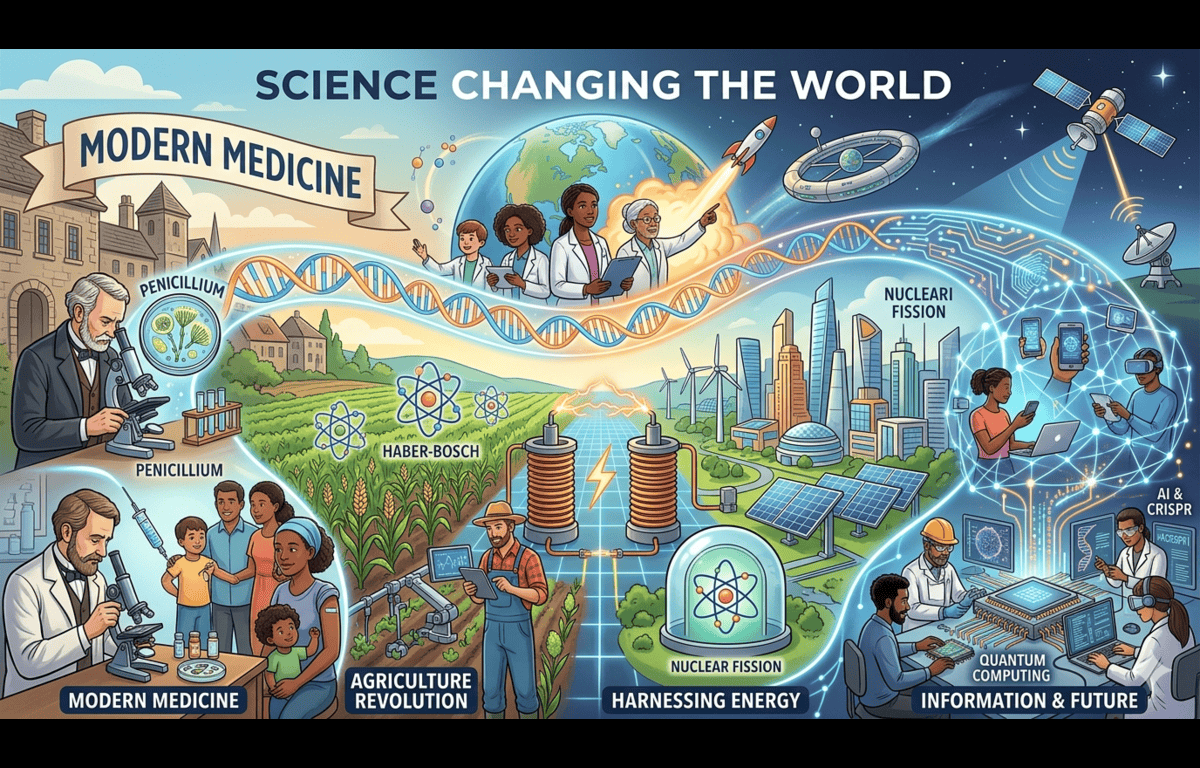
Introduction: The Engine of Human Evolution
For the vast majority of human history, the world was a place of profound mystery and unpredictable danger. Natural disasters were attributed to the whims of angry deities, diseases were thought to be the result of “bad air” or moral failings, and the fundamental laws governing the universe were entirely unknown. Today, we live in a world that our ancestors would view as indistinguishable from magic. We communicate instantaneously across oceans, we cure once-fatal illnesses with a simple course of pills, and we have sent human beings to walk on the surface of the moon.
What catalyzed this incredible transformation? The answer lies in the systematic, empirical pursuit of knowledge we call science.
The story of how scientific discoveries have changed the world is not just a timeline of inventions; it is the narrative of human liberation. Science has liberated us from the dark ages of superstition, from the absolute limits of human physical strength, and from the devastating mortality rates that once kept the global population in check. By observing the natural world, forming hypotheses, conducting rigorous experiments, and sharing knowledge, humanity has built a compounding tower of innovation.
This comprehensive guide explores the pivotal scientific breakthroughs that have reshaped our reality. We will journey through the realms of medicine, agriculture, energy, and communication, examining not only what these discoveries are, but how they have fundamentally altered the human experience, creating a more interconnected, healthier, and advanced global society.
1. The Dawn of Modern Medicine: Redefining Human Health and Longevity
Perhaps no field of scientific inquiry has had a more direct, intimate impact on human life than medicine. For millennia, average human life expectancy hovered around 30 to 40 years. Childhood mortality was staggeringly high, and a simple scratch could lead to a fatal infection. Today, global life expectancy has more than doubled, largely due to a handful of monumental scientific discoveries.
The Miracle of Antibiotics
Before the 20th century, bacterial infections like pneumonia, tuberculosis, and syphilis were largely untreatable death sentences. The discovery of penicillin by Alexander Fleming in 1928 marked the beginning of the antibiotic era. Fleming observed that a mold called Penicillium notatum secreted a substance that killed surrounding bacteria.
However, it took the collaborative work of scientists Howard Florey and Ernst Chain in the 1940s to purify and mass-produce penicillin. The impact was immediate and staggering. During World War II, antibiotics saved countless soldiers from dying of infected wounds. In the civilian world, previously fatal illnesses became easily treatable. Antibiotics revolutionized not just treatment, but also medical procedures; modern surgeries, organ transplants, and cancer treatments would be impossible without antibiotics to prevent post-operative infections.
Vaccines and the Eradication of Disease
The concept of inoculation has roots in various ancient cultures, but the scientific development of vaccines fundamentally changed global public health. Edward Jenner’s pioneering work with the smallpox vaccine in 1796 laid the groundwork. Smallpox was one of the most devastating diseases in human history, killing hundreds of millions of people. Thanks to a coordinated global vaccination campaign led by the World Health Organization (WHO), smallpox was officially declared eradicated in 1980—one of the greatest triumphs in scientific history.
Similarly, the development of the polio vaccine by Jonas Salk and Albert Sabin in the mid-20th century saved millions of children from paralysis and death. More recently, the unprecedented speed of the development of mRNA vaccines for COVID-19 showcased the incredible power of modern genomic science. By teaching the immune system to recognize and fight pathogens without exposing the body to the disease itself, vaccines have fundamentally altered the landscape of human survival.
Medical Imaging: Looking Inside the Body
For centuries, the only way to see inside the human body was through invasive surgery or post-mortem dissection. The discovery of X-rays by Wilhelm Conrad Roentgen in 1895 changed this overnight. Roentgen accidentally discovered that invisible electromagnetic radiation could pass through human tissue but not bone, creating an image on photographic plates.
This discovery evolved into a massive field of diagnostic medicine. The subsequent inventions of Ultrasound, Computed Tomography (CT) scans, and Magnetic Resonance Imaging (MRI) have given physicians the ability to detect tumors, diagnose internal injuries, and monitor fetal development with incredible precision and without the need for a scalpel. This non-invasive diagnostic power has saved countless lives through early detection and accurate treatment planning.
2. The Agricultural Revolution: Feeding a Growing Planet
As human populations grew, the specter of mass starvation loomed large. Eighteenth-century economist Thomas Malthus famously predicted that human population growth would inevitably outpace our ability to produce food, leading to widespread famine. That this Malthusian catastrophe has largely been avoided is a testament to scientific discoveries in agriculture.
The Haber-Bosch Process: Bread from the Air
Nitrogen is an essential nutrient for plant growth, but while it makes up 78% of the Earth’s atmosphere, it exists in a form that most plants cannot use. Historically, agriculture was limited by the amount of naturally occurring nitrogen in the soil, which had to be replenished with manure or crop rotation.
In the early 20th century, German chemists Fritz Haber and Carl Bosch developed a method to synthesize ammonia from atmospheric nitrogen and hydrogen gas under high heat and pressure. The Haber-Bosch process allowed for the mass production of synthetic fertilizers. It is estimated that without this discovery, the Earth could only support about half of its current population. Synthetic fertilizers initiated an agricultural boom that fed billions, fundamentally shifting human demographics and allowing societies to urbanize and industrialize.
The Green Revolution and Crop Genetics
In the mid-20th century, a series of research and technology transfer initiatives, collectively known as the Green Revolution, exponentially increased global agricultural production. Led by agronomist Norman Borlaug (often called the “father of the Green Revolution”), scientists developed high-yielding, disease-resistant varieties of wheat and rice.
Combined with modern irrigation techniques and the aforementioned synthetic fertilizers, these new crop varieties transformed countries like India and Mexico from food-deficient nations into major agricultural exporters. Today, the science of agriculture continues to evolve with Genetically Modified Organisms (GMOs). By editing the genetic makeup of crops, scientists have created plants that are resistant to pests, tolerant of droughts, and fortified with essential vitamins (such as Golden Rice, engineered to combat Vitamin A deficiency). These advancements ensure global food security in the face of climate change and a population projected to reach nearly 10 billion by 2050.
3. Harnessing Energy: Powering Modern Civilization
Human progress is inextricably linked to our ability to harness and manipulate energy. From the mastery of fire to the combustion engine, energy transformations have driven societal change. However, specific scientific breakthroughs in the 19th and 20th centuries created the powered world we recognize today.
Electromagnetism and the Electric Grid
Before the 19th century, electricity was a mere scientific curiosity—a parlor trick involving static shocks. The theoretical and experimental work of scientists like Michael Faraday and James Clerk Maxwell fundamentally changed the world. Faraday’s discovery of electromagnetic induction—the principle that moving a magnet through a coil of copper wire generates an electric current—is the foundational mechanism for almost all modern power generation.
The subsequent development of the electric lightbulb by Thomas Edison and the alternating current (AC) power grid championed by Nikola Tesla and George Westinghouse brought light to the night and power to factories. Electricity transformed human sleep patterns, drastically improved industrial productivity, and became the invisible nervous system of modern civilization, powering everything from life-saving hospital equipment to the device you are using to read this article.
The Atom: Nuclear Fission
In the early 20th century, physicists like Albert Einstein, Marie Curie, and Ernest Rutherford unlocked the secrets of the atom, revealing that immense amounts of energy were locked within its nucleus. The discovery of nuclear fission—the splitting of a heavy atomic nucleus, such as uranium—by Otto Hahn and Fritz Strassmann in 1938 ushered in the Atomic Age.
While this discovery unfortunately led to the development of devastating nuclear weapons, it also gave rise to nuclear power. Nuclear energy provides a massive, reliable source of electricity without the greenhouse gas emissions associated with burning fossil fuels. Today, as the world grapples with climate change, the science of nuclear energy (and the ongoing pursuit of clean, limitless nuclear fusion) remains critical to our sustainable future.
The Transition to Renewables
Understanding the greenhouse effect—first quantified by scientist Svante Arrhenius in 1896—has led to a global push for sustainable energy. The scientific development of photovoltaic cells (solar panels) and advanced aerodynamics (wind turbines) has turned renewable energy from a niche environmental concept into the fastest-growing sector of the global energy market. Advancements in materials science, particularly in lithium-ion battery technology, have allowed us to store this energy efficiently, paving the way for electric vehicles and a decarbonized global grid.
4. The Communication and Information Age: Connecting Humanity
The ability to share information rapidly across vast distances has accelerated human progress more than any other factor in recent history. The transition from the industrial age to the information age was driven by breakthroughs in physics, mathematics, and computer science.
The Transistor: The Building Block of the Digital World
If you were to point to a single invention that created the modern world, the transistor would be a primary candidate. Invented in 1947 by John Bardeen, Walter Brattain, and William Shockley at Bell Labs, the transistor replaced bulky, fragile, and hot vacuum tubes.
A transistor is a tiny semiconductor device used to amplify or switch electrical signals and power. By miniaturizing these components, engineers were able to pack millions, and eventually billions, of transistors onto a single silicon microchip. This is the foundation of all modern electronics. Without the transistor, there would be no personal computers, no smartphones, no modern aviation software, and no digital financial systems. It democratized access to computing power, taking it out of government laboratories and placing it in the hands of individuals globally.
The Internet and the World Wide Web
The creation of the internet was not a single “eureka” moment but a gradual evolution of computer networking protocols. Funded initially by the U.S. Department of Defense as ARPANET, scientists developed packet switching to allow computers to communicate across distributed networks.
However, it was British computer scientist Tim Berners-Lee who, in 1989, invented the World Wide Web. By creating a system of interconnected, hyperlinked documents accessible via a browser, Berners-Lee made the internet navigable for the general public. The impact has been profound. The internet has democratized information, disrupted traditional media and commerce, created entirely new global economies, and allowed for the instant sharing of scientific data across borders, accelerating the pace of future discoveries.
Space Exploration and Satellite Technology
When the Soviet Union launched Sputnik 1 in 1957, humanity officially became a spacefaring species. The ensuing space race led to the Apollo moon landings, a pinnacle of human engineering. However, the scientific discoveries made for space exploration have deeply impacted life on Earth.
Satellites orbiting our planet govern our daily lives. The Global Positioning System (GPS), originally designed for military use, now guides everything from commercial airliners to food delivery drivers. Weather satellites save lives by tracking hurricanes and monsoons days in advance. Communication satellites provide internet and television access to the most remote regions of the globe, ensuring that isolated populations are included in the global community.
5. Looking Ahead: The Next Frontiers of Discovery
The scientific method is a perpetual engine. As we look to the future, several emerging scientific discoveries are poised to change the world just as profoundly as antibiotics or the internet.
- Artificial Intelligence (AI) and Machine Learning: Computer science has advanced to the point where algorithms can learn from massive datasets, recognizing patterns that humans cannot. AI is already revolutionizing medical diagnostics, autonomous transportation, and materials science. As AI models become more sophisticated, they will act as powerful collaborators in solving complex global challenges like climate modeling and drug discovery.
- CRISPR and Gene Editing: The discovery of CRISPR-Cas9, a molecular tool adapted from the immune defense system of bacteria, allows scientists to edit DNA with unprecedented precision, speed, and affordability. This technology holds the potential to cure genetic diseases like sickle cell anemia, engineer crops that are virtually immune to climate change, and fundamentally alter the biological future of humanity.
- Quantum Computing: While traditional computers use bits (0s and 1s), quantum computers use quantum bits (qubits), allowing them to exist in multiple states simultaneously. This means they can perform certain complex calculations exponentially faster than the most powerful supercomputers today. Quantum computing could revolutionize cryptography, discover new life-saving pharmaceuticals in days rather than years, and optimize global logistics systems.
Conclusion: The Ongoing Journey of Progress
To ask how scientific discoveries have changed the world is to ask how humanity has survived and thrived. Every aspect of our modern existence—the food we eat, the medicines we take, the vehicles we travel in, and the screens we look at—is the direct result of rigorous scientific inquiry.
Science is an inclusive, collaborative endeavor. It relies on the cumulative knowledge of generations of curious individuals across all cultures and continents. While scientific advancements bring new challenges and ethical dilemmas—such as data privacy in the digital age or the implications of genetic editing—the scientific method itself remains our best tool for navigating these complexities.
By fostering a society that values scientific literacy, funds basic research, and promotes inclusive education, we ensure that the engine of discovery continues to run. The next life-saving medicine, clean energy solution, or profound understanding of the universe is waiting to be uncovered, promising a brighter, more equitable future for all of humanity.
Frequently Asked Questions (FAQ)
Q1: What is considered the most important scientific discovery in history?
While it is difficult to narrow down to just one, many historians and scientists point to the germ theory of disease (championed by Louis Pasteur and Robert Koch) and the subsequent discovery of penicillin (antibiotics). Before these discoveries, infectious diseases were the leading cause of human mortality. Germ theory fundamentally revolutionized public health, sanitation, and medicine, doubling the human lifespan.
Q2: How did the discovery of electricity change daily life?
The harnessing of electricity shifted society from a daylight-dependent, manual-labor economy to a 24-hour, industrialized, and interconnected global society. It allowed for the invention of artificial lighting, refrigeration (which revolutionized food safety and storage), mass communication (telegraph, radio, internet), and automated manufacturing, drastically raising the global standard of living.
Q3: Are scientific discoveries always beneficial?
Not inherently. Science is a tool, and like any tool, it can be used for immense good or immense destruction. For example, the discovery of nuclear fission led to both carbon-free nuclear energy and devastating atomic weapons. Similarly, the combustion engine drove industrial progress but also caused widespread environmental pollution and climate change. The application of science requires ethical guidelines and responsible societal oversight.
Q4: What role does failure play in scientific discovery?
Failure is a critical, unavoidable part of the scientific method. Every failed experiment provides valuable data, eliminating incorrect hypotheses and guiding researchers closer to the truth. Many great discoveries, such as Alexander Fleming’s discovery of penicillin or Wilson and Penzias’s discovery of cosmic microwave background radiation, were the results of “accidents” or unexpected anomalies during seemingly failed experiments.
Q5: How is artificial intelligence considered a scientific discovery?
While AI is heavily rooted in engineering and computer programming, the underlying principles are based on breakthroughs in mathematics, statistics, and neuroscience (such as understanding how neural networks function). The discovery of how to train algorithms to “learn” from data—rather than just executing pre-written commands—represents a fundamental leap in information science, allowing machines to approximate human cognitive tasks.
Q6: How can individuals support ongoing scientific discoveries?
You don’t need to be a laboratory researcher to support science. Individuals can contribute by staying informed through credible sources, advocating for science-based public policies and research funding, participating in “citizen science” projects (like data collection for environmental studies), and fostering a sense of curiosity and critical thinking in younger generations.
Reference Links for Further Reading
To learn more about the incredible scientific discoveries that have shaped our world, explore these highly respected resources:
-
Nobel Prize Official Website: Explore the history of the greatest minds and discoveries in Physics, Chemistry, and Medicine.
-
World Health Organization (WHO) – Global Health Histories: Read about the eradication of smallpox and the impact of modern vaccines.
-
NASA – Benefits to You: Discover how space exploration technologies have been adapted for everyday use on Earth.
-
Nature – News & Comment: Stay up to date with the latest scientific discoveries and their global impacts from one of the world’s leading multidisciplinary science journals.
-
National Science Foundation (NSF): Learn about ongoing research and how fundamental discoveries drive the global economy.
Leave a Reply