Category: Science

  • How Scientific Discoveries Have Changed the World: A Journey Through Human Progress

    How Scientific Discoveries Have Changed the World: A Journey Through Human Progress

    Introduction: The Engine of Human Evolution

    For the vast majority of human history, the world was a place of profound mystery and unpredictable danger. Natural disasters were attributed to the whims of angry deities, diseases were thought to be the result of “bad air” or moral failings, and the fundamental laws governing the universe were entirely unknown. Today, we live in a world that our ancestors would view as indistinguishable from magic. We communicate instantaneously across oceans, we cure once-fatal illnesses with a simple course of pills, and we have sent human beings to walk on the surface of the moon.

    What catalyzed this incredible transformation? The answer lies in the systematic, empirical pursuit of knowledge we call science.

    The story of how scientific discoveries have changed the world is not just a timeline of inventions; it is the narrative of human liberation. Science has liberated us from the dark ages of superstition, from the absolute limits of human physical strength, and from the devastating mortality rates that once kept the global population in check. By observing the natural world, forming hypotheses, conducting rigorous experiments, and sharing knowledge, humanity has built a compounding tower of innovation.

    This comprehensive guide explores the pivotal scientific breakthroughs that have reshaped our reality. We will journey through the realms of medicine, agriculture, energy, and communication, examining not only what these discoveries are, but how they have fundamentally altered the human experience, creating a more interconnected, healthier, and advanced global society.


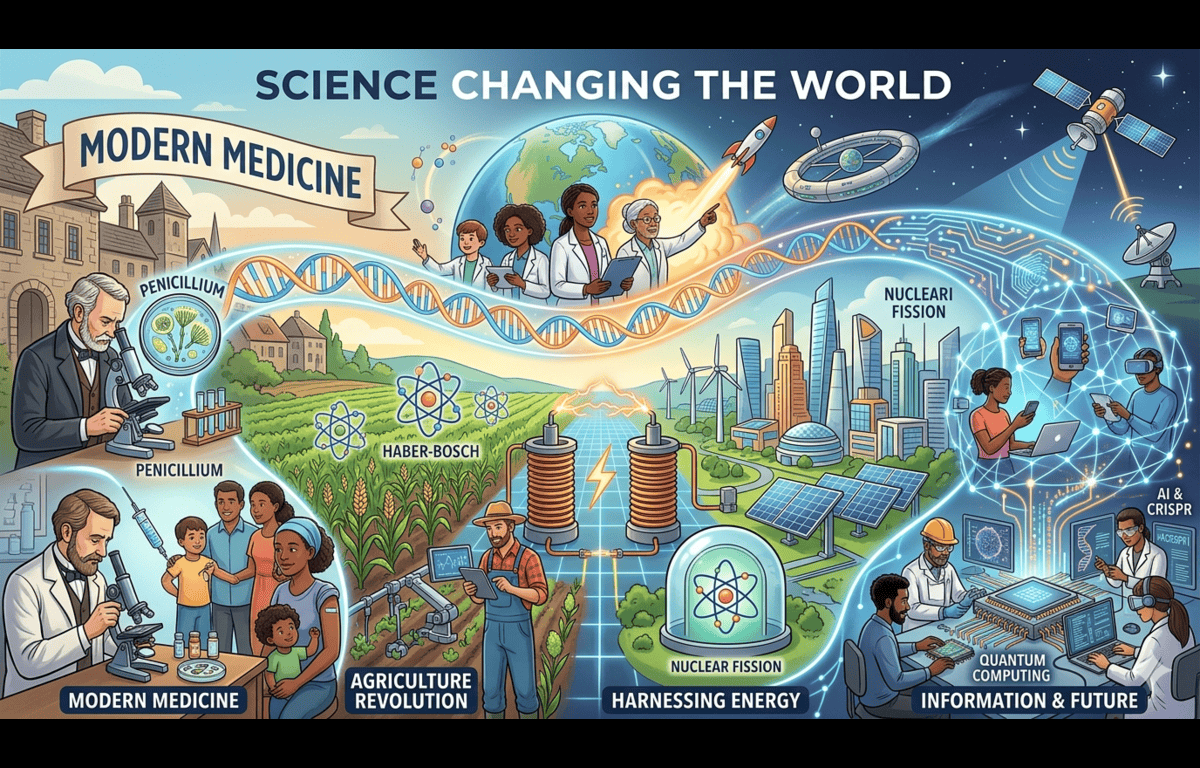
    1. The Dawn of Modern Medicine: Redefining Human Health and Longevity

    Perhaps no field of scientific inquiry has had a more direct, intimate impact on human life than medicine. For millennia, average human life expectancy hovered around 30 to 40 years. Childhood mortality was staggeringly high, and a simple scratch could lead to a fatal infection. Today, global life expectancy has more than doubled, largely due to a handful of monumental scientific discoveries.

    The Miracle of Antibiotics

    Before the 20th century, bacterial infections like pneumonia, tuberculosis, and syphilis were largely untreatable death sentences. The discovery of penicillin by Alexander Fleming in 1928 marked the beginning of the antibiotic era. Fleming observed that a mold called Penicillium notatum secreted a substance that killed surrounding bacteria.

    However, it took the collaborative work of scientists Howard Florey and Ernst Chain in the 1940s to purify and mass-produce penicillin. The impact was immediate and staggering. During World War II, antibiotics saved countless soldiers from dying of infected wounds. In the civilian world, previously fatal illnesses became easily treatable. Antibiotics revolutionized not just treatment, but also medical procedures; modern surgeries, organ transplants, and cancer treatments would be impossible without antibiotics to prevent post-operative infections.

    Vaccines and the Eradication of Disease

    The concept of inoculation has roots in various ancient cultures, but the scientific development of vaccines fundamentally changed global public health. Edward Jenner’s pioneering work with the smallpox vaccine in 1796 laid the groundwork. Smallpox was one of the most devastating diseases in human history, killing hundreds of millions of people. Thanks to a coordinated global vaccination campaign led by the World Health Organization (WHO), smallpox was officially declared eradicated in 1980—one of the greatest triumphs in scientific history.

    Similarly, the development of the polio vaccine by Jonas Salk and Albert Sabin in the mid-20th century saved millions of children from paralysis and death. More recently, the unprecedented speed of the development of mRNA vaccines for COVID-19 showcased the incredible power of modern genomic science. By teaching the immune system to recognize and fight pathogens without exposing the body to the disease itself, vaccines have fundamentally altered the landscape of human survival.

    Medical Imaging: Looking Inside the Body

    For centuries, the only way to see inside the human body was through invasive surgery or post-mortem dissection. The discovery of X-rays by Wilhelm Conrad Roentgen in 1895 changed this overnight. Roentgen accidentally discovered that invisible electromagnetic radiation could pass through human tissue but not bone, creating an image on photographic plates.

    This discovery evolved into a massive field of diagnostic medicine. The subsequent inventions of Ultrasound, Computed Tomography (CT) scans, and Magnetic Resonance Imaging (MRI) have given physicians the ability to detect tumors, diagnose internal injuries, and monitor fetal development with incredible precision and without the need for a scalpel. This non-invasive diagnostic power has saved countless lives through early detection and accurate treatment planning.


    2. The Agricultural Revolution: Feeding a Growing Planet

    As human populations grew, the specter of mass starvation loomed large. Eighteenth-century economist Thomas Malthus famously predicted that human population growth would inevitably outpace our ability to produce food, leading to widespread famine. That this Malthusian catastrophe has largely been avoided is a testament to scientific discoveries in agriculture.

    The Haber-Bosch Process: Bread from the Air

    Nitrogen is an essential nutrient for plant growth, but while it makes up 78% of the Earth’s atmosphere, it exists in a form that most plants cannot use. Historically, agriculture was limited by the amount of naturally occurring nitrogen in the soil, which had to be replenished with manure or crop rotation.

    In the early 20th century, German chemists Fritz Haber and Carl Bosch developed a method to synthesize ammonia from atmospheric nitrogen and hydrogen gas under high heat and pressure. The Haber-Bosch process allowed for the mass production of synthetic fertilizers. It is estimated that without this discovery, the Earth could only support about half of its current population. Synthetic fertilizers initiated an agricultural boom that fed billions, fundamentally shifting human demographics and allowing societies to urbanize and industrialize.

    The Green Revolution and Crop Genetics

    In the mid-20th century, a series of research and technology transfer initiatives, collectively known as the Green Revolution, exponentially increased global agricultural production. Led by agronomist Norman Borlaug (often called the “father of the Green Revolution”), scientists developed high-yielding, disease-resistant varieties of wheat and rice.

    Combined with modern irrigation techniques and the aforementioned synthetic fertilizers, these new crop varieties transformed countries like India and Mexico from food-deficient nations into major agricultural exporters. Today, the science of agriculture continues to evolve with Genetically Modified Organisms (GMOs). By editing the genetic makeup of crops, scientists have created plants that are resistant to pests, tolerant of droughts, and fortified with essential vitamins (such as Golden Rice, engineered to combat Vitamin A deficiency). These advancements ensure global food security in the face of climate change and a population projected to reach nearly 10 billion by 2050.


    3. Harnessing Energy: Powering Modern Civilization

    Human progress is inextricably linked to our ability to harness and manipulate energy. From the mastery of fire to the combustion engine, energy transformations have driven societal change. However, specific scientific breakthroughs in the 19th and 20th centuries created the powered world we recognize today.

    Electromagnetism and the Electric Grid

    Before the 19th century, electricity was a mere scientific curiosity—a parlor trick involving static shocks. The theoretical and experimental work of scientists like Michael Faraday and James Clerk Maxwell fundamentally changed the world. Faraday’s discovery of electromagnetic induction—the principle that moving a magnet through a coil of copper wire generates an electric current—is the foundational mechanism for almost all modern power generation.

    The subsequent development of the electric lightbulb by Thomas Edison and the alternating current (AC) power grid championed by Nikola Tesla and George Westinghouse brought light to the night and power to factories. Electricity transformed human sleep patterns, drastically improved industrial productivity, and became the invisible nervous system of modern civilization, powering everything from life-saving hospital equipment to the device you are using to read this article.

    The Atom: Nuclear Fission

    In the early 20th century, physicists like Albert Einstein, Marie Curie, and Ernest Rutherford unlocked the secrets of the atom, revealing that immense amounts of energy were locked within its nucleus. The discovery of nuclear fission—the splitting of a heavy atomic nucleus, such as uranium—by Otto Hahn and Fritz Strassmann in 1938 ushered in the Atomic Age.

    While this discovery unfortunately led to the development of devastating nuclear weapons, it also gave rise to nuclear power. Nuclear energy provides a massive, reliable source of electricity without the greenhouse gas emissions associated with burning fossil fuels. Today, as the world grapples with climate change, the science of nuclear energy (and the ongoing pursuit of clean, limitless nuclear fusion) remains critical to our sustainable future.

    The Transition to Renewables

    Understanding the greenhouse effect—first quantified by scientist Svante Arrhenius in 1896—has led to a global push for sustainable energy. The scientific development of photovoltaic cells (solar panels) and advanced aerodynamics (wind turbines) has turned renewable energy from a niche environmental concept into the fastest-growing sector of the global energy market. Advancements in materials science, particularly in lithium-ion battery technology, have allowed us to store this energy efficiently, paving the way for electric vehicles and a decarbonized global grid.


    4. The Communication and Information Age: Connecting Humanity

    The ability to share information rapidly across vast distances has accelerated human progress more than any other factor in recent history. The transition from the industrial age to the information age was driven by breakthroughs in physics, mathematics, and computer science.

    The Transistor: The Building Block of the Digital World

    If you were to point to a single invention that created the modern world, the transistor would be a primary candidate. Invented in 1947 by John Bardeen, Walter Brattain, and William Shockley at Bell Labs, the transistor replaced bulky, fragile, and hot vacuum tubes.

    A transistor is a tiny semiconductor device used to amplify or switch electrical signals and power. By miniaturizing these components, engineers were able to pack millions, and eventually billions, of transistors onto a single silicon microchip. This is the foundation of all modern electronics. Without the transistor, there would be no personal computers, no smartphones, no modern aviation software, and no digital financial systems. It democratized access to computing power, taking it out of government laboratories and placing it in the hands of individuals globally.

    The Internet and the World Wide Web

    The creation of the internet was not a single “eureka” moment but a gradual evolution of computer networking protocols. Funded initially by the U.S. Department of Defense as ARPANET, scientists developed packet switching to allow computers to communicate across distributed networks.

    However, it was British computer scientist Tim Berners-Lee who, in 1989, invented the World Wide Web. By creating a system of interconnected, hyperlinked documents accessible via a browser, Berners-Lee made the internet navigable for the general public. The impact has been profound. The internet has democratized information, disrupted traditional media and commerce, created entirely new global economies, and allowed for the instant sharing of scientific data across borders, accelerating the pace of future discoveries.

    Space Exploration and Satellite Technology

    When the Soviet Union launched Sputnik 1 in 1957, humanity officially became a spacefaring species. The ensuing space race led to the Apollo moon landings, a pinnacle of human engineering. However, the scientific discoveries made for space exploration have deeply impacted life on Earth.

    Satellites orbiting our planet govern our daily lives. The Global Positioning System (GPS), originally designed for military use, now guides everything from commercial airliners to food delivery drivers. Weather satellites save lives by tracking hurricanes and monsoons days in advance. Communication satellites provide internet and television access to the most remote regions of the globe, ensuring that isolated populations are included in the global community.


    5. Looking Ahead: The Next Frontiers of Discovery

    The scientific method is a perpetual engine. As we look to the future, several emerging scientific discoveries are poised to change the world just as profoundly as antibiotics or the internet.

    • Artificial Intelligence (AI) and Machine Learning: Computer science has advanced to the point where algorithms can learn from massive datasets, recognizing patterns that humans cannot. AI is already revolutionizing medical diagnostics, autonomous transportation, and materials science. As AI models become more sophisticated, they will act as powerful collaborators in solving complex global challenges like climate modeling and drug discovery.
    • CRISPR and Gene Editing: The discovery of CRISPR-Cas9, a molecular tool adapted from the immune defense system of bacteria, allows scientists to edit DNA with unprecedented precision, speed, and affordability. This technology holds the potential to cure genetic diseases like sickle cell anemia, engineer crops that are virtually immune to climate change, and fundamentally alter the biological future of humanity.
    • Quantum Computing: While traditional computers use bits (0s and 1s), quantum computers use quantum bits (qubits), allowing them to exist in multiple states simultaneously. This means they can perform certain complex calculations exponentially faster than the most powerful supercomputers today. Quantum computing could revolutionize cryptography, discover new life-saving pharmaceuticals in days rather than years, and optimize global logistics systems.

    Conclusion: The Ongoing Journey of Progress

    To ask how scientific discoveries have changed the world is to ask how humanity has survived and thrived. Every aspect of our modern existence—the food we eat, the medicines we take, the vehicles we travel in, and the screens we look at—is the direct result of rigorous scientific inquiry.

    Science is an inclusive, collaborative endeavor. It relies on the cumulative knowledge of generations of curious individuals across all cultures and continents. While scientific advancements bring new challenges and ethical dilemmas—such as data privacy in the digital age or the implications of genetic editing—the scientific method itself remains our best tool for navigating these complexities.

    By fostering a society that values scientific literacy, funds basic research, and promotes inclusive education, we ensure that the engine of discovery continues to run. The next life-saving medicine, clean energy solution, or profound understanding of the universe is waiting to be uncovered, promising a brighter, more equitable future for all of humanity.


    Frequently Asked Questions (FAQ)

    Q1: What is considered the most important scientific discovery in history?

    While it is difficult to narrow down to just one, many historians and scientists point to the germ theory of disease (championed by Louis Pasteur and Robert Koch) and the subsequent discovery of penicillin (antibiotics). Before these discoveries, infectious diseases were the leading cause of human mortality. Germ theory fundamentally revolutionized public health, sanitation, and medicine, doubling the human lifespan.

    Q2: How did the discovery of electricity change daily life?

    The harnessing of electricity shifted society from a daylight-dependent, manual-labor economy to a 24-hour, industrialized, and interconnected global society. It allowed for the invention of artificial lighting, refrigeration (which revolutionized food safety and storage), mass communication (telegraph, radio, internet), and automated manufacturing, drastically raising the global standard of living.

    Q3: Are scientific discoveries always beneficial?

    Not inherently. Science is a tool, and like any tool, it can be used for immense good or immense destruction. For example, the discovery of nuclear fission led to both carbon-free nuclear energy and devastating atomic weapons. Similarly, the combustion engine drove industrial progress but also caused widespread environmental pollution and climate change. The application of science requires ethical guidelines and responsible societal oversight.

    Q4: What role does failure play in scientific discovery?

    Failure is a critical, unavoidable part of the scientific method. Every failed experiment provides valuable data, eliminating incorrect hypotheses and guiding researchers closer to the truth. Many great discoveries, such as Alexander Fleming’s discovery of penicillin or Wilson and Penzias’s discovery of cosmic microwave background radiation, were the results of “accidents” or unexpected anomalies during seemingly failed experiments.

    Q5: How is artificial intelligence considered a scientific discovery?

    While AI is heavily rooted in engineering and computer programming, the underlying principles are based on breakthroughs in mathematics, statistics, and neuroscience (such as understanding how neural networks function). The discovery of how to train algorithms to “learn” from data—rather than just executing pre-written commands—represents a fundamental leap in information science, allowing machines to approximate human cognitive tasks.

    Q6: How can individuals support ongoing scientific discoveries?

    You don’t need to be a laboratory researcher to support science. Individuals can contribute by staying informed through credible sources, advocating for science-based public policies and research funding, participating in “citizen science” projects (like data collection for environmental studies), and fostering a sense of curiosity and critical thinking in younger generations.


    Reference Links for Further Reading

    To learn more about the incredible scientific discoveries that have shaped our world, explore these highly respected resources:

    1. Nobel Prize Official Website: Explore the history of the greatest minds and discoveries in Physics, Chemistry, and Medicine.

    2. World Health Organization (WHO) – Global Health Histories: Read about the eradication of smallpox and the impact of modern vaccines.

    3. NASA – Benefits to You: Discover how space exploration technologies have been adapted for everyday use on Earth.

    4. Nature – News & Comment: Stay up to date with the latest scientific discoveries and their global impacts from one of the world’s leading multidisciplinary science journals.

    5. National Science Foundation (NSF): Learn about ongoing research and how fundamental discoveries drive the global economy.

  • The Invisible Thread: Why Science Matters in Everyday Life

    The Invisible Thread: Why Science Matters in Everyday Life

    When you hear the word “science,” what comes to mind? For many, it conjures images of individuals in stark white lab coats peering through microscopes, complex mathematical equations scribbled across chalkboards, or the sterile environment of a research facility. It is easy to compartmentalize science as an academic pursuit entirely separate from our daily routines. However, this perception could not be further from the truth.

    Science is not just an academic discipline; it is the fundamental framework of our existence. It is the invisible thread woven through every action we take, every breath we draw, and every convenience we enjoy. Understanding why science matters in everyday life is crucial for fostering a society that makes informed decisions, appreciates the world around us, and continues to drive human progress forward.

    In this comprehensive guide, we will explore the profound impact of scientific discovery on our daily routines, our health, our environment, and our future.


    1. The Science of the Morning Routine

    The integration of science into our lives begins before we even open our eyes. The alarm clock that wakes you is a marvel of modern electronics and physics. But let us look at the physical actions that make up a typical morning.

    The Chemistry of Cleanliness

    When you step into the shower, you are engaging in a chemical process. Soap is created through a chemical reaction called saponification, which allows water to mix with oils and dirt on your skin so they can be washed away.

    Similarly, brushing your teeth is a daily scientific intervention. Toothpaste contains fluoride, a naturally occurring mineral that has been scientifically proven to strengthen tooth enamel and prevent decay. By simply maintaining personal hygiene, you are relying on centuries of chemical and biological research designed to keep the human body healthy and free from bacterial infections.

    Thermodynamics in Your Coffee Cup

    If you brew a cup of coffee or tea to start your day, you are experimenting with thermodynamics and extraction chemistry. The temperature of the water determines which flavor compounds are extracted from the coffee grounds or tea leaves. If the water is too hot, it extracts bitter acids; if it is too cold, the beverage will be weak and underdeveloped.

    Furthermore, if you enjoy toast, you are experiencing the Maillard reaction. This is a chemical reaction between amino acids and reducing sugars that gives browned food its distinctive flavor. Whether you are searing a steak or toasting bread, you are performing a delicious chemical experiment in your kitchen.


    2. Health and Medicine: The Lifesaving Science

    Perhaps the most universally acknowledged area where science matters in everyday life is healthcare. Our understanding of human biology, disease, and pharmacology has revolutionized what it means to live a long, healthy life.

    The Eradication of Disease

    A little over a century ago, common infections were a leading cause of mortality. The discovery of penicillin by Alexander Fleming in 1928, and the subsequent development of antibiotics, fundamentally changed human history. Today, bacterial infections that were once death sentences are routinely treated with a simple prescription.

    Vaccines represent another monumental triumph of scientific application. By understanding how the immune system works, scientists have developed ways to train our bodies to fight off pathogens before they can cause severe illness. The near-eradication of polio and the complete eradication of smallpox are testaments to the power of public health science.

    Modern Medical Technology

    Beyond medication, the technology we use to diagnose and treat illnesses is deeply rooted in physics and engineering.

    • X-rays and MRI Machines: These allow doctors to look inside the human body without making a single incision, utilizing electromagnetic radiation and strong magnetic fields.
    • Wearable Health Tech: Today, many people wear smartwatches that track heart rates, blood oxygen levels, and sleep patterns. These devices use advanced optical sensors and algorithms to provide real-time biometric data, empowering individuals to take control of their cardiovascular health.

    3. Connecting the Globe: Technology and Communication

    The modern world is defined by connectivity. The fact that you can read this article on a screen, perhaps while sitting in a coffee shop or commuting to work, is the result of decades of intense scientific research in physics, computer science, and engineering.

    The Magic of the Smartphone

    Consider the smartphone in your pocket. It is essentially a supercomputer that relies on multiple branches of science to function:

    • Quantum Mechanics: The semiconductors and microchips inside your phone operate on principles of quantum physics. Without an understanding of how electrons behave at the microscopic level, modern computing would not exist.
    • Chemistry: The lithium-ion battery that powers your device is a carefully balanced electrochemical cell designed to store and release energy efficiently.
    • Relativity: The GPS (Global Positioning System) you use to navigate relies on satellites orbiting the Earth. Because these satellites are moving fast and are further away from Earth’s gravitational pull, time moves slightly differently for them compared to us on the ground. Engineers must apply Albert Einstein’s theory of relativity to adjust the satellites’ internal clocks; without this scientific correction, your GPS would drift by miles every single day.

    The Internet and Fiber Optics

    The internet, the vast network that houses human knowledge and facilitates global communication, runs on light. Fiber optic cables, made of meticulously engineered glass strands thinner than a human hair, transmit data across oceans using the principle of total internal reflection. This physics concept allows light pulses to travel thousands of miles with minimal signal loss, enabling instantaneous global communication.


    4. The Food on Our Tables: Agricultural Science

    As the global population continues to grow, feeding everyone is a monumental challenge. Science is the bedrock of modern agriculture, ensuring that food is abundant, safe, and nutritious.

    Enhancing Crop Yields

    Agricultural science involves biology, genetics, and ecology. Through selective breeding and, more recently, genetic modification, scientists have developed crop varieties that are resistant to pests, diseases, and harsh weather conditions. This ensures stable food supplies even in changing climates.

    Food Preservation and Safety

    Before the advent of modern refrigeration, food spoilage was a constant threat, leading to significant waste and foodborne illnesses. Understanding thermodynamics led to the invention of the refrigerator, a device that actively removes heat from an enclosed space, slowing down the biological decay of food.

    Furthermore, pasteurization—a process named after scientist Louis Pasteur—involves heating liquids like milk to a specific temperature to kill harmful bacteria without destroying the food’s nutritional value. This simple scientific process saves countless lives every year by preventing diseases like salmonella and E. coli.


    5. Transportation: Moving the World

    Whether you walk, bike, drive, or fly, science dictates how you move from point A to point B.

    Aerodynamics and Engineering

    The design of a modern car or airplane is heavily influenced by fluid dynamics. Engineers use wind tunnels and computer simulations to design vehicles that cut through the air with minimal resistance. This scientific application reduces fuel consumption and lowers carbon emissions, saving money and benefiting the environment.

    The Rise of Sustainable Transport

    As we look to the future, the science of alternative energy is transforming transportation. Electric vehicles (EVs) are becoming increasingly common, relying on advancements in battery chemistry and electric motor efficiency. Meanwhile, material scientists are constantly developing lighter, stronger materials—like carbon fiber—to make vehicles safer and more energy-efficient.


    6. Protecting Our Shared Home: Environmental Science

    Understanding our planet and how human activity impacts it is vital for our survival. Environmental science is an interdisciplinary field that combines ecology, geology, meteorology, and chemistry to address issues like climate change, pollution, and resource management.

    Understanding Climate Change

    Through meticulous data collection—from ice core samples in Antarctica to satellite imagery of deforestation—scientists have established a clear picture of how greenhouse gases are warming our planet. This scientific consensus is crucial because it informs international policies aimed at reducing emissions and mitigating the impacts of extreme weather.

    Renewable Energy Solutions

    Science does not just identify problems; it provides solutions. The transition to renewable energy is purely a scientific endeavor.

    • Solar Power: Photovoltaic cells convert sunlight directly into electricity by utilizing the photoelectric effect, a phenomenon explained by Albert Einstein.
    • Wind Power: Modern wind turbines are aerodynamic marvels that capture the kinetic energy of the wind and use electromagnetic induction to generate clean electricity.

    7. Critical Thinking: The Scientific Method as a Life Skill

    Perhaps the most underrated reason why science matters in everyday life is not found in physical objects or technologies, but in a way of thinking.

    The scientific method is a structured approach to problem-solving. It involves making an observation, asking a question, forming a hypothesis, conducting an experiment, and analyzing the results.

    While you may not be in a laboratory, you use this method constantly. If your desk lamp won’t turn on (observation), you might guess the bulb is dead (hypothesis). You replace the bulb (experiment). If it turns on, your hypothesis was correct; if not, you must form a new hypothesis—perhaps the outlet is broken.

    Navigating Misinformation

    In the digital age, we are constantly bombarded with information, some of it factual, much of it false. Scientific literacy equips individuals with the critical thinking skills necessary to evaluate claims, demand evidence, and distinguish between reliable information and pseudoscience. An inclusive, science-literate society is less vulnerable to scams, health hoaxes, and manipulative algorithms.


    Conclusion: Embracing the Scientific Worldview

    Science is not a distant, abstract concept reserved for a select few. It is the foundation of our modern world. From the hygiene practices that keep us healthy and the technology that connects us, to the food we eat and the critical thinking skills we rely on, science is the invisible infrastructure of everyday life.

    By fostering an appreciation for science, supporting scientific education, and maintaining a curious, evidence-based mindset, we empower ourselves to make better decisions for our health, our communities, and our planet. The next time you turn on a light, send a text message, or take a sip of clean water, take a moment to appreciate the centuries of scientific inquiry that made it possible.


    Frequently Asked Questions (FAQ)

    Q1: How does science help us in our daily life?

    Science helps us in countless ways every day. It provides the medical knowledge to keep us healthy, the engineering to build safe homes and transportation, the agricultural advancements to ensure a steady food supply, and the technology to communicate globally. Everything from your microwave to your mattress relies on scientific principles.

    Q2: What is the most important scientific discovery for daily life?

    While highly subjective, many experts point to the discovery of the germ theory of disease and the subsequent development of antibiotics and vaccines. Before these discoveries, life expectancy was significantly shorter, and minor infections could be fatal. The harnessing of electricity is another foundational discovery that underpins almost all modern convenience.

    Q3: Do I need to be good at math or chemistry to understand daily science?

    Not at all. While the underlying formulas can be complex, the core principles of how things work are accessible to everyone. Being scientifically literate simply means having a general understanding of the natural world and, more importantly, a willingness to ask questions and seek evidence-based answers.

    Q4: How does science affect the environment?

    Science plays a dual role. Historically, industrial science led to pollution and resource depletion. However, modern environmental science is our primary tool for understanding these impacts and reversing them. Science provides the data to track climate change and the technology (like solar panels and biodegradable materials) to build a sustainable future.

    Q5: Why is scientific literacy important for society?

    Scientific literacy empowers individuals to make informed decisions about their health, their communities, and their votes. In a world facing complex challenges like pandemics and climate change, a society that understands and values scientific consensus is better equipped to navigate crises and support policies that benefit humanity.


    Reference Links and Further Reading

    To continue exploring how science shapes our world, consider visiting these reputable scientific organizations and publications:

    1. National Science Foundation (NSF): An independent federal agency promoting the progress of science and funding research that impacts daily life. www.nsf.gov

    2. Science News: An excellent resource for readable, up-to-date reporting on scientific breakthroughs and how they affect society. www.sciencenews.org

    3. The World Health Organization (WHO): The definitive source for global public health information, vaccine science, and disease prevention. www.who.int

    4. NASA – Climate Change: A comprehensive, accessible resource detailing the science behind global warming and environmental changes. climate.nasa.gov

    5. Scientific American: A publication dedicated to making complex scientific concepts understandable and relevant to the general public. www.scientificamerican.com

  • What Is Science? A Beginner’s Guide to Understanding the Universe

    What Is Science? A Beginner’s Guide to Understanding the Universe

    Have you ever looked up at a night sky full of stars and wondered how far away they are? Have you ever watched a plant sprout from a tiny seed in the dirt and marveled at how it knew to grow toward the sun? Or perhaps you have simply baked a cake and watched liquid batter transform into a fluffy, solid dessert.

    If you have ever asked “how” or “why” about the world around you, you have already taken your first steps into the realm of science.

    For many of us, the word “science” brings up memories of memorizing the periodic table in a stuffy classroom, complicated mathematical formulas, or intimidating professionals in crisp white lab coats. But science is not just a subject in school, and it is certainly not an exclusive club. Science is a deeply human endeavor. It is a tool, a process, and a shared global journey to understand the universe and our place within it.

    This comprehensive, beginner-friendly guide will break down what science actually is, how the scientific method works, the different branches of scientific study, and why thinking like a scientist is something everyone can—and should—do.


    1. The Core Definition: What Exactly Is Science?

    To understand science, we can start by looking at the word itself. The word comes from the Latin word scientia, which translates simply to “knowledge.”

    However, defining science just as “knowledge” is incomplete. A library is full of knowledge, but a library is not science. Instead, it is better to think of science in two distinct but deeply connected ways:

    1. Science as a Body of Knowledge: This is the vast collection of facts, laws, and theories humanity has discovered over thousands of years. It is knowing that water freezes at 32 degrees Fahrenheit (0 degrees Celsius), that the Earth orbits the Sun, and that the human body is made up of billions of cells.
    2. Science as a Process: This is the more important definition. Science is a methodical, logical process for discovering how things in the universe work. It is an action. It is the act of observing, questioning, testing, and revising.

    Science is not a belief system. It does not ask you to take anything on faith. Instead, it asks for evidence. It relies on the idea that the natural world follows predictable patterns and that, through careful observation and experimentation, we can understand those patterns.

    Crucially, science is always a work in progress. It is self-correcting. When new evidence emerges that contradicts old knowledge, science updates its understanding. This willingness to be wrong and to learn from mistakes is what makes science the most reliable tool we have for finding the truth about our physical reality.


    2. The Blueprint of Discovery: The Scientific Method

    The engine that drives all scientific discovery is known as the Scientific Method. You do not need a multimillion-dollar laboratory to use it; in fact, you likely use variations of it in your everyday life without even realizing it.

    The scientific method is a standardized series of steps designed to minimize bias, reduce errors, and ensure that results are reliable and can be repeated by others. While scientists might sometimes bounce back and forth between these steps, the general blueprint looks like this:

    Step 1: Make an Observation

    Everything begins with noticing something. Let us use a highly relatable, everyday example: You walk into your living room and notice that your favorite houseplant is wilting, even though you watered it recently.

    Step 2: Ask a Question

    Observation naturally leads to curiosity. Why is the plant wilting? Is it getting too much sun? Not enough sun? Is the room too cold? Is there a draft?

    Step 3: Form a Hypothesis

    A hypothesis is often called an “educated guess,” but it is more accurately described as a testable explanation. It is a proposed answer to your question based on what you already know.

    • Your Hypothesis: “The plant is wilting because it is sitting too close to the air conditioning vent and the cold air is harming it.”

    Step 4: Conduct an Experiment

    This is where you test your hypothesis. A good experiment changes only one variable at a time so you can be sure of what caused the result.

    • Your Experiment: You move the plant to a different table, away from the cold air vent. You change absolutely nothing else—you keep the watering schedule and the amount of sunlight exactly the same.

    Step 5: Analyze the Data

    After a set period, you look at the results. What happened?

    • The Data: After one week, the plant’s leaves are perky and green again.

    Step 6: Draw a Conclusion

    Did the data support your hypothesis? In this case, yes. You can conclude that the cold air draft was likely causing the plant to wilt. If the plant had continued to wilt, your hypothesis would have been proven wrong, and you would go back to Step 3 to form a new hypothesis (e.g., “Maybe the soil needs fertilizer”).

    Step 7: Communicate and Peer Review

    In professional science, the final step is sharing your findings. Scientists publish their work in journals where other experts (peers) review the methods to ensure they were fair and accurate. If another scientist cannot replicate the experiment and get the same results, the original conclusion is called into question.


    3. The Tree of Knowledge: Major Branches of Science

    The universe is infinitely complex, so science is divided into different branches to make studying it manageable. Think of science as a massive tree. The trunk is the scientific method, and branching off from it are various disciplines.

    The Natural Sciences

    These branches study the physical, natural world and the events that occur within it.

    • Physics: The study of matter, energy, motion, and force. Physics asks the most fundamental questions about how the universe operates, from the behavior of tiny subatomic particles (quantum mechanics) to the massive gravitational pull of black holes (astrophysics).
    • Chemistry: The study of the composition, properties, and reactions of matter. If physics is the rulebook of the universe, chemistry is the study of the pieces on the board. Chemists look at how atoms and molecules interact to create everything from the plastic in your keyboard to the medicine in your cabinet.
    • Biology: The study of living organisms. Biology is incredibly diverse, encompassing genetics (how traits are passed down), ecology (how organisms interact with their environment), botany (plants), zoology (animals), and microbiology (bacteria and viruses).
    • Astronomy: The study of celestial objects and space. Astronomers study planets, stars, galaxies, and the origins of the universe itself.
    • Earth Science: The study of our home planet. This includes geology (rocks and the Earth’s physical structure), meteorology (weather and climate), and oceanography (the oceans).

    The Formal Sciences

    Unlike natural sciences, formal sciences do not rely on empirical observation of the physical world. Instead, they study formal systems and abstract concepts.

    • Mathematics: The study of numbers, quantities, shapes, and patterns. Math is often called the “language of science” because natural scientists use mathematical equations to express their findings.
    • Logic: The study of reasoning and valid inferences.
    • Computer Science: The study of computation, algorithms, and information processing.

    The Social Sciences

    These branches study human society and human behavior. Because human beings are unpredictable, social sciences rely heavily on statistics and large-scale observation.

    • Psychology: The study of the human mind and behavior.
    • Sociology: The study of human society, social structures, and institutions.
    • Economics: The study of how people, businesses, and governments allocate resources.
    • Anthropology: The study of human cultures, origins, and evolution.

    The Applied Sciences

    Applied sciences take the discoveries made in pure science and apply them to solve practical, real-world problems.

    • Medicine: Applying biology and chemistry to heal the sick and prevent disease.
    • Engineering: Applying physics, math, and materials science to build structures, machines, and software.

    4. Unpacking Misconceptions: Theory vs. Law

    One of the biggest barriers to understanding science for beginners is the terminology, specifically how scientists use certain words differently than the general public. The most common point of confusion revolves around the words “theory” and “law.”

    In everyday conversation, if someone says, “I have a theory about who stole the cookies,” they mean they have a hunch or a guess.

    In science, a Theory is the exact opposite of a guess. A scientific theory is a well-substantiated, highly tested, and widely accepted explanation for a natural phenomenon. It is the highest level of understanding in science. Theories pull together facts, laws, and tested hypotheses into a comprehensive framework.

    • Example: The Theory of Evolution by Natural Selection or the Germ Theory of Disease. These are not guesses; they are frameworks supported by mountains of evidence.

    A Scientific Law, on the other hand, is a statement based on repeated experimental observations that describes what happens in nature under certain conditions, usually expressed as a mathematical equation.

    • Example: Newton’s Law of Universal Gravitation calculates the force of gravity between two objects.

    The Key Difference: A law tells you what happens. A theory tells you why or how it happens. A theory never “grows up” to become a law; they serve two completely different purposes.


    5. Science Belongs to Everyone: The Importance of Inclusivity

    Historically, the image of a scientist has been narrow—often depicted as a solitary older man in a lab. This stereotype is not only inaccurate today, but it is also harmful because it makes science feel exclusionary.

    Science is a collective human heritage. It belongs to people of all genders, races, backgrounds, and abilities. In fact, science is strongest when it is inclusive. When people from diverse backgrounds bring different perspectives, they ask different questions and notice different problems, leading to richer, more comprehensive discoveries.

    Furthermore, empirical western science is increasingly recognizing the value of Indigenous knowledge systems. Communities that have lived in harmony with specific ecosystems for millennia hold deep, observational knowledge about sustainability, agriculture, and local biology that perfectly complements the scientific method.

    You do not need a Ph.D. to participate in science. Citizen Science is a growing movement where everyday people help professional scientists collect and analyze data. Whether it is tracking local bird populations, monitoring water quality in a nearby stream, or classifying galaxies using online photos from telescopes, people everywhere are contributing to our understanding of the universe.


    6. The Limits of Science: What It Cannot Do

    While science is an incredibly powerful tool, it is important to acknowledge its boundaries. Science is limited to the observable, measurable natural world.

    Here is what science cannot do:

    • Science cannot make moral judgments. Science can tell us how to split the atom to create immense energy, but it cannot tell us whether it is morally right to use that energy to build a weapon. Ethics and morality belong to the realms of philosophy, religion, and societal discourse.
    • Science cannot determine aesthetic value. Science can analyze the chemical composition of the paint on the Mona Lisa, and it can explain how our eyes process the colors, but it cannot tell us if the painting is beautiful.
    • Science cannot draw conclusions about the supernatural. Because science relies on testing and measuring the natural world, it has no tools to evaluate claims about gods, spirits, or anything outside of physical reality.

    Understanding these limits does not weaken science; it clarifies its purpose. Science is here to explain the how and the what of our reality.


    7. How to Think Like a Scientist Every Day

    You do not need be wearing a lab coat to engage in scientific thinking. Cultivating a scientific mindset is an excellent way to navigate a modern world filled with misinformation. Here is how you can think like a scientist:

    • Stay Curious: Keep asking “why.” Never lose the childlike wonder of looking at a rainbow or a complex machine and wanting to know how it works.
    • Embrace Skepticism: When presented with a claim—especially online—ask for the evidence. Where did this information come from? Is the source credible?
    • Be Willing to Change Your Mind: This is the hardest part, but it is the core of science. If you believe something, and you are presented with strong, credible evidence that you are wrong, have the humility to update your beliefs.
    • Look for Variables: When trying to solve a problem in your life (from fixing a broken lawnmower to improving your sleep schedule), change one thing at a time so you can accurately see what makes a difference.

    Conclusion

    Science is not a dusty textbook; it is a living, breathing, ongoing conversation about the universe. From the vast, swirling galaxies millions of light-years away to the microscopic bacteria living in our own bodies, science gives us the lenses through which we can see reality clearly.

    It is a process built on curiosity, fueled by evidence, and refined by time. Whether you are aiming to become a professional researcher, hoping to pass an upcoming exam, or simply looking to understand the news better, learning the basics of science equips you with a powerful toolkit for understanding the world. Keep exploring, keep questioning, and remember that the universe is waiting to be understood.


    Frequently Asked Questions (FAQ)

    Q: Is science ever completely “settled” or finished?

    A: Rarely. While many fundamental concepts (like gravity or the fact that the Earth is round) are supported by such overwhelming evidence that they are considered facts, the finer details are always being studied. Science is an ongoing process of refining and expanding our knowledge. New technology often allows us to see things we couldn’t before, which can lead to updates in our scientific understanding.

    Q: What is the difference between a hypothesis and a theory?

    A: A hypothesis is a testable, educated proposal meant to answer a specific question before an experiment is done. A theory is a broad, overarching explanation that has already been tested extensively and is supported by a massive amount of evidence and data from many different experiments.

    Q: Do scientists ever fail?

    A: All the time! In fact, “failure” is a vital part of the scientific method. When an experiment does not support a hypothesis, that is not a defeat; it is new data. Figuring out how something doesn’t work brings scientists one step closer to figuring out how it does work.

    Q: Can I trust scientific studies I read about in the news?

    A: It depends. News articles sometimes oversimplify complex studies or use sensational headlines to get clicks. It is always best to look for articles from reputable science journalists or, better yet, read the summary (abstract) of the actual peer-reviewed study if you can find it. Look out for studies that only used a very small number of test subjects or studies that have not been peer-reviewed yet.

    Q: What does “peer-reviewed” mean?

    A: Before a scientific paper is published in a credible journal, it is sent to a group of independent, anonymous experts in that specific field (the scientist’s “peers”). These experts scrutinize the study to ensure the methodology was sound, the math was correct, and the conclusions are backed by the data. If it fails this review, it is not published.

    Q: What is pseudoscience?

    A: Pseudoscience refers to beliefs or practices that claim to be scientific but do not adhere to the scientific method. Pseudoscience often relies on anecdotal evidence, lacks testable hypotheses, and cannot be proven wrong (falsified). Examples include astrology, crystal healing, and phrenology.


    Reference Links for Further Exploration

    To continue your journey into understanding science, check out these highly credible, beginner-friendly resources:

    1. Understanding Science (UC Berkeley): An incredibly comprehensive and accessible guide to how science really works. undsci.berkeley.edu

    2. Science News Explores: Dedicated to providing accurate, engaging science news for learners of all ages. snexplores.org

    3. NASA Knows! (For Students): Excellent breakdowns of physics, astronomy, and aerospace concepts. nasa.gov/stem

    4. National Science Foundation (NSF): News and articles on recent discoveries across all branches of science. nsf.gov

    5. Scientific American: One of the oldest and most respected magazines offering insights into current scientific research. scientificamerican.com