We’ve all been there. You wake up with a sudden burst of motivation, buy a fresh notebook, and write down a list of ambitious goals. This is the year I run a marathon, write a novel, and learn a new language, you tell yourself. For the first two weeks, you are unstoppable. But then, life happens. Work gets overwhelming, your energy dips, and suddenly, that pristine notebook is gathering dust on your nightstand.
If this cycle sounds familiar, take a deep breath. You are not alone, and more importantly, you are not incapable of achieving great things. The problem usually isn’t a lack of willpower or discipline; it’s a flawed approach to goal setting itself.
In this comprehensive guide, we are going to dismantle the outdated, rigid ways we’ve been taught to set goals. We will replace them with science-backed, inclusive, and highly adaptable strategies designed for the reality of everyday life. Whether you are aiming for a career milestone, a personal wellness target, or simply trying to build a better daily routine, this framework will teach you how to set goals you’ll actually achieve.
1. The Psychology Behind Why We Fail at Goal Setting
To understand how to set goals effectively, we first need to look at why we so often fail. Human brains are wired for immediate gratification, making long-term planning a cognitive challenge.
The Willpower Myth
Society often tells us that success is purely a matter of willpower. If you didn’t reach your goal, the narrative goes, you simply didn’t want it badly enough. This is both false and actively harmful. Willpower is a finite resource. When we rely solely on brute force to change our behavior, we inevitably run out of steam, especially when navigating stress, mental health fluctuations, or systemic barriers.
Approach vs. Avoidance Goals
Psychologists categorize goals into two main types: approach and avoidance.
-
Avoidance goals are focused on moving away from a negative outcome (e.g., “I will stop eating junk food” or “I won’t be late to work”). These often induce anxiety and require constant self-monitoring, which drains energy.
-
Approach goals focus on moving toward a positive outcome (e.g., “I will nourish my body with more vegetables” or “I will leave the house ten minutes earlier to enjoy a calm commute”).
According to research published by the American Psychological Association (APA), approach goals are significantly more sustainable and lead to higher rates of success because they are rooted in positive reinforcement rather than fear.
Key Takeaway: Shift your mindset away from what you are trying to stop doing, and focus entirely on what you want to start doing.
2. Step One: Define Your True “Why”
Before determining what you want to achieve, you must understand why you want to achieve it. This is where intrinsic and extrinsic motivation come into play.
Extrinsic motivation comes from outside forces—like wanting a promotion for the status, or losing weight to meet societal beauty standards. Intrinsic motivation comes from within—like wanting to learn a skill because you find it fascinating, or exercising because it makes your mind feel clear and capable. Goals tied to intrinsic motivation have a much higher survival rate.
The “Five Whys” Exercise
To uncover your true motivation, use the “Five Whys” technique. Start with your surface-level goal and ask yourself “why” five times.
Example:
-
Goal: I want to read 20 books this year.
Why? Because I want to spend less time scrolling on my phone.
-
Why do you want to spend less time scrolling? Because it makes me feel anxious and unproductive.
-
Why does that matter? Because I want to feel more grounded and present in my daily life.
-
Why do you want to feel more grounded? Because I’ve been feeling disconnected from myself and my own thoughts.
-
Why is that important? Because I want to cultivate a richer inner life and feel at peace with myself.
Suddenly, the goal isn’t just about reading a certain number of pages; it’s about reclaiming your peace of mind. When you encounter friction, remembering this deeper “why” will keep you anchored.
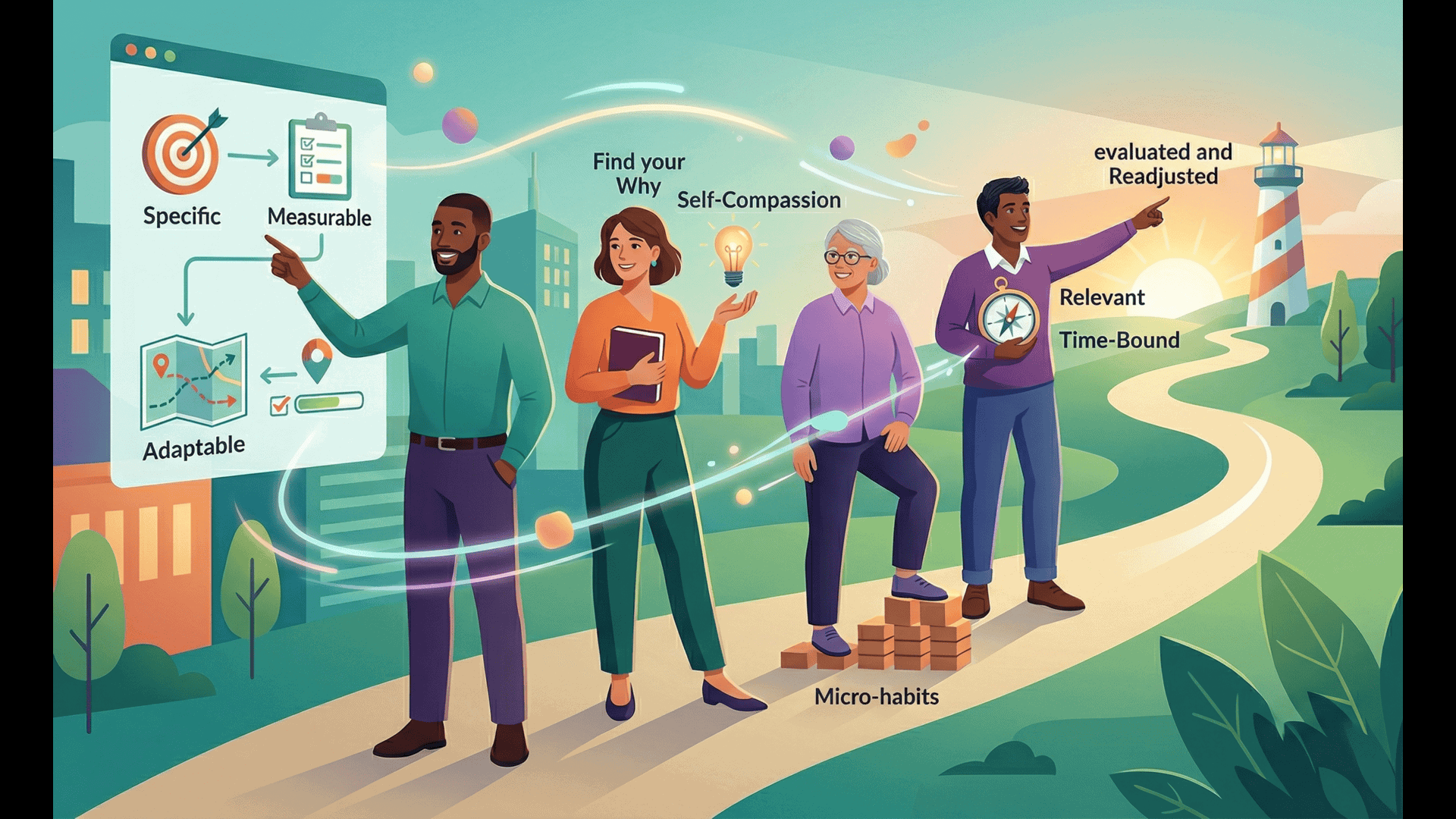
3. Step Two: The SMARTER Goal Framework
You have likely heard of SMART goals (Specific, Measurable, Achievable, Relevant, Time-bound). While this is a great starting point, we need to adapt it to be more inclusive of the human experience. Let’s look at the upgraded SMARTER framework.
Specific
Vague goals produce vague results. “I want to be healthier” is a wish. “I want to walk for 20 minutes a day” is a specific goal. You need to know exactly what success looks like.
Measurable
How will you track your progress? This doesn’t always mean tracking numbers on a scale or dollars in a bank account. It can be a simple habit tracker where you check off a box. The goal is to have objective evidence that you are moving forward.
Adaptable (Replacing “Achievable”)
This is a crucial shift for inclusive goal setting. Life is unpredictable. Chronic illness flares up, family emergencies happen, and burnout is real. If your goal requires 100% perfection, you will quit the first time you stumble. Build flexibility into your goals. Create a “baseline” and an “ideal.”
- Ideal: Workout for 45 minutes, 4 days a week.
- Baseline (for low-energy days): Stretch for 10 minutes.
Both count as a win.
Relevant
Does this goal align with your current season of life? If you just had a baby, starting an intensive side hustle might not be relevant to your current capacity. Ensure your goals align with your current values and resources.
Time-Bound
Give yourself a deadline, but make it realistic. Deadlines create a sense of urgency and prevent goals from floating perpetually in the future.
Evaluated
Regularly review your goals. Set a monthly calendar reminder to check in. Are you making progress? If not, why? This isn’t an invitation to judge yourself, but an opportunity to gather data.
Readjusted
If your evaluation reveals that a goal is no longer serving you, or the method isn’t working, change it! Pivoting is not failing; it is a sign of intelligence and self-awareness.
4. Step Three: The Magic of Micro-Habits
One of the biggest mistakes people make is trying to overhaul their entire life overnight. Motivation is like a spark—it’s great for starting a fire, but it won’t keep it burning. For that, you need the slow, steady fuel of habits.
In his groundbreaking work, author James Clear discusses the concept of atomic habits (you can explore more of his concepts at JamesClear.com). The premise is that massive success doesn’t require massive action; it requires small, consistent improvements.
Shrink the Goal Until It’s Too Easy to Fail
If your goal is to floss your teeth every night, start by committing to flossing one tooth. It sounds ridiculous, but that is the point. You are removing the mental friction of starting. Once you have the floss in your hand and have done one tooth, you will likely do the rest. But on the days you are absolutely exhausted, flossing one tooth keeps the habit streak alive.
Habit Stacking
Instead of trying to find a new time slot for a new behavior, “stack” it onto something you already do without thinking.
-
Instead of: “I will meditate more.”
-
Try: “After I pour my morning cup of coffee, I will sit and take five deep, mindful breaths.”
By tying the new habit to an existing, deeply ingrained anchor (making coffee), you automate the behavior much faster.
5. Step Four: Anticipate Roadblocks with Implementation Intentions
Most goal-setting advice focuses on the sunny, best-case scenario. But what happens when things go wrong? To set goals you’ll actually achieve, you have to plan for failure.
Psychologist Peter Gollwitzer pioneered the concept of “Implementation Intentions,” which are essentially “If-Then” plans. By deciding in advance how you will handle obstacles, you bypass the need to make a decision when you are stressed or tired.
How to Create If-Then Plans:
Sit down and list every realistic obstacle that could derail your goal. Then, create a plan for it.
-
Obstacle: I want to cook dinner after work, but I often feel too exhausted.
-
If-Then Plan: If I am too tired to cook on a weeknight, then I will keep two healthy pre-made meals in the freezer that I can just heat up, so I don’t order takeout.
-
-
Obstacle: I want to save money, but my friends always invite me out for expensive drinks.
-
If-Then Plan: If my friends invite me out, then I will suggest we meet for a coffee walk instead, or I will eat beforehand and just order an appetizer.
-
Key Takeaway: You cannot control the obstacles life throws at you, but you can control your pre-planned response to them.
6. Step Five: Architect Your Environment
Willpower is weak; environment is strong. You can have the best intentions in the world, but if your environment is actively working against you, you will struggle. Designing your environment—often called choice architecture—involves making the right choices the easiest choices, and the wrong choices the hardest ones.
Reduce Friction for Good Habits
If you want to read more before bed, put the book on your pillow in the morning. If you want to exercise in the morning, lay your clothes out the night before and put your shoes by the door. Every step you remove between yourself and the desired action increases your chance of success.
Increase Friction for Bad Habits
Conversely, if you are trying to break a habit, make it difficult. If you want to spend less time on social media, log out of the apps every time you use them, or use a website blocker. The extra seconds it takes to type in your password might just be enough time for your rational brain to kick in and say, “Actually, I don’t need to do this right now.”
The Power of Your Social Environment
Your environment includes the people around you. Seek out individuals who normalize the behaviors you want to adopt. If you are trying to write a book, join a local writers’ group. If you are trying to learn coding, participate in online forums. Accountability and community are massive drivers of human behavior.
7. Step Six: Practice Relentless Self-Compassion
This is arguably the most important, and most overlooked, step in goal setting. When we stumble, our instinct is often self-flagellation. We beat ourselves up, label ourselves as failures, and abandon the goal entirely.
Research shows that self-criticism actually decreases motivation and self-control. It shifts the brain into a state of inhibition. Self-compassion, on the other hand, allows us to acknowledge a mistake without letting it define us.
If you miss a week of your new routine, speak to yourself the way you would speak to a friend. You wouldn’t tell a friend they are a hopeless failure; you would tell them it’s been a tough week and they can try again tomorrow. Offer yourself that same grace. A lapse is not a relapse, and a detour is not a dead end.
Conclusion
Learning how to set goals you’ll actually achieve is not about turning yourself into an unfeeling machine of productivity. It is about deeply understanding your intrinsic motivations, breaking massive mountains into manageable pebbles, planning for the inevitable roadblocks, and shaping your environment to support your success.
Remember to utilize the SMARTER framework, adapt your expectations to your current capacity, and lead with self-compassion. Growth is not a linear, upward trajectory; it is a messy, beautiful series of steps forward, occasional steps back, and continuous course corrections. Take out that notebook again, but this time, write down a goal that honors the reality of who you are and the life you live. You’ve got this.
Frequently Asked Questions (FAQ)
1. How many goals should I set at once?
Less is more. Attempting to change too many areas of your life simultaneously is a recipe for burnout. It is highly recommended to focus on one to three major goals at a time. Once a new behavior becomes an automated habit (which generally takes anywhere from 21 to 66 days), you can begin introducing a new goal.
2. What should I do if I completely lose motivation?
First, recognize that motivation is an emotion, and all emotions are fleeting. Rely on your systems, not your feelings. If you have lost motivation, fall back on your “baseline” goals (the easiest, smallest version of your habit). Revisit your “Five Whys” to remind yourself of the deeper purpose, and check if you are experiencing burnout—in which case, your priority should be rest.
3. Are daily goals better than weekly goals?
It depends entirely on the nature of the goal and your personal lifestyle. Daily goals are excellent for building foundational habits (like drinking water or meditating). Weekly goals offer more flexibility, which is often necessary for larger projects or busy schedules (like “working out 3 times a week” versus “working out every day”). Choose the timeframe that causes you the least anxiety.
4. How do I balance long-term goals with enjoying the present moment?
Focus on the process, not just the destination. If your long-term goal requires you to be miserable in the present, it is not sustainable. Find ways to make the journey enjoyable. For instance, if your goal is to save money for a house, don’t cut out all joy; instead, find free or low-cost activities that bring you present-moment happiness so you don’t feel chronically deprived.
5. Is it okay to change my goals halfway through the year?
Absolutely. This is the “R” (Readjusted) in the SMARTER framework. Life circumstances change, values shift, and new information comes to light. If a goal is no longer relevant, serving your well-being, or realistic given a change in your circumstances, releasing it is a healthy and strategic choice, not a failure.
I hope this framework helps you build a more sustainable and compassionate approach to your ambitions! What is one small, “baseline” habit you feel ready to start implementing today?
Leave a Reply