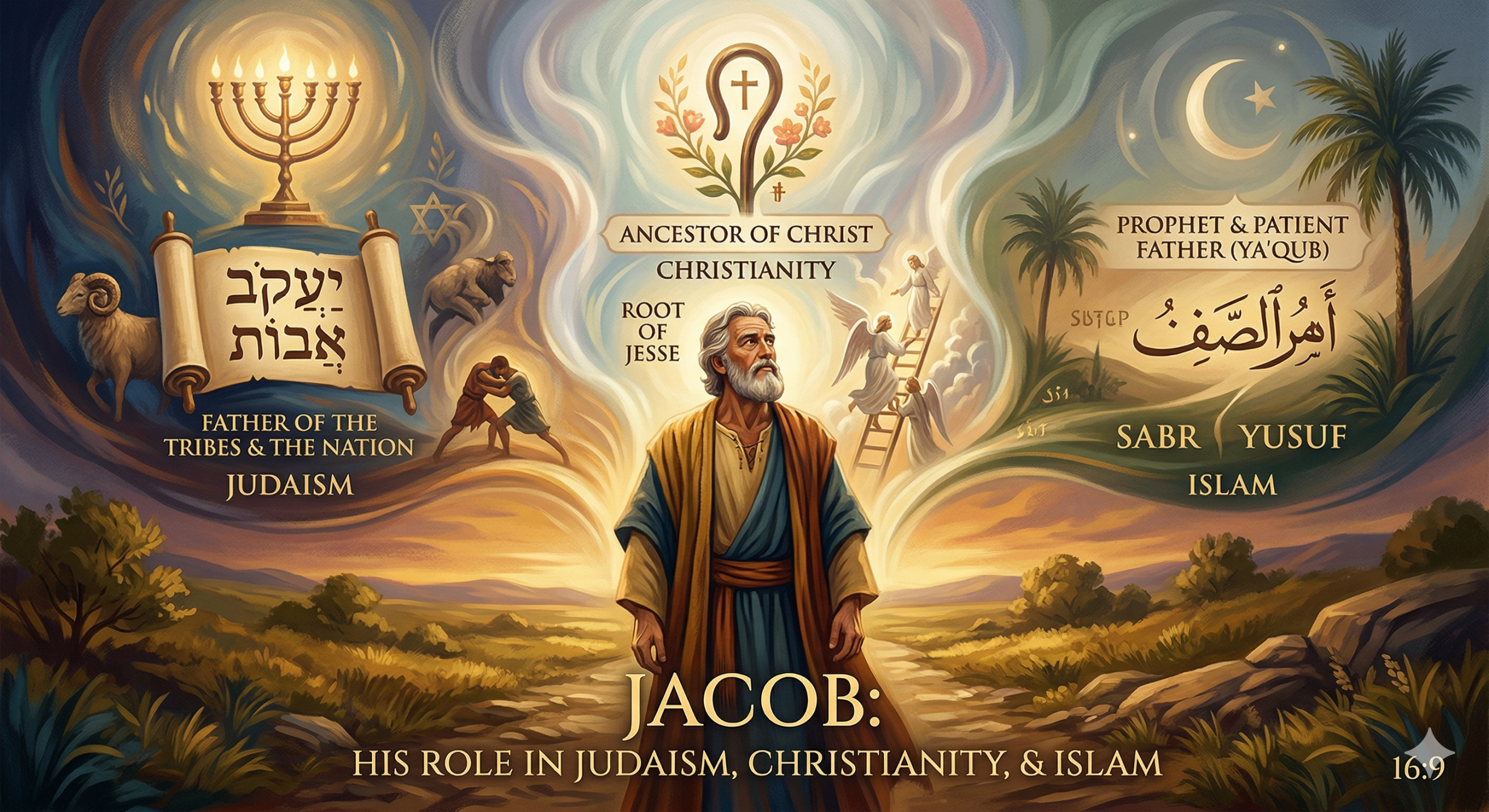
In the tapestry of monotheistic faiths—Judaism, Christianity, and Islam—few figures loom larger than the patriarchs. Among them, Jacob, the son of Isaac and grandson of Abraham, stands as a pivotal figure, revered by billions as a profound ancestor, prophet, and exemplar of faith. His life, a compelling narrative of struggle, transformation, and divine covenant, resonates uniquely within each of these Abrahamic traditions, leaving an indelible mark on their theology, history, and spiritual identity.
Let us embark on a comprehensive exploration to understand who Jacob was and delve deeply into the distinct yet often interwoven roles he plays in Judaism, Christianity, and Islam.
Part 1: Who Was Jacob? A Narrative Introduction
Before we analyze his religious significance, it’s crucial to establish the foundational story of Jacob as primarily depicted in the Hebrew Bible (Genesis).
Early Life and Deception
Jacob, whose Hebrew name Ya’akov means “he who grabs the heel” (as he was born grasping his twin brother Esau’s heel), was the younger of the twins. Esau, a skilled hunter and their father’s favorite, was born first, entitling him to the birthright—the privileges and leadership role within the family.
Jacob, however, was a quiet, domestic man and his mother Rebekah’s favorite. One crucial day, a famished Esau, returning from hunting, notoriously sold his birthright to Jacob for a bowl of red lentil stew. Later, under Rebekah’s guidance, Jacob, disguised as Esau, deceived his blind, dying father into giving him the blessing intended for the firstborn. This act fractured the family, forcing Jacob to flee into exile to escape his brother’s murderous rage.
Exile, Marriage, and Twelve Sons
Jacob traveled to his uncle Laban’s home in Paddan-aram. There, he fell deeply in love with Laban’s younger daughter, Rachel. In a strange twist of poetic justice, Laban tricked Jacob into marrying his older daughter, Leah, first. To marry Rachel, Jacob committed to another seven years of labor—fourteen years in total. During this time and afterwards, through his two wives and their two handmaids (Bilah and Zilpah), Jacob fathered twelve sons (Reuben, Simeon, Levi, Judah, Issachar, Zebulun, Dan, Naphtali, Gad, Asher, Joseph, Benjamin) and at least one daughter (Dinah). These sons would become the eponymous ancestors of the Twelve Tribes of Israel.
Transformation and Reconciliation
After years of accumulating wealth and family, Jacob decided to return to his homeland. The journey was fraught with anxiety about facing Esau. On the night before their meeting, a transformative event occurred. Jacob, left alone, wrestled all night with a mysterious figure (interpreted variously as God, an angel, or Esau’s guardian spirit). As dawn broke, the figure could not overpower Jacob and demanded to be let go. Jacob refused unless he received a blessing. The figure then gave him a new name: Israel, meaning “one who wrestles with God” or “God prevails.” Although Jacob walked away with a limp, he had been profoundly changed, moving from a position of deception to one of tested strength and spiritual commitment.
The subsequent meeting with Esau, contrary to Jacob’s fears, was peaceful and reconciled.
Later Life and Egypt
Jacob’s later life was marked by the favoritism he showed his son Joseph, leading to jealousy among his brothers. They sold Joseph into slavery, deceiving Jacob into believing he was dead, a grief that haunted Jacob for many years. However, divine providence was at work. Through a remarkable series of events in Egypt, Joseph rose to become a powerful ruler, second only to Pharaoh. When a severe famine struck Canaan, Jacob sent his sons to Egypt for grain, leading to a dramatic reunion and forgiveness. Jacob and his entire family settled in Egypt in the fertile land of Goshen.
Jacob spent the final seventeen years of his life in Egypt. Before his death, he blessed his twelve sons and his grandsons Ephraim and Manasseh (sons of Joseph), delivering a poetic prophetic utterance about each son’s future that became significantly important in Jewish tradition. His body was embalmed and, in accordance with his wishes, carried back to Canaan for burial in the Cave of Machpelah alongside his parents, grandparents, and wife Leah.
Now that we have surveyed the major arcs of Jacob’s life story, let’s explore how each faith interprets and reveres him.
Part 2: Jacob’s Role in Judaism
In Judaism, Jacob is not merely an ancestor; he is the central patriarch, his name synonymous with the nation itself. His narrative is woven into the very fabric of Jewish history, theology, and ritual.
1. The Forefather and Name-Giver of the Nation
While Abraham is the first patriarch who discovered monotheism and established the covenant, and Isaac is the second, it is from Jacob that the “Children of Israel” truly descend.
The Progenitor of the Twelve Tribes: His twelve sons are the physical and symbolic origins of the entire Jewish people. Each of the tribes traces its lineage directly back to one of Jacob’s sons, ensuring his personal history is the collective history of the nation.
The Symbol of Ongoing Struggle and Identity: His new name, Israel, became the defining name for the entire people and, ultimately, for the modern state. The wrestling narrative is often interpreted as a metaphor for the Jewish people’s historically turbulent relationship with God—questioning, striving, and always remaining connected. Judaism, in essence, is the religion of those who continue to “wrestle with God.”
2. A Righteous, Thoughtful Patriarch
While earlier sources sometimes depict Jacob in a less complex, almost entirely negative light regarding his deceptiveness, later Rabbinic tradition (especially Midrash and later commentators) strives to contextualize or even justify his actions. He is portrayed as a profoundly spiritual and learned man:
A “Pure Man, Dwelling in Tents”: This phrase (Genesis 25:27) is interpreted not as domesticity but as dedication to Torah study, even before the Torah was formally given. Some traditions even imagine him and other patriarchs studying in academies of spiritual wisdom.
A Balance of Attributes: In Jewish philosophical and mystical thought (like Kabbalah), Abraham is often associated with Chesed (loving-kindness/grace) and Isaac with Gevurah (strict judgment/restraint). Jacob is seen as the synthesis and harmonization of these two, representing Tiferet (beauty, truth, compassion). His life, combining struggle and ultimate success, embodies this balanced attribute.
3. Spiritual Connection and Covenant
Jacob’s life is punctuated by divine encounters that re-affirm and expand the covenant made with his father and grandfather:
Jacob’s Ladder: En route to his exile, Jacob dreams of a ladder reaching to heaven with angels ascending and descending. God appears at the top, reiterating the promise of the land, numerous descendants, and divine protection. This event is profoundly symbolic of communication between heaven and earth and is a core memory of divine immanence.
The Wrestling Match: This transformative experience at Peniel signifies not just physical strength, but spiritual endurance and the necessity of confronting internal and external struggles to gain true identity and divine blessing.
The Bet-El Covenant Renewal: After returning to Canaan, Jacob goes back to where he saw the ladder (Bet-El) and is commanded to build an altar. God changes his name to Israel there (or reaffirms the change) and explicitly states, “Be fruitful and multiply; a nation and a assembly of nations shall come from you, and kings shall descend from you” (Genesis 35:11). This firmly solidifies his place as the father of kings, including eventually the Messiah in Jewish thought.
4. The Centrality of the Blessings
The prophetic blessings Jacob bestows upon his sons on his deathbed (Genesis 49) are incredibly significant:
Tribal Prophecy: These blessings are read as foundational texts defining the character, historical trajectory, and unique spiritual role of each of the Twelve Tribes. For example, Judah is blessed with kingship (later interpreted as the Messianic line), Levi and Simeon are criticized for their anger, Joseph is richly blessed with fruitfulness and strength, etc.
Understanding the Future: These verses have historically been studied and commented on extensively by Jewish scholars to find clues about the nature of Jewish destiny, exile, redemption, and the ultimate restoration.
In essence, for Judaism, Jacob is not just a figure from the distant past; he is the living ancestor, the literal and symbolic father of every Jew and the nation of Israel. His stories are studied, his virtues are emulated, and his struggles are seen as reflections of the continuing Jewish experience.
Part 3: Jacob’s Role in Christianity
While Christianity, like Judaism, reveres the Hebrew Bible (as the Old Testament) and thus the core historical narrative of Jacob, its emphasis and interpretation are distinctly shaped by the person and work of Jesus Christ. Jacob remains a significant patriarch and prophet, but his role is often viewed through a christological lens.
1. A Key Ancestor in the Genealogy of Jesus
One of the most immediate and tangible ways Jacob figures in Christianity is through the genealogies of Jesus provided in the Gospels of Matthew and Luke.
Establishing Messianic Credentials: Both genealogies explicitly trace Jesus’ lineage back through Joseph (his legal father, in Matthew’s case) or Mary (often interpreted to be Luke’s focus), with Jacob clearly included as a link.
Fulfillment of Prophecy: This places Jesus squarely within the lineage of the patriarchs and the tribe of Judah, fulfilling key Messianic prophecies in Christian interpretation. Jesus is understood as the “King of the Jews” (descendant of Judah, blessed by Jacob) and, ultimately, the fulfillment of the entire Abrahamic-Isaac-Jacob covenant, now extended to all nations
2. A Type or Prefigurement of Christ and His Church
Christian theology frequently uses typological interpretation—seeing events and figures in the Old Testament as foreshadowing (types) of Christ and New Testament truths.
The Twelve Apostles and Twelve Tribes: Just as Jacob fathered the twelve tribes that formed the physical Israel, Christ chose twelve apostles to form the foundations of the “new Israel”—the Christian Church. This parallel is widely recognized in Christian iconography and thought.
The True Israel: The name “Israel” itself is complex. Christianity considers itself the “True Israel” (or “Israel of God”), meaning those who, by faith in Christ, are now inheritors of the spiritual promises made to Abraham, Isaac, and Jacob. Jacob’s transformation and reception of the name “Israel” can be seen, for Christians, as a prototype of the transformation through Christ and the resulting spiritual identity as God’s chosen people.
Jacob’s Deception vs. Christ’s Sinlessness: Some Christian interpretations may contrast Jacob’s use of deception (even if understandable in context) with Christ’s absolute sinlessness and perfect righteousness. While still revered, Jacob, like all Old Testament figures, is seen as ultimately human, needing a savior, which contrasts with the divine nature of Jesus.
The Stairway to Heaven: The imagery of Jacob’s ladder is often interpreted Christologically. Christ himself says, “You will see heaven open, and the angels of God ascending and descending on the Son of Man” (John 1:51). Here, Jesus identifies himself as the ultimate mediator, the true “ladder” connecting God and humanity, fulfilling and superceding the symbolic ladder of Jacob.
3. An Example of Faith and Grace
Despite his complexities, Jacob is ultimately included in the “Hall of Faith” in Hebrews 11. He is presented as:
A Hero of Faith: His actions, including blessing his sons (particularly Ephraim and Manasseh, intentionally crossing his hands to bless the younger above the older, a significant action noted in the epistle), are celebrated as acts of faith. He believed God’s promises and looked forward to the ultimate fulfillment.
A Recipient of Grace: The narrative demonstrates God’s sovereignty and grace. God chose and blessed Jacob, the younger, even before his birth, not because of his worthiness (which was initially questionable), but because of God’s own purposes. This theme of unexpected choice and divine grace resonates strongly in Christian theology.
4. Ethical Teaching and Reconciliation
The moral lessons from Jacob’s life are often emphasized in Christian preaching and teaching:
Consequences of Sin: His acts of deception led to immediate exile, family division, and ultimately his own deception by Laban. This serves as a cautionary tale about the pitfalls of manipulation and dishonesty, even when trying to secure seemingly good outcomes (like God’s blessing).
The Power of Transformation and Reconciliation: His change in character and subsequent reconciliation with Esau are powerful illustrations of forgiveness and the possibility of transforming broken relationships, aligning with core Christian values.
While Jacob remains foundational in terms of history and genealogy, Christianity’s primary focus is Christ. Jacob’s role, therefore, is multifaceted: he is a literal ancestor, a symbolic prefigurement, and an enduring example of faith and God’s grace—all ultimately pointing towards the person of Jesus Christ as the fulfillment of the covenant and the true source of spiritual identity.
Part 4: Jacob’s Role in Islam
In Islam, Jacob is revered as a major prophet and messenger of God, a noble ancestor of other prophets (most notably Joseph), and a model of righteous conduct. While the Quran confirms much of the core narrative from earlier scriptures, its portrayal focuses on spiritual lessons, unwavering faith, and the prophet’s role in conveying God’s message.
1. A Noble Prophet and Righteous Servant
The Quran explicitly lists Jacob (known as Ya’qub) among the prophets and righteous figures:
Praiseworthy and Endowed: He is described as one of the “excellent” and “chosen ones” (Surah 38:45-47), possessed of “spiritual power and vision.” In Surah 6:84, he, along with his father and grandfather, is numbered among those who were given guidance, scripture, and wisdom.
A Link in the Prophetic Chain: Islamic tradition emphasizes a continuous chain of prophets, all teaching the same fundamental message of monotheism (Tawhid). Jacob is a crucial link between Isaac and the long line of Israelite prophets who followed, continuing the path established by Abraham.
2. Emphasis on Fatherly Patience and Spiritual Wisdom
The Quranic narrative of Jacob focuses disproportionately on his relationship with his sons, particularly the loss of Joseph. His character is presented as:
The Embodiment of Sabr (Patience/Perseverance): In Surah Yusuf (one of the most detailed narratives in the Quran), Jacob’s profound grief over the disappearance of Joseph is contrasted with his unwavering faith. When his other sons repeatedly lie to him about Joseph’s fate, Jacob’s response is often: “Beautiful patience is my resort” (Fasabrun jameel, Surah 12:18, 83). He models dignified, trusting patience rather than despair, trusting completely in God’s ultimately benevolent plan.
Deep Spiritual Insight: Despite being visually blind later in life due to grief, Jacob is portrayed as possessing true spiritual vision. In the same surah, he says, “I know from Allah that which you do not know” (Surah 12:86), indicating a prophetic understanding beyond the obvious, physical reality.
The Role of a Teacher/Mentor: He is depicted as advising his sons, not just physically protecting them, but instructing them on etiquette (such as entering the city by different gates) and spiritually reminding them of God’s sovereignty. Even when criticizing them, his deep, enduring love is palpable.
3. Specific Departures and Islamic Focus
While confirming the core story, the Quran often omits or differs on certain details present in the Hebrew Bible, shaping the narrative according to Islamic theological priorities:
Downplaying or Nuancing the Deception: The Quran does not detail the dramatic deception of Isaac for the blessing, nor does it portray Jacob explicitly wrestling physically with God or an angel. The focus isn’t on a moral low point or a transformative wrestle but rather on his consistent righteousness and patience throughout trials. While his younger life is not emphasized, his character during the Joseph narrative is the primary canvas for his virtues.
Explicit Monotheistic Identity: The Quran firmly depicts Jacob (and other pre-Islamic prophets) as Muslims (meaning “those who submit to God”). On his deathbed, rather than focusing on tribal futures, the Quran portrays Jacob gathering his sons and asking, “What will you worship after me?” They reply, “We will worship your God and the God of your fathers—Abraham, Ishmael, and Isaac—the One God, and we submit to Him” (Surah 2:133). This reinforces the concept that the core message has always been one and the same.
Importance of Joseph and Egypt: Jacob is heavily intertwined with the story of Joseph, which is celebrated in Islam as the “most beautiful of stories.” Jacob’s eventual journey to and life in Egypt are viewed as parts of God’s overarching plan to establish Joseph and eventually the Israelites in a position of influence and, much later, leading to the events with Moses and the Exodus.
4. A Symbol of Faith and Forgiveness
Unwavering Trust: Even in his deepest sorrow and when others mocked his grief or expressed doubt, Jacob remains a paragon of unwavering trust in God’s justice and mercy.
Model of Forgiveness: His final, magnanimous forgiveness of his sons for their past actions towards Joseph, and his promise to seek God’s forgiveness on their behalf, highlights the central Islamic values of mercy, repentance, and reconciliation within families.
For Muslims, Jacob is more than an ancestor; he is an inspired prophet whose life—particularly his response to immense loss—provides profound lessons on patience, faith, family relationships, and the true meaning of submitting to God’s will.
Part 5: Comparing and Contrasting His Roles
Now that we have explored Jacob’s role within each tradition, let’s explicitly compare and contrast them.
| Feature | Judaism | Christianity | Islam |
| Primary Identity | Progenitor of the Nation, Name-Giver, Living Ancestor | Vital Ancestor of Jesus Christ, Type of Christ/Church | Major Prophet, Messenger of God, Noble Moral Exemplar |
| Name “Israel” | The defining name for the entire people and land; symbol of ongoing struggle. | Typologically applied to the Church (“True Israel”); fulfillment found in Christ. | Not emphasized as much in the primary narrative, though the concept of the Children of Israel (Bani Isra’il) is frequently mentioned. |
| Central Narrative Focus | Struggles (Esau, wrestling), Deception/Transformation, Covenantal Promises, Tribal Blessings. | Genealogy of Jesus, Covenant Fulfillment, Typology, Example of Faith/Grace. | Relationship with Sons (Sabr, Patience), Spiritual Insight, Teaching Monotheism, Forgiveness, Link to Joseph. |
| Theological Focus | Ongoing relationship with God (struggle), Synthesis of attributes (Tiferet), Continuity of covenant. | Grace, Christology (genealogy, typology), Faith as trust in future fulfillment. | Tawhid (Monotheism), Prophetic chain, Sabr (Patience), Forgiveness, Continuous line of submission. |
| Role as Patriarch | One of the three foundational “Fathers” (avot), deeply revered and studied. | Revere as a significant Old Testament figure and crucial link in Jesus’ lineage. | Highly respected prophet and ancestor; distinct emphasis on specific moral qualities and paternal love. |
| Textual Source | Hebrew Bible (Torah, especially Genesis); Midrash, Rabbinic commentary, Zohar (Kabbalah). | Old Testament (Genesis, other references) and New Testament (Genealogies, Typology, Example). | The Quran (Surahs 2, 3, 4, 6, 12, 19, 21, 38, etc.); Hadith, Islamic commentary (Tafsir). |
| Ritual/Daily Life | Integral to Jewish history, identity, liturgy (mention in prayers), and tribal association. | Revere as part of sacred history, illustrative teachings. | Remember as a revered prophet, recited in prayers and stories of the prophets, example of patient conduct. |
Key Points of Connection:
Shared Lineage: All three religions recognize Jacob as a direct descendant of Abraham and Isaac, confirming a profound shared history and common spiritual ancestry.
The Covenant: While interpreted differently, the concept of a special promise made to Abraham, which continued through Isaac and Jacob, is central to understanding his significance for all three faiths. For Jews, it is the ongoing physical and spiritual covenant with their nation. For Christians, it is a covenant that finds its complete and universal fulfillment in Jesus. For Muslims, it is part of the broader, continuous prophetic message of monotheism that culminated in Prophet Muhammad.
Revered Moral Examples: Though with varying emphases (e.g., Jewish focus on transformation, Christian on grace/faith, Islamic on patience/prophetic righteousness), all traditions present Jacob as a figure from whom profound moral and spiritual lessons can be drawn. Themes of family, faith in difficulty, transformation, and reconciliation resonate across all three.
Shared Narrative Base: Despite specific departures or shifts in focus, the fundamental events of his life—his brothers, his deception/struggles, his marriage/sons, his migration to Egypt, and his relationship with Joseph—form a common bedrock of story.
Key Points of Divergence:
The Nature of Identity: Is Jacob primarily the literal father of the physical Jewish nation (Judaism), a symbolic/genealogical link for the Christian messiah and a foreshadowing of the multi-national Church (Christianity), or an esteemed prophet and messenger of the One True Faith as taught by all prophets including Muhammad (Islam)? This fundamental difference in perspective defines how his entire life is interpreted.
Central Event Emphasis: Judaism places immense weight on the wrestling narrative and name change to Israel, interpreting it as a national metaphor. Islam focuses on his role as a patient father during the Joseph story. Christianity prioritizes his place in Jesus’ genealogy and typological significance.
Christological Interpretation: This is the singular defining difference for Christianity. Every aspect of Jacob’s significance, from his genealogy to his symbolic roles, is understood in relation to Jesus Christ. Judaism and Islam have completely different theological frameworks for understanding messiahship or prophethood.
The Deception Narrative: Judaism and Christianity grapple with the initial deception and portray it as a complex event that still allowed God’s plan to proceed, eventually leading to transformation for Jacob. Islam downplays or recontextualizes this, emphasizing Jacob’s inherent prophetic righteousness and patience.
Conclusion
In conclusion, Jacob, whether called by that name or revered as Ya’qub, is far more than a figure of ancient history; he is a bridge across centuries and a profound connection point between Judaism, Christianity, and Islam. As we have explored:
For Judaism, he is the living ancestor, the literal father of the Twelve Tribes, and the symbol of the perpetual wrestling with God that defines Jewish identity and destiny.
For Christianity, he is a critical link in the genealogy of Jesus, a dynamic type prefiguring Christ and the Church, and a powerful example of faith and God’s unexpected grace.
For Islam, he is an esteemed prophet and messenger, a paragon of fatherly patience and unwavering faith during trials, and a noble link in the continuous chain of monotheistic guidance.
While distinct theological frameworks interpret his life and role differently, the shared reverence for this foundational patriarch highlights the deep commonality and profound differences that shape these three sister faiths. By studying figures like Jacob, we gain not only a deeper understanding of each tradition but also a richer appreciation for the intricate and often beautiful ways in which their narratives are intertwined. Understanding Jacob’s multifaceted role can contribute to greater mutual respect and a more nuanced dialogue among the Abrahamic religions, reminding us all of our shared spiritual heritage and the enduring power of faith, transformation, and patience.
Frequently Asked Questions: Jacob in the Abrahamic Faiths
1. Who was Jacob?
Jacob was a central patriarch in the Abrahamic traditions. He was the son of Isaac, the grandson of Abraham, and the younger twin brother of Esau. He is best known for acquiring his brother’s birthright, receiving his father’s blessing, and fathering twelve sons who became the ancestors of the Twelve Tribes of Israel.
2. Why was Jacob’s name changed to Israel?
According to the biblical narrative, Jacob’s name was changed after he wrestled all night with a divine figure. The name “Israel” translates to “one who wrestles with God” or “God prevails.” This marked a turning point in his life, symbolizing his transformation from a man who relied on deception to one of tested spiritual strength and endurance.
3. Why is Jacob considered the central patriarch in Judaism?
While Abraham and Isaac came before him, Jacob is the literal progenitor of the Jewish nation. His twelve sons form the foundation of the Twelve Tribes of Israel. Furthermore, his new name, Israel, became the defining identity for the Jewish people, and his life’s struggles are viewed as a reflection of the nation’s ongoing, dynamic relationship with God.
4. How does Christianity interpret the story of Jacob?
Christianity reveres Jacob primarily as a vital ancestor in the earthly lineage of Jesus Christ, fulfilling Old Testament prophecies. Additionally, Christians often view his life typologically; for example, just as Jacob fathered the twelve tribes of physical Israel, Jesus chose twelve apostles to build the Christian Church (often referred to as the “True Israel”).
5. What is Jacob’s (Ya’qub’s) primary significance in Islam?
In Islam, Jacob is highly esteemed as a noble prophet and messenger of God. The Quran places a strong emphasis on his character, specifically highlighting his profound, unwavering patience (Sabr) and unshakeable trust in God during the long disappearance of his beloved son, Joseph (Yusuf). He is viewed as a model of righteous fatherhood and spiritual wisdom.
6. Do all three religions view his early acts of deception the same way?
No, there is a divergence in focus. Judaism and Christianity grapple with his early deception (tricking his father for the blessing) as a complex event that highlights his human flaws, the necessity of his later spiritual transformation, and the sovereignty of God’s grace. Islam, however, does not emphasize these deceptive acts, focusing instead on his consistent righteousness, prophetic insight, and patient endurance in his later life.