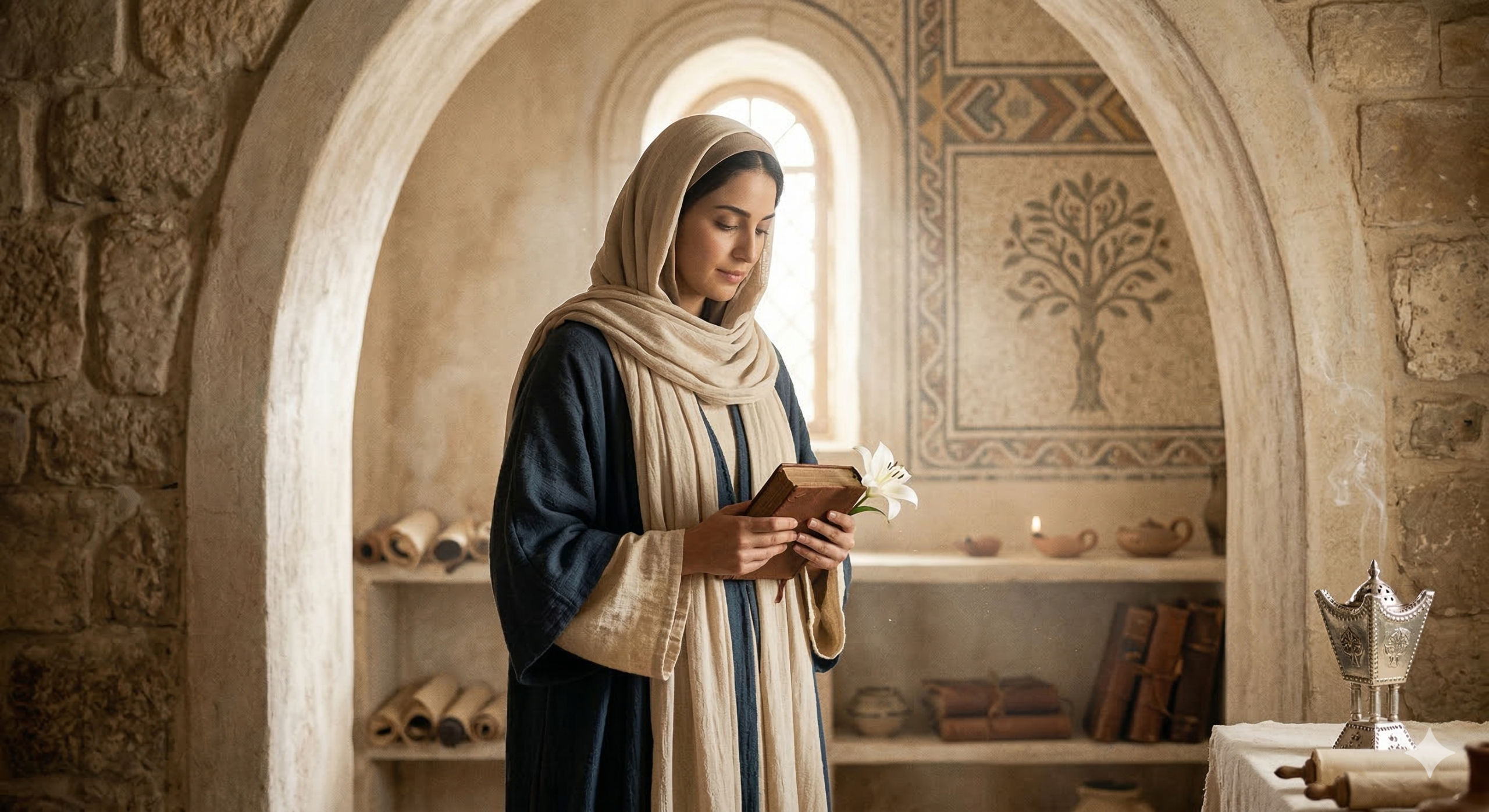
Maryam, the mother of Isa (Jesus), peace be upon them both, is one of the most revered and iconic women in human history. While best known for her central role in the foundational narratives of Christianity and Islam, her influence and the descriptions of her character ripple through various other faith traditions and historical texts.
This post delves into the fascinating and multifaceted way Maryam (PBUH) is described across different religions, exploring the nuances of her portrayal and the universal themes of faith, purity, and devotion she embodies.
1. Maryam (PBUH) in Islam: The Exalted, Purified, and Chaste
In Islam, Maryam (PBUH) holds an unparalleled status among women. Her name is mentioned 34 times in the Quran, more than in the entire New Testament, making her the only woman explicitly named in the holy text. Her life and character are described in great detail, primarily in Surah Al-Imran (Chapter 3) and Surah Maryam (Chapter 19), which is named in her honor.
A. The Vowed Child and Divine Care
The Quranic narrative begins before her birth. Her mother, the wife of Imran, made a vow to dedicate the child in her womb to the service of God at the Temple in Jerusalem. When she gave birth to a female child, she initially expressed surprise but fulfilled her promise, naming her Maryam, meaning “maidservant of God.”
From a young age, Maryam’s devotion was extraordinary. The Quran describes how she was placed under the guardianship of the Prophet Zakariya (Zachariah). Each time he entered her private chamber (mihrab), he found her with miraculous provisions of food and drink, which she stated were from Allah. This early description establishes her as a recipient of unique divine grace and protection.
B. The Annunciation and the Miraculous Virgin Birth
The most defining event in Maryam’s life is the Annunciation. The Angel Jibril (Gabriel) appeared to her in the form of a man to announce that God had chosen her to give birth to a “pure son.” Her response, marked by humility and faith, is captured in the Quranic verse:
“She said, ‘My Lord, how will I have a child when no man has touched me?’ [The angel] said, ‘Such is Allah; He creates what He wills. When He decrees a matter, He only says to it, ‘Be,’ and it is.'” (Quran 3:47)
This description powerfully emphasizes both her perpetual virginity and the omnipotence of God. Isa’s birth is portrayed as a profound miracle, not as evidence of his divinity, but as a “Sign unto men and a Mercy.”
C. Her Exemplary Character and Titles
Throughout the Quran, Maryam is described with the highest of virtues. She is called Siddiqah (the truthful, she who sincerely believes), Mustafia (the chosen one), and Tahirah (the purified). She is held up as a model for all believers, a woman who guarded her chastity, believed in the words of her Lord, and was “of the devoutly obedient” (Qanitin).
Her pain and vulnerability during childbirth are also humanely depicted, showing her strength and complete reliance on God in her moment of greatest need. When she brought the infant Isa to her people and they accused her of unchastity, God miraculously made the baby speak from the cradle to defend his mother’s innocence and announce his prophetic mission.
2. Mary in Christianity: The Mother of God and Spiritual Beacon
In Christianity, Mary is at the heart of the salvation narrative, uniquely honored as the mother of Jesus Christ, whom Christians believe to be the Son of God and the Messiah. While all Christian traditions revere her, the descriptions and level of devotion vary.
A. The Biblical Narrative: Purity and Discipleship
The Gospels of Matthew and Luke provide the canonical account of Mary. She is described as a young, chaste woman in Nazareth, betrothed to a man named Joseph of the house of David. Similar to the Quranic account, the Angel Gabriel appears to her, declaring her “full of grace” and favored by God to conceive the Messiah through the Holy Spirit.
Her acceptance of this monumental call, known as her Fiat, is described as the ultimate act of faith and obedience: “Behold, I am the servant of the Lord; let it be to me according to your word.” (Luke 1:38). This phrase establishes her as the archetype of perfect discipleship.
B. “Theotokos” and the Mother of God
A key theological title bestowed upon her is Theotokos, a Greek term meaning “God-bearer” or “Mother of God.” This title was formally affirmed at the Council of Ephesus in 431 AD, signifying her unique role in the Incarnation of Christ. This description elevates her not just as the historical mother of a human but as the woman chosen to give human form to the divine.
C. Diverse Traditions of Veneration
- Catholicism: Places a particularly strong emphasis on Mary, often referring to her as the “Blessed Virgin Mary” and the “Queen of Heaven.” Catholic doctrine includes the Immaculate Conception (the belief that she was conceived without original sin) and the Assumption (the belief that her body and soul were taken into heaven at the end of her life). She is described as a primary intercessor and “Mother of the Church.”
- Eastern Orthodoxy: Also holds a deep devotion to Mary, who is consistently referred to as the Theotokos and Panagia (All-Holy). She is a central figure in icons and liturgy, often depicted in a position of honor next to Christ.
- Protestantism: Generally focuses on the biblical description of Mary as a faithful servant and the historical mother of Jesus. While most Protestants respect her role and honor her faith, they tend to emphasize that worship and prayer belong solely to God, often avoiding the post-biblical dogmas and devotional practices common in Catholic and Orthodox traditions.
3. Beyond the Mainstream: Perspectives from Other Traditions
While Christianity and Islam offer the most detailed and revered descriptions, Maryam’s figure appears in or is viewed through the lens of other religious and historical contexts, sometimes with striking differences.
A. Judaism: Historical Context and Interpretations
In the Hebrew Bible (the Tanakh), which pre-dates the birth of Jesus, there is no direct figure corresponding to the Mary of the New Testament. However, the name “Mary” itself is derived from the Hebrew Miriam, a significant prophetess and the sister of Moses and Aaron.
The description of Miriam as a leader who guided her people and taught the women offers a compelling pre-figuration of female spiritual authority. In the centuries following the rise of Christianity, some Jewish historical and polemical texts presented Mary in a less-than-venerable light, reflecting the theological tensions between the two emergent religions. However, modern Jewish scholars often view Mary within her correct first-century Jewish context, as a woman of faith living in a turbulent time.
B. Baháʼí Faith: A Station of Honor
The Baháʼí Faith recognizes and honors Maryam as the “Pure and Spotless Virgin.” She is described as one who was chosen by God and through whom the “Word of God” was made manifest. Baháʼí teachings affirm the miraculous nature of Jesus’ birth and describe Mary as a figure of unique purity, humility, and devotion, echoing many of the sentiments found in Islam and Christianity.
C. Druze Faith
In the Druze faith, Maryam is also a respected and sacred figure, viewed through the religion’s unique gnostic and esoteric interpretations. She is seen as an embodiment of spiritual purity and a key figure in the historical chain of divine manifestation.
Conclusion: A Thread of Purity and Faith
From the exalted “Sayyidatuna” (Our Lady) and “Greatest Woman” in Islam to the “Theotokos” (God-Bearer) and “Blessed” in Christianity, Maryam (PBUH) is described with a rich array of titles and from diverse theological perspectives.
While the doctrinal implications of her life—her exact status, the nature of her son, and her role in salvation—continue to be areas of significant debate and division among faiths, a powerful and unifying thread runs through all descriptions of her. She is consistently portrayed as a woman of unparalleled purity, profound humility, and unyielding faith. Her unwavering “yes” to God, despite the monumental challenges and societal judgment she faced, stands as a universal and inspiring beacon of devotion that continues to resonate with billions of people around the world.