The story of a devastating flood, a righteous man, and a vessel of salvation is one of humanity’s most enduring and widely known narratives. While many are familiar with the Noah of the Sunday School stories—the old man with a long beard rounding up animals two-by-two—this description barely scratches the surface.
Noah (known as Nōaḥ in Hebrew and Nūḥ in Arabic) is a titanic figure in spiritual history. He is revered by billions of people across the globe, yet the nuances of his character, the purpose of his mission, and his final legacy differ significantly between religious traditions.
This post will delve into how Noah is described in the foundational texts and traditions of major world religions, revealing a figure who is at once a blameless patriarch, a powerful preacher, and a symbolic manifestation of Divine guidance.
1. Judaism: The Blameless Patriarch and the Universal Covenant
In Judaism, the story of Noah is found in the Book of Genesis, chapters 5-9. In this narrative, Noah is the tenth generation from Adam, a crucial link in the antediluvian (pre-flood) line.
How is He Described?
Judaism describes Noah primarily through the lens of his righteousness and obedience. Genesis 6:9 provides the quintessential summary of his character: “Noah was a righteous man, blameless in his generation. Noah walked with God.”
In a world described as being filled with corruption, lawlessness, and wickedness, Noah stands alone as the solitary example of piety. He is a man who implicitly listens to God. When commanded to build a massive ark, collect a bewildering array of animals, and prepare for a catastrophe, Noah does so without a single recorded word of protest or doubt.
His Spiritual Significance
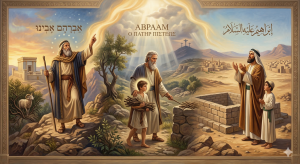
While his righteousness is celebrated, Jewish rabbinical discussion surrounding Noah is complex. Some rabbis point out that his description is qualified: he was “blameless in his generation.” This has led to comparisons with Abraham. Abraham famously argues with God to save the wicked cities of Sodom and Gomorrah. Noah, in contrast, appears to accept the destruction of his neighbors without interceding on their behalf.
This comparison isn’t necessarily a condemnation of Noah, but rather a subtle critique that sets the stage for Abraham’s more active, pastoral form of righteousness. Noah is often viewed as “the righteous man in a fur coat,” who ensures his own comfort (and survival) but doesn’t necessarily warm the world around him.
The Noahide Laws
Noah’s legacy in Judaism extends far beyond the flood. He is viewed as the “second father” of humanity, as all people are descended from his three sons: Shem, Ham, and Japheth.
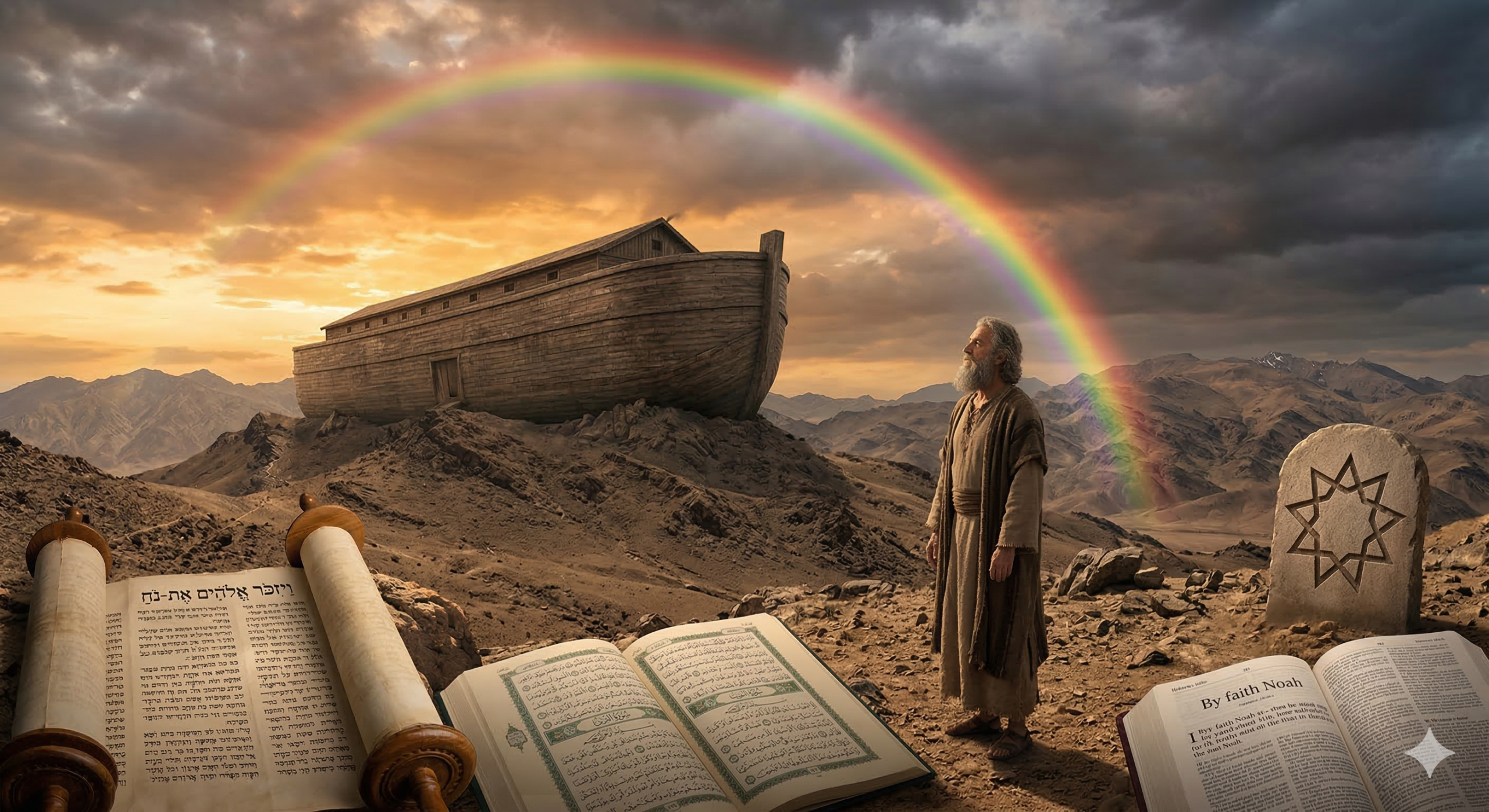
After disembarking from the Ark, God makes the first covenant mentioned in the Torah—not with a specific tribe, but with all living creatures. The rainbow is established as the sign of this eternal promise to never again destroy the earth by flood. As part of this covenant, God gives Noah a set of moral imperatives that are seen as obligatory for all mankind, not just Jews. These Seven Laws of Noah (Noahide Laws) include:
- Not to worship idols.
- Not to blaspheme God.
- Not to commit murder.
- Not to commit adultery or sexual immorality.
- Not to steal.
- Not to eat flesh torn from a living animal.
- To establish courts of justice.
In Jewish law, non-Jews who observe these seven laws are regarded as “Righteous Gentiles” and are assured of a place in the World to Come.
2. Christianity: A Type of Christ and a Preacher of Faith
Christianity inherits the Jewish narrative of Noah but interprets his character and the flood through the lens of New Testament theology. Here, Noah’s story becomes a powerful symbolic foreshadowing, or “type,” of future events.
How is He Described?
The New Testament adds new dimensions to the description of Noah. While Genesis depicts him as quietly obedient, the First Epistle of Peter (3:20) describes the people of Noah’s time as “disobedient” while “God’s patience waited,” suggesting a period of warning.
Crucially, the Second Epistle of Peter (2:5) explicitly calls Noah “a preacher of righteousness.” In this view, he was not just building a ship in secret; he was actively warning his contemporaries of the coming judgment and calling them to repentance, though they refused to listen.
Hebrews 11, the famous “Hall of Faith” chapter, describes Noah as a paragon of faith. It says that “by faith Noah, being warned by God concerning events as yet unseen, in godly fear constructed an ark for the saving of his household.” His faith is shown by his belief in a disaster that had no precedent.
His Spiritual Significance
In Christianity, the flood is seen as a crucial moment of cleansing judgment, paralleling the baptismal waters of the church. The Ark becomes a profound symbol for the Church itself—the only vessel of salvation in a world overwhelmed by the “flood” of sin.
Noah himself is interpreted as a “type” of Christ. Just as Noah saved his family from physical destruction through the Ark, Christ saves humanity from spiritual destruction through the Cross. Both Noah and Christ are righteous men in a sinful world, who bring a small group of believers through a safe passage to a new beginning.
Jesus himself uses the story of Noah to teach about the end times. In the Gospels of Matthew (24:37-39) and Luke (17:26-27), he warns that his second coming will be “just as it was in the days of Noah”—a time when people were living in heedless worldly pursuits, completely unaware of the impending judgment.
3. Islam: A Grateful Servant and the First Messenger of Resolve
Noah, known as Nūḥ, is a figure of immense significance in Islam. He is mentioned in the Quran more than forty times, and Surah 71 of the Quran is named after him. He is considered not just a prophet, but the first Messenger (Rasul) sent by God to humanity to convey a specific code of law (sharia).
How is He Described?
The Quranic description of Noah focuses on his patience, resilience, and unwavering dedication to his prophetic mission. Islam teaches that ten generations of mankind lived in pure monotheism before corruption and idol worship crept in. God sent Noah to warn his people to abandon their false idols (named in Surah Nuh as Wadd, Suwa’, Yaghuth, Ya’uq, and Nasr) and return to the worship of the One True God.
The Quran highlights Noah’s relentless, agonizing effort. For 950 years (Quran 29:14), he preached “by day and by night,” “publicly and privately,” appealing to his people’s reason by pointing to the wonders of creation, and warning them of a “painful torment” if they refused his message. He is described as a “calm and patient man” and a “devotee most grateful” (Quran 17:3).
His Spiritual Significance
The centerpiece of the Islamic Noah story is not his relationship with animals, but the spiritual heartbreak of his mission. The Quran details how his people mocked him (“he is just a human like you,” “only the lowest among us follow him”), put their fingers in their ears, and covered themselves with their garments so they would not see him.
This pain extends into his own family. The Quran states that only “a few” believed with him. His wife is listed among the disbelievers (Quran 66:10). In a particularly poignant scene (Surah Hud 42-43), Noah sees his son being carried away by the floodwaters and begs him to “embark with us,” but the son replies, “I will take refuge on a mountain,” only to be swept away.
Because of this unparalleled endurance in the face of near-total rejection, Noah is classified in Islam as one of the five Ulul ‘azm prophets—the “Prophets of Firm Resolve,” along with Abraham, Moses, Jesus, and Muhammad. His story is told to Prophet Muhammad and his followers as an example of patience, comfort, and ultimate victory in the face of persecution.
4. Baha’i Faith: A Manifestation of God and the Spirit of New Life
In the Baha’i Faith, which views religious history as a series of progressive revelations, Noah is revered as a “Manifestation of God.” This title places him in the same spiritual rank as Abraham, Moses, Jesus, Muhammad, the Báb, and Baha’u’llah.
How is He Described?
The description of Noah in Baha’i writings, primarily in Baha’u’llah’s Kitáb-i-Íqán (Book of Certitude), focuses on him as a perfect reflection of Divine attributes and the bringer of a new spiritual cycle. He is described as being invested with the “robe of Prophethood” and “moved by the Spirit of God” to arose and proclaim His Cause.
The Baha’i Faith echoes the Islamic description of Noah as a man persecuted and rejected. Baha’u’llah writes that for 950 years Noah prayerfully exhorted his people, yet “None, however, heeded His call. Each day they inflicted on His blessed person such pain and suffering that no one believed He could survive.”
His Spiritual Significance
The Baha’i interpretation of the Noah story is deeply symbolic. The primary Baha’i figures have stated that the literal story of a global flood and a physical ark is not a fact of science or anatomy. Instead, the story has a spiritual meaning.
In Baha’i theology:
- The Flood symbolizes the flood of godlessness, ignorance, and materialism that overtakes humanity when it turns away from God.
- The Ark symbolizes the Covenant of God and the Cause of the Manifestation Himself. Only those who enter this “Ark of the Spirit” by accepting the Prophet’s teachings are saved from the spiritual death of the flood.
- The New Earth symbolizes the new spiritual reality and moral order that the Prophet establishes.
Therefore, Noah is described not just as a survival expert, but as the giver of “the grace of a new life” to all who believed in him. Through his sacrifice and endurance, he washed the world of its spiritual “corruption” and prepared the soil of human hearts for the next Manifestation of God.
Conclusion: A Legacy That Overflows the Banks
The story of Noah is often packaged as a simple tale of salvation. However, a deeper look at how he is described in the world’s major religions reveals a complex and profound figure.
- In Judaism, he is the quietly obedient patriarch through whom God makes a universal covenant with all humanity.
- In Christianity, he is the faithful preacher whose story is a profound “type” of Christ and the Church.
- In Islam, he is the resolute Messenger whose 950 years of patient preaching stand as a pillar of fortitude.
- In the Baha’i Faith, he is a Divine Manifestation who symbolicly saves humanity from the flood of godlessness through the “Ark” of his Covenant.
Despite these differences, a unifying thread runs through every description. Noah is always a solitary beacon of light in a darkening world. He is the one who “walks with God” when everyone else runs away. His story is a permanent reminder that even in the face of overwhelming corruption and impending judgment, righteousness is noticed, obedience is rewarded, and a vessel of salvation is always provided for those with the faith to build it.