
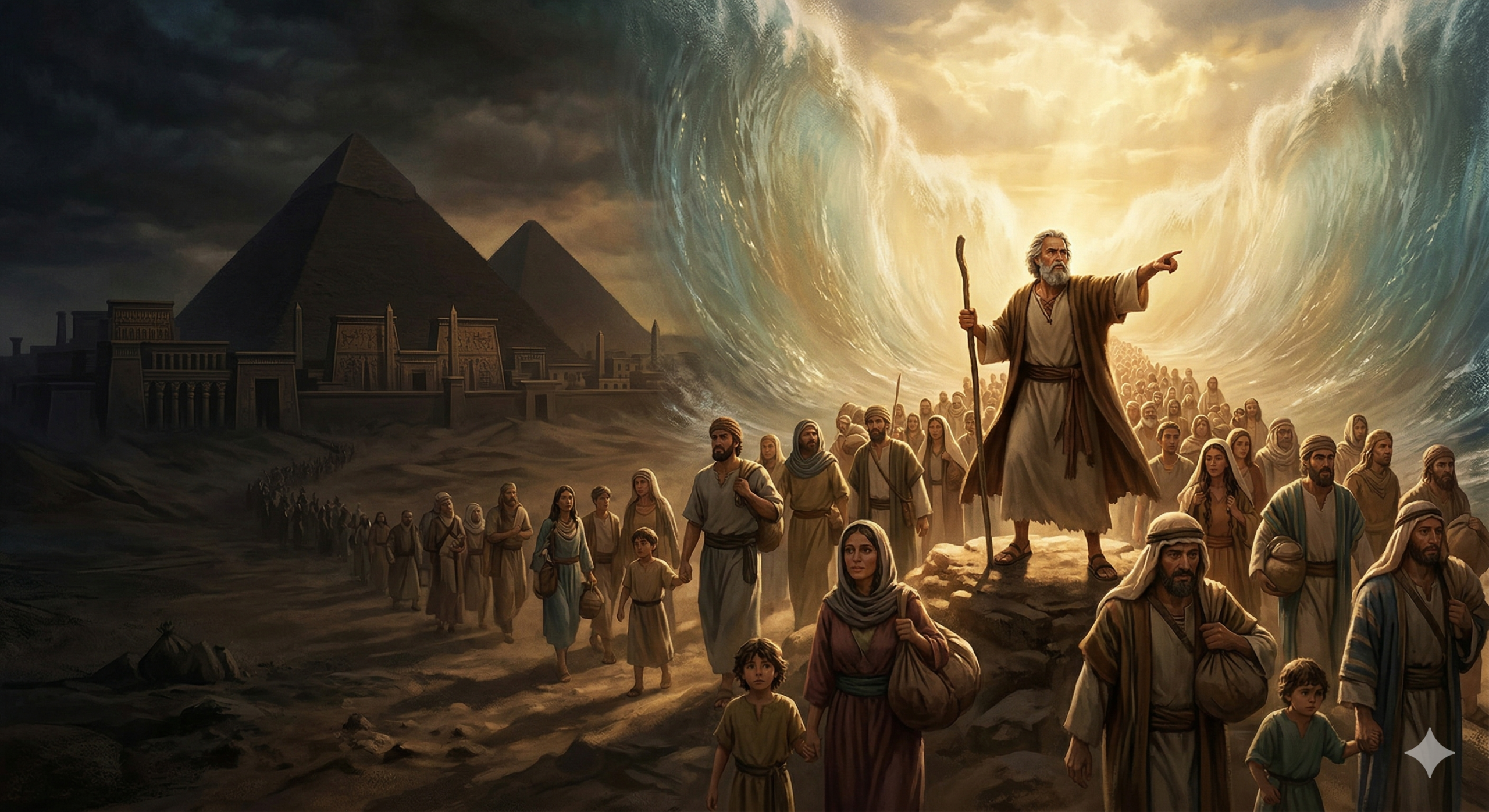
The narrative of Moses and Pharaoh is not just a tale from antiquity; it is a seismic event that reshaped the spiritual landscape of the world. Centered on the themes of divine justice, the struggle against tyranny, and the universal yearning for liberty, this story is a foundation stone of faith for billions of people. For Jews, Christians, and Muslims, the journey from the brick kilns of Egypt to the freedom of the wilderness is a living paradigm, interpreted through unique yet beautifully interwoven perspectives.
This article embarks on a comparative journey, exploring how each of the three major Abrahamic religions understands this epic confrontation, the miracles that accompanied it, and its enduring message of hope: that even the most formidable oppression must yield to the power of ultimate freedom.
Part I: The Cradle of the Narrative: Judaism’s Foundation Stone
For the Jewish people, the story of Moses and the Exodus is the story of their birth as a nation. It is the defining moment of redemption, a central theme that pulsates through their scripture, liturgy, and daily consciousness.
The Context of Bondage
The narrative, primarily found in the Book of Exodus (Shemot in Hebrew), begins with the children of Israel, descendants of Jacob, suffering under a new Pharaoh who “did not know Joseph.” Fearing their growing numbers, he systematically enslaves them and, in a fit of genocidal paranoia, decrees the death of all newborn Hebrew males. It is into this crucible of oppression that Moses is born.
The Calling
Saved by his mother’s desperate ingenuity and the compassion of Pharaoh’s own daughter, Moses is raised in the palace. But his heart remains with his people. After fleeing to Midian to escape justice for killing an Egyptian taskmaster, Moses has a life-altering encounter. While shepherding sheep near Mount Horeb, he sees a bush that burns but is not consumed.
From the fire, God speaks, revealing His name as “I Am Who I Am” (Yahweh) and commissioning Moses to return to Egypt. His mandate is clear and revolutionary: “Let My people go.”
The Confrontation and the Plagues
Joined by his brother Aaron, who serves as his spokesperson, Moses stands before the god-king of Egypt. Pharaoh’s response is one of arrogant disdain: “Who is the LORD, that I should obey his voice?” The contest is not just between a prophet and a king; it is a showdown between the true Creator and the false gods of Egypt.
When Pharaoh refuses, God unleashes a sequence of ten plagues. Each is a direct challenge to the Egyptian pantheon, turning their sources of life and power—the Nile, livestock, the sun—into instruments of judgment. With each plague, Pharaoh alternately relents and hardens his heart, a complex dynamic that showcases both human stubbornness and divine sovereignty.
The Exodus and the Final Plague
The final, most devastating plague is the Death of the Firstborn. The Israelites are instructed to paint the doorposts of their homes with the blood of a lamb, so that the Angel of Death will “pass over” them. In the resulting grief and chaos, Pharaoh finally expels the Israelites. They depart in haste, their bread not even having had time to rise, a detail immortalized in the unleavened matzah of Passover.
The Miracle at the Red Sea
The story reaches its dramatic climax as Pharaoh, regretting his decision, pursues the fleeing multitude with his chariots. Trapped between the army and the sea, the Israelites are terrified.
But God commands Moses to stretch out his staff. A strong east wind parts the waters, creating two massive walls and a dry path for the Israelites to cross. When the Egyptian army attempts to follow, the waters collapse, drowning them and sealing the deliverance of Israel.
The Enduring Legacy
The Exodus is the central act of redemption in Jewish theology. It proved God’s power over history and His covenantal commitment to His people. It is commemorated annually in the festival of Passover (Pesach), a joyous, eight-day celebration centered on the Seder meal, where the story is retold from one generation to the next, ensuring that the memory of slavery and the sweetness of freedom are never forgotten.
Part II: A Typology of Redemption: The Christian Interpretation
Christians accept the Jewish narrative as a historical and spiritually foundational truth. However, they see it through the prism of Jesus Christ. For Christianity, the story of Moses is not just history; it is prophecy in action, a “typology” that foreshadows a greater and final redemption.
Typology: Foreshadowing the Messiah
Typology is the Christian method of interpreting Old Testament events and figures as prefigurations, or “types,” of New Testament truths. In this framework, Moses becomes a powerful prefigure of Jesus.
Both were saved from genocidal decrees as infants (Pharaoh vs. Herod). -Both left a position of status (royal palace vs. heavenly glory) to save their people. Both are prophets and mediators who bring a covenant from God to mankind.
Spiritual Freedom: The Greater Exodus
The core distinction lies in the nature of the liberation. While Moses led a physical people out of physical slavery in Egypt, Jesus is seen as leading all humanity out of the spiritual slavery of sin and the fear of death. For Christians, the tyranny of Pharaoh is a potent metaphor for the tyranny of sin, and the destination is not an earthly Promised Land but an eternal, spiritual one.
The Ultimate Passover Lamb
One of the most profound connections is made during the Crucifixion, which Christian tradition places at the time of the Passover festival. In the Book of John, Jesus is explicitly identified as the “Lamb of God who takes away the sin of the world.” His blood, shed on the cross, is the ultimate “Passover blood,” providing final and complete protection not from a physical plague, but from eternal judgment.
The New Covenant
Furthermore, just as Moses mediated the “Old Covenant” (the Mosaic Law) on Mount Sinai, Jesus is seen as mediating a “New Covenant” of grace and forgiveness. The Law of Moses, while good, revealed sin but could not conquer it; the grace of Christ, Christians believe, offers the power to overcome it.
In summary, Christianity enriches the Exodus narrative by giving it a universal and spiritual dimension. It transforms a story of a single nation’s history into a promise of salvation for all people, a message that the ultimate freedom is one of the heart and soul.
Part III: The Prophet of Allah: Moses in Islam
Moses, or Musa as he is known in Arabic, is a towering figure in Islam. He is the most frequently mentioned prophet in the Quran, highly revered not just as a prophet (nabi), but as a “Messenger” (rasul)—one of a small group of prophets charged with delivering a revealed scripture, the Torah (Tawrat). The Quranic account, while sharing the core structure of the Biblical narrative, infuses it with unique details and a profound emphasis on key Islamic theological themes.
Musa in the Quran: A Life of Guidance
The Quran relates Musa’s story in multiple surahs (chapters), often as a source of comfort and parallel for Prophet Muhammad, whose own struggles against the polytheists of Mecca are seen as mirroring Musa’s confrontation with Pharaoh.
Unique Details and Emphasis
The Quran offers several fascinating, unique elements:
- The Revelation to his Mother: The Quran explicitly states that Allah inspired Musa’s mother to cast him into the river, a detail that emphasizes divine guidance from the very beginning of his life.
- Adoption by Asiya: In the Quran, it is not Pharaoh’s daughter who rescues Musa, but Pharaoh’s wife, named in later Islamic tradition as Asiya. She is portrayed as an exemplary woman of faith who stands up to her husband’s cruelty.
- Aaron’s Prophethood: Musa’s speech impediment and his request for Aaron’s help are present, but the Quran is clear that Aaron, too, was a prophet of God, commissioned as Musa’s assistant.
- The Duel with Magicians: The confrontation focuses heavily on a public contest between Musa and Pharaoh’s court magicians. When Musa’s staff transforms into a serpent and devours their illusions, the magicians recognize the divine source of his power and immediately submit to the one true God, much to Pharaoh’s fury.
Pharaoh’s Ultimate Hubris and Belated Repentance
The Quranic Pharaoh (Fir’awn) is a figure of unmitigated arrogance, declaring himself to be the highest Lord. He is the personification of “Shirk” (associating partners with God) and “Taghut” (rebellion against divine authority). In a powerful and tragic detail, as Pharaoh is drowning in the Red Sea, he finally tries to repent, exclaiming, “I believe that there is no god but Him in whom the Children of Israel believe.” But God rejects his deathbed conversion as futile.
Significance: Tawhid against Tyranny
The story in Islam is a supreme lesson in “Tawhid”—the absolute oneness of God. It is a promise that divine truth will always prevail over earthly tyranny, no matter how powerful it may seem. It provides Musa as a model of courage, faith, and complete trust in Allah’s guidance, offering solace and direction to believers of every age
Part IV: From the Nile to Today: A Story of Living Freedom
While Judaism, Christianity, and Islam offer distinct theological interpretations of the Moses and Pharaoh story, they all share a profound common ground. At its heart, the narrative is about the immutable power of God to overcome oppression, the necessity of faith, and the ethical imperative of justice.
These shared values have given the story a universal resonance, allowing it to transcend its ancient context and inspire countless generations. The powerful refrain, “Let my people go,” has served as a moral compass and a rallying cry for diverse social justice and liberation movements throughout history:
- The Civil Rights Movement: In the United States, leaders like Martin Luther King Jr. frequently invoked the figure of Moses and the journey of the Israelites as a direct parallel to the struggle for racial equality. Spirituals like “Go Down, Moses” became anthems of resistance.
- Liberation Theology: In 20th-century Latin America, a theological movement emerged that used the Exodus as its central paradigm, arguing that God has a preferential option for the poor and that the church must actively participate in liberating people from economic and political oppression.
- Anti-Apartheid Movement: In South Africa, the story of a people struggling against an oppressive regime and ultimately finding freedom was a potent source of hope and inspiration during the dark days of apartheid.
Conclusion
The journey from oppression to freedom is not a completed event in the distant past; it is an ongoing spiritual and ethical imperative. The story of Moses and Pharaoh in Judaism, Christianity, and Islam stands as an eternal beacon, a promise that resonates from the ancient Nile to the modern world: that while the night of tyranny may be long, the dawn of freedom is inevitable, and the human spirit, with divine aid, will always find its way to the wilderness of liberty.
Frequently Asked Questions: Moses and Pharaoh in the Abrahamic Faiths
Q: What is the central theme of the Moses and Pharaoh story across all three religions?
A: Across Judaism, Christianity, and Islam, the core theme is the triumph of divine justice over earthly tyranny. It is a universal narrative about the journey from oppression to freedom, demonstrating that ultimate power belongs to God and that faith can guide humanity through its darkest periods of enslavement.
Q: Why is the Exodus considered the foundational event in Judaism?
A: For Judaism, the Exodus is the birth of the Jewish nation. It represents the fulfillment of God’s covenant to redeem His people from physical slavery. This act of salvation is so central that it is woven into daily Jewish liturgy and is the focus of Passover (Pesach), an annual eight-day festival where the story is retold to ensure the memory of liberation is passed down through generations.
Q: What does “typology” mean in the Christian interpretation of Moses?
A: In Christian theology, “typology” is a way of reading Old Testament events as foreshadowing or prefiguring the life and work of Jesus Christ. Christians view Moses as a “type” of Christ: just as Moses led the Israelites out of physical slavery in Egypt, Jesus is believed to lead humanity out of the spiritual slavery of sin and death.
Q: How does the Islamic account of Musa (Moses) differ from the Biblical account?
A: While sharing the same core narrative, the Quran includes unique details. For example, Musa is adopted by Pharaoh’s wife (Asiya), who is revered as an exemplary woman of faith, rather than Pharaoh’s daughter. The Quran also places a strong emphasis on Tawhid (the absolute oneness of God), framing the conflict as a supreme clash between divine truth and Pharaoh’s arrogant claim to divinity.
Q: Are the ten plagues the same in all three traditions?
A: The concept of divine plagues sent to punish Pharaoh and Egypt is present in all three traditions. The specific list of ten plagues is detailed in the Torah (and accepted by Christianity). The Quran also explicitly mentions plagues (such as floods, locusts, lice, frogs, and blood) sent as clear signs to Pharaoh, though it focuses more on the overarching lesson of Pharaoh’s stubbornness in the face of these miracles.
Q: How is the story of the Exodus relevant to modern social issues?
A: The phrase “Let my people go” has transcended its ancient origins to become a universal rallying cry against oppression. The narrative has heavily inspired modern liberation movements, including the U.S. Civil Rights Movement, Latin American Liberation Theology, and the Anti-Apartheid movement in South Africa, serving as a timeless blueprint for seeking justice.


