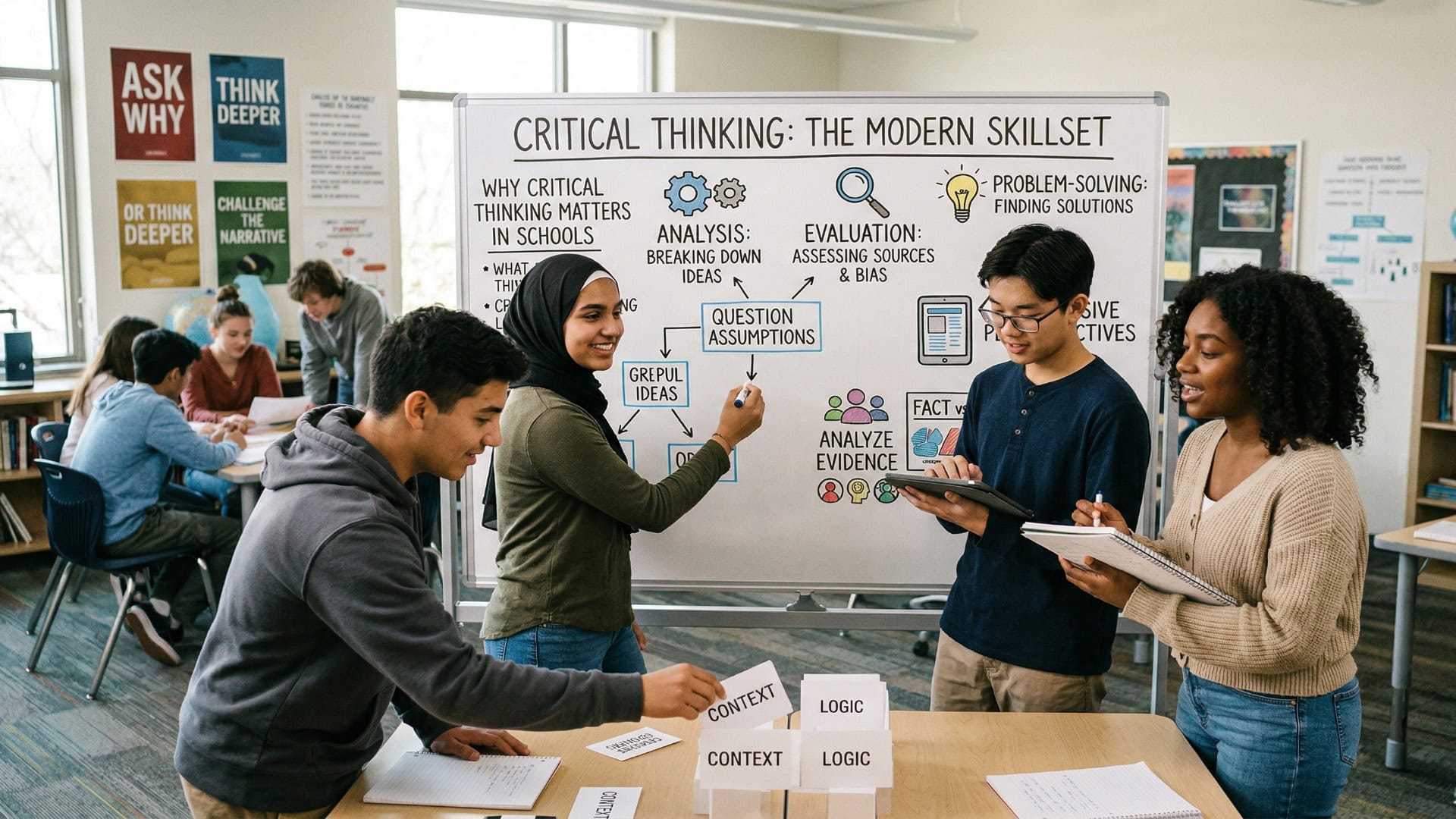
In an era where all the world’s information is accessible from a device that fits in our pockets, the traditional model of education—memorizing facts and regurgitating them on standardized tests—is rapidly becoming obsolete. Today’s learners do not just need to know what to think; they urgently need to know how to think.
Teaching critical thinking in schools is no longer a luxury or an advanced elective. It is a fundamental necessity for navigating the complexities of the 21st century. From preparing the next generation for an unpredictable job market to empowering them to decipher facts from misinformation, cognitive agility is the most valuable tool we can equip them with.
In this comprehensive guide, we will explore why critical thinking is the cornerstone of a modern, inclusive education system, how educators can integrate it into their classrooms, and the profound impact it has on student development.
The Shift from Memorization to Meaning
Historically, education systems were designed during the Industrial Revolution. The goal was straightforward: produce a compliant workforce capable of following instructions and executing repetitive tasks. Success was measured by rote memorization and the ability to recall specific dates, formulas, and historical events.
However, we are now firmly entrenched in the Information Age, transitioning rapidly into the Age of Artificial Intelligence. When algorithms can calculate complex equations in milliseconds and search engines can retrieve historical data instantly, the human advantage shifts. The value now lies in analysis, synthesis, and evaluation.
Students today are overwhelmed with data. Without the mental framework to filter, verify, and understand this information, they are left vulnerable. Education must pivot from transferring information to fostering intellectual independence.
What Exactly Is Critical Thinking in a Classroom Context?
Critical thinking is often treated as an educational buzzword, but its definition is precise. It is the objective analysis and evaluation of an issue in order to form a judgment. In a classroom setting, it involves several interconnected skills:
- Observation: Gathering information through the senses and recognizing patterns.
- Analysis: Breaking down complex information into its component parts to understand its structure.
- Inference: Drawing logical conclusions based on evidence rather than assumptions.
- Evaluation: Assessing the credibility, relevance, and bias of information sources.
- Problem-Solving: Developing effective, creative solutions to overcome challenges.
- Metacognition: Thinking about one’s own thinking; recognizing personal biases and blind spots.
When a student applies these skills, they stop asking, “Is this on the test?” and start asking, “Why does this matter, and how does it connect to what I already know?”
Top Reasons Why Critical Thinking Belongs in Schools
Integrating critical thinking into the curriculum offers profound benefits that extend far beyond the classroom walls. Here is why it must be a priority for educational institutions worldwide.
1. Future-Proofing Careers in an Automated World
The job market is undergoing a seismic shift. According to the World Economic Forum’s Future of Jobs Report, analytical thinking, creative thinking, and complex problem-solving consistently rank among the top skills desired by employers.
Routine, manual, and even some cognitive tasks are being automated by AI. The jobs of tomorrow—many of which do not even exist yet—will require human beings to manage ambiguity, connect disparate ideas, and innovate. By teaching critical thinking, schools provide learners with a flexible, universally applicable skill set that cannot be easily replaced by machines.
2. Navigating the Misinformation Epidemic
We live in an ecosystem of deepfakes, clickbait, algorithmic echo chambers, and viral misinformation. When students lack media literacy and critical evaluation skills, they are easily manipulated by sensationalism and false narratives.
Teaching critical thinking equips learners with an internal fact-checker. They learn to ask vital questions:
- Who is the author of this content?
- What is their hidden agenda or bias?
- Is the evidence cited scientifically sound or anecdotal?
By fostering this healthy skepticism, educators empower individuals to make informed decisions about their health, their finances, and their communities.
3. Fostering Emotional Intelligence and Inclusive Empathy
Critical thinking is not entirely a cold, logical process; it is deeply intertwined with emotional intelligence. A core component of critical thinking is the ability to step outside one’s own perspective and consider alternative viewpoints.
When schools cultivate these skills, they promote a more inclusive environment. Students learn to challenge stereotypes, question systemic biases, and listen to marginalized voices. Instead of reacting defensively to opposing opinions, they learn to analyze them objectively. This reduces polarization and fosters a culture of empathy and mutual respect.
4. Nurturing Independent and Confident Learners
A classroom focused solely on the “right answer” breeds anxiety and a fear of failure. Conversely, a classroom that values the process of thinking builds resilience.
When students are encouraged to hypothesize, test, fail, and iterate, they realize that making mistakes is a natural part of learning. This shifts their mindset from a fixed view of their abilities to a growth mindset. They become confident, independent self-starters who trust their own intellectual capabilities.
5. Enhancing Civic Engagement and Democratic Participation
A functioning society relies on an informed and engaged citizenry. Voters are routinely asked to make decisions on complex policies involving economics, healthcare, and the environment. Without critical thinking, voters are easily swayed by emotional rhetoric and demagoguery.
By teaching students to analyze policy proposals, understand cause-and-effect relationships, and debate civilly, schools act as the training ground for active, responsible citizenship.
How Educators Can Integrate Critical Thinking (Practical Strategies)
A common misconception is that critical thinking is a separate subject to be taught in isolation. In reality, it should be woven into the fabric of every subject. Here are inclusive, accessible ways educators can bring this into their daily routines:
Shift from Lecture to Socratic Dialogue
Instead of delivering information via one-way lectures, educators can use the Socratic method. This involves asking probing, open-ended questions that force students to examine their assumptions. For example, instead of stating the causes of a historical conflict, a teacher might ask, “What economic factors might have pressured these two nations into war?”
Implement Project-Based Learning (PBL)
Project-based learning involves presenting learners with a real-world problem and asking them to design a solution. Whether it is calculating the environmental impact of the school’s cafeteria or writing a business plan for a community need, PBL forces students to synthesize information from multiple disciplines (math, science, language arts) to achieve a tangible goal.
Encourage Debate and Role-Play
Structured debates teach students how to construct logical arguments, anticipate counterarguments, and communicate effectively. Role-playing historical figures, scientists, or literary characters forces students to inhabit perspectives completely different from their own, building cognitive flexibility. For resources on structuring debates, organizations like Edutopia offer excellent educator toolkits.
Teach Information Literacy Directly
Educators should bring real-world media into the classroom. Analyzing a news article, a political advertisement, or even a popular TikTok trend helps students practice identifying logical fallacies, emotional manipulation, and statistical misrepresentation in real-time.
Overcoming the Barriers to Critical Thinking in Education
If the benefits are so clear, why isn’t critical thinking the primary focus of every school? The reality is that educators face significant systemic barriers.
The Tyranny of Standardized Testing
In many educational systems, school funding and teacher evaluations are tied to student performance on multiple-choice standardized tests. These tests are highly efficient at measuring factual recall but notoriously poor at measuring nuanced, critical thought. Teachers often feel immense pressure to “teach to the test,” leaving little time for deep exploration. Solution: Advocacy for alternative assessment models, such as portfolio reviews and performance-based assessments, is crucial.
Time Constraints and Overpacked Curriculums
Curriculums are often a mile wide and an inch deep. Teachers are expected to cover a massive amount of content within a single school year. Critical thinking requires time—time to pause, discuss, debate, and reflect. Solution: Educational boards must prioritize depth over breadth, allowing teachers to focus on fundamental concepts rather than rushing through an exhaustive list of topics.
Ensuring Equitable Access
Historically, critical thinking and advanced problem-solving tracks were reserved for “gifted” programs, which often suffered from systemic biases and excluded students from underrepresented backgrounds or those with neurodivergent learning profiles. True educational reform requires that critical thinking frameworks are applied universally, ensuring that all learners, regardless of background or learning style, are given the opportunity to develop these high-level cognitive skills.
Conclusion
The primary goal of education should not be to fill a student’s mind with facts, but to teach them how to use their mind effectively. By prioritizing critical thinking in schools, we are doing more than just improving academic outcomes. We are empowering the next generation to be resilient problem-solvers, empathetic citizens, and adaptable professionals capable of thriving in a complex, ever-changing world.
It is time to move beyond the rote memorization of the past and embrace an educational model that respects the intellect and potential of every student.
Frequently Asked Questions (FAQ)
Q1: At what age should schools start teaching critical thinking?
Critical thinking should begin in early childhood education. While the complexity of the concepts scales with age, even kindergarteners can be taught foundational skills. Asking young children “why” they think something happens, encouraging them to sort objects by different categories, and teaching them to resolve interpersonal conflicts are all early forms of critical thinking.
Q2: Does teaching critical thinking mean students will become cynical or argumentative?
No. There is a distinct difference between being critical and being cynical. Cynicism is a general distrust of motives, while critical thinking is the objective evaluation of information. Furthermore, true critical thinking includes learning how to construct and deconstruct arguments respectfully, which actually reduces hostile argumentation and promotes civil discourse.
Q3: How can parents support critical thinking at home?
Parents can support these skills by asking open-ended questions rather than providing immediate answers. If a child asks how something works, reply with, “What do you think?” Encourage them to explain their reasoning. Additionally, discussing news events as a family and encouraging children to read books from diverse perspectives helps build cognitive empathy and analytical skills.
Q4: Is critical thinking only relevant to STEM (Science, Technology, Engineering, Math) subjects?
Absolutely not. While it is vital for the scientific method and mathematical logic, critical thinking is equally crucial in the humanities. In literature, it is used to analyze character motivations and thematic elements. In history, it is used to evaluate primary sources and understand the biases of historical narratives. It is a universal skill.
Q5: Can critical thinking be accurately graded or assessed?
Yes, but not easily through traditional multiple-choice tests. Assessing critical thinking requires qualitative methods, such as grading essays using rubrics that focus on the strength of the argument and use of evidence. Project presentations, debates, and peer reviews are also excellent ways for educators to evaluate a student’s critical thinking capabilities.